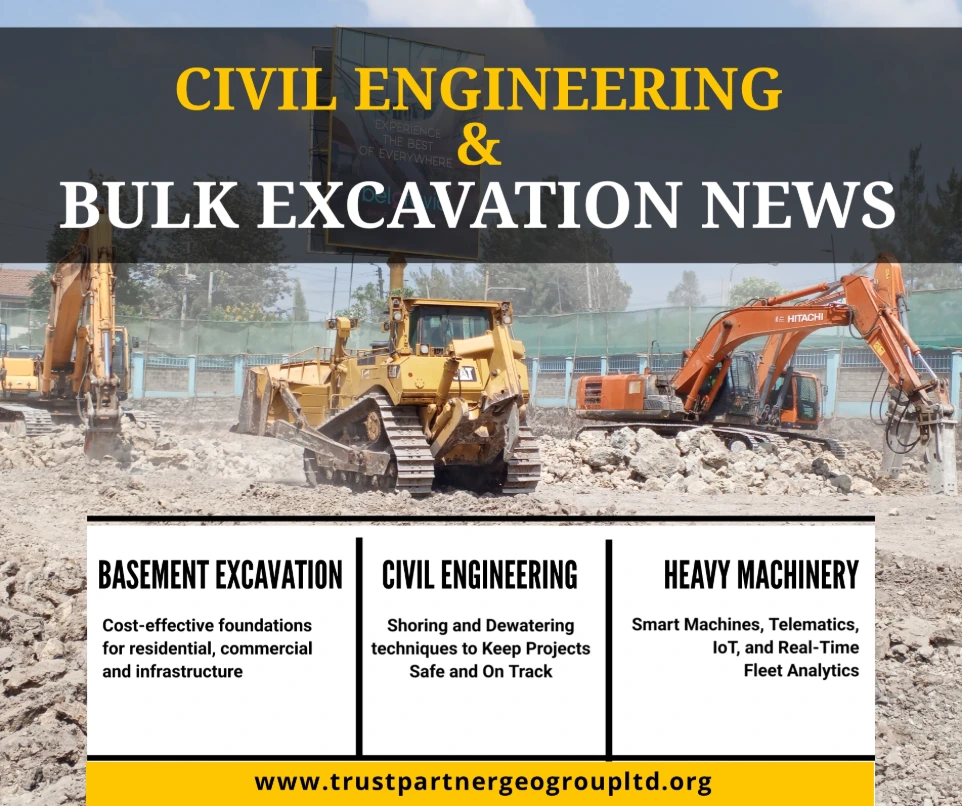
Excavation Contractors in Mombasa County: Basement, Road & Marine Construction Specialists [2026]
Coastal excavation in Kenya: specialist basement excavation, road earthworks and marine construction in Mombasa County with corrosion-resistant heavy equipment for hire and coastal dewatering expertise
Table of Contents
- 1. Why Mombasa County Needs Specialised Excavation Contractors
- 2. Basement Excavation in Mombasa: Coastal Geology and Water Table Challenges
- 3. Road Construction Earthworks in Mombasa County
- 4. Marine Construction Excavation: Seawalls, Jetties and Reclamation
- 5. Coastal Soil Conditions and Excavation Techniques
- 6. Dewatering and Groundwater Management in Coastal Excavation
- 7. Heavy Equipment for Hire in Mombasa: Fleet and Logistics
- 8. NEMA, County Compliance and Coastal Environmental Safeguards
- 9. Construction Costs for Excavation in Mombasa [2026]
- 10. Frequently Asked Questions
- 11. Conclusion
At 06:00 on a Tuesday in Nyali, the tide is receding and a basement excavation crew is racing to pour the blinding layer before the water table rises with the afternoon spring tide. The coral limestone walls weep saline water. The dewatering pumps run continuously, consuming 800 litres per minute. The excavator's undercarriage shows early rust despite being only six months old. This is not Nairobi. This is excavation in Kenya's coastal zone - where the geology is coral, the groundwater is saline, the tides dictate your programme, and the contractor who treats Mombasa like Kiambu will fail. Mombasa County is Kenya's second-largest construction market and its most technically challenging excavation environment. From high-rise basement excavation on Mombasa Island to road earthworks through coral rag in Kisauni, from marina dredging in Kilifi to seawall construction in Diani, coastal excavation in Kenya demands contractors who understand marine geology, corrosion protection, tidal dewatering and coastal regulation. Trust Partners Geo-Group Ltd provides heavy equipment for hire and excavation expertise specifically adapted to Mombasa County's conditions - corrosion-protected machines, coastal dewatering systems, marine-experienced operators and full regulatory compliance. This guide explains why coastal excavation is different, what it costs, and how to hire the right contractor for your Mombasa project.
Trust Partners Geo-Group Ltd - Coastal Operations Team
NCA-registered excavation contractor with 15+ years of coastal construction experience across Mombasa, Kilifi, Malindi and Diani. Specialised in marine excavation, coral rock breaking and coastal dewatering.
1. Why Mombasa County Needs Specialised Excavation Contractors
Mombasa County's construction boom is accelerating. The Dongo Kundu Special Economic Zone, the Mombasa Gate Bridge, the Mombasa-Malindi highway upgrade, numerous resort developments in Diani and Watamu, and high-rise residential towers in Nyali and Bamburi are driving unprecedented demand for earthworks. But Mombasa is not an inland city with inland geology. It sits on a coral platform surrounded by the Indian Ocean, and every excavation interacts with that reality.
The key differences that define excavation in Kenya's coastal zone:
- Geology: Coral limestone, marine sand and mangrove peat replace the volcanic soils and laterite of the highlands. Coral is porous, abrasive and unpredictable in hardness;
- Hydrology: The water table is 1-3 metres below ground level across much of the county, and it fluctuates with the tides. Basement excavation without dewatering is impossible;
- Corrosion: Saline groundwater and humid salt air destroy unprotected steel within months. Standard shoring, reinforcement and equipment require protective coatings;
- Climate: 1,200mm+ annual rainfall concentrated in April-May and October-November rains creates erosion risks that inland contractors underestimate;
- Regulation: Marine works require Kenya Maritime Authority (KMA) approval, NEMA coastal EIAs, and strict setback compliance that Nairobi contractors have never encountered.
The excavation contractor who thrives in Mombasa is not merely a digger of holes. They are a coastal engineer, a hydrologist, a corrosion specialist and a marine regulator all in one. Trust Partners Geo-Group Ltd has developed these capabilities through years of coastal project delivery, and we bring them to every Mombasa County assignment.
2. Basement Excavation in Mombasa: Coastal Geology and Water Table Challenges
Basement excavation in Mombasa is fundamentally a dewatering project that happens to involve earthmoving. The coastal water table, combined with porous coral limestone, means that any excavation below 2 metres will encounter water - and that water is saline, corrosive, and tidally influenced.
Coral Limestone Excavation
Mombasa's subsurface is dominated by coral limestone (coral rag) - calcium carbonate rock formed from ancient reef deposits. The rock is highly variable: in some areas like Bamburi, it is massive and hard, requiring hydraulic breakers or ripping; in others like Likoni, it is weathered, fractured and porous, excavating almost like soil until a hard layer is hit unexpectedly. Coral is abrasive - it wears bucket teeth, breaker tool bits and undercarriage components 20-30% faster than Nairobi quartzite. It is also soluble in acidic conditions, creating unpredictable voids and sinkholes that must be grouted before foundation construction.
Dewatering-Intensive Basements
A typical 4-metre deep basement excavation in Nyali requires: wellpoint dewatering systems installed 1-2 weeks before bulk excavation; continuous pumping at 500-1,500 litres per minute depending on soil permeability; and sump pumps and permanent under-slab drainage after construction. The dewatering cost for a Mombasa basement is KES 400,000-800,000 over 6-10 weeks - compared to KES 100,000-200,000 for an equivalent Nairobi basement. On a recent 3,000 m2 basement in Shanzu, dewatering consumed 12% of the earthworks budget, but without it, the excavation would have been a swimming pool.
Corrosion Protection
Saline groundwater accelerates corrosion of steel reinforcement, sheet piles and anchor systems. For Mombasa basement excavation, Trust Partners Geo-Group Ltd specifies: epoxy-coated or stainless-steel reinforcement in permanent shoring; galvanised or sacrificial-anode-protected steel sheet piles; and high-sulphate-resistant cement for any concrete poured against saline soil. Equipment corrosion protection includes daily freshwater washdowns, sealed electrical connectors and undercarriage coatings.
3. Road Construction Earthworks in Mombasa County
Mombasa County's road network - from the Mombasa-Malindi highway to county access roads in Kisauni and Changamwe - requires earthworks contractors who understand coastal subgrades.
Subgrade Challenges
Coastal road subgrades encounter: coral limestone that is hard but porous, requiring ripping and compaction with moisture control; marine sand that is loose and saturated, prone to liquefaction under traffic vibration, requiring densification or replacement; expansive black cotton clay in inland areas like Changamwe that swells when wet and cracks when dry; and mangrove peat along coastal fringes that is entirely unsuitable for road foundations and must be removed and replaced with granular fill. The standard Nairobi approach of strip-and-fill with laterite does not work when laterite is unavailable and coral sand lacks cohesion.
Drainage Design
Mombasa's high rainfall and flat topography create drainage challenges that road earthworks must address at the subgrade level. Excavation contractors must: create cambers and cross-falls that shed water despite flat terrain; install subsoil drains wrapped in geotextile to prevent coral sand from clogging pipes; and construct raised embankments in flood-prone areas using imported granular fill. On the Dongo Kundu access road, Trust Partners Geo-Group Ltd placed 1.2 metres of selected coral fill over peat removal to create a stable subgrade in a tidal flood zone.
Coral Aggregate Production
Where Nairobi contractors import crushed stone from quarries in Kiambu and Machakos, Mombasa road projects often crush coral limestone on-site or source from local coral quarries. The aggregate is lighter and more porous than volcanic stone, requiring adjusted mix designs for concrete and asphalt. Earthworks contractors must coordinate with crushing plant operators to ensure sub-base and base course materials meet Kenya Road Design Manual specifications.
4. Marine Construction Excavation: Seawalls, Jetties and Reclamation
Marine construction is the most specialised sector of excavation in Kenya, and Mombasa County is its epicentre. From luxury marina developments in Kilifi to protective seawalls in Diani, marine excavation operates at the intersection of civil engineering and oceanography.
Seawall and Revetment Foundations
Seawalls require deep foundations excavated below scour level - typically 2-3 metres below seabed level for gravity walls and 4-6 metres for piled walls. Excavation is conducted from land using long-reach excavators (15-22 metre booms) or from barges using amphibious machines. The excavation must account for tidal windows - work is scheduled during low spring tides when intertidal zones are exposed. Cofferdams or sheet pile walls create dry working areas for foundation pouring. On a recent seawall project in Bamburi, Trust Partners Geo-Group Ltd used a 20-metre long-reach excavator to trench 3.5 metres below mean sea level for a concrete toe wall, working only during neap tide windows.
Jetty and Pier Excavation
Jetties require pile cap excavation below the seabed, often in coral rock. The work is performed from jack-up barges or floating platforms. Hydraulic breaker-equipped excavators on barges fracture coral to create pile cap trenches. Divers verify excavation levels and inspect for unexploded ordnance - Mombasa's wartime history means some marine areas contain UXO that must be cleared before excavation.
Dredging and Land Reclamation
Dredging removes seabed material to deepen channels or create landfill for reclamation. Cutter suction dredgers pump slurry through pipelines to disposal areas or reclamation sites. Environmental compliance is strict: turbidity curtains contain sediment, dredged material is tested for contaminants, and disposal sites are approved by NEMA. The Mombasa Port expansion and Dongo Kundu SEZ have driven major dredging demand, with millions of cubic metres of marine sand relocated.
Mangrove and Coastal Sensitivity
Marine excavation in Mombasa often impacts mangroves, seagrass beds and coral reefs - ecosystems protected under Kenyan law. NEMA requires Environmental Impact Assessments with mitigation plans: mangrove replanting at 3:1 ratios; silt curtains during dredging; and seasonal work windows that avoid fish spawning periods. The contractor who ignores these requirements faces stop-work orders and criminal prosecution.
5. Coastal Soil Conditions and Excavation Techniques
Understanding Mombasa's soil profile is essential for selecting the right excavation in Kenya methodology.
| Soil Type | Location | Excavation Method | Challenges |
|---|---|---|---|
| Coral limestone (hard) | Nyali, Bamburi, Shanzu | Breaker, ripping, blasting | Abrasive, porous, voids |
| Coral sand | Coastal strip, Diani | Direct excavation | Loose, saturated, erosion |
| Marine clay | Mombasa Island, Likoni | Direct excavation | Soft, high moisture, sulphates |
| Mangrove peat | Creek fringes, Tudor | Remove and replace | Organic, compressible, acidic |
| Black cotton soil | Changamwe, inland | Stabilise or replace | Expansive, cracking |
Coral Rock Breaking
Hard coral limestone requires hydraulic breakers or, in bulk applications, controlled blasting. Coral is softer than Nairobi quartzite (typically 30-60 MPa compressive strength versus 80-150 MPa) but more abrasive due to its granular structure. Breaker tool bits wear rapidly - moil points last 15-25 hours versus 30-50 hours in quartzite. On large sites, drilling and blasting is more economical: drill 50mm holes on a 1.5m x 1.5m pattern, load with emulsion explosives, and blast in controlled sequences. Blasting in Mombasa requires KMA approval due to vibration effects on coastal structures and marine life.
Sand Excavation and Stabilisation
Marine sand excavates easily but presents stability challenges. Excavation sides in saturated sand slump at angles flatter than 1:2 unless shored. Dewatering is essential - even a 2-metre trench in sand will collapse and flood without pumping. For road subgrades, sand requires compaction at precise moisture content (typically 8-12%) and may need geotextile separation to prevent mixing with sub-base aggregate.
6. Dewatering and Groundwater Management in Coastal Excavation
Dewatering is the single most critical activity in Mombasa basement excavation. Without it, work stops.
Wellpoint Dewatering
Wellpoint systems consist of 50mm diameter wellpoints installed at 1.0-1.5 metre spacing around the excavation perimeter, connected to header pipes and vacuum pumps. They are effective in sand and weathered coral to depths of 4-5 metres. In Mombasa's sandy soils, wellpoints achieve drawdown of 3-4 metres below ground level, sufficient for shallow basements and utility trenches. Cost: KES 8,000-15,000 per wellpoint installed, plus KES 15,000-25,000 per week for pump rental and operation.
Deep Well Dewatering
For deeper excavations (5+ metres) or large sites, deep wells with submersible pumps are required. Wells are drilled at 15-30 metre spacing, cased with PVC or steel, and pumped at 10-50 litres per minute each. In coral limestone, wells are often drilled by rotary percussion rigs through the rock to reach less permeable layers. A deep well system for a 5,000 m2 commercial basement in Nyali might include 8-12 wells pumping continuously for 8-12 weeks. Cost: KES 150,000-300,000 per well installed, plus KES 20,000-35,000 per week operation.
Tidal Influence Management
Unlike inland dewatering, Mombasa's groundwater fluctuates with the tide - typically 0.5-1.5 metres between low and high tide, and up to 2.5 metres during spring tides. Dewatering systems must be sized for the highest water level, not the average. Pumps require float switches and backup power because a power outage during high tide can flood an excavation in 2-3 hours. On marine projects, dewatering must also account for storm surge and wave overtopping during high seas.
Saline Water Disposal
Dewatering effluent in Mombasa is saline and cannot be discharged to freshwater systems or used for irrigation without treatment. Options include: discharge to the sea via approved outfalls (requires KMA approval); discharge to sewer systems (requires Mombasa Water and Sewerage Company approval); or evaporation ponds for small volumes. NEMA monitors dewatering discharge and can prosecute for unauthorised release of saline water into mangroves or agricultural land.
7. Heavy Equipment for Hire in Mombasa: Fleet and Logistics
Mobilising heavy equipment for hire to Mombasa requires planning that inland projects do not. The 480 km journey from Nairobi takes 8-12 hours by low-loader, and the coastal environment demands equipment modifications.
Corrosion-Protected Fleet
Standard earthmoving equipment deteriorates rapidly in Mombasa's salt air. Trust Partners Geo-Group Ltd coastal fleet includes: excavators with sealed electrical harnesses, galvanised undercarriage components and daily freshwater washdown protocols; amphibious excavators with pontoon tracks for intertidal and shallow water work; long-reach excavators (18-22m) for seawall and revetment excavation from stable ground; and dewatering pumps, wellpoint systems and header pipe networks. All machines receive corrosion inhibitor application before coastal deployment and freshwater washing after each shift.
Mobilisation and Logistics
Transporting a 30-tonne excavator from Nairobi to Mombasa costs KES 150,000-250,000 by low-loader and requires police escort for oversize loads. For marine projects, barge transport and jack-up platform mobilisation add further complexity. Trust Partners Geo-Group Ltd manages all logistics, permitting and coastal mobilisation, ensuring equipment arrives on site ready for saline conditions.
Operator Competency
Coastal excavation operators need skills beyond standard earthmoving: tidal work scheduling for marine projects; dewatering system monitoring and troubleshooting; corrosion prevention awareness (daily washing, grease points); and marine safety protocols (life jackets, radio communication, man-overboard procedures). Our Mombasa-deployed operators are coastal-certified and experienced in coral rock excavation.
8. NEMA, County Compliance and Coastal Environmental Safeguards
Coastal excavation in Kenya operates under a multi-layered regulatory framework that is stricter than inland construction.
| Requirement | Authority | What It Covers |
|---|---|---|
| NEMA EIA / ESIA | NEMA | Coastal projects >1 ha; marine works; mangrove impact |
| KMA Marine Works Permit | Kenya Maritime Authority | Works below high water mark; dredging; jetties |
| County Development Permit | Mombasa County | Building plans; setbacks; drainage |
| Coastal Setback Compliance | NEMA / County | 30-60m from high water mark |
| Mangrove Protection Order | KFS / NEMA | Replanting ratios; buffer zones |
| NCA Registration | NCA | Contractor classification; site safety |
Trust Partners Geo-Group Ltd provides regulatory navigation as part of our Mombasa service: ESIA coordination with NEMA-accredited consultants; KMA marine works permit application; county building plan approval support; and NCA-compliant safety and environmental management on site. We do not commence excavation until all permits are verified.
9. Construction Costs for Excavation in Mombasa [2026]
Coastal excavation costs reflect the technical challenges of dewatering, corrosion protection and marine logistics.
| Item | 2026 Rate (KES) | Notes |
|---|---|---|
| Bulk excavation (sand/coral soil) | 1,800 - 2,800/m3 | Includes dewatering basic |
| Coral rock breaking (breaker) | 8,000 - 14,000/m3 | Softer than quartzite but abrasive |
| Coral rock blasting | 3,500 - 6,000/m3 | Requires KMA approval |
| Wellpoint dewatering | 8,000 - 15,000/point | Plus weekly pump rental |
| Deep well dewatering | 150,000 - 300,000/well | Includes drilling and pump |
| Sheet pile shoring (coated) | 3,500 - 5,500/m2 | Corrosion-protected steel |
| Peat removal and replacement | 2,500 - 4,000/m3 | Import granular fill |
| Marine excavation (dredging) | 1,200 - 2,500/m3 | Depends on disposal distance |
| Seawall foundation trench | 6,000 - 10,000/m3 | Tidal work, cofferdams |
| Equipment mobilisation (Nairobi-Mombasa) | 150,000 - 300,000 | Per machine by low-loader |
All-in project estimates: a 2,000 m3 basement in Nyali with dewatering and coral breaking costs KES 4.5-7.5 million; a 1 km rural road with peat removal and coral fill costs KES 12-18 million; and a 100-metre seawall with foundation excavation costs KES 8-15 million depending on tidal access and rock hardness.
10. Frequently Asked Questions: Excavation in Mombasa County
What makes excavation in Mombasa County different from Nairobi?
Excavation in Mombasa County differs fundamentally from Nairobi due to coastal geology, hydrology and climate. Mombasa's subsurface consists of coral limestone, sandy soils and marine deposits rather than Nairobi's volcanic tuff and quartzite. The water table is typically 1-3 metres below ground level, making basement excavation a dewatering-intensive operation. Saline groundwater accelerates steel corrosion and concrete degradation, requiring protective measures for foundations and shoring. The tropical climate brings intense rainfall (1,200mm+ annually) that causes rapid erosion on exposed cuts. Marine construction adds tidal considerations, where excavation levels must account for sea level, wave action and saltwater intrusion. These factors require excavation contractors with specific coastal experience, not just general earthworks capability. Trust Partners Geo-Group Ltd brings coastal excavation expertise, corrosion-resistant heavy equipment for hire and marine construction methodology to Mombasa County projects.
How is basement excavation done in Mombasa's high water table?
Basement excavation in Mombasa requires aggressive dewatering because the coastal water table is often within 1-2 metres of ground level. The standard approach is: install deep well points or wellpoint dewatering systems around the entire excavation perimeter before bulk digging begins; pump continuously to lower the water table at least 1 metre below the excavation base; excavate in controlled lifts of 1.0-1.5 metres, maintaining the dewatering system throughout; and install a permanent under-slab drainage blanket and sump pump system before backfilling. In coral limestone areas like Nyali and Bamburi, the rock is porous and dewatering must account for tidal fluctuations - the water table rises and falls with the tide, sometimes by 1-2 metres. On a recent 4-metre deep basement excavation in Nyali, Trust Partners Geo-Group Ltd installed 12 deep wells pumping 800 litres per minute continuously for 6 weeks, maintaining a dry excavation despite spring tides. Without this dewatering intensity, a Mombasa basement excavation floods within hours.
What equipment is used for marine construction excavation in Kenya?
Marine construction excavation in Kenya uses specialised heavy equipment for hire designed for coastal and intertidal conditions. Amphibious excavators with pontoon undercarriages work in shallow water and soft mud for dredging, mangrove clearance and lagoon excavation. Long-reach excavators (15-22 metre boom) construct seawalls and revetments from stable ground above the high water mark. Hydraulic cutter suction dredgers remove seabed material for channel deepening and land reclamation. For hard coral rock breaking in marine environments, barge-mounted hydraulic breakers or drilling and blasting (with KCAA and KMA approval) are used. All marine equipment requires galvanised or stainless-steel components to resist saltwater corrosion. Trust Partners Geo-Group Ltd provides long-reach excavators, amphibious machines and marine-experienced operators for coastal excavation projects in Mombasa, Kilifi, Lamu and Diani.
How much does basement excavation cost in Mombasa compared to Nairobi?
Basement excavation in Mombasa costs 15-30% more than equivalent work in Nairobi due to dewatering, corrosion protection and coastal logistics. In 2026, indicative rates are: bulk excavation in sand/coral soils KES 1,800-2,800 per m3 (Nairobi: KES 1,500-2,500); rock breaking in coral limestone KES 8,000-14,000 per m3 (Nairobi quartzite: KES 10,000-16,000 - coral is softer but more abrasive); dewatering system rental KES 80,000-150,000 per week for wellpoint systems; and corrosion-protected shoring (steel sheet piles with coatings) KES 3,500-5,500 per m2 installed. The dewatering cost is the biggest differential: a Mombasa basement typically requires 6-12 weeks of continuous pumping versus 2-4 weeks in Nairobi. However, Mombasa's coral limestone is generally easier to break than Nairobi quartzite, partially offsetting the dewatering premium on rock basement projects. Trust Partners Geo-Group Ltd provides transparent Mombasa-specific pricing that accounts for coastal conditions, with no hidden dewatering surcharges.
What are the main soil types for road construction in Mombasa County?
Mombasa County road construction encounters four dominant soil types: coral limestone (calcium carbonate rock) - hard when fresh but weathered and porous near surface, requiring ripping or breaking for subgrade preparation; marine sand - loose, saturated and prone to liquefaction under vibration, requiring compaction with moisture control and sometimes geotextile stabilisation; black cotton clay (inland areas like Changamwe) - expansive when wet, requiring lime stabilisation or replacement with granular fill; and mangrove peat (coastal fringes) - highly organic, compressible and unsuitable for road foundations, requiring complete removal and replacement. The Mombasa-Malindi road and county access roads require excavation contractors who can identify these soils in real time and adjust earthworks methodology. Trust Partners Geo-Group Ltd conducts pre-construction geotechnical investigation and soil mapping for all Mombasa road projects to prevent pavement failure from inadequate subgrade preparation.
Do I need special permits for marine excavation in Mombasa?
Yes. Marine construction excavation in Mombasa requires multiple approvals beyond standard construction permits. The Kenya Maritime Authority (KMA) regulates all works below the high water mark, including dredging, seawall construction and jetty excavation. NEMA requires an Environmental Impact Assessment (EIA) for any marine works exceeding 1 hectare or disturbing mangroves, coral reefs or seagrass beds. The County Government of Mombasa issues coastal development permits and enforces setback requirements (typically 30-60 metres from the high water mark). For dredging, the National Environment Management Authority requires a Marine Environment Management Plan. If blasting is proposed for coral rock removal, additional KCAA and KMA explosive permits are required. Trust Partners Geo-Group Ltd navigates this regulatory landscape for coastal clients, ensuring that marine excavation projects are fully permitted before mobilisation.
Can excavation contractors from Nairobi work in Mombasa County?
Yes, but coastal excavation requires specific expertise that many Nairobi-based contractors lack. The logistics of mobilising heavy equipment for hire from Nairobi to Mombasa (480 km) add KES 150,000-300,000 in transport costs and 2-3 days in mobilisation time. More importantly, Nairobi contractors unfamiliar with coastal conditions often underestimate dewatering requirements, specify incorrect corrosion protection, or use equipment that suffers rapid deterioration in the saline atmosphere. Trust Partners Geo-Group Ltd operates nationwide with dedicated Mombasa deployment capability. We maintain corrosion-protected equipment, employ coastal-experienced operators, and understand the Mombasa County regulatory environment. For developers in Mombasa, hiring a contractor with proven coastal experience - whether Nairobi-based with coastal capability or locally established - is more important than geographic convenience.
Where can I hire heavy equipment for basement excavation in Mombasa?
Trust Partners Geo-Group Ltd provides heavy equipment for hire in Mombasa County for basement excavation, road construction and marine works. Our coastal fleet includes: 20-30 tonne excavators with corrosion-resistant undercarriages for basement and bulk excavation; long-reach excavators (15-20m) for seawall and revetment construction; amphibious excavators for dredging and intertidal work; wheel loaders with sealed electrical systems for saline environments; and dewatering pumps, wellpoint systems and sump pump installations. All equipment is transported from our Nairobi headquarters with coastal mobilisation logistics managed in-house. We serve Mombasa Island, Nyali, Bamburi, Shanzu, Diani, Kilifi, Malindi and the entire coastal region. Contact us at +254 718 68 69 67 or info@trustpartnergeogroupltd.org for Mombasa-specific heavy equipment for hire and excavation services.
11. Conclusion: The Coast Demands Different Skills
Mombasa County is not merely another market for excavation in Kenya. It is a distinct technical environment where coral replaces laterite, tides replace topography, and salt replaces dust. The contractor who arrives from Nairobi with standard equipment and inland assumptions will discover - expensively - that coastal excavation is a specialisation, not a location.
For developers building basement excavation projects in Nyali, road contractors cutting through coral rag in Kilifi, or marina developers dredging channels in Diani, the right excavation contractor is the one who has already solved the problems you are about to encounter. They know that dewatering is not a line item but a programme-critical activity. They know that corrosion protection is not an option but a necessity. They know that marine permits take 12 weeks, not 2. And they know that coral rock breaks differently than anything in the highlands.
Trust Partners Geo-Group Ltd has built coastal capability through years of project delivery across Mombasa, Kilifi, Malindi and Lamu. Our heavy equipment for hire fleet includes corrosion-protected machines, long-reach excavators and amphibious units. Our operators understand tides and dewatering. Our engineers navigate KMA and NEMA coastal regulations. And our pricing is transparent, with no hidden dewatering surprises.
Whether your project is a high-rise basement on Mombasa Island, a highway earthworks programme in Kwale, or a marine reclamation in Kilifi, we provide the coastal excavation expertise that ensures your project stays dry, compliant and on programme.
Coastal Excavation & Heavy Equipment For Hire in Mombasa
Basement excavation, road earthworks and marine construction in Mombasa County with corrosion-protected equipment and coastal expertise.
Free lead magnet: ask for our Mombasa Coastal Excavation Planning Checklist (PDF) - dewatering design guide, corrosion protection specifications, KMA permit requirements and tidal work windows for marine construction.
Related Resources
Wheel Loader vs. Backhoe Loader: Which is Better for Your Kenyan Construction Project?
The previous blog in our equipment series - loader selection for earthworks productivity.
READ MOREBasement Excavation Depth Guide: From 4 Meters to 30 Meters in Kenya
Technical depth guide for basement excavation planning, dewatering and shoring across all project scales.
READ MOREBasement Excavation Cost in Nairobi 2026: Complete Price Guide Per m3
Compare Nairobi basement costs with Mombasa coastal premiums for informed budgeting.
READ MORERoad Construction in Kenya: Earthwork and Base Preparation for Road Projects
Road subgrade preparation methodologies applicable to Mombasa's coastal soils.
READ MOREDrainage Solutions for Road Construction in Kenya
Coastal-specific drainage design for high-rainfall, flat-terrain road projects.
READ MOREExcavation in Kenya: Complete Guide to Costs, Methods & Contractors [2026]
The definitive nationwide overview of excavation in Kenya - methods, regulations and costs.
READ MORETRUST PARTNERS GEO-GROUP LTD | YOUR VISION, OUR EXCAVATION
WEBSITE: WWW.TRUSTPARTNERGEOGROUPLTD.ORG | EMAIL: INFO@TRUSTPARTNERGEOGROUPLTD.ORG | PHONE: +254 718 68 69 67
FOLLOW US: FACEBOOK | TIKTOK | INSTAGRAM | LINKEDIN
© 2026 TRUST PARTNERS GEO-GROUP LTD. ALL RIGHTS RESERVED.
Excavation Contractors in Mombasa County: Basement, Road & Marine Construction Specialists [2026]
Coastal excavation in Kenya: specialist basement excavation, road earthworks and marine construction in Mombasa County with corrosion-resistant heavy equipment for hire and coastal dewatering expertise
Table of Contents
- 1. Why Mombasa County Needs Specialised Excavation Contractors
- 2. Basement Excavation in Mombasa: Coastal Geology and Water Table Challenges
- 3. Road Construction Earthworks in Mombasa County
- 4. Marine Construction Excavation: Seawalls, Jetties and Reclamation
- 5. Coastal Soil Conditions and Excavation Techniques
- 6. Dewatering and Groundwater Management in Coastal Excavation
- 7. Heavy Equipment for Hire in Mombasa: Fleet and Logistics
- 8. NEMA, County Compliance and Coastal Environmental Safeguards
- 9. Construction Costs for Excavation in Mombasa [2026]
- 10. Frequently Asked Questions
- 11. Conclusion
At 06:00 on a Tuesday in Nyali, the tide is receding and a basement excavation crew is racing to pour the blinding layer before the water table rises with the afternoon spring tide. The coral limestone walls weep saline water. The dewatering pumps run continuously, consuming 800 litres per minute. The excavator's undercarriage shows early rust despite being only six months old. This is not Nairobi. This is excavation in Kenya's coastal zone - where the geology is coral, the groundwater is saline, the tides dictate your programme, and the contractor who treats Mombasa like Kiambu will fail. Mombasa County is Kenya's second-largest construction market and its most technically challenging excavation environment. From high-rise basement excavation on Mombasa Island to road earthworks through coral rag in Kisauni, from marina dredging in Kilifi to seawall construction in Diani, coastal excavation in Kenya demands contractors who understand marine geology, corrosion protection, tidal dewatering and coastal regulation. Trust Partners Geo-Group Ltd provides heavy equipment for hire and excavation expertise specifically adapted to Mombasa County's conditions - corrosion-protected machines, coastal dewatering systems, marine-experienced operators and full regulatory compliance. This guide explains why coastal excavation is different, what it costs, and how to hire the right contractor for your Mombasa project.
Trust Partners Geo-Group Ltd - Coastal Operations Team
NCA-registered excavation contractor with 15+ years of coastal construction experience across Mombasa, Kilifi, Malindi and Diani. Specialised in marine excavation, coral rock breaking and coastal dewatering.
1. Why Mombasa County Needs Specialised Excavation Contractors
Mombasa County's construction boom is accelerating. The Dongo Kundu Special Economic Zone, the Mombasa Gate Bridge, the Mombasa-Malindi highway upgrade, numerous resort developments in Diani and Watamu, and high-rise residential towers in Nyali and Bamburi are driving unprecedented demand for earthworks. But Mombasa is not an inland city with inland geology. It sits on a coral platform surrounded by the Indian Ocean, and every excavation interacts with that reality.
The key differences that define excavation in Kenya's coastal zone:
- Geology: Coral limestone, marine sand and mangrove peat replace the volcanic soils and laterite of the highlands. Coral is porous, abrasive and unpredictable in hardness;
- Hydrology: The water table is 1-3 metres below ground level across much of the county, and it fluctuates with the tides. Basement excavation without dewatering is impossible;
- Corrosion: Saline groundwater and humid salt air destroy unprotected steel within months. Standard shoring, reinforcement and equipment require protective coatings;
- Climate: 1,200mm+ annual rainfall concentrated in April-May and October-November rains creates erosion risks that inland contractors underestimate;
- Regulation: Marine works require Kenya Maritime Authority (KMA) approval, NEMA coastal EIAs, and strict setback compliance that Nairobi contractors have never encountered.
The excavation contractor who thrives in Mombasa is not merely a digger of holes. They are a coastal engineer, a hydrologist, a corrosion specialist and a marine regulator all in one. Trust Partners Geo-Group Ltd has developed these capabilities through years of coastal project delivery, and we bring them to every Mombasa County assignment.
2. Basement Excavation in Mombasa: Coastal Geology and Water Table Challenges
Basement excavation in Mombasa is fundamentally a dewatering project that happens to involve earthmoving. The coastal water table, combined with porous coral limestone, means that any excavation below 2 metres will encounter water - and that water is saline, corrosive, and tidally influenced.
Coral Limestone Excavation
Mombasa's subsurface is dominated by coral limestone (coral rag) - calcium carbonate rock formed from ancient reef deposits. The rock is highly variable: in some areas like Bamburi, it is massive and hard, requiring hydraulic breakers or ripping; in others like Likoni, it is weathered, fractured and porous, excavating almost like soil until a hard layer is hit unexpectedly. Coral is abrasive - it wears bucket teeth, breaker tool bits and undercarriage components 20-30% faster than Nairobi quartzite. It is also soluble in acidic conditions, creating unpredictable voids and sinkholes that must be grouted before foundation construction.
Dewatering-Intensive Basements
A typical 4-metre deep basement excavation in Nyali requires: wellpoint dewatering systems installed 1-2 weeks before bulk excavation; continuous pumping at 500-1,500 litres per minute depending on soil permeability; and sump pumps and permanent under-slab drainage after construction. The dewatering cost for a Mombasa basement is KES 400,000-800,000 over 6-10 weeks - compared to KES 100,000-200,000 for an equivalent Nairobi basement. On a recent 3,000 m2 basement in Shanzu, dewatering consumed 12% of the earthworks budget, but without it, the excavation would have been a swimming pool.
Corrosion Protection
Saline groundwater accelerates corrosion of steel reinforcement, sheet piles and anchor systems. For Mombasa basement excavation, Trust Partners Geo-Group Ltd specifies: epoxy-coated or stainless-steel reinforcement in permanent shoring; galvanised or sacrificial-anode-protected steel sheet piles; and high-sulphate-resistant cement for any concrete poured against saline soil. Equipment corrosion protection includes daily freshwater washdowns, sealed electrical connectors and undercarriage coatings.
3. Road Construction Earthworks in Mombasa County
Mombasa County's road network - from the Mombasa-Malindi highway to county access roads in Kisauni and Changamwe - requires earthworks contractors who understand coastal subgrades.
Subgrade Challenges
Coastal road subgrades encounter: coral limestone that is hard but porous, requiring ripping and compaction with moisture control; marine sand that is loose and saturated, prone to liquefaction under traffic vibration, requiring densification or replacement; expansive black cotton clay in inland areas like Changamwe that swells when wet and cracks when dry; and mangrove peat along coastal fringes that is entirely unsuitable for road foundations and must be removed and replaced with granular fill. The standard Nairobi approach of strip-and-fill with laterite does not work when laterite is unavailable and coral sand lacks cohesion.
Drainage Design
Mombasa's high rainfall and flat topography create drainage challenges that road earthworks must address at the subgrade level. Excavation contractors must: create cambers and cross-falls that shed water despite flat terrain; install subsoil drains wrapped in geotextile to prevent coral sand from clogging pipes; and construct raised embankments in flood-prone areas using imported granular fill. On the Dongo Kundu access road, Trust Partners Geo-Group Ltd placed 1.2 metres of selected coral fill over peat removal to create a stable subgrade in a tidal flood zone.
Coral Aggregate Production
Where Nairobi contractors import crushed stone from quarries in Kiambu and Machakos, Mombasa road projects often crush coral limestone on-site or source from local coral quarries. The aggregate is lighter and more porous than volcanic stone, requiring adjusted mix designs for concrete and asphalt. Earthworks contractors must coordinate with crushing plant operators to ensure sub-base and base course materials meet Kenya Road Design Manual specifications.
4. Marine Construction Excavation: Seawalls, Jetties and Reclamation
Marine construction is the most specialised sector of excavation in Kenya, and Mombasa County is its epicentre. From luxury marina developments in Kilifi to protective seawalls in Diani, marine excavation operates at the intersection of civil engineering and oceanography.
Seawall and Revetment Foundations
Seawalls require deep foundations excavated below scour level - typically 2-3 metres below seabed level for gravity walls and 4-6 metres for piled walls. Excavation is conducted from land using long-reach excavators (15-22 metre booms) or from barges using amphibious machines. The excavation must account for tidal windows - work is scheduled during low spring tides when intertidal zones are exposed. Cofferdams or sheet pile walls create dry working areas for foundation pouring. On a recent seawall project in Bamburi, Trust Partners Geo-Group Ltd used a 20-metre long-reach excavator to trench 3.5 metres below mean sea level for a concrete toe wall, working only during neap tide windows.
Jetty and Pier Excavation
Jetties require pile cap excavation below the seabed, often in coral rock. The work is performed from jack-up barges or floating platforms. Hydraulic breaker-equipped excavators on barges fracture coral to create pile cap trenches. Divers verify excavation levels and inspect for unexploded ordnance - Mombasa's wartime history means some marine areas contain UXO that must be cleared before excavation.
Dredging and Land Reclamation
Dredging removes seabed material to deepen channels or create landfill for reclamation. Cutter suction dredgers pump slurry through pipelines to disposal areas or reclamation sites. Environmental compliance is strict: turbidity curtains contain sediment, dredged material is tested for contaminants, and disposal sites are approved by NEMA. The Mombasa Port expansion and Dongo Kundu SEZ have driven major dredging demand, with millions of cubic metres of marine sand relocated.
Mangrove and Coastal Sensitivity
Marine excavation in Mombasa often impacts mangroves, seagrass beds and coral reefs - ecosystems protected under Kenyan law. NEMA requires Environmental Impact Assessments with mitigation plans: mangrove replanting at 3:1 ratios; silt curtains during dredging; and seasonal work windows that avoid fish spawning periods. The contractor who ignores these requirements faces stop-work orders and criminal prosecution.
5. Coastal Soil Conditions and Excavation Techniques
Understanding Mombasa's soil profile is essential for selecting the right excavation in Kenya methodology.
| Soil Type | Location | Excavation Method | Challenges |
|---|---|---|---|
| Coral limestone (hard) | Nyali, Bamburi, Shanzu | Breaker, ripping, blasting | Abrasive, porous, voids |
| Coral sand | Coastal strip, Diani | Direct excavation | Loose, saturated, erosion |
| Marine clay | Mombasa Island, Likoni | Direct excavation | Soft, high moisture, sulphates |
| Mangrove peat | Creek fringes, Tudor | Remove and replace | Organic, compressible, acidic |
| Black cotton soil | Changamwe, inland | Stabilise or replace | Expansive, cracking |
Coral Rock Breaking
Hard coral limestone requires hydraulic breakers or, in bulk applications, controlled blasting. Coral is softer than Nairobi quartzite (typically 30-60 MPa compressive strength versus 80-150 MPa) but more abrasive due to its granular structure. Breaker tool bits wear rapidly - moil points last 15-25 hours versus 30-50 hours in quartzite. On large sites, drilling and blasting is more economical: drill 50mm holes on a 1.5m x 1.5m pattern, load with emulsion explosives, and blast in controlled sequences. Blasting in Mombasa requires KMA approval due to vibration effects on coastal structures and marine life.
Sand Excavation and Stabilisation
Marine sand excavates easily but presents stability challenges. Excavation sides in saturated sand slump at angles flatter than 1:2 unless shored. Dewatering is essential - even a 2-metre trench in sand will collapse and flood without pumping. For road subgrades, sand requires compaction at precise moisture content (typically 8-12%) and may need geotextile separation to prevent mixing with sub-base aggregate.
6. Dewatering and Groundwater Management in Coastal Excavation
Dewatering is the single most critical activity in Mombasa basement excavation. Without it, work stops.
Wellpoint Dewatering
Wellpoint systems consist of 50mm diameter wellpoints installed at 1.0-1.5 metre spacing around the excavation perimeter, connected to header pipes and vacuum pumps. They are effective in sand and weathered coral to depths of 4-5 metres. In Mombasa's sandy soils, wellpoints achieve drawdown of 3-4 metres below ground level, sufficient for shallow basements and utility trenches. Cost: KES 8,000-15,000 per wellpoint installed, plus KES 15,000-25,000 per week for pump rental and operation.
Deep Well Dewatering
For deeper excavations (5+ metres) or large sites, deep wells with submersible pumps are required. Wells are drilled at 15-30 metre spacing, cased with PVC or steel, and pumped at 10-50 litres per minute each. In coral limestone, wells are often drilled by rotary percussion rigs through the rock to reach less permeable layers. A deep well system for a 5,000 m2 commercial basement in Nyali might include 8-12 wells pumping continuously for 8-12 weeks. Cost: KES 150,000-300,000 per well installed, plus KES 20,000-35,000 per week operation.
Tidal Influence Management
Unlike inland dewatering, Mombasa's groundwater fluctuates with the tide - typically 0.5-1.5 metres between low and high tide, and up to 2.5 metres during spring tides. Dewatering systems must be sized for the highest water level, not the average. Pumps require float switches and backup power because a power outage during high tide can flood an excavation in 2-3 hours. On marine projects, dewatering must also account for storm surge and wave overtopping during high seas.
Saline Water Disposal
Dewatering effluent in Mombasa is saline and cannot be discharged to freshwater systems or used for irrigation without treatment. Options include: discharge to the sea via approved outfalls (requires KMA approval); discharge to sewer systems (requires Mombasa Water and Sewerage Company approval); or evaporation ponds for small volumes. NEMA monitors dewatering discharge and can prosecute for unauthorised release of saline water into mangroves or agricultural land.
7. Heavy Equipment for Hire in Mombasa: Fleet and Logistics
Mobilising heavy equipment for hire to Mombasa requires planning that inland projects do not. The 480 km journey from Nairobi takes 8-12 hours by low-loader, and the coastal environment demands equipment modifications.
Corrosion-Protected Fleet
Standard earthmoving equipment deteriorates rapidly in Mombasa's salt air. Trust Partners Geo-Group Ltd coastal fleet includes: excavators with sealed electrical harnesses, galvanised undercarriage components and daily freshwater washdown protocols; amphibious excavators with pontoon tracks for intertidal and shallow water work; long-reach excavators (18-22m) for seawall and revetment excavation from stable ground; and dewatering pumps, wellpoint systems and header pipe networks. All machines receive corrosion inhibitor application before coastal deployment and freshwater washing after each shift.
Mobilisation and Logistics
Transporting a 30-tonne excavator from Nairobi to Mombasa costs KES 150,000-250,000 by low-loader and requires police escort for oversize loads. For marine projects, barge transport and jack-up platform mobilisation add further complexity. Trust Partners Geo-Group Ltd manages all logistics, permitting and coastal mobilisation, ensuring equipment arrives on site ready for saline conditions.
Operator Competency
Coastal excavation operators need skills beyond standard earthmoving: tidal work scheduling for marine projects; dewatering system monitoring and troubleshooting; corrosion prevention awareness (daily washing, grease points); and marine safety protocols (life jackets, radio communication, man-overboard procedures). Our Mombasa-deployed operators are coastal-certified and experienced in coral rock excavation.
8. NEMA, County Compliance and Coastal Environmental Safeguards
Coastal excavation in Kenya operates under a multi-layered regulatory framework that is stricter than inland construction.
| Requirement | Authority | What It Covers |
|---|---|---|
| NEMA EIA / ESIA | NEMA | Coastal projects >1 ha; marine works; mangrove impact |
| KMA Marine Works Permit | Kenya Maritime Authority | Works below high water mark; dredging; jetties |
| County Development Permit | Mombasa County | Building plans; setbacks; drainage |
| Coastal Setback Compliance | NEMA / County | 30-60m from high water mark |
| Mangrove Protection Order | KFS / NEMA | Replanting ratios; buffer zones |
| NCA Registration | NCA | Contractor classification; site safety |
Trust Partners Geo-Group Ltd provides regulatory navigation as part of our Mombasa service: ESIA coordination with NEMA-accredited consultants; KMA marine works permit application; county building plan approval support; and NCA-compliant safety and environmental management on site. We do not commence excavation until all permits are verified.
9. Construction Costs for Excavation in Mombasa [2026]
Coastal excavation costs reflect the technical challenges of dewatering, corrosion protection and marine logistics.
| Item | 2026 Rate (KES) | Notes |
|---|---|---|
| Bulk excavation (sand/coral soil) | 1,800 - 2,800/m3 | Includes dewatering basic |
| Coral rock breaking (breaker) | 8,000 - 14,000/m3 | Softer than quartzite but abrasive |
| Coral rock blasting | 3,500 - 6,000/m3 | Requires KMA approval |
| Wellpoint dewatering | 8,000 - 15,000/point | Plus weekly pump rental |
| Deep well dewatering | 150,000 - 300,000/well | Includes drilling and pump |
| Sheet pile shoring (coated) | 3,500 - 5,500/m2 | Corrosion-protected steel |
| Peat removal and replacement | 2,500 - 4,000/m3 | Import granular fill |
| Marine excavation (dredging) | 1,200 - 2,500/m3 | Depends on disposal distance |
| Seawall foundation trench | 6,000 - 10,000/m3 | Tidal work, cofferdams |
| Equipment mobilisation (Nairobi-Mombasa) | 150,000 - 300,000 | Per machine by low-loader |
All-in project estimates: a 2,000 m3 basement in Nyali with dewatering and coral breaking costs KES 4.5-7.5 million; a 1 km rural road with peat removal and coral fill costs KES 12-18 million; and a 100-metre seawall with foundation excavation costs KES 8-15 million depending on tidal access and rock hardness.
10. Frequently Asked Questions: Excavation in Mombasa County
What makes excavation in Mombasa County different from Nairobi?
Excavation in Mombasa County differs fundamentally from Nairobi due to coastal geology, hydrology and climate. Mombasa's subsurface consists of coral limestone, sandy soils and marine deposits rather than Nairobi's volcanic tuff and quartzite. The water table is typically 1-3 metres below ground level, making basement excavation a dewatering-intensive operation. Saline groundwater accelerates steel corrosion and concrete degradation, requiring protective measures for foundations and shoring. The tropical climate brings intense rainfall (1,200mm+ annually) that causes rapid erosion on exposed cuts. Marine construction adds tidal considerations, where excavation levels must account for sea level, wave action and saltwater intrusion. These factors require excavation contractors with specific coastal experience, not just general earthworks capability. Trust Partners Geo-Group Ltd brings coastal excavation expertise, corrosion-resistant heavy equipment for hire and marine construction methodology to Mombasa County projects.
How is basement excavation done in Mombasa's high water table?
Basement excavation in Mombasa requires aggressive dewatering because the coastal water table is often within 1-2 metres of ground level. The standard approach is: install deep well points or wellpoint dewatering systems around the entire excavation perimeter before bulk digging begins; pump continuously to lower the water table at least 1 metre below the excavation base; excavate in controlled lifts of 1.0-1.5 metres, maintaining the dewatering system throughout; and install a permanent under-slab drainage blanket and sump pump system before backfilling. In coral limestone areas like Nyali and Bamburi, the rock is porous and dewatering must account for tidal fluctuations - the water table rises and falls with the tide, sometimes by 1-2 metres. On a recent 4-metre deep basement excavation in Nyali, Trust Partners Geo-Group Ltd installed 12 deep wells pumping 800 litres per minute continuously for 6 weeks, maintaining a dry excavation despite spring tides. Without this dewatering intensity, a Mombasa basement excavation floods within hours.
What equipment is used for marine construction excavation in Kenya?
Marine construction excavation in Kenya uses specialised heavy equipment for hire designed for coastal and intertidal conditions. Amphibious excavators with pontoon undercarriages work in shallow water and soft mud for dredging, mangrove clearance and lagoon excavation. Long-reach excavators (15-22 metre boom) construct seawalls and revetments from stable ground above the high water mark. Hydraulic cutter suction dredgers remove seabed material for channel deepening and land reclamation. For hard coral rock breaking in marine environments, barge-mounted hydraulic breakers or drilling and blasting (with KCAA and KMA approval) are used. All marine equipment requires galvanised or stainless-steel components to resist saltwater corrosion. Trust Partners Geo-Group Ltd provides long-reach excavators, amphibious machines and marine-experienced operators for coastal excavation projects in Mombasa, Kilifi, Lamu and Diani.
How much does basement excavation cost in Mombasa compared to Nairobi?
Basement excavation in Mombasa costs 15-30% more than equivalent work in Nairobi due to dewatering, corrosion protection and coastal logistics. In 2026, indicative rates are: bulk excavation in sand/coral soils KES 1,800-2,800 per m3 (Nairobi: KES 1,500-2,500); rock breaking in coral limestone KES 8,000-14,000 per m3 (Nairobi quartzite: KES 10,000-16,000 - coral is softer but more abrasive); dewatering system rental KES 80,000-150,000 per week for wellpoint systems; and corrosion-protected shoring (steel sheet piles with coatings) KES 3,500-5,500 per m2 installed. The dewatering cost is the biggest differential: a Mombasa basement typically requires 6-12 weeks of continuous pumping versus 2-4 weeks in Nairobi. However, Mombasa's coral limestone is generally easier to break than Nairobi quartzite, partially offsetting the dewatering premium on rock basement projects. Trust Partners Geo-Group Ltd provides transparent Mombasa-specific pricing that accounts for coastal conditions, with no hidden dewatering surcharges.
What are the main soil types for road construction in Mombasa County?
Mombasa County road construction encounters four dominant soil types: coral limestone (calcium carbonate rock) - hard when fresh but weathered and porous near surface, requiring ripping or breaking for subgrade preparation; marine sand - loose, saturated and prone to liquefaction under vibration, requiring compaction with moisture control and sometimes geotextile stabilisation; black cotton clay (inland areas like Changamwe) - expansive when wet, requiring lime stabilisation or replacement with granular fill; and mangrove peat (coastal fringes) - highly organic, compressible and unsuitable for road foundations, requiring complete removal and replacement. The Mombasa-Malindi road and county access roads require excavation contractors who can identify these soils in real time and adjust earthworks methodology. Trust Partners Geo-Group Ltd conducts pre-construction geotechnical investigation and soil mapping for all Mombasa road projects to prevent pavement failure from inadequate subgrade preparation.
Do I need special permits for marine excavation in Mombasa?
Yes. Marine construction excavation in Mombasa requires multiple approvals beyond standard construction permits. The Kenya Maritime Authority (KMA) regulates all works below the high water mark, including dredging, seawall construction and jetty excavation. NEMA requires an Environmental Impact Assessment (EIA) for any marine works exceeding 1 hectare or disturbing mangroves, coral reefs or seagrass beds. The County Government of Mombasa issues coastal development permits and enforces setback requirements (typically 30-60 metres from the high water mark). For dredging, the National Environment Management Authority requires a Marine Environment Management Plan. If blasting is proposed for coral rock removal, additional KCAA and KMA explosive permits are required. Trust Partners Geo-Group Ltd navigates this regulatory landscape for coastal clients, ensuring that marine excavation projects are fully permitted before mobilisation.
Can excavation contractors from Nairobi work in Mombasa County?
Yes, but coastal excavation requires specific expertise that many Nairobi-based contractors lack. The logistics of mobilising heavy equipment for hire from Nairobi to Mombasa (480 km) add KES 150,000-300,000 in transport costs and 2-3 days in mobilisation time. More importantly, Nairobi contractors unfamiliar with coastal conditions often underestimate dewatering requirements, specify incorrect corrosion protection, or use equipment that suffers rapid deterioration in the saline atmosphere. Trust Partners Geo-Group Ltd operates nationwide with dedicated Mombasa deployment capability. We maintain corrosion-protected equipment, employ coastal-experienced operators, and understand the Mombasa County regulatory environment. For developers in Mombasa, hiring a contractor with proven coastal experience - whether Nairobi-based with coastal capability or locally established - is more important than geographic convenience.
Where can I hire heavy equipment for basement excavation in Mombasa?
Trust Partners Geo-Group Ltd provides heavy equipment for hire in Mombasa County for basement excavation, road construction and marine works. Our coastal fleet includes: 20-30 tonne excavators with corrosion-resistant undercarriages for basement and bulk excavation; long-reach excavators (15-20m) for seawall and revetment construction; amphibious excavators for dredging and intertidal work; wheel loaders with sealed electrical systems for saline environments; and dewatering pumps, wellpoint systems and sump pump installations. All equipment is transported from our Nairobi headquarters with coastal mobilisation logistics managed in-house. We serve Mombasa Island, Nyali, Bamburi, Shanzu, Diani, Kilifi, Malindi and the entire coastal region. Contact us at +254 718 68 69 67 or info@trustpartnergeogroupltd.org for Mombasa-specific heavy equipment for hire and excavation services.
11. Conclusion: The Coast Demands Different Skills
Mombasa County is not merely another market for excavation in Kenya. It is a distinct technical environment where coral replaces laterite, tides replace topography, and salt replaces dust. The contractor who arrives from Nairobi with standard equipment and inland assumptions will discover - expensively - that coastal excavation is a specialisation, not a location.
For developers building basement excavation projects in Nyali, road contractors cutting through coral rag in Kilifi, or marina developers dredging channels in Diani, the right excavation contractor is the one who has already solved the problems you are about to encounter. They know that dewatering is not a line item but a programme-critical activity. They know that corrosion protection is not an option but a necessity. They know that marine permits take 12 weeks, not 2. And they know that coral rock breaks differently than anything in the highlands.
Trust Partners Geo-Group Ltd has built coastal capability through years of project delivery across Mombasa, Kilifi, Malindi and Lamu. Our heavy equipment for hire fleet includes corrosion-protected machines, long-reach excavators and amphibious units. Our operators understand tides and dewatering. Our engineers navigate KMA and NEMA coastal regulations. And our pricing is transparent, with no hidden dewatering surprises.
Whether your project is a high-rise basement on Mombasa Island, a highway earthworks programme in Kwale, or a marine reclamation in Kilifi, we provide the coastal excavation expertise that ensures your project stays dry, compliant and on programme.
Coastal Excavation & Heavy Equipment For Hire in Mombasa
Basement excavation, road earthworks and marine construction in Mombasa County with corrosion-protected equipment and coastal expertise.
Free lead magnet: ask for our Mombasa Coastal Excavation Planning Checklist (PDF) - dewatering design guide, corrosion protection specifications, KMA permit requirements and tidal work windows for marine construction.
Related Resources
Wheel Loader vs. Backhoe Loader: Which is Better for Your Kenyan Construction Project?
The previous blog in our equipment series - loader selection for earthworks productivity.
READ MOREBasement Excavation Depth Guide: From 4 Meters to 30 Meters in Kenya
Technical depth guide for basement excavation planning, dewatering and shoring across all project scales.
READ MOREBasement Excavation Cost in Nairobi 2026: Complete Price Guide Per m3
Compare Nairobi basement costs with Mombasa coastal premiums for informed budgeting.
READ MORERoad Construction in Kenya: Earthwork and Base Preparation for Road Projects
Road subgrade preparation methodologies applicable to Mombasa's coastal soils.
READ MOREDrainage Solutions for Road Construction in Kenya
Coastal-specific drainage design for high-rainfall, flat-terrain road projects.
READ MOREExcavation in Kenya: Complete Guide to Costs, Methods & Contractors [2026]
The definitive nationwide overview of excavation in Kenya - methods, regulations and costs.
READ MORETRUST PARTNERS GEO-GROUP LTD | YOUR VISION, OUR EXCAVATION
WEBSITE: WWW.TRUSTPARTNERGEOGROUPLTD.ORG | EMAIL: INFO@TRUSTPARTNERGEOGROUPLTD.ORG | PHONE: +254 718 68 69 67
FOLLOW US: FACEBOOK | TIKTOK | INSTAGRAM | LINKEDIN
© 2026 TRUST PARTNERS GEO-GROUP LTD. ALL RIGHTS RESERVED.