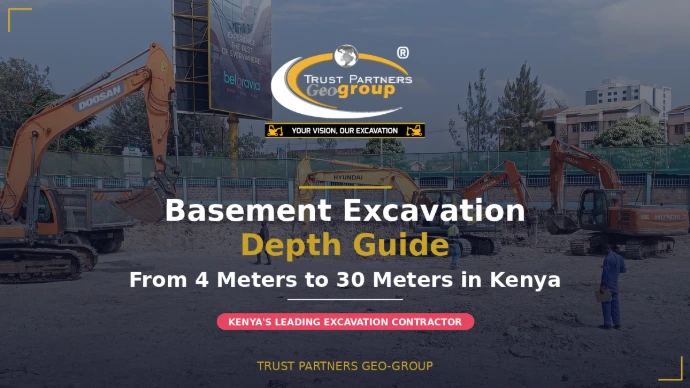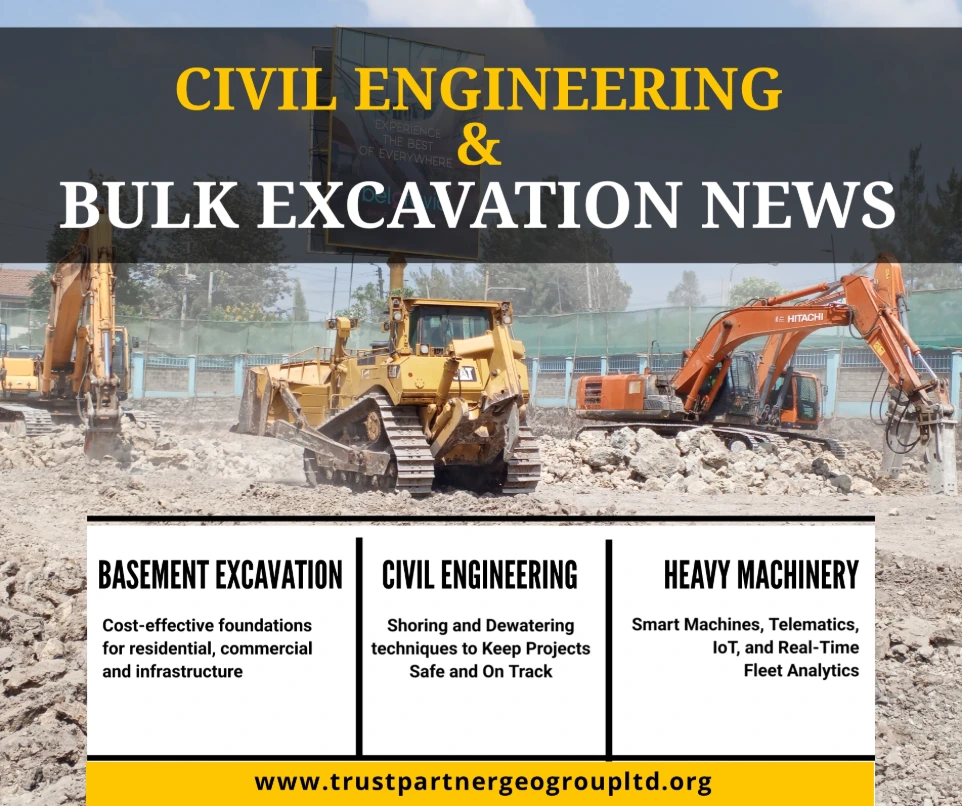
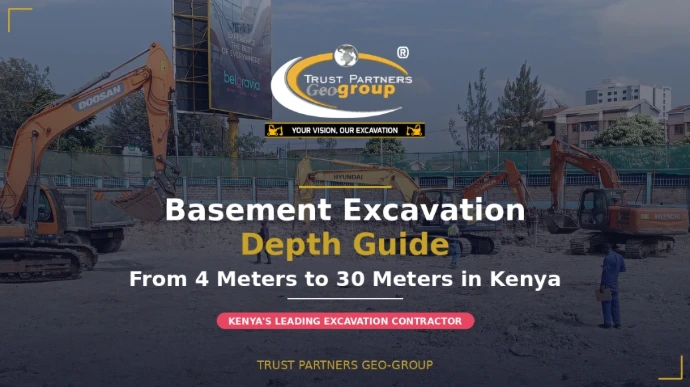
A Complete Technical Guide for Developers, Contractors & Project Managers Planning Basement Excavations Across Nairobi, Mombasa, Kisumu & Beyond — From 4 Meters to 30 Meters and Beyond
Table of Contents
Jump to any section of this guide
When planning a construction project in Kenya, one of the most critical decisions you'll make is determining the right basement excavation depth. Whether you're building a residential apartment in Kilimani, a commercial tower in Upper Hill, or an industrial facility in Athi River, the depth of your basement excavation directly impacts structural integrity, project cost, timeline, and safety.
At Trust Partners Geo-Group, we have executed basement excavations ranging from standard 4-meter residential basements to mega excavations exceeding 30 meters deep across Nairobi, Mombasa, Kisumu, and beyond. This guide breaks down everything you need to know about basement excavation depths in Kenya.
The deeper you go, the more engineering precision you need. At Trust Partners Geo-Group, we treat every meter as a critical engineering decision.
Why Basement Depth Matters in Kenya
Basement excavation is not just about digging a hole. The depth you choose affects:
- Structural load-bearing capacity — Deeper basements require stronger foundations and retaining walls
- Groundwater management — Nairobi's water table varies by location; deeper excavations face higher hydrostatic pressure
- Shoring requirements — Depth determines the type of shoring system (sheet piles, soldier piles, diaphragm walls)
- Project cost — Costs increase exponentially with depth due to dewatering, shoring, and hauling
- Permitting complexity — Deep excavations require more rigorous NCA (National Construction Authority) approvals
- Neighboring structure protection — Deep excavations near existing buildings demand specialized stabilization
Standard Basement Excavation: 4 to 6 Meters
Typical Applications
- Residential apartments and townhouses
- Small commercial buildings
- Parking basements for low-rise developments
- Retail spaces in mixed-use buildings
Common Locations in Kenya
- Karen, Lavington, Kileleshwa — Residential developments with single-level parking
- Ruiru, Thika, Kiambu — Suburban housing projects
- Mombasa, Kisumu — Coastal and lakeside residential projects
Engineering Considerations
- Soil type: Typically red volcanic soil (Nairobi) or sandy loam (coastal areas)
- Shoring method: Simple cantilever shoring or anchored sheet piles
- Dewatering: Minimal; sump pumps usually sufficient
- Excavation method: Standard excavators (20-30 ton) with backhoe loaders
- Timeline: 2-4 weeks depending on site size
Cost Range (2026 Estimates)
| Item | Cost per Cubic Meter (KES) |
|---|---|
| Excavation & hauling | 1,500 – 2,500 |
| Shoring (if needed) | 800 – 1,500 |
| Dewatering | 200 – 400 |
| Total typical range | 2,500 – 4,400 |
For 4-6 meter depths in Nairobi's red soil, expect minimal dewatering challenges. However, in areas like Parklands or near Nairobi River, groundwater can appear at 3-4 meters.
Medium-Depth Basements: 7 to 15 Meters
Typical Applications
- Multi-level parking basements
- Commercial office buildings
- Mixed-use developments (retail + parking + offices)
- Hotels with underground facilities
- Shopping malls with basement parking
Common Locations in Kenya
- Upper Hill, Westlands, Kilimani — High-rise commercial and residential towers
- Parklands, Hurlingham — Mixed-use developments
- Nairobi CBD — Redevelopment projects
- Mombasa CBD — Coastal commercial buildings
Engineering Considerations
- Soil type: Variable; may encounter clay lenses, cotton soil, or weathered rock
- Shoring method: Anchored sheet piles, soldier piles with lagging, or secant piles
- Dewatering: Active dewatering with well-point systems or deep wells required
- Excavation method: Large excavators (30-50 ton) with articulated dump trucks; may require blasting permits for rock
- Timeline: 6-12 weeks
Special requirements:
- Vibration monitoring for adjacent buildings
- Geotechnical instrumentation (inclinometers, piezometers)
- Traffic management for spoil removal in dense urban areas
Cost Range (2026 Estimates)
| Item | Cost per Cubic Meter (KES) |
|---|---|
| Excavation & hauling | 2,000 – 3,500 |
| Shoring & retaining | 2,500 – 5,000 |
| Dewatering | 1,000 – 2,500 |
| Geotechnical monitoring | 300 – 600 |
| Total typical range | 5,800 – 11,600 |
Trust Partners Geo-Group completed a 12-meter basement excavation in Upper Hill for a 15-story commercial tower. The project required secant pile shoring, deep well dewatering, and real-time vibration monitoring of adjacent buildings. Completed on schedule with zero safety incidents.
Deep Basements: 16 to 25 Meters
Typical Applications
- High-rise residential towers (20+ floors)
- Underground commercial complexes
- Data centers and secure facilities
- Multi-level automated parking systems
- Basement utility plants and substations
Common Locations in Kenya
- Upper Hill, Westlands — Premium high-rise developments
- Nairobi CBD — Redevelopment of older commercial buildings
- Kilimani, Kileleshwa — Luxury residential towers
- Mombasa — Waterfront developments
Engineering Considerations
- Soil type: Often transitions to hard rock, weathered formations, or high-pressure aquifers
- Shoring method: Diaphragm walls, top-down construction, or deep secant pile walls
- Dewatering: Complex multi-stage dewatering; may require artesian pressure relief
- Excavation method: Heavy-duty excavators (50+ ton), hydraulic breakers for rock; potential controlled blasting
- Timeline: 3-6 months
Special requirements:
- Detailed geotechnical investigation (boreholes every 15-20 meters)
- Third-party structural monitoring of neighboring buildings
- Specialized dewatering design by hydrogeologists
- NEMA environmental impact assessment for large-scale dewatering
- Traffic management plans for high-volume spoil removal (500+ truckloads)
Cost Range (2026 Estimates)
| Item | Cost per Cubic Meter (KES) |
|---|---|
| Excavation & hauling | 3,500 – 6,000 |
| Shoring (diaphragm/secant walls) | 8,000 – 15,000 |
| Dewatering (multi-stage) | 3,000 – 6,000 |
| Geotechnical & structural monitoring | 1,000 – 2,000 |
| Rock breaking/blasting | 2,000 – 4,000 (if applicable) |
| Total typical range | 17,500 – 33,000 |
At 16+ meters, groundwater pressure becomes a dominant factor. In Nairobi's Upper Hill and Parklands areas, artesian pressures can destabilize excavation walls if not properly relieved. Always engage a hydrogeologist for dewatering design at these depths.
Mega Basements: 26 to 30+ Meters
Typical Applications
- Mega-malls and mixed-use developments
- Underground metro/transportation facilities
- Deep utility tunnels and interconnections
- Large-scale data centers
- Underground sports and entertainment venues
Common Locations in Kenya
- Nairobi CBD — Future mega-developments
- Westlands — Large-scale mixed-use projects
- Mombasa — Port-adjacent logistics and commercial hubs
Engineering Considerations
- Soil type: Hard rock, fractured formations, or complex geological strata
- Shoring method: Diaphragm walls with internal bracing or top-down construction
- Dewatering: Major dewatering campaign; may require permanent dewatering systems
- Excavation method: Specialized heavy equipment, controlled blasting, mechanical rock breaking
- Timeline: 6-12 months or longer
Special requirements:
- Extensive geotechnical investigation (20+ boreholes)
- Finite element modeling of excavation behavior
- Real-time automated monitoring systems
- Emergency response plans for wall failure or flooding
- Coordination with Nairobi City County for traffic and utility diversions
- International engineering peer review recommended
Cost Range (2026 Estimates)
| Item | Cost per Cubic Meter (KES) |
|---|---|
| Excavation & hauling | 5,000 – 10,000 |
| Shoring (diaphragm walls with bracing) | 15,000 – 30,000 |
| Dewatering (major campaign) | 8,000 – 15,000 |
| Geotechnical & structural monitoring | 3,000 – 5,000 |
| Rock breaking/blasting | 4,000 – 8,000 |
| Project management & engineering | 2,000 – 4,000 |
| Total typical range | 37,000 – 72,000 |
Mega excavations at 30+ meters are rare in Kenya but growing as Nairobi's skyline rises. These projects require international-standard engineering and should only be undertaken by contractors with proven deep-excavation experience.
Factors That Determine Excavation Depth
1. Building Height and Structural Loads
Taller buildings require deeper foundations to transfer loads to stable ground. A general rule:
- 1 basement level (4-6m): Up to 8-10 stories
- 2-3 basement levels (8-15m): 10-20 stories
- 4+ basement levels (16m+): 20+ stories
2. Parking Requirements
Nairobi County and other jurisdictions require minimum parking ratios:
- Residential: 1 space per unit (varies by zoning)
- Commercial: 1 space per 50-100 sqm of office space
- Retail: 1 space per 25-50 sqm
For high-density projects, this often drives the need for multi-level basement parking.
3. Soil and Geological Conditions
- Red volcanic soil (Nairobi): Generally stable to 10-15m, then transitions to weathered rock
- Black cotton soil: Expansive and problematic; requires special treatment
- Coastal sands (Mombasa): High groundwater, requires dewatering from shallow depths
- Lakebed deposits (Kisumu): Soft soils, may require ground improvement
4. Groundwater Table
- High water table areas: Parklands, parts of Upper Hill, areas near rivers
- Low water table areas: Karen, parts of Kileleshwa, elevated areas
5. Adjacent Structures
Proximity to existing buildings limits excavation depth due to:
- Settlement concerns
- Lateral earth pressure on neighboring foundations
- Vibration restrictions during excavation
6. Zoning and Regulatory Requirements
- Nairobi County building codes: Setback and coverage requirements
- NCA regulations: Deep excavation permits and safety requirements
- NEMA: Environmental clearances for large dewatering operations
Soil Conditions in Nairobi and Kenya
Understanding your site's soil is critical before setting excavation depth. Here's what we commonly encounter:
Nairobi Region Soil Profile
| Depth | Typical Soil Type | Characteristics |
|---|---|---|
| 0-2m | Topsoil / fill | Variable quality; often removed |
| 2-8m | Red volcanic soil (murram) | Good bearing capacity, stable |
| 8-15m | Weathered rock / hardpan | Variable, may require breaking |
| 15m+ | Hard rock (phonolite, basalt) | Requires blasting or hydraulic breaking |
Special Soil Challenges
Black Cotton Soil (Vertisol)
- Found in: Parts of Kajiado, Athi River, some Nairobi areas
- Problem: High swelling when wet, shrinkage when dry
- Solution: Remove and replace, or chemical stabilization
Cotton Soil in Nairobi
- Found in: Syokimau, Mlolongo, parts of Athi River
- Problem: Poor drainage, low bearing capacity
- Solution: Excavation below cotton soil layer, or ground improvement
Coastal Sands (Mombasa, Malindi)
- Problem: High permeability, saltwater intrusion, loose compaction
- Solution: Dewatering, compaction grouting, sheet pile shoring
Shoring and Dewatering by Depth
Shoring Systems by Depth Range
| Depth | Recommended Shoring | Approximate Cost (KES/m) |
|---|---|---|
| 4-6m | Cantilever sheet piles, soldier piles | 8,000 – 15,000 |
| 7-12m | Anchored sheet piles, secant piles | 15,000 – 30,000 |
| 13-20m | Secant piles, diaphragm walls | 30,000 – 60,000 |
| 21-30m+ | Diaphragm walls with bracing, top-down | 60,000 – 120,000 |
Dewatering Methods by Depth
| Depth | Dewatering Method | Equipment |
|---|---|---|
| 4-6m | Sump pumping | Submersible pumps |
| 7-12m | Well-point system | Vacuum pumps, well-point rods |
| 13-20m | Deep wells with submersible pumps | Borehole drilling rigs, electric pumps |
| 21-30m+ | Multi-stage deep wells, artesian pressure relief | Specialized drilling, high-capacity pumps |
Trust Partners Geo-Group Advantage: We maintain a fleet of modern shoring equipment and dewatering pumps, allowing us to mobilize quickly for projects of any depth across Kenya.
Cost Implications by Depth
Cost Multipliers by Depth (Relative to 4-6m Standard)
| Depth Range | Cost Multiplier | Key Cost Drivers |
|---|---|---|
| 4-6m | 1.0x (baseline) | Standard excavation, minimal shoring |
| 7-12m | 2.5x – 4.0x | Shoring, dewatering, monitoring |
| 13-20m | 5.0x – 8.0x | Complex shoring, major dewatering, rock breaking |
| 21-30m+ | 10.0x – 20.0x | Diaphragm walls, artesian control, international engineering |
Cost-Saving Tips
- Early geotechnical investigation — Prevents surprises and change orders
- Optimize basement footprint — Smaller footprint = less excavation volume
- Consider top-down construction — Can reduce shoring costs for deep basements
- Plan spoil disposal early — Hauling costs are significant; negotiate disposal sites in advance
- Bundle with equipment hire — Using the same contractor for excavation and equipment reduces coordination costs
NCA and Safety Compliance Requirements
National Construction Authority (NCA) Requirements
For basement excavations in Kenya, NCA requires:
All Excavations (Any Depth)
- Registered contractor (NCA category appropriate for project value)
- Site safety officer
- Method statement and risk assessment
- Emergency response plan
Excavations Over 5 Meters
- Geotechnical investigation report
- Shoring design by a registered structural engineer
- Dewatering plan (if applicable)
- Regular safety inspections
Excavations Over 15 Meters
- Third-party geotechnical review
- Structural monitoring plan for adjacent buildings
- Specialized insurance coverage
- NCA notification and potential inspection
Safety Standards We Follow
At Trust Partners Geo-Group, we adhere to:
- OSHA excavation safety standards (adapted for Kenya)
- Kenya Bureau of Standards (KEBS) construction guidelines
- NCA contractor registration and safety requirements
- NEMA environmental compliance for dewatering and spoil disposal
- ISO 45001 occupational health and safety management principles
Key Safety Measures by Depth
| Depth | Critical Safety Measures |
|---|---|
| 4-6m | Trench shields, ladder access, daily inspections |
| 7-12m | Shoring design verification, dewatering monitoring, vibration limits |
| 13-20m | Automated monitoring, emergency dewatering, structural instrumentation |
| 21-30m+ | Real-time data logging, 24/7 monitoring, emergency response team on standby |
Choosing the Right Excavation Contractor
Not every contractor can handle deep basement excavations. Here's what to look for:
Essential Qualifications
- NCA registration in the appropriate category
- Proven experience at your required depth
- In-house equipment fleet or reliable hire partners
- Registered structural engineer on team or retainer
- Safety record with documented incident rates
- Insurance coverage for deep excavation risks
- Local knowledge of Nairobi/Kenya soil conditions and regulations
Red Flags to Avoid
- No NCA registration or expired license
- No experience at your required depth
- Relies entirely on subcontracted equipment (delays likely)
- No geotechnical engineer on project
- Vague or incomplete safety plan
- Cannot provide references for similar-depth projects
Questions to Ask Your Contractor
- "How many basements have you excavated at [X] meters depth?"
- "Can you provide references from projects of similar depth and complexity?"
- "What shoring system do you recommend for my site, and why?"
- "How will you handle dewatering given my site's groundwater conditions?"
- "What is your safety incident rate over the past 3 years?"
- "Do you have your own equipment, or will you subcontract?"
- "What is your typical timeline for a [X] meter deep basement of [Y] square meters?"
Trust Partners Geo-Group has completed basement excavations from 4 meters to over 30 meters across Kenya. We own our equipment fleet, employ certified engineers, and maintain an industry-leading safety record.
Conclusion
Basement excavation depth in Kenya ranges from simple 4-meter residential parking to complex 30-meter mega-developments. The key to success is:
- Early geotechnical understanding — Know your soil before you dig
- Appropriate shoring and dewatering — Match the system to the depth and conditions
- Experienced contractor — Deep excavation is not a learning exercise
- Regulatory compliance — NCA, NEMA, and county requirements are non-negotiable
- Safety first — Every meter deeper increases risk; safety systems must scale accordingly
At Trust Partners Geo-Group, we bring proven expertise, modern equipment, and unwavering safety commitment to every basement excavation project — from 4 meters to 30 meters and beyond.
Frequently Asked Questions
Common questions about basement excavation depths in Kenya
There is no absolute maximum depth specified by NCA, but excavations over 15 meters require enhanced engineering review, third-party monitoring, and specialized safety measures. Practical limits are determined by soil conditions, groundwater, and adjacent structures.
4-6 meters: 2-4 weeks
7-12 meters: 6-12 weeks
13-20 meters: 3-6 months
21-30+ meters: 6-12 months or longer
Timelines depend on site size, soil conditions, weather, and regulatory approvals.
Yes, but dewatering costs increase significantly. For deep excavations (15m+), we recommend scheduling during dry seasons (January-March, July-October) when possible.
See our cost tables above. For a precise quote, contact us with your project details. We provide free site assessments and preliminary estimates.
Yes, absolutely. NCA requires a geotechnical investigation for excavations over 5 meters. For deep excavations (15m+), we recommend 10-20 boreholes across the site.
We implement: pre-construction condition surveys of adjacent structures, vibration monitoring with real-time alerts, settlement monitoring with automated inclinometers, controlled excavation sequences to minimize lateral pressure, and immediate response protocols if thresholds are exceeded.
This is common and expected. Our dewatering plans include contingency measures: additional well points or deep wells, grouting to seal water-bearing layers, temporary cofferdams for localized water control, and 24/7 pump redundancy to prevent flooding.
Yes. We have hydraulic breakers, rock hammers, and controlled blasting capabilities for hard rock encountered at depth. Blasting requires special permits and is coordinated with local authorities.
Yes. Trust Partners Geo-Group offers flexible equipment hire with certified operators, which is ideal for projects that prefer to manage their own excavation sequencing.
We operate nationwide including: Nairobi (Parklands, Kilimani, Upper Hill, Kileleshwa, Lavington, South C, Karen, Westlands, Industrial Area, Athi River, Syokimau, Ruiru, Kiambu) and other cities (Mombasa, Kisumu, Nakuru, Thika, Eldoret, Garissa, Nyeri, Meru, Machakos, Kitale, Kakamega, Naivasha, Malindi, Embu).
Ready to Start Your Basement Excavation Project?
Contact Trust Partners Geo-Group for a free site assessment and preliminary estimate. We serve Nairobi, Mombasa, Kisumu, Nakuru, and all major towns across Kenya.
Call +254 718 68 69 67A Complete Technical Guide for Developers, Contractors & Project Managers Planning Basement Excavations Across Nairobi, Mombasa, Kisumu & Beyond — From 4 Meters to 30 Meters and Beyond
Table of Contents
Jump to any section of this guide
When planning a construction project in Kenya, one of the most critical decisions you'll make is determining the right basement excavation depth. Whether you're building a residential apartment in Kilimani, a commercial tower in Upper Hill, or an industrial facility in Athi River, the depth of your basement excavation directly impacts structural integrity, project cost, timeline, and safety.
At Trust Partners Geo-Group, we have executed basement excavations ranging from standard 4-meter residential basements to mega excavations exceeding 30 meters deep across Nairobi, Mombasa, Kisumu, and beyond. This guide breaks down everything you need to know about basement excavation depths in Kenya.
The deeper you go, the more engineering precision you need. At Trust Partners Geo-Group, we treat every meter as a critical engineering decision.
Why Basement Depth Matters in Kenya
Basement excavation is not just about digging a hole. The depth you choose affects:
- Structural load-bearing capacity — Deeper basements require stronger foundations and retaining walls
- Groundwater management — Nairobi's water table varies by location; deeper excavations face higher hydrostatic pressure
- Shoring requirements — Depth determines the type of shoring system (sheet piles, soldier piles, diaphragm walls)
- Project cost — Costs increase exponentially with depth due to dewatering, shoring, and hauling
- Permitting complexity — Deep excavations require more rigorous NCA (National Construction Authority) approvals
- Neighboring structure protection — Deep excavations near existing buildings demand specialized stabilization
Standard Basement Excavation: 4 to 6 Meters
Typical Applications
- Residential apartments and townhouses
- Small commercial buildings
- Parking basements for low-rise developments
- Retail spaces in mixed-use buildings
Common Locations in Kenya
- Karen, Lavington, Kileleshwa — Residential developments with single-level parking
- Ruiru, Thika, Kiambu — Suburban housing projects
- Mombasa, Kisumu — Coastal and lakeside residential projects
Engineering Considerations
- Soil type: Typically red volcanic soil (Nairobi) or sandy loam (coastal areas)
- Shoring method: Simple cantilever shoring or anchored sheet piles
- Dewatering: Minimal; sump pumps usually sufficient
- Excavation method: Standard excavators (20-30 ton) with backhoe loaders
- Timeline: 2-4 weeks depending on site size
Cost Range (2026 Estimates)
| Item | Cost per Cubic Meter (KES) |
|---|---|
| Excavation & hauling | 1,500 – 2,500 |
| Shoring (if needed) | 800 – 1,500 |
| Dewatering | 200 – 400 |
| Total typical range | 2,500 – 4,400 |
For 4-6 meter depths in Nairobi's red soil, expect minimal dewatering challenges. However, in areas like Parklands or near Nairobi River, groundwater can appear at 3-4 meters.
Medium-Depth Basements: 7 to 15 Meters
Typical Applications
- Multi-level parking basements
- Commercial office buildings
- Mixed-use developments (retail + parking + offices)
- Hotels with underground facilities
- Shopping malls with basement parking
Common Locations in Kenya
- Upper Hill, Westlands, Kilimani — High-rise commercial and residential towers
- Parklands, Hurlingham — Mixed-use developments
- Nairobi CBD — Redevelopment projects
- Mombasa CBD — Coastal commercial buildings
Engineering Considerations
- Soil type: Variable; may encounter clay lenses, cotton soil, or weathered rock
- Shoring method: Anchored sheet piles, soldier piles with lagging, or secant piles
- Dewatering: Active dewatering with well-point systems or deep wells required
- Excavation method: Large excavators (30-50 ton) with articulated dump trucks; may require blasting permits for rock
- Timeline: 6-12 weeks
Special requirements:
- Vibration monitoring for adjacent buildings
- Geotechnical instrumentation (inclinometers, piezometers)
- Traffic management for spoil removal in dense urban areas
Cost Range (2026 Estimates)
| Item | Cost per Cubic Meter (KES) |
|---|---|
| Excavation & hauling | 2,000 – 3,500 |
| Shoring & retaining | 2,500 – 5,000 |
| Dewatering | 1,000 – 2,500 |
| Geotechnical monitoring | 300 – 600 |
| Total typical range | 5,800 – 11,600 |
Trust Partners Geo-Group completed a 12-meter basement excavation in Upper Hill for a 15-story commercial tower. The project required secant pile shoring, deep well dewatering, and real-time vibration monitoring of adjacent buildings. Completed on schedule with zero safety incidents.
Deep Basements: 16 to 25 Meters
Typical Applications
- High-rise residential towers (20+ floors)
- Underground commercial complexes
- Data centers and secure facilities
- Multi-level automated parking systems
- Basement utility plants and substations
Common Locations in Kenya
- Upper Hill, Westlands — Premium high-rise developments
- Nairobi CBD — Redevelopment of older commercial buildings
- Kilimani, Kileleshwa — Luxury residential towers
- Mombasa — Waterfront developments
Engineering Considerations
- Soil type: Often transitions to hard rock, weathered formations, or high-pressure aquifers
- Shoring method: Diaphragm walls, top-down construction, or deep secant pile walls
- Dewatering: Complex multi-stage dewatering; may require artesian pressure relief
- Excavation method: Heavy-duty excavators (50+ ton), hydraulic breakers for rock; potential controlled blasting
- Timeline: 3-6 months
Special requirements:
- Detailed geotechnical investigation (boreholes every 15-20 meters)
- Third-party structural monitoring of neighboring buildings
- Specialized dewatering design by hydrogeologists
- NEMA environmental impact assessment for large-scale dewatering
- Traffic management plans for high-volume spoil removal (500+ truckloads)
Cost Range (2026 Estimates)
| Item | Cost per Cubic Meter (KES) |
|---|---|
| Excavation & hauling | 3,500 – 6,000 |
| Shoring (diaphragm/secant walls) | 8,000 – 15,000 |
| Dewatering (multi-stage) | 3,000 – 6,000 |
| Geotechnical & structural monitoring | 1,000 – 2,000 |
| Rock breaking/blasting | 2,000 – 4,000 (if applicable) |
| Total typical range | 17,500 – 33,000 |
At 16+ meters, groundwater pressure becomes a dominant factor. In Nairobi's Upper Hill and Parklands areas, artesian pressures can destabilize excavation walls if not properly relieved. Always engage a hydrogeologist for dewatering design at these depths.
Mega Basements: 26 to 30+ Meters
Typical Applications
- Mega-malls and mixed-use developments
- Underground metro/transportation facilities
- Deep utility tunnels and interconnections
- Large-scale data centers
- Underground sports and entertainment venues
Common Locations in Kenya
- Nairobi CBD — Future mega-developments
- Westlands — Large-scale mixed-use projects
- Mombasa — Port-adjacent logistics and commercial hubs
Engineering Considerations
- Soil type: Hard rock, fractured formations, or complex geological strata
- Shoring method: Diaphragm walls with internal bracing or top-down construction
- Dewatering: Major dewatering campaign; may require permanent dewatering systems
- Excavation method: Specialized heavy equipment, controlled blasting, mechanical rock breaking
- Timeline: 6-12 months or longer
Special requirements:
- Extensive geotechnical investigation (20+ boreholes)
- Finite element modeling of excavation behavior
- Real-time automated monitoring systems
- Emergency response plans for wall failure or flooding
- Coordination with Nairobi City County for traffic and utility diversions
- International engineering peer review recommended
Cost Range (2026 Estimates)
| Item | Cost per Cubic Meter (KES) |
|---|---|
| Excavation & hauling | 5,000 – 10,000 |
| Shoring (diaphragm walls with bracing) | 15,000 – 30,000 |
| Dewatering (major campaign) | 8,000 – 15,000 |
| Geotechnical & structural monitoring | 3,000 – 5,000 |
| Rock breaking/blasting | 4,000 – 8,000 |
| Project management & engineering | 2,000 – 4,000 |
| Total typical range | 37,000 – 72,000 |
Mega excavations at 30+ meters are rare in Kenya but growing as Nairobi's skyline rises. These projects require international-standard engineering and should only be undertaken by contractors with proven deep-excavation experience.
Factors That Determine Excavation Depth
1. Building Height and Structural Loads
Taller buildings require deeper foundations to transfer loads to stable ground. A general rule:
- 1 basement level (4-6m): Up to 8-10 stories
- 2-3 basement levels (8-15m): 10-20 stories
- 4+ basement levels (16m+): 20+ stories
2. Parking Requirements
Nairobi County and other jurisdictions require minimum parking ratios:
- Residential: 1 space per unit (varies by zoning)
- Commercial: 1 space per 50-100 sqm of office space
- Retail: 1 space per 25-50 sqm
For high-density projects, this often drives the need for multi-level basement parking.
3. Soil and Geological Conditions
- Red volcanic soil (Nairobi): Generally stable to 10-15m, then transitions to weathered rock
- Black cotton soil: Expansive and problematic; requires special treatment
- Coastal sands (Mombasa): High groundwater, requires dewatering from shallow depths
- Lakebed deposits (Kisumu): Soft soils, may require ground improvement
4. Groundwater Table
- High water table areas: Parklands, parts of Upper Hill, areas near rivers
- Low water table areas: Karen, parts of Kileleshwa, elevated areas
5. Adjacent Structures
Proximity to existing buildings limits excavation depth due to:
- Settlement concerns
- Lateral earth pressure on neighboring foundations
- Vibration restrictions during excavation
6. Zoning and Regulatory Requirements
- Nairobi County building codes: Setback and coverage requirements
- NCA regulations: Deep excavation permits and safety requirements
- NEMA: Environmental clearances for large dewatering operations
Soil Conditions in Nairobi and Kenya
Understanding your site's soil is critical before setting excavation depth. Here's what we commonly encounter:
Nairobi Region Soil Profile
| Depth | Typical Soil Type | Characteristics |
|---|---|---|
| 0-2m | Topsoil / fill | Variable quality; often removed |
| 2-8m | Red volcanic soil (murram) | Good bearing capacity, stable |
| 8-15m | Weathered rock / hardpan | Variable, may require breaking |
| 15m+ | Hard rock (phonolite, basalt) | Requires blasting or hydraulic breaking |
Special Soil Challenges
Black Cotton Soil (Vertisol)
- Found in: Parts of Kajiado, Athi River, some Nairobi areas
- Problem: High swelling when wet, shrinkage when dry
- Solution: Remove and replace, or chemical stabilization
Cotton Soil in Nairobi
- Found in: Syokimau, Mlolongo, parts of Athi River
- Problem: Poor drainage, low bearing capacity
- Solution: Excavation below cotton soil layer, or ground improvement
Coastal Sands (Mombasa, Malindi)
- Problem: High permeability, saltwater intrusion, loose compaction
- Solution: Dewatering, compaction grouting, sheet pile shoring
Shoring and Dewatering by Depth
Shoring Systems by Depth Range
| Depth | Recommended Shoring | Approximate Cost (KES/m) |
|---|---|---|
| 4-6m | Cantilever sheet piles, soldier piles | 8,000 – 15,000 |
| 7-12m | Anchored sheet piles, secant piles | 15,000 – 30,000 |
| 13-20m | Secant piles, diaphragm walls | 30,000 – 60,000 |
| 21-30m+ | Diaphragm walls with bracing, top-down | 60,000 – 120,000 |
Dewatering Methods by Depth
| Depth | Dewatering Method | Equipment |
|---|---|---|
| 4-6m | Sump pumping | Submersible pumps |
| 7-12m | Well-point system | Vacuum pumps, well-point rods |
| 13-20m | Deep wells with submersible pumps | Borehole drilling rigs, electric pumps |
| 21-30m+ | Multi-stage deep wells, artesian pressure relief | Specialized drilling, high-capacity pumps |
Trust Partners Geo-Group Advantage: We maintain a fleet of modern shoring equipment and dewatering pumps, allowing us to mobilize quickly for projects of any depth across Kenya.
Cost Implications by Depth
Cost Multipliers by Depth (Relative to 4-6m Standard)
| Depth Range | Cost Multiplier | Key Cost Drivers |
|---|---|---|
| 4-6m | 1.0x (baseline) | Standard excavation, minimal shoring |
| 7-12m | 2.5x – 4.0x | Shoring, dewatering, monitoring |
| 13-20m | 5.0x – 8.0x | Complex shoring, major dewatering, rock breaking |
| 21-30m+ | 10.0x – 20.0x | Diaphragm walls, artesian control, international engineering |
Cost-Saving Tips
- Early geotechnical investigation — Prevents surprises and change orders
- Optimize basement footprint — Smaller footprint = less excavation volume
- Consider top-down construction — Can reduce shoring costs for deep basements
- Plan spoil disposal early — Hauling costs are significant; negotiate disposal sites in advance
- Bundle with equipment hire — Using the same contractor for excavation and equipment reduces coordination costs
NCA and Safety Compliance Requirements
National Construction Authority (NCA) Requirements
For basement excavations in Kenya, NCA requires:
All Excavations (Any Depth)
- Registered contractor (NCA category appropriate for project value)
- Site safety officer
- Method statement and risk assessment
- Emergency response plan
Excavations Over 5 Meters
- Geotechnical investigation report
- Shoring design by a registered structural engineer
- Dewatering plan (if applicable)
- Regular safety inspections
Excavations Over 15 Meters
- Third-party geotechnical review
- Structural monitoring plan for adjacent buildings
- Specialized insurance coverage
- NCA notification and potential inspection
Safety Standards We Follow
At Trust Partners Geo-Group, we adhere to:
- OSHA excavation safety standards (adapted for Kenya)
- Kenya Bureau of Standards (KEBS) construction guidelines
- NCA contractor registration and safety requirements
- NEMA environmental compliance for dewatering and spoil disposal
- ISO 45001 occupational health and safety management principles
Key Safety Measures by Depth
| Depth | Critical Safety Measures |
|---|---|
| 4-6m | Trench shields, ladder access, daily inspections |
| 7-12m | Shoring design verification, dewatering monitoring, vibration limits |
| 13-20m | Automated monitoring, emergency dewatering, structural instrumentation |
| 21-30m+ | Real-time data logging, 24/7 monitoring, emergency response team on standby |
Choosing the Right Excavation Contractor
Not every contractor can handle deep basement excavations. Here's what to look for:
Essential Qualifications
- NCA registration in the appropriate category
- Proven experience at your required depth
- In-house equipment fleet or reliable hire partners
- Registered structural engineer on team or retainer
- Safety record with documented incident rates
- Insurance coverage for deep excavation risks
- Local knowledge of Nairobi/Kenya soil conditions and regulations
Red Flags to Avoid
- No NCA registration or expired license
- No experience at your required depth
- Relies entirely on subcontracted equipment (delays likely)
- No geotechnical engineer on project
- Vague or incomplete safety plan
- Cannot provide references for similar-depth projects
Questions to Ask Your Contractor
- "How many basements have you excavated at [X] meters depth?"
- "Can you provide references from projects of similar depth and complexity?"
- "What shoring system do you recommend for my site, and why?"
- "How will you handle dewatering given my site's groundwater conditions?"
- "What is your safety incident rate over the past 3 years?"
- "Do you have your own equipment, or will you subcontract?"
- "What is your typical timeline for a [X] meter deep basement of [Y] square meters?"
Trust Partners Geo-Group has completed basement excavations from 4 meters to over 30 meters across Kenya. We own our equipment fleet, employ certified engineers, and maintain an industry-leading safety record.
Conclusion
Basement excavation depth in Kenya ranges from simple 4-meter residential parking to complex 30-meter mega-developments. The key to success is:
- Early geotechnical understanding — Know your soil before you dig
- Appropriate shoring and dewatering — Match the system to the depth and conditions
- Experienced contractor — Deep excavation is not a learning exercise
- Regulatory compliance — NCA, NEMA, and county requirements are non-negotiable
- Safety first — Every meter deeper increases risk; safety systems must scale accordingly
At Trust Partners Geo-Group, we bring proven expertise, modern equipment, and unwavering safety commitment to every basement excavation project — from 4 meters to 30 meters and beyond.
Frequently Asked Questions
Common questions about basement excavation depths in Kenya
There is no absolute maximum depth specified by NCA, but excavations over 15 meters require enhanced engineering review, third-party monitoring, and specialized safety measures. Practical limits are determined by soil conditions, groundwater, and adjacent structures.
4-6 meters: 2-4 weeks
7-12 meters: 6-12 weeks
13-20 meters: 3-6 months
21-30+ meters: 6-12 months or longer
Timelines depend on site size, soil conditions, weather, and regulatory approvals.
Yes, but dewatering costs increase significantly. For deep excavations (15m+), we recommend scheduling during dry seasons (January-March, July-October) when possible.
See our cost tables above. For a precise quote, contact us with your project details. We provide free site assessments and preliminary estimates.
Yes, absolutely. NCA requires a geotechnical investigation for excavations over 5 meters. For deep excavations (15m+), we recommend 10-20 boreholes across the site.
We implement: pre-construction condition surveys of adjacent structures, vibration monitoring with real-time alerts, settlement monitoring with automated inclinometers, controlled excavation sequences to minimize lateral pressure, and immediate response protocols if thresholds are exceeded.
This is common and expected. Our dewatering plans include contingency measures: additional well points or deep wells, grouting to seal water-bearing layers, temporary cofferdams for localized water control, and 24/7 pump redundancy to prevent flooding.
Yes. We have hydraulic breakers, rock hammers, and controlled blasting capabilities for hard rock encountered at depth. Blasting requires special permits and is coordinated with local authorities.
Yes. Trust Partners Geo-Group offers flexible equipment hire with certified operators, which is ideal for projects that prefer to manage their own excavation sequencing.
We operate nationwide including: Nairobi (Parklands, Kilimani, Upper Hill, Kileleshwa, Lavington, South C, Karen, Westlands, Industrial Area, Athi River, Syokimau, Ruiru, Kiambu) and other cities (Mombasa, Kisumu, Nakuru, Thika, Eldoret, Garissa, Nyeri, Meru, Machakos, Kitale, Kakamega, Naivasha, Malindi, Embu).
Ready to Start Your Basement Excavation Project?
Contact Trust Partners Geo-Group for a free site assessment and preliminary estimate. We serve Nairobi, Mombasa, Kisumu, Nakuru, and all major towns across Kenya.
Call +254 718 68 69 67