
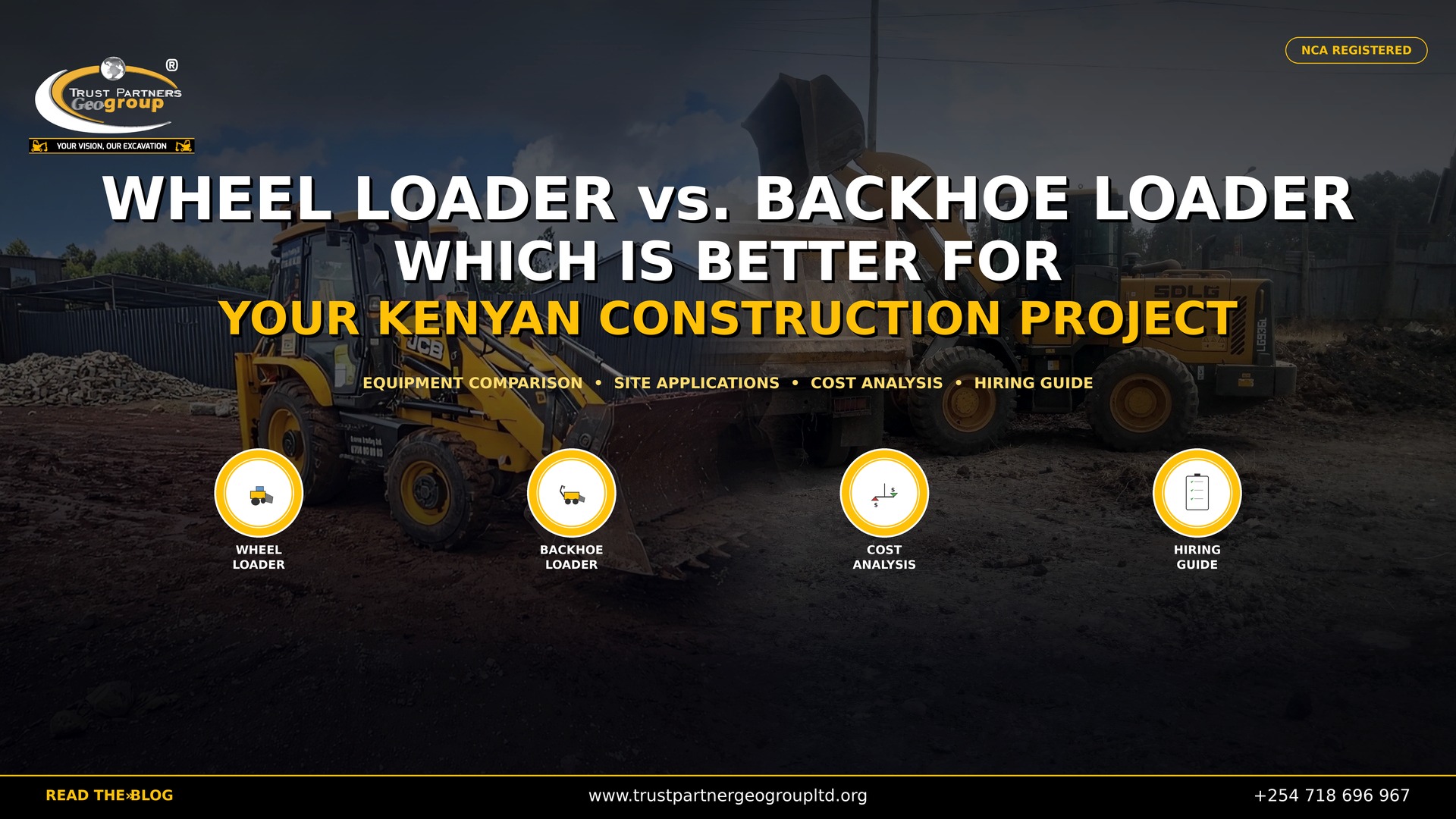
Wheel Loader vs. Backhoe Loader: Which is Better for Your Kenyan Construction Project? [2026]
Construction loader selection guide: comparing wheel loader and backhoe loader productivity, hire rates and applications for excavation in Kenya, basement excavation and heavy equipment for hire
Table of Contents
- 1. Why Loader Selection Matters for Excavation in Kenya
- 2. Wheel Loader: Design, Strengths and Productivity
- 3. Backhoe Loader: Design, Versatility and Applications
- 4. Head-to-Head Comparison: Wheel Loader vs Backhoe Loader
- 5. Kenyan Construction Applications: Basement, Roads and Bulk Earthworks
- 6. Hire Rates and Operating Costs [2026]
- 7. Decision Framework: Which Loader Should You Hire?
- 8. Frequently Asked Questions
- 9. Conclusion
On a 5,000 m3 basement excavation site in Westlands, the excavator has just finished the bulk cut and twenty 20-tonne tipper trucks are queued at the gate, each costing KES 5,000 per hour in standing charges. The contractor hired a backhoe loader to clear the muck. It manages 40 m3 per hour. The trucks wait. The excavator waits. The programme bleeds. On the adjacent site, a contractor hired a 3 m3 wheel loader that clears 200 m3 per hour, keeps the trucks moving, and finishes the muck-away in three days instead of two weeks. The difference is not operator skill. It is machine selection. For excavation in Kenya, choosing between a wheel loader and a backhoe loader is one of the most consequential equipment decisions a contractor or developer makes - affecting programme, cost per m3, truck utilisation and site logistics. The backhoe loader is the Swiss Army knife of construction: it digs, it loads, it trenches, and it fits through narrow gates. The wheel loader is the sledgehammer: it moves bulk material at volumes no backhoe can match, but it cannot dig and it demands space. This guide provides the technical comparison, the cost analysis and the decision framework to ensure that your next heavy equipment for hire choice is the right one for your basement excavation, road project or bulk earthworks contract.
Trust Partners Geo-Group Ltd - Fleet Management & Equipment Selection Team
NCA-registered excavation contractor with 15+ years of loader fleet operations, material handling optimisation and heavy equipment for hire across Kenya's commercial, infrastructure and residential construction sectors.
1. Why Loader Selection Matters for Excavation in Kenya
Kenya's construction sector is experiencing unprecedented demand for earthmoving equipment. From the Nairobi-Mombasa Expressway to high-rise basement excavation in Kilimani, from county road upgrades in Machakos to residential estates in Kiambu, contractors need loaders that match their material volumes, site constraints and programme deadlines. The wrong loader choice creates cascading inefficiencies: trucks queue because the loader is too slow; excavators idle because muck is not cleared; operators work overtime to compensate for low productivity; and fuel costs mount while output stagnates.
The wheel loader and backhoe loader serve fundamentally different roles, yet contractors often conflate them or default to the cheaper option without analysing total project cost. This guide eliminates that guesswork. By understanding the engineering differences, productivity metrics and cost-per-m3 economics, you can make a data-driven construction loader selection that protects your programme and your margin.
2. Wheel Loader: Design, Strengths and Productivity
The wheel loader is a purpose-built material handling machine. Its design prioritises speed, reach and volume over versatility.
Design and Mechanics
A wheel loader features a rigid or articulated chassis with a large front-mounted bucket (1.5 to 7 m3), a powerful diesel engine (100-400 hp), and a hydrostatic or torque-converter transmission that delivers high travel speeds (up to 40 km/h). The loader arms provide high lift height and breakout force, enabling the machine to fill its bucket in a single pass through a stockpile and load high-sided tipper trucks in 3-5 passes. Articulated steering (the chassis bends in the middle) provides a tight turning radius despite the machine's size, allowing manoeuvring in confined loading bays and quarry faces.
Productivity Metrics
Wheel loader productivity is measured in loose cubic metres per hour. A mid-size 3 m3 wheel loader operating in a basement excavation muck-away cycle achieves: bucket load 2.2-2.8 m3 (fill factor 75-90% for wet laterite); cycle time 45-70 seconds (dig, reverse, travel 30m, dump, return); and effective output 150-250 m3 per hour. In quarry aggregate handling, where travel distances are longer, output drops to 100-180 m3/hr but remains 4-6x higher than a backhoe loader. The wheel loader's productivity is its defining advantage: it is a bulk material machine, and bulk material is what Kenyan earthworks projects generate.
Limitations
Wheel loaders cannot dig below grade. They have no backhoe arm, no trenching capability, and limited precision for fine grading. They require wide access (minimum 3.5-4 metres for small units, 5-6 metres for large units) and turning circles that exceed 10 metres. On tight urban basement excavation sites with narrow ramps and adjacent buildings, a wheel loader may be physically unable to enter the excavation. They are also expensive to mobilise and hire, making them uneconomical for small volumes or short programmes.
3. Backhoe Loader: Design, Versatility and Applications
The backhoe loader is the construction industry's multi-tool. It combines a front loader bucket with a rear-mounted backhoe arm, offering digging and loading in a single compact machine.
Design and Mechanics
A backhoe loader is built on a tractor-style chassis with 4-wheel drive, a front loader bucket (0.2-0.4 m3), and a rear backhoe arm with a digging bucket (0.15-0.25 m3). The operator's seat rotates 180 degrees to face either the loader or the backhoe. The backhoe arm digs to 4-6 metres depth with a reach of 6-7 metres, sufficient for trenches, footings and shallow basement excavation. The machine is narrow (2.0-2.4 metres) and relatively light (7-10 tonnes), allowing it to work on paved surfaces, in residential compounds, and through standard site gates without damaging infrastructure.
Versatility Advantage
The backhoe loader's strength is doing many tasks adequately rather than one task exceptionally. On a small construction site, it can: dig foundation trenches and footing pits; backfill trenches after pipe laying; load small tipper trucks (3-10 tonnes); clear site debris and topsoil; and grade surfaces with the front bucket. For developers who cannot justify hiring separate excavator, wheel loader and grader machines, the backhoe loader is the economical compromise. On a residential basement excavation of 300 m3, a backhoe loader can complete the dig, load the trucks and backfill the trenches without any additional equipment.
Productivity Limitations
The backhoe loader pays for versatility with productivity. Its front loader bucket is one-tenth the size of a wheel loader's, and its backhoe digs at one-third the speed of a 20-tonne excavator. Productivity metrics: front loader output 25-50 m3 per hour; backhoe digging output 8-15 m3 per hour in medium soil; and truck loading 6-10 passes per 10-tonne truck, taking 4-6 minutes per truck. On bulk earthworks where a wheel loader clears 200 m3/hr, the backhoe loader's 40 m3/hr creates a bottleneck that extends programmes and inflates truck waiting costs.
4. Head-to-Head Comparison: Wheel Loader vs Backhoe Loader
| Specification | Wheel Loader (3 m3) | Backhoe Loader (0.3 m3) |
|---|---|---|
| Operating weight | 12 - 18 tonnes | 7 - 10 tonnes |
| Bucket capacity (front) | 2.0 - 4.0 m3 | 0.2 - 0.4 m3 |
| Backhoe dig depth | None | 4.0 - 6.0 m |
| Loading output | 150 - 250 m3/hr | 25 - 50 m3/hr |
| Travel speed | 25 - 40 km/h | 15 - 25 km/h |
| Turning radius | 6 - 10 m | 3.5 - 5 m |
| Site access width | 4.0 - 6.0 m | 2.0 - 2.5 m |
| Fuel consumption | 12 - 18 L/hr | 6 - 10 L/hr |
| Hire rate (2026) | KES 8,000-12,000/hr | KES 4,500-6,500/hr |
| Cost per m3 moved | KES 40 - 80 | KES 120 - 250 |
| Best application | Bulk loading, stockpiling, quarry | Trenching, small dig, confined sites |
The data is unambiguous: the wheel loader is cheaper per m3 and dramatically more productive on bulk work. The backhoe loader is cheaper per hour and more versatile on small, complex sites. The correct choice depends on which metric matters more for your specific project.
5. Kenyan Construction Applications: Basement, Roads and Bulk Earthworks
Real-world project types illustrate when each machine dominates.
Basement Excavation Muck-Away
Large commercial basement excavation in Nairobi generates 2,000-10,000 m3 of spoil that must be cleared as fast as the excavator produces it. A 30-tonne excavator with a 1.5 m3 bucket loads a 20-tonne truck in 3-4 minutes. If the truck waits 15 minutes for a backhoe loader to fill it, the queue cascades and the excavator stops. A 3 m3 wheel loader fills the same truck in 2.5 minutes, maintaining continuous flow. On a recent 4,000 m3 basement in Upper Hill, switching from a backhoe loader to a wheel loader reduced muck-away time from 18 days to 5 days, saving KES 1.8 million in truck standing charges and programme costs.
Road Construction and Aggregate Handling
Road projects require continuous feeding of crushers, pavers and tipper trucks with aggregate, sub-base and asphalt. Wheel loaders are the only viable primary loading machines. A 4 m3 wheel loader keeps a 100-tonne-per-hour crusher fed without interruption and loads 30-tonne trucks for haul to paver at 180 m3/hr. Backhoe loaders are relegated to drainage trenching, culvert backfilling and small material movements where bringing a wheel loader is inefficient. On the Nairobi-Nakuru highway upgrade, Trust Partners Geo-Group Ltd deployed wheel loaders for aggregate stockpile management and backhoe loaders for culvert and drainage excavation - the correct tool for each task.
Residential and Small-Scale Projects
For residential foundations, swimming pools, small water pans and farm dams, the backhoe loader is often the only machine needed. It digs the footing, loads the spoil into a small truck, backfills after construction, and grades the surface. The developer hires one machine instead of three, reducing equipment costs by 50-60%. On a Karen residential project with a 400 m3 basement, a backhoe loader completed excavation, truck loading and backfilling in 12 days at a total equipment cost of KES 580,000. Hiring separate excavator, wheel loader and grader would have cost KES 1.2 million for the same work.
Quarry and Mining Support
Quarries demand wheel loaders almost exclusively. The machines work 10-12 hour shifts loading blasted rock into crushers and stockpiling aggregate. Backhoe loaders lack the bucket capacity, breakout force and structural durability for quarry production. A 5 m3 wheel loader in a limestone quarry achieves 300-400 tonnes per hour, while a backhoe loader would achieve 40-60 tonnes per hour and suffer structural failure within weeks.
6. Hire Rates and Operating Costs [2026]
Understanding the total cost of ownership - not just the hire rate - is essential for construction loader selection.
| Cost Component | Wheel Loader (3 m3) | Backhoe Loader |
|---|---|---|
| Hourly hire rate | KES 8,000 - 12,000 | KES 4,500 - 6,500 |
| Daily rate (8 hrs) | KES 56,000 - 84,000 | KES 31,500 - 45,500 |
| Monthly rate (discounted) | KES 1.2 - 1.8M | KES 650K - 950K |
| Fuel per hour | 12 - 18 L (KES 2,300-3,400) | 6 - 10 L (KES 1,100-1,900) |
| Operator daily wage | KES 3,500 - 5,000 | KES 3,000 - 4,500 |
| Tyre replacement (set) | KES 320,000 - 600,000 | KES 100,000 - 180,000 |
| Service (250 hrs) | KES 20,000 - 35,000 | KES 12,000 - 20,000 |
Cost Per Cubic Metre Analysis
The most meaningful cost metric is KES per m3 moved, not KES per hour. On a bulk earthworks project moving 500 m3 per day: a wheel loader at KES 10,000/hr × 8 hrs = KES 80,000/day moves 500 m3 at KES 160/m3; a backhoe loader at KES 5,500/hr × 10 hrs = KES 55,000/day moves 150 m3 at KES 367/m3. To move 500 m3 with a backhoe requires 33 hours (4+ days), costing KES 181,500 and extending the programme by 300%. The wheel loader is cheaper per m3 and cheaper per project despite the higher hourly rate.
Trust Partners Geo-Group Ltd Loader Hire
Trust Partners Geo-Group Ltd provides transparent, telematics-verified loader hire. Every machine is equipped with fuel monitoring and hour tracking, ensuring that clients pay only for productive time. Long-term contracts receive discounted rates and priority maintenance. We match the loader to the project - never supplying a backhoe loader for bulk work or an oversized wheel loader for confined sites.
7. Decision Framework: Which Loader Should You Hire?
Use this decision tree to select the correct loader for your excavation in Kenya project.
Choose a Wheel Loader If:
- Total material volume exceeds 2,000 m3;
- You are loading 20-tonne or larger tipper trucks;
- Site access is 4+ metres wide with turning space;
- The programme is critical - every day counts;
- You already have an excavator for digging;
- The work is primarily loading, stockpiling or aggregate handling.
Choose a Backhoe Loader If:
- Total material volume is under 1,000 m3;
- Site access is narrow (under 3 metres) or through residential gates;
- You need digging capability (trenches, footings, shallow basements);
- You cannot justify hiring separate excavator and loader;
- The programme is flexible (4+ weeks available);
- The work is mixed - some digging, some loading, some grading.
Choose Both If:
- Large basement excavation with narrow access ramp - backhoe for final trimming and trenching, wheel loader for bulk muck-away;
- Road projects with drainage and bulk earthworks - wheel loader for aggregate, backhoe for culverts and trenches;
- Phased projects where early stages need versatility and later stages need volume.
8. Frequently Asked Questions: Wheel Loader vs Backhoe Loader in Kenya
What is the difference between a wheel loader and a backhoe loader?
A wheel loader is a dedicated loading machine with a large front-mounted bucket, articulated steering and high travel speed, designed for bulk material handling, stockpiling and truck loading. A backhoe loader is a versatile dual-purpose machine with a front loader bucket and a rear-mounted backhoe arm with a digging bucket, designed for light excavation, trenching and loading on smaller projects. For excavation in Kenya, wheel loaders dominate bulk earthworks, quarry aggregate handling and large basement excavation muck-away because they move 2-3x more material per hour. Backhoe loaders excel on confined residential sites, utility trenching and small-scale projects where owning two machines is uneconomical. Trust Partners Geo-Group Ltd provides both wheel loaders and backhoe loaders as part of our heavy equipment for hire fleet, matched to project scale and site constraints.
Which loader is better for basement excavation in Kenya?
For basement excavation in Kenya, the choice depends on project scale and site access. Large commercial basements (2,000+ m3) with wide access ramps benefit from wheel loaders (2-4 m3 bucket) that clear muck from the excavation floor and load 20-tonne tipper trucks at 150-250 m3 per hour. The wheel loader's speed, reach and bucket capacity keep excavators working continuously without waiting for trucks. For small residential basements or tight urban sites with narrow access, a backhoe loader is often the only viable loader because its compact size (under 2.5m width) fits through standard gates and its backhoe arm can dig footings and trenches that a wheel loader cannot reach. On a recent 3,000 m3 basement excavation in Kilimani, Trust Partners Geo-Group Ltd deployed a 3 m3 wheel loader for bulk mucking and a backhoe loader for final cleaning and trenching - the combination optimised both speed and access.
How much does it cost to hire a wheel loader vs backhoe loader in Kenya?
In Kenya's heavy equipment for hire market in 2026, indicative rates are: wheel loader 2-3 m3 bucket at KES 8,000-12,000 per hour; wheel loader 4-5 m3 bucket at KES 12,000-18,000 per hour; and backhoe loader 0.3 m3 front / 0.15 m3 rear at KES 4,500-6,500 per hour. Daily rates (8 hours) are typically 7x the hourly rate; monthly rates offer 30-40% discounts. The wheel loader costs more per hour but moves 4-6x more material, making it cheaper per m3 on bulk work. The backhoe loader is cheaper per hour and eliminates the need to hire a separate mini-excavator for trenching. Fuel consumption is 12-18 L/hr for wheel loaders and 6-10 L/hr for backhoe loaders. Trust Partners Geo-Group Ltd offers transparent loader hire pricing with telematics monitoring to verify productive hours.
Can a backhoe loader replace an excavator on small excavation projects?
On small-scale excavation in Kenya - residential foundations, utility trenches, swimming pools and small basement excavation up to 500 m3 - a backhoe loader can replace both an excavator and a wheel loader, reducing hire costs by 40-50%. The backhoe arm digs to 4-5 metres depth with a 0.15-0.25 m3 bucket, sufficient for trenches, footings and shallow basements. The front loader bucket backfills, loads trucks and clears site. However, the backhoe is not a production machine: it digs at one-third the speed of a 20-tonne excavator and loads at one-fifth the speed of a wheel loader. For programmes longer than 4 weeks or volumes exceeding 1,000 m3, hiring separate excavator and wheel loader becomes more economical despite higher combined hire rates. Trust Partners Geo-Group Ltd analyses project volume, depth and programme to recommend the most cost-effective machine combination.
What size wheel loader do I need for my earthworks project?
Wheel loader sizing depends on truck size, material density and production target. The rule of thumb is that the loader should fill the truck in 3-5 passes. For a 20-tonne tipper truck with 12 m3 capacity, a 2.5-3.0 m3 wheel loader fills it in 4-5 passes. For a 30-tonne truck with 18 m3 capacity, a 4.0-4.5 m3 loader is required. For basement excavation in Nairobi where trucks queue on narrow city roads, a smaller, faster loader (2 m3) that fills trucks quickly and clears the queue may be more productive than a large loader that waits for trucks. For quarry and mining applications, 5-7 m3 loaders match 40-tonne articulated dump trucks. Trust Partners Geo-Group Ltd provides wheel loaders from 1.5 m3 to 5 m3 buckets, matched to your truck fleet and earthworks volume.
Are wheel loaders or backhoe loaders better for road construction in Kenya?
For road construction in Kenya, wheel loaders are the primary production machines. They load aggregate into pavers, stockpile sub-base material, clear spoil, and handle asphalt during surfacing. Their high travel speed (up to 40 km/h) allows them to move between work fronts quickly, and their large buckets keep pavers and crushers fed. Backhoe loaders play a supporting role on road projects: digging drainage trenches, backfilling culverts, and loading small quantities of material where bringing a wheel loader is inefficient. On the Nairobi-Mombasa Expressway and county road projects, Trust Partners Geo-Group Ltd deploys wheel loaders as the main material handlers and backhoe loaders for utility and drainage work. The combination ensures that high-production tasks get high-production machines while smaller tasks are not over-resourced.
What are the maintenance and fuel costs for loaders in Kenya?
Operating costs for loaders in Kenya in 2026 are: wheel loader 2-3 m3 fuel consumption 12-18 litres per hour at KES 190/litre = KES 2,300-3,400/hr; backhoe loader fuel consumption 6-10 litres per hour = KES 1,100-1,900/hr. Maintenance intervals are every 250 hours for engine service (oil, filters) at KES 15,000-25,000, and every 1,000 hours for hydraulic service at KES 35,000-50,000. Tyres are the highest consumable cost: wheel loader OTR tyres last 2,000-4,000 hours and cost KES 80,000-150,000 each; backhoe loader tyres last 3,000-5,000 hours and cost KES 25,000-45,000 each. Undercarriage and bucket wear add KES 200-400 per operating hour. For heavy equipment for hire, Trust Partners Geo-Group Ltd includes routine maintenance in the hire rate, with telematics monitoring to track actual fuel consumption and prevent misuse.
Where can I hire wheel loaders and backhoe loaders in Kenya?
Trust Partners Geo-Group Ltd provides both wheel loaders and backhoe loaders for hire across Kenya as part of our heavy equipment for hire fleet. Our wheel loader range includes 2 m3, 3 m3 and 4.5 m3 machines for bulk earthworks, basement excavation muck-away, quarry handling and road construction. Our backhoe loader range includes 4x4 models with extendable dipper arms for trenching, small excavation and utility work. All machines are maintained to NCA standards, operated by certified drivers, and available with telematics monitoring. We serve Nairobi, Mombasa, Kisumu, Nakuru, Eldoret and nationwide. Contact us at +254 718 68 69 67 or info@trustpartnergeogroupltd.org to discuss loader selection for your excavation in Kenya project.
9. Conclusion: Match the Machine to the Material
The wheel loader versus backhoe loader debate is not about which machine is better. It is about which machine is better for your specific project. The wheel loader is a bulk production weapon that dominates large-scale basement excavation, quarry handling and road construction where volume and speed determine profitability. The backhoe loader is a versatile problem-solver that thrives on small sites, tight access and mixed workloads where hiring multiple machines is uneconomical.
For excavation in Kenya, the wrong choice is expensive. A backhoe loader on a 5,000 m3 bulk earthworks project destroys programme and budget. A wheel loader on a 300 m3 residential site is overkill that cannot even access the work area. The contractor who analyses volume, access, truck size and programme duration before hiring wins. The contractor who defaults to the cheapest hourly rate loses.
Trust Partners Geo-Group Ltd does not simply rent machines. We engineer solutions. When you contact us for heavy equipment for hire, we analyse your project parameters and recommend the loader - or combination of loaders - that delivers the lowest cost per m3 and the fastest programme. Whether you need a 4 m3 wheel loader for a highway project, a backhoe loader for a residential basement, or both for a phased commercial development, our fleet, operators and telematics ensure that every hour is productive and every shilling is accounted for.
Wheel Loader & Backhoe Loader Hire
Hire the right loader for your earthworks, basement excavation, road construction and material handling projects in Nairobi, Mombasa, Kisumu and across Kenya.
Free lead magnet: ask for our Loader Selection Decision Matrix (PDF) - project volume, access width, truck size and programme duration calculator for choosing between wheel loader and backhoe loader on Kenyan construction sites.
Related Resources
Hydraulic Breaker Attachment Selection Guide: Matching Breaker Size to Excavator Tonnage in Kenya
The previous blog in our equipment series - correctly matched breaker attachments for rock breaking and basement excavation.
READ MOREDump Trucks & Tippers Hire in Kenya: How to Calculate Fleet Size for Your Excavation Project
Match your loader output to the right truck fleet size to eliminate queues and maximise earthworks productivity.
READ MORE11-20 Ton vs 30 Ton vs 50 Ton Excavator: Which Size Do You Need?
Pair your loader selection with the right excavator tonnage for integrated earthworks efficiency.
READ MOREBulk Excavation Cost Per Cubic Meter in Kenya [2026 Updated Rates]
Understand how loader productivity directly affects your per-m3 earthworks costs.
READ MORERoad Construction in Kenya: Earthwork and Base Preparation for Road Projects
Loader applications and fleet optimisation for road construction earthworks across Kenya.
READ MOREExcavation in Kenya: Complete Guide to Costs, Methods & Contractors [2026]
The definitive overview of excavation in Kenya - methods, regulations, costs and contractor selection.
READ MORETRUST PARTNERS GEO-GROUP LTD | YOUR VISION, OUR EXCAVATION
WEBSITE: WWW.TRUSTPARTNERGEOGROUPLTD.ORG | EMAIL: INFO@TRUSTPARTNERGEOGROUPLTD.ORG | PHONE: +254 718 68 69 67
FOLLOW US: FACEBOOK | TIKTOK | INSTAGRAM | LINKEDIN
© 2026 TRUST PARTNERS GEO-GROUP LTD. ALL RIGHTS RESERVED.
Wheel Loader vs. Backhoe Loader: Which is Better for Your Kenyan Construction Project? [2026]
Construction loader selection guide: comparing wheel loader and backhoe loader productivity, hire rates and applications for excavation in Kenya, basement excavation and heavy equipment for hire
Table of Contents
- 1. Why Loader Selection Matters for Excavation in Kenya
- 2. Wheel Loader: Design, Strengths and Productivity
- 3. Backhoe Loader: Design, Versatility and Applications
- 4. Head-to-Head Comparison: Wheel Loader vs Backhoe Loader
- 5. Kenyan Construction Applications: Basement, Roads and Bulk Earthworks
- 6. Hire Rates and Operating Costs [2026]
- 7. Decision Framework: Which Loader Should You Hire?
- 8. Frequently Asked Questions
- 9. Conclusion
On a 5,000 m3 basement excavation site in Westlands, the excavator has just finished the bulk cut and twenty 20-tonne tipper trucks are queued at the gate, each costing KES 5,000 per hour in standing charges. The contractor hired a backhoe loader to clear the muck. It manages 40 m3 per hour. The trucks wait. The excavator waits. The programme bleeds. On the adjacent site, a contractor hired a 3 m3 wheel loader that clears 200 m3 per hour, keeps the trucks moving, and finishes the muck-away in three days instead of two weeks. The difference is not operator skill. It is machine selection. For excavation in Kenya, choosing between a wheel loader and a backhoe loader is one of the most consequential equipment decisions a contractor or developer makes - affecting programme, cost per m3, truck utilisation and site logistics. The backhoe loader is the Swiss Army knife of construction: it digs, it loads, it trenches, and it fits through narrow gates. The wheel loader is the sledgehammer: it moves bulk material at volumes no backhoe can match, but it cannot dig and it demands space. This guide provides the technical comparison, the cost analysis and the decision framework to ensure that your next heavy equipment for hire choice is the right one for your basement excavation, road project or bulk earthworks contract.
Trust Partners Geo-Group Ltd - Fleet Management & Equipment Selection Team
NCA-registered excavation contractor with 15+ years of loader fleet operations, material handling optimisation and heavy equipment for hire across Kenya's commercial, infrastructure and residential construction sectors.
1. Why Loader Selection Matters for Excavation in Kenya
Kenya's construction sector is experiencing unprecedented demand for earthmoving equipment. From the Nairobi-Mombasa Expressway to high-rise basement excavation in Kilimani, from county road upgrades in Machakos to residential estates in Kiambu, contractors need loaders that match their material volumes, site constraints and programme deadlines. The wrong loader choice creates cascading inefficiencies: trucks queue because the loader is too slow; excavators idle because muck is not cleared; operators work overtime to compensate for low productivity; and fuel costs mount while output stagnates.
The wheel loader and backhoe loader serve fundamentally different roles, yet contractors often conflate them or default to the cheaper option without analysing total project cost. This guide eliminates that guesswork. By understanding the engineering differences, productivity metrics and cost-per-m3 economics, you can make a data-driven construction loader selection that protects your programme and your margin.
2. Wheel Loader: Design, Strengths and Productivity
The wheel loader is a purpose-built material handling machine. Its design prioritises speed, reach and volume over versatility.
Design and Mechanics
A wheel loader features a rigid or articulated chassis with a large front-mounted bucket (1.5 to 7 m3), a powerful diesel engine (100-400 hp), and a hydrostatic or torque-converter transmission that delivers high travel speeds (up to 40 km/h). The loader arms provide high lift height and breakout force, enabling the machine to fill its bucket in a single pass through a stockpile and load high-sided tipper trucks in 3-5 passes. Articulated steering (the chassis bends in the middle) provides a tight turning radius despite the machine's size, allowing manoeuvring in confined loading bays and quarry faces.
Productivity Metrics
Wheel loader productivity is measured in loose cubic metres per hour. A mid-size 3 m3 wheel loader operating in a basement excavation muck-away cycle achieves: bucket load 2.2-2.8 m3 (fill factor 75-90% for wet laterite); cycle time 45-70 seconds (dig, reverse, travel 30m, dump, return); and effective output 150-250 m3 per hour. In quarry aggregate handling, where travel distances are longer, output drops to 100-180 m3/hr but remains 4-6x higher than a backhoe loader. The wheel loader's productivity is its defining advantage: it is a bulk material machine, and bulk material is what Kenyan earthworks projects generate.
Limitations
Wheel loaders cannot dig below grade. They have no backhoe arm, no trenching capability, and limited precision for fine grading. They require wide access (minimum 3.5-4 metres for small units, 5-6 metres for large units) and turning circles that exceed 10 metres. On tight urban basement excavation sites with narrow ramps and adjacent buildings, a wheel loader may be physically unable to enter the excavation. They are also expensive to mobilise and hire, making them uneconomical for small volumes or short programmes.
3. Backhoe Loader: Design, Versatility and Applications
The backhoe loader is the construction industry's multi-tool. It combines a front loader bucket with a rear-mounted backhoe arm, offering digging and loading in a single compact machine.
Design and Mechanics
A backhoe loader is built on a tractor-style chassis with 4-wheel drive, a front loader bucket (0.2-0.4 m3), and a rear backhoe arm with a digging bucket (0.15-0.25 m3). The operator's seat rotates 180 degrees to face either the loader or the backhoe. The backhoe arm digs to 4-6 metres depth with a reach of 6-7 metres, sufficient for trenches, footings and shallow basement excavation. The machine is narrow (2.0-2.4 metres) and relatively light (7-10 tonnes), allowing it to work on paved surfaces, in residential compounds, and through standard site gates without damaging infrastructure.
Versatility Advantage
The backhoe loader's strength is doing many tasks adequately rather than one task exceptionally. On a small construction site, it can: dig foundation trenches and footing pits; backfill trenches after pipe laying; load small tipper trucks (3-10 tonnes); clear site debris and topsoil; and grade surfaces with the front bucket. For developers who cannot justify hiring separate excavator, wheel loader and grader machines, the backhoe loader is the economical compromise. On a residential basement excavation of 300 m3, a backhoe loader can complete the dig, load the trucks and backfill the trenches without any additional equipment.
Productivity Limitations
The backhoe loader pays for versatility with productivity. Its front loader bucket is one-tenth the size of a wheel loader's, and its backhoe digs at one-third the speed of a 20-tonne excavator. Productivity metrics: front loader output 25-50 m3 per hour; backhoe digging output 8-15 m3 per hour in medium soil; and truck loading 6-10 passes per 10-tonne truck, taking 4-6 minutes per truck. On bulk earthworks where a wheel loader clears 200 m3/hr, the backhoe loader's 40 m3/hr creates a bottleneck that extends programmes and inflates truck waiting costs.
4. Head-to-Head Comparison: Wheel Loader vs Backhoe Loader
| Specification | Wheel Loader (3 m3) | Backhoe Loader (0.3 m3) |
|---|---|---|
| Operating weight | 12 - 18 tonnes | 7 - 10 tonnes |
| Bucket capacity (front) | 2.0 - 4.0 m3 | 0.2 - 0.4 m3 |
| Backhoe dig depth | None | 4.0 - 6.0 m |
| Loading output | 150 - 250 m3/hr | 25 - 50 m3/hr |
| Travel speed | 25 - 40 km/h | 15 - 25 km/h |
| Turning radius | 6 - 10 m | 3.5 - 5 m |
| Site access width | 4.0 - 6.0 m | 2.0 - 2.5 m |
| Fuel consumption | 12 - 18 L/hr | 6 - 10 L/hr |
| Hire rate (2026) | KES 8,000-12,000/hr | KES 4,500-6,500/hr |
| Cost per m3 moved | KES 40 - 80 | KES 120 - 250 |
| Best application | Bulk loading, stockpiling, quarry | Trenching, small dig, confined sites |
The data is unambiguous: the wheel loader is cheaper per m3 and dramatically more productive on bulk work. The backhoe loader is cheaper per hour and more versatile on small, complex sites. The correct choice depends on which metric matters more for your specific project.
5. Kenyan Construction Applications: Basement, Roads and Bulk Earthworks
Real-world project types illustrate when each machine dominates.
Basement Excavation Muck-Away
Large commercial basement excavation in Nairobi generates 2,000-10,000 m3 of spoil that must be cleared as fast as the excavator produces it. A 30-tonne excavator with a 1.5 m3 bucket loads a 20-tonne truck in 3-4 minutes. If the truck waits 15 minutes for a backhoe loader to fill it, the queue cascades and the excavator stops. A 3 m3 wheel loader fills the same truck in 2.5 minutes, maintaining continuous flow. On a recent 4,000 m3 basement in Upper Hill, switching from a backhoe loader to a wheel loader reduced muck-away time from 18 days to 5 days, saving KES 1.8 million in truck standing charges and programme costs.
Road Construction and Aggregate Handling
Road projects require continuous feeding of crushers, pavers and tipper trucks with aggregate, sub-base and asphalt. Wheel loaders are the only viable primary loading machines. A 4 m3 wheel loader keeps a 100-tonne-per-hour crusher fed without interruption and loads 30-tonne trucks for haul to paver at 180 m3/hr. Backhoe loaders are relegated to drainage trenching, culvert backfilling and small material movements where bringing a wheel loader is inefficient. On the Nairobi-Nakuru highway upgrade, Trust Partners Geo-Group Ltd deployed wheel loaders for aggregate stockpile management and backhoe loaders for culvert and drainage excavation - the correct tool for each task.
Residential and Small-Scale Projects
For residential foundations, swimming pools, small water pans and farm dams, the backhoe loader is often the only machine needed. It digs the footing, loads the spoil into a small truck, backfills after construction, and grades the surface. The developer hires one machine instead of three, reducing equipment costs by 50-60%. On a Karen residential project with a 400 m3 basement, a backhoe loader completed excavation, truck loading and backfilling in 12 days at a total equipment cost of KES 580,000. Hiring separate excavator, wheel loader and grader would have cost KES 1.2 million for the same work.
Quarry and Mining Support
Quarries demand wheel loaders almost exclusively. The machines work 10-12 hour shifts loading blasted rock into crushers and stockpiling aggregate. Backhoe loaders lack the bucket capacity, breakout force and structural durability for quarry production. A 5 m3 wheel loader in a limestone quarry achieves 300-400 tonnes per hour, while a backhoe loader would achieve 40-60 tonnes per hour and suffer structural failure within weeks.
6. Hire Rates and Operating Costs [2026]
Understanding the total cost of ownership - not just the hire rate - is essential for construction loader selection.
| Cost Component | Wheel Loader (3 m3) | Backhoe Loader |
|---|---|---|
| Hourly hire rate | KES 8,000 - 12,000 | KES 4,500 - 6,500 |
| Daily rate (8 hrs) | KES 56,000 - 84,000 | KES 31,500 - 45,500 |
| Monthly rate (discounted) | KES 1.2 - 1.8M | KES 650K - 950K |
| Fuel per hour | 12 - 18 L (KES 2,300-3,400) | 6 - 10 L (KES 1,100-1,900) |
| Operator daily wage | KES 3,500 - 5,000 | KES 3,000 - 4,500 |
| Tyre replacement (set) | KES 320,000 - 600,000 | KES 100,000 - 180,000 |
| Service (250 hrs) | KES 20,000 - 35,000 | KES 12,000 - 20,000 |
Cost Per Cubic Metre Analysis
The most meaningful cost metric is KES per m3 moved, not KES per hour. On a bulk earthworks project moving 500 m3 per day: a wheel loader at KES 10,000/hr × 8 hrs = KES 80,000/day moves 500 m3 at KES 160/m3; a backhoe loader at KES 5,500/hr × 10 hrs = KES 55,000/day moves 150 m3 at KES 367/m3. To move 500 m3 with a backhoe requires 33 hours (4+ days), costing KES 181,500 and extending the programme by 300%. The wheel loader is cheaper per m3 and cheaper per project despite the higher hourly rate.
Trust Partners Geo-Group Ltd Loader Hire
Trust Partners Geo-Group Ltd provides transparent, telematics-verified loader hire. Every machine is equipped with fuel monitoring and hour tracking, ensuring that clients pay only for productive time. Long-term contracts receive discounted rates and priority maintenance. We match the loader to the project - never supplying a backhoe loader for bulk work or an oversized wheel loader for confined sites.
7. Decision Framework: Which Loader Should You Hire?
Use this decision tree to select the correct loader for your excavation in Kenya project.
Choose a Wheel Loader If:
- Total material volume exceeds 2,000 m3;
- You are loading 20-tonne or larger tipper trucks;
- Site access is 4+ metres wide with turning space;
- The programme is critical - every day counts;
- You already have an excavator for digging;
- The work is primarily loading, stockpiling or aggregate handling.
Choose a Backhoe Loader If:
- Total material volume is under 1,000 m3;
- Site access is narrow (under 3 metres) or through residential gates;
- You need digging capability (trenches, footings, shallow basements);
- You cannot justify hiring separate excavator and loader;
- The programme is flexible (4+ weeks available);
- The work is mixed - some digging, some loading, some grading.
Choose Both If:
- Large basement excavation with narrow access ramp - backhoe for final trimming and trenching, wheel loader for bulk muck-away;
- Road projects with drainage and bulk earthworks - wheel loader for aggregate, backhoe for culverts and trenches;
- Phased projects where early stages need versatility and later stages need volume.
8. Frequently Asked Questions: Wheel Loader vs Backhoe Loader in Kenya
What is the difference between a wheel loader and a backhoe loader?
A wheel loader is a dedicated loading machine with a large front-mounted bucket, articulated steering and high travel speed, designed for bulk material handling, stockpiling and truck loading. A backhoe loader is a versatile dual-purpose machine with a front loader bucket and a rear-mounted backhoe arm with a digging bucket, designed for light excavation, trenching and loading on smaller projects. For excavation in Kenya, wheel loaders dominate bulk earthworks, quarry aggregate handling and large basement excavation muck-away because they move 2-3x more material per hour. Backhoe loaders excel on confined residential sites, utility trenching and small-scale projects where owning two machines is uneconomical. Trust Partners Geo-Group Ltd provides both wheel loaders and backhoe loaders as part of our heavy equipment for hire fleet, matched to project scale and site constraints.
Which loader is better for basement excavation in Kenya?
For basement excavation in Kenya, the choice depends on project scale and site access. Large commercial basements (2,000+ m3) with wide access ramps benefit from wheel loaders (2-4 m3 bucket) that clear muck from the excavation floor and load 20-tonne tipper trucks at 150-250 m3 per hour. The wheel loader's speed, reach and bucket capacity keep excavators working continuously without waiting for trucks. For small residential basements or tight urban sites with narrow access, a backhoe loader is often the only viable loader because its compact size (under 2.5m width) fits through standard gates and its backhoe arm can dig footings and trenches that a wheel loader cannot reach. On a recent 3,000 m3 basement excavation in Kilimani, Trust Partners Geo-Group Ltd deployed a 3 m3 wheel loader for bulk mucking and a backhoe loader for final cleaning and trenching - the combination optimised both speed and access.
How much does it cost to hire a wheel loader vs backhoe loader in Kenya?
In Kenya's heavy equipment for hire market in 2026, indicative rates are: wheel loader 2-3 m3 bucket at KES 8,000-12,000 per hour; wheel loader 4-5 m3 bucket at KES 12,000-18,000 per hour; and backhoe loader 0.3 m3 front / 0.15 m3 rear at KES 4,500-6,500 per hour. Daily rates (8 hours) are typically 7x the hourly rate; monthly rates offer 30-40% discounts. The wheel loader costs more per hour but moves 4-6x more material, making it cheaper per m3 on bulk work. The backhoe loader is cheaper per hour and eliminates the need to hire a separate mini-excavator for trenching. Fuel consumption is 12-18 L/hr for wheel loaders and 6-10 L/hr for backhoe loaders. Trust Partners Geo-Group Ltd offers transparent loader hire pricing with telematics monitoring to verify productive hours.
Can a backhoe loader replace an excavator on small excavation projects?
On small-scale excavation in Kenya - residential foundations, utility trenches, swimming pools and small basement excavation up to 500 m3 - a backhoe loader can replace both an excavator and a wheel loader, reducing hire costs by 40-50%. The backhoe arm digs to 4-5 metres depth with a 0.15-0.25 m3 bucket, sufficient for trenches, footings and shallow basements. The front loader bucket backfills, loads trucks and clears site. However, the backhoe is not a production machine: it digs at one-third the speed of a 20-tonne excavator and loads at one-fifth the speed of a wheel loader. For programmes longer than 4 weeks or volumes exceeding 1,000 m3, hiring separate excavator and wheel loader becomes more economical despite higher combined hire rates. Trust Partners Geo-Group Ltd analyses project volume, depth and programme to recommend the most cost-effective machine combination.
What size wheel loader do I need for my earthworks project?
Wheel loader sizing depends on truck size, material density and production target. The rule of thumb is that the loader should fill the truck in 3-5 passes. For a 20-tonne tipper truck with 12 m3 capacity, a 2.5-3.0 m3 wheel loader fills it in 4-5 passes. For a 30-tonne truck with 18 m3 capacity, a 4.0-4.5 m3 loader is required. For basement excavation in Nairobi where trucks queue on narrow city roads, a smaller, faster loader (2 m3) that fills trucks quickly and clears the queue may be more productive than a large loader that waits for trucks. For quarry and mining applications, 5-7 m3 loaders match 40-tonne articulated dump trucks. Trust Partners Geo-Group Ltd provides wheel loaders from 1.5 m3 to 5 m3 buckets, matched to your truck fleet and earthworks volume.
Are wheel loaders or backhoe loaders better for road construction in Kenya?
For road construction in Kenya, wheel loaders are the primary production machines. They load aggregate into pavers, stockpile sub-base material, clear spoil, and handle asphalt during surfacing. Their high travel speed (up to 40 km/h) allows them to move between work fronts quickly, and their large buckets keep pavers and crushers fed. Backhoe loaders play a supporting role on road projects: digging drainage trenches, backfilling culverts, and loading small quantities of material where bringing a wheel loader is inefficient. On the Nairobi-Mombasa Expressway and county road projects, Trust Partners Geo-Group Ltd deploys wheel loaders as the main material handlers and backhoe loaders for utility and drainage work. The combination ensures that high-production tasks get high-production machines while smaller tasks are not over-resourced.
What are the maintenance and fuel costs for loaders in Kenya?
Operating costs for loaders in Kenya in 2026 are: wheel loader 2-3 m3 fuel consumption 12-18 litres per hour at KES 190/litre = KES 2,300-3,400/hr; backhoe loader fuel consumption 6-10 litres per hour = KES 1,100-1,900/hr. Maintenance intervals are every 250 hours for engine service (oil, filters) at KES 15,000-25,000, and every 1,000 hours for hydraulic service at KES 35,000-50,000. Tyres are the highest consumable cost: wheel loader OTR tyres last 2,000-4,000 hours and cost KES 80,000-150,000 each; backhoe loader tyres last 3,000-5,000 hours and cost KES 25,000-45,000 each. Undercarriage and bucket wear add KES 200-400 per operating hour. For heavy equipment for hire, Trust Partners Geo-Group Ltd includes routine maintenance in the hire rate, with telematics monitoring to track actual fuel consumption and prevent misuse.
Where can I hire wheel loaders and backhoe loaders in Kenya?
Trust Partners Geo-Group Ltd provides both wheel loaders and backhoe loaders for hire across Kenya as part of our heavy equipment for hire fleet. Our wheel loader range includes 2 m3, 3 m3 and 4.5 m3 machines for bulk earthworks, basement excavation muck-away, quarry handling and road construction. Our backhoe loader range includes 4x4 models with extendable dipper arms for trenching, small excavation and utility work. All machines are maintained to NCA standards, operated by certified drivers, and available with telematics monitoring. We serve Nairobi, Mombasa, Kisumu, Nakuru, Eldoret and nationwide. Contact us at +254 718 68 69 67 or info@trustpartnergeogroupltd.org to discuss loader selection for your excavation in Kenya project.
9. Conclusion: Match the Machine to the Material
The wheel loader versus backhoe loader debate is not about which machine is better. It is about which machine is better for your specific project. The wheel loader is a bulk production weapon that dominates large-scale basement excavation, quarry handling and road construction where volume and speed determine profitability. The backhoe loader is a versatile problem-solver that thrives on small sites, tight access and mixed workloads where hiring multiple machines is uneconomical.
For excavation in Kenya, the wrong choice is expensive. A backhoe loader on a 5,000 m3 bulk earthworks project destroys programme and budget. A wheel loader on a 300 m3 residential site is overkill that cannot even access the work area. The contractor who analyses volume, access, truck size and programme duration before hiring wins. The contractor who defaults to the cheapest hourly rate loses.
Trust Partners Geo-Group Ltd does not simply rent machines. We engineer solutions. When you contact us for heavy equipment for hire, we analyse your project parameters and recommend the loader - or combination of loaders - that delivers the lowest cost per m3 and the fastest programme. Whether you need a 4 m3 wheel loader for a highway project, a backhoe loader for a residential basement, or both for a phased commercial development, our fleet, operators and telematics ensure that every hour is productive and every shilling is accounted for.
Wheel Loader & Backhoe Loader Hire
Hire the right loader for your earthworks, basement excavation, road construction and material handling projects in Nairobi, Mombasa, Kisumu and across Kenya.
Free lead magnet: ask for our Loader Selection Decision Matrix (PDF) - project volume, access width, truck size and programme duration calculator for choosing between wheel loader and backhoe loader on Kenyan construction sites.
Related Resources
Hydraulic Breaker Attachment Selection Guide: Matching Breaker Size to Excavator Tonnage in Kenya
The previous blog in our equipment series - correctly matched breaker attachments for rock breaking and basement excavation.
READ MOREDump Trucks & Tippers Hire in Kenya: How to Calculate Fleet Size for Your Excavation Project
Match your loader output to the right truck fleet size to eliminate queues and maximise earthworks productivity.
READ MORE11-20 Ton vs 30 Ton vs 50 Ton Excavator: Which Size Do You Need?
Pair your loader selection with the right excavator tonnage for integrated earthworks efficiency.
READ MOREBulk Excavation Cost Per Cubic Meter in Kenya [2026 Updated Rates]
Understand how loader productivity directly affects your per-m3 earthworks costs.
READ MORERoad Construction in Kenya: Earthwork and Base Preparation for Road Projects
Loader applications and fleet optimisation for road construction earthworks across Kenya.
READ MOREExcavation in Kenya: Complete Guide to Costs, Methods & Contractors [2026]
The definitive overview of excavation in Kenya - methods, regulations, costs and contractor selection.
READ MORETRUST PARTNERS GEO-GROUP LTD | YOUR VISION, OUR EXCAVATION
WEBSITE: WWW.TRUSTPARTNERGEOGROUPLTD.ORG | EMAIL: INFO@TRUSTPARTNERGEOGROUPLTD.ORG | PHONE: +254 718 68 69 67
FOLLOW US: FACEBOOK | TIKTOK | INSTAGRAM | LINKEDIN
© 2026 TRUST PARTNERS GEO-GROUP LTD. ALL RIGHTS RESERVED.