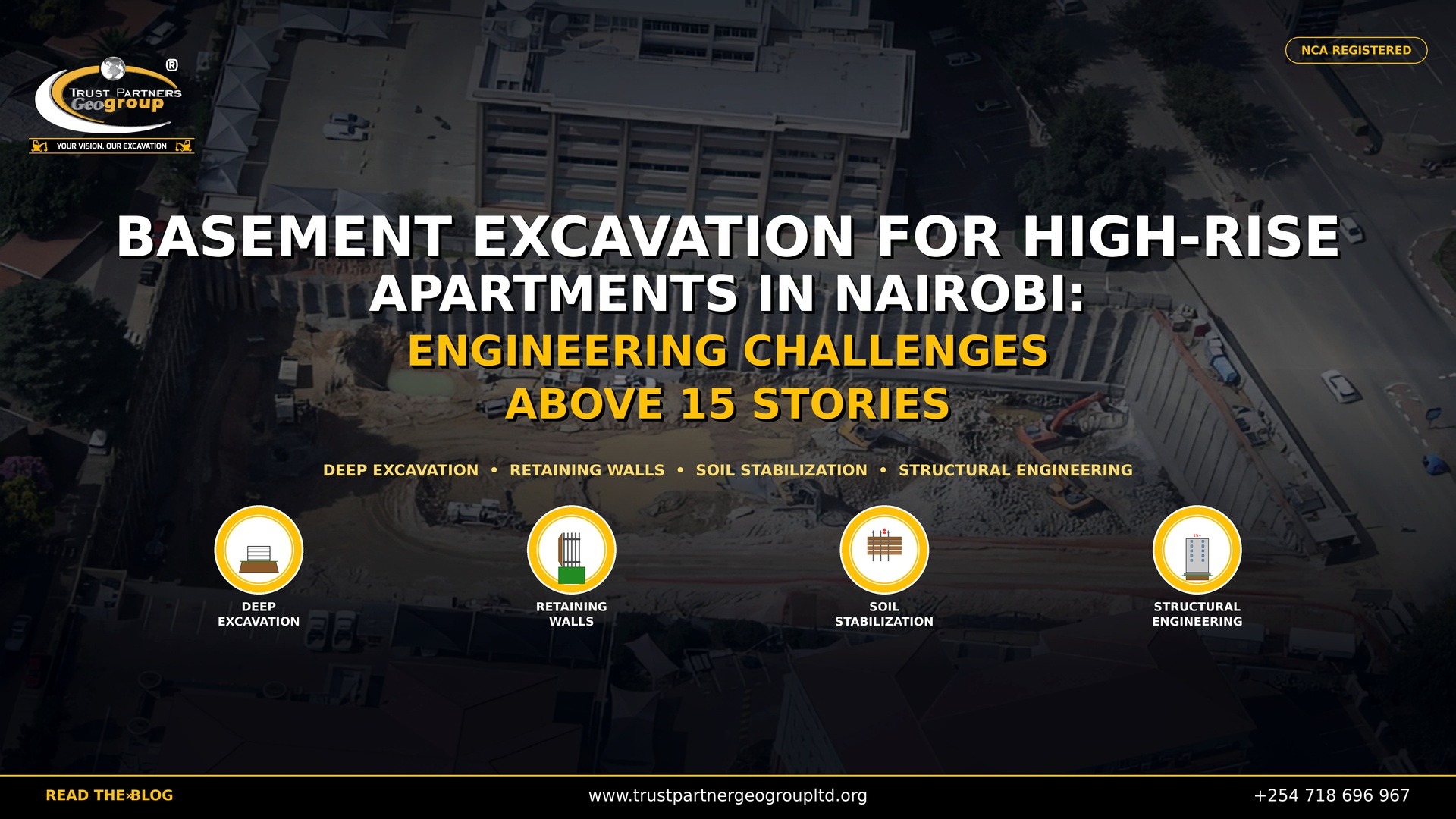
Basement Excavation for High-Rise Apartments in Nairobi: Engineering Challenges Above 15 Stories [2026]
Deep basement excavation, structural shoring and dewatering for multi-storey apartment towers in Upper Hill, Kilimani, Parklands and Nairobi CBD
Table of Contents
- 1. Why High-Rise Basement Excavation is Nairobi's Most Complex Earthworks Discipline
- 2. Basement Depth Requirements for Towers Above 15, 20 and 30 Stories
- 3. Nairobi's Volcanic Soils: Red Coffee Soil, Tuff and Basalt at Depth
- 4. Structural Shoring: Contiguous Bored Piles, Diaphragm Walls and Secant Piles
- 5. Deep Dewatering for Basements Below 10 Metres
- 6. Bottom-Up vs Top-Down Construction Methods
- 7. Urban Constraints: Vibration, Noise and Zero-Lot-Line Proximity
- 8. Heavy Equipment for Hire: Long-Reach Excavators, Cranes and Piling Rigs
- 9. Construction Costs and Programme [2026]
- 10. NCA, NEMA and Nairobi County Compliance
- 11. Frequently Asked Questions
- 12. Conclusion
At 14 metres below Upper Hill's bustling surface, where four levels of basement parking will soon support a 28-storey apartment tower, a 1,200-millimetre contiguous bored pile wall stands as a silent concrete fortress. Each pile was drilled through 8 metres of red coffee soil, 4 metres of fractured volcanic tuff and 2 metres into solid basalt, then reinforced with 40-millimetre steel bars and tremie-poured with C35 concrete. This is not standard basement excavation. This is structural earthworks. And it is becoming the defining engineering challenge of Nairobi's vertical expansion. As Kenya's capital runs out of horizontal space, developers are building upward at a pace unseen in East Africa. Towers of 15, 25 and 35 storeys now rise in Upper Hill, Kilimani, Parklands and Westlands, each requiring basements of 10-20 metres depth to accommodate parking, mechanical plant, water storage and emergency systems. But Nairobi's geology does not cooperate easily. The same volcanic soils that give the city its dramatic red landscape become progressively harder, more fractured and more water-bearing with depth. The lateral earth pressure on a 15-metre basement wall is four times that on a 4-metre residential basement. The groundwater at 12 metres depth cannot be handled by wellpoints. And the vibration from breaking basalt 2 metres from an existing apartment block demands precision that separates professional contractors from informal diggers. Trust Partners Geo-Group Ltd provides heavy equipment for hire and engineered basement excavation solutions specifically for Nairobi's high-rise market. From contiguous bored pile walls to deep well dewatering, from long-reach excavators to crane muck-hoisting systems, we deliver the excavation in Kenya expertise that turns geotechnical risk into certified subgrade. Whether you are breaking ground on a 20-storey tower in Kilimani or a 30-storey mixed-use development in Upper Hill, this guide provides the technical depth, cost transparency and regulatory clarity your structural engineer and project financier demand.
Trust Partners Geo-Group Ltd - High-Rise Foundation & Deep Excavation Team
NCA-registered excavation contractor with 15+ years in mega basement excavation, high-rise shoring and deep dewatering across Nairobi's most demanding urban sites.
1. Why High-Rise Basement Excavation is Nairobi's Most Complex Earthworks Discipline
Standard residential basement excavation in Nairobi typically reaches 3-5 metres depth for single-level parking or storage. The shoring is often simple sheet piles or soldier piles. The dewatering, if required at all, is handled by basic sump pumps. And the spoil is trucked out via a simple access ramp. High-rise basement excavation shatters every one of these assumptions.
A basement supporting a 15-storey tower must handle structural loads that are an order of magnitude greater than a bungalow. The foundation system - whether mat raft, pile cap grid or box foundation - requires a subgrade of exceptional quality, free of loose material, water and organic content. The basement walls themselves are structural elements that resist not just soil pressure but hydrostatic pressure, surcharge from adjacent buildings and seismic forces. And the excavation must proceed in dense urban environments where the nearest building may be 1.5 metres from the site boundary, where utility tunnels crisscross the subgrade, and where county regulations prohibit noise, vibration and traffic disruption that standard methods inevitably create.
The consequence is that high-rise basement excavation in Nairobi is a distinct discipline requiring structural engineering integration, geotechnical real-time monitoring, and equipment capabilities that few contractors possess. Trust Partners Geo-Group Ltd has invested in 30-50 tonne long-reach excavators, rotary piling rigs, deep well dewatering systems and crane muck-hoisting capabilities specifically to serve this market. Our portfolio includes basements to 20+ metres depth in Upper Hill and Kilimani, giving us the empirical data and proven methodologies that high-rise developers require.
2. Basement Depth Requirements for Towers Above 15, 20 and 30 Stories
Basement depth is not arbitrary. It is dictated by structural engineering requirements, parking bay geometry, building services and Nairobi County regulations.
15-Storey Towers: Two-Level Basements (8-10 Metres)
A typical 15-storey residential tower in Kilimani or Parklands requires two basement levels: Basement 1 for parking (clear height 2.4 metres plus slab and services = 3.5 metres) and Basement 2 for additional parking and building services (another 3.5 metres). With foundation depth below slab, total excavation reaches 8-10 metres. At this depth, standard sheet pile shoring is inadequate. Contiguous bored pile walls or secant pile walls are required, with ground anchors or internal struts to resist lateral pressure.
20-25 Storey Towers: Three-Level Basements (12-16 Metres)
Towers exceeding 20 storeys require three basement levels to achieve sufficient parking capacity per unit (Nairobi County requires approximately 1.5 parking bays per two-bedroom unit in high-density zones). Three-level basements at 12-16 metres depth enter the zone where Nairobi's volcanic tuff and basalt are consistently encountered. Shoring must be contiguous bored piles minimum 800mm diameter, or diaphragm walls for zero-lot-line sites. Dewatering requires deep wells, not wellpoints. And muck removal typically requires crane hoisting since access ramps become impractical.
30+ Storey Towers: Four-Level Basements (16-20 Metres)
Nairobi's emerging supertall residential market - towers of 30-40 storeys in Upper Hill and the CBD - demands four-level basements at 16-20 metres depth. At these depths, top-down construction is often the only viable method in dense urban sites. The permanent basement slabs are constructed at each level and act as internal struts while excavation proceeds downward. Diaphragm walls are mandatory. Ground anchors are installed from each slab level. And dewatering must handle artesian pressures that can reach 2-3 bar in fractured basalt aquifers.
| Building Height | Basement Levels | Excavation Depth | Standard Shoring |
|---|---|---|---|
| 15 storeys | 2 levels | 8-10 metres | Contiguous bored piles / secant piles |
| 20-25 storeys | 3 levels | 12-16 metres | Contiguous bored piles (800mm+) |
| 30+ storeys | 4 levels | 16-20 metres | Diaphragm walls + top-down |
3. Nairobi's Volcanic Soils: Red Coffee Soil, Tuff and Basalt at Depth
Nairobi's geology is defined by Pleistocene volcanic activity that deposited successive layers of lava, tuff and ash. For high-rise basement excavation, these layers present a predictable but challenging sequence.
Upper Layer: Red Coffee Soil (0-4 Metres)
The upper stratum is the familiar red coffee soil (ferralitic latosol) - deeply weathered, high in iron oxides, and relatively easy to excavate. In the upper 2-3 metres, it is loose enough for standard bucket excavation. Below 3 metres, it becomes denser and more cohesive, requiring ripper-equipped bulldozers or heavy excavator buckets. For high-rise basements, this layer is stripped quickly but must be stockpiled for later use in landscaping - Nairobi County requires topsoil preservation on all major developments.
Transition Layer: Volcanic Tuff (4-8 Metres)
Below the red soil, Nairobi's ground transitions into volcanic tuff - a compacted ash deposit that varies from soft and friable to hard and cemented. Tuff is abrasive on equipment and requires hydraulic breakers when cemented. In some areas (notably Upper Hill and parts of Westlands), the tuff contains agglomerate lenses - coarse volcanic breccia with embedded rock fragments that destroy standard excavation teeth. On a recent 16-metre basement in Upper Hill, Trust Partners Geo-Group Ltd replaced breaker chisels every 48 hours in the agglomerate zone, compared to 200+ hours in soft rock.
Bedrock Layer: Basalt and Trachyte (8-15+ Metres)
The deepest layer encountered in high-rise basements is solid basalt or trachyte - igneous rocks with compressive strengths of 80-150 MPa. Breaking basalt requires heavy hydraulic breakers on 30+ tonne excavators, or controlled chemical cracking where vibration restrictions apply. In one Kilimani project, basalt was encountered at 9 metres and extended to 14 metres, requiring 6 weeks of breaker work that added KES 4.2 million to the excavation budget but provided a rock subgrade of 400+ kN/m2 bearing capacity - ideal for the tower's mat foundation.
4. Structural Shoring: Contiguous Bored Piles, Diaphragm Walls and Secant Piles
High-rise basement excavation cannot use timber shoring or standard sheet piles. The lateral earth pressure at 12-20 metres depth exceeds the capacity of light shoring by multiples. Structural shoring is not optional - it is a permanent design element.
Contiguous Bored Pile Walls
Contiguous bored piles are the most common shoring for Nairobi high-rise basements. Piles 600-1,200mm in diameter are drilled at centres of 1.0-1.2 times the pile diameter, creating a near-continuous concrete wall. Each pile is reinforced with a steel cage and concreted with C30/37 or higher grade concrete. For a 15-storey tower basement in Parklands, Trust Partners Geo-Group Ltd installed 800mm diameter contiguous piles to 18 metres depth (6 metres embedment below basement subgrade), providing a wall stiffness that limited lateral movement to 12mm - well within the structural engineer's 20mm tolerance.
Secant Pile Walls
Secant piles are similar to contiguous piles but overlap by 100-150mm, creating a truly continuous water-resistant wall. Female piles (unreinforced) are drilled first, followed by male piles (reinforced) that cut into the female piles. Secant walls are used where groundwater ingress must be minimised and where the basement wall will serve as the permanent external wall. Cost is 20-30% higher than contiguous piles but waterproofing savings often offset this.
Diaphragm Walls
For basements exceeding 15 metres depth or sites with extreme lateral loads, diaphragm walls are the gold standard. A trench is excavated under bentonite slurry to the full wall depth, a steel reinforcement panel is lowered, and concrete is placed by tremie pipe displacing the slurry. Diaphragm walls can be 600-1,500mm thick and 30+ metres deep. They serve as both temporary shoring and permanent basement walls. In Nairobi's CBD, where a 35-storey tower required a 20-metre basement within 2 metres of an operating hotel, Trust Partners Geo-Group Ltd constructed a 1,000mm thick diaphragm wall that became the permanent basement structure, eliminating the need for a secondary wall.
Ground Anchors and Struts
Shoring walls require lateral support as excavation proceeds. Ground anchors (prestressed steel tendons grouted into drilled holes) are installed from the excavation face into stable soil or rock behind the wall. In Nairobi's basalt, anchors achieve 30-50 tonne capacity each. Where adjacent buildings prevent anchor installation (zero-lot-line sites), internal steel struts or concrete buttresses support the wall. On a recent Kileleshwa project, a combination of ground anchors on the open sides and internal struts on the boundary side provided full support for a 14-metre deep excavation.
5. Deep Dewatering for Basements Below 10 Metres
Shallow dewatering methods fail in deep high-rise basements. Wellpoints lose suction beyond 6 metres. Sump pumps cannot handle the inflow volumes. Deep basements require engineered dewatering systems designed by hydrogeologists.
Deep Well Submersible Systems
Deep wells 150-200mm in diameter are drilled 3-5 metres below basement subgrade, lined with slotted PVC casing and gravel packs, and pumped by submersible electric or diesel pumps. In Nairobi's fractured volcanic rock, deep wells achieve 10-15 metres of drawdown and handle inflows of 500-2,000 litres per minute per well. A typical 12-metre basement requires 3-5 deep wells operating continuously. Cost: KES 120,000-180,000 per week for a three-well system with fuel and maintenance.
Eductor (Ejector) Systems
In dense sites where deep well drilling is obstructed by neighbouring foundations, eductor systems use high-pressure water injection to create vacuum and draw groundwater. They require no large-diameter wells and can be installed in limited space. Eductor systems are 25-35% more expensive than deep wells but essential for zero-lot-line basements in Upper Hill and Kilimani.
Artesian Pressure Management
The deepest basements in Nairobi (16-20 metres) sometimes encounter artesian groundwater under pressure in fractured basalt. Left uncontrolled, this water fountains into the excavation, destabilising the subgrade and preventing foundation work. Artesian control requires pressure relief wells or sub-slab drainage blankets that bleed pressure before the basement slab is poured. On a 18-metre basement project, Trust Partners Geo-Group Ltd installed pressure relief wells that reduced artesian head from 2.8 bar to 0.3 bar, allowing safe foundation construction.
6. Bottom-Up vs Top-Down Construction Methods
The method of construction fundamentally changes the excavation approach, programme and cost for deep basements.
Bottom-Up Construction
In bottom-up construction, the entire basement is excavated to subgrade, then foundations and basement walls are built upward from the bottom. This is the standard method for most Nairobi high-rise basements. It requires full shoring installation before excavation, ground anchors or struts at multiple levels, and a temporary access ramp or crane muck-hoisting system. Bottom-up is faster and cheaper than top-down for sites with sufficient space for ramps and where adjacent buildings do not constrain anchor installation.
Top-Down Construction
Top-down construction reverses the sequence. The ground floor slab is cast first on the natural ground surface (or after minimal stripping). Excavation then proceeds beneath this slab, which acts as a rigid horizontal strut. As each basement level is excavated, the permanent floor slab is cast, providing lateral support to the shoring walls. This method is essential for very deep basements (16-20 metres) in dense urban sites where external strutting is impossible and ground anchors cannot be installed due to adjacent buildings. The permanent slabs must be designed to handle construction loads during excavation, increasing structural steel requirements. Programme is typically 15-25% longer than bottom-up, but the method enables development on sites that would otherwise be unbuildable.
| Method | Best For | Depth Range | Relative Cost | Programme |
|---|---|---|---|---|
| Bottom-up | Sites with ramp access, anchor space | 8-16 metres | Standard | Faster |
| Top-down | Zero-lot-line, very deep, constrained | 16-25 metres | +15-25% | Slower |
7. Urban Constraints: Vibration, Noise and Zero-Lot-Line Proximity
Nairobi's high-rise boom is occurring in its most densely developed neighbourhoods. Upper Hill, Kilimani and Westlands have virtually no greenfield sites. Every new basement is excavated within metres of operating buildings, active roads and buried utilities.
Vibration Monitoring and Control
Rock breaking in basalt generates peak particle velocities (PPV) that can damage adjacent structures if uncontrolled. Nairobi County guidelines limit construction vibration to 5 mm/s for residential buildings and 10 mm/s for commercial structures. Trust Partners Geo-Group Ltd deploys seismographs on all adjacent buildings during breaker operations, with real-time alerts if PPV exceeds 3 mm/s. When approaching limits, we switch to chemical cracking agents or reduce breaker energy. On a recent Kilimani project, 14 days of breaker work was completed with zero exceedances by using low-energy breakers and intermittent operation.
Noise Restrictions and Working Hours
Nairobi County restricts noisy construction work (piling, breaking, trucking) to 08:00-17:00 in residential zones and 08:00-20:00 in commercial zones. High-rise basement projects must schedule the noisiest activities within these windows and use electric or sound-attenuated equipment where possible. Trust Partners Geo-Group Ltd provides sound-attenuated generators and muffled breakers for sites in mixed-use zones like Kileleshwa and Lavington.
Zero-Lot-Line Proximity
When the site boundary is 1-2 metres from an existing building, standard ground anchors cannot be installed because they would penetrate the neighbour's foundation zone. In these cases, internal struts, raking shores or top-down construction must be used. Muck removal is also constrained - crane hoisting or conveyor systems replace truck ramps. Every zero-lot-line project requires a method statement approved by the neighbouring building's structural engineer and Nairobi County.
8. Heavy Equipment for Hire: Long-Reach Excavators, Cranes and Piling Rigs
High-rise basement excavation demands equipment that standard hire fleets do not provide. Trust Partners Geo-Group Ltd maintains a dedicated high-rise basement equipment pool.
Long-Reach Excavators (30-50 Tonne)
Standard excavators cannot reach the bottom of a 15-metre basement from surface level. Long-reach excavators with booms extending 15-22 metres are required for bulk excavation and final trimming at depth. Our fleet includes 30-tonne and 50-tonne long-reach machines with GPS guidance for ±25mm subgrade accuracy. For basalt breaking, these machines are fitted with heavy-duty hydraulic breakers (4,000-6,000 Joule impact energy) capable of fracturing Nairobi's hardest volcanic rock.
Rotary Piling Rigs
Contiguous bored pile and secant pile walls require rotary piling rigs with torque capacities of 150-250 kNm. These machines drill 600-1,200mm diameter holes to 20+ metres depth, install reinforcement cages, and concret piles in a continuous operation. Trust Partners Geo-Group Ltd operates Soilmec and Bauer-class piling rigs with experienced crews who understand Nairobi's soil transitions.
Crawler Cranes and Muck Hoisting
When access ramps are impossible, all spoil must be hoisted from the excavation by crane. Crawler cranes with 50-100 tonne capacity lower muck skips into the basement and lift them to waiting trucks at surface level. A typical 12-metre basement generates 8,000-12,000 m3 of spoil. At 5 m3 per skip and 10 minutes per cycle, crane hoisting adds 3-4 weeks to the programme compared to ramp haulage but enables development on otherwise constrained sites.
Deep Well Dewatering Pumps
Our dewatering fleet includes submersible pumps rated at 5-15 kW with flow rates of 500-2,000 litres per minute. Diesel-powered vacuum-assisted systems ensure continuous operation during Nairobi's frequent power outages. All dewatering systems include automatic level controllers and telemetry alerts to our operations centre.
9. Construction Costs and Programme [2026]
High-rise basement excavation costs in Nairobi are substantially higher than residential basements due to structural shoring, deep dewatering and rock breaking requirements.
| Item | 2026 Rate (KES) | Notes |
|---|---|---|
| Base excavation (8-10m, red soil) | 1,000-2,500/m3 | Two-level basement, medium depth |
| Base excavation (12-16m) | 1,500-3,500/m3 | Three-level, deep commercial |
| Base excavation (16-20m, top-down) | 2,500-4,500/m3 | Four-level, structural slabs as struts |
| Rock breaking (tuff, hourly) | 7,000-8,000/hr | Breaker on 30-ton excavator |
| Hard rock basalt breaking | 1,500-4,500/m3 | Heavy breaking or chemical cracking |
| Contiguous bored pile wall | 8,000-14,000/m2 | 800-1200mm, C35 concrete, installed |
| Secant pile wall | 10,000-16,000/m2 | Water-resistant, overlapping |
| Diaphragm wall | 15,000-25,000/m2 | Bentonite trench, tremie concrete |
| Ground anchors | 15,000-25,000 each | Prestressed, 30-50 tonne capacity |
| Internal steel struts | 8,000-12,000/m | Install and remove |
| Deep well dewatering | 120,000-180,000/week | 3-well system, submersible pumps |
| Eductor dewatering | 160,000-220,000/week | Confined sites, zero-lot-line |
| Crane muck hoisting | 45,000-65,000/day | Crawler crane + skips + crew |
| Soil disposal (Nairobi County) | 900-1,300/m3 | Haulage to approved dumps |
Typical project estimates: A two-level basement (8-10m) for a 15-storey apartment in Kilimani (5,000 m3) with contiguous bored pile walls and deep well dewatering costs KES 10-16 million over 10-12 weeks. A three-level basement (14m) for a 22-storey tower in Upper Hill (10,000 m3) with secant piles, ground anchors and crane hoisting costs KES 22-32 million over 16-20 weeks. A four-level basement (18m) for a 30-storey tower in the CBD (18,000 m3) with diaphragm walls and top-down construction costs KES 45-65 million over 26-32 weeks. Trust Partners Geo-Group Ltd provides fixed-price contracts for high-rise basement excavation with programme guarantees.
10. NCA, NEMA and Nairobi County Compliance
High-rise basement excavation in Nairobi operates under the strictest regulatory framework in Kenyan construction. Non-compliance stops projects and exposes developers to criminal liability.
| Requirement | Authority | Threshold / Condition |
|---|---|---|
| Building plan approval | Nairobi City County | All high-rise structures; structural drawings + geotechnical report |
| NCA registration | National Construction Authority | Contractor NCA 4+ for structures >4 storeys; project registration mandatory |
| NEMA EIA | NEMA | Earthworks >1,000 m3 or within 30m of watercourse/riparian zone |
| Shoring design approval | Nairobi County Building Inspector | Excavation >3m; signed by registered structural engineer |
| Vibration permit | Nairobi County Environment | Rock breaking within 50m of sensitive structures |
| Traffic management plan | Nairobi County Transport | Haulage affecting major roads (Uhuru Highway, Mombasa Rd, etc.) |
For basements deeper than 8 metres, Nairobi County requires a method statement covering: excavation sequence, shoring installation stages, dewatering procedures, emergency response for shoring failure or flooding, and spoil disposal logistics. The county building inspector conducts stage inspections at 3-metre intervals during excavation. Trust Partners Geo-Group Ltd prepares all compliance documentation, coordinates inspections, and ensures that no excavation proceeds without full regulatory approval.
11. Frequently Asked Questions: High-Rise Basement Excavation in Nairobi
How deep is basement excavation for a 15-storey apartment building in Nairobi?
Basement excavation for a 15-storey apartment building in Nairobi typically reaches 8-12 metres depth for two basement levels (parking and services). For towers exceeding 20 storeys, three-level basements at 12-18 metres are common to accommodate parking bays, generator rooms, water storage tanks and electrical substations. The exact depth depends on structural load requirements, soil bearing capacity and Nairobi County setback regulations. In Upper Hill and Kilimani, where high-rises exceed 25 storeys, basements of 15-20 metres are increasingly required. Trust Partners Geo-Group Ltd provides mega basement excavation services from 4 metres to over 30 metres deep, using contiguous bored pile walls, ground anchors and deep well dewatering systems specifically engineered for Nairobi's volcanic soils.
What shoring system is best for high-rise basement excavation in Nairobi?
For high-rise basement excavation in Nairobi above 15 storeys, contiguous bored pile walls or diaphragm walls are the standard shoring systems. Contiguous bored piles (600-1,200mm diameter) drilled at close centres form a continuous concrete retaining wall capable of supporting 12-20 metre deep excavations with minimal lateral movement. Diaphragm walls (concrete walls cast in-situ within bentonite slurry trenches) provide the highest structural integrity for basements exceeding 15 metres and are often used as the permanent basement wall. In less dense areas like Parklands or Kileleshwa, secant pile walls or sheet pile combinations with ground anchors may suffice for 8-12 metre depths. Trust Partners Geo-Group Ltd designs and installs all high-rise shoring types, with structural engineer certification and NCA compliance for every Nairobi project.
How much does high-rise basement excavation cost in Nairobi in 2026?
High-rise basement excavation costs in Nairobi in 2026 range from KES 1,500-3,500 per cubic metre for deep commercial basements 8-15 metres depth. A typical two-level basement (8-10 metres) for a 15-storey apartment in Kilimani or Upper Hill costs KES 8-15 million for 4,000-6,000 m3 of excavation, including contiguous bored pile shoring and deep well dewatering. Three-level basements (12-18 metres) for 20+ storey towers range from KES 15-30 million. Costs include: bulk excavation in red coffee soil at KES 700-1,250/m3; rock breaking in volcanic tuff at KSH 7,000-8,000/hour; contiguous bored pile walls at KES 8,000-14,000/m2; deep well dewatering at KES 120,000-180,000/week; and ground anchors at KES 15,000-25,000 each. Trust Partners Geo-Group Ltd provides transparent fixed-price quotations for high-rise basement excavation with no hidden mobilisation fees.
What are the main engineering challenges for deep basement excavation in Nairobi?
Deep basement excavation for high-rise apartments in Nairobi faces six primary engineering challenges. First, lateral earth pressure increases exponentially with depth, requiring engineered shoring (bored piles or diaphragm walls) rather than standard timber or sheet pile solutions. Second, Nairobi's volcanic tuff and basalt layers, encountered below 6-8 metres, require hydraulic breakers or controlled blasting that generates vibration risks for adjacent buildings. Third, deep dewatering is essential as excavations below 8 metres often intercept perched water tables or fractured rock aquifers. Fourth, zero-lot-line construction in dense areas like Upper Hill and Kilimani demands vibration monitoring, noise control and 24-hour shoring surveillance. Fifth, muck removal from deep basements requires crane hoisting or conveyor systems since standard dump trucks cannot access the excavation floor. Sixth, Nairobi County requires NCA-registered contractors, structural engineer-certified shoring designs and NEMA approvals for earthworks exceeding 1,000 m3. Trust Partners Geo-Group Ltd manages all six challenges as part of our integrated high-rise basement excavation service.
Do I need NEMA approval for high-rise basement excavation in Nairobi?
Yes. NEMA requires an Environmental Impact Assessment (EIA) for basement excavation projects exceeding 1,000 cubic metres of earthworks or located within 30 metres of a watercourse, wetland or riparian zone. Most high-rise apartment basements in Nairobi exceed this threshold easily. Additionally, Nairobi City County requires building plan approval, NCA contractor registration (NCA 4 or above for structures above 4 storeys), and shoring design certification by a registered structural engineer before excavation below 3 metres. For basements deeper than 8 metres, the county building inspector may require a geotechnical investigation report and a method statement for dewatering and spoil disposal. Trust Partners Geo-Group Ltd coordinates all NEMA, NCA and Nairobi County approvals as part of our project management service, ensuring no regulatory delays.
What equipment is used for high-rise basement excavation in Nairobi?
High-rise basement excavation in Nairobi requires a specialised heavy equipment for hire fleet distinct from standard residential projects. Key machines include: 30-50 tonne long-reach excavators for bulk excavation and final trimming at 10-18 metre depths; hydraulic breaker-equipped excavators for fracturing volcanic tuff and basalt; crawler cranes or tower cranes for hoisting muck from deep excavations where ramp access is impossible; rotary piling rigs for contiguous bored pile and secant pile wall installation; high-capacity dewatering pumps (submersible and vacuum) for deep well systems; grout pumps for ground anchor and soil nail installation; and concrete batching/pumping equipment for diaphragm wall and pile cap construction. Trust Partners Geo-Group Ltd provides the complete high-rise basement equipment package, including NCA-certified operators with experience in Nairobi's dense urban environment.
How long does high-rise basement excavation take in Nairobi?
Programme duration for high-rise basement excavation in Nairobi depends on depth, soil conditions and urban constraints. Typical timelines are: two-level basement (8-10 metres, 4,000-6,000 m3) 8-12 weeks including shoring, dewatering and bulk excavation; three-level basement (12-15 metres, 8,000-12,000 m3) 14-20 weeks with contiguous bored pile walls and deep dewatering; and four-level basement (16-20 metres, 15,000+ m3) 20-30 weeks requiring diaphragm walls and top-down construction methods. Hard rock in Upper Hill or Kilimani can add 3-5 weeks. Nairobi County restricts noisy work (breaking, piling) to daytime hours (08:00-17:00) in residential zones, extending programmes for mixed-use sites. Trust Partners Geo-Group Ltd programmes high-rise basement excavation to align with your structural steel and superstructure schedule, ensuring the basement never becomes the critical path.
Where can I hire heavy equipment for high-rise basement excavation in Nairobi?
Trust Partners Geo-Group Ltd provides heavy equipment for hire for high-rise basement excavation across Nairobi including Upper Hill, Kilimani, Parklands, Kileleshwa, Lavington, South C, Karen, Westlands and the CBD. Our high-rise fleet includes: 30-50 tonne long-reach excavators for deep bulk excavation; hydraulic breaker attachments for volcanic rock; rotary piling rigs for contiguous bored pile and secant pile walls; crawler cranes for deep muck hoisting; deep well dewatering pump systems; grout pumps for ground anchors; and 10-tonne smooth drum rollers for basement backfill compaction. All equipment is operated by NCA-certified drivers with high-rise urban excavation experience. We provide 24/7 emergency support and maintenance teams stationed across Nairobi. Contact us at +254 718 68 69 67 or info@trustpartnergeogroupltd.org for high-rise basement excavation equipment hire in Nairobi.
12. Conclusion: Building Nairobi's Vertical Future from the Ground Down
Nairobi's skyline is being rewritten. The towers that will define the city in 2030 are being excavated today - in 14-metre basements beneath Upper Hill, in 16-metre cuttings below Kilimani, in 20-metre structural boxes that will anchor the next generation of Kenyan architecture. But these foundations are not dug. They are engineered.
High-rise basement excavation is the most technically demanding discipline in Kenyan construction. It requires structural shoring that would be excessive for any other building type. It requires dewatering systems that handle pressures unknown in shallow works. It requires equipment - long-reach excavators, piling rigs, crane hoisting systems - that standard hire fleets do not possess. And it requires regulatory compliance that informal contractors cannot navigate.
Trust Partners Geo-Group Ltd has built its reputation on the basements that others cannot execute. From 8-metre two-level parking structures in Parklands to 20-metre four-level mega basements in the CBD, we bring the engineering rigour, equipment capability and regulatory expertise that high-rise developers require. Our heavy equipment for hire fleet is maintained specifically for deep excavation work. Our operators are NCA-certified for high-rise sites. And our project managers understand that in excavation in Kenya's most competitive market, the basement is where the tower begins - or where it fails.
For developers, structural engineers and project managers planning Nairobi's next high-rise landmark, we provide the technical partnership that turns geotechnical challenge into certified subgrade. Contact Trust Partners Geo-Group Ltd today for a site-specific assessment, structural shoring design consultation, and transparent fixed-price quotation for your high-rise basement excavation.
High-Rise Basement Excavation in Nairobi
Deep basement excavation for apartments above 15 stories in Upper Hill, Kilimani, Parklands, Kileleshwa and Nairobi CBD with heavy equipment for hire and structural shoring expertise.
Free lead magnet: ask for our High-Rise Basement Excavation Cost Calculator (PDF) - depth assessment, shoring selection, dewatering sizing and budget estimation for Nairobi towers above 15 storeys.
Related Resources
Mega Basement Excavation: Managing Projects Over 30 Meters Deep in East Africa
Our flagship deep-excavation case study covering the most challenging basement projects in the region.
READ MOREBasement Excavation Depth Guide: From 4 Meters to 30 Meters in Kenya
The definitive nationwide guide to basement depths, soil constraints and engineering solutions for all building types.
READ MOREBasement Excavation Cost in Nairobi 2026: Complete Price Guide Per M3
Transparent pricing benchmarks for all basement excavation depths and soil types across Nairobi.
READ MOREBasement Excavation in Parklands, Kilimani & Upper Hill: What Developers Need to Know
Hyper-local guide to urban basement challenges in Nairobi's densest high-rise development zones.
READ MOREMat Foundation Excavation for High-Rise Buildings in Nairobi: Load Distribution & Depth
Technical guide to raft and mat foundation excavation specifically for Nairobi's high-rise towers.
READ MOREPile Foundation Excavation in Kenya: Bored Piles vs. Driven Piles [2026 Guide]
Deep-dive into pile foundation methods that support Nairobi's tallest structures.
READ MORETRUST PARTNERS GEO-GROUP LTD | YOUR VISION, OUR EXCAVATION
WEBSITE: WWW.TRUSTPARTNERGEOGROUPLTD.ORG | EMAIL: INFO@TRUSTPARTNERGEOGROUPLTD.ORG | PHONE: +254 718 68 69 67
FOLLOW US: FACEBOOK | TIKTOK | INSTAGRAM | LINKEDIN
© 2026 TRUST PARTNERS GEO-GROUP LTD. ALL RIGHTS RESERVED.
Basement Excavation for High-Rise Apartments in Nairobi: Engineering Challenges Above 15 Stories [2026]
Deep basement excavation, structural shoring and dewatering for multi-storey apartment towers in Upper Hill, Kilimani, Parklands and Nairobi CBD
Table of Contents
- 1. Why High-Rise Basement Excavation is Nairobi's Most Complex Earthworks Discipline
- 2. Basement Depth Requirements for Towers Above 15, 20 and 30 Stories
- 3. Nairobi's Volcanic Soils: Red Coffee Soil, Tuff and Basalt at Depth
- 4. Structural Shoring: Contiguous Bored Piles, Diaphragm Walls and Secant Piles
- 5. Deep Dewatering for Basements Below 10 Metres
- 6. Bottom-Up vs Top-Down Construction Methods
- 7. Urban Constraints: Vibration, Noise and Zero-Lot-Line Proximity
- 8. Heavy Equipment for Hire: Long-Reach Excavators, Cranes and Piling Rigs
- 9. Construction Costs and Programme [2026]
- 10. NCA, NEMA and Nairobi County Compliance
- 11. Frequently Asked Questions
- 12. Conclusion
At 14 metres below Upper Hill's bustling surface, where four levels of basement parking will soon support a 28-storey apartment tower, a 1,200-millimetre contiguous bored pile wall stands as a silent concrete fortress. Each pile was drilled through 8 metres of red coffee soil, 4 metres of fractured volcanic tuff and 2 metres into solid basalt, then reinforced with 40-millimetre steel bars and tremie-poured with C35 concrete. This is not standard basement excavation. This is structural earthworks. And it is becoming the defining engineering challenge of Nairobi's vertical expansion. As Kenya's capital runs out of horizontal space, developers are building upward at a pace unseen in East Africa. Towers of 15, 25 and 35 storeys now rise in Upper Hill, Kilimani, Parklands and Westlands, each requiring basements of 10-20 metres depth to accommodate parking, mechanical plant, water storage and emergency systems. But Nairobi's geology does not cooperate easily. The same volcanic soils that give the city its dramatic red landscape become progressively harder, more fractured and more water-bearing with depth. The lateral earth pressure on a 15-metre basement wall is four times that on a 4-metre residential basement. The groundwater at 12 metres depth cannot be handled by wellpoints. And the vibration from breaking basalt 2 metres from an existing apartment block demands precision that separates professional contractors from informal diggers. Trust Partners Geo-Group Ltd provides heavy equipment for hire and engineered basement excavation solutions specifically for Nairobi's high-rise market. From contiguous bored pile walls to deep well dewatering, from long-reach excavators to crane muck-hoisting systems, we deliver the excavation in Kenya expertise that turns geotechnical risk into certified subgrade. Whether you are breaking ground on a 20-storey tower in Kilimani or a 30-storey mixed-use development in Upper Hill, this guide provides the technical depth, cost transparency and regulatory clarity your structural engineer and project financier demand.
Trust Partners Geo-Group Ltd - High-Rise Foundation & Deep Excavation Team
NCA-registered excavation contractor with 15+ years in mega basement excavation, high-rise shoring and deep dewatering across Nairobi's most demanding urban sites.
1. Why High-Rise Basement Excavation is Nairobi's Most Complex Earthworks Discipline
Standard residential basement excavation in Nairobi typically reaches 3-5 metres depth for single-level parking or storage. The shoring is often simple sheet piles or soldier piles. The dewatering, if required at all, is handled by basic sump pumps. And the spoil is trucked out via a simple access ramp. High-rise basement excavation shatters every one of these assumptions.
A basement supporting a 15-storey tower must handle structural loads that are an order of magnitude greater than a bungalow. The foundation system - whether mat raft, pile cap grid or box foundation - requires a subgrade of exceptional quality, free of loose material, water and organic content. The basement walls themselves are structural elements that resist not just soil pressure but hydrostatic pressure, surcharge from adjacent buildings and seismic forces. And the excavation must proceed in dense urban environments where the nearest building may be 1.5 metres from the site boundary, where utility tunnels crisscross the subgrade, and where county regulations prohibit noise, vibration and traffic disruption that standard methods inevitably create.
The consequence is that high-rise basement excavation in Nairobi is a distinct discipline requiring structural engineering integration, geotechnical real-time monitoring, and equipment capabilities that few contractors possess. Trust Partners Geo-Group Ltd has invested in 30-50 tonne long-reach excavators, rotary piling rigs, deep well dewatering systems and crane muck-hoisting capabilities specifically to serve this market. Our portfolio includes basements to 20+ metres depth in Upper Hill and Kilimani, giving us the empirical data and proven methodologies that high-rise developers require.
2. Basement Depth Requirements for Towers Above 15, 20 and 30 Stories
Basement depth is not arbitrary. It is dictated by structural engineering requirements, parking bay geometry, building services and Nairobi County regulations.
15-Storey Towers: Two-Level Basements (8-10 Metres)
A typical 15-storey residential tower in Kilimani or Parklands requires two basement levels: Basement 1 for parking (clear height 2.4 metres plus slab and services = 3.5 metres) and Basement 2 for additional parking and building services (another 3.5 metres). With foundation depth below slab, total excavation reaches 8-10 metres. At this depth, standard sheet pile shoring is inadequate. Contiguous bored pile walls or secant pile walls are required, with ground anchors or internal struts to resist lateral pressure.
20-25 Storey Towers: Three-Level Basements (12-16 Metres)
Towers exceeding 20 storeys require three basement levels to achieve sufficient parking capacity per unit (Nairobi County requires approximately 1.5 parking bays per two-bedroom unit in high-density zones). Three-level basements at 12-16 metres depth enter the zone where Nairobi's volcanic tuff and basalt are consistently encountered. Shoring must be contiguous bored piles minimum 800mm diameter, or diaphragm walls for zero-lot-line sites. Dewatering requires deep wells, not wellpoints. And muck removal typically requires crane hoisting since access ramps become impractical.
30+ Storey Towers: Four-Level Basements (16-20 Metres)
Nairobi's emerging supertall residential market - towers of 30-40 storeys in Upper Hill and the CBD - demands four-level basements at 16-20 metres depth. At these depths, top-down construction is often the only viable method in dense urban sites. The permanent basement slabs are constructed at each level and act as internal struts while excavation proceeds downward. Diaphragm walls are mandatory. Ground anchors are installed from each slab level. And dewatering must handle artesian pressures that can reach 2-3 bar in fractured basalt aquifers.
| Building Height | Basement Levels | Excavation Depth | Standard Shoring |
|---|---|---|---|
| 15 storeys | 2 levels | 8-10 metres | Contiguous bored piles / secant piles |
| 20-25 storeys | 3 levels | 12-16 metres | Contiguous bored piles (800mm+) |
| 30+ storeys | 4 levels | 16-20 metres | Diaphragm walls + top-down |
3. Nairobi's Volcanic Soils: Red Coffee Soil, Tuff and Basalt at Depth
Nairobi's geology is defined by Pleistocene volcanic activity that deposited successive layers of lava, tuff and ash. For high-rise basement excavation, these layers present a predictable but challenging sequence.
Upper Layer: Red Coffee Soil (0-4 Metres)
The upper stratum is the familiar red coffee soil (ferralitic latosol) - deeply weathered, high in iron oxides, and relatively easy to excavate. In the upper 2-3 metres, it is loose enough for standard bucket excavation. Below 3 metres, it becomes denser and more cohesive, requiring ripper-equipped bulldozers or heavy excavator buckets. For high-rise basements, this layer is stripped quickly but must be stockpiled for later use in landscaping - Nairobi County requires topsoil preservation on all major developments.
Transition Layer: Volcanic Tuff (4-8 Metres)
Below the red soil, Nairobi's ground transitions into volcanic tuff - a compacted ash deposit that varies from soft and friable to hard and cemented. Tuff is abrasive on equipment and requires hydraulic breakers when cemented. In some areas (notably Upper Hill and parts of Westlands), the tuff contains agglomerate lenses - coarse volcanic breccia with embedded rock fragments that destroy standard excavation teeth. On a recent 16-metre basement in Upper Hill, Trust Partners Geo-Group Ltd replaced breaker chisels every 48 hours in the agglomerate zone, compared to 200+ hours in soft rock.
Bedrock Layer: Basalt and Trachyte (8-15+ Metres)
The deepest layer encountered in high-rise basements is solid basalt or trachyte - igneous rocks with compressive strengths of 80-150 MPa. Breaking basalt requires heavy hydraulic breakers on 30+ tonne excavators, or controlled chemical cracking where vibration restrictions apply. In one Kilimani project, basalt was encountered at 9 metres and extended to 14 metres, requiring 6 weeks of breaker work that added KES 4.2 million to the excavation budget but provided a rock subgrade of 400+ kN/m2 bearing capacity - ideal for the tower's mat foundation.
4. Structural Shoring: Contiguous Bored Piles, Diaphragm Walls and Secant Piles
High-rise basement excavation cannot use timber shoring or standard sheet piles. The lateral earth pressure at 12-20 metres depth exceeds the capacity of light shoring by multiples. Structural shoring is not optional - it is a permanent design element.
Contiguous Bored Pile Walls
Contiguous bored piles are the most common shoring for Nairobi high-rise basements. Piles 600-1,200mm in diameter are drilled at centres of 1.0-1.2 times the pile diameter, creating a near-continuous concrete wall. Each pile is reinforced with a steel cage and concreted with C30/37 or higher grade concrete. For a 15-storey tower basement in Parklands, Trust Partners Geo-Group Ltd installed 800mm diameter contiguous piles to 18 metres depth (6 metres embedment below basement subgrade), providing a wall stiffness that limited lateral movement to 12mm - well within the structural engineer's 20mm tolerance.
Secant Pile Walls
Secant piles are similar to contiguous piles but overlap by 100-150mm, creating a truly continuous water-resistant wall. Female piles (unreinforced) are drilled first, followed by male piles (reinforced) that cut into the female piles. Secant walls are used where groundwater ingress must be minimised and where the basement wall will serve as the permanent external wall. Cost is 20-30% higher than contiguous piles but waterproofing savings often offset this.
Diaphragm Walls
For basements exceeding 15 metres depth or sites with extreme lateral loads, diaphragm walls are the gold standard. A trench is excavated under bentonite slurry to the full wall depth, a steel reinforcement panel is lowered, and concrete is placed by tremie pipe displacing the slurry. Diaphragm walls can be 600-1,500mm thick and 30+ metres deep. They serve as both temporary shoring and permanent basement walls. In Nairobi's CBD, where a 35-storey tower required a 20-metre basement within 2 metres of an operating hotel, Trust Partners Geo-Group Ltd constructed a 1,000mm thick diaphragm wall that became the permanent basement structure, eliminating the need for a secondary wall.
Ground Anchors and Struts
Shoring walls require lateral support as excavation proceeds. Ground anchors (prestressed steel tendons grouted into drilled holes) are installed from the excavation face into stable soil or rock behind the wall. In Nairobi's basalt, anchors achieve 30-50 tonne capacity each. Where adjacent buildings prevent anchor installation (zero-lot-line sites), internal steel struts or concrete buttresses support the wall. On a recent Kileleshwa project, a combination of ground anchors on the open sides and internal struts on the boundary side provided full support for a 14-metre deep excavation.
5. Deep Dewatering for Basements Below 10 Metres
Shallow dewatering methods fail in deep high-rise basements. Wellpoints lose suction beyond 6 metres. Sump pumps cannot handle the inflow volumes. Deep basements require engineered dewatering systems designed by hydrogeologists.
Deep Well Submersible Systems
Deep wells 150-200mm in diameter are drilled 3-5 metres below basement subgrade, lined with slotted PVC casing and gravel packs, and pumped by submersible electric or diesel pumps. In Nairobi's fractured volcanic rock, deep wells achieve 10-15 metres of drawdown and handle inflows of 500-2,000 litres per minute per well. A typical 12-metre basement requires 3-5 deep wells operating continuously. Cost: KES 120,000-180,000 per week for a three-well system with fuel and maintenance.
Eductor (Ejector) Systems
In dense sites where deep well drilling is obstructed by neighbouring foundations, eductor systems use high-pressure water injection to create vacuum and draw groundwater. They require no large-diameter wells and can be installed in limited space. Eductor systems are 25-35% more expensive than deep wells but essential for zero-lot-line basements in Upper Hill and Kilimani.
Artesian Pressure Management
The deepest basements in Nairobi (16-20 metres) sometimes encounter artesian groundwater under pressure in fractured basalt. Left uncontrolled, this water fountains into the excavation, destabilising the subgrade and preventing foundation work. Artesian control requires pressure relief wells or sub-slab drainage blankets that bleed pressure before the basement slab is poured. On a 18-metre basement project, Trust Partners Geo-Group Ltd installed pressure relief wells that reduced artesian head from 2.8 bar to 0.3 bar, allowing safe foundation construction.
6. Bottom-Up vs Top-Down Construction Methods
The method of construction fundamentally changes the excavation approach, programme and cost for deep basements.
Bottom-Up Construction
In bottom-up construction, the entire basement is excavated to subgrade, then foundations and basement walls are built upward from the bottom. This is the standard method for most Nairobi high-rise basements. It requires full shoring installation before excavation, ground anchors or struts at multiple levels, and a temporary access ramp or crane muck-hoisting system. Bottom-up is faster and cheaper than top-down for sites with sufficient space for ramps and where adjacent buildings do not constrain anchor installation.
Top-Down Construction
Top-down construction reverses the sequence. The ground floor slab is cast first on the natural ground surface (or after minimal stripping). Excavation then proceeds beneath this slab, which acts as a rigid horizontal strut. As each basement level is excavated, the permanent floor slab is cast, providing lateral support to the shoring walls. This method is essential for very deep basements (16-20 metres) in dense urban sites where external strutting is impossible and ground anchors cannot be installed due to adjacent buildings. The permanent slabs must be designed to handle construction loads during excavation, increasing structural steel requirements. Programme is typically 15-25% longer than bottom-up, but the method enables development on sites that would otherwise be unbuildable.
| Method | Best For | Depth Range | Relative Cost | Programme |
|---|---|---|---|---|
| Bottom-up | Sites with ramp access, anchor space | 8-16 metres | Standard | Faster |
| Top-down | Zero-lot-line, very deep, constrained | 16-25 metres | +15-25% | Slower |
7. Urban Constraints: Vibration, Noise and Zero-Lot-Line Proximity
Nairobi's high-rise boom is occurring in its most densely developed neighbourhoods. Upper Hill, Kilimani and Westlands have virtually no greenfield sites. Every new basement is excavated within metres of operating buildings, active roads and buried utilities.
Vibration Monitoring and Control
Rock breaking in basalt generates peak particle velocities (PPV) that can damage adjacent structures if uncontrolled. Nairobi County guidelines limit construction vibration to 5 mm/s for residential buildings and 10 mm/s for commercial structures. Trust Partners Geo-Group Ltd deploys seismographs on all adjacent buildings during breaker operations, with real-time alerts if PPV exceeds 3 mm/s. When approaching limits, we switch to chemical cracking agents or reduce breaker energy. On a recent Kilimani project, 14 days of breaker work was completed with zero exceedances by using low-energy breakers and intermittent operation.
Noise Restrictions and Working Hours
Nairobi County restricts noisy construction work (piling, breaking, trucking) to 08:00-17:00 in residential zones and 08:00-20:00 in commercial zones. High-rise basement projects must schedule the noisiest activities within these windows and use electric or sound-attenuated equipment where possible. Trust Partners Geo-Group Ltd provides sound-attenuated generators and muffled breakers for sites in mixed-use zones like Kileleshwa and Lavington.
Zero-Lot-Line Proximity
When the site boundary is 1-2 metres from an existing building, standard ground anchors cannot be installed because they would penetrate the neighbour's foundation zone. In these cases, internal struts, raking shores or top-down construction must be used. Muck removal is also constrained - crane hoisting or conveyor systems replace truck ramps. Every zero-lot-line project requires a method statement approved by the neighbouring building's structural engineer and Nairobi County.
8. Heavy Equipment for Hire: Long-Reach Excavators, Cranes and Piling Rigs
High-rise basement excavation demands equipment that standard hire fleets do not provide. Trust Partners Geo-Group Ltd maintains a dedicated high-rise basement equipment pool.
Long-Reach Excavators (30-50 Tonne)
Standard excavators cannot reach the bottom of a 15-metre basement from surface level. Long-reach excavators with booms extending 15-22 metres are required for bulk excavation and final trimming at depth. Our fleet includes 30-tonne and 50-tonne long-reach machines with GPS guidance for ±25mm subgrade accuracy. For basalt breaking, these machines are fitted with heavy-duty hydraulic breakers (4,000-6,000 Joule impact energy) capable of fracturing Nairobi's hardest volcanic rock.
Rotary Piling Rigs
Contiguous bored pile and secant pile walls require rotary piling rigs with torque capacities of 150-250 kNm. These machines drill 600-1,200mm diameter holes to 20+ metres depth, install reinforcement cages, and concret piles in a continuous operation. Trust Partners Geo-Group Ltd operates Soilmec and Bauer-class piling rigs with experienced crews who understand Nairobi's soil transitions.
Crawler Cranes and Muck Hoisting
When access ramps are impossible, all spoil must be hoisted from the excavation by crane. Crawler cranes with 50-100 tonne capacity lower muck skips into the basement and lift them to waiting trucks at surface level. A typical 12-metre basement generates 8,000-12,000 m3 of spoil. At 5 m3 per skip and 10 minutes per cycle, crane hoisting adds 3-4 weeks to the programme compared to ramp haulage but enables development on otherwise constrained sites.
Deep Well Dewatering Pumps
Our dewatering fleet includes submersible pumps rated at 5-15 kW with flow rates of 500-2,000 litres per minute. Diesel-powered vacuum-assisted systems ensure continuous operation during Nairobi's frequent power outages. All dewatering systems include automatic level controllers and telemetry alerts to our operations centre.
9. Construction Costs and Programme [2026]
High-rise basement excavation costs in Nairobi are substantially higher than residential basements due to structural shoring, deep dewatering and rock breaking requirements.
| Item | 2026 Rate (KES) | Notes |
|---|---|---|
| Base excavation (8-10m, red soil) | 1,000-2,500/m3 | Two-level basement, medium depth |
| Base excavation (12-16m) | 1,500-3,500/m3 | Three-level, deep commercial |
| Base excavation (16-20m, top-down) | 2,500-4,500/m3 | Four-level, structural slabs as struts |
| Rock breaking (tuff, hourly) | 7,000-8,000/hr | Breaker on 30-ton excavator |
| Hard rock basalt breaking | 1,500-4,500/m3 | Heavy breaking or chemical cracking |
| Contiguous bored pile wall | 8,000-14,000/m2 | 800-1200mm, C35 concrete, installed |
| Secant pile wall | 10,000-16,000/m2 | Water-resistant, overlapping |
| Diaphragm wall | 15,000-25,000/m2 | Bentonite trench, tremie concrete |
| Ground anchors | 15,000-25,000 each | Prestressed, 30-50 tonne capacity |
| Internal steel struts | 8,000-12,000/m | Install and remove |
| Deep well dewatering | 120,000-180,000/week | 3-well system, submersible pumps |
| Eductor dewatering | 160,000-220,000/week | Confined sites, zero-lot-line |
| Crane muck hoisting | 45,000-65,000/day | Crawler crane + skips + crew |
| Soil disposal (Nairobi County) | 900-1,300/m3 | Haulage to approved dumps |
Typical project estimates: A two-level basement (8-10m) for a 15-storey apartment in Kilimani (5,000 m3) with contiguous bored pile walls and deep well dewatering costs KES 10-16 million over 10-12 weeks. A three-level basement (14m) for a 22-storey tower in Upper Hill (10,000 m3) with secant piles, ground anchors and crane hoisting costs KES 22-32 million over 16-20 weeks. A four-level basement (18m) for a 30-storey tower in the CBD (18,000 m3) with diaphragm walls and top-down construction costs KES 45-65 million over 26-32 weeks. Trust Partners Geo-Group Ltd provides fixed-price contracts for high-rise basement excavation with programme guarantees.
10. NCA, NEMA and Nairobi County Compliance
High-rise basement excavation in Nairobi operates under the strictest regulatory framework in Kenyan construction. Non-compliance stops projects and exposes developers to criminal liability.
| Requirement | Authority | Threshold / Condition |
|---|---|---|
| Building plan approval | Nairobi City County | All high-rise structures; structural drawings + geotechnical report |
| NCA registration | National Construction Authority | Contractor NCA 4+ for structures >4 storeys; project registration mandatory |
| NEMA EIA | NEMA | Earthworks >1,000 m3 or within 30m of watercourse/riparian zone |
| Shoring design approval | Nairobi County Building Inspector | Excavation >3m; signed by registered structural engineer |
| Vibration permit | Nairobi County Environment | Rock breaking within 50m of sensitive structures |
| Traffic management plan | Nairobi County Transport | Haulage affecting major roads (Uhuru Highway, Mombasa Rd, etc.) |
For basements deeper than 8 metres, Nairobi County requires a method statement covering: excavation sequence, shoring installation stages, dewatering procedures, emergency response for shoring failure or flooding, and spoil disposal logistics. The county building inspector conducts stage inspections at 3-metre intervals during excavation. Trust Partners Geo-Group Ltd prepares all compliance documentation, coordinates inspections, and ensures that no excavation proceeds without full regulatory approval.
11. Frequently Asked Questions: High-Rise Basement Excavation in Nairobi
How deep is basement excavation for a 15-storey apartment building in Nairobi?
Basement excavation for a 15-storey apartment building in Nairobi typically reaches 8-12 metres depth for two basement levels (parking and services). For towers exceeding 20 storeys, three-level basements at 12-18 metres are common to accommodate parking bays, generator rooms, water storage tanks and electrical substations. The exact depth depends on structural load requirements, soil bearing capacity and Nairobi County setback regulations. In Upper Hill and Kilimani, where high-rises exceed 25 storeys, basements of 15-20 metres are increasingly required. Trust Partners Geo-Group Ltd provides mega basement excavation services from 4 metres to over 30 metres deep, using contiguous bored pile walls, ground anchors and deep well dewatering systems specifically engineered for Nairobi's volcanic soils.
What shoring system is best for high-rise basement excavation in Nairobi?
For high-rise basement excavation in Nairobi above 15 storeys, contiguous bored pile walls or diaphragm walls are the standard shoring systems. Contiguous bored piles (600-1,200mm diameter) drilled at close centres form a continuous concrete retaining wall capable of supporting 12-20 metre deep excavations with minimal lateral movement. Diaphragm walls (concrete walls cast in-situ within bentonite slurry trenches) provide the highest structural integrity for basements exceeding 15 metres and are often used as the permanent basement wall. In less dense areas like Parklands or Kileleshwa, secant pile walls or sheet pile combinations with ground anchors may suffice for 8-12 metre depths. Trust Partners Geo-Group Ltd designs and installs all high-rise shoring types, with structural engineer certification and NCA compliance for every Nairobi project.
How much does high-rise basement excavation cost in Nairobi in 2026?
High-rise basement excavation costs in Nairobi in 2026 range from KES 1,500-3,500 per cubic metre for deep commercial basements 8-15 metres depth. A typical two-level basement (8-10 metres) for a 15-storey apartment in Kilimani or Upper Hill costs KES 8-15 million for 4,000-6,000 m3 of excavation, including contiguous bored pile shoring and deep well dewatering. Three-level basements (12-18 metres) for 20+ storey towers range from KES 15-30 million. Costs include: bulk excavation in red coffee soil at KES 700-1,250/m3; rock breaking in volcanic tuff at KSH 7,000-8,000/hour; contiguous bored pile walls at KES 8,000-14,000/m2; deep well dewatering at KES 120,000-180,000/week; and ground anchors at KES 15,000-25,000 each. Trust Partners Geo-Group Ltd provides transparent fixed-price quotations for high-rise basement excavation with no hidden mobilisation fees.
What are the main engineering challenges for deep basement excavation in Nairobi?
Deep basement excavation for high-rise apartments in Nairobi faces six primary engineering challenges. First, lateral earth pressure increases exponentially with depth, requiring engineered shoring (bored piles or diaphragm walls) rather than standard timber or sheet pile solutions. Second, Nairobi's volcanic tuff and basalt layers, encountered below 6-8 metres, require hydraulic breakers or controlled blasting that generates vibration risks for adjacent buildings. Third, deep dewatering is essential as excavations below 8 metres often intercept perched water tables or fractured rock aquifers. Fourth, zero-lot-line construction in dense areas like Upper Hill and Kilimani demands vibration monitoring, noise control and 24-hour shoring surveillance. Fifth, muck removal from deep basements requires crane hoisting or conveyor systems since standard dump trucks cannot access the excavation floor. Sixth, Nairobi County requires NCA-registered contractors, structural engineer-certified shoring designs and NEMA approvals for earthworks exceeding 1,000 m3. Trust Partners Geo-Group Ltd manages all six challenges as part of our integrated high-rise basement excavation service.
Do I need NEMA approval for high-rise basement excavation in Nairobi?
Yes. NEMA requires an Environmental Impact Assessment (EIA) for basement excavation projects exceeding 1,000 cubic metres of earthworks or located within 30 metres of a watercourse, wetland or riparian zone. Most high-rise apartment basements in Nairobi exceed this threshold easily. Additionally, Nairobi City County requires building plan approval, NCA contractor registration (NCA 4 or above for structures above 4 storeys), and shoring design certification by a registered structural engineer before excavation below 3 metres. For basements deeper than 8 metres, the county building inspector may require a geotechnical investigation report and a method statement for dewatering and spoil disposal. Trust Partners Geo-Group Ltd coordinates all NEMA, NCA and Nairobi County approvals as part of our project management service, ensuring no regulatory delays.
What equipment is used for high-rise basement excavation in Nairobi?
High-rise basement excavation in Nairobi requires a specialised heavy equipment for hire fleet distinct from standard residential projects. Key machines include: 30-50 tonne long-reach excavators for bulk excavation and final trimming at 10-18 metre depths; hydraulic breaker-equipped excavators for fracturing volcanic tuff and basalt; crawler cranes or tower cranes for hoisting muck from deep excavations where ramp access is impossible; rotary piling rigs for contiguous bored pile and secant pile wall installation; high-capacity dewatering pumps (submersible and vacuum) for deep well systems; grout pumps for ground anchor and soil nail installation; and concrete batching/pumping equipment for diaphragm wall and pile cap construction. Trust Partners Geo-Group Ltd provides the complete high-rise basement equipment package, including NCA-certified operators with experience in Nairobi's dense urban environment.
How long does high-rise basement excavation take in Nairobi?
Programme duration for high-rise basement excavation in Nairobi depends on depth, soil conditions and urban constraints. Typical timelines are: two-level basement (8-10 metres, 4,000-6,000 m3) 8-12 weeks including shoring, dewatering and bulk excavation; three-level basement (12-15 metres, 8,000-12,000 m3) 14-20 weeks with contiguous bored pile walls and deep dewatering; and four-level basement (16-20 metres, 15,000+ m3) 20-30 weeks requiring diaphragm walls and top-down construction methods. Hard rock in Upper Hill or Kilimani can add 3-5 weeks. Nairobi County restricts noisy work (breaking, piling) to daytime hours (08:00-17:00) in residential zones, extending programmes for mixed-use sites. Trust Partners Geo-Group Ltd programmes high-rise basement excavation to align with your structural steel and superstructure schedule, ensuring the basement never becomes the critical path.
Where can I hire heavy equipment for high-rise basement excavation in Nairobi?
Trust Partners Geo-Group Ltd provides heavy equipment for hire for high-rise basement excavation across Nairobi including Upper Hill, Kilimani, Parklands, Kileleshwa, Lavington, South C, Karen, Westlands and the CBD. Our high-rise fleet includes: 30-50 tonne long-reach excavators for deep bulk excavation; hydraulic breaker attachments for volcanic rock; rotary piling rigs for contiguous bored pile and secant pile walls; crawler cranes for deep muck hoisting; deep well dewatering pump systems; grout pumps for ground anchors; and 10-tonne smooth drum rollers for basement backfill compaction. All equipment is operated by NCA-certified drivers with high-rise urban excavation experience. We provide 24/7 emergency support and maintenance teams stationed across Nairobi. Contact us at +254 718 68 69 67 or info@trustpartnergeogroupltd.org for high-rise basement excavation equipment hire in Nairobi.
12. Conclusion: Building Nairobi's Vertical Future from the Ground Down
Nairobi's skyline is being rewritten. The towers that will define the city in 2030 are being excavated today - in 14-metre basements beneath Upper Hill, in 16-metre cuttings below Kilimani, in 20-metre structural boxes that will anchor the next generation of Kenyan architecture. But these foundations are not dug. They are engineered.
High-rise basement excavation is the most technically demanding discipline in Kenyan construction. It requires structural shoring that would be excessive for any other building type. It requires dewatering systems that handle pressures unknown in shallow works. It requires equipment - long-reach excavators, piling rigs, crane hoisting systems - that standard hire fleets do not possess. And it requires regulatory compliance that informal contractors cannot navigate.
Trust Partners Geo-Group Ltd has built its reputation on the basements that others cannot execute. From 8-metre two-level parking structures in Parklands to 20-metre four-level mega basements in the CBD, we bring the engineering rigour, equipment capability and regulatory expertise that high-rise developers require. Our heavy equipment for hire fleet is maintained specifically for deep excavation work. Our operators are NCA-certified for high-rise sites. And our project managers understand that in excavation in Kenya's most competitive market, the basement is where the tower begins - or where it fails.
For developers, structural engineers and project managers planning Nairobi's next high-rise landmark, we provide the technical partnership that turns geotechnical challenge into certified subgrade. Contact Trust Partners Geo-Group Ltd today for a site-specific assessment, structural shoring design consultation, and transparent fixed-price quotation for your high-rise basement excavation.
High-Rise Basement Excavation in Nairobi
Deep basement excavation for apartments above 15 stories in Upper Hill, Kilimani, Parklands, Kileleshwa and Nairobi CBD with heavy equipment for hire and structural shoring expertise.
Free lead magnet: ask for our High-Rise Basement Excavation Cost Calculator (PDF) - depth assessment, shoring selection, dewatering sizing and budget estimation for Nairobi towers above 15 storeys.
Related Resources
Mega Basement Excavation: Managing Projects Over 30 Meters Deep in East Africa
Our flagship deep-excavation case study covering the most challenging basement projects in the region.
READ MOREBasement Excavation Depth Guide: From 4 Meters to 30 Meters in Kenya
The definitive nationwide guide to basement depths, soil constraints and engineering solutions for all building types.
READ MOREBasement Excavation Cost in Nairobi 2026: Complete Price Guide Per M3
Transparent pricing benchmarks for all basement excavation depths and soil types across Nairobi.
READ MOREBasement Excavation in Parklands, Kilimani & Upper Hill: What Developers Need to Know
Hyper-local guide to urban basement challenges in Nairobi's densest high-rise development zones.
READ MOREMat Foundation Excavation for High-Rise Buildings in Nairobi: Load Distribution & Depth
Technical guide to raft and mat foundation excavation specifically for Nairobi's high-rise towers.
READ MOREPile Foundation Excavation in Kenya: Bored Piles vs. Driven Piles [2026 Guide]
Deep-dive into pile foundation methods that support Nairobi's tallest structures.
READ MORETRUST PARTNERS GEO-GROUP LTD | YOUR VISION, OUR EXCAVATION
WEBSITE: WWW.TRUSTPARTNERGEOGROUPLTD.ORG | EMAIL: INFO@TRUSTPARTNERGEOGROUPLTD.ORG | PHONE: +254 718 68 69 67
FOLLOW US: FACEBOOK | TIKTOK | INSTAGRAM | LINKEDIN
© 2026 TRUST PARTNERS GEO-GROUP LTD. ALL RIGHTS RESERVED.