![𝐁𝐚𝐬𝐞𝐦𝐞𝐧𝐭 𝐄𝐱𝐜𝐚𝐯𝐚𝐭𝐢𝐨𝐧 𝐢𝐧 𝐏𝐚𝐫𝐤𝐥𝐚𝐧𝐝𝐬, 𝐊𝐢𝐥𝐢𝐦𝐚𝐧𝐢 & 𝐔𝐩𝐩𝐞𝐫 𝐇𝐢𝐥𝐥: 𝐖𝐡𝐚𝐭 𝐃𝐞𝐯𝐞𝐥𝐨𝐩𝐞𝐫𝐬 𝐍𝐞𝐞𝐝 𝐭𝐨 𝐊𝐧𝐨𝐰 [2026]](https://trustpartnergeogroupltd.org/web/image/blog.post/23/author_avatar/%F0%9D%90%81%F0%9D%90%9A%F0%9D%90%AC%F0%9D%90%9E%F0%9D%90%A6%F0%9D%90%9E%F0%9D%90%A7%F0%9D%90%AD%20%F0%9D%90%84%F0%9D%90%B1%F0%9D%90%9C%F0%9D%90%9A%F0%9D%90%AF%F0%9D%90%9A%F0%9D%90%AD%F0%9D%90%A2%F0%9D%90%A8%F0%9D%90%A7%20%F0%9D%90%A2%F0%9D%90%A7%20%F0%9D%90%8F%F0%9D%90%9A%F0%9D%90%AB%F0%9D%90%A4%F0%9D%90%A5%F0%9D%90%9A%F0%9D%90%A7%F0%9D%90%9D%F0%9D%90%AC%2C%20%F0%9D%90%8A%F0%9D%90%A2%F0%9D%90%A5%F0%9D%90%A2%F0%9D%90%A6%F0%9D%90%9A%F0%9D%90%A7%F0%9D%90%A2%20%26%20%F0%9D%90%94%F0%9D%90%A9%F0%9D%90%A9%F0%9D%90%9E%F0%9D%90%AB%20%F0%9D%90%87%F0%9D%90%A2%F0%9D%90%A5%F0%9D%90%A5:%20%F0%9D%90%96%F0%9D%90%A1%F0%9D%90%9A%F0%9D%90%AD%20%F0%9D%90%83%F0%9D%90%9E%F0%9D%90%AF%F0%9D%90%9E%F0%9D%90%A5%F0%9D%90%A8%F0%9D%90%A9%F0%9D%90%9E%F0%9D%90%AB%F0%9D%90%AC%20%F0%9D%90%8D%F0%9D%90%9E%F0%9D%90%9E%F0%9D%90%9D%20%F0%9D%90%AD%F0%9D%90%A8%20%F0%9D%90%8A%F0%9D%90%A7%F0%9D%90%A8%F0%9D%90%B0%20%5B2026%5D?unique=ed7b50c)
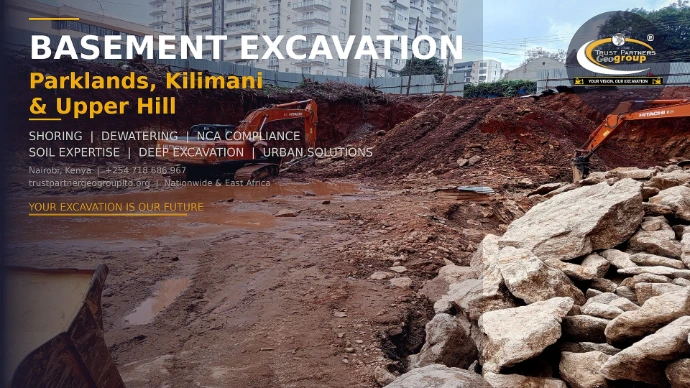
Basement Excavation in Parklands, Kilimani & Upper Hill
What developers, architects, and property owners need to know about deep basement excavation in Nairobi's most demanding urban neighborhoods -- from soil challenges to compliance and cost optimization.
Developing in Nairobi's premium neighborhoods -- Parklands, Kilimani, and Upper Hill -- demands more than standard excavation. These areas present a unique convergence of high-density urban constraints, complex soil profiles, and stringent regulatory requirements that can make or break your basement project. Whether you are planning a commercial high-rise in Upper Hill, a residential complex in Kilimani, or a mixed-use development in Parklands, understanding the local excavation landscape is critical to staying on schedule, on budget, and compliant.
Why These Areas Demand Specialized Expertise
Nairobi's urban core is evolving rapidly, and Parklands, Kilimani, and Upper Hill sit at the epicenter of this transformation. Each neighborhood presents distinct challenges that require tailored excavation strategies:
Upper Hill
Nairobi's commercial district with high-rise developments requiring deep basements for parking and services. Tight site boundaries and proximity to major infrastructure demand precision shoring and vibration control.
Commercial FocusKilimani
A blend of residential apartments and commercial spaces with varying soil conditions. Many projects involve retrofitting existing structures or excavating adjacent to occupied buildings, requiring careful dewatering and noise management.
Mixed-UseParklands
Established neighborhood with mature trees, underground utilities, and residential sensitivity. Excavation here often requires utility diversion, root protection zones, and community engagement to minimize disruption.
ResidentialSoil Conditions and Geotechnical Challenges
Understanding Nairobi's soil profile is fundamental to successful basement excavation. The Kenya National Building Code (2022) explicitly addresses soil conditions in foundation design, particularly the prevalence of black cotton soil (expansive clay) in parts of the city.
According to the National Building Code of Kenya (2022), where a floor is to be constructed on black cotton soil, the soil shall be entirely removed down to rock level or to such other level approved by a civil engineer. For depths not exceeding 1.8m, removal to at least 0.9m with proper overlay is required. All excavations exceeding 3 meters in depth must be designed by a registered civil engineer and approved by the relevant authority.
Key Soil Challenges in These Neighborhoods
- Expansive Clay (Black Cotton Soil): Found in pockets across Nairobi, this soil type swells when wet and shrinks when dry, exerting significant pressure on basement walls. Proper removal and replacement with engineered fill is essential.
- Red Volcanic Soils: Common in Upper Hill and parts of Kilimani, these soils offer better bearing capacity but can be prone to erosion during excavation if not properly managed.
- Groundwater Variability: Seasonal water table fluctuations can complicate dewatering efforts, particularly during the rainy season. Active dewatering systems are often necessary for deep excavations.
- Rock Intercepts: Unexpected rock formations can delay excavation timelines and require specialized breaking equipment, impacting project costs.
Shoring and Dewatering Solutions
Deep urban excavations in Nairobi's premium neighborhoods require robust temporary works. The proximity of adjacent buildings, roads, and utilities means that shoring systems must be engineered to prevent soil movement and protect surrounding infrastructure.
Shoring Systems We Deploy
- Soldier Pile and Lagging: Ideal for staged excavation in dry soils where access is limited. Steel H-piles are driven at intervals, with timber or concrete lagging inserted between them as excavation proceeds.
- Sheet Piling: Interlocking steel sheets driven into the ground to create a continuous wall. Excellent for waterlogged soils and deep excavations where groundwater control is critical.
- Soil Nailing with Shotcrete: Used where property lines are restrictive. Soil nails reinforce the excavation face while shotcrete provides surface protection.
- Hydraulic Shoring: Lightweight aluminum systems ideal for trenching and utility work where rapid deployment is needed.
Dewatering Strategies
Groundwater management is non-negotiable for basement excavations in these areas. Our approach includes:
- Wellpoint Dewatering: A series of small-diameter wells connected to a header pipe and vacuum pump, effective for shallow to medium-depth excavations.
- Deep Wells with Submersible Pumps: For excavations exceeding 10 meters where wellpoint systems are insufficient.
- Cut-off Walls: Sheet pile or secant pile walls that physically block groundwater from entering the excavation.
- Sump Pumping: Strategic placement of sumps at the excavation base to collect and remove seepage water.
Under the National Construction Authority (NCA) Act and Work Injury Benefits Act, contractors must submit safety plans as part of project registration. The Directorate of Occupational Safety and Health Services (DOSHS) requires site registration as workplaces, with mandatory risk assessments, PPE provision, and safety training for all personnel. Excavations exceeding 3m require engineered designs and formal approval.
Navigating Nairobi's Regulatory Landscape
Construction in Parklands, Kilimani, and Upper Hill operates under multiple regulatory layers. Compliance failures can result in work stoppages, penalties, or project delays.
Key Regulatory Requirements
- NCA Registration: All contractors must be registered with the National Construction Authority. The NCA evaluates plant and equipment ownership, safety systems, and technical capacity. No provision is made for hired plant and equipment in registration scoring.
- County Approval: Nairobi City County requires building permits and excavation approvals. For developments in Upper Hill (a high-income area with lower rates of illegal construction), the approval process is more stringent.
- NEMA Compliance: The National Environment Management Authority requires environmental impact assessments for larger projects, particularly those involving significant soil removal or tree cutting.
- Utility Coordination: Excavation within 1 meter of underground utilities requires coordination with the utility operator and approved work method statements.
- Neighbor Notifications: The National Building Code requires that owners notify the approving authority at least 7 days prior to excavation commencement.
Cost Factors for Basement Excavation in These Areas
Pricing for basement excavation in Nairobi's premium neighborhoods varies significantly based on several project-specific factors:
- Excavation Depth: Standard single-basement works (4-6m) are considerably less complex than mega-basement excavations exceeding 20-30m, which require specialized equipment and extended dewatering.
- Site Access: Constrained urban plots in Kilimani and Upper Hill often require creative logistics -- including crane lifts for equipment, night-time spoil removal, and traffic management plans.
- Proximity to Structures: Excavations adjacent to existing buildings require vibration monitoring, precision shoring, and potentially underpinning -- all adding to project costs.
- Soil Conditions: Unexpected rock, high groundwater, or contaminated soils can trigger change orders and timeline extensions.
- Shoring Duration: The longer shoring systems remain in place, the higher the rental and maintenance costs. Efficient sequencing is critical.
How to Choose the Right Excavation Contractor
Selecting a basement excavation contractor in Nairobi goes beyond comparing quotes. Given the technical complexity and regulatory burden, developers should evaluate:
- Local Experience: Has the contractor worked specifically in Parklands, Kilimani, or Upper Hill? Local knowledge of soil conditions, utility networks, and county processes is invaluable.
- Equipment Ownership: NCA registration favors owned equipment. A contractor with a modern fleet of 30-ton+ excavators, bulldozers, and specialized shoring equipment demonstrates capacity.
- Safety Record: Request documentation of safety programs, incident rates, and compliance audits. Under the Work Injury Benefits Act, contractors must maintain liability insurance.
- Engineering Support: Can the contractor provide or coordinate geotechnical assessments, structural monitoring, and shoring design?
- Project Portfolio: Review completed projects of similar scale and complexity. Mega-basement experience (30m+) is a different discipline from shallow foundation work.
Frequently Asked Questions
Ready to Excavate in Parklands, Kilimani or Upper Hill?
Trust Partners Geo-Group delivers precise, safe basement excavation solutions tailored to Nairobi's most demanding urban environments. From site assessment to final handover, we handle the complexity so you can focus on development.
Call +254 718 686 967 for a Free QuoteConclusion
Basement excavation in Parklands, Kilimani, and Upper Hill represents some of the most technically demanding construction work in Nairobi. Success requires more than heavy equipment -- it demands geotechnical expertise, regulatory fluency, urban logistics mastery, and an unwavering commitment to safety.
At Trust Partners Geo-Group, we combine deep local knowledge with modern equipment and rigorous compliance protocols to deliver basement excavations that keep your project on track. Whether you are breaking ground on a commercial tower in Upper Hill, a residential development in Kilimani, or a mixed-use project in Parklands, our team is equipped to handle the complexities of Nairobi's urban excavation landscape.
Your excavation is our future. Contact us today for a comprehensive site assessment and discover why developers across Nairobi trust us with their most challenging basement projects.
Basement Excavation in Parklands, Kilimani & Upper Hill
What developers, architects, and property owners need to know about deep basement excavation in Nairobi's most demanding urban neighborhoods -- from soil challenges to compliance and cost optimization.
Developing in Nairobi's premium neighborhoods -- Parklands, Kilimani, and Upper Hill -- demands more than standard excavation. These areas present a unique convergence of high-density urban constraints, complex soil profiles, and stringent regulatory requirements that can make or break your basement project. Whether you are planning a commercial high-rise in Upper Hill, a residential complex in Kilimani, or a mixed-use development in Parklands, understanding the local excavation landscape is critical to staying on schedule, on budget, and compliant.
Why These Areas Demand Specialized Expertise
Nairobi's urban core is evolving rapidly, and Parklands, Kilimani, and Upper Hill sit at the epicenter of this transformation. Each neighborhood presents distinct challenges that require tailored excavation strategies:
Upper Hill
Nairobi's commercial district with high-rise developments requiring deep basements for parking and services. Tight site boundaries and proximity to major infrastructure demand precision shoring and vibration control.
Commercial FocusKilimani
A blend of residential apartments and commercial spaces with varying soil conditions. Many projects involve retrofitting existing structures or excavating adjacent to occupied buildings, requiring careful dewatering and noise management.
Mixed-UseParklands
Established neighborhood with mature trees, underground utilities, and residential sensitivity. Excavation here often requires utility diversion, root protection zones, and community engagement to minimize disruption.
ResidentialSoil Conditions and Geotechnical Challenges
Understanding Nairobi's soil profile is fundamental to successful basement excavation. The Kenya National Building Code (2022) explicitly addresses soil conditions in foundation design, particularly the prevalence of black cotton soil (expansive clay) in parts of the city.
According to the National Building Code of Kenya (2022), where a floor is to be constructed on black cotton soil, the soil shall be entirely removed down to rock level or to such other level approved by a civil engineer. For depths not exceeding 1.8m, removal to at least 0.9m with proper overlay is required. All excavations exceeding 3 meters in depth must be designed by a registered civil engineer and approved by the relevant authority.
Key Soil Challenges in These Neighborhoods
- Expansive Clay (Black Cotton Soil): Found in pockets across Nairobi, this soil type swells when wet and shrinks when dry, exerting significant pressure on basement walls. Proper removal and replacement with engineered fill is essential.
- Red Volcanic Soils: Common in Upper Hill and parts of Kilimani, these soils offer better bearing capacity but can be prone to erosion during excavation if not properly managed.
- Groundwater Variability: Seasonal water table fluctuations can complicate dewatering efforts, particularly during the rainy season. Active dewatering systems are often necessary for deep excavations.
- Rock Intercepts: Unexpected rock formations can delay excavation timelines and require specialized breaking equipment, impacting project costs.
Shoring and Dewatering Solutions
Deep urban excavations in Nairobi's premium neighborhoods require robust temporary works. The proximity of adjacent buildings, roads, and utilities means that shoring systems must be engineered to prevent soil movement and protect surrounding infrastructure.
Shoring Systems We Deploy
- Soldier Pile and Lagging: Ideal for staged excavation in dry soils where access is limited. Steel H-piles are driven at intervals, with timber or concrete lagging inserted between them as excavation proceeds.
- Sheet Piling: Interlocking steel sheets driven into the ground to create a continuous wall. Excellent for waterlogged soils and deep excavations where groundwater control is critical.
- Soil Nailing with Shotcrete: Used where property lines are restrictive. Soil nails reinforce the excavation face while shotcrete provides surface protection.
- Hydraulic Shoring: Lightweight aluminum systems ideal for trenching and utility work where rapid deployment is needed.
Dewatering Strategies
Groundwater management is non-negotiable for basement excavations in these areas. Our approach includes:
- Wellpoint Dewatering: A series of small-diameter wells connected to a header pipe and vacuum pump, effective for shallow to medium-depth excavations.
- Deep Wells with Submersible Pumps: For excavations exceeding 10 meters where wellpoint systems are insufficient.
- Cut-off Walls: Sheet pile or secant pile walls that physically block groundwater from entering the excavation.
- Sump Pumping: Strategic placement of sumps at the excavation base to collect and remove seepage water.
Under the National Construction Authority (NCA) Act and Work Injury Benefits Act, contractors must submit safety plans as part of project registration. The Directorate of Occupational Safety and Health Services (DOSHS) requires site registration as workplaces, with mandatory risk assessments, PPE provision, and safety training for all personnel. Excavations exceeding 3m require engineered designs and formal approval.
Navigating Nairobi's Regulatory Landscape
Construction in Parklands, Kilimani, and Upper Hill operates under multiple regulatory layers. Compliance failures can result in work stoppages, penalties, or project delays.
Key Regulatory Requirements
- NCA Registration: All contractors must be registered with the National Construction Authority. The NCA evaluates plant and equipment ownership, safety systems, and technical capacity. No provision is made for hired plant and equipment in registration scoring.
- County Approval: Nairobi City County requires building permits and excavation approvals. For developments in Upper Hill (a high-income area with lower rates of illegal construction), the approval process is more stringent.
- NEMA Compliance: The National Environment Management Authority requires environmental impact assessments for larger projects, particularly those involving significant soil removal or tree cutting.
- Utility Coordination: Excavation within 1 meter of underground utilities requires coordination with the utility operator and approved work method statements.
- Neighbor Notifications: The National Building Code requires that owners notify the approving authority at least 7 days prior to excavation commencement.
Cost Factors for Basement Excavation in These Areas
Pricing for basement excavation in Nairobi's premium neighborhoods varies significantly based on several project-specific factors:
- Excavation Depth: Standard single-basement works (4-6m) are considerably less complex than mega-basement excavations exceeding 20-30m, which require specialized equipment and extended dewatering.
- Site Access: Constrained urban plots in Kilimani and Upper Hill often require creative logistics -- including crane lifts for equipment, night-time spoil removal, and traffic management plans.
- Proximity to Structures: Excavations adjacent to existing buildings require vibration monitoring, precision shoring, and potentially underpinning -- all adding to project costs.
- Soil Conditions: Unexpected rock, high groundwater, or contaminated soils can trigger change orders and timeline extensions.
- Shoring Duration: The longer shoring systems remain in place, the higher the rental and maintenance costs. Efficient sequencing is critical.
How to Choose the Right Excavation Contractor
Selecting a basement excavation contractor in Nairobi goes beyond comparing quotes. Given the technical complexity and regulatory burden, developers should evaluate:
- Local Experience: Has the contractor worked specifically in Parklands, Kilimani, or Upper Hill? Local knowledge of soil conditions, utility networks, and county processes is invaluable.
- Equipment Ownership: NCA registration favors owned equipment. A contractor with a modern fleet of 30-ton+ excavators, bulldozers, and specialized shoring equipment demonstrates capacity.
- Safety Record: Request documentation of safety programs, incident rates, and compliance audits. Under the Work Injury Benefits Act, contractors must maintain liability insurance.
- Engineering Support: Can the contractor provide or coordinate geotechnical assessments, structural monitoring, and shoring design?
- Project Portfolio: Review completed projects of similar scale and complexity. Mega-basement experience (30m+) is a different discipline from shallow foundation work.
Frequently Asked Questions
Ready to Excavate in Parklands, Kilimani or Upper Hill?
Trust Partners Geo-Group delivers precise, safe basement excavation solutions tailored to Nairobi's most demanding urban environments. From site assessment to final handover, we handle the complexity so you can focus on development.
Call +254 718 686 967 for a Free QuoteConclusion
Basement excavation in Parklands, Kilimani, and Upper Hill represents some of the most technically demanding construction work in Nairobi. Success requires more than heavy equipment -- it demands geotechnical expertise, regulatory fluency, urban logistics mastery, and an unwavering commitment to safety.
At Trust Partners Geo-Group, we combine deep local knowledge with modern equipment and rigorous compliance protocols to deliver basement excavations that keep your project on track. Whether you are breaking ground on a commercial tower in Upper Hill, a residential development in Kilimani, or a mixed-use project in Parklands, our team is equipped to handle the complexities of Nairobi's urban excavation landscape.
Your excavation is our future. Contact us today for a comprehensive site assessment and discover why developers across Nairobi trust us with their most challenging basement projects.