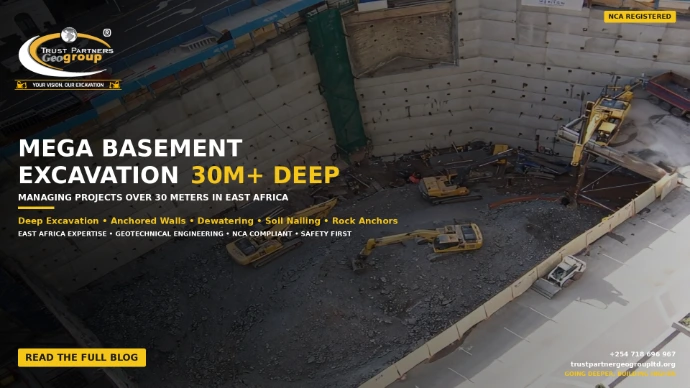
Mega Basement Excavation: Projects Over 30 Meters Deep
Managing Ultra-Deep Excavation Projects in East Africa — Your authoritative guide to bulk basement construction exceeding 30 meters across Kenya, Tanzania, Uganda, and Rwanda.
When your project demands a basement deeper than 30 meters, you have crossed from standard excavation into the realm of mega basement engineering — a discipline where precision, safety, and specialized equipment determine success or catastrophic failure.
Across East Africa, the construction boom is driving unprecedented demand for deep substructures. From mixed-use towers in Nairobi's Upper Hill to underground parking complexes in Dar es Salaam's CBD and commercial basements in Kampala's Nakasero district, developers are pushing excavation depths well beyond conventional limits. At 30 meters and deeper, every decision — from shoring system selection to dewatering strategy to spoil logistics — carries exponentially higher stakes.
This is not work for general contractors or standard excavation crews. Mega basement excavation requires specialized heavy equipment, certified deep-excavation engineers, and a contractor with documented experience at these depths. In East Africa, that experience is rare — and that is exactly why Trust Partners Geo-Group Ltd has invested heavily in building this capability.
Standard basement excavation — the kind most contractors in Nairobi handle daily — typically ranges from 4 to 12 meters. At these depths, open-cut or simple timber-shored methods are often sufficient. The ground pressure is manageable, dewatering is straightforward, and standard 20-ton excavators can complete the work efficiently.
At 30 meters, everything changes. The lateral earth pressure at the base of a 30-meter cut is approximately 7 to 10 times greater than at 4 meters, depending on soil density. Groundwater inflow can reach hundreds of liters per minute. The excavation volume for a single basement level at 30 meters equals the volume of six to eight standard basements. And the margin for error shrinks to nearly zero — a wall collapse at 30 meters does not just delay a project; it can destroy adjacent buildings, endanger lives, and trigger regulatory shutdowns that last months.
The key differentiators of mega basement excavation include:
- ›Structural Shoring Systems: Soldier piles, sheet piles, diaphragm walls, or secant pile systems capable of resisting earth pressures at 30+ meters. Timber shoring is not an option.
- ›Active Dewatering Infrastructure: Deep well dewatering with multiple submersible pumps, wellpoint arrays, and sometimes eductor systems to handle artesian pressure.
- ›Heavy-Duty Equipment: 30-ton and 35-ton excavators with extended-reach booms, hydraulic rockbreakers for bedrock, and high-capacity tippers for spoil removal.
- ›Geotechnical Monitoring: Real-time inclinometers, piezometers, and settlement markers to detect wall movement or groundwater changes before they become critical.
- ›Top-Down or Bottom-Up Sequencing: Mega excavations often require constructing the basement roof or intermediate slabs before completing full-depth excavation to maintain lateral stability.
- ›Specialized Spoil Logistics: At 30 meters, a single basement can generate 50,000 to 100,000 cubic meters of spoil. Managing that volume requires dedicated haulage fleets and disposal site coordination.
| Factor | Standard (4m – 12m) | Deep (15m – 25m) | Mega (30m+) |
|---|---|---|---|
| Shoring Required | Timber or simple steel | Soldier piles with lagging | Diaphragm walls or secant piles |
| Dewatering Method | Sump pumping | Wellpoint arrays | Deep wells + eductor systems |
| Excavator Size | 20-ton standard | 30-ton with long reach | 35-ton + specialized attachments |
| Construction Sequence | Open-cut, bottom-up | Benched or shored cut-and-cover | Top-down or hybrid sequencing |
| Typical Duration | 2 – 6 weeks | 8 – 16 weeks | 20 – 40 weeks |
| Spoil Volume (per 1000m2) | 4,000 – 12,000 m³ | 15,000 – 25,000 m³ | 30,000 – 50,000+ m³ |
| Engineering Oversight | Site engineer | Geotechnical consultant | Full structural + geo team on-site |
| Regulatory Scrutiny | NCA standard | NCA + NEMA | NCA + NEMA + County structural review |
East Africa sits at the intersection of the African Plate and the Somali Plate, with the East African Rift Valley running through Kenya, Tanzania, and Uganda. This tectonic activity creates geological conditions that make deep excavation both challenging and unpredictable. Understanding these conditions is essential before breaking ground on any mega basement project.
- ›Volcanic Tuff and Basalt: Nairobi and surrounding areas sit on volcanic deposits from the Rift Valley. At 30 meters, crews frequently encounter hard volcanic tuff or basalt layers that require hydraulic rockbreaking or controlled blasting permits.
- ›Deep Cotton Soil: In Nairobi's high-end neighborhoods (Parklands, Kilimani, Lavington, South C), cotton soil extends 8 to 15 meters before transitioning to firmer ground. This unstable, high-plasticity material requires continuous dewatering and immediate shoring.
- ›High Water Table: Proximity to the Nairobi River basin and seasonal aquifers means water table levels can fluctuate dramatically. At 30 meters, artesian pressure is a real risk in some zones.
- ›Urban Congestion: Mega projects in Nairobi's CBD or Upper Hill operate within meters of existing high-rise buildings. Vibration limits, noise restrictions, and 24-hour traffic management are mandatory.
- ✓Dual-Attachment Fleet: 35-ton Hyundai HX 330 with bucket + rockbreaker for seamless rock/soil transitions
- ✓Deep Well Dewatering: Submersible pumps rated for 40+ meter head pressure
- ✓Real-Time Monitoring: Inclinometers and piezometers with SMS alerts to project engineers
- ✓Silent Hours Compliance: Scheduled rockbreaking within Nairobi County noise bylaws
- ›Coastal Sediments: Dar es Salaam and coastal Tanzania sit on loose marine sediments and coral limestone. At depth, these materials can be highly porous and prone to sudden collapse if dewatering is not managed precisely.
- ›Expansive Clays: Inland areas around Dodoma and Arusha feature expansive clay soils that swell when wet and shrink when dry. At 30 meters, this seasonal movement can exert enormous pressure on basement walls.
- ›Saline Groundwater: Coastal projects encounter saline groundwater that corrodes standard steel shoring and reinforcement. Specialized coatings or stainless steel components are often required.
- ›Seasonal Flooding: Tanzania's heavy rainy seasons (March–May and October–December) can overwhelm standard dewatering systems. Mega projects require flood-proof pump infrastructure.
- ✓Coastal-Grade Shoring: Galvanized or epoxy-coated steel to resist saline corrosion
- ✓Expansive Clay Management: Chemical stabilization and moisture barrier installation
- ✓Redundant Pump Systems: Backup generators and secondary pump arrays for flood resilience
- ✓Local Permitting: NEMC (Tanzania) and municipal coordination handled in-house
- ›Lateritic Crust: Kampala and central Uganda feature thick lateritic soil crusts that are iron-hard when dry but rapidly soften when exposed to water. At 30 meters, this creates unpredictable bearing conditions.
- ›Lake Victoria Basin Hydrology: The basin's complex aquifer system means groundwater can enter excavations from multiple directions. Deep wells must be strategically placed around the full perimeter.
- ›Hillside Stability: Kampala's seven hills create sloped sites where lateral earth pressure is asymmetric. Retaining wall design must account for differential loading.
- ›Decomposed Granite: In southwestern Uganda, decomposed granite layers create sandy, cohesionless zones that are prone to running ground conditions during excavation.
- ✓Laterite-Specific Shoring: Soldier pile walls with pressure grouting for cohesionless zones
- ✓Perimeter Dewatering: Ring of deep wells with automated pump control systems
- ✓Asymmetric Wall Design: Cantilevered retaining walls with tie-back anchors for hillside sites
- ✓NEMA Uganda Compliance: Full environmental impact assessment and wetland buffer management
| System | Max Depth | Best For | East Africa Application | Relative Cost |
|---|---|---|---|---|
| Soldier Piles + Timber Lagging | 15m – 20m | Stable soils, moderate water | Nairobi residential deep basements | Medium |
| Sheet Piles (Steel) | 20m – 25m | Soft soils, high water table | Dar es Salaam coastal projects | Medium-High |
| Secant Pile Walls | 30m – 40m | Waterproof cut-off, tight urban | Kampala CBD and Nakasero | High |
| Diaphragm Walls | 40m – 60m+ | Mega projects, permanent walls | Nairobi Upper Hill towers | Very High |
| Tie-Back Anchors | Supplementary | Reducing wall thickness | Kampala hillside sites | Medium |
| Soil Nailing | 15m – 25m | Stable ground, temporary support | Arusha and drier inland zones | Low-Medium |
At 30 meters, dewatering is not optional — it is the single most critical factor determining whether your project succeeds or fails. The hydrostatic pressure at this depth can exceed 3 bar (300 kPa), enough to collapse inadequately shored walls or turn an excavation base into a swimming pool within hours.
Trust Partners Geo-Group deploys a tiered dewatering approach based on site-specific hydrogeological assessment:
- ›Stage 1 — Wellpoint Arrays (5m – 15m): For shallow dewatering and initial groundwater lowering. Used in conjunction with deeper systems, not as standalone for 30m projects.
- ›Stage 2 — Deep Wells with Submersible Pumps (15m – 35m): The backbone of mega dewatering. Wells drilled around the excavation perimeter, each equipped with high-capacity submersible pumps rated for the required head pressure. Pump activation is sequenced to create a cone of depression that keeps the excavation dry.
- ›Stage 3 — Eductor Systems (Artesian Pressure): Where artesian pressure is encountered — common in the Nairobi River basin and Lake Victoria aquifers — eductor systems use high-pressure water injection to create vacuum suction, pulling groundwater from deep confined aquifers.
- ›Stage 4 — Sump and Perimeter Drainage: Even with active dewatering, residual seepage and rainfall must be managed. Perimeter trench drains and emergency sump pumps provide the final line of defense.
- ›Discharge Management: All dewatering discharge is routed through sedimentation tanks and oil-water separators before release to storm drains or approved discharge points. NEMA and local environmental regulations are strictly followed.
Standard 20-ton excavators cannot handle the reach, power, or stability requirements of 30-meter excavation. Trust Partners Geo-Group maintains a specialized fleet for mega projects, with equipment mobilized across East Africa within 72 hours.
| Equipment | Model | Key Specs | Mega Project Role |
|---|---|---|---|
| Primary Excavator | Hyundai HX 330 (35-ton) | 3.3m³ bucket, 12m reach, 330 HP | Bulk excavation at 30m+ depth |
| Secondary Excavator | Doosan DX 300 (30-ton) | 2.5m³ bucket, 11m reach, 275 HP | Mid-depth work + rockbreaking |
| Rockbreaking Unit | Doosan DX 300 + hydraulic breaker | 4,000 Joule impact, 300–500 BPM | Volcanic tuff and basalt fragmentation |
| Long-Reach Excavator | Hitachi ZX 350LC (35-ton) | 18m boom reach, 1.8m³ bucket | Deep reach from stable ground level |
| Spoil Haulage | Tata LPK 2518 (18-ton tipper) | 14m³ capacity, 4x4 off-road | High-volume spoil removal |
| Site Grading | Caterpillar 140H Grader | 14ft blade, 165 HP | Access roads and bench preparation |
| Compaction | Bomag BW 213 Roller | 13-ton, vibratory + smooth drum | Base preparation and backfill compaction |
| Dewatering Pumps | Grundfos SP 46 Submersible | 45m³/hr, 50m head, 15kW | Deep well dewatering arrays |
At 30 meters, you cannot simply dig and build. The excavation sequence must maintain lateral stability at every stage while allowing construction to proceed. Trust Partners Geo-Group employs three primary sequencing methods depending on site constraints:
Best for: Sites with adequate space for sloped excavation or where shoring can be installed from ground level.
Sequence:
- Install perimeter shoring (soldier piles or sheet piles)
- Excavate in 3m benches with lagging installation
- Install dewatering system at each bench level
- Reach final depth and construct base slab
- Build walls and floors upward to ground level
Pros: Simple, cost-effective, well-understood
Cons: Requires wide shoring footprint, limited in tight urban sites
Best for: Ultra-deep projects in dense urban areas where lateral support is critical and space is minimal.
Sequence:
- Install permanent diaphragm or secant pile walls
- Construct basement roof at ground level
- Excavate first level beneath roof, install floor slab
- Repeat: excavate next level, install floor as support
- Complete final excavation and base slab
Pros: Minimal lateral movement, protects adjacent buildings
Cons: Complex, expensive, slower progress
Best for: Projects with intermediate depth (25m – 35m) or variable soil conditions requiring flexibility.
Sequence:
- Install shoring and dewatering for upper levels
- Excavate upper 15m using bottom-up method
- Construct intermediate structural slab
- Switch to top-down for remaining depth
- Complete base and permanent works
Pros: Balances cost and safety, adaptable
Cons: Requires careful transition planning
At 30 meters, a trench wall collapse or groundwater inundation is not a minor incident — it is a potential mass-casualty event. Trust Partners Geo-Group maintains safety standards that exceed NCA (Kenya), OSHA-equivalent (Tanzania), and OSHA (Uganda) requirements for deep excavation work.
Our mega excavation safety protocol includes:
- ›Daily Safety Briefings: Every shift begins with a toolbox talk specific to that day's excavation depth, weather conditions, and equipment operations.
- ›Real-Time Monitoring: Inclinometers installed in shoring walls transmit data every 15 minutes. If wall deflection exceeds 5mm, work stops immediately and engineering review is triggered.
- ›Gas Detection: At depths below 20 meters, oxygen deficiency and methane accumulation become risks. Continuous multi-gas monitors are mandatory for all personnel.
- ›Emergency Egress: Every excavation level has two independent egress routes — typically stair towers and emergency ladders. Rescue equipment is staged at ground level.
- ›Weather Holds: Excavation stops during heavy rainfall or when groundwater monitoring indicates rising pressure. No exceptions.
- ›Adjacent Structure Protection: Pre-excavation surveys, vibration monitoring, and settlement markers on all buildings within 50 meters of the excavation perimeter.
Mega basement excavation triggers the highest level of regulatory scrutiny in every East African jurisdiction. Trust Partners Geo-Group manages all permitting and compliance documentation as part of our project delivery package.
| Country | Primary Regulator | Key Requirements for 30m+ | Environmental |
|---|---|---|---|
| Kenya | NCA (National Construction Authority) | Registered deep-excavation contractor, structural engineer sign-off, shoring design review | NEMA EIA + water discharge permit |
| Tanzania | TBA (Tanzania Building Authority) | Geotechnical investigation report, excavation safety plan, municipal approval | NEMC EIA + coastal zone permit if applicable |
| Uganda | NBSC (National Building Review Board) | Structural stability certificate, excavation method statement, safety officer certification | NEMA EIA + wetland buffer compliance |
| Rwanda | RBA (Rwanda Building Authority) | Engineering design review, construction permit, safety protocol submission | REMA EIA + hillside stability assessment |
- ✓Comprehensive geotechnical investigation and interpretation
- ✓Shoring system design, supply, and installation
- ✓Full dewatering system design and operation
- ✓Excavation to specified depth with certified operators
- ✓Real-time geotechnical monitoring (inclinometers, piezometers)
- ✓Spoil removal to approved disposal sites
- ✓NCA / TBA / NBSC compliant safety documentation
- ×VAT: Charged at applicable local tax rates
- ×Third-Party Geotechnical Report: Client engages independent geotechnical firm; we interpret and design based on their findings
- ×Structural Design: Basement structural design (slabs, columns, walls) by client's structural engineer
- ×Rockbreaking: If bedrock is encountered beyond predicted depths, charged at KSH 8,000 – 10,000/hour per rockbreaker unit
- ×Permit Fees: NCA, NEMA, municipal, and water authority fees are client responsibility (we handle applications)
- ×Adjacent Building Protection: Underpinning, piling, or structural reinforcement of neighboring buildings quoted separately
Planning a Mega Basement Project?
Trust Partners Geo-Group delivers 30-meter-plus basement excavation across Kenya, Tanzania, Uganda, and Rwanda. Contact us for a preliminary site assessment and feasibility study.
Call for Free AssessmentVisit us at www.trustpartnergeogroupltd.org
Proven 30M+ Experience
Documented delivery of basement excavations exceeding 30 meters across Kenya, Tanzania, and Uganda. We don't learn on your project.
Specialized Shoring Design
From diaphragm walls to secant piles, we design and install shoring systems rated for the extreme earth pressures at 30+ meter depths.
Advanced Dewatering
Deep well arrays, eductor systems, and redundant pump infrastructure capable of handling artesian pressure and high-volume groundwater inflow.
Heavy-Duty Fleet
35-ton Hyundai HX 330, 30-ton Doosan DX 300, long-reach Hitachi ZX 350LC, and dedicated rockbreaking units. Mobilized across East Africa.
Cross-Border Compliance
We navigate NCA (Kenya), TBA (Tanzania), NBSC (Uganda), and RBA (Rwanda) permitting, including NEMA environmental compliance across all jurisdictions.
24/7 Site Support
Mobile service teams, on-site parts inventory, and dedicated project engineers mean minimal downtime even on the most complex mega excavations.
Kenya
Nairobi | Mombasa | Kisumu | Nakuru | Eldoret | Thika | Machakos | Nyeri | Meru | Kitale | Naivasha | Malindi | Garissa | Laikipia | Bomet | Vihiga | Murang'a | Nyandarua
Tanzania
Dar es Salaam | Arusha | Dodoma | Mwanza | Zanzibar | Moshi | Tanga | Mbeya | Morogoro | Iringa | Shinyanga | Singida | Kigoma
Uganda
Kampala | Entebbe | Jinja | Mbarara | Gulu | Mbale | Fort Portal | Lira | Arua | Masaka | Kabale | Soroti | Tororo
Rwanda
Kigali | Butare | Gitarama | Ruhengeri | Gisenyi | Byumba | Cyangugu | Kibuye | Rwamagana | Kibungo | Nyanza
| Application | Typical Depth | Common Locations | Key Challenge |
|---|---|---|---|
| Mixed-Use Tower Basements | 30m – 45m | Nairobi Upper Hill, Dar es Salaam CBD | Adjacent building protection |
| Underground Parking Complexes | 25m – 35m | Kampala Nakasero, Nairobi Westlands | High water table management |
| Data Center Substructures | 30m – 40m | Nairobi, Kigali, Dar es Salaam | Waterproofing and climate control |
| Hotel & Conference Basements | 25m – 30m | Zanzibar, Mombasa, Entebbe | Coastal saline groundwater |
| Retail Mall Foundations | 20m – 30m | Kampala, Nairobi, Arusha | Large footprint spoil logistics |
| Industrial Plant Basements | 30m – 50m | Athi River, Dodoma, Mbeya | Heavy foundation loading |
Mega Basement Excavation: Projects Over 30 Meters Deep
Managing Ultra-Deep Excavation Projects in East Africa — Your authoritative guide to bulk basement construction exceeding 30 meters across Kenya, Tanzania, Uganda, and Rwanda.
When your project demands a basement deeper than 30 meters, you have crossed from standard excavation into the realm of mega basement engineering — a discipline where precision, safety, and specialized equipment determine success or catastrophic failure.
Across East Africa, the construction boom is driving unprecedented demand for deep substructures. From mixed-use towers in Nairobi's Upper Hill to underground parking complexes in Dar es Salaam's CBD and commercial basements in Kampala's Nakasero district, developers are pushing excavation depths well beyond conventional limits. At 30 meters and deeper, every decision — from shoring system selection to dewatering strategy to spoil logistics — carries exponentially higher stakes.
This is not work for general contractors or standard excavation crews. Mega basement excavation requires specialized heavy equipment, certified deep-excavation engineers, and a contractor with documented experience at these depths. In East Africa, that experience is rare — and that is exactly why Trust Partners Geo-Group Ltd has invested heavily in building this capability.
Standard basement excavation — the kind most contractors in Nairobi handle daily — typically ranges from 4 to 12 meters. At these depths, open-cut or simple timber-shored methods are often sufficient. The ground pressure is manageable, dewatering is straightforward, and standard 20-ton excavators can complete the work efficiently.
At 30 meters, everything changes. The lateral earth pressure at the base of a 30-meter cut is approximately 7 to 10 times greater than at 4 meters, depending on soil density. Groundwater inflow can reach hundreds of liters per minute. The excavation volume for a single basement level at 30 meters equals the volume of six to eight standard basements. And the margin for error shrinks to nearly zero — a wall collapse at 30 meters does not just delay a project; it can destroy adjacent buildings, endanger lives, and trigger regulatory shutdowns that last months.
The key differentiators of mega basement excavation include:
- ›Structural Shoring Systems: Soldier piles, sheet piles, diaphragm walls, or secant pile systems capable of resisting earth pressures at 30+ meters. Timber shoring is not an option.
- ›Active Dewatering Infrastructure: Deep well dewatering with multiple submersible pumps, wellpoint arrays, and sometimes eductor systems to handle artesian pressure.
- ›Heavy-Duty Equipment: 30-ton and 35-ton excavators with extended-reach booms, hydraulic rockbreakers for bedrock, and high-capacity tippers for spoil removal.
- ›Geotechnical Monitoring: Real-time inclinometers, piezometers, and settlement markers to detect wall movement or groundwater changes before they become critical.
- ›Top-Down or Bottom-Up Sequencing: Mega excavations often require constructing the basement roof or intermediate slabs before completing full-depth excavation to maintain lateral stability.
- ›Specialized Spoil Logistics: At 30 meters, a single basement can generate 50,000 to 100,000 cubic meters of spoil. Managing that volume requires dedicated haulage fleets and disposal site coordination.
| Factor | Standard (4m – 12m) | Deep (15m – 25m) | Mega (30m+) |
|---|---|---|---|
| Shoring Required | Timber or simple steel | Soldier piles with lagging | Diaphragm walls or secant piles |
| Dewatering Method | Sump pumping | Wellpoint arrays | Deep wells + eductor systems |
| Excavator Size | 20-ton standard | 30-ton with long reach | 35-ton + specialized attachments |
| Construction Sequence | Open-cut, bottom-up | Benched or shored cut-and-cover | Top-down or hybrid sequencing |
| Typical Duration | 2 – 6 weeks | 8 – 16 weeks | 20 – 40 weeks |
| Spoil Volume (per 1000m2) | 4,000 – 12,000 m³ | 15,000 – 25,000 m³ | 30,000 – 50,000+ m³ |
| Engineering Oversight | Site engineer | Geotechnical consultant | Full structural + geo team on-site |
| Regulatory Scrutiny | NCA standard | NCA + NEMA | NCA + NEMA + County structural review |
East Africa sits at the intersection of the African Plate and the Somali Plate, with the East African Rift Valley running through Kenya, Tanzania, and Uganda. This tectonic activity creates geological conditions that make deep excavation both challenging and unpredictable. Understanding these conditions is essential before breaking ground on any mega basement project.
- ›Volcanic Tuff and Basalt: Nairobi and surrounding areas sit on volcanic deposits from the Rift Valley. At 30 meters, crews frequently encounter hard volcanic tuff or basalt layers that require hydraulic rockbreaking or controlled blasting permits.
- ›Deep Cotton Soil: In Nairobi's high-end neighborhoods (Parklands, Kilimani, Lavington, South C), cotton soil extends 8 to 15 meters before transitioning to firmer ground. This unstable, high-plasticity material requires continuous dewatering and immediate shoring.
- ›High Water Table: Proximity to the Nairobi River basin and seasonal aquifers means water table levels can fluctuate dramatically. At 30 meters, artesian pressure is a real risk in some zones.
- ›Urban Congestion: Mega projects in Nairobi's CBD or Upper Hill operate within meters of existing high-rise buildings. Vibration limits, noise restrictions, and 24-hour traffic management are mandatory.
- ✓Dual-Attachment Fleet: 35-ton Hyundai HX 330 with bucket + rockbreaker for seamless rock/soil transitions
- ✓Deep Well Dewatering: Submersible pumps rated for 40+ meter head pressure
- ✓Real-Time Monitoring: Inclinometers and piezometers with SMS alerts to project engineers
- ✓Silent Hours Compliance: Scheduled rockbreaking within Nairobi County noise bylaws
- ›Coastal Sediments: Dar es Salaam and coastal Tanzania sit on loose marine sediments and coral limestone. At depth, these materials can be highly porous and prone to sudden collapse if dewatering is not managed precisely.
- ›Expansive Clays: Inland areas around Dodoma and Arusha feature expansive clay soils that swell when wet and shrink when dry. At 30 meters, this seasonal movement can exert enormous pressure on basement walls.
- ›Saline Groundwater: Coastal projects encounter saline groundwater that corrodes standard steel shoring and reinforcement. Specialized coatings or stainless steel components are often required.
- ›Seasonal Flooding: Tanzania's heavy rainy seasons (March–May and October–December) can overwhelm standard dewatering systems. Mega projects require flood-proof pump infrastructure.
- ✓Coastal-Grade Shoring: Galvanized or epoxy-coated steel to resist saline corrosion
- ✓Expansive Clay Management: Chemical stabilization and moisture barrier installation
- ✓Redundant Pump Systems: Backup generators and secondary pump arrays for flood resilience
- ✓Local Permitting: NEMC (Tanzania) and municipal coordination handled in-house
- ›Lateritic Crust: Kampala and central Uganda feature thick lateritic soil crusts that are iron-hard when dry but rapidly soften when exposed to water. At 30 meters, this creates unpredictable bearing conditions.
- ›Lake Victoria Basin Hydrology: The basin's complex aquifer system means groundwater can enter excavations from multiple directions. Deep wells must be strategically placed around the full perimeter.
- ›Hillside Stability: Kampala's seven hills create sloped sites where lateral earth pressure is asymmetric. Retaining wall design must account for differential loading.
- ›Decomposed Granite: In southwestern Uganda, decomposed granite layers create sandy, cohesionless zones that are prone to running ground conditions during excavation.
- ✓Laterite-Specific Shoring: Soldier pile walls with pressure grouting for cohesionless zones
- ✓Perimeter Dewatering: Ring of deep wells with automated pump control systems
- ✓Asymmetric Wall Design: Cantilevered retaining walls with tie-back anchors for hillside sites
- ✓NEMA Uganda Compliance: Full environmental impact assessment and wetland buffer management
| System | Max Depth | Best For | East Africa Application | Relative Cost |
|---|---|---|---|---|
| Soldier Piles + Timber Lagging | 15m – 20m | Stable soils, moderate water | Nairobi residential deep basements | Medium |
| Sheet Piles (Steel) | 20m – 25m | Soft soils, high water table | Dar es Salaam coastal projects | Medium-High |
| Secant Pile Walls | 30m – 40m | Waterproof cut-off, tight urban | Kampala CBD and Nakasero | High |
| Diaphragm Walls | 40m – 60m+ | Mega projects, permanent walls | Nairobi Upper Hill towers | Very High |
| Tie-Back Anchors | Supplementary | Reducing wall thickness | Kampala hillside sites | Medium |
| Soil Nailing | 15m – 25m | Stable ground, temporary support | Arusha and drier inland zones | Low-Medium |
At 30 meters, dewatering is not optional — it is the single most critical factor determining whether your project succeeds or fails. The hydrostatic pressure at this depth can exceed 3 bar (300 kPa), enough to collapse inadequately shored walls or turn an excavation base into a swimming pool within hours.
Trust Partners Geo-Group deploys a tiered dewatering approach based on site-specific hydrogeological assessment:
- ›Stage 1 — Wellpoint Arrays (5m – 15m): For shallow dewatering and initial groundwater lowering. Used in conjunction with deeper systems, not as standalone for 30m projects.
- ›Stage 2 — Deep Wells with Submersible Pumps (15m – 35m): The backbone of mega dewatering. Wells drilled around the excavation perimeter, each equipped with high-capacity submersible pumps rated for the required head pressure. Pump activation is sequenced to create a cone of depression that keeps the excavation dry.
- ›Stage 3 — Eductor Systems (Artesian Pressure): Where artesian pressure is encountered — common in the Nairobi River basin and Lake Victoria aquifers — eductor systems use high-pressure water injection to create vacuum suction, pulling groundwater from deep confined aquifers.
- ›Stage 4 — Sump and Perimeter Drainage: Even with active dewatering, residual seepage and rainfall must be managed. Perimeter trench drains and emergency sump pumps provide the final line of defense.
- ›Discharge Management: All dewatering discharge is routed through sedimentation tanks and oil-water separators before release to storm drains or approved discharge points. NEMA and local environmental regulations are strictly followed.
Standard 20-ton excavators cannot handle the reach, power, or stability requirements of 30-meter excavation. Trust Partners Geo-Group maintains a specialized fleet for mega projects, with equipment mobilized across East Africa within 72 hours.
| Equipment | Model | Key Specs | Mega Project Role |
|---|---|---|---|
| Primary Excavator | Hyundai HX 330 (35-ton) | 3.3m³ bucket, 12m reach, 330 HP | Bulk excavation at 30m+ depth |
| Secondary Excavator | Doosan DX 300 (30-ton) | 2.5m³ bucket, 11m reach, 275 HP | Mid-depth work + rockbreaking |
| Rockbreaking Unit | Doosan DX 300 + hydraulic breaker | 4,000 Joule impact, 300–500 BPM | Volcanic tuff and basalt fragmentation |
| Long-Reach Excavator | Hitachi ZX 350LC (35-ton) | 18m boom reach, 1.8m³ bucket | Deep reach from stable ground level |
| Spoil Haulage | Tata LPK 2518 (18-ton tipper) | 14m³ capacity, 4x4 off-road | High-volume spoil removal |
| Site Grading | Caterpillar 140H Grader | 14ft blade, 165 HP | Access roads and bench preparation |
| Compaction | Bomag BW 213 Roller | 13-ton, vibratory + smooth drum | Base preparation and backfill compaction |
| Dewatering Pumps | Grundfos SP 46 Submersible | 45m³/hr, 50m head, 15kW | Deep well dewatering arrays |
At 30 meters, you cannot simply dig and build. The excavation sequence must maintain lateral stability at every stage while allowing construction to proceed. Trust Partners Geo-Group employs three primary sequencing methods depending on site constraints:
Best for: Sites with adequate space for sloped excavation or where shoring can be installed from ground level.
Sequence:
- Install perimeter shoring (soldier piles or sheet piles)
- Excavate in 3m benches with lagging installation
- Install dewatering system at each bench level
- Reach final depth and construct base slab
- Build walls and floors upward to ground level
Pros: Simple, cost-effective, well-understood
Cons: Requires wide shoring footprint, limited in tight urban sites
Best for: Ultra-deep projects in dense urban areas where lateral support is critical and space is minimal.
Sequence:
- Install permanent diaphragm or secant pile walls
- Construct basement roof at ground level
- Excavate first level beneath roof, install floor slab
- Repeat: excavate next level, install floor as support
- Complete final excavation and base slab
Pros: Minimal lateral movement, protects adjacent buildings
Cons: Complex, expensive, slower progress
Best for: Projects with intermediate depth (25m – 35m) or variable soil conditions requiring flexibility.
Sequence:
- Install shoring and dewatering for upper levels
- Excavate upper 15m using bottom-up method
- Construct intermediate structural slab
- Switch to top-down for remaining depth
- Complete base and permanent works
Pros: Balances cost and safety, adaptable
Cons: Requires careful transition planning
At 30 meters, a trench wall collapse or groundwater inundation is not a minor incident — it is a potential mass-casualty event. Trust Partners Geo-Group maintains safety standards that exceed NCA (Kenya), OSHA-equivalent (Tanzania), and OSHA (Uganda) requirements for deep excavation work.
Our mega excavation safety protocol includes:
- ›Daily Safety Briefings: Every shift begins with a toolbox talk specific to that day's excavation depth, weather conditions, and equipment operations.
- ›Real-Time Monitoring: Inclinometers installed in shoring walls transmit data every 15 minutes. If wall deflection exceeds 5mm, work stops immediately and engineering review is triggered.
- ›Gas Detection: At depths below 20 meters, oxygen deficiency and methane accumulation become risks. Continuous multi-gas monitors are mandatory for all personnel.
- ›Emergency Egress: Every excavation level has two independent egress routes — typically stair towers and emergency ladders. Rescue equipment is staged at ground level.
- ›Weather Holds: Excavation stops during heavy rainfall or when groundwater monitoring indicates rising pressure. No exceptions.
- ›Adjacent Structure Protection: Pre-excavation surveys, vibration monitoring, and settlement markers on all buildings within 50 meters of the excavation perimeter.
Mega basement excavation triggers the highest level of regulatory scrutiny in every East African jurisdiction. Trust Partners Geo-Group manages all permitting and compliance documentation as part of our project delivery package.
| Country | Primary Regulator | Key Requirements for 30m+ | Environmental |
|---|---|---|---|
| Kenya | NCA (National Construction Authority) | Registered deep-excavation contractor, structural engineer sign-off, shoring design review | NEMA EIA + water discharge permit |
| Tanzania | TBA (Tanzania Building Authority) | Geotechnical investigation report, excavation safety plan, municipal approval | NEMC EIA + coastal zone permit if applicable |
| Uganda | NBSC (National Building Review Board) | Structural stability certificate, excavation method statement, safety officer certification | NEMA EIA + wetland buffer compliance |
| Rwanda | RBA (Rwanda Building Authority) | Engineering design review, construction permit, safety protocol submission | REMA EIA + hillside stability assessment |
- ✓Comprehensive geotechnical investigation and interpretation
- ✓Shoring system design, supply, and installation
- ✓Full dewatering system design and operation
- ✓Excavation to specified depth with certified operators
- ✓Real-time geotechnical monitoring (inclinometers, piezometers)
- ✓Spoil removal to approved disposal sites
- ✓NCA / TBA / NBSC compliant safety documentation
- ×VAT: Charged at applicable local tax rates
- ×Third-Party Geotechnical Report: Client engages independent geotechnical firm; we interpret and design based on their findings
- ×Structural Design: Basement structural design (slabs, columns, walls) by client's structural engineer
- ×Rockbreaking: If bedrock is encountered beyond predicted depths, charged at KSH 8,000 – 10,000/hour per rockbreaker unit
- ×Permit Fees: NCA, NEMA, municipal, and water authority fees are client responsibility (we handle applications)
- ×Adjacent Building Protection: Underpinning, piling, or structural reinforcement of neighboring buildings quoted separately
Planning a Mega Basement Project?
Trust Partners Geo-Group delivers 30-meter-plus basement excavation across Kenya, Tanzania, Uganda, and Rwanda. Contact us for a preliminary site assessment and feasibility study.
Call for Free AssessmentVisit us at www.trustpartnergeogroupltd.org
Proven 30M+ Experience
Documented delivery of basement excavations exceeding 30 meters across Kenya, Tanzania, and Uganda. We don't learn on your project.
Specialized Shoring Design
From diaphragm walls to secant piles, we design and install shoring systems rated for the extreme earth pressures at 30+ meter depths.
Advanced Dewatering
Deep well arrays, eductor systems, and redundant pump infrastructure capable of handling artesian pressure and high-volume groundwater inflow.
Heavy-Duty Fleet
35-ton Hyundai HX 330, 30-ton Doosan DX 300, long-reach Hitachi ZX 350LC, and dedicated rockbreaking units. Mobilized across East Africa.
Cross-Border Compliance
We navigate NCA (Kenya), TBA (Tanzania), NBSC (Uganda), and RBA (Rwanda) permitting, including NEMA environmental compliance across all jurisdictions.
24/7 Site Support
Mobile service teams, on-site parts inventory, and dedicated project engineers mean minimal downtime even on the most complex mega excavations.
Kenya
Nairobi | Mombasa | Kisumu | Nakuru | Eldoret | Thika | Machakos | Nyeri | Meru | Kitale | Naivasha | Malindi | Garissa | Laikipia | Bomet | Vihiga | Murang'a | Nyandarua
Tanzania
Dar es Salaam | Arusha | Dodoma | Mwanza | Zanzibar | Moshi | Tanga | Mbeya | Morogoro | Iringa | Shinyanga | Singida | Kigoma
Uganda
Kampala | Entebbe | Jinja | Mbarara | Gulu | Mbale | Fort Portal | Lira | Arua | Masaka | Kabale | Soroti | Tororo
Rwanda
Kigali | Butare | Gitarama | Ruhengeri | Gisenyi | Byumba | Cyangugu | Kibuye | Rwamagana | Kibungo | Nyanza
| Application | Typical Depth | Common Locations | Key Challenge |
|---|---|---|---|
| Mixed-Use Tower Basements | 30m – 45m | Nairobi Upper Hill, Dar es Salaam CBD | Adjacent building protection |
| Underground Parking Complexes | 25m – 35m | Kampala Nakasero, Nairobi Westlands | High water table management |
| Data Center Substructures | 30m – 40m | Nairobi, Kigali, Dar es Salaam | Waterproofing and climate control |
| Hotel & Conference Basements | 25m – 30m | Zanzibar, Mombasa, Entebbe | Coastal saline groundwater |
| Retail Mall Foundations | 20m – 30m | Kampala, Nairobi, Arusha | Large footprint spoil logistics |
| Industrial Plant Basements | 30m – 50m | Athi River, Dodoma, Mbeya | Heavy foundation loading |