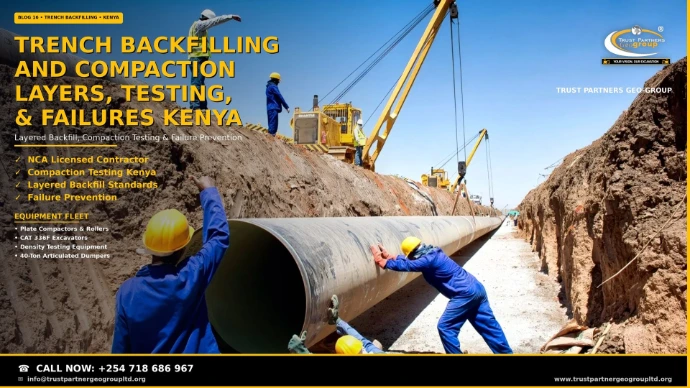
Trench Backfilling and Compaction Standards in Kenya: Layer Thickness, Testing and Common Failures
The dig gets the glory; the backfill gets the blame. The layered specification, materials rules, testing regime and failure modes — the half of the trench nobody sees until it fails.

1. Backfill: The Invisible Half
Every metre of trench is bought twice: once when it is dug, once when it is filled — and only the second purchase is graded. This article governs what goes back in, in what layers, to what density, proven by what tests — the standards our services portfolio applies on every utility run delivered by Trust Partners Geo-Group under our trench digging service, with the corridor craft covered in our fiber trenching guide.
2. The Layer Cake Specification
| Zone | Material | Thickness / Method | Target |
|---|---|---|---|
| Bedding | Screened sand / fine granular | 75–100 mm, leveled | Protects pipe from point loads |
| Sidefill & haunching | Screened granular | 150 mm compacted layers to +150 over crown | 90–95% Proctor |
| Initial cover | Fine material | 150 mm before plant crosses | Hand or plate compacted |
| General backfill | Approved spoil or import | 200 mm compacted layers | 90–95% under pavements |
Costed honestly: KES 150–350 per metre of trench to execute, against KES 2,000–5,000 per metre to remediate a failed one.
3. Materials Rules
- No topsoil, no organics, no rubble in any layer — rot and voids are settlement by design.
- PI below ~12% for any material near the pipe — expansive clays move pipes with the seasons.
- Trench spoil is a material, not a default: it earns its place by testing. Sandy gravels often pass with screening; fat clays fail and import the pipe zone.
- Imported bedding at KES 1,500–3,000 per truckload is cheap insurance beside a cracked slab.
4. Compaction Targets & Testing
Field density testing against the Proctor standard, logged by chainage and layer. Methods: sand-cone — the reference method; speedy moisture paired with density estimates; and nuclear density gauges on larger programmes. Frequencies on specified utility runs: typically one test per 100–200 linear metres per layer — denser under road crossings, where failure consequences multiply. Failed tests trigger removal and recompaction: cheap at that stage, ruinous after surfacing. The full framework sits in our earthworks QA/QC and compaction testing guide.
5. The Six Failure Modes
- Loose dumping — one-lift spoil compacts for months; the surface follows it down.
- Wrong material — organics and rubble rot, compress, void.
- No moisture conditioning — dry fill refuses to densify; wet fill pumps.
- Skipped layers — the 200mm discipline abandoned under pressure.
- Untested compaction — covered on assumption, not certificate.
- Water ingress — rain washing fines from open, uncompacted trenches.
Every mechanism is procedural; every one is preventable; and the settlement visible in month six was priced in month one.
6. Costs 2026
| Item | Basis | 2026 Band (KES) |
|---|---|---|
| Bedding & sidefill material | per truckload imported | 1,500–3,000 |
| Layered backfill & compaction | per m of trench | 150–350 |
| Density testing | per test | 3,000–8,000 |
| Plate/rammer hire | per day | 2,000–5,000 |
| Trench roller hire | per day | 8,000–15,000 |
| Failure remediation | per m re-excavated | 2,000–5,000 |
7. A Complete Specimen Specification
📋 Copy-ready trench backfill spec
Bedding: 75–100mm screened sand, leveled. Sidefill to +150mm over crown: screened granular, 150mm layers, 93% Proctor min. Cover: 150mm fine material before plant crossing. General backfill: approved material, 200mm layers, 90% Proctor min (95% under pavements), field density tested at 1 per 150m per layer with records. No topsoil, organics or rubble in any layer; PI ≤12% within 300mm of pipe. Backfill placed and compacted within the protection zone rules of the trench shoring standards.
8. Frequently Asked Questions
The layered specification that prevents settlement, stated bottom-up. Bedding: 75–100mm of screened sand or fine granular material under the pipe or duct, protecting it from point loads of the trench floor. Sidefill and haunching: material placed and compacted in 150mm layers around the pipe up to 150mm above its crown — the zone that transfers loads around rather than onto the pipe; screened granular material here, placed by hand or small plant beside the pipe, never dumped from height. Initial cover: 150mm of fine material above the crown before any heavy plant crosses. General backfill: the remainder in 200mm compacted layers to surface. Compaction targets: 90–95% of maximum dry density (Proctor) under pavements and structures, with field density verification where the engineer specifies. Two material rules ride through every layer: no topsoil, no organics, no rubble — and excavated trench spoil rarely qualifies untreated. This specification costs KES 150–350 per metre of trench to execute properly, against KES 2,000–5,000 per metre to remediate a failed one — the best ratio in earthworks.
By field density testing against the Proctor standard — the same QA/QC architecture that governs all Kenyan earthworks. The methods in common use: sand-cone testing — the reference method, excavating a small hole, measuring its volume with calibrated sand, and weighing the removed material to compute dry density; speedy moisture tests paired with field dry-density estimates; and increasingly nuclear density gauges on larger programmes, giving instant readings logged against location. The testing regime on a specified trench: a field density test per layer per specified frequency — typically one test per 100–200 linear metres per layer on utility runs, and denser grids under road crossings and pavements, where the consequences of failure multiply. The paperwork matters: each test logged with chainage, layer and result, and the engineer certifying the trench before the next layer covers the evidence. Failed tests trigger removal and recompaction — cheap at that stage, ruinous after surfacing. The wider testing framework — frequencies, standards and compliance — is mapped in our guide to earthworks QA/QC and compaction testing.
Because most trench settlement is built in the week of the backfill, and surfaces the following rainy season. The six mechanisms, in order of frequency: loose dumping — spoil thrown back in one lift compacts under its own weight for months, and the surface follows it down; wrong material — topsoil, organics and rubble in the backfill rot, compress and create voids; no moisture conditioning — dry fill placed dry refuses to densify, and wet fill pumps under compaction; skipped layers — the 200mm discipline abandoned under programme pressure; untested compaction — work covered on assumption rather than certificate; and water ingress — rain entering an open, uncompacted trench washes fines and leaves cavities. Each mechanism is procedural, which is why each is preventable — and why prevention costs 5–10% of the remediation: digging out a failed trench beneath a cracked driveway or road pavement, re-filling to specification and reinstating surfaces runs KES 2,000–5,000 per metre, against KES 150–350 per metre of doing it right the first time. The settlement you see in month six was priced in month one.
Sometimes — but trench spoil is a material, not a default, and it earns its place by testing, not by convenience. Excavated soil qualifies when: it is free of topsoil and organic matter; its particle size will not damage the pipe or ducts; its plasticity index stays below about 12% — above that, wet-season shrink-swell cycles move the pipe with the soil; and it can be moisture-conditioned and compacted to the specified density in layers. Sandy and gravelly spoils often pass with simple screening; fat clays and mixed fill usually fail at least one criterion — the black cotton belts of Western Kenya and the Rift floor spoil being classic cases — and then the specification changes: import approved granular material for the pipe zone and use the spoil, if at all, in the upper general backfill where it is compacted in thinner lifts. The economics are honest either way: imported bedding and sidefill at KES 1,500–3,000 per truckload is cheap insurance beside a cracked slab or a re-excavated road; and every cubic metre of unsuitable spoil trucked away is cheaper than the same cubic metre discovered under a failed surface next season.
Sized to the trench and the layer. Plate compactors — hand-guided vibratory plates — do the pipe zone and first layers where space is tight; expect 150–200mm effective depth per pass, which is exactly why the layer spec says 150–200mm. Trench rollers — remote-controlled or ride-on units sized to the trench width — take the general backfill at production pace on deeper or wider runs. Rammers serve cohesive clays the plates bounce off. Small vibratory rollers and, on long runs, standard rollers finish the upper layers to the specified density. Two operating rules decide whether the iron delivers the number: moisture conditioning — material within about ±2% of optimum moisture densifies; far from it, no machine helps — and the lift discipline, because a compactor densifies roughly its own drum or plate depth, and a 600mm loose lift is a promise, not a layer. Hire runs KES 2,000–5,000 per day for plates and rammers, KES 8,000–15,000 for trench rollers — trivial against the specification they deliver.
Fill It Right. Test It. Never Dig It Twice.
Trust Partners Geo-Group Ltd backfills utility trenches across Kenya to written specification — layered, conditioned, tested and certified — with the equipment and records that keep surfaces level for decades.
Price a Backfill-Compliant Trench✉️ Contact Us
📞 +254 718 68 69 67
Trench Backfilling and Compaction Standards in Kenya: Layer Thickness, Testing and Common Failures
The dig gets the glory; the backfill gets the blame. The layered specification, materials rules, testing regime and failure modes — the half of the trench nobody sees until it fails.
1. Backfill: The Invisible Half
Every metre of trench is bought twice: once when it is dug, once when it is filled — and only the second purchase is graded. This article governs what goes back in, in what layers, to what density, proven by what tests — the standards our services portfolio applies on every utility run delivered by Trust Partners Geo-Group under our trench digging service, with the corridor craft covered in our fiber trenching guide.
2. The Layer Cake Specification
| Zone | Material | Thickness / Method | Target |
|---|---|---|---|
| Bedding | Screened sand / fine granular | 75–100 mm, leveled | Protects pipe from point loads |
| Sidefill & haunching | Screened granular | 150 mm compacted layers to +150 over crown | 90–95% Proctor |
| Initial cover | Fine material | 150 mm before plant crosses | Hand or plate compacted |
| General backfill | Approved spoil or import | 200 mm compacted layers | 90–95% under pavements |
Costed honestly: KES 150–350 per metre of trench to execute, against KES 2,000–5,000 per metre to remediate a failed one.
3. Materials Rules
- No topsoil, no organics, no rubble in any layer — rot and voids are settlement by design.
- PI below ~12% for any material near the pipe — expansive clays move pipes with the seasons.
- Trench spoil is a material, not a default: it earns its place by testing. Sandy gravels often pass with screening; fat clays fail and import the pipe zone.
- Imported bedding at KES 1,500–3,000 per truckload is cheap insurance beside a cracked slab.
4. Compaction Targets & Testing
Field density testing against the Proctor standard, logged by chainage and layer. Methods: sand-cone — the reference method; speedy moisture paired with density estimates; and nuclear density gauges on larger programmes. Frequencies on specified utility runs: typically one test per 100–200 linear metres per layer — denser under road crossings, where failure consequences multiply. Failed tests trigger removal and recompaction: cheap at that stage, ruinous after surfacing. The full framework sits in our earthworks QA/QC and compaction testing guide.
5. The Six Failure Modes
- Loose dumping — one-lift spoil compacts for months; the surface follows it down.
- Wrong material — organics and rubble rot, compress, void.
- No moisture conditioning — dry fill refuses to densify; wet fill pumps.
- Skipped layers — the 200mm discipline abandoned under pressure.
- Untested compaction — covered on assumption, not certificate.
- Water ingress — rain washing fines from open, uncompacted trenches.
Every mechanism is procedural; every one is preventable; and the settlement visible in month six was priced in month one.
6. Costs 2026
| Item | Basis | 2026 Band (KES) |
|---|---|---|
| Bedding & sidefill material | per truckload imported | 1,500–3,000 |
| Layered backfill & compaction | per m of trench | 150–350 |
| Density testing | per test | 3,000–8,000 |
| Plate/rammer hire | per day | 2,000–5,000 |
| Trench roller hire | per day | 8,000–15,000 |
| Failure remediation | per m re-excavated | 2,000–5,000 |
7. A Complete Specimen Specification
📋 Copy-ready trench backfill spec
Bedding: 75–100mm screened sand, leveled. Sidefill to +150mm over crown: screened granular, 150mm layers, 93% Proctor min. Cover: 150mm fine material before plant crossing. General backfill: approved material, 200mm layers, 90% Proctor min (95% under pavements), field density tested at 1 per 150m per layer with records. No topsoil, organics or rubble in any layer; PI ≤12% within 300mm of pipe. Backfill placed and compacted within the protection zone rules of the trench shoring standards.
8. Frequently Asked Questions
The layered specification that prevents settlement, stated bottom-up. Bedding: 75–100mm of screened sand or fine granular material under the pipe or duct, protecting it from point loads of the trench floor. Sidefill and haunching: material placed and compacted in 150mm layers around the pipe up to 150mm above its crown — the zone that transfers loads around rather than onto the pipe; screened granular material here, placed by hand or small plant beside the pipe, never dumped from height. Initial cover: 150mm of fine material above the crown before any heavy plant crosses. General backfill: the remainder in 200mm compacted layers to surface. Compaction targets: 90–95% of maximum dry density (Proctor) under pavements and structures, with field density verification where the engineer specifies. Two material rules ride through every layer: no topsoil, no organics, no rubble — and excavated trench spoil rarely qualifies untreated. This specification costs KES 150–350 per metre of trench to execute properly, against KES 2,000–5,000 per metre to remediate a failed one — the best ratio in earthworks.
By field density testing against the Proctor standard — the same QA/QC architecture that governs all Kenyan earthworks. The methods in common use: sand-cone testing — the reference method, excavating a small hole, measuring its volume with calibrated sand, and weighing the removed material to compute dry density; speedy moisture tests paired with field dry-density estimates; and increasingly nuclear density gauges on larger programmes, giving instant readings logged against location. The testing regime on a specified trench: a field density test per layer per specified frequency — typically one test per 100–200 linear metres per layer on utility runs, and denser grids under road crossings and pavements, where the consequences of failure multiply. The paperwork matters: each test logged with chainage, layer and result, and the engineer certifying the trench before the next layer covers the evidence. Failed tests trigger removal and recompaction — cheap at that stage, ruinous after surfacing. The wider testing framework — frequencies, standards and compliance — is mapped in our guide to earthworks QA/QC and compaction testing.
Because most trench settlement is built in the week of the backfill, and surfaces the following rainy season. The six mechanisms, in order of frequency: loose dumping — spoil thrown back in one lift compacts under its own weight for months, and the surface follows it down; wrong material — topsoil, organics and rubble in the backfill rot, compress and create voids; no moisture conditioning — dry fill placed dry refuses to densify, and wet fill pumps under compaction; skipped layers — the 200mm discipline abandoned under programme pressure; untested compaction — work covered on assumption rather than certificate; and water ingress — rain entering an open, uncompacted trench washes fines and leaves cavities. Each mechanism is procedural, which is why each is preventable — and why prevention costs 5–10% of the remediation: digging out a failed trench beneath a cracked driveway or road pavement, re-filling to specification and reinstating surfaces runs KES 2,000–5,000 per metre, against KES 150–350 per metre of doing it right the first time. The settlement you see in month six was priced in month one.
Sometimes — but trench spoil is a material, not a default, and it earns its place by testing, not by convenience. Excavated soil qualifies when: it is free of topsoil and organic matter; its particle size will not damage the pipe or ducts; its plasticity index stays below about 12% — above that, wet-season shrink-swell cycles move the pipe with the soil; and it can be moisture-conditioned and compacted to the specified density in layers. Sandy and gravelly spoils often pass with simple screening; fat clays and mixed fill usually fail at least one criterion — the black cotton belts of Western Kenya and the Rift floor spoil being classic cases — and then the specification changes: import approved granular material for the pipe zone and use the spoil, if at all, in the upper general backfill where it is compacted in thinner lifts. The economics are honest either way: imported bedding and sidefill at KES 1,500–3,000 per truckload is cheap insurance beside a cracked slab or a re-excavated road; and every cubic metre of unsuitable spoil trucked away is cheaper than the same cubic metre discovered under a failed surface next season.
Sized to the trench and the layer. Plate compactors — hand-guided vibratory plates — do the pipe zone and first layers where space is tight; expect 150–200mm effective depth per pass, which is exactly why the layer spec says 150–200mm. Trench rollers — remote-controlled or ride-on units sized to the trench width — take the general backfill at production pace on deeper or wider runs. Rammers serve cohesive clays the plates bounce off. Small vibratory rollers and, on long runs, standard rollers finish the upper layers to the specified density. Two operating rules decide whether the iron delivers the number: moisture conditioning — material within about ±2% of optimum moisture densifies; far from it, no machine helps — and the lift discipline, because a compactor densifies roughly its own drum or plate depth, and a 600mm loose lift is a promise, not a layer. Hire runs KES 2,000–5,000 per day for plates and rammers, KES 8,000–15,000 for trench rollers — trivial against the specification they deliver.
Fill It Right. Test It. Never Dig It Twice.
Trust Partners Geo-Group Ltd backfills utility trenches across Kenya to written specification — layered, conditioned, tested and certified — with the equipment and records that keep surfaces level for decades.
Price a Backfill-Compliant Trench✉️ Contact Us
📞 +254 718 68 69 67