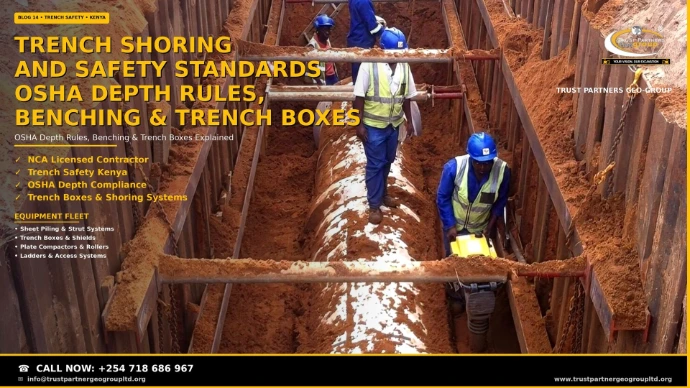
Trench Shoring and Safety Standards in Kenya: OSHA Depth Rules, Benching and Trench Boxes Explained
A cubic metre of soil weighs up to two tonnes, and it does not ask permission before it moves. The depth rules, protection systems and the competent-person regime that keep trench crews alive.

1. The Trench Collapse Problem
The standards below govern every metre of trenching in our services portfolio — applied by Trust Partners Geo-Group under our trench digging service with named competent persons on every run.
Trench collapses kill more construction workers than any other excavation failure mode, and the fatalities cluster exactly where instinct says safety is optional: trenches under 2.5 metres deep, the 'shallow enough to skip it' band. The physics explains the confidence trap — soil looks solid, stands for hours, even days; then one rain, one vibration, one surcharge converts it to a fluid that fills the trench in seconds. A single cubic metre weighs 1.5–2 tonnes; a collapse along a worker's full body length is measured in tonnes, pressing the chest beyond the ability to breathe. Survival odds drop steeply after minutes, which is why the entire discipline below — depths, systems, access, inspections — is organised around one principle: the trench must never be allowed to trap anyone, because rescue is excavation. The digging craft itself — dimensions, machines, rates — is covered in our trench digging guide for Kenya; this article governs the safety that surrounds it.
2. The 1.5-Metre Rule & Soil Classification
The trigger is 1.5 metres: OSHA-aligned practice and Kenyan safety standards require a protective system for any trench deeper than 1.5m where workers enter. The deeper insight is that depth alone understates danger: sandy, silty, waterlogged or previously disturbed soils fail shallower; spoil piles, plant and traffic surcharge the faces; even 1.2m trenches have buried workers. Professional sites therefore classify soils — competent, average, weak — and require protection from shallower depths in the weaker classes, with the classification signed by the competent person and revisited at every change of ground. The rule is the floor of the discipline, not its ceiling: if a worker's head is below ground level and the walls are neither supported nor cut back to a safe angle, the trench needs a designed protective system — full stop.
3. The Three Protection Philosophies
| System | How It Works | Where It Wins | 2026 Cost |
|---|---|---|---|
| Sloping / benching | Walls cut back — slope ~1.5:1, or stepped benches | Open ground, space to spare | No steel; 2–3× excavation volume |
| Shoring | Walls braced in place — timber, hydraulic struts, sheets | Trench shape must be preserved (services, formwork) | KES 500–1,500 per m of trench |
| Shielding (trench boxes) | Steel box protects crew inside; advances with the work | Urban runs, unstable ground, speed | Box hire KES 500–1,500/m/week |
Protection runs 15–30% of trench cost whichever system wins — the cheapest life insurance and the cheapest schedule insurance in earthworks. A quote without a protection line is not cheaper; it is unpriced.
4. Trench Boxes & Shoring in Practice
The urban standard, run with discipline: the box is lowered by the excavator onto a prepared base — never dragged carelessly through fresh faces; spoil, plant and materials stay a metre clear of the edge; the crew works inside as the box advances in increments — the excavation ahead never outrunning the box's leading edge by more than the manufacturer's safe distance, typically a metre; junctions adapt with stacked units. What makes boxes safe is not just the steel: boxes rated for the actual depth — ratings shrink as soil weakens; no climbing on spreaders; and ladder access inside the protected zone, because a ladder outside a box is decoration to a buried worker.
5. Access, Egress & Atmospheric Hazards
- Ladders or ramps for any trench 1.2m or deeper, within 7.5m lateral travel of every worker — trouble must reach daylight in seconds.
- Ladders extending a metre above the landing for a handhold.
- Spoil and materials a metre from the edge — the surcharge that triggers so many collapses.
- Plant routes kept clear of edges, or verified for edge load capacity.
- Barricading on any run the public can approach.
- Atmospheric testing before and during work in deeper or suspect ground — silts, fill, fuel proximity — under confined-space procedures with standby rescue where gas is possible.
None of these lines is expensive; every one of them appears on the accident report when it is missing.
6. The Competent Person & Inspection Regime
The named individual with authority and knowledge to spot hazards and stop the work — a legal role under the OSHA framework Kenyan sites apply, not a courtesy title. Duties: soil classification at every ground change; daily inspections before every shift; re-inspection after rain, vibration events or any stability-relevant change; selection and verification of protective systems; access and egress checks; atmospheric test records; and the paperwork that proves it all. The developer's single screening question for any trench contractor: name your competent person, show their last inspection record. The answer — or its absence — is the safety audit. The wider framework they operate within is mapped in our guide to the top ten safe excavation factors.
7. What Protection Costs 2026
| Item | Basis | 2026 Band (KES) |
|---|---|---|
| Trench boxes / shields (hire) | per metre of box, per week | 500–1,500 |
| Hydraulic shoring sets | per set per week | 3,000–8,000 |
| Sheeting & strutting (installed) | per m of trench | 500–1,500 |
| Protection share of trench cost | total | 15–30% |
| Competent person & inspection regime | per project | Professional standard, priced in |
Against a single collapse — medical costs, enforcement, programme, litigation, and the unpriceable — protection is the cheapest line on the trench bill. The calculator prices trench scopes with protection included.
8. Frequently Asked Questions
The trigger is 1.5 metres — OSHA-aligned practice and Kenyan safety standards require a protective system for any trench deeper than 1.5 metres where workers enter, and the deeper insight is that depth alone understates the danger: sandy, silty, waterlogged or previously disturbed soils can fail shallower, and even 1.2-metre trenches have buried workers where soil sloughed or a surcharge — spoil piles, plant, traffic — pressed the face. The classification approach used on professional sites assigns soils into strength classes and requires protection from shallower depths in the weaker ones. The practical rule for any Kenyan site: if a worker's head will be below ground level and the walls are not mechanically supported or cut back to a safe angle, the trench needs a designed protective system — box, shields, hydraulic shoring or a benched/battered profile — selected by a competent person whose name appears on the method statement. The 1.5-metre line is the legal floor of the discipline, not its ceiling.
Three philosophies of the same protection. Sloping and benching cut the trench walls back so no unsupported face stands: sloping lays the wall back at a safe angle — roughly 1.5 horizontal to 1 vertical in average soils, flatter in weak ones — while benching steps the sides in horizontal shelves. Cost: no steel, but two to three times the excavation volume and land take — viable in open ground, rarely in urban corridors. Shoring braces the walls in place so the trench keeps its designed width: timber poling boards, hydraulic struts and walers, or sheeted faces — the walls carry the soil and the trench carries its shape. Shielding — trench boxes and manhole shields — takes the opposite approach: the steel box does not prevent collapse; it protects the workers inside it, dragged or lowered along the run as work advances. Boxes are the urban standard: fast to deploy, quick to move, protective in unstable ground where installing shoring would itself be dangerous. The selection logic: space and soil allow benching; trench shape must be preserved — services, formwork — shoring; speed and uncertainty — boxes. Costed: protection runs 15–30% of trench cost whichever system wins.
A trench box — trench shield — is a steel-walled, open-topped frame with two spreader bars holding the walls apart: the box does not hold the trench up; it keeps the soil off the crew. Installation and advance follow a strict sequence: the box is lowered into the excavation by the excavator — never dragged through freshly dug faces without care — and rests on a prepared base at the work depth; the crew works inside it, and spoil, plant and materials stay at least a metre from the edge; as work advances, the excavator drags the box forward in increments, the excavation ahead never outrunning the box's leading edge by more than the safe distance the manufacturer's data allows — typically a metre or less; and at manholes or junctions, boxes adapt with stacked or modified units. What makes boxes safe is discipline, not just steel: boxes rated for the depth actually used — depth ratings shrink as soil weakens; no climbing on spreaders; and ladder access inside the protected zone. Hire runs KES 500–1,500 per metre of box per week in the Nairobi market, and a competent box program costs less than one collapsed trench — by any arithmetic that counts lives or money.
The named individual with the authority and knowledge to spot trench hazards and stop the work — a legal role under the OSHA framework Kenyan sites apply, not a courtesy title. The competent person's working definition: someone capable of identifying existing and predictable hazards in the surroundings and work conditions — soil behaviour, water, surcharges, vibrations, atmospheres — with authority to take prompt corrective measures, including stopping the job. Their duties on a trenching programme: soil classification at every significant change of ground; the daily inspection regime — every trench, every shift, before work starts; re-inspection after rainstorms, vibration events, thaw or any change that could affect stability; the selection and verification of protective systems; the access and egress checks — ladders within 7.5 metres of lateral travel for trenches from 1.2 metres deep; the atmospheric tests before and during work in deeper or suspect ground, where oxygen deficiency and gases kill silently; and the records that prove all of it. Developers should ask one question of any trench contractor: name your competent person and show their last inspection record. The answer — or its absence — tells you everything about how your trench will run.
The access rules that keep a protected trench a survivable one: ladders or ramps for any trench 1.2 metres or deeper, positioned within 7.5 metres of lateral travel from every worker — a worker in trouble must reach daylight in seconds, not minutes; ladders extending a metre above the landing for a handhold; access inside the protected zone — a ladder outside a trench box is decoration, because the worker inside cannot reach it through a collapse. Around the trench: spoil piles and materials at least a metre from the edge — the surcharge that triggers so many collapses; plant routes routed away from edges, or verified for edge load capacity; and barricading or fencing on any run the public can approach. For deeper or suspect ground — silts, fill, proximity to fuel or sewers — atmospheric testing before entry and continuous monitoring where gas is possible, under confined-space procedures with standby rescue arrangements. None of these lines is expensive; every one of them is on the accident report when it is missing. The wider excavation safety architecture sits in our guide to the top ten factors that determine safe excavation.
Every Trench Protected. Every Shift Inspected. Every Crew Home.
Trust Partners Geo-Group Ltd digs utility and drainage trenches across Kenya with OSHA-aligned protection systems, certified trench boxes, named competent persons and documented daily inspections — safety as method, not poster.
Price a Protected Trench Scope✉️ Contact Us
📞 +254 718 68 69 67
Trench Shoring and Safety Standards in Kenya: OSHA Depth Rules, Benching and Trench Boxes Explained
A cubic metre of soil weighs up to two tonnes, and it does not ask permission before it moves. The depth rules, protection systems and the competent-person regime that keep trench crews alive.
1. The Trench Collapse Problem
The standards below govern every metre of trenching in our services portfolio — applied by Trust Partners Geo-Group under our trench digging service with named competent persons on every run.
Trench collapses kill more construction workers than any other excavation failure mode, and the fatalities cluster exactly where instinct says safety is optional: trenches under 2.5 metres deep, the 'shallow enough to skip it' band. The physics explains the confidence trap — soil looks solid, stands for hours, even days; then one rain, one vibration, one surcharge converts it to a fluid that fills the trench in seconds. A single cubic metre weighs 1.5–2 tonnes; a collapse along a worker's full body length is measured in tonnes, pressing the chest beyond the ability to breathe. Survival odds drop steeply after minutes, which is why the entire discipline below — depths, systems, access, inspections — is organised around one principle: the trench must never be allowed to trap anyone, because rescue is excavation. The digging craft itself — dimensions, machines, rates — is covered in our trench digging guide for Kenya; this article governs the safety that surrounds it.
2. The 1.5-Metre Rule & Soil Classification
The trigger is 1.5 metres: OSHA-aligned practice and Kenyan safety standards require a protective system for any trench deeper than 1.5m where workers enter. The deeper insight is that depth alone understates danger: sandy, silty, waterlogged or previously disturbed soils fail shallower; spoil piles, plant and traffic surcharge the faces; even 1.2m trenches have buried workers. Professional sites therefore classify soils — competent, average, weak — and require protection from shallower depths in the weaker classes, with the classification signed by the competent person and revisited at every change of ground. The rule is the floor of the discipline, not its ceiling: if a worker's head is below ground level and the walls are neither supported nor cut back to a safe angle, the trench needs a designed protective system — full stop.
3. The Three Protection Philosophies
| System | How It Works | Where It Wins | 2026 Cost |
|---|---|---|---|
| Sloping / benching | Walls cut back — slope ~1.5:1, or stepped benches | Open ground, space to spare | No steel; 2–3× excavation volume |
| Shoring | Walls braced in place — timber, hydraulic struts, sheets | Trench shape must be preserved (services, formwork) | KES 500–1,500 per m of trench |
| Shielding (trench boxes) | Steel box protects crew inside; advances with the work | Urban runs, unstable ground, speed | Box hire KES 500–1,500/m/week |
Protection runs 15–30% of trench cost whichever system wins — the cheapest life insurance and the cheapest schedule insurance in earthworks. A quote without a protection line is not cheaper; it is unpriced.
4. Trench Boxes & Shoring in Practice
The urban standard, run with discipline: the box is lowered by the excavator onto a prepared base — never dragged carelessly through fresh faces; spoil, plant and materials stay a metre clear of the edge; the crew works inside as the box advances in increments — the excavation ahead never outrunning the box's leading edge by more than the manufacturer's safe distance, typically a metre; junctions adapt with stacked units. What makes boxes safe is not just the steel: boxes rated for the actual depth — ratings shrink as soil weakens; no climbing on spreaders; and ladder access inside the protected zone, because a ladder outside a box is decoration to a buried worker.
5. Access, Egress & Atmospheric Hazards
- Ladders or ramps for any trench 1.2m or deeper, within 7.5m lateral travel of every worker — trouble must reach daylight in seconds.
- Ladders extending a metre above the landing for a handhold.
- Spoil and materials a metre from the edge — the surcharge that triggers so many collapses.
- Plant routes kept clear of edges, or verified for edge load capacity.
- Barricading on any run the public can approach.
- Atmospheric testing before and during work in deeper or suspect ground — silts, fill, fuel proximity — under confined-space procedures with standby rescue where gas is possible.
None of these lines is expensive; every one of them appears on the accident report when it is missing.
6. The Competent Person & Inspection Regime
The named individual with authority and knowledge to spot hazards and stop the work — a legal role under the OSHA framework Kenyan sites apply, not a courtesy title. Duties: soil classification at every ground change; daily inspections before every shift; re-inspection after rain, vibration events or any stability-relevant change; selection and verification of protective systems; access and egress checks; atmospheric test records; and the paperwork that proves it all. The developer's single screening question for any trench contractor: name your competent person, show their last inspection record. The answer — or its absence — is the safety audit. The wider framework they operate within is mapped in our guide to the top ten safe excavation factors.
7. What Protection Costs 2026
| Item | Basis | 2026 Band (KES) |
|---|---|---|
| Trench boxes / shields (hire) | per metre of box, per week | 500–1,500 |
| Hydraulic shoring sets | per set per week | 3,000–8,000 |
| Sheeting & strutting (installed) | per m of trench | 500–1,500 |
| Protection share of trench cost | total | 15–30% |
| Competent person & inspection regime | per project | Professional standard, priced in |
Against a single collapse — medical costs, enforcement, programme, litigation, and the unpriceable — protection is the cheapest line on the trench bill. The calculator prices trench scopes with protection included.
8. Frequently Asked Questions
The trigger is 1.5 metres — OSHA-aligned practice and Kenyan safety standards require a protective system for any trench deeper than 1.5 metres where workers enter, and the deeper insight is that depth alone understates the danger: sandy, silty, waterlogged or previously disturbed soils can fail shallower, and even 1.2-metre trenches have buried workers where soil sloughed or a surcharge — spoil piles, plant, traffic — pressed the face. The classification approach used on professional sites assigns soils into strength classes and requires protection from shallower depths in the weaker ones. The practical rule for any Kenyan site: if a worker's head will be below ground level and the walls are not mechanically supported or cut back to a safe angle, the trench needs a designed protective system — box, shields, hydraulic shoring or a benched/battered profile — selected by a competent person whose name appears on the method statement. The 1.5-metre line is the legal floor of the discipline, not its ceiling.
Three philosophies of the same protection. Sloping and benching cut the trench walls back so no unsupported face stands: sloping lays the wall back at a safe angle — roughly 1.5 horizontal to 1 vertical in average soils, flatter in weak ones — while benching steps the sides in horizontal shelves. Cost: no steel, but two to three times the excavation volume and land take — viable in open ground, rarely in urban corridors. Shoring braces the walls in place so the trench keeps its designed width: timber poling boards, hydraulic struts and walers, or sheeted faces — the walls carry the soil and the trench carries its shape. Shielding — trench boxes and manhole shields — takes the opposite approach: the steel box does not prevent collapse; it protects the workers inside it, dragged or lowered along the run as work advances. Boxes are the urban standard: fast to deploy, quick to move, protective in unstable ground where installing shoring would itself be dangerous. The selection logic: space and soil allow benching; trench shape must be preserved — services, formwork — shoring; speed and uncertainty — boxes. Costed: protection runs 15–30% of trench cost whichever system wins.
A trench box — trench shield — is a steel-walled, open-topped frame with two spreader bars holding the walls apart: the box does not hold the trench up; it keeps the soil off the crew. Installation and advance follow a strict sequence: the box is lowered into the excavation by the excavator — never dragged through freshly dug faces without care — and rests on a prepared base at the work depth; the crew works inside it, and spoil, plant and materials stay at least a metre from the edge; as work advances, the excavator drags the box forward in increments, the excavation ahead never outrunning the box's leading edge by more than the safe distance the manufacturer's data allows — typically a metre or less; and at manholes or junctions, boxes adapt with stacked or modified units. What makes boxes safe is discipline, not just steel: boxes rated for the depth actually used — depth ratings shrink as soil weakens; no climbing on spreaders; and ladder access inside the protected zone. Hire runs KES 500–1,500 per metre of box per week in the Nairobi market, and a competent box program costs less than one collapsed trench — by any arithmetic that counts lives or money.
The named individual with the authority and knowledge to spot trench hazards and stop the work — a legal role under the OSHA framework Kenyan sites apply, not a courtesy title. The competent person's working definition: someone capable of identifying existing and predictable hazards in the surroundings and work conditions — soil behaviour, water, surcharges, vibrations, atmospheres — with authority to take prompt corrective measures, including stopping the job. Their duties on a trenching programme: soil classification at every significant change of ground; the daily inspection regime — every trench, every shift, before work starts; re-inspection after rainstorms, vibration events, thaw or any change that could affect stability; the selection and verification of protective systems; the access and egress checks — ladders within 7.5 metres of lateral travel for trenches from 1.2 metres deep; the atmospheric tests before and during work in deeper or suspect ground, where oxygen deficiency and gases kill silently; and the records that prove all of it. Developers should ask one question of any trench contractor: name your competent person and show their last inspection record. The answer — or its absence — tells you everything about how your trench will run.
The access rules that keep a protected trench a survivable one: ladders or ramps for any trench 1.2 metres or deeper, positioned within 7.5 metres of lateral travel from every worker — a worker in trouble must reach daylight in seconds, not minutes; ladders extending a metre above the landing for a handhold; access inside the protected zone — a ladder outside a trench box is decoration, because the worker inside cannot reach it through a collapse. Around the trench: spoil piles and materials at least a metre from the edge — the surcharge that triggers so many collapses; plant routes routed away from edges, or verified for edge load capacity; and barricading or fencing on any run the public can approach. For deeper or suspect ground — silts, fill, proximity to fuel or sewers — atmospheric testing before entry and continuous monitoring where gas is possible, under confined-space procedures with standby rescue arrangements. None of these lines is expensive; every one of them is on the accident report when it is missing. The wider excavation safety architecture sits in our guide to the top ten factors that determine safe excavation.
Every Trench Protected. Every Shift Inspected. Every Crew Home.
Trust Partners Geo-Group Ltd digs utility and drainage trenches across Kenya with OSHA-aligned protection systems, certified trench boxes, named competent persons and documented daily inspections — safety as method, not poster.
Price a Protected Trench Scope✉️ Contact Us
📞 +254 718 68 69 67