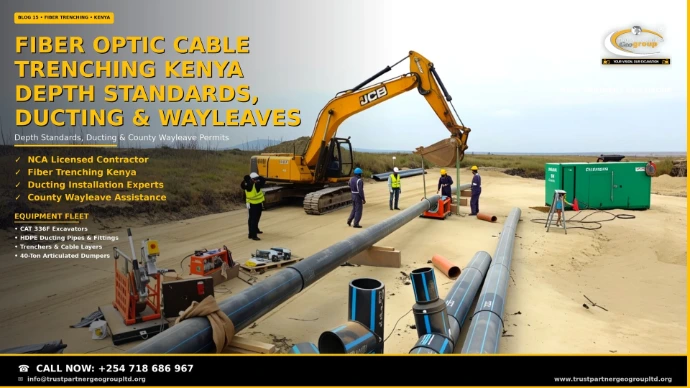
Fiber Optic Cable Trenching in Kenya: Depth Standards, Ducting and County Wayleave Permits
Kenya's connectivity runs through trenches: the depth standards, HDPE ducting systems, installation sequence and the wayleave paperwork that decides whether the dig takes days or months.

1. The Rollout & the Trench That Enables It
Every gigabit promise in Kenya's digital strategy ends in a trench: backbone routes linking counties, metro rings beneath cities, last-mile drops into estates and industrial parks. The digging is the quick part — production crews walk rural runs at 300–500 metres a day in good ground. The disciplines that decide the programme are the standards this guide covers, delivered within our services portfolio by Trust Partners Geo-Group under our trench digging service, with the crew-side safety covered in this cluster's shoring and safety standards.
2. Depth & Trench Standards
| Location | Depth | Width | Reason |
|---|---|---|---|
| Open ground (rural backbone) | 0.9–1.2 m | 300–450 mm | Ploughs, animals, casual digging |
| Road crossings / road reserve | 1.2–1.5 m | Per authority spec | Roadworks & drainage loads |
| Sharing corridors with power | 300–600 mm horizontal separation | Maintenance safety both ways | |
The protection stack: 75mm bedding sand, ducts, 150mm soft cover, warning tape at 150mm below surface, marker posts at direction changes. Depth standards protect the cable from everything except deliberate excavation — the tape and markers exist for that.
3. HDPE Ducting Systems
HDPE is the national standard: 40–50mm internal diameter for main runs, configured to the network design. Single duct for spurs and drops; multi-way bundles — 2, 4, 7-way — on backbones, because spare ways let future cables pull through without new trenches, and the re-trench is the expensive part, with the re-wayleave the most expensive part. Fittings that matter: sweep bends at direction and depth changes — tight elbows kink pulling ropes and shorten cable life; chambers every 250–500 metres and at every branch, sized for a crouching technician and proper bend radius; draw ropes in every duct; end caps against water and fauna. Duct materials run KES 150–400 per metre — the cheapest insurance the network ever buys.
4. The Installation Sequence
- Survey & wayleave — route, crossings, permits secured before mobilisation.
- Trench to depth — formation trimmed, walls safe, spoil managed.
- Bedding — 75mm screened sand protecting ducts from the floor.
- Lay ducts — aligned, jointed, sweeps at changes, ropes in, caps on.
- Warning tape & cover — 150mm soft cover, tape above.
- Chambers — at intervals and junctions, lids at finished level.
- Test before & after pulling — OTDR traces before and after cable installation, proving and locating any damage before handover.
- Backfill & reinstate — compacted layers under roads; markers posted; as-built drawings delivered — the file the next crew trusts with their lives.
5. Wayleaves & Permits: The Paper Critical Path
The stack that gates the dig: county wayleaves for county roads and reserves — drawings, method statements, sometimes public participation; weeks to months by county. Road authority permits — KURA urban, KeNHA national trunk — with their own depth, reinstatement and traffic conditions. Private wayleaves negotiated with crossed landowners. And special-zone consents — parks, rail, pipelines, airports — wherever the route crosses them. The disciplines that keep it fast: survey before applying, standardise the drawing pack, engage counties early. The dig takes days; the paperwork takes months; programmes that reverse that order idle machines.
6. Costs 2026 per Metre
| Scope | 2026 Band (KES/metre) | Drivers |
|---|---|---|
| Rural open ground (soil) | 300–600 | Production pace, haul |
| Urban / constrained corridors | 600–1,200 | Reinstatement, traffic, night windows |
| Road crossings & specials | Priced per section | Depth, concrete protection, supervision |
| Chambers / manholes | 80,000–250,000 each | Size, depth, traffic class |
| Duct materials | 150–400 /m | Diameter, way count |
Production trenching in good ground is the lever that moves every number — and the wayleave calendar is the lever that moves the programme. For pipeline-style heavy ducting comparisons, our pipeline trenching guide covers the bigger-bore end of the corridor business.
7. Working in Live Corridors
Fiber rarely gets a corridor to itself. The rules: scan every alignment — records review, electromagnetic scanning, trial holes at crossings and every 20–30 metres of uncertainty; machine exclusion zones around located services, with spotters controlling every crossing; undocumented services assumed to exist on older corridors, because Nairobi's drawings are archaeology, not geography; and whatever is found unmapped — recorded, reported, and added to the as-built file. A cut fiber trunk costs carriers per-minute penalties; a cut 11kV line costs more than that — the scan is the cheapest line in the budget.
8. Frequently Asked Questions
The working standard on Kenyan fiber builds: 0.9–1.2 metres in open ground — deep enough to escape ploughing, animal traffic and casual digging, shallow enough to keep excavation economical in long rural runs. 1.2–1.5 metres under road crossings, where protection from future roadworks and drainage loads matters most; some authorities specify the deeper band for any crossing of their reserve. Trench width stays modest — 300–450mm — because fiber ducts are small and the backfill cost follows the width. The protection stack on top of depth: 75mm of bedding sand under the ducts, a 150mm cover of soft soil or sand above them, warning tape at 150mm below surface announcing what lies below, and marker posts at changes of direction. Where fiber shares corridors with power, horizontal separation rules apply — typically 300–600mm depending on voltage — because a trench shared too closely becomes a maintenance hazard for both utilities. Depth standards exist to protect the cable from everything except deliberate excavation — and the warning tape and markers exist for that.
HDPE ducting is the national standard: corrugated or smooth-walled high-density polyethylene pipes, typically 40–50mm internal diameter for main runs, in configurations matched to the network design. Single-duct for spur and drop lines; multi-way bundles — 2-way, 4-way, 7-way — along backbone and metro routes, so future cables pull through spare ways without new trenches: the duct install is cheap, the re-trench is expensive, and the wayleave for the re-trench is the expensive part. The fittings matter as much as the pipe: sweep bends at depth changes and direction changes — tight elbows kink pulling ropes and shorten cable life; chambers and manholes at junctions, typically every 250–500 metres and at every branch, sized for a crouching technician and the bend radius of the largest cable; draw ropes left in every duct; and end caps keeping water and fauna out until the cable arrives. Duct materials run KES 150–400 per metre depending on diameter and configuration — a fraction of the installed trench cost, and the cheapest insurance the network ever buys.
A wayleave is the legal permission to place infrastructure through land or road reserve you do not own — and on fiber programmes it is usually the critical path, not the digging. The stack: county wayleaves for trenches along county roads and within county reserves — applied for with drawings, method statements and sometimes public participation, taking weeks to a few months depending on county; road authority permits — KURA for urban roads, KeNHA for national trunk roads — for any crossing or occupation of their reserves, each with their own conditions on depth, reinstatement and traffic management; private wayleaves — negotiated agreements with landowners whose plots the route crosses, compensating access and disturbance; and where routes cross special zones — parks, rail, pipelines, airports — the relevant authority's consent joins the file. Costs vary wildly by authority and route: budget fees, application costs and the time value of the wait. The practical disciplines that keep wayleaves fast: survey the route before applying, standardise the drawing pack, and engage the counties early — the dig takes days, the paperwork takes months, and programmes that reverse that order idle machines.
2026 bands for the open-ground rural standard: KES 300–600 per metre in ordinary soil — trench, bedding, ducts, warning tape, layered backfill and compaction, using mini to midi excavators at production pace. Urban and constrained corridors: KES 600–1,200 per metre, the premium buying reinstatement of pavements, traffic management, night or off-peak windows and the tighter logistics of working among live services. Road crossings and special sections price separately — deeper digs, concrete protection, authority supervision. Chambers add KES 80,000–250,000 each depending on size and depth. The wayleave costs sit outside the rate but inside the budget. The efficiency lever that moves every number: production trenching — the right machine class walking straight runs at 300–500 metres per day in good ground — versus stop-start work in congested corridors at a fifth of that pace. Long rural backbone runs price near the bottom of the band; estate and CBD reticulation near the top; and quotes should state which end of the spectrum your route inhabits before the digger mobilises.
The sequence that protects the network before it carries a single packet: survey and wayleave first — the route, the crossings, the permits. Trench to depth and trim — formation level, walls safe, spoil managed. Bedding — 75mm of sand or fine soil, screened, protecting the duct from the trench floor's irregularities. Lay ducts — aligned, jointed with proper couplers, sweep bends at changes, draw ropes in, end caps on. Warning tape and cover — 150mm of soft cover, tape above, then the first backfill lifts. Chambers at intervals and junctions, lids level with finished ground. Test before and after pulling — OTDR traces on the cable before installation and after, so any damage is proven, located and repaired before handover. Backfill and reinstate — compacted layers to specification under roads, restoration of surfaces, markers posted. Then the as-built drawings — because the next crew to open that ground will trust them with their lives. The trench-side safety discipline for the crew meanwhile follows the shoring and safety standards from this cluster.
Dig the Route. Pull the Country Forward.
Trust Partners Geo-Group Ltd trenches fiber and utility corridors across Kenya — production rural runs, urban reticulation, ducting, chambers, wayleave support and the as-built documentation carriers hand down for decades.
Price Your Route on the Calculator✉️ Contact Us
📞 +254 718 68 69 67
Fiber Optic Cable Trenching in Kenya: Depth Standards, Ducting and County Wayleave Permits
Kenya's connectivity runs through trenches: the depth standards, HDPE ducting systems, installation sequence and the wayleave paperwork that decides whether the dig takes days or months.
1. The Rollout & the Trench That Enables It
Every gigabit promise in Kenya's digital strategy ends in a trench: backbone routes linking counties, metro rings beneath cities, last-mile drops into estates and industrial parks. The digging is the quick part — production crews walk rural runs at 300–500 metres a day in good ground. The disciplines that decide the programme are the standards this guide covers, delivered within our services portfolio by Trust Partners Geo-Group under our trench digging service, with the crew-side safety covered in this cluster's shoring and safety standards.
2. Depth & Trench Standards
| Location | Depth | Width | Reason |
|---|---|---|---|
| Open ground (rural backbone) | 0.9–1.2 m | 300–450 mm | Ploughs, animals, casual digging |
| Road crossings / road reserve | 1.2–1.5 m | Per authority spec | Roadworks & drainage loads |
| Sharing corridors with power | 300–600 mm horizontal separation | Maintenance safety both ways | |
The protection stack: 75mm bedding sand, ducts, 150mm soft cover, warning tape at 150mm below surface, marker posts at direction changes. Depth standards protect the cable from everything except deliberate excavation — the tape and markers exist for that.
3. HDPE Ducting Systems
HDPE is the national standard: 40–50mm internal diameter for main runs, configured to the network design. Single duct for spurs and drops; multi-way bundles — 2, 4, 7-way — on backbones, because spare ways let future cables pull through without new trenches, and the re-trench is the expensive part, with the re-wayleave the most expensive part. Fittings that matter: sweep bends at direction and depth changes — tight elbows kink pulling ropes and shorten cable life; chambers every 250–500 metres and at every branch, sized for a crouching technician and proper bend radius; draw ropes in every duct; end caps against water and fauna. Duct materials run KES 150–400 per metre — the cheapest insurance the network ever buys.
4. The Installation Sequence
- Survey & wayleave — route, crossings, permits secured before mobilisation.
- Trench to depth — formation trimmed, walls safe, spoil managed.
- Bedding — 75mm screened sand protecting ducts from the floor.
- Lay ducts — aligned, jointed, sweeps at changes, ropes in, caps on.
- Warning tape & cover — 150mm soft cover, tape above.
- Chambers — at intervals and junctions, lids at finished level.
- Test before & after pulling — OTDR traces before and after cable installation, proving and locating any damage before handover.
- Backfill & reinstate — compacted layers under roads; markers posted; as-built drawings delivered — the file the next crew trusts with their lives.
5. Wayleaves & Permits: The Paper Critical Path
The stack that gates the dig: county wayleaves for county roads and reserves — drawings, method statements, sometimes public participation; weeks to months by county. Road authority permits — KURA urban, KeNHA national trunk — with their own depth, reinstatement and traffic conditions. Private wayleaves negotiated with crossed landowners. And special-zone consents — parks, rail, pipelines, airports — wherever the route crosses them. The disciplines that keep it fast: survey before applying, standardise the drawing pack, engage counties early. The dig takes days; the paperwork takes months; programmes that reverse that order idle machines.
6. Costs 2026 per Metre
| Scope | 2026 Band (KES/metre) | Drivers |
|---|---|---|
| Rural open ground (soil) | 300–600 | Production pace, haul |
| Urban / constrained corridors | 600–1,200 | Reinstatement, traffic, night windows |
| Road crossings & specials | Priced per section | Depth, concrete protection, supervision |
| Chambers / manholes | 80,000–250,000 each | Size, depth, traffic class |
| Duct materials | 150–400 /m | Diameter, way count |
Production trenching in good ground is the lever that moves every number — and the wayleave calendar is the lever that moves the programme. For pipeline-style heavy ducting comparisons, our pipeline trenching guide covers the bigger-bore end of the corridor business.
7. Working in Live Corridors
Fiber rarely gets a corridor to itself. The rules: scan every alignment — records review, electromagnetic scanning, trial holes at crossings and every 20–30 metres of uncertainty; machine exclusion zones around located services, with spotters controlling every crossing; undocumented services assumed to exist on older corridors, because Nairobi's drawings are archaeology, not geography; and whatever is found unmapped — recorded, reported, and added to the as-built file. A cut fiber trunk costs carriers per-minute penalties; a cut 11kV line costs more than that — the scan is the cheapest line in the budget.
8. Frequently Asked Questions
The working standard on Kenyan fiber builds: 0.9–1.2 metres in open ground — deep enough to escape ploughing, animal traffic and casual digging, shallow enough to keep excavation economical in long rural runs. 1.2–1.5 metres under road crossings, where protection from future roadworks and drainage loads matters most; some authorities specify the deeper band for any crossing of their reserve. Trench width stays modest — 300–450mm — because fiber ducts are small and the backfill cost follows the width. The protection stack on top of depth: 75mm of bedding sand under the ducts, a 150mm cover of soft soil or sand above them, warning tape at 150mm below surface announcing what lies below, and marker posts at changes of direction. Where fiber shares corridors with power, horizontal separation rules apply — typically 300–600mm depending on voltage — because a trench shared too closely becomes a maintenance hazard for both utilities. Depth standards exist to protect the cable from everything except deliberate excavation — and the warning tape and markers exist for that.
HDPE ducting is the national standard: corrugated or smooth-walled high-density polyethylene pipes, typically 40–50mm internal diameter for main runs, in configurations matched to the network design. Single-duct for spur and drop lines; multi-way bundles — 2-way, 4-way, 7-way — along backbone and metro routes, so future cables pull through spare ways without new trenches: the duct install is cheap, the re-trench is expensive, and the wayleave for the re-trench is the expensive part. The fittings matter as much as the pipe: sweep bends at depth changes and direction changes — tight elbows kink pulling ropes and shorten cable life; chambers and manholes at junctions, typically every 250–500 metres and at every branch, sized for a crouching technician and the bend radius of the largest cable; draw ropes left in every duct; and end caps keeping water and fauna out until the cable arrives. Duct materials run KES 150–400 per metre depending on diameter and configuration — a fraction of the installed trench cost, and the cheapest insurance the network ever buys.
A wayleave is the legal permission to place infrastructure through land or road reserve you do not own — and on fiber programmes it is usually the critical path, not the digging. The stack: county wayleaves for trenches along county roads and within county reserves — applied for with drawings, method statements and sometimes public participation, taking weeks to a few months depending on county; road authority permits — KURA for urban roads, KeNHA for national trunk roads — for any crossing or occupation of their reserves, each with their own conditions on depth, reinstatement and traffic management; private wayleaves — negotiated agreements with landowners whose plots the route crosses, compensating access and disturbance; and where routes cross special zones — parks, rail, pipelines, airports — the relevant authority's consent joins the file. Costs vary wildly by authority and route: budget fees, application costs and the time value of the wait. The practical disciplines that keep wayleaves fast: survey the route before applying, standardise the drawing pack, and engage the counties early — the dig takes days, the paperwork takes months, and programmes that reverse that order idle machines.
2026 bands for the open-ground rural standard: KES 300–600 per metre in ordinary soil — trench, bedding, ducts, warning tape, layered backfill and compaction, using mini to midi excavators at production pace. Urban and constrained corridors: KES 600–1,200 per metre, the premium buying reinstatement of pavements, traffic management, night or off-peak windows and the tighter logistics of working among live services. Road crossings and special sections price separately — deeper digs, concrete protection, authority supervision. Chambers add KES 80,000–250,000 each depending on size and depth. The wayleave costs sit outside the rate but inside the budget. The efficiency lever that moves every number: production trenching — the right machine class walking straight runs at 300–500 metres per day in good ground — versus stop-start work in congested corridors at a fifth of that pace. Long rural backbone runs price near the bottom of the band; estate and CBD reticulation near the top; and quotes should state which end of the spectrum your route inhabits before the digger mobilises.
The sequence that protects the network before it carries a single packet: survey and wayleave first — the route, the crossings, the permits. Trench to depth and trim — formation level, walls safe, spoil managed. Bedding — 75mm of sand or fine soil, screened, protecting the duct from the trench floor's irregularities. Lay ducts — aligned, jointed with proper couplers, sweep bends at changes, draw ropes in, end caps on. Warning tape and cover — 150mm of soft cover, tape above, then the first backfill lifts. Chambers at intervals and junctions, lids level with finished ground. Test before and after pulling — OTDR traces on the cable before installation and after, so any damage is proven, located and repaired before handover. Backfill and reinstate — compacted layers to specification under roads, restoration of surfaces, markers posted. Then the as-built drawings — because the next crew to open that ground will trust them with their lives. The trench-side safety discipline for the crew meanwhile follows the shoring and safety standards from this cluster.
Dig the Route. Pull the Country Forward.
Trust Partners Geo-Group Ltd trenches fiber and utility corridors across Kenya — production rural runs, urban reticulation, ducting, chambers, wayleave support and the as-built documentation carriers hand down for decades.
Price Your Route on the Calculator✉️ Contact Us
📞 +254 718 68 69 67