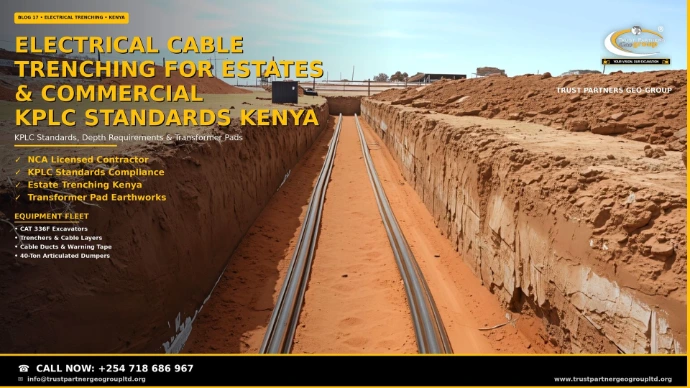
Electrical Cable Trenching for Estates and Commercial Projects in Kenya: KPLC Standards and Depths
Estate power runs underground — and Kenya Power's standards decide whether your network gets connected, inspected and maintained. Depths, protection, transformer pads and the tests before backfill.

1. KPLC Standards & Depth Requirements
Every estate and commercial development that connects to Kenya Power's network inherits its burial standards — the depths, protections and inspection rituals that decide whether the connection proceeds. The core requirements on a compliant build, delivered within our services portfolio by Trust Partners Geo-Group under our trench digging service:
- Depth: LV runs at 0.9–1.2 metres; HV and road crossings at 1.2–1.5 metres — final word in the KPLC-approved drawings.
- Protection: fine bedding under the cable, protective tiles or half-hoops above, warning tape announcing the route.
- Ducting on reticulation: HDPE ducts in developed areas — cables pull through ways rather than direct burial, easing maintenance and upgrades.
- Separation: horizontal clearances from water, sewer and telecom — shared trenches become hazards for every utility.
- Inspection before backfill: the KPLC inspector walks the open trench; only their sign-off authorises covering.
Compliance is not decoration: networks built to standard get connected and maintained; networks that shortcut it get rejected at inspection — and re-excavation is the most expensive construction method known.
2. Trench Geometry & Cable Protection
| Element | Specification | Purpose |
|---|---|---|
| Trench width (single LV circuit) | 450–600 mm | Working room without backfill waste |
| Bedding | 75–100 mm screened fine material | No point loads on cable or ducts |
| Sweep bends (ducted runs) | Manufacturer radius, formed not kinked | Pulling and cable life |
| Protection | Tiles or half-hoops directly above | Spade and pick defence |
| Cover & tape | 150 mm fine cover; tape at 150 mm below surface | Early warning for every future dig |
| Backfill | Layered, compacted — backfill standards | Surfaces that stay level |
Depth without the stack fails; the stack without depth fails sooner. Both, inspected, is the standard.
3. Transformer Pads: The Earthworks
The pad carrying an estate's transformer is a specialist earthworks scope inside the trenching programme: excavation for plinth and bund — 3–8 m³ by transformer size, floor compacted to specification; the plinth — mass concrete sized to footprint, weight and margin, top at design level, cable trenches entering the right faces; the bund — sized to retain the transformer's oil plus rainwater margin, because a burst transformer must not drain into the soil; earthing — earth pit and electrode beside the pad, excavated, driven, backfilled with earthing compound, resistance tested — the invisible half of electrical safety; and the entering trenches — HV and LV routes meeting the plinth with duct or cable interfaces formed. Costed: pad earthworks and plinth KES 150,000–400,000 by class; earthing KES 40,000–120,000 tested.
4. Tests & Inspection Before Backfill
- Physical inspection — KPLC walks the open run: depth, bedding, alignment, bend radii, protection seated, tape positioned, separations honoured.
- Insulation resistance — between conductors and to earth, every length, before covering.
- Continuity — on laid runs, logged.
- HV DC testing — where the specification demands, on main distribution lengths.
- Earthing resistance — at pads and substations, against design values.
- Then backfill — layered and certified per this cluster's backfill standards, with as-builts recording what the ground now holds.
The tests are cheap, the backfill is final, and the network is only as good as what was proven before it was covered.
5. Sequencing With Roads & Other Services
Estate electrical runs share the ground with everything else, and the order decides the cost. The professional sequence: electrical and other utility trenches first, before roads and pavements exist — because opening finished surfaces is the premium option; crossings resolved in the drawing phase — electrical over or under water and sewer, with separations maintained, at right angles where they must cross; and the trench protection discipline active wherever crews work among live services. Developers who sequence utilities before surfaces save multiples; those who reverse it fund the re-excavation of their own asphalt.
6. Costs 2026
| Scope | 2026 Band (KES) | Drivers |
|---|---|---|
| LV estate reticulation (open ground) | 350–700 per m | Soil, production, ducting |
| HV runs & road crossings | 600–1,200 per m | Depth, protection, inspection |
| Congested commercial corridors | to 1,500 per m | Reinstatement, coordination |
| Transformer pad earthworks & plinth | 150,000–400,000 | Transformer class |
| Earthing installation (tested) | 40,000–120,000 | Electrode count, soil resistivity |
Insist on itemised quotes — bedding, protection, tape, backfill and inspection attendance as separate lines. Those are the lines stripped from 'competitive' bids and discovered by the inspector in the open trench.
7. The Compliance Path to Connection
The route from trench to transformer energised: KPLC-approved drawings before mobilisation; approved materials — ducts, cables, protection, warning tape to specification; inspection attendance scheduled, not hoped for; tests logged and certificates filed; as-built drawings delivered. Each step is cheap in sequence and ruinous in reverse. The digging and backfilling crafts complete the picture in this cluster's trench digging guide and backfill standards.
8. Frequently Asked Questions
Kenya Power's distribution standards govern how their networks — and the estate and commercial networks that connect to them — are buried, and the core requirements on any compliant build: depth — low-voltage runs at a minimum of about 0.9 metres, high-voltage and road crossings deeper at 1.2–1.5 metres, with the final word in the project's KPLC-approved drawings; protection — bedding of fine material under the cable, a protective covering of tiles or half-hoops above it, and warning tape announcing the line; ducting on estate reticulation — HDPE ducts for LV networks in developed areas, so cables pull through ways rather than direct burial, easing maintenance and future upgrades; separation from other services — horizontal clearances from water, sewer and telecom lines, because shared trenches become maintenance hazards for every utility; and inspection before backfill — the KPLC inspector walks the open trench, verifies depths, bedding and protection, and only then authorises covering. Compliance is not optional decoration: networks built to standard get connected, tested and maintained; networks that shortcut the standard get rejected at inspection, and re-excavation is the most expensive construction method known.
By voltage class and location, on the KPLC-aligned bands: low-voltage estate and commercial runs — 0.9 to 1.2 metres, the depth that escapes cultivation, casual digging and light construction; high-voltage and main distribution runs — 1.2 to 1.5 metres, with deeper cover where routes cross roads, heavy-load areas or future construction zones; road crossings — deeper again with ducted installation and often concrete protection, because the road above will be opened again someday. Trench width stays lean — 450–600mm for single-circuit LV — because width is backfill cost. The protection stack that makes the depth work: 75–100mm of screened bedding under the cable or duct, the cable laid to the designed alignment with sweep bends where ducts turn, protective tiles or half-hoops directly above, 150mm of fine cover, warning tape at 150mm below surface, then compacted backfill in layers. Depth without the stack fails; the stack without depth fails sooner. Both, verified by inspection, is the standard.
The transformer pad is the plinth that carries the distribution transformer serving an estate or commercial site — and its earthworks are a specialist little discipline inside the trenching programme. The scope: excavation for the plinth and bund — typically a pit of 3–8 m³ depending on transformer size, with the pit floor compacted to specification; the plinth — mass concrete, sized to the transformer's footprint and weight plus a margin, plinth top at the designed level with cable trenches entering from the correct faces; the bund or oil-containment wall around the pad — sized to retain the transformer's oil volume plus rainwater margin, because a burst transformer must not drain its oil into the soil; earthing — the earth pit and electrodes beside the pad, excavated, electrode driven, pit backfilled with earthing compound — the invisible half of electrical safety, tested for resistance before handover; and cable trenches entering the pad from the HV and LV routes, with the duct or cable interface at the plinth face. Costed: pad earthworks and plinth KES 150,000–400,000 by transformer class; earthing installations KES 40,000–120,000 tested. The pad looks like a concrete rectangle; the engineering inside the ground around it is what keeps an estate lit and safe.
2026 bands by class and corridor. LV estate reticulation in open ground — trench, bedding, ducting or direct-burial cable, tiles, tape, layered backfill: KES 350–700 per metre, production crews walking 200–400 metres a day in good soil. HV runs and road crossings: KES 600–1,200 per metre, the premium buying depth, protection and inspection. Congested commercial corridors — reinstatement, traffic management, live-service coordination — up to KES 1,500 per metre. Transformer pads and substation earthworks price per structure: KES 150,000–400,000 for pads, plus earthing tested. The comparison discipline: electrical trenching quotes should itemise bedding, protection, tape, backfill and inspection attendance as separate lines — the lines most likely to be stripped out of a 'competitive' quote, and the lines whose absence KPLC's inspector discovers in the open trench. Price the whole stack on the calculator; compare quotes line by line, not rate by rate.
The verification sequence that turns an open trench into an accepted network: physical inspection first — the KPLC inspector walks the open run: depth check against the drawings, bedding quality, cable or duct alignment, bend radii at direction changes, protection tiles or hoops seated, warning tape positioned, separation from crossing services honoured. Electrical tests on the cable itself — insulation resistance between conductors and to earth, on every length, before it disappears under backfill; continuity checks on laid runs; and where the project specification demands, high-voltage DC testing on main distribution lengths. Earthing tests at pads and substations — electrode resistance measurements, logged against the design values. Then, and only then, the backfill proceeds in the layered specification — with the crew-side safety from this cluster's shoring standards and the compaction evidence from the backfill standards guide — and the as-built drawings record what the ground now holds. The tests are cheap, the backfill is final, and the network is only as good as what was proven before it was covered.
Trench to the Standard. Connect Without Drama.
Trust Partners Geo-Group Ltd delivers KPLC-standard electrical trenching across Kenya — estate reticulation, HV runs, transformer pads, tested earthing, inspection attendance and the as-built file that energises without delay.
Price Your Electrical Trenching✉️ Contact Us
📞 +254 718 68 69 67
Electrical Cable Trenching for Estates and Commercial Projects in Kenya: KPLC Standards and Depths
Estate power runs underground — and Kenya Power's standards decide whether your network gets connected, inspected and maintained. Depths, protection, transformer pads and the tests before backfill.
1. KPLC Standards & Depth Requirements
Every estate and commercial development that connects to Kenya Power's network inherits its burial standards — the depths, protections and inspection rituals that decide whether the connection proceeds. The core requirements on a compliant build, delivered within our services portfolio by Trust Partners Geo-Group under our trench digging service:
- Depth: LV runs at 0.9–1.2 metres; HV and road crossings at 1.2–1.5 metres — final word in the KPLC-approved drawings.
- Protection: fine bedding under the cable, protective tiles or half-hoops above, warning tape announcing the route.
- Ducting on reticulation: HDPE ducts in developed areas — cables pull through ways rather than direct burial, easing maintenance and upgrades.
- Separation: horizontal clearances from water, sewer and telecom — shared trenches become hazards for every utility.
- Inspection before backfill: the KPLC inspector walks the open trench; only their sign-off authorises covering.
Compliance is not decoration: networks built to standard get connected and maintained; networks that shortcut it get rejected at inspection — and re-excavation is the most expensive construction method known.
2. Trench Geometry & Cable Protection
| Element | Specification | Purpose |
|---|---|---|
| Trench width (single LV circuit) | 450–600 mm | Working room without backfill waste |
| Bedding | 75–100 mm screened fine material | No point loads on cable or ducts |
| Sweep bends (ducted runs) | Manufacturer radius, formed not kinked | Pulling and cable life |
| Protection | Tiles or half-hoops directly above | Spade and pick defence |
| Cover & tape | 150 mm fine cover; tape at 150 mm below surface | Early warning for every future dig |
| Backfill | Layered, compacted — backfill standards | Surfaces that stay level |
Depth without the stack fails; the stack without depth fails sooner. Both, inspected, is the standard.
3. Transformer Pads: The Earthworks
The pad carrying an estate's transformer is a specialist earthworks scope inside the trenching programme: excavation for plinth and bund — 3–8 m³ by transformer size, floor compacted to specification; the plinth — mass concrete sized to footprint, weight and margin, top at design level, cable trenches entering the right faces; the bund — sized to retain the transformer's oil plus rainwater margin, because a burst transformer must not drain into the soil; earthing — earth pit and electrode beside the pad, excavated, driven, backfilled with earthing compound, resistance tested — the invisible half of electrical safety; and the entering trenches — HV and LV routes meeting the plinth with duct or cable interfaces formed. Costed: pad earthworks and plinth KES 150,000–400,000 by class; earthing KES 40,000–120,000 tested.
4. Tests & Inspection Before Backfill
- Physical inspection — KPLC walks the open run: depth, bedding, alignment, bend radii, protection seated, tape positioned, separations honoured.
- Insulation resistance — between conductors and to earth, every length, before covering.
- Continuity — on laid runs, logged.
- HV DC testing — where the specification demands, on main distribution lengths.
- Earthing resistance — at pads and substations, against design values.
- Then backfill — layered and certified per this cluster's backfill standards, with as-builts recording what the ground now holds.
The tests are cheap, the backfill is final, and the network is only as good as what was proven before it was covered.
5. Sequencing With Roads & Other Services
Estate electrical runs share the ground with everything else, and the order decides the cost. The professional sequence: electrical and other utility trenches first, before roads and pavements exist — because opening finished surfaces is the premium option; crossings resolved in the drawing phase — electrical over or under water and sewer, with separations maintained, at right angles where they must cross; and the trench protection discipline active wherever crews work among live services. Developers who sequence utilities before surfaces save multiples; those who reverse it fund the re-excavation of their own asphalt.
6. Costs 2026
| Scope | 2026 Band (KES) | Drivers |
|---|---|---|
| LV estate reticulation (open ground) | 350–700 per m | Soil, production, ducting |
| HV runs & road crossings | 600–1,200 per m | Depth, protection, inspection |
| Congested commercial corridors | to 1,500 per m | Reinstatement, coordination |
| Transformer pad earthworks & plinth | 150,000–400,000 | Transformer class |
| Earthing installation (tested) | 40,000–120,000 | Electrode count, soil resistivity |
Insist on itemised quotes — bedding, protection, tape, backfill and inspection attendance as separate lines. Those are the lines stripped from 'competitive' bids and discovered by the inspector in the open trench.
7. The Compliance Path to Connection
The route from trench to transformer energised: KPLC-approved drawings before mobilisation; approved materials — ducts, cables, protection, warning tape to specification; inspection attendance scheduled, not hoped for; tests logged and certificates filed; as-built drawings delivered. Each step is cheap in sequence and ruinous in reverse. The digging and backfilling crafts complete the picture in this cluster's trench digging guide and backfill standards.
8. Frequently Asked Questions
Kenya Power's distribution standards govern how their networks — and the estate and commercial networks that connect to them — are buried, and the core requirements on any compliant build: depth — low-voltage runs at a minimum of about 0.9 metres, high-voltage and road crossings deeper at 1.2–1.5 metres, with the final word in the project's KPLC-approved drawings; protection — bedding of fine material under the cable, a protective covering of tiles or half-hoops above it, and warning tape announcing the line; ducting on estate reticulation — HDPE ducts for LV networks in developed areas, so cables pull through ways rather than direct burial, easing maintenance and future upgrades; separation from other services — horizontal clearances from water, sewer and telecom lines, because shared trenches become maintenance hazards for every utility; and inspection before backfill — the KPLC inspector walks the open trench, verifies depths, bedding and protection, and only then authorises covering. Compliance is not optional decoration: networks built to standard get connected, tested and maintained; networks that shortcut the standard get rejected at inspection, and re-excavation is the most expensive construction method known.
By voltage class and location, on the KPLC-aligned bands: low-voltage estate and commercial runs — 0.9 to 1.2 metres, the depth that escapes cultivation, casual digging and light construction; high-voltage and main distribution runs — 1.2 to 1.5 metres, with deeper cover where routes cross roads, heavy-load areas or future construction zones; road crossings — deeper again with ducted installation and often concrete protection, because the road above will be opened again someday. Trench width stays lean — 450–600mm for single-circuit LV — because width is backfill cost. The protection stack that makes the depth work: 75–100mm of screened bedding under the cable or duct, the cable laid to the designed alignment with sweep bends where ducts turn, protective tiles or half-hoops directly above, 150mm of fine cover, warning tape at 150mm below surface, then compacted backfill in layers. Depth without the stack fails; the stack without depth fails sooner. Both, verified by inspection, is the standard.
The transformer pad is the plinth that carries the distribution transformer serving an estate or commercial site — and its earthworks are a specialist little discipline inside the trenching programme. The scope: excavation for the plinth and bund — typically a pit of 3–8 m³ depending on transformer size, with the pit floor compacted to specification; the plinth — mass concrete, sized to the transformer's footprint and weight plus a margin, plinth top at the designed level with cable trenches entering from the correct faces; the bund or oil-containment wall around the pad — sized to retain the transformer's oil volume plus rainwater margin, because a burst transformer must not drain its oil into the soil; earthing — the earth pit and electrodes beside the pad, excavated, electrode driven, pit backfilled with earthing compound — the invisible half of electrical safety, tested for resistance before handover; and cable trenches entering the pad from the HV and LV routes, with the duct or cable interface at the plinth face. Costed: pad earthworks and plinth KES 150,000–400,000 by transformer class; earthing installations KES 40,000–120,000 tested. The pad looks like a concrete rectangle; the engineering inside the ground around it is what keeps an estate lit and safe.
2026 bands by class and corridor. LV estate reticulation in open ground — trench, bedding, ducting or direct-burial cable, tiles, tape, layered backfill: KES 350–700 per metre, production crews walking 200–400 metres a day in good soil. HV runs and road crossings: KES 600–1,200 per metre, the premium buying depth, protection and inspection. Congested commercial corridors — reinstatement, traffic management, live-service coordination — up to KES 1,500 per metre. Transformer pads and substation earthworks price per structure: KES 150,000–400,000 for pads, plus earthing tested. The comparison discipline: electrical trenching quotes should itemise bedding, protection, tape, backfill and inspection attendance as separate lines — the lines most likely to be stripped out of a 'competitive' quote, and the lines whose absence KPLC's inspector discovers in the open trench. Price the whole stack on the calculator; compare quotes line by line, not rate by rate.
The verification sequence that turns an open trench into an accepted network: physical inspection first — the KPLC inspector walks the open run: depth check against the drawings, bedding quality, cable or duct alignment, bend radii at direction changes, protection tiles or hoops seated, warning tape positioned, separation from crossing services honoured. Electrical tests on the cable itself — insulation resistance between conductors and to earth, on every length, before it disappears under backfill; continuity checks on laid runs; and where the project specification demands, high-voltage DC testing on main distribution lengths. Earthing tests at pads and substations — electrode resistance measurements, logged against the design values. Then, and only then, the backfill proceeds in the layered specification — with the crew-side safety from this cluster's shoring standards and the compaction evidence from the backfill standards guide — and the as-built drawings record what the ground now holds. The tests are cheap, the backfill is final, and the network is only as good as what was proven before it was covered.
Trench to the Standard. Connect Without Drama.
Trust Partners Geo-Group Ltd delivers KPLC-standard electrical trenching across Kenya — estate reticulation, HV runs, transformer pads, tested earthing, inspection attendance and the as-built file that energises without delay.
Price Your Electrical Trenching✉️ Contact Us
📞 +254 718 68 69 67