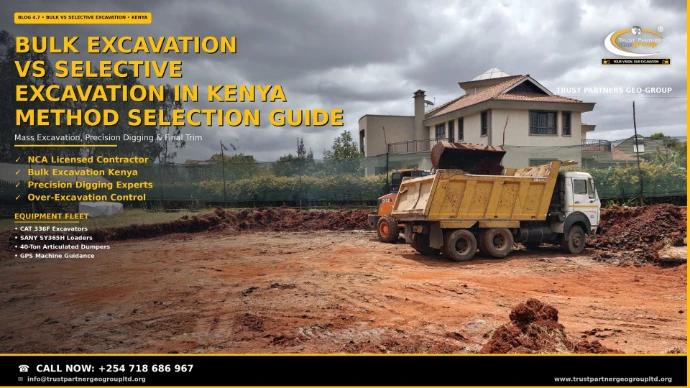
Bulk Excavation vs Selective Excavation in Kenya: Method Selection Guide
Every dig is two jobs wearing one helmet: mass removal at production rates, then precision work at specification tolerances. Choosing where each starts — and what the boundary costs — is the craft this guide teaches.

1. Two Methods, One Site
Bulk and selective excavation are not competing philosophies; they are sequential phases of every competent dig. The confusion costs money when a site applies one method where the other rules: bulk techniques driven into a sensitive formation produce over-excavation, remediation and delay; selective techniques applied to mass earthworks produce gentle, expensive slowness. The guide below prices both honestly and — more usefully — prices the boundary between them, which is where budgets are actually won and lost. Our bulk basement work and the precision trims that follow it are the two halves of one contract.
2. Bulk: Production Economics
| Machine Class | Daily Production (soil) | All-in Rate (KES/m³) | Bulk Sweet Spot |
|---|---|---|---|
| 20t excavator + tippers | 400–800 m³ | 450–750 | Mid-size basements, platforms |
| 30t excavator + tippers | 600–1,200 m³ | 400–700 | The production standard |
| 50t + heavy fleet | 1,200–2,500 m³ | 350–600 | Mega digs, quarry scale |
| Any class in rock | 80–250 m³ (breaking) | 1,500–2,800 | Pre-priced only |
Bulk rewards the system, not the machine: matched tippers sized to the bucket (3–6 passes per load), haul roads maintained to speed, and shift patterns that keep the face loaded. Its enemies are standing time — queues, breakdowns, rain on unfilled faces — every one of which converts directly into cost per m³.
3. Selective: Precision Economics
Selective work trades volume for fidelity, and its rates reflect the operator's attention as much as the iron: 100–300 m³ per day at KES 700–1,500 per m³ for formation-adjacent digging, and per-m² pricing for final trims where tolerance, not volume, is the deliverable. The premium buys: protection of services and structures in congested corridors; segregation of reusable or hazardous materials; the last half-metre above formation where over-dig costs multiply; and working room so tight that production is physically impossible anyway. The economics only work when the specification demands them — selective digging on open uniform ground is theatre — and fail when the specification is vague, because precision without a stated tolerance is unmeasurable and unpriceable.
4. The Hybrid Programme: Sequencing Both
The professional sequence, on almost any significant dig: bulk from the surface at full production; transition zone — roughly the final metre — where production continues but level control tightens and survey checks land every lift; selective band — the last 300mm above formation — dug slowly, from the formation drawings, with the engineer on call; final trim to tolerance, inspection, handover. The transition is where the method statement earns its keep: machines swap (production unit out, precision unit in), operators swap (production crew out, trim specialist in), and the surveyor's levels become the operator's instructions rather than the site's record. Sites that skip the transition discover it anyway — at the formation, where the remediation invoice lives. Programme timelines scale directly with how cleanly this boundary is drawn.
5. Over-Excavation: The Silent Budget Killer
The worked example from the FAQ deserves its own section because it is the single most common earthworks failure in Kenya: a 2,000 m² basement formation over-dug 200mm average is 400 m³ of unplanned removal (KES 200K–400K), replaced with approved material compacted in layers (KES 240K–480K), plus testing and a week of programme. Half a million shillings of negligence, invisible on any drawing. The controls: bulk stops 300mm above formation by written rule; dig-to levels marked on the face; GPS guidance where tolerances tighten; and the engineer's formation inspection treated as a stage gate, not a courtesy call. On expansive black cotton the stakes double: dig past formation and the replacement depth is set by the clay, not the design.
6. Final Trim & Tolerances
| Receiving Surface | Tolerance | How It's Held |
|---|---|---|
| General platforms, landscape | ±100mm | Digger grade + spot levels |
| Blinding / mass concrete | ±50mm | Grade control + trim bucket |
| Raft / pile cap formation | ±25mm | Survey-verified before inspection |
| Industrial slab-on-grade | ±15mm over bays | Laser/GPS machine control |
The pricing insight: trim work is usually bought per m² (KES 150–350) precisely because its value is tolerance, not volume — and because the alternative pricing (per m³) invites exactly the over-excavation it exists to prevent.
7. Real Numbers 2026
| Item | 2026 Band (KES) | Note |
|---|---|---|
| Bulk excavation, soil, ≤10km haul | 400–700 /m³ | Machine-class dependent |
| Bulk in rock (broken) | 1,500–2,800 /m³ | Pre-price from probes |
| Selective near formation/services | 700–1,500 /m³ | Production 100–300 m³/day |
| Final trim to tolerance | 150–350 /m² | Per m² by design |
| Over-excavation remediation | 600–1,200 /m³ replaced | The penalty line |
| GPS machine control (hire premium) | +3,000–8,000 /day | Pays for itself on tight tolerance |
| Engineer formation inspection | Per visit, professional fee | Stage gate, not optional |
Compare quotes against these bands line by line — and treat any single-rate quote covering both bulk and formation as a warning: it has no boundary, and the boundary is where the money is. Cut-and-fill balancing and the method savings analysis complete the economics.
8. Frequently Asked Questions
Bulk excavation moves large volumes to rough level without distinction — the method for mass basement digs, platform cuts and site grading where the material is uniform and the final surface comes later. Production defines it: a 30-ton excavator with matched tippers moves 600–1,200 m³ per day in soil, at KES 400–700 per m³ all-in. Selective excavation removes specific material while protecting what must stay — foundation formations in layered ground, services corridors, material segregation for reuse, the last 300mm above a sensitive formation. Production drops to 100–300 m³ per day and rates rise to KES 700–1,500 per m³, because the machine works to a line, not a level, and the operator's attention is the specification. The mistake is treating them as competitors: every real site needs bulk first and selective last, and the craft is drawing the line between them correctly. Our bulk basement practice runs the hybrid on every deep dig.
The selection test is what lies between the surface and the formation. Uniform soil, no sensitive interfaces, formation tolerance achievable later — bulk all the way: mass production rates, lowest cost per m³. Layered or variable ground, services or structures to protect, a formation that the next trade builds directly on, or materials that must be segregated for reuse — selective from the start of the sensitive zone, usually the last 0.5–1.5 metres above formation. The decisive question: can a rough cut be cleaned up cheaply, or does an over-dig cost structurally? If over-dug ground needs engineered backfill, compaction testing and re-trim, the 'cheap' bulk pass through that zone is the expensive one. Site-specific triggers we apply: switch to selective at the top of rock, at the water table, at any service corridor, and at 300mm above design formation on specification surfaces.
Over-excavation is the silent line item that separates tidy budgets from post-mortems, and the arithmetic is unforgiving. Example: a 2,000 m² basement formation over-dug by an average 200mm is 400 m³ of unplanned removal — KES 200,000–400,000 at bulk rates, before the real cost: the over-dug zone must be backfilled with approved material (not the spoil that just came out), compacted in 150mm layers to specification, and re-trimmed — adding KES 600–1,200 per m³ of replacement, or KES 240,000–480,000, plus testing and a week of programme. Total for a careless 200mm: KES 0.5M–1M and a delayed slab. On black cotton sites the penalty compounds: over-excavation into expansive clay below formation can force full replacement depths the design never intended. The controls are procedural: level survey control visible to the operator, dig-to levels marked on the drawings, bulk stops 300mm above formation by rule, and GPS machine control where tolerances are tight.
2026 bands, all-in with carting within 10 km: bulk excavation in ordinary soil — KES 400–700 per m³, driven by machine class and haul; bulk in rock — KES 1,500–2,800 with breaking; selective excavation near formation or services — KES 700–1,500 per m³ at the production rates above; final trim and formation preparation — often priced per m² instead, at KES 150–350 per m², since the value is tolerance, not volume. The premium of selective over bulk — roughly 50–100% — buys the formation quality the structure inherits, and it is almost always cheaper than remediating an over-dug one. Our rate breakdown itemises every line from mobilisation to trim, and the method savings analysis shows where the hybrid beats both extremes.
The tolerances follow what the formation receives. General platforms and landscape areas: ±100mm is workable — drainage falls matter more than absolute level. Formation under blinding or mass concrete: ±50mm, achievable with grade control and a skilled operator. Formation under raft or pile caps: ±25mm, verified by level survey before the engineer's inspection — anything outside is trimmed or built up with approved material before sign-off. Slab-on-grade industrial floors: ±15mm over long bays, which is where laser/GPS machine control pays for itself by removing rework entirely. The cost logic: tolerance is purchased twice — once in the trim operation, and once in what the next trade does not have to correct. Cheap trim with loose tolerance is expensive if it pours extra concrete; a tight trim with tight tolerance is cheap insurance. State the tolerance in the excavation specification, and hold the engineer's inspection at formation before anything covers it.
Draw the Boundary Right; We'll Dig Both Sides.
Trust Partners Geo-Group Ltd runs the full sequence — bulk fleets at production rates, selective crews at specification tolerances, GPS-guided trims, and formation handover your engineer signs without argument. Send your drawings for a two-phase quotation.
Get a Bulk & Trim Quote📞 +254 718 68 69 67
Bulk Excavation vs Selective Excavation in Kenya: Method Selection Guide
Every dig is two jobs wearing one helmet: mass removal at production rates, then precision work at specification tolerances. Choosing where each starts — and what the boundary costs — is the craft this guide teaches.
1. Two Methods, One Site
Bulk and selective excavation are not competing philosophies; they are sequential phases of every competent dig. The confusion costs money when a site applies one method where the other rules: bulk techniques driven into a sensitive formation produce over-excavation, remediation and delay; selective techniques applied to mass earthworks produce gentle, expensive slowness. The guide below prices both honestly and — more usefully — prices the boundary between them, which is where budgets are actually won and lost. Our bulk basement work and the precision trims that follow it are the two halves of one contract.
2. Bulk: Production Economics
| Machine Class | Daily Production (soil) | All-in Rate (KES/m³) | Bulk Sweet Spot |
|---|---|---|---|
| 20t excavator + tippers | 400–800 m³ | 450–750 | Mid-size basements, platforms |
| 30t excavator + tippers | 600–1,200 m³ | 400–700 | The production standard |
| 50t + heavy fleet | 1,200–2,500 m³ | 350–600 | Mega digs, quarry scale |
| Any class in rock | 80–250 m³ (breaking) | 1,500–2,800 | Pre-priced only |
Bulk rewards the system, not the machine: matched tippers sized to the bucket (3–6 passes per load), haul roads maintained to speed, and shift patterns that keep the face loaded. Its enemies are standing time — queues, breakdowns, rain on unfilled faces — every one of which converts directly into cost per m³.
3. Selective: Precision Economics
Selective work trades volume for fidelity, and its rates reflect the operator's attention as much as the iron: 100–300 m³ per day at KES 700–1,500 per m³ for formation-adjacent digging, and per-m² pricing for final trims where tolerance, not volume, is the deliverable. The premium buys: protection of services and structures in congested corridors; segregation of reusable or hazardous materials; the last half-metre above formation where over-dig costs multiply; and working room so tight that production is physically impossible anyway. The economics only work when the specification demands them — selective digging on open uniform ground is theatre — and fail when the specification is vague, because precision without a stated tolerance is unmeasurable and unpriceable.
4. The Hybrid Programme: Sequencing Both
The professional sequence, on almost any significant dig: bulk from the surface at full production; transition zone — roughly the final metre — where production continues but level control tightens and survey checks land every lift; selective band — the last 300mm above formation — dug slowly, from the formation drawings, with the engineer on call; final trim to tolerance, inspection, handover. The transition is where the method statement earns its keep: machines swap (production unit out, precision unit in), operators swap (production crew out, trim specialist in), and the surveyor's levels become the operator's instructions rather than the site's record. Sites that skip the transition discover it anyway — at the formation, where the remediation invoice lives. Programme timelines scale directly with how cleanly this boundary is drawn.
5. Over-Excavation: The Silent Budget Killer
The worked example from the FAQ deserves its own section because it is the single most common earthworks failure in Kenya: a 2,000 m² basement formation over-dug 200mm average is 400 m³ of unplanned removal (KES 200K–400K), replaced with approved material compacted in layers (KES 240K–480K), plus testing and a week of programme. Half a million shillings of negligence, invisible on any drawing. The controls: bulk stops 300mm above formation by written rule; dig-to levels marked on the face; GPS guidance where tolerances tighten; and the engineer's formation inspection treated as a stage gate, not a courtesy call. On expansive black cotton the stakes double: dig past formation and the replacement depth is set by the clay, not the design.
6. Final Trim & Tolerances
| Receiving Surface | Tolerance | How It's Held |
|---|---|---|
| General platforms, landscape | ±100mm | Digger grade + spot levels |
| Blinding / mass concrete | ±50mm | Grade control + trim bucket |
| Raft / pile cap formation | ±25mm | Survey-verified before inspection |
| Industrial slab-on-grade | ±15mm over bays | Laser/GPS machine control |
The pricing insight: trim work is usually bought per m² (KES 150–350) precisely because its value is tolerance, not volume — and because the alternative pricing (per m³) invites exactly the over-excavation it exists to prevent.
7. Real Numbers 2026
| Item | 2026 Band (KES) | Note |
|---|---|---|
| Bulk excavation, soil, ≤10km haul | 400–700 /m³ | Machine-class dependent |
| Bulk in rock (broken) | 1,500–2,800 /m³ | Pre-price from probes |
| Selective near formation/services | 700–1,500 /m³ | Production 100–300 m³/day |
| Final trim to tolerance | 150–350 /m² | Per m² by design |
| Over-excavation remediation | 600–1,200 /m³ replaced | The penalty line |
| GPS machine control (hire premium) | +3,000–8,000 /day | Pays for itself on tight tolerance |
| Engineer formation inspection | Per visit, professional fee | Stage gate, not optional |
Compare quotes against these bands line by line — and treat any single-rate quote covering both bulk and formation as a warning: it has no boundary, and the boundary is where the money is. Cut-and-fill balancing and the method savings analysis complete the economics.
8. Frequently Asked Questions
Bulk excavation moves large volumes to rough level without distinction — the method for mass basement digs, platform cuts and site grading where the material is uniform and the final surface comes later. Production defines it: a 30-ton excavator with matched tippers moves 600–1,200 m³ per day in soil, at KES 400–700 per m³ all-in. Selective excavation removes specific material while protecting what must stay — foundation formations in layered ground, services corridors, material segregation for reuse, the last 300mm above a sensitive formation. Production drops to 100–300 m³ per day and rates rise to KES 700–1,500 per m³, because the machine works to a line, not a level, and the operator's attention is the specification. The mistake is treating them as competitors: every real site needs bulk first and selective last, and the craft is drawing the line between them correctly. Our bulk basement practice runs the hybrid on every deep dig.
The selection test is what lies between the surface and the formation. Uniform soil, no sensitive interfaces, formation tolerance achievable later — bulk all the way: mass production rates, lowest cost per m³. Layered or variable ground, services or structures to protect, a formation that the next trade builds directly on, or materials that must be segregated for reuse — selective from the start of the sensitive zone, usually the last 0.5–1.5 metres above formation. The decisive question: can a rough cut be cleaned up cheaply, or does an over-dig cost structurally? If over-dug ground needs engineered backfill, compaction testing and re-trim, the 'cheap' bulk pass through that zone is the expensive one. Site-specific triggers we apply: switch to selective at the top of rock, at the water table, at any service corridor, and at 300mm above design formation on specification surfaces.
Over-excavation is the silent line item that separates tidy budgets from post-mortems, and the arithmetic is unforgiving. Example: a 2,000 m² basement formation over-dug by an average 200mm is 400 m³ of unplanned removal — KES 200,000–400,000 at bulk rates, before the real cost: the over-dug zone must be backfilled with approved material (not the spoil that just came out), compacted in 150mm layers to specification, and re-trimmed — adding KES 600–1,200 per m³ of replacement, or KES 240,000–480,000, plus testing and a week of programme. Total for a careless 200mm: KES 0.5M–1M and a delayed slab. On black cotton sites the penalty compounds: over-excavation into expansive clay below formation can force full replacement depths the design never intended. The controls are procedural: level survey control visible to the operator, dig-to levels marked on the drawings, bulk stops 300mm above formation by rule, and GPS machine control where tolerances are tight.
2026 bands, all-in with carting within 10 km: bulk excavation in ordinary soil — KES 400–700 per m³, driven by machine class and haul; bulk in rock — KES 1,500–2,800 with breaking; selective excavation near formation or services — KES 700–1,500 per m³ at the production rates above; final trim and formation preparation — often priced per m² instead, at KES 150–350 per m², since the value is tolerance, not volume. The premium of selective over bulk — roughly 50–100% — buys the formation quality the structure inherits, and it is almost always cheaper than remediating an over-dug one. Our rate breakdown itemises every line from mobilisation to trim, and the method savings analysis shows where the hybrid beats both extremes.
The tolerances follow what the formation receives. General platforms and landscape areas: ±100mm is workable — drainage falls matter more than absolute level. Formation under blinding or mass concrete: ±50mm, achievable with grade control and a skilled operator. Formation under raft or pile caps: ±25mm, verified by level survey before the engineer's inspection — anything outside is trimmed or built up with approved material before sign-off. Slab-on-grade industrial floors: ±15mm over long bays, which is where laser/GPS machine control pays for itself by removing rework entirely. The cost logic: tolerance is purchased twice — once in the trim operation, and once in what the next trade does not have to correct. Cheap trim with loose tolerance is expensive if it pours extra concrete; a tight trim with tight tolerance is cheap insurance. State the tolerance in the excavation specification, and hold the engineer's inspection at formation before anything covers it.
Draw the Boundary Right; We'll Dig Both Sides.
Trust Partners Geo-Group Ltd runs the full sequence — bulk fleets at production rates, selective crews at specification tolerances, GPS-guided trims, and formation handover your engineer signs without argument. Send your drawings for a two-phase quotation.
Get a Bulk & Trim Quote📞 +254 718 68 69 67