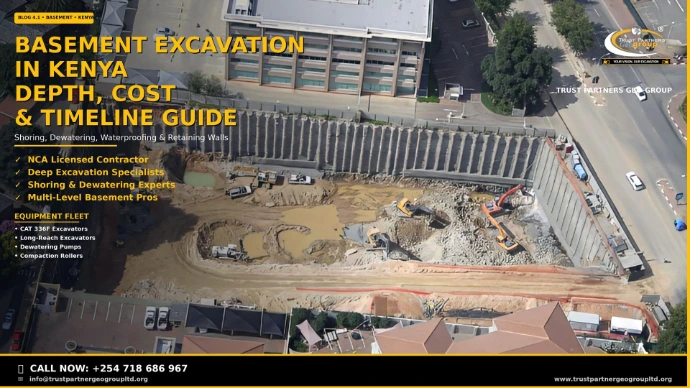
Basement Excavation in Kenya: Depth, Cost & Timeline Guide for Developers
The definitive 2026 developer's guide: what basements really cost per m² and m³, what changes at each depth band, how shoring and dewatering are engineered — and how long each level honestly takes.

1. The Basement Decision: Why Developers Dig Down
In Nairobi's land market, the surface is the expensive storey. Plots in Westlands, Kilimani, Upper Hill and the Karen fringe price parking, plant and storage into the sky or the ground — and the ground wins on cost per usable square metre almost every time. The arithmetic that drives Kenya's basement boom: a single-level basement adds sellable or rentable floor area at roughly 40–60% of the above-ground build cost in high-value zones, and two levels push the ratio further where plot ratios reward depth. But the saving is earned, not given: every metre below natural ground trades cheap air for engineered ground — shoring instead of scaffolding, dewatering instead of drainage gravity, and method statements instead of improvisation. Developers who price the depth honestly win; those who price the digging alone meet the difference as variations.
2. Depth Bands: 4m, 8m, 12m+ and What Changes
Basement engineering changes character at predictable depths — knowing the bands is knowing the budget:
| Depth Band | Levels | Ground Behaviour | Method Thresholds |
|---|---|---|---|
| 3.5–4.5 m | One | Red soil stands short-term; batters viable | Bulk dig with battered faces; light retention if tight |
| 6.5–8.5 m | Two | Slake-prone soils; water table met in Upper Hill/Westlands basin | Piled or sheeted retention mandatory; dewatering designed |
| 9.5–12.5 m | Three | Bracing loads dominate; basal heave risk in clays | Braced excavation, struts at 2.5–3.5 m verticals; staged passes |
| 15–25 m | Mega | Diaphragm behaviour; groundwater pressure head high | Diaphragm walls, top-down or semi-top-down, instrumentation |
The deeper insight: the cost curve is not linear. From one to two levels, digging roughly doubles while total cost roughly triples — the increment is retention and water. From two to three, digging grows 50% while cost doubles again — bracing and programme. Our depth guide carries the engineering detail band by band.
3. The Cost Stack: Real 2026 Rates, Line by Line
The line-item structure professional contractors quote against — and the rates Nairobi projects actually close at in 2026:
| Line Item | Rate Basis | 2026 Rate (KES) |
|---|---|---|
| Bulk soil excavation & carting | per m³ | 400–800 (red soil); haul beyond 10 km adds 50–150/m³ |
| Rock breaking (where met) | per m³ | 1,500–2,800 (tuff/coral, Nairobi & coast) |
| Soldier pile wall with lagging | per m² of face | 8,000–18,000 |
| Sheet pile wall (incl. mobilisation) | per m² of face | 9,000–20,000 |
| Ground anchors / soil nails | per anchor | 3,000–8,000 |
| Wellpoint dewatering system | per month operating | 150,000–400,000 |
| Deep wells (where specified) | per well installed | 80,000–150,000 |
| Formation trim & testing | per m² | 150–350 + lab testing per visit |
| Single-level basement, complete | per m² floor area | 8,000–15,000 |
| Two-level basement, complete | per m² | 15,000–28,000 |
| Three-level basement, complete | per m² | 25,000–45,000 |
Cross-check rule: the digging lines (first two rows) should total 30–40% of a complete per-m² figure. If a quote shows 70% digging, the shoring and water are missing — and will arrive later as variations. Our cost-per-m² breakdown itemises a live project; the level-by-level comparison shows where each shilling goes.
4. Programmes That Hold: Weeks per Basement Level
| Stage | 1 Level | 2 Levels | 3 Levels |
|---|---|---|---|
| Mobilisation, setting out, haul roads | 1 wk | 1–2 wk | 2 wk |
| Shoring installation | 0–1 wk | 2–4 wk | 4–6 wk |
| Dewatering lead (pre-drawdown) | 0 | 2–3 wk | 3–4 wk |
| Bulk excavation | 2–4 wk | 4–8 wk | 8–14 wk |
| Formation trim, inspection, blinding | 1 wk | 1–2 wk | 2–3 wk |
| Indicative total | 4–8 wk | 10–16 wk | 16–26 wk |
Rock, high water and urban haulage windows extend each stage as noted in the FAQ. The compression opportunity most developers miss: shoring and dewatering lead times overlap bulk excavation only when sequenced deliberately — a professional method statement stacks them; an amateur one runs them end to end and adds a month.
5. Shoring Systems: Selection & Cost per m² of Face
Retention design follows soil strength, water, depth and neighbours — the four inputs that decide the system:
- Battered slopes — free, to ~4.5 m where space allows; the reason suburban single basements stay cheap.
- Soldier piles & lagging — the urban default to 8–10 m: piles at 1.2–2.0 m centres bored or driven, excavated in lifts as lagging is placed. Works above and below water with dewatering running.
- Sheet piles — interlocking steel driven ahead of the dig; unbeatable below the water table in granular ground; vibratory hammer mobilisation is the price of entry.
- Anchored walls (nails/anchors) — where struts would strangle the works: anchors drilled and grouted into stable ground, proof-loaded to 1.2–1.5× design.
- Diaphragm walls & top-down — the mega-basement answer at 15 m+, priced per project with instrumentation budgets to match.
The cost insight: retention runs 8,000–20,000 KES per m² of retained face, and a typical two-level urban basement retains 1,500–2,500 m² of face per level — which is why the shoring line, not the digging line, separates honest quotes. Mega-basement practice covers the deep end of the spectrum.
6. Dewatering: Sizing, Methods & True Costs
Dewatering is where basement budgets quietly double when treated as an afterthought. The engineering sequence: the ground investigation reports permeability and water strike; the designer sets the target drawdown (formation level plus 0.5–1.0 m of working margin); the method follows the soil — wellpoints at 1.0–1.5 m spacing for sands and silts drawing 4–6 m, deep wells for deeper cuts and tighter soils, ejectors for the low-permeability end. A Nairobi two-level basement in the Upper Hill–Westlands water regime typically runs 40–80 wellpoints on ring mains, moving 5–15 L/s — that is a system with fuel, maintenance and discharge settlement, not a pump in a puddle.
⚠️ The three dewatering clauses that save projects
1. Start early: pumping begins 2–4 weeks before bulk digging — drawdown lags pumping, and wet digging is slow, dangerous digging. 2. Never stop early: run until the slab out-weights uplift, or basal heave floods the formation through the concrete. 3. Discharge clean: settlement before discharge and monitoring of neighbours' drawdown are NEMA and litigation protection in one. Our high water table guide covers the permanent defence.
7. The Risk Register: What Actually Moves the Budget
- Rock below formation — the Nairobi/coast surprise; at 20–40 m³/day breaking versus 150–250 m³/day digging, a 500 m³ rock lens adds 2–3 weeks and KES 1M+; probe before quoting.
- Water above prediction — under-designed dewatering shows up as flooded formations, heaving bases and standby fleets; the fix costs multiples of the design.
- Neighbour claims — vibration, dust, haulage and drawdown all reach adjacent owners; pre-works condition surveys and agreed monitoring are cheap insurance.
- Utility strikes — Nairobi's undocumented services; scans and trial holes before the first bucket, every time.
- Programme stacking — the fixable error: shoring, dewatering and digging run end-to-end instead of overlapped; a month lost to sequencing, not ground.
Every item on this register appears in NEMA and OSHA site requirements for a reason — the regulators have read the same post-mortems.
8. Frequently Asked Questions
As of 2026, honest Nairobi benchmarks by deliverable: bulk digging and carting at KES 400–800 per m³ for red soil; a completed single-level basement (dig, cart, trim) at KES 8,000–15,000 per m² of basement floor area; a two-level basement at KES 15,000–28,000 per m²; and three levels at KES 25,000–45,000 per m² — the escalation driven by shoring, dewatering and programme, not digging. The digging itself is rarely more than 35% of the total. Per-m² figures are the developer's planning tool; per-m³ rates are the contractor's measurement basis — insist on quotes structured both ways so you can cross-check. Our cost-per-m² breakdown itemises every line from mobilisation to formation trim, and the level-by-level comparison shows exactly where the money goes as you dig deeper.
Depth follows engineering, not ambition. One level: 3.5–4.5 metres below formation — straightforward bulk work with battered or lightly retained faces. Two levels: 6.5–8.5 metres — the shoring decision arrives here; soldier piles, sheet piles or anchored walls replace open batters, and dewatering becomes a designed system rather than a sump pump. Three levels: 9.5–12.5 metres — braced or piled retention is mandatory, dewatering runs continuously, and excavation sequences in passes tied to strut levels. Beyond 15 metres you are in mega-basement territory — diaphragm walls, top-down or semi-top-down construction, and specialist monitoring. Kenya's deepest commercial basements to date sit in the 15–25 metre band; the engineering ceiling is about method and budget, not ground. Our depth guide from 4 to 30 metres maps the methods by band.
Realistic programmes from mobilisation, assuming competent ground and one working shift: single-level basement on an open site — 4 to 8 weeks including formation trim and engineer inspection. Two-level urban basement with sheet-piled retention — 10 to 16 weeks, the shoring and dewatering dominating the calendar. Three-level — 16 to 26 weeks. Add rock (breaking at 20–40 m³/day against 150–250 m³/day digging), high water tables (dewatering lead time of 2–4 weeks before bulk digging stabilises), and urban logistics (restricted haulage windows can halve carting rates) and programmes stretch accordingly. The single biggest schedule killer is encountering unpriced ground — rock or water discovered mid-dig adds weeks while variations are negotiated. Programmes quoted without a site investigation behind them are aspirations, not plans.
The system follows the depth, soil, water and neighbours. Battered slopes: free but space-hungry; viable to about 4–5 metres where room allows. Soldier piles and lagging: the urban workhorse to about 8–10 metres — bored or driven piles at 1.2–2.0 m centres with timber or concrete lagging between; KES 8,000–18,000 per m² of retained face including excavation sequencing. Sheet piles: interlocking steel sheets driven ahead of excavation, best below water and in granular soils; similar cost banding with heavy mobilisation for the vibratory hammer. Anchored walls (ground anchors or soil nails): where space forbids struts, anchors tie the wall back into the ground at KES 3,000–8,000 per anchor on top of the wall. Diaphragm walls and top-down construction: the mega-basement answer, priced per project. The wrong choice costs twice — under-designed shoring fails, over-designed shoring wastes. See mega-basement practice for the deep end.
Dewatering is designed from the ground investigation's permeability and the excavation geometry, not guesswork. For medium sand and silty soils, wellpoints at 1.0–1.5 m spacing along the excavation perimeter draw the water table down 4–6 metres — a typical two-level basement runs 40–80 wellpoints on a single header, pumping 5–15 litres per second depending on ground. For deeper cuts or lower permeability, deep wells at strategic corners with submersible pumps do the heavy lifting. Costs: wellpoint systems hire and operate at KES 150,000–400,000 per month on urban basements, deep wells KES 80,000–150,000 each installed. The non-negotiables: start pumping 2–4 weeks before bulk digging, keep pumping until the slab out-weights the uplift, monitor drawdown and neighbouring structures, and discharge to settlement — silt-laden discharge into Nairobi's drains is a NEMA problem you do not want. Our high water table waterproofing guide covers the defensive side.
Planning a Basement? Price the Depth, Not the Digging.
Trust Partners Geo-Group Ltd delivers basements across Nairobi and Kenya — bulk excavation, engineered shoring, designed dewatering and formation handover — with itemised quotes against the rate structure above. Send your drawings for a costed method statement.
Get a Basement Excavation Quote📞 +254 718 68 69 67
Basement Excavation in Kenya: Depth, Cost & Timeline Guide for Developers
The definitive 2026 developer's guide: what basements really cost per m² and m³, what changes at each depth band, how shoring and dewatering are engineered — and how long each level honestly takes.
1. The Basement Decision: Why Developers Dig Down
In Nairobi's land market, the surface is the expensive storey. Plots in Westlands, Kilimani, Upper Hill and the Karen fringe price parking, plant and storage into the sky or the ground — and the ground wins on cost per usable square metre almost every time. The arithmetic that drives Kenya's basement boom: a single-level basement adds sellable or rentable floor area at roughly 40–60% of the above-ground build cost in high-value zones, and two levels push the ratio further where plot ratios reward depth. But the saving is earned, not given: every metre below natural ground trades cheap air for engineered ground — shoring instead of scaffolding, dewatering instead of drainage gravity, and method statements instead of improvisation. Developers who price the depth honestly win; those who price the digging alone meet the difference as variations.
2. Depth Bands: 4m, 8m, 12m+ and What Changes
Basement engineering changes character at predictable depths — knowing the bands is knowing the budget:
| Depth Band | Levels | Ground Behaviour | Method Thresholds |
|---|---|---|---|
| 3.5–4.5 m | One | Red soil stands short-term; batters viable | Bulk dig with battered faces; light retention if tight |
| 6.5–8.5 m | Two | Slake-prone soils; water table met in Upper Hill/Westlands basin | Piled or sheeted retention mandatory; dewatering designed |
| 9.5–12.5 m | Three | Bracing loads dominate; basal heave risk in clays | Braced excavation, struts at 2.5–3.5 m verticals; staged passes |
| 15–25 m | Mega | Diaphragm behaviour; groundwater pressure head high | Diaphragm walls, top-down or semi-top-down, instrumentation |
The deeper insight: the cost curve is not linear. From one to two levels, digging roughly doubles while total cost roughly triples — the increment is retention and water. From two to three, digging grows 50% while cost doubles again — bracing and programme. Our depth guide carries the engineering detail band by band.
3. The Cost Stack: Real 2026 Rates, Line by Line
The line-item structure professional contractors quote against — and the rates Nairobi projects actually close at in 2026:
| Line Item | Rate Basis | 2026 Rate (KES) |
|---|---|---|
| Bulk soil excavation & carting | per m³ | 400–800 (red soil); haul beyond 10 km adds 50–150/m³ |
| Rock breaking (where met) | per m³ | 1,500–2,800 (tuff/coral, Nairobi & coast) |
| Soldier pile wall with lagging | per m² of face | 8,000–18,000 |
| Sheet pile wall (incl. mobilisation) | per m² of face | 9,000–20,000 |
| Ground anchors / soil nails | per anchor | 3,000–8,000 |
| Wellpoint dewatering system | per month operating | 150,000–400,000 |
| Deep wells (where specified) | per well installed | 80,000–150,000 |
| Formation trim & testing | per m² | 150–350 + lab testing per visit |
| Single-level basement, complete | per m² floor area | 8,000–15,000 |
| Two-level basement, complete | per m² | 15,000–28,000 |
| Three-level basement, complete | per m² | 25,000–45,000 |
Cross-check rule: the digging lines (first two rows) should total 30–40% of a complete per-m² figure. If a quote shows 70% digging, the shoring and water are missing — and will arrive later as variations. Our cost-per-m² breakdown itemises a live project; the level-by-level comparison shows where each shilling goes.
4. Programmes That Hold: Weeks per Basement Level
| Stage | 1 Level | 2 Levels | 3 Levels |
|---|---|---|---|
| Mobilisation, setting out, haul roads | 1 wk | 1–2 wk | 2 wk |
| Shoring installation | 0–1 wk | 2–4 wk | 4–6 wk |
| Dewatering lead (pre-drawdown) | 0 | 2–3 wk | 3–4 wk |
| Bulk excavation | 2–4 wk | 4–8 wk | 8–14 wk |
| Formation trim, inspection, blinding | 1 wk | 1–2 wk | 2–3 wk |
| Indicative total | 4–8 wk | 10–16 wk | 16–26 wk |
Rock, high water and urban haulage windows extend each stage as noted in the FAQ. The compression opportunity most developers miss: shoring and dewatering lead times overlap bulk excavation only when sequenced deliberately — a professional method statement stacks them; an amateur one runs them end to end and adds a month.
5. Shoring Systems: Selection & Cost per m² of Face
Retention design follows soil strength, water, depth and neighbours — the four inputs that decide the system:
- Battered slopes — free, to ~4.5 m where space allows; the reason suburban single basements stay cheap.
- Soldier piles & lagging — the urban default to 8–10 m: piles at 1.2–2.0 m centres bored or driven, excavated in lifts as lagging is placed. Works above and below water with dewatering running.
- Sheet piles — interlocking steel driven ahead of the dig; unbeatable below the water table in granular ground; vibratory hammer mobilisation is the price of entry.
- Anchored walls (nails/anchors) — where struts would strangle the works: anchors drilled and grouted into stable ground, proof-loaded to 1.2–1.5× design.
- Diaphragm walls & top-down — the mega-basement answer at 15 m+, priced per project with instrumentation budgets to match.
The cost insight: retention runs 8,000–20,000 KES per m² of retained face, and a typical two-level urban basement retains 1,500–2,500 m² of face per level — which is why the shoring line, not the digging line, separates honest quotes. Mega-basement practice covers the deep end of the spectrum.
6. Dewatering: Sizing, Methods & True Costs
Dewatering is where basement budgets quietly double when treated as an afterthought. The engineering sequence: the ground investigation reports permeability and water strike; the designer sets the target drawdown (formation level plus 0.5–1.0 m of working margin); the method follows the soil — wellpoints at 1.0–1.5 m spacing for sands and silts drawing 4–6 m, deep wells for deeper cuts and tighter soils, ejectors for the low-permeability end. A Nairobi two-level basement in the Upper Hill–Westlands water regime typically runs 40–80 wellpoints on ring mains, moving 5–15 L/s — that is a system with fuel, maintenance and discharge settlement, not a pump in a puddle.
⚠️ The three dewatering clauses that save projects
1. Start early: pumping begins 2–4 weeks before bulk digging — drawdown lags pumping, and wet digging is slow, dangerous digging. 2. Never stop early: run until the slab out-weights uplift, or basal heave floods the formation through the concrete. 3. Discharge clean: settlement before discharge and monitoring of neighbours' drawdown are NEMA and litigation protection in one. Our high water table guide covers the permanent defence.
7. The Risk Register: What Actually Moves the Budget
- Rock below formation — the Nairobi/coast surprise; at 20–40 m³/day breaking versus 150–250 m³/day digging, a 500 m³ rock lens adds 2–3 weeks and KES 1M+; probe before quoting.
- Water above prediction — under-designed dewatering shows up as flooded formations, heaving bases and standby fleets; the fix costs multiples of the design.
- Neighbour claims — vibration, dust, haulage and drawdown all reach adjacent owners; pre-works condition surveys and agreed monitoring are cheap insurance.
- Utility strikes — Nairobi's undocumented services; scans and trial holes before the first bucket, every time.
- Programme stacking — the fixable error: shoring, dewatering and digging run end-to-end instead of overlapped; a month lost to sequencing, not ground.
Every item on this register appears in NEMA and OSHA site requirements for a reason — the regulators have read the same post-mortems.
8. Frequently Asked Questions
As of 2026, honest Nairobi benchmarks by deliverable: bulk digging and carting at KES 400–800 per m³ for red soil; a completed single-level basement (dig, cart, trim) at KES 8,000–15,000 per m² of basement floor area; a two-level basement at KES 15,000–28,000 per m²; and three levels at KES 25,000–45,000 per m² — the escalation driven by shoring, dewatering and programme, not digging. The digging itself is rarely more than 35% of the total. Per-m² figures are the developer's planning tool; per-m³ rates are the contractor's measurement basis — insist on quotes structured both ways so you can cross-check. Our cost-per-m² breakdown itemises every line from mobilisation to formation trim, and the level-by-level comparison shows exactly where the money goes as you dig deeper.
Depth follows engineering, not ambition. One level: 3.5–4.5 metres below formation — straightforward bulk work with battered or lightly retained faces. Two levels: 6.5–8.5 metres — the shoring decision arrives here; soldier piles, sheet piles or anchored walls replace open batters, and dewatering becomes a designed system rather than a sump pump. Three levels: 9.5–12.5 metres — braced or piled retention is mandatory, dewatering runs continuously, and excavation sequences in passes tied to strut levels. Beyond 15 metres you are in mega-basement territory — diaphragm walls, top-down or semi-top-down construction, and specialist monitoring. Kenya's deepest commercial basements to date sit in the 15–25 metre band; the engineering ceiling is about method and budget, not ground. Our depth guide from 4 to 30 metres maps the methods by band.
Realistic programmes from mobilisation, assuming competent ground and one working shift: single-level basement on an open site — 4 to 8 weeks including formation trim and engineer inspection. Two-level urban basement with sheet-piled retention — 10 to 16 weeks, the shoring and dewatering dominating the calendar. Three-level — 16 to 26 weeks. Add rock (breaking at 20–40 m³/day against 150–250 m³/day digging), high water tables (dewatering lead time of 2–4 weeks before bulk digging stabilises), and urban logistics (restricted haulage windows can halve carting rates) and programmes stretch accordingly. The single biggest schedule killer is encountering unpriced ground — rock or water discovered mid-dig adds weeks while variations are negotiated. Programmes quoted without a site investigation behind them are aspirations, not plans.
The system follows the depth, soil, water and neighbours. Battered slopes: free but space-hungry; viable to about 4–5 metres where room allows. Soldier piles and lagging: the urban workhorse to about 8–10 metres — bored or driven piles at 1.2–2.0 m centres with timber or concrete lagging between; KES 8,000–18,000 per m² of retained face including excavation sequencing. Sheet piles: interlocking steel sheets driven ahead of excavation, best below water and in granular soils; similar cost banding with heavy mobilisation for the vibratory hammer. Anchored walls (ground anchors or soil nails): where space forbids struts, anchors tie the wall back into the ground at KES 3,000–8,000 per anchor on top of the wall. Diaphragm walls and top-down construction: the mega-basement answer, priced per project. The wrong choice costs twice — under-designed shoring fails, over-designed shoring wastes. See mega-basement practice for the deep end.
Dewatering is designed from the ground investigation's permeability and the excavation geometry, not guesswork. For medium sand and silty soils, wellpoints at 1.0–1.5 m spacing along the excavation perimeter draw the water table down 4–6 metres — a typical two-level basement runs 40–80 wellpoints on a single header, pumping 5–15 litres per second depending on ground. For deeper cuts or lower permeability, deep wells at strategic corners with submersible pumps do the heavy lifting. Costs: wellpoint systems hire and operate at KES 150,000–400,000 per month on urban basements, deep wells KES 80,000–150,000 each installed. The non-negotiables: start pumping 2–4 weeks before bulk digging, keep pumping until the slab out-weights the uplift, monitor drawdown and neighbouring structures, and discharge to settlement — silt-laden discharge into Nairobi's drains is a NEMA problem you do not want. Our high water table waterproofing guide covers the defensive side.
Planning a Basement? Price the Depth, Not the Digging.
Trust Partners Geo-Group Ltd delivers basements across Nairobi and Kenya — bulk excavation, engineered shoring, designed dewatering and formation handover — with itemised quotes against the rate structure above. Send your drawings for a costed method statement.
Get a Basement Excavation Quote📞 +254 718 68 69 67