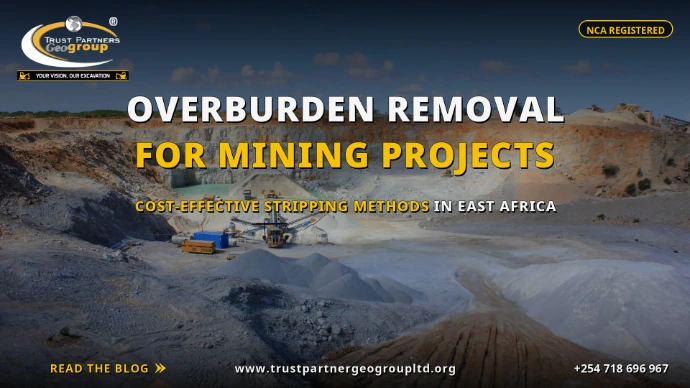
Overburden Removal for Mining Projects: Cost-Effective Stripping Methods in East Africa
Stripping methods, 2026 costs & dump design for mine sites across Kenya, Tanzania, Uganda & the wider region
Table of Contents
- 1. What Is Overburden - and Why It Decides Mine Economics
- 2. Overburden Types Across East Africa
- 3. Mining Stripping Methods Compared
- 4. Choosing the Method: The Distance & Volume Rule
- 5. Overburden Excavation Costs [2026]
- 6. Waste Dump Design & Spoil Management
- 7. Topsoil Management & Progressive Rehabilitation
- 8. Mine Site Preparation: The Full Sequence
- 9. Scheduling Stripping Against Ore Production
- 10. Permits & Environmental Compliance
- 11. Frequently Asked Questions
- 12. Conclusion
Before any mine produces a gram of gold, a tonne of soda ash or a truckload of quarry stone, it must first move the material that nature put on top - the overburden. For most East African surface mines, overburden removal is 30-70% of everything ever excavated and the single largest operating cost line. Choosing the right stripping method for the depth, volume and haul distance is therefore not an engineering detail - it is the difference between a mine and a hole that loses money. This guide compares the mining stripping methods used across Kenya and East Africa, with 2026 overburden excavation costs, dump design rules and the full mine site preparation sequence.
Trust Partners Geo-Group Ltd - Engineering Team
NCA-registered excavation & civil engineering contractor with 15+ years of earthworks, quarry and contract stripping experience across East Africa. Reviewed by registered engineers.
1. What Is Overburden - and Why It Decides Mine Economics
Overburden is everything between the surface and the valuable material: topsoil, subsoil, weathered rock and barren hard rock. Its importance is captured in one number - the stripping ratio (waste volume per unit of ore), which we covered in depth in our open-pit excavation guide. A gold pit at 5:1 moves five cubic meters of waste for every tonne of ore; at KES 250-450 per m3 stripped, that is KES 1,250-2,250 of pure cost riding on every tonne before the ore itself is touched.
Three consequences follow:
- Stripping method selection is a profit decision - a KES 100/m3 saving on 1 million m3 of overburden is KES 100 million straight to margin.
- Stripping is scheduled capital - overburden must move before the ore beneath it earns anything, so stripping rate sets the pace of the whole mine.
- Dumps are permanent assets (or liabilities) - stripped material has to go somewhere engineered, permitted and progressively rehabilitated.
2. Overburden Types Across East Africa
| Overburden Type | Where Found | How It Strips |
|---|---|---|
| Topsoil & red lateritic soils | Kenyan highlands, Uganda, western Tanzania | Free dig - dozer, scraper or excavator; topsoil stockpiled separately |
| Black cotton (expansive clay) | Kajiado, Kisumu, Athi plains, Tanzanian lowlands | Free dig but treacherous when wet; trafficability fails in rains - strip dry |
| Volcanic ash & pumice | Rift Valley (Naivasha, Nakuru, Magadi) | Very easy digging, poor haul-road material; dust control needed |
| Weathered / saprolitic rock | Gold belts (Migori, Kakamega, Geita), coastal sands | Ripping with D8/D9 class dozers, then load & haul |
| Hard cap / ferricrete & fresh rock | Laterite caps region-wide; phonolite/trachyte near Nairobi | Drill & blast (or hammer in small volumes) |
| Unconsolidated sands & gravels | Kwale (titanium), riverine deposits | Dredging or free dig with dewatering |
Overburden removal Kenya contractors price by stratum precisely because one deposit commonly contains three or four of these in sequence, not a single blended rate. A blended rate invites disputes the day the hard cap appears.
3. Mining Stripping Methods Compared
| Method | Best Haul Range | 2026 Cost (KES/m3) | Strengths & Limits |
|---|---|---|---|
| Dozer push | <80-100m | 150-300 | Cheapest for short pushes into adjacent dumps; production falls steeply beyond 100m |
| Scraper fleet | 150-1,500m | 180-350 | Load, haul and spread in one machine; needs firm running surfaces and big open areas - struggles in wet cotton soils |
| Excavator + truck | 300m-any distance | 250-450 | The East African default: flexible, works in confined pits and wet ground, easy to scale by adding trucks |
| Rip + load (dozer ripping ahead) | any (pre-break) | 700-1,200 | For weathered rock; avoids blasting permits and vibration issues |
| Drill & blast | any (hard caps) | 800-1,500 | Only option for fresh rock caps; see our quarry blasting guide |
| Cast blasting | throws directly to dump | saves 30-60% vs. dig-and-haul | Explosives throw overburden straight into the spoil area; geometry-dependent, rare but powerful where it fits |
Real mines combine methods: dozers push the near field to the dump edge, excavator-truck handles the main volume, rippers or blasters deal with the hard cap, and scrapers take the long flat runs where terrain allows.
4. Choosing the Method: The Distance & Volume Rule
The selection logic in one picture:
Haul < 100m: dozer push (150-300/m3) | 150-1,500m: scrapers (180-350/m3) | > 300m or confined/wet: excavator + truck (250-450/m3)
Overlay three qualifiers:
- Volume: scraper fleets need scale (300,000+ m3 campaigns) to justify mobilization; small strips default to excavator-truck even at scraper distances.
- Ground conditions: scrapers need firm, dry running. In black cotton country the wet season converts scraper economics into rescue economics - plan scraper campaigns for dry windows or budget matting.
- Equipment availability: East Africa's hire market is deep in excavators and tippers, thin in scrapers and very thin in large dozers. A theoretically optimal method you cannot mobilize is not optimal. For machine rates, see our equipment hire guide.
5. Overburden Excavation Costs [2026]
Contract stripping rates across Kenya and comparable East African markets, mine-scale volumes (>50,000 m3):
| Activity | Unit | Rate (KES) | Basis |
|---|---|---|---|
| Bush clearing & grubbing | m2 | 30-80 | Dozer + rake, disposal on site |
| Topsoil strip & stockpile | m3 | 70-150 | <300m push/haul to stockpile |
| Dozer push to dump | m3 | 150-300 | <100m, D8-D9 class |
| Scraper load-haul-spread | m3 | 180-350 | 150-1,500m, dry running |
| Free-dig, load & haul (excavator-truck) | m3 | 250-450 | <2km haul |
| Rip, load & haul weathered rock | m3 | 700-1,200 | D8+ ripping |
| Drill, blast, load & haul hard cap | m3 | 800-1,500 | Production scale |
| Dump dozing & maintenance | m3 | 40-80 | Often included in strip rate |
| Fleet mobilization (regional) | project | 100,000-500,000+ | Per campaign; cross-border moves priced individually |
Worked example - a Migori gold pit advance, 120,000 m3 strip: topsoil 8,000 m3 @ 110 = KES 0.88M; free-dig 80,000 m3 @ 380 = KES 30.4M; saprolite rip-load-haul 28,000 m3 @ 950 = KES 26.6M; dump dozing included; mobilization KES 0.35M. Total ≈ KES 58.2M (≈KES 485/m3 blended). The same strip priced as one blended "overburden" line would hide the fact that 23% of the volume drives 46% of the cost - stratum pricing is how you see it.
6. Waste Dump Design & Spoil Management
A waste dump is an engineered landform, not a pile. The design rules:
- Foundation first: strip weak or organic ground from the dump footprint - a dump built on black cotton or swamp will creep, slump and fail in the rains.
- Lifts and berms: build in 5-10m lifts with berms, overall slope 25-37° for soil dumps (flatter for ash and saturated material).
- Drainage: perimeter cut-off drains around the dump, silt traps before discharge, and under-drains where springs exist. Water is the trigger for nearly all dump failures.
- Location economics: haul cost rises with distance, but the dump must also be outside the ultimate pit shell and away from watercourses - the classic error is dumping on tomorrow's ore and paying to move it twice.
- Backfill where possible: once pit sections are exhausted, dumping in-pit (backfilling) shortens hauls, deletes dump footprint, and pre-builds the rehabilitated landform - the cheapest waste disposal in mining.
7. Topsoil Management & Progressive Rehabilitation
Topsoil is the mine's rehabilitation currency - and NEMA approval conditions treat it that way:
- Strip it separately, always: the top 150-300mm goes to dedicated stockpiles, maximum 2-3m high (taller piles kill the soil biology that makes topsoil valuable).
- Sign and protect: stockpiles are mapped, signed, grass-seeded if standing over a season, and never used as general fill or road material.
- Rehabilitate progressively: as dump sections reach final profile, re-slope, spread topsoil (150-300mm), rip-compact gently, and re-vegetate. Progressive rehab spreads closure cost over mine life, cuts erosion and silt-trap loading, and is the single best community-relations asset a mine owns.
- Balance the inventory: topsoil stripped should equal topsoil respread - a shortfall means someone buried it, and the closure plan just became unfundable.
Contract clause worth having: pay stripping rates against surveyed volumes and verified topsoil recovery. What gets measured gets stockpiled; what doesn't, gets buried in the dump.
8. Mine Site Preparation: The Full Sequence
Mine site preparation East Africa operators plan for - everything before first ore - follows a dependable sequence, typically 2-6 months for small-medium operations:
| Stage | Contents | Typical Duration |
|---|---|---|
| 1. Access & enabling works | Access road, bridges/culverts, security fencing, camp and laydown areas | 3-8 weeks |
| 2. Clearing & grubbing | Vegetation clearance over pit, dumps, plant site, roads | 1-3 weeks |
| 3. Drainage | Crest cut-off drains, river/stream diversions if needed, silt control | 2-4 weeks (critical before rains) |
| 4. Topsoil stripping | Whole disturbed footprint, to stockpiles | 1-3 weeks |
| 5. Box cut / initial strip | First overburden push exposing ore - 20,000-100,000+ m3 for medium pits | 4-10 weeks |
| 6. Haul roads & dump establishment | Pit-to-dump and pit-to-plant roads, dump foundations | Parallel with box cut |
Two scheduling rules save the most money in East Africa: start in the dry season (wet-season stripping routinely doubles time and cost), and sequence land access before machines - a fleet standing idle over an unresolved land-consent issue burns KES 200,000-600,000 per day in demurrage and hire.
9. Scheduling Stripping Against Ore Production
Stripping is a conveyor belt feeding the future: the ore exposed this quarter is mined next quarter. Manage it with three controls:
- Minimum exposed-ore inventory: typically 3-6 months of ore kept drilled-blasted-free ahead of the mill or crusher. Below that, the stripping fleet becomes the mine's bottleneck - and accelerating it later costs premium rates.
- Deferred stripping in the early years: strip only what the mining schedule needs. Stripping the whole pit upfront converts profit into a pre-paid dirt mountain and wrecks project cash flow - a classic junior-miner error.
- Weekly volume reconciliation: surveyed strip volumes vs. plan, per stratum. Drifting 10% behind on stripping compounds into an ore starvation crisis two quarters later; catching it weekly costs a schedule tweak, catching it late costs a second fleet.
"Mines don't run out of ore - they run out of exposed ore. The stripping schedule is the mine schedule." - Trust Partners Geo-Group Ltd, Contracts Team
10. Permits & Environmental Compliance
Stripping activity sits under the same framework as the pit itself:
- Mining license / quarry permit covering the stripping footprint (State Department for Mining; counties for construction minerals);
- NEMA EIA license - whose conditions explicitly cover topsoil management, dump stability, silt control, dust suppression and progressive rehabilitation, audited annually;
- County permits including haul-route and rehabilitation-bond conditions;
- Water abstraction & discharge permits (WRA) where dewatering or diversions apply;
- Blasting authorization (Ministry of Interior) if hard caps require drill and blast.
Across East Africa the pattern is similar (NEMA-equivalent agencies in Tanzania, Uganda, Rwanda), with land-consent processes varying most between jurisdictions. Cross-border stripping campaigns should budget 3-6 months of permitting lead time and use locally registered entities or joint ventures where required.
11. Frequently Asked Questions: Overburden Removal in East Africa
What is overburden removal in mining?
Overburden removal (stripping) is the excavation of soil, weathered rock and barren material lying above an ore body or quarry stone so the valuable material can be mined. It includes topsoil stripping and stockpiling for later rehabilitation, removal of soft overburden by excavators, scrapers or dozers, and ripping or blasting of hard caps. In East African mines overburden typically represents 30-70% of all material moved and is usually the single largest operating cost.
What does overburden excavation cost per cubic meter in Kenya?
2026 overburden excavation costs in Kenya: topsoil strip and stockpile KES 70-150 per m3; free-dig soft overburden, load and haul KES 250-450 per m3; dozer push (under 80m) KES 150-300 per m3; scraper fleets (150-1,500m hauls) KES 180-350 per m3; ripping weathered rock KES 700-1,200 per m3; drill and blast of hard caps KES 800-1,500 per m3. Rates assume mine-scale volumes above 50,000 m3 and hauls under 2 km.
Which stripping method is cheapest for mining overburden?
The cheapest method depends on haul distance: dozer push wins under 80-100m (KES 150-300/m3), scrapers dominate from 150m to about 1,500m (KES 180-350/m3), and excavator-truck fleets win beyond that or in confined pits (KES 250-450/m3). Cast blasting - using explosives to throw overburden directly into the dump area - can cut excavation cost 30-60% where geometry allows but is rare in East Africa. Most Kenyan projects combine methods by depth and distance.
What is the difference between topsoil stripping and overburden removal?
Topsoil stripping is the careful removal and separate stockpiling of the upper 150-300mm of fertile soil for reuse in rehabilitation - it is an environmental obligation under NEMA approvals. Overburden removal is the bulk excavation of everything else above the ore, which goes to waste dumps. Mixing the two wastes topsoil and contaminates potential fill material; compliant operations always strip and stockpile topsoil first, then strip overburden.
How are mine waste dumps designed in Kenya?
Waste dumps are engineered structures: stable overall slope angles (typically 25-37 degrees for soil dumps), benched lifts of 5-10m with berms, foundation preparation (weak ground stripped first), perimeter drainage and silt traps, and progressive rehabilitation - re-sloping, topsoiling and re-vegetating completed sections while the dump is still growing. NEMA approval conditions and county permits specify the requirements; dumps on slopes or near watercourses need a geotechnical design.
How long does mine site preparation take in East Africa?
Mine site preparation in East Africa - bush clearing, access roads, topsoil stripping, box cuts, drainage and laydown areas - typically takes 2-6 months for a small-medium operation before first ore, depending on overburden depth and season. A box cut exposing ore for a medium quarry or gold pit might move 20,000-100,000 m3. Wet-season starts routinely double both time and cost; schedule stripping for dry windows where the programme allows.
Should mines strip overburden themselves or contract it out?
Contract stripping usually wins for campaigns under 1-2 million m3 or 2-3 years duration: no fleet capital, no maintenance organization, and the contractor carries utilization and breakdown risk at a fixed rate per m3 (KES 250-450 for free-dig in Kenya). Owner-operated fleets win on very long-life mines where utilization is guaranteed. A common East African model: owner mines ore, contractor strips waste - keeping the owner's fleet focused on revenue material.
What equipment is used for overburden stripping in East Africa?
Typical East African stripping fleets: D6-D9 dozers for push work and dump maintenance; motor scrapers (20-30 m3 bowls) where hauls suit; 30-90t hydraulic excavators loading 25-60t articulated or rigid dump trucks for longer hauls and confined pits; wheel loaders for stockpiles and rehandle; graders and water bowsers for haul roads. Drills and explosives handle hard caps. Equipment availability locally favors excavator-truck systems, which dominate Kenyan contract stripping.
12. Conclusion: Strip Smart, Strip Early, Strip Once
Overburden is the tax every surface mine pays before earning a shilling - and the only controllable part of that tax is how you strip it. Match the method to the distance, price by stratum, build dumps as engineered structures, protect every cubic meter of topsoil, and keep the stripping schedule a quarter ahead of the ore. Mines that do these five things convert their biggest cost into a competitive advantage; the rest convert it into a bail-out.
Trust Partners Geo-Group Ltd delivers contract overburden stripping and mine site preparation across Kenya and East Africa - clearing, topsoil management, bulk stripping, dump construction and progressive rehabilitation - on per-cubic-meter rates with weekly surveyed reconciliation. Send us your strip plan or reserve model for a quotation within 48 hours.
Contract Overburden Stripping & Mine Site Preparation
Fleets matched to your haul distances, stratum-based pricing, engineered dumps and progressive rehabilitation - from box cut to steady-state stripping across East Africa.
Free lead magnet: ask for our Stripping Method Selection Sheet (PDF) - the distance-volume decision matrix with 2026 East African rates pre-loaded.
Related Resources
Open-Pit Mine Excavation in Kenya: Stripping Ratio, Bench Design & Equipment
The stripping ratio math that drives every overburden decision.
READ MOREQuarry Excavation & Rock Blasting in Kenya: Permits, Safety, Production
Drill-and-blast methods for hard caps - permits and safety controls.
READ MOREBulk Excavation Cost Per Cubic Meter in Kenya [2026 Rates]
The unit rates behind every stripping cost quoted in this guide.
READ MOREConstruction Heavy Equipment Hire & Rental Prices in Kenya [2026]
Dozer, scraper, excavator and truck rates for stripping fleet planning.
READ MOREFoundation Excavation in Black Cotton Soil [2026 Guide]
Why expansive clays wreck stripping programmes - and how to work around them.
READ MOREExcavation in Kenya: Complete Guide to Costs, Methods & Contractors
The pillar guide to excavation methods, equipment and contractor selection.
READ MORETRUST PARTNERS GEO-GROUP LTD | YOUR VISION, OUR EXCAVATION
WEBSITE: WWW.TRUSTPARTNERGEOGROUPLTD.ORG | EMAIL: INFO@TRUSTPARTNERGEOGROUPLTD.ORG | PHONE: +254 718 68 69 67
FOLLOW US: FACEBOOK | TIKTOK | INSTAGRAM | YOUTUBE | LINKEDIN
© 2026 TRUST PARTNERS GEO-GROUP LTD. ALL RIGHTS RESERVED.
Overburden Removal for Mining Projects: Cost-Effective Stripping Methods in East Africa
Stripping methods, 2026 costs & dump design for mine sites across Kenya, Tanzania, Uganda & the wider region
Table of Contents
- 1. What Is Overburden - and Why It Decides Mine Economics
- 2. Overburden Types Across East Africa
- 3. Mining Stripping Methods Compared
- 4. Choosing the Method: The Distance & Volume Rule
- 5. Overburden Excavation Costs [2026]
- 6. Waste Dump Design & Spoil Management
- 7. Topsoil Management & Progressive Rehabilitation
- 8. Mine Site Preparation: The Full Sequence
- 9. Scheduling Stripping Against Ore Production
- 10. Permits & Environmental Compliance
- 11. Frequently Asked Questions
- 12. Conclusion
Before any mine produces a gram of gold, a tonne of soda ash or a truckload of quarry stone, it must first move the material that nature put on top - the overburden. For most East African surface mines, overburden removal is 30-70% of everything ever excavated and the single largest operating cost line. Choosing the right stripping method for the depth, volume and haul distance is therefore not an engineering detail - it is the difference between a mine and a hole that loses money. This guide compares the mining stripping methods used across Kenya and East Africa, with 2026 overburden excavation costs, dump design rules and the full mine site preparation sequence.
Trust Partners Geo-Group Ltd - Engineering Team
NCA-registered excavation & civil engineering contractor with 15+ years of earthworks, quarry and contract stripping experience across East Africa. Reviewed by registered engineers.
1. What Is Overburden - and Why It Decides Mine Economics
Overburden is everything between the surface and the valuable material: topsoil, subsoil, weathered rock and barren hard rock. Its importance is captured in one number - the stripping ratio (waste volume per unit of ore), which we covered in depth in our open-pit excavation guide. A gold pit at 5:1 moves five cubic meters of waste for every tonne of ore; at KES 250-450 per m3 stripped, that is KES 1,250-2,250 of pure cost riding on every tonne before the ore itself is touched.
Three consequences follow:
- Stripping method selection is a profit decision - a KES 100/m3 saving on 1 million m3 of overburden is KES 100 million straight to margin.
- Stripping is scheduled capital - overburden must move before the ore beneath it earns anything, so stripping rate sets the pace of the whole mine.
- Dumps are permanent assets (or liabilities) - stripped material has to go somewhere engineered, permitted and progressively rehabilitated.
2. Overburden Types Across East Africa
| Overburden Type | Where Found | How It Strips |
|---|---|---|
| Topsoil & red lateritic soils | Kenyan highlands, Uganda, western Tanzania | Free dig - dozer, scraper or excavator; topsoil stockpiled separately |
| Black cotton (expansive clay) | Kajiado, Kisumu, Athi plains, Tanzanian lowlands | Free dig but treacherous when wet; trafficability fails in rains - strip dry |
| Volcanic ash & pumice | Rift Valley (Naivasha, Nakuru, Magadi) | Very easy digging, poor haul-road material; dust control needed |
| Weathered / saprolitic rock | Gold belts (Migori, Kakamega, Geita), coastal sands | Ripping with D8/D9 class dozers, then load & haul |
| Hard cap / ferricrete & fresh rock | Laterite caps region-wide; phonolite/trachyte near Nairobi | Drill & blast (or hammer in small volumes) |
| Unconsolidated sands & gravels | Kwale (titanium), riverine deposits | Dredging or free dig with dewatering |
Overburden removal Kenya contractors price by stratum precisely because one deposit commonly contains three or four of these in sequence, not a single blended rate. A blended rate invites disputes the day the hard cap appears.
3. Mining Stripping Methods Compared
| Method | Best Haul Range | 2026 Cost (KES/m3) | Strengths & Limits |
|---|---|---|---|
| Dozer push | <80-100m | 150-300 | Cheapest for short pushes into adjacent dumps; production falls steeply beyond 100m |
| Scraper fleet | 150-1,500m | 180-350 | Load, haul and spread in one machine; needs firm running surfaces and big open areas - struggles in wet cotton soils |
| Excavator + truck | 300m-any distance | 250-450 | The East African default: flexible, works in confined pits and wet ground, easy to scale by adding trucks |
| Rip + load (dozer ripping ahead) | any (pre-break) | 700-1,200 | For weathered rock; avoids blasting permits and vibration issues |
| Drill & blast | any (hard caps) | 800-1,500 | Only option for fresh rock caps; see our quarry blasting guide |
| Cast blasting | throws directly to dump | saves 30-60% vs. dig-and-haul | Explosives throw overburden straight into the spoil area; geometry-dependent, rare but powerful where it fits |
Real mines combine methods: dozers push the near field to the dump edge, excavator-truck handles the main volume, rippers or blasters deal with the hard cap, and scrapers take the long flat runs where terrain allows.
4. Choosing the Method: The Distance & Volume Rule
The selection logic in one picture:
Haul < 100m: dozer push (150-300/m3) | 150-1,500m: scrapers (180-350/m3) | > 300m or confined/wet: excavator + truck (250-450/m3)
Overlay three qualifiers:
- Volume: scraper fleets need scale (300,000+ m3 campaigns) to justify mobilization; small strips default to excavator-truck even at scraper distances.
- Ground conditions: scrapers need firm, dry running. In black cotton country the wet season converts scraper economics into rescue economics - plan scraper campaigns for dry windows or budget matting.
- Equipment availability: East Africa's hire market is deep in excavators and tippers, thin in scrapers and very thin in large dozers. A theoretically optimal method you cannot mobilize is not optimal. For machine rates, see our equipment hire guide.
5. Overburden Excavation Costs [2026]
Contract stripping rates across Kenya and comparable East African markets, mine-scale volumes (>50,000 m3):
| Activity | Unit | Rate (KES) | Basis |
|---|---|---|---|
| Bush clearing & grubbing | m2 | 30-80 | Dozer + rake, disposal on site |
| Topsoil strip & stockpile | m3 | 70-150 | <300m push/haul to stockpile |
| Dozer push to dump | m3 | 150-300 | <100m, D8-D9 class |
| Scraper load-haul-spread | m3 | 180-350 | 150-1,500m, dry running |
| Free-dig, load & haul (excavator-truck) | m3 | 250-450 | <2km haul |
| Rip, load & haul weathered rock | m3 | 700-1,200 | D8+ ripping |
| Drill, blast, load & haul hard cap | m3 | 800-1,500 | Production scale |
| Dump dozing & maintenance | m3 | 40-80 | Often included in strip rate |
| Fleet mobilization (regional) | project | 100,000-500,000+ | Per campaign; cross-border moves priced individually |
Worked example - a Migori gold pit advance, 120,000 m3 strip: topsoil 8,000 m3 @ 110 = KES 0.88M; free-dig 80,000 m3 @ 380 = KES 30.4M; saprolite rip-load-haul 28,000 m3 @ 950 = KES 26.6M; dump dozing included; mobilization KES 0.35M. Total ≈ KES 58.2M (≈KES 485/m3 blended). The same strip priced as one blended "overburden" line would hide the fact that 23% of the volume drives 46% of the cost - stratum pricing is how you see it.
6. Waste Dump Design & Spoil Management
A waste dump is an engineered landform, not a pile. The design rules:
- Foundation first: strip weak or organic ground from the dump footprint - a dump built on black cotton or swamp will creep, slump and fail in the rains.
- Lifts and berms: build in 5-10m lifts with berms, overall slope 25-37° for soil dumps (flatter for ash and saturated material).
- Drainage: perimeter cut-off drains around the dump, silt traps before discharge, and under-drains where springs exist. Water is the trigger for nearly all dump failures.
- Location economics: haul cost rises with distance, but the dump must also be outside the ultimate pit shell and away from watercourses - the classic error is dumping on tomorrow's ore and paying to move it twice.
- Backfill where possible: once pit sections are exhausted, dumping in-pit (backfilling) shortens hauls, deletes dump footprint, and pre-builds the rehabilitated landform - the cheapest waste disposal in mining.
7. Topsoil Management & Progressive Rehabilitation
Topsoil is the mine's rehabilitation currency - and NEMA approval conditions treat it that way:
- Strip it separately, always: the top 150-300mm goes to dedicated stockpiles, maximum 2-3m high (taller piles kill the soil biology that makes topsoil valuable).
- Sign and protect: stockpiles are mapped, signed, grass-seeded if standing over a season, and never used as general fill or road material.
- Rehabilitate progressively: as dump sections reach final profile, re-slope, spread topsoil (150-300mm), rip-compact gently, and re-vegetate. Progressive rehab spreads closure cost over mine life, cuts erosion and silt-trap loading, and is the single best community-relations asset a mine owns.
- Balance the inventory: topsoil stripped should equal topsoil respread - a shortfall means someone buried it, and the closure plan just became unfundable.
Contract clause worth having: pay stripping rates against surveyed volumes and verified topsoil recovery. What gets measured gets stockpiled; what doesn't, gets buried in the dump.
8. Mine Site Preparation: The Full Sequence
Mine site preparation East Africa operators plan for - everything before first ore - follows a dependable sequence, typically 2-6 months for small-medium operations:
| Stage | Contents | Typical Duration |
|---|---|---|
| 1. Access & enabling works | Access road, bridges/culverts, security fencing, camp and laydown areas | 3-8 weeks |
| 2. Clearing & grubbing | Vegetation clearance over pit, dumps, plant site, roads | 1-3 weeks |
| 3. Drainage | Crest cut-off drains, river/stream diversions if needed, silt control | 2-4 weeks (critical before rains) |
| 4. Topsoil stripping | Whole disturbed footprint, to stockpiles | 1-3 weeks |
| 5. Box cut / initial strip | First overburden push exposing ore - 20,000-100,000+ m3 for medium pits | 4-10 weeks |
| 6. Haul roads & dump establishment | Pit-to-dump and pit-to-plant roads, dump foundations | Parallel with box cut |
Two scheduling rules save the most money in East Africa: start in the dry season (wet-season stripping routinely doubles time and cost), and sequence land access before machines - a fleet standing idle over an unresolved land-consent issue burns KES 200,000-600,000 per day in demurrage and hire.
9. Scheduling Stripping Against Ore Production
Stripping is a conveyor belt feeding the future: the ore exposed this quarter is mined next quarter. Manage it with three controls:
- Minimum exposed-ore inventory: typically 3-6 months of ore kept drilled-blasted-free ahead of the mill or crusher. Below that, the stripping fleet becomes the mine's bottleneck - and accelerating it later costs premium rates.
- Deferred stripping in the early years: strip only what the mining schedule needs. Stripping the whole pit upfront converts profit into a pre-paid dirt mountain and wrecks project cash flow - a classic junior-miner error.
- Weekly volume reconciliation: surveyed strip volumes vs. plan, per stratum. Drifting 10% behind on stripping compounds into an ore starvation crisis two quarters later; catching it weekly costs a schedule tweak, catching it late costs a second fleet.
"Mines don't run out of ore - they run out of exposed ore. The stripping schedule is the mine schedule." - Trust Partners Geo-Group Ltd, Contracts Team
10. Permits & Environmental Compliance
Stripping activity sits under the same framework as the pit itself:
- Mining license / quarry permit covering the stripping footprint (State Department for Mining; counties for construction minerals);
- NEMA EIA license - whose conditions explicitly cover topsoil management, dump stability, silt control, dust suppression and progressive rehabilitation, audited annually;
- County permits including haul-route and rehabilitation-bond conditions;
- Water abstraction & discharge permits (WRA) where dewatering or diversions apply;
- Blasting authorization (Ministry of Interior) if hard caps require drill and blast.
Across East Africa the pattern is similar (NEMA-equivalent agencies in Tanzania, Uganda, Rwanda), with land-consent processes varying most between jurisdictions. Cross-border stripping campaigns should budget 3-6 months of permitting lead time and use locally registered entities or joint ventures where required.
11. Frequently Asked Questions: Overburden Removal in East Africa
What is overburden removal in mining?
Overburden removal (stripping) is the excavation of soil, weathered rock and barren material lying above an ore body or quarry stone so the valuable material can be mined. It includes topsoil stripping and stockpiling for later rehabilitation, removal of soft overburden by excavators, scrapers or dozers, and ripping or blasting of hard caps. In East African mines overburden typically represents 30-70% of all material moved and is usually the single largest operating cost.
What does overburden excavation cost per cubic meter in Kenya?
2026 overburden excavation costs in Kenya: topsoil strip and stockpile KES 70-150 per m3; free-dig soft overburden, load and haul KES 250-450 per m3; dozer push (under 80m) KES 150-300 per m3; scraper fleets (150-1,500m hauls) KES 180-350 per m3; ripping weathered rock KES 700-1,200 per m3; drill and blast of hard caps KES 800-1,500 per m3. Rates assume mine-scale volumes above 50,000 m3 and hauls under 2 km.
Which stripping method is cheapest for mining overburden?
The cheapest method depends on haul distance: dozer push wins under 80-100m (KES 150-300/m3), scrapers dominate from 150m to about 1,500m (KES 180-350/m3), and excavator-truck fleets win beyond that or in confined pits (KES 250-450/m3). Cast blasting - using explosives to throw overburden directly into the dump area - can cut excavation cost 30-60% where geometry allows but is rare in East Africa. Most Kenyan projects combine methods by depth and distance.
What is the difference between topsoil stripping and overburden removal?
Topsoil stripping is the careful removal and separate stockpiling of the upper 150-300mm of fertile soil for reuse in rehabilitation - it is an environmental obligation under NEMA approvals. Overburden removal is the bulk excavation of everything else above the ore, which goes to waste dumps. Mixing the two wastes topsoil and contaminates potential fill material; compliant operations always strip and stockpile topsoil first, then strip overburden.
How are mine waste dumps designed in Kenya?
Waste dumps are engineered structures: stable overall slope angles (typically 25-37 degrees for soil dumps), benched lifts of 5-10m with berms, foundation preparation (weak ground stripped first), perimeter drainage and silt traps, and progressive rehabilitation - re-sloping, topsoiling and re-vegetating completed sections while the dump is still growing. NEMA approval conditions and county permits specify the requirements; dumps on slopes or near watercourses need a geotechnical design.
How long does mine site preparation take in East Africa?
Mine site preparation in East Africa - bush clearing, access roads, topsoil stripping, box cuts, drainage and laydown areas - typically takes 2-6 months for a small-medium operation before first ore, depending on overburden depth and season. A box cut exposing ore for a medium quarry or gold pit might move 20,000-100,000 m3. Wet-season starts routinely double both time and cost; schedule stripping for dry windows where the programme allows.
Should mines strip overburden themselves or contract it out?
Contract stripping usually wins for campaigns under 1-2 million m3 or 2-3 years duration: no fleet capital, no maintenance organization, and the contractor carries utilization and breakdown risk at a fixed rate per m3 (KES 250-450 for free-dig in Kenya). Owner-operated fleets win on very long-life mines where utilization is guaranteed. A common East African model: owner mines ore, contractor strips waste - keeping the owner's fleet focused on revenue material.
What equipment is used for overburden stripping in East Africa?
Typical East African stripping fleets: D6-D9 dozers for push work and dump maintenance; motor scrapers (20-30 m3 bowls) where hauls suit; 30-90t hydraulic excavators loading 25-60t articulated or rigid dump trucks for longer hauls and confined pits; wheel loaders for stockpiles and rehandle; graders and water bowsers for haul roads. Drills and explosives handle hard caps. Equipment availability locally favors excavator-truck systems, which dominate Kenyan contract stripping.
12. Conclusion: Strip Smart, Strip Early, Strip Once
Overburden is the tax every surface mine pays before earning a shilling - and the only controllable part of that tax is how you strip it. Match the method to the distance, price by stratum, build dumps as engineered structures, protect every cubic meter of topsoil, and keep the stripping schedule a quarter ahead of the ore. Mines that do these five things convert their biggest cost into a competitive advantage; the rest convert it into a bail-out.
Trust Partners Geo-Group Ltd delivers contract overburden stripping and mine site preparation across Kenya and East Africa - clearing, topsoil management, bulk stripping, dump construction and progressive rehabilitation - on per-cubic-meter rates with weekly surveyed reconciliation. Send us your strip plan or reserve model for a quotation within 48 hours.
Contract Overburden Stripping & Mine Site Preparation
Fleets matched to your haul distances, stratum-based pricing, engineered dumps and progressive rehabilitation - from box cut to steady-state stripping across East Africa.
Free lead magnet: ask for our Stripping Method Selection Sheet (PDF) - the distance-volume decision matrix with 2026 East African rates pre-loaded.
Related Resources
Open-Pit Mine Excavation in Kenya: Stripping Ratio, Bench Design & Equipment
The stripping ratio math that drives every overburden decision.
READ MOREQuarry Excavation & Rock Blasting in Kenya: Permits, Safety, Production
Drill-and-blast methods for hard caps - permits and safety controls.
READ MOREBulk Excavation Cost Per Cubic Meter in Kenya [2026 Rates]
The unit rates behind every stripping cost quoted in this guide.
READ MOREConstruction Heavy Equipment Hire & Rental Prices in Kenya [2026]
Dozer, scraper, excavator and truck rates for stripping fleet planning.
READ MOREFoundation Excavation in Black Cotton Soil [2026 Guide]
Why expansive clays wreck stripping programmes - and how to work around them.
READ MOREExcavation in Kenya: Complete Guide to Costs, Methods & Contractors
The pillar guide to excavation methods, equipment and contractor selection.
READ MORETRUST PARTNERS GEO-GROUP LTD | YOUR VISION, OUR EXCAVATION
WEBSITE: WWW.TRUSTPARTNERGEOGROUPLTD.ORG | EMAIL: INFO@TRUSTPARTNERGEOGROUPLTD.ORG | PHONE: +254 718 68 69 67
FOLLOW US: FACEBOOK | TIKTOK | INSTAGRAM | YOUTUBE | LINKEDIN
© 2026 TRUST PARTNERS GEO-GROUP LTD. ALL RIGHTS RESERVED.