
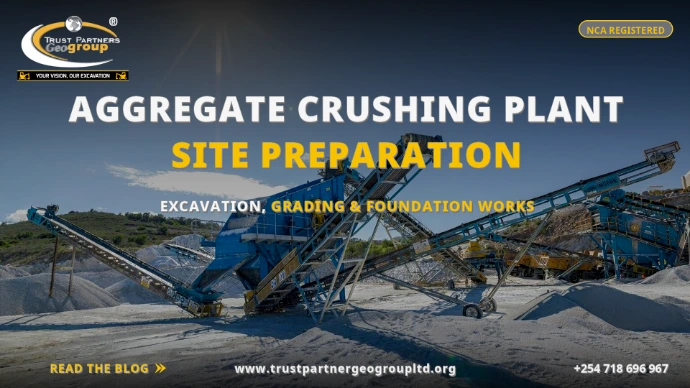
Aggregate Crushing Plant Site Preparation: Excavation, Grading & Foundation Works in Kenya
Cut-to-fill earthworks, crusher foundations, screen pads, conveyor corridors & drainage for quarries in Nairobi, Nakuru, Kakamega & across Kenya
Table of Contents
- 1. What Is Aggregate Crushing Plant Site Preparation?
- 2. Clearing, Stripping & Site Access
- 3. Bulk Cut-and-Fill Earthworks & Platform Grading
- 4. Crusher, Screen & Transfer Point Foundation Excavation
- 5. Conveyor Corridor Earthworks & Alignment
- 6. Drainage, Silt Control & Process Water Management
- 7. Haul Roads & Stockpile Base Construction
- 8. NEMA Compliance & Environmental Safeguards
- 9. Equipment Selection & Fleet Productivity
- 10. Construction Costs & Programme [2026]
- 11. Frequently Asked Questions
- 12. Conclusion
Before a single tonne of ballast or aggregate is crushed, the ground beneath the plant must be transformed from raw hillside or flat bush into an engineered platform capable of supporting vibrating machinery weighing hundreds of tonnes, handling thousands of tonnes of daily throughput, and draining stormwater without eroding the operation into the neighbouring valley. Aggregate plant excavation Kenya contractors perform is the invisible discipline that makes the visible production possible. This guide covers the full quarry site preparation sequence - from bush to crusher base - with 2026 rates, equipment choices and the compliance framework NEMA and county governments enforce on every new aggregate processing plant construction project.
Trust Partners Geo-Group Ltd - Engineering Team
NCA-registered excavation & civil engineering contractor with 15+ years of quarry earthworks, dam construction and heavy infrastructure experience across East Africa. Reviewed by registered engineers.
1. What Is Aggregate Crushing Plant Site Preparation?
An aggregate crushing plant is not a single machine - it is a production line: run-of-mine feed from the quarry face, primary jaw or gyratory crusher, secondary and tertiary cone crushers, vibrating screens, conveyors, transfer points, product stockpiles, and wash plants if manufactured sand is produced. Each element demands a specific grade, foundation depth and drainage condition:
- Primary crusher: the heaviest and most vibration-intensive unit, requiring the deepest, most massive foundation;
- Screen towers: elevated structures that need level, vibration-isolated bases;
- Conveyor corridors: long, gently graded pathways with millimeter-level straightness tolerances;
- Stockpile areas: large flat pads that must drain and not consolidate differentially under thousands of tonnes of product;
- Wash plants and settling ponds: excavated basins with engineered linings where process water is clarified and recycled.
Site preparation is the earthworks phase that creates all of these conditions before structural steel and mechanical erection begins. Done poorly, it produces misaligned conveyors, cracked crusher housings, flooded platforms and NEMA enforcement actions. Done properly, it is invisible - the plant simply runs.
2. Clearing, Stripping & Site Access
The first physical act is removing everything that is not engineered fill:
- Vegetation clearing: trees, stumps and root systems removed entirely - decomposing organic matter creates voids and settlement under foundations;
- Topsoil stripping: the organic-rich upper 150-400mm is stockpiled for rehabilitation of the quarry buffer zone and final landform, never used as structural fill;
- Termite mound treatment: in savanna and bush zones (common in Machakos, Kajiado and parts of Nakuru), termite mounds are dense but unstable - they must be excavated and replaced with compacted fill;
- Access roads: a temporary haul road from the public road to the plant footprint is built first so equipment and fill materials can move without destroying the surrounding land.
Stripping volumes for a medium plant site (2-5 hectares) typically run 8,000-25,000 m3. The stockpile must be located outside the plant footprint and drainage catchment - a detail often missed on tight quarry leases. Our overburden stripping guide details the methods and rates.
3. Bulk Cut-and-Fill Earthworks & Platform Grading
Most aggregate plant sites in Kenya are not flat. They sit on quarry benches, hillsides or undulating farmland. The earthworks contractor must create a platform - a level or gently sloped surface large enough for the processing train, stockpiles and turning radii:
| Platform Element | Design Grade | Tolerance | Compaction |
|---|---|---|---|
| Primary crusher pad | Level (0% slope) | +/- 50mm over 20m | 98% MDD, proof-rolled |
| Secondary/tertiary area | Level to 0.5% fall | +/- 75mm | 95-98% MDD |
| Screen tower base | Level | +/- 25mm | 98% MDD, vibration-tested |
| Conveyor corridor (fixed) | Design longitudinal grade +/- 0.5% | +/- 50mm over 50m | 95% MDD minimum |
| Stockpile pads | 1-2% cross-fall for drainage | +/- 100mm | 92-95% MDD |
| Haul roads | 2-3% camber, 8-10% max grade | +/- 50mm | 98% MDD, CBR 30+ |
Cut-to-fill balance is the economic heart of this phase. Importing fill to a remote quarry adds KES 300-600 per m3 in haulage; exporting waste adds similar cost. The ideal design balances cut volumes against fill requirements within the site boundary. Our cut-and-fill volume calculation guide explains the survey and software methods.
Layer placement: 200-300mm loose lifts, moisture within +/- 2% of optimum, compacted with smooth drum and padfoot rollers to the specified percentage of maximum dry density (Mod AASHTO). Every layer is tested - one nuclear density test per 500 m2 minimum. Black cotton soil or expansive clays within the platform area must be over-excavated and replaced with imported granular fill - they shrink, swell and crack foundations.
4. Crusher, Screen & Transfer Point Foundation Excavation
This is where crushing plant foundation work demands precision beyond ordinary civil construction:
Primary Crusher Foundations
Jaw and gyratory crushers for 100-300 tph plants generate dynamic loads that require mass concrete foundations on competent bearing. Excavation depths:
- Small jaw crushers (30-50 tph): 1.5-2.5m into firm laterite or weathered rock;
- Medium primary crushers (100-150 tph): 2.5-3.5m, often into weathered rock with rock bolt anchoring;
- Large primary gyratory (200+ tph): 3.5-5.0m, frequently requiring controlled blasting or hydraulic breaker excavation into fresh bedrock.
Bearing capacity must exceed 300 kPa; where natural ground is weaker, the foundation is deepened or widened, or improved with crushed stone replacement layers. The excavation is proof-rolled with a 10-tonne roller and inspected by the structural engineer before rebar and formwork.
Screen Tower and Secondary Foundations
Vibrating screens transmit high-frequency vibration into the ground. Their foundations are typically isolated reinforced concrete blocks 2.0-3.5m deep, separated from adjacent structures by vibration gaps or anti-vibration mounts. Excavation tolerances are tighter than standard - +/- 25mm on plan and level - because the screen frame bolts directly to anchor bolts cast into the concrete.
Transfer Points and Hoppers
These receive impact loads from falling rock. Excavation is shallower (1.0-1.8m) but requires dense backfill and often a crushed stone blinding layer to distribute point loads. Underground chute and tunnel excavations between transfer points demand temporary shoring in unstable ground.
5. Conveyor Corridor Earthworks & Alignment
Fixed conveyors are the arteries of the plant - and they are unforgiving of poor grading:
- Longitudinal grade: typically 0-12 degrees (0-21% slope) depending on belt type and material; the earthworks must achieve the design grade to within +/- 0.5% over the full length;
- Cross-fall: conveyor galleries need to be straight in plan - any lateral deviation creates belt tracking problems, spillage and premature wear;
- Support footing spacing: trestle footings at 10-20m intervals require individual excavations 1.0-1.5m deep on compacted fill or natural ground;
- Transfer tower foundations: elevated junction points where multiple conveyors meet need larger footings, often 2.0-3.0m deep with reinforced concrete pedestals.
Where conveyors cross soft ground, gullies or access roads, the earthworks contractor must build embankments or culverts to maintain grade. GPS machine control on dozers and graders is now standard for achieving the straightness and grade tolerances conveyor manufacturers specify. A conveyor that is 200 meters long and 50mm out of level at the discharge end creates a chronic spillage and maintenance problem - precision at the earthworks stage pays for itself in operational savings.
6. Drainage, Silt Control & Process Water Management
Aggregate plants generate two kinds of water: clean stormwater that should never touch the process area, and dirty process water laden with fines, dust suppressants and (in wash plants) suspended solids. The earthworks must separate them:
| Drainage System | Function | Typical Construction |
|---|---|---|
| Clean-water diversion | Intercept upslope runoff before it enters the plant | Cutoff berm or V-ditch with rip rap lining, 300-500mm deep |
| Process area collection | Capture wash-down, spillage and fines-laden runoff | Concrete or stone-lined trench, 1:200 slope to sump |
| Settling pond / silt trap | Clarify dirty water before discharge or recycling | Excavated basin 2-5m deep, 500-2,000 m3 capacity, often clay-lined |
| Under-drainage | Lower groundwater table beneath platform | French drain or perforated pipe in gravel envelope, 1.0-1.5m deep |
| Culverts | Pass natural drainage beneath haul roads | Reinforced concrete pipe or box culvert, 600-1,200mm diameter |
Platform surface grading is critical: the crusher and screen areas slope 1-2% away from structures to prevent ponding around foundations. In high-rainfall counties (Kakamega, Nyeri, parts of Kiambu), stormwater design uses 1-in-25-year rainfall intensity; arid counties (Kajiado, Garissa) may use 1-in-10-year but must handle flash-flood volumes. Wash plants that produce manufactured sand require the largest settling infrastructure - a 100 tph wash plant can generate 30-50 m3/hour of slurry water that must be clarified before recycling or discharge.
7. Haul Roads & Stockpile Base Construction
The plant does not operate in isolation - it is fed by quarry trucks and delivers product to customers:
- ROM (run-of-mine) haul roads: from the quarry face or borrow pit to the primary crusher hopper, designed for 30-40 tonne articulated dump trucks at 8-10% maximum grade. These are temporary or semi-permanent roads requiring 300-500mm of compacted subgrade and a wearing course of crushed stone or laterite;
- Product haul roads: from stockpiles to the weighbridge and exit gate, carrying loaded tipper trucks. These need all-weather surfacing, camber for drainage, and dust suppression systems;
- Stockpile bases: product stockpiles (20mm, 10mm, dust, ballast) sit on compacted platforms sloped 1-2% to drain. The subgrade must not consolidate under 5-10 metre stockpile heights - which means 95%+ compaction and exclusion of organic or expansive soils.
Haul road earthworks are often the largest volume item after the main platform. A 1-kilometre access road with 6m width and 500mm depth of cut-to-fill can consume 6,000-10,000 m3 of earthworks. In wet-season construction, roads must be crowned and drained immediately after grading or they become impassable within one rain event.
8. NEMA Compliance & Environmental Safeguards
Aggregate processing plant construction in Kenya triggers multiple regulatory layers:
| Requirement | Authority | What It Covers |
|---|---|---|
| EIA license | NEMA | Mandatory for any quarry or aggregate plant; covers dust, noise, water and rehabilitation |
| Mining license / mineral rights | State Department for Mining | Extraction rights, annual fees, production reporting |
| Water permits | Water Resources Authority (WRA) | Abstraction for wash plants, dewatering, discharge of clarified water |
| County permits | County government | Land use, building plan approval, access road agreements, local rates |
| NCA contractor registration | National Construction Authority | Earthworks and civil works must be executed by NCA-registered contractors |
Critical compliance point: buffer zones and noise
Crushing within 500 metres of residential areas, schools or hospitals triggers additional NEMA scrutiny. Noise limits are 70 dB daytime and 60 dB nighttime at the boundary. Earthworks contractors must be aware that NEMA officers inspect not just the plant but the access roads, drainage outfalls and stockpile dust - and they can issue stop-work orders on the entire operation for non-compliance.
Rehabilitation bonds are standard: the quarry operator must deposit funds (or a bank guarantee) with NEMA or the county to ensure the site is restored after closure. Earthworks contractors are often engaged to shape the final landform - which is why topsoil stockpiling from day one matters. A site stripped without topsoil preservation cannot be vegetated at closure, and the bond is forfeited.
9. Equipment Selection & Fleet Productivity
The right fleet for aggregate plant excavation Kenya projects depends on terrain, rock quantity and programme:
| Equipment | Role | Typical Size Class |
|---|---|---|
| Excavator | Foundation digging, rock excavation, trenching | 20-30 tonne (CAT 320, Komatsu PC200, Hitachi ZX200) |
| Articulated dump truck | Haulage of cut material, fill delivery | 25-40 tonne (CAT 730, Volvo A30) |
| Dozer | Spreading fill, rough grading, stockpile pushing | D6-D8 (CAT D6, Komatsu D65) |
| Motor grader | Final platform grading, haul road finishing | 140-160 hp (CAT 140, Komatsu GD655) |
| Smooth drum roller | Compaction of granular fills and platform layers | 10-14 tonne (Bomag BW211, Dynapac CA250) |
| Padfoot roller | Compaction of clayey fills and cohesive soils | 12-16 tonne (Bomag BW213, CAT CP54) |
| Hydraulic breaker | Rock excavation where blasting is restricted | 2,000-4,000 Joule (matched to 20-30t carrier) |
| Wheel loader | Stockpile management, backfilling, material handling | 3-5 m3 bucket (CAT 966, Komatsu WA380) |
GPS machine control on dozers and graders is now cost-effective even for medium quarry projects. It eliminates grade stakes, reduces rework, and achieves the tight tolerances conveyor corridors demand. A 20-tonne excavator with a hydraulic breaker can produce 80-150 m3 of rock excavation per day in weathered basalt or granite - the rate-limiting item on many Kenyan quarry sites where bedrock is shallow.
10. Construction Costs & Programme [2026]
Indicative earthworks costs for aggregate plant site preparation in Kenya (small-medium plant, 50-150 tph, 2-4 hectare footprint):
| Item | 2026 Rate | Typical Share |
|---|---|---|
| Clearing and topsoil stripping | KES 70-150/m2 | 5-8% |
| Bulk cut-and-fill earthworks | KES 250-450/m3 | 25-35% |
| Crusher foundation excavation | KES 350-600/m3 | 15-20% |
| Platform grading and compaction | KES 180-300/m2 | 15-20% |
| Drainage trenches and culverts | KES 1,500-3,000/m | 10-15% |
| Haul road construction | KES 450-800/m3 | 15-20% |
| Rock excavation (breaker or drill-and-blast) | KES 800-1,500/m3 | 10-20% |
| Stockpile base preparation | KES 120-200/m2 | 5-8% |
All-in site preparation for a small-medium plant typically lands at KES 8-25 million; large installations (200+ tph) with extensive rock excavation or import fill can reach KES 40-80 million before concrete and steel. Programme: 6-10 weeks for small-medium plants on moderate terrain; 3-5 months for large or rock-heavy sites. Dry-season execution is strongly advised - April-May and October-November rains in most of Kenya add 30-50% to earthworks duration.
Pro tip: negotiate a lump-sum or unit-rate contract?
Where the geotechnical investigation is thorough and quantities are reliable, a unit-rate contract (per m3 of excavation, per m2 of grading) gives transparency. Where ground conditions are uncertain - common in greenfield quarries - a lump-sum with defined geotechnical risk thresholds protects both parties. Trust Partners Geo-Group Ltd offers both structures, with preliminary site investigation to de-risk pricing.
11. Frequently Asked Questions: Aggregate Plant Site Preparation in Kenya
What is aggregate crushing plant site preparation?
Aggregate crushing plant site preparation is the earthworks and civil engineering phase that creates a stable, level, drained platform before crushers, screens, conveyors and support structures are installed. It includes clearing and stripping, bulk cut-and-fill earthworks to achieve design grades, excavation for heavy equipment foundations, construction of haul roads and drainage, and installation of services. Poor site preparation causes differential settlement, misaligned conveyors, and operational downtime - which is why quarry operators treat it as a critical path activity, not just 'digging a hole'.
How deep are crusher foundations excavated in Kenya?
Primary jaw and gyratory crusher foundations in Kenya typically require excavation 2.5-4.5 meters deep into firm, weathered rock or competent soil, depending on crusher size and dynamic loading. Secondary and tertiary cone crushers need 1.5-2.5 meters. The key factor is not just static weight but vibration: crushers generate cyclic loads that demand foundations with mass concrete on engineered subgrade, often with reinforced pedestals anchored by rock bolts or dowels into bedrock. Foundation excavation must achieve bearing capacities of 300-500 kPa minimum, with proof-rolling and density testing before any concrete is poured.
What does quarry site preparation cost in Kenya in 2026?
2026 indicative costs for aggregate plant site preparation in Kenya: clearing and topsoil stripping KES 70-150 per m2; bulk cut-and-fill earthworks KES 250-450 per m3; crusher foundation excavation KES 350-600 per m3; platform grading and compaction KES 180-300 per m2; haul road construction KES 450-800 per m3; drainage trenches and culverts KES 1,500-3,000 per linear meter. A small-medium plant (50-150 tph) site preparation typically runs KES 8-25 million; large installations (200+ tph) with extensive cut-to-fill can reach KES 40-80 million before concrete and steel.
What equipment is used for aggregate plant earthworks?
Typical fleet for aggregate plant site preparation: 20-30 tonne excavators for foundation digging and rock excavation; articulated dump trucks (25-40 tonne) for haulage; dozers (D6-D8 class) for spreading and grading; motor graders for final platform levels and haul roads; smooth drum and padfoot rollers for compaction to 95-98% Mod AASHTO; hydraulic breakers or drill-and-blast for rock excavation where bedrock is shallow; and wheel loaders for stockpile management. GPS machine control on dozers and graders is increasingly standard for achieving the tight tolerances crusher platforms demand.
What environmental permits does a quarry crushing plant need in Kenya?
Key permits: NEMA EIA license (mandatory for any quarry or aggregate processing operation under the Environmental Management and Coordination Act); mining license from the State Department for Mining (if extracting from a licensed quarry); Water Resources Authority (WRA) permits for abstraction, dewatering and any discharge; county government business permits and land use approvals; and NEMA effluent discharge license if process water or wash plant effluent leaves the site. Dust suppression plans, noise management and rehabilitation bonds are standard conditions. Crushing within 500 meters of residential areas triggers additional NEMA scrutiny and noise mitigation requirements.
How is drainage designed around a crushing plant?
Crushing plant drainage has three layers: clean-water diversion drains (berms and channels) that intercept upslope runoff before it enters the plant area; dirty-water collection trenches and sumps that capture wash-down water, spillage and fines-laden runoff from the processing area for recycling or treatment; and under-drainage or French drains beneath the platform where groundwater is high. All process-area drainage is directed to a settling pond or silt trap before any discharge. Platform grades are typically sloped 1-2% away from structures to prevent ponding around foundations. In high-rainfall zones like Kakamega or Nyeri, stormwater design uses 1-in-25-year rainfall intensity.
What foundation types are used for vibrating screens and conveyors?
Vibrating screens require reinforced concrete block foundations isolated from adjacent structures to prevent vibration transmission - typically 2.0-3.5 meters deep with mass concrete and anti-vibration mounts or spring isolators. Fixed conveyors and transfer points use strip or pad footings 1.0-1.5 meters deep on compacted engineered fill; long overland conveyors may need pile foundations where traversing soft ground. The critical detail is alignment: conveyor galleries must be graded to millimeter-level straightness over hundreds of meters, so the earthworks contractor must achieve sub-grade tolerances of +/- 50mm before the structural steel contractor begins. Any settlement after steel erection is expensive to correct.
How long does aggregate plant site preparation take in Kenya?
A small-medium aggregate plant (50-150 tph) on moderate terrain requires 6-10 weeks for complete site preparation: 1-2 weeks clearing and stripping, 3-5 weeks bulk earthworks and platform grading, 2-3 weeks foundation excavation and backfill, and 1-2 weeks drainage and haul roads running in parallel. Large plants (200+ tph) or sites requiring significant rock excavation or import fill can take 3-5 months. Dry-season scheduling is essential - attempting cut-to-fill or compaction during heavy rains in April-May or October-November adds weeks and compromises density. Contractors typically mobilize immediately after the short rains to maximize the dry window.
12. Conclusion: The Platform Determines the Production
An aggregate crushing plant is only as reliable as the ground it stands on. A crusher vibrating on a poorly compacted pad destroys itself; a conveyor 50mm out of grade spills tonnes of product daily; a platform that ponds water in the rainy season shuts down the operation. The earthworks phase - clearing, cut-and-fill, foundation excavation, grading, drainage and haul roads - is not preliminary work. It is the foundation of the foundation.
Trust Partners Geo-Group Ltd delivers the full site preparation package for aggregate processing plants across Kenya: bush clearing and topsoil management, bulk earthworks with GPS-controlled grading, precision foundation excavation for crushers and screens, conveyor corridor alignment, drainage and settling pond construction, and all-weather haul roads. We work under your structural engineer's hold points and deliver platforms ready for steel and concrete - on unit-rate or lump-sum contracts, with NCA-registered crews and tested compaction on every layer.
Aggregate Plant Site Preparation & Quarry Earthworks
Clearing, bulk earthworks, crusher foundation excavation, platform grading, drainage and haul roads - built to specification, tested every layer, ready for your structural contractor.
Free lead magnet: ask for our Aggregate Plant Site Preparation Checklist (PDF) - earthworks hold points, density testing frequencies and foundation inspection records your structural engineer will require.
Related Resources
Tailings Dam Construction and Excavation: Environmental Safeguards for Kenyan Mines
The previous blog in our mining series - engineered embankments, liners and compliance for mine waste facilities.
READ MOREOpen-Pit Mine Excavation in Kenya: Stripping Ratio, Bench Design & Equipment Selection
Pit planning and excavation for the quarries that feed these crushing plants.
READ MOREOverburden Removal for Mining Projects: Cost-Effective Stripping Methods in East Africa
The clearing and stripping methods that begin every quarry and aggregate plant project.
READ MOREEarthworks QA/QC: Compaction Testing & Density Control
The layer-by-layer testing regime every crusher platform and haul road demands.
READ MORECut-and-Fill Earthworks Balance: Calculate Volumes for Kenyan Sites
Volume balancing for quarry platform and stockpile earthworks.
READ MOREBorrow Pit Excavation in Kenya: Sourcing Fill Material [2026]
Finding and approving granular fill and select material for quarry platform construction.
READ MORETRUST PARTNERS GEO-GROUP LTD | YOUR VISION, OUR EXCAVATION
WEBSITE: WWW.TRUSTPARTNERGEOGROUPLTD.ORG | EMAIL: INFO@TRUSTPARTNERGEOGROUPLTD.ORG | PHONE: +254 718 68 69 67
FOLLOW US: FACEBOOK | TIKTOK | INSTAGRAM | YOUTUBE | LINKEDIN
© 2026 TRUST PARTNERS GEO-GROUP LTD. ALL RIGHTS RESERVED.
Aggregate Crushing Plant Site Preparation: Excavation, Grading & Foundation Works in Kenya
Cut-to-fill earthworks, crusher foundations, screen pads, conveyor corridors & drainage for quarries in Nairobi, Nakuru, Kakamega & across Kenya
Table of Contents
- 1. What Is Aggregate Crushing Plant Site Preparation?
- 2. Clearing, Stripping & Site Access
- 3. Bulk Cut-and-Fill Earthworks & Platform Grading
- 4. Crusher, Screen & Transfer Point Foundation Excavation
- 5. Conveyor Corridor Earthworks & Alignment
- 6. Drainage, Silt Control & Process Water Management
- 7. Haul Roads & Stockpile Base Construction
- 8. NEMA Compliance & Environmental Safeguards
- 9. Equipment Selection & Fleet Productivity
- 10. Construction Costs & Programme [2026]
- 11. Frequently Asked Questions
- 12. Conclusion
Before a single tonne of ballast or aggregate is crushed, the ground beneath the plant must be transformed from raw hillside or flat bush into an engineered platform capable of supporting vibrating machinery weighing hundreds of tonnes, handling thousands of tonnes of daily throughput, and draining stormwater without eroding the operation into the neighbouring valley. Aggregate plant excavation Kenya contractors perform is the invisible discipline that makes the visible production possible. This guide covers the full quarry site preparation sequence - from bush to crusher base - with 2026 rates, equipment choices and the compliance framework NEMA and county governments enforce on every new aggregate processing plant construction project.
Trust Partners Geo-Group Ltd - Engineering Team
NCA-registered excavation & civil engineering contractor with 15+ years of quarry earthworks, dam construction and heavy infrastructure experience across East Africa. Reviewed by registered engineers.
1. What Is Aggregate Crushing Plant Site Preparation?
An aggregate crushing plant is not a single machine - it is a production line: run-of-mine feed from the quarry face, primary jaw or gyratory crusher, secondary and tertiary cone crushers, vibrating screens, conveyors, transfer points, product stockpiles, and wash plants if manufactured sand is produced. Each element demands a specific grade, foundation depth and drainage condition:
- Primary crusher: the heaviest and most vibration-intensive unit, requiring the deepest, most massive foundation;
- Screen towers: elevated structures that need level, vibration-isolated bases;
- Conveyor corridors: long, gently graded pathways with millimeter-level straightness tolerances;
- Stockpile areas: large flat pads that must drain and not consolidate differentially under thousands of tonnes of product;
- Wash plants and settling ponds: excavated basins with engineered linings where process water is clarified and recycled.
Site preparation is the earthworks phase that creates all of these conditions before structural steel and mechanical erection begins. Done poorly, it produces misaligned conveyors, cracked crusher housings, flooded platforms and NEMA enforcement actions. Done properly, it is invisible - the plant simply runs.
2. Clearing, Stripping & Site Access
The first physical act is removing everything that is not engineered fill:
- Vegetation clearing: trees, stumps and root systems removed entirely - decomposing organic matter creates voids and settlement under foundations;
- Topsoil stripping: the organic-rich upper 150-400mm is stockpiled for rehabilitation of the quarry buffer zone and final landform, never used as structural fill;
- Termite mound treatment: in savanna and bush zones (common in Machakos, Kajiado and parts of Nakuru), termite mounds are dense but unstable - they must be excavated and replaced with compacted fill;
- Access roads: a temporary haul road from the public road to the plant footprint is built first so equipment and fill materials can move without destroying the surrounding land.
Stripping volumes for a medium plant site (2-5 hectares) typically run 8,000-25,000 m3. The stockpile must be located outside the plant footprint and drainage catchment - a detail often missed on tight quarry leases. Our overburden stripping guide details the methods and rates.
3. Bulk Cut-and-Fill Earthworks & Platform Grading
Most aggregate plant sites in Kenya are not flat. They sit on quarry benches, hillsides or undulating farmland. The earthworks contractor must create a platform - a level or gently sloped surface large enough for the processing train, stockpiles and turning radii:
| Platform Element | Design Grade | Tolerance | Compaction |
|---|---|---|---|
| Primary crusher pad | Level (0% slope) | +/- 50mm over 20m | 98% MDD, proof-rolled |
| Secondary/tertiary area | Level to 0.5% fall | +/- 75mm | 95-98% MDD |
| Screen tower base | Level | +/- 25mm | 98% MDD, vibration-tested |
| Conveyor corridor (fixed) | Design longitudinal grade +/- 0.5% | +/- 50mm over 50m | 95% MDD minimum |
| Stockpile pads | 1-2% cross-fall for drainage | +/- 100mm | 92-95% MDD |
| Haul roads | 2-3% camber, 8-10% max grade | +/- 50mm | 98% MDD, CBR 30+ |
Cut-to-fill balance is the economic heart of this phase. Importing fill to a remote quarry adds KES 300-600 per m3 in haulage; exporting waste adds similar cost. The ideal design balances cut volumes against fill requirements within the site boundary. Our cut-and-fill volume calculation guide explains the survey and software methods.
Layer placement: 200-300mm loose lifts, moisture within +/- 2% of optimum, compacted with smooth drum and padfoot rollers to the specified percentage of maximum dry density (Mod AASHTO). Every layer is tested - one nuclear density test per 500 m2 minimum. Black cotton soil or expansive clays within the platform area must be over-excavated and replaced with imported granular fill - they shrink, swell and crack foundations.
4. Crusher, Screen & Transfer Point Foundation Excavation
This is where crushing plant foundation work demands precision beyond ordinary civil construction:
Primary Crusher Foundations
Jaw and gyratory crushers for 100-300 tph plants generate dynamic loads that require mass concrete foundations on competent bearing. Excavation depths:
- Small jaw crushers (30-50 tph): 1.5-2.5m into firm laterite or weathered rock;
- Medium primary crushers (100-150 tph): 2.5-3.5m, often into weathered rock with rock bolt anchoring;
- Large primary gyratory (200+ tph): 3.5-5.0m, frequently requiring controlled blasting or hydraulic breaker excavation into fresh bedrock.
Bearing capacity must exceed 300 kPa; where natural ground is weaker, the foundation is deepened or widened, or improved with crushed stone replacement layers. The excavation is proof-rolled with a 10-tonne roller and inspected by the structural engineer before rebar and formwork.
Screen Tower and Secondary Foundations
Vibrating screens transmit high-frequency vibration into the ground. Their foundations are typically isolated reinforced concrete blocks 2.0-3.5m deep, separated from adjacent structures by vibration gaps or anti-vibration mounts. Excavation tolerances are tighter than standard - +/- 25mm on plan and level - because the screen frame bolts directly to anchor bolts cast into the concrete.
Transfer Points and Hoppers
These receive impact loads from falling rock. Excavation is shallower (1.0-1.8m) but requires dense backfill and often a crushed stone blinding layer to distribute point loads. Underground chute and tunnel excavations between transfer points demand temporary shoring in unstable ground.
5. Conveyor Corridor Earthworks & Alignment
Fixed conveyors are the arteries of the plant - and they are unforgiving of poor grading:
- Longitudinal grade: typically 0-12 degrees (0-21% slope) depending on belt type and material; the earthworks must achieve the design grade to within +/- 0.5% over the full length;
- Cross-fall: conveyor galleries need to be straight in plan - any lateral deviation creates belt tracking problems, spillage and premature wear;
- Support footing spacing: trestle footings at 10-20m intervals require individual excavations 1.0-1.5m deep on compacted fill or natural ground;
- Transfer tower foundations: elevated junction points where multiple conveyors meet need larger footings, often 2.0-3.0m deep with reinforced concrete pedestals.
Where conveyors cross soft ground, gullies or access roads, the earthworks contractor must build embankments or culverts to maintain grade. GPS machine control on dozers and graders is now standard for achieving the straightness and grade tolerances conveyor manufacturers specify. A conveyor that is 200 meters long and 50mm out of level at the discharge end creates a chronic spillage and maintenance problem - precision at the earthworks stage pays for itself in operational savings.
6. Drainage, Silt Control & Process Water Management
Aggregate plants generate two kinds of water: clean stormwater that should never touch the process area, and dirty process water laden with fines, dust suppressants and (in wash plants) suspended solids. The earthworks must separate them:
| Drainage System | Function | Typical Construction |
|---|---|---|
| Clean-water diversion | Intercept upslope runoff before it enters the plant | Cutoff berm or V-ditch with rip rap lining, 300-500mm deep |
| Process area collection | Capture wash-down, spillage and fines-laden runoff | Concrete or stone-lined trench, 1:200 slope to sump |
| Settling pond / silt trap | Clarify dirty water before discharge or recycling | Excavated basin 2-5m deep, 500-2,000 m3 capacity, often clay-lined |
| Under-drainage | Lower groundwater table beneath platform | French drain or perforated pipe in gravel envelope, 1.0-1.5m deep |
| Culverts | Pass natural drainage beneath haul roads | Reinforced concrete pipe or box culvert, 600-1,200mm diameter |
Platform surface grading is critical: the crusher and screen areas slope 1-2% away from structures to prevent ponding around foundations. In high-rainfall counties (Kakamega, Nyeri, parts of Kiambu), stormwater design uses 1-in-25-year rainfall intensity; arid counties (Kajiado, Garissa) may use 1-in-10-year but must handle flash-flood volumes. Wash plants that produce manufactured sand require the largest settling infrastructure - a 100 tph wash plant can generate 30-50 m3/hour of slurry water that must be clarified before recycling or discharge.
7. Haul Roads & Stockpile Base Construction
The plant does not operate in isolation - it is fed by quarry trucks and delivers product to customers:
- ROM (run-of-mine) haul roads: from the quarry face or borrow pit to the primary crusher hopper, designed for 30-40 tonne articulated dump trucks at 8-10% maximum grade. These are temporary or semi-permanent roads requiring 300-500mm of compacted subgrade and a wearing course of crushed stone or laterite;
- Product haul roads: from stockpiles to the weighbridge and exit gate, carrying loaded tipper trucks. These need all-weather surfacing, camber for drainage, and dust suppression systems;
- Stockpile bases: product stockpiles (20mm, 10mm, dust, ballast) sit on compacted platforms sloped 1-2% to drain. The subgrade must not consolidate under 5-10 metre stockpile heights - which means 95%+ compaction and exclusion of organic or expansive soils.
Haul road earthworks are often the largest volume item after the main platform. A 1-kilometre access road with 6m width and 500mm depth of cut-to-fill can consume 6,000-10,000 m3 of earthworks. In wet-season construction, roads must be crowned and drained immediately after grading or they become impassable within one rain event.
8. NEMA Compliance & Environmental Safeguards
Aggregate processing plant construction in Kenya triggers multiple regulatory layers:
| Requirement | Authority | What It Covers |
|---|---|---|
| EIA license | NEMA | Mandatory for any quarry or aggregate plant; covers dust, noise, water and rehabilitation |
| Mining license / mineral rights | State Department for Mining | Extraction rights, annual fees, production reporting |
| Water permits | Water Resources Authority (WRA) | Abstraction for wash plants, dewatering, discharge of clarified water |
| County permits | County government | Land use, building plan approval, access road agreements, local rates |
| NCA contractor registration | National Construction Authority | Earthworks and civil works must be executed by NCA-registered contractors |
Critical compliance point: buffer zones and noise
Crushing within 500 metres of residential areas, schools or hospitals triggers additional NEMA scrutiny. Noise limits are 70 dB daytime and 60 dB nighttime at the boundary. Earthworks contractors must be aware that NEMA officers inspect not just the plant but the access roads, drainage outfalls and stockpile dust - and they can issue stop-work orders on the entire operation for non-compliance.
Rehabilitation bonds are standard: the quarry operator must deposit funds (or a bank guarantee) with NEMA or the county to ensure the site is restored after closure. Earthworks contractors are often engaged to shape the final landform - which is why topsoil stockpiling from day one matters. A site stripped without topsoil preservation cannot be vegetated at closure, and the bond is forfeited.
9. Equipment Selection & Fleet Productivity
The right fleet for aggregate plant excavation Kenya projects depends on terrain, rock quantity and programme:
| Equipment | Role | Typical Size Class |
|---|---|---|
| Excavator | Foundation digging, rock excavation, trenching | 20-30 tonne (CAT 320, Komatsu PC200, Hitachi ZX200) |
| Articulated dump truck | Haulage of cut material, fill delivery | 25-40 tonne (CAT 730, Volvo A30) |
| Dozer | Spreading fill, rough grading, stockpile pushing | D6-D8 (CAT D6, Komatsu D65) |
| Motor grader | Final platform grading, haul road finishing | 140-160 hp (CAT 140, Komatsu GD655) |
| Smooth drum roller | Compaction of granular fills and platform layers | 10-14 tonne (Bomag BW211, Dynapac CA250) |
| Padfoot roller | Compaction of clayey fills and cohesive soils | 12-16 tonne (Bomag BW213, CAT CP54) |
| Hydraulic breaker | Rock excavation where blasting is restricted | 2,000-4,000 Joule (matched to 20-30t carrier) |
| Wheel loader | Stockpile management, backfilling, material handling | 3-5 m3 bucket (CAT 966, Komatsu WA380) |
GPS machine control on dozers and graders is now cost-effective even for medium quarry projects. It eliminates grade stakes, reduces rework, and achieves the tight tolerances conveyor corridors demand. A 20-tonne excavator with a hydraulic breaker can produce 80-150 m3 of rock excavation per day in weathered basalt or granite - the rate-limiting item on many Kenyan quarry sites where bedrock is shallow.
10. Construction Costs & Programme [2026]
Indicative earthworks costs for aggregate plant site preparation in Kenya (small-medium plant, 50-150 tph, 2-4 hectare footprint):
| Item | 2026 Rate | Typical Share |
|---|---|---|
| Clearing and topsoil stripping | KES 70-150/m2 | 5-8% |
| Bulk cut-and-fill earthworks | KES 250-450/m3 | 25-35% |
| Crusher foundation excavation | KES 350-600/m3 | 15-20% |
| Platform grading and compaction | KES 180-300/m2 | 15-20% |
| Drainage trenches and culverts | KES 1,500-3,000/m | 10-15% |
| Haul road construction | KES 450-800/m3 | 15-20% |
| Rock excavation (breaker or drill-and-blast) | KES 800-1,500/m3 | 10-20% |
| Stockpile base preparation | KES 120-200/m2 | 5-8% |
All-in site preparation for a small-medium plant typically lands at KES 8-25 million; large installations (200+ tph) with extensive rock excavation or import fill can reach KES 40-80 million before concrete and steel. Programme: 6-10 weeks for small-medium plants on moderate terrain; 3-5 months for large or rock-heavy sites. Dry-season execution is strongly advised - April-May and October-November rains in most of Kenya add 30-50% to earthworks duration.
Pro tip: negotiate a lump-sum or unit-rate contract?
Where the geotechnical investigation is thorough and quantities are reliable, a unit-rate contract (per m3 of excavation, per m2 of grading) gives transparency. Where ground conditions are uncertain - common in greenfield quarries - a lump-sum with defined geotechnical risk thresholds protects both parties. Trust Partners Geo-Group Ltd offers both structures, with preliminary site investigation to de-risk pricing.
11. Frequently Asked Questions: Aggregate Plant Site Preparation in Kenya
What is aggregate crushing plant site preparation?
Aggregate crushing plant site preparation is the earthworks and civil engineering phase that creates a stable, level, drained platform before crushers, screens, conveyors and support structures are installed. It includes clearing and stripping, bulk cut-and-fill earthworks to achieve design grades, excavation for heavy equipment foundations, construction of haul roads and drainage, and installation of services. Poor site preparation causes differential settlement, misaligned conveyors, and operational downtime - which is why quarry operators treat it as a critical path activity, not just 'digging a hole'.
How deep are crusher foundations excavated in Kenya?
Primary jaw and gyratory crusher foundations in Kenya typically require excavation 2.5-4.5 meters deep into firm, weathered rock or competent soil, depending on crusher size and dynamic loading. Secondary and tertiary cone crushers need 1.5-2.5 meters. The key factor is not just static weight but vibration: crushers generate cyclic loads that demand foundations with mass concrete on engineered subgrade, often with reinforced pedestals anchored by rock bolts or dowels into bedrock. Foundation excavation must achieve bearing capacities of 300-500 kPa minimum, with proof-rolling and density testing before any concrete is poured.
What does quarry site preparation cost in Kenya in 2026?
2026 indicative costs for aggregate plant site preparation in Kenya: clearing and topsoil stripping KES 70-150 per m2; bulk cut-and-fill earthworks KES 250-450 per m3; crusher foundation excavation KES 350-600 per m3; platform grading and compaction KES 180-300 per m2; haul road construction KES 450-800 per m3; drainage trenches and culverts KES 1,500-3,000 per linear meter. A small-medium plant (50-150 tph) site preparation typically runs KES 8-25 million; large installations (200+ tph) with extensive cut-to-fill can reach KES 40-80 million before concrete and steel.
What equipment is used for aggregate plant earthworks?
Typical fleet for aggregate plant site preparation: 20-30 tonne excavators for foundation digging and rock excavation; articulated dump trucks (25-40 tonne) for haulage; dozers (D6-D8 class) for spreading and grading; motor graders for final platform levels and haul roads; smooth drum and padfoot rollers for compaction to 95-98% Mod AASHTO; hydraulic breakers or drill-and-blast for rock excavation where bedrock is shallow; and wheel loaders for stockpile management. GPS machine control on dozers and graders is increasingly standard for achieving the tight tolerances crusher platforms demand.
What environmental permits does a quarry crushing plant need in Kenya?
Key permits: NEMA EIA license (mandatory for any quarry or aggregate processing operation under the Environmental Management and Coordination Act); mining license from the State Department for Mining (if extracting from a licensed quarry); Water Resources Authority (WRA) permits for abstraction, dewatering and any discharge; county government business permits and land use approvals; and NEMA effluent discharge license if process water or wash plant effluent leaves the site. Dust suppression plans, noise management and rehabilitation bonds are standard conditions. Crushing within 500 meters of residential areas triggers additional NEMA scrutiny and noise mitigation requirements.
How is drainage designed around a crushing plant?
Crushing plant drainage has three layers: clean-water diversion drains (berms and channels) that intercept upslope runoff before it enters the plant area; dirty-water collection trenches and sumps that capture wash-down water, spillage and fines-laden runoff from the processing area for recycling or treatment; and under-drainage or French drains beneath the platform where groundwater is high. All process-area drainage is directed to a settling pond or silt trap before any discharge. Platform grades are typically sloped 1-2% away from structures to prevent ponding around foundations. In high-rainfall zones like Kakamega or Nyeri, stormwater design uses 1-in-25-year rainfall intensity.
What foundation types are used for vibrating screens and conveyors?
Vibrating screens require reinforced concrete block foundations isolated from adjacent structures to prevent vibration transmission - typically 2.0-3.5 meters deep with mass concrete and anti-vibration mounts or spring isolators. Fixed conveyors and transfer points use strip or pad footings 1.0-1.5 meters deep on compacted engineered fill; long overland conveyors may need pile foundations where traversing soft ground. The critical detail is alignment: conveyor galleries must be graded to millimeter-level straightness over hundreds of meters, so the earthworks contractor must achieve sub-grade tolerances of +/- 50mm before the structural steel contractor begins. Any settlement after steel erection is expensive to correct.
How long does aggregate plant site preparation take in Kenya?
A small-medium aggregate plant (50-150 tph) on moderate terrain requires 6-10 weeks for complete site preparation: 1-2 weeks clearing and stripping, 3-5 weeks bulk earthworks and platform grading, 2-3 weeks foundation excavation and backfill, and 1-2 weeks drainage and haul roads running in parallel. Large plants (200+ tph) or sites requiring significant rock excavation or import fill can take 3-5 months. Dry-season scheduling is essential - attempting cut-to-fill or compaction during heavy rains in April-May or October-November adds weeks and compromises density. Contractors typically mobilize immediately after the short rains to maximize the dry window.
12. Conclusion: The Platform Determines the Production
An aggregate crushing plant is only as reliable as the ground it stands on. A crusher vibrating on a poorly compacted pad destroys itself; a conveyor 50mm out of grade spills tonnes of product daily; a platform that ponds water in the rainy season shuts down the operation. The earthworks phase - clearing, cut-and-fill, foundation excavation, grading, drainage and haul roads - is not preliminary work. It is the foundation of the foundation.
Trust Partners Geo-Group Ltd delivers the full site preparation package for aggregate processing plants across Kenya: bush clearing and topsoil management, bulk earthworks with GPS-controlled grading, precision foundation excavation for crushers and screens, conveyor corridor alignment, drainage and settling pond construction, and all-weather haul roads. We work under your structural engineer's hold points and deliver platforms ready for steel and concrete - on unit-rate or lump-sum contracts, with NCA-registered crews and tested compaction on every layer.
Aggregate Plant Site Preparation & Quarry Earthworks
Clearing, bulk earthworks, crusher foundation excavation, platform grading, drainage and haul roads - built to specification, tested every layer, ready for your structural contractor.
Free lead magnet: ask for our Aggregate Plant Site Preparation Checklist (PDF) - earthworks hold points, density testing frequencies and foundation inspection records your structural engineer will require.
Related Resources
Tailings Dam Construction and Excavation: Environmental Safeguards for Kenyan Mines
The previous blog in our mining series - engineered embankments, liners and compliance for mine waste facilities.
READ MOREOpen-Pit Mine Excavation in Kenya: Stripping Ratio, Bench Design & Equipment Selection
Pit planning and excavation for the quarries that feed these crushing plants.
READ MOREOverburden Removal for Mining Projects: Cost-Effective Stripping Methods in East Africa
The clearing and stripping methods that begin every quarry and aggregate plant project.
READ MOREEarthworks QA/QC: Compaction Testing & Density Control
The layer-by-layer testing regime every crusher platform and haul road demands.
READ MORECut-and-Fill Earthworks Balance: Calculate Volumes for Kenyan Sites
Volume balancing for quarry platform and stockpile earthworks.
READ MOREBorrow Pit Excavation in Kenya: Sourcing Fill Material [2026]
Finding and approving granular fill and select material for quarry platform construction.
READ MORETRUST PARTNERS GEO-GROUP LTD | YOUR VISION, OUR EXCAVATION
WEBSITE: WWW.TRUSTPARTNERGEOGROUPLTD.ORG | EMAIL: INFO@TRUSTPARTNERGEOGROUPLTD.ORG | PHONE: +254 718 68 69 67
FOLLOW US: FACEBOOK | TIKTOK | INSTAGRAM | YOUTUBE | LINKEDIN
© 2026 TRUST PARTNERS GEO-GROUP LTD. ALL RIGHTS RESERVED.