Sustainable Site Development: Low-Impact Excavation Techniques for Green Building Projects in Kenya
Eco-friendly site preparation, topsoil preservation, erosion control, dust suppression & low-impact earthworks for LEED, EDGE & Green Star projects in Nairobi, Mombasa & across Kenya
Table of Contents
- 1. Why Low-Impact Excavation Matters for Green Buildings
- 2. Green Certification: LEED, EDGE and Green Star Requirements
- 3. Topsoil Preservation and Stripping Techniques
- 4. Erosion and Sediment Control Systems
- 5. Low-Impact Equipment Selection and Haul Routes
- 6. Dust Suppression and Air Quality Management
- 7. Noise and Vibration Reduction in Urban Sites
- 8. Spoil Management: Reuse, Recycling and Diversion
- 9. Tree Protection and Existing Vegetation
- 10. Groundwater and Soil Protection
- 11. Heavy Equipment for Hire: Low-Impact Machine Options
- 12. NEMA, County and Green Building Compliance
- 13. Construction Costs and Programme [2026]
- 14. Frequently Asked Questions
- 15. Conclusion
On a hillside plot in Karen where a developer is building Kenya's next LEED Platinum office park, the first act of construction is not foundation excavation - it is the careful stripping of 300mm of precious topsoil, the installation of silt fences before a single tonne of laterite is moved, and the marking of tree protection zones around indigenous podo trees that predate the project by a century. This is low-impact excavation - the discipline of moving earth while preserving the site ecosystem, and it is now a requirement, not an option, for green building earthworks in Kenya. With Nairobi's construction boom pushing into sensitive highland areas, with NEMA requiring sediment control on all significant earthworks, and with green certification schemes (LEED, EDGE, Green Star) awarding points for sustainable site management, the contractor who understands eco friendly site preparation Nairobi is the contractor who wins the premium projects. With heavy equipment for hire from Trust Partners Geo-Group Ltd, developers can access rubber-tracked, low-emission machines without capital investment. This guide covers the full sustainable excavation Kenya sequence - topsoil preservation, erosion control, dust suppression, tree protection, spoil management and compliance - with 2026 costs for green building site preparation.
Trust Partners Geo-Group Ltd - Environmental Engineering Team
NCA-registered excavation & civil engineering contractor with 15+ years of sustainable site development, low-impact earthworks, green building site preparation and environmental compliance experience across East Africa. Reviewed by registered environmental engineers.
1. Why Low-Impact Excavation Matters for Green Buildings
Green building certification in Kenya has moved from niche to mainstream. The Kenya Green Building Society reports that certified building floor area has grown from 50,000 m2 in 2018 to over 400,000 m2 in 2026. Major developments including Two Rivers, Garden City, Tatu City and numerous office towers in Upper Hill and Westlands have pursued LEED, EDGE or Green Star ratings. A common thread in all these certifications is the Sustainable Sites credit category, which requires developers to minimize the environmental impact of construction.
For earthworks contractors, this means a fundamental shift in approach:
- From bulk removal to selective stripping: topsoil is not spoil to be dumped - it is a resource to be preserved and reused;
- From open site to controlled site: silt fences, sediment traps and dust suppression are installed before excavation begins, not after complaints;
- From maximum production to minimum disturbance: equipment is restricted to designated haul routes, and only the area needed for immediate work is exposed;
- From disposal to diversion: excavated material is sorted, reused on site, or recycled rather than sent to landfill;
- From standard equipment to low-impact equipment: rubber tracks, Tier 3 engines, and noise suppression become standard specifications.
The business case is compelling. Green-certified buildings in Nairobi command 10-20% rental premiums and sell for 15-25% more than conventional buildings. But certification requires documentation - photographs, inspection records, waste diversion receipts, dust monitoring data - that standard earthworks contractors often fail to provide. The contractor who understands green building requirements and delivers the documentation is the contractor who builds relationships with the architects, engineers and developers who design Kenya's premium projects.
2. Green Certification: LEED, EDGE and Green Star Requirements
Each green certification scheme has specific requirements for site preparation and earthworks that affect contractor scope and documentation.
LEED (Leadership in Energy and Environmental Design)
LEED v4.1 allocates up to 10 points in the Sustainable Sites category for construction activity pollution prevention, site assessment, and site development - protect or restore habitat. Requirements include: implementation of an Erosion and Sedimentation Control Plan covering all construction activities; protection of topsoil and reuse on site; minimization of disturbed area; and restoration of open area with native or adaptive vegetation. LEED requires photographic documentation of all measures, monthly inspection reports, and quantified data on topsoil volumes stripped and reused, and spoil diversion rates.
EDGE (Excellence in Design for Greater Efficiencies)
EDGE, developed by IFC and increasingly used in Kenyan residential and commercial projects, requires: protection of existing vegetation and topsoil; erosion control during construction; and minimization of site disturbance. EDGE is less documentation-intensive than LEED but still requires photographic evidence and a site management plan. The earthworks contractor must demonstrate that at least 50% of existing topsoil was preserved and reused.
Green Star Kenya
The Kenya Green Building Society's Green Star rating requires: a Site Management Plan approved before construction; erosion and sediment control measures in place before earthworks; dust suppression during dry periods; and a target of 80% construction waste diversion from landfill. Green Star auditors conduct site inspections and will withhold credits if controls are inadequate or undocumented.
| Certification | Site Credits | Topsoil Requirement | Waste Diversion Target |
|---|---|---|---|
| LEED v4.1 | Up to 10 points | 100% strip and reuse | 50-75% diversion |
| EDGE | Mandatory + optional | 50% minimum reuse | Not specified |
| Green Star | Up to 12 points | 100% strip and reuse | 80% diversion |
3. Topsoil Preservation and Stripping Techniques
Topsoil is the most valuable material on a green building site. In Kenya's volcanic and lateritic landscapes, the native topsoil layer is typically 150-400mm deep, rich in organic matter, and essential for establishing the landscaping that green certifications require. Once mixed with subsoil or compacted by equipment, it is destroyed.
Stripping Procedure
The correct sequence is: survey the site to identify topsoil depth variation (it may be 100mm on ridges and 500mm in valleys); mark stripping boundaries and depths; use a motor grader or excavator with a blade set to the measured topsoil depth to strip in lifts without mixing subsoil; haul topsoil immediately to a designated stockpile area outside the construction zone; and shape the stockpile with gentle side slopes (3:1) to prevent erosion and cover with geotextile or mulch.
Stockpile Management
Topsoil stockpiles must be: located away from drainage lines and areas prone to waterlogging; protected from contamination by fuel, cement, or chemicals (no fuel storage or equipment maintenance near stockpiles); covered with breathable geotextile or 50mm of straw mulch to prevent weed growth and moisture loss; and seeded with a temporary cover crop if stored for more than 3 months to prevent erosion. The stockpile volume is recorded and photographed for certification documentation.
Respreading
After construction, the topsoil is respread over exposed areas at design depth: 150-200mm for lawns and open space; 300-400mm for planting beds and tree pits; and 100mm for rough areas and berms. The respread topsoil is lightly ripped to relieve any compaction caused by stockpiling, then graded and prepared for planting or seeding. On a 1-hectare green building site, preserving and reusing native topsoil saves KES 800,000-1.2 million compared to importing replacement topsoil.
4. Erosion and Sediment Control Systems
Erosion control is the most visible indicator of a contractor's environmental commitment. NEMA requires it; green certifications demand it; and neighbours judge the project by it. In Kenya's climate, where intense rains can fall on exposed laterite and wash tonnes of sediment into watercourses within hours, erosion control is not optional.
Silt Fences
Silt fences are the primary perimeter control. They consist of geotextile fabric (typically 1.0m high, 90-120gsm weight) supported by hardwood or steel posts at 2-metre spacing, with the bottom 150mm of fabric buried in a trench and backfilled. Silt fences must be installed before any earthworks begin, maintained weekly (removing accumulated sediment when it reaches one-third of fence height), and repaired immediately if damaged. On a 1-hectare site, 300-400 linear metres of silt fence are typical.
Sediment Traps
Sediment traps are constructed at every point where site runoff discharges to a stormwater system, natural watercourse, or adjacent property. A typical trap is a stone-lined or geotextile-lined pit (1.5m x 1.5m x 1.0m deep) with a baffle wall that slows water flow and allows sediment to settle before water overflows. Traps must be cleaned after every significant rain event and maintained until the site is fully stabilized.
Check Dams and Channels
Temporary drainage channels convey water across the site without causing erosion. Check dams (logs, stone, or sandbag barriers) are placed across channels at 5-10 metre intervals to reduce flow velocity and promote settling. Channels must be sized for the 10-year storm event - in Nairobi, this means handling 50-80mm of rainfall in 24 hours.
Stabilization
Exposed slopes must be stabilized within 7 days of grading. Methods include: hydroseeding (spraying seed, mulch and binder in a slurry) for slopes up to 2:1; jute mesh or coir matting for steeper slopes; and temporary cover crops (rye grass, Sudan grass) for large areas. In Kenya's dry season, irrigation may be needed to establish cover crops.
| Control Measure | Application | Typical Cost |
|---|---|---|
| Silt fence | Perimeter, stockpiles | KES 250-450/m |
| Sediment trap | Outfalls, drains | KES 80,000-150,000 each |
| Check dam | Temporary channels | KES 15,000-30,000 each |
| Hydroseeding | Exposed slopes | KES 80-150/m2 |
| Coir matting | Steep slopes | KES 200-350/m2 |
| Wheel wash | Site exit | KES 40,000-80,000 |
5. Low-Impact Equipment Selection and Haul Routes
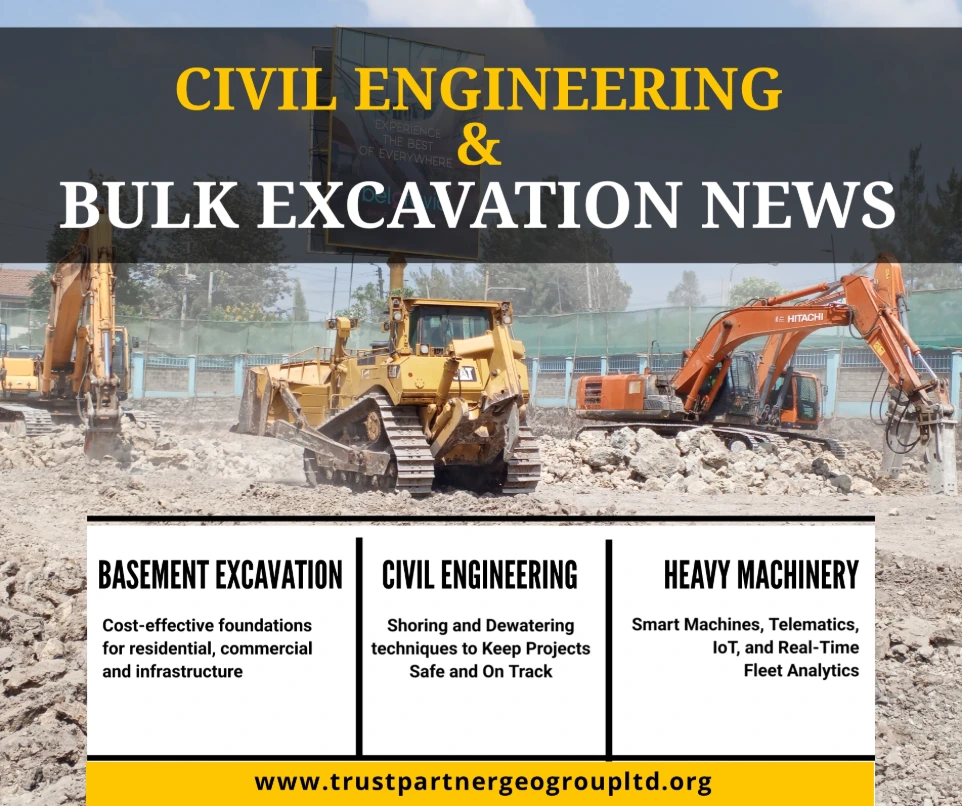
The equipment that moves across a green building site determines how much damage it causes. Standard steel-tracked bulldozers and heavy dump trucks compact soil, damage vegetation, and create ruts that become erosion channels. Low-impact equipment and disciplined haul route management minimize these effects.
Rubber-Tracked Equipment
Rubber-tracked excavators and bulldozers distribute machine weight over a larger footprint, reducing ground pressure from 0.8-1.2 kg/cm2 (steel tracks) to 0.3-0.5 kg/cm2. This prevents subgrade compaction, protects tree root zones, and allows work on softer ground without creating ruts. On a Karen green residential project, switching from steel to rubber tracks reduced topsoil compaction by 60% and eliminated the need for deep ripping before landscaping.
Mini-Excavators and Skid-Steers
For work near tree protection zones, in confined areas, or on finished surfaces, mini-excavators (3-5 tonne) and skid-steer loaders with rubber tyres provide access without the ground damage of full-size machines. They are essential for trenching near protected trees, grading in tight spaces, and working on surfaces that will not be re-excavated.
Haul Route Management
Haul routes must be designated before construction begins, surfaced with 150-200mm of crushed stone or gravel where possible, and maintained to prevent dust and rutting. Routes should avoid tree protection zones, steep slopes, and drainage lines. Where haul routes cross sensitive areas, timber mats or steel road plates distribute loads and prevent compaction. Haul routes are inspected weekly and repaired as needed.
Phased Excavation
Instead of clearing and excavating the entire site at once, green building projects use phased excavation: only the area needed for immediate construction is disturbed; the remainder is protected by silt fences and left vegetated until needed; and as each phase is completed, it is stabilized before the next phase begins. This minimizes the area exposed to erosion at any time and reduces dust generation.
6. Dust Suppression and Air Quality Management
Dust is the invisible pollutant that affects worker health, neighbour relations, and green certification credits. In Nairobi's dry season, uncontrolled earthworks can generate PM10 levels exceeding 1,000 micrograms per m3 - four times the NEMA limit and ten times the WHO guideline.
Water Suppression
The primary dust control method is water spraying. A water truck makes 2-3 passes per day over all unpaved haul roads and exposed surfaces during dry conditions. The water must be applied as a fine spray, not a flood, to avoid creating mud that tracks onto public roads. In water-scarce areas, recycled water from site dewatering or rainwater harvesting can be used for dust suppression.
Speed Limits
Vehicle speed is the single biggest factor in dust generation from unpaved roads. Reducing speed from 40 km/h to 15 km/h reduces dust emissions by 70-80%. Speed limit signs (15-20 km/h) must be posted at all site entrances and enforced.
Truck Covers
All trucks hauling spoil, sand, or demolition debris must cover their loads with tarpaulins. Uncovered loads not only generate dust on site but can result in KES 10,000-50,000 fines from county environmental officers for littering public roads.
Dust Binders
For long-term exposed areas (storage yards, completed but unlandscaped areas), dust suppressant chemicals can be applied. Options include: magnesium chloride (hygroscopic, pulls moisture from air, lasts 2-4 weeks); lignin sulphonate (by-product of paper industry, binds surface particles, biodegradable); and calcium chloride (similar to magnesium chloride but more corrosive to equipment). These cost KES 30-60 per m2 applied and are most cost-effective for areas that will remain exposed for 2+ months.
Air Quality Monitoring
Green building projects increasingly install real-time PM10/PM2.5 monitors at the site boundary. These provide continuous data that demonstrates compliance with NEMA limits and supports green certification documentation. Monitors cost KES 150,000-300,000 to purchase or KES 30,000-50,000 per month to rent, with data uploaded to cloud dashboards accessible to auditors and neighbours.
7. Noise and Vibration Reduction in Urban Sites
Green building projects in urban Nairobi operate under strict noise constraints that affect equipment choice, working hours, and community relations. Nairobi County bylaws limit construction noise to 70 dB during daytime (07:00-19:00) and 60 dB at night at the site boundary.
Equipment Noise Control
Modern low-noise equipment includes: excavators and bulldozers with enclosed engine compartments and muffler systems that reduce noise by 5-10 dB; hydraulic breakers with noise suppression kits (rubber dampers, enclosed hoods); and electric or hybrid equipment that eliminates engine noise entirely. Where standard equipment must be used, acoustic barriers (timber hoarding with mineral wool backing) can reduce noise at the boundary by 10-15 dB.
Working Hours
Standard construction hours in Nairobi are 07:30-17:30 weekdays and 08:00-13:00 Saturdays. Noisy work on Sundays and public holidays is prohibited without special permit. Green building projects often go further, restricting noisy activities to 08:00-17:00 and avoiding weekends entirely near residential areas. This requires careful programme planning but significantly improves community relations and reduces the risk of stop-work orders from county noise officers.
Vibration Monitoring
For sites near sensitive buildings (hospitals, schools, historic structures), vibration monitoring is required. Peak particle velocity must not exceed 5 mm/s for residential buildings and 10 mm/s for commercial structures. Vibratory compaction, impact driving, and heavy rock breaking are the main sources of excessive vibration. Pre-augering, hydraulic pressing, or chemical splitting can replace impact methods in sensitive areas.
8. Spoil Management: Reuse, Recycling and Diversion
Green building certifications reward waste diversion from landfill. For earthworks contractors, this means treating excavated material as a resource, not as waste to be dumped.
On-Site Reuse
The highest-value use of excavated material is on the same site. Topsoil is respread for landscaping. Subsoil is used for fill, berms, and contouring. Rock is crushed on site for aggregate base, drainage blanket, or concrete aggregate. On a 2-hectare green building site in Kiambu, 70% of excavated material was reused on site, saving KES 1.8 million in disposal and import costs.
Off-Site Recycling
Material that cannot be reused on site can be diverted to recycling facilities: clean concrete and masonry to crushing plants for recycled aggregate; clean soil to landscaping suppliers or agricultural users; and rock to quarries for processing. The key is segregation - mixed spoil (soil, concrete, timber, metal) goes to landfill; segregated streams go to recycling. Green Star requires waste weighing tickets from approved recycling facilities as proof of diversion.
Landfill Diversion Targets
Green Star targets 80% diversion from landfill. LEED targets 50-75% depending on the credit pursued. For a typical green building earthworks project, this means: 100% of topsoil reused on site; 60-80% of subsoil reused as fill or diverted to landscaping; 50-70% of rock crushed for aggregate; and only 10-20% of total excavated volume sent to landfill (typically contaminated soil, mixed debris, or unsuitable material). Achieving these targets requires a sorting area, separate stockpiles, and accurate weighing records.
9. Tree Protection and Existing Vegetation
Trees are the most visible and emotionally significant element of a site's natural heritage. Their protection is required by county bylaws, green certifications, and common sense - a mature indigenous tree provides shade, habitat, carbon sequestration, and property value that cannot be replaced by planting saplings.
Tree Protection Zones (TPZ)
The TPZ is a fenced area around each protected tree that prevents equipment access, material storage, and soil disturbance within the tree's root zone. The radius is calculated as 1 metre per 30cm of trunk diameter at breast height (1.3m above ground). A tree with 60cm diameter gets a 2-metre radius TPZ; a tree with 1.2m diameter gets a 4-metre radius. The fence must be solid (not silt fence) - timber hoarding or steel mesh on posts - to prevent equipment intrusion.
Root Protection
Tree roots extend well beyond the canopy drip line, often to a radius of 1.5-2 times the canopy radius. Within this area: no excavation deeper than 100mm (hand tools only for surface work); no material storage or fuel handling; no changes to drainage (do not divert water toward or away from the tree); and no soil compaction (no equipment, no vehicle parking). Where utilities must cross a root zone, directional drilling or air-excavation (hydro-vac) is used instead of open trenching.
Tree Health Monitoring
Protected trees are inspected monthly by an arborist during construction. Signs of stress - leaf yellowing, premature leaf drop, dieback, or fungal growth - trigger immediate investigation and remedial action (watering, mulching, or pruning). Photographic records of each protected tree before, during, and after construction are required for green certification.
10. Groundwater and Soil Protection
Green building earthworks must protect groundwater quality and soil structure. In Kenya's volcanic areas, shallow aquifers supply drinking water to neighbouring properties; contamination during construction can have serious legal and health consequences.
Fuel and Chemical Management
All fuel storage, equipment maintenance, and chemical handling must occur in a designated area with an impermeable liner (concrete pad or HDPE membrane) and a containment bund capable of holding 110% of the largest container. Spill kits must be available on site. No refuelling or oil changes are permitted within 10 metres of drainage lines, water bodies, or unprotected slopes. On a green building site in Lavington where a subcontractor changed an excavator's hydraulic oil on bare soil, the resulting contamination required KES 400,000 in soil removal and disposal.
Dewatering Discharge
Where dewatering is required for basement or tank excavation, discharged water must pass through a sediment trap before release to stormwater systems. Water containing cement wash, oil, or chemicals must be collected and disposed of by a licensed waste contractor. NEMA and WRA can prosecute for illegal discharge of contaminated water.
Soil Structure Protection
Soil structure - the natural aggregation of particles that allows water infiltration and root penetration - is destroyed by compaction, mixing, and chemical contamination. Green building sites protect soil structure by: stripping topsoil before heavy equipment operates; restricting equipment to designated haul routes; avoiding work on wet soil that smears and compacts; and preventing cement, lime, or fuel spills that alter soil chemistry.
11. Heavy Equipment for Hire: Low-Impact Machine Options
Green building developers increasingly require low-impact equipment that meets emission, noise, and ground-pressure standards. Trust Partners Geo-Group Ltd provides heavy equipment for hire with low-impact options suited to sustainable site development.
| Equipment | Low-Impact Feature | Standard Rate | Low-Impact Premium |
|---|---|---|---|
| 20-30t excavator | Rubber tracks, Tier 3 engine | KES 8,000-12,000/hr | +KES 1,000-2,000/hr |
| Bulldozer | Rubber tracks, noise suppression | KES 8,000-12,000/hr | +KES 1,000-2,000/hr |
| Mini-excavator | Rubber tracks, electric option | KES 3,500-5,500/hr | +KES 500-1,000/hr |
| Skid-steer loader | Rubber tyres, low ground pressure | KES 3,000-4,500/hr | +KES 300-500/hr |
| Water truck | Dust suppression, recycled water compatible | KES 4,000-6,000/hr | Standard |
| Motor grader | GPS control, precision grading | KES 7,000-10,000/hr | Standard |
| Dump truck | Tarpaulin cover, speed-limited | KES 5,000-8,000/hr | Standard |
The low-impact premium is typically 10-15% above standard hire rates, but this is offset by: reduced topsoil replacement costs (rubber tracks preserve soil structure); faster green certification approval (documentation of low-impact equipment supports credits); lower risk of NEMA penalties and neighbour complaints; and reduced need for soil remediation after construction. For a 1-hectare green building site, the total equipment premium is KES 150,000-300,000 - less than the cost of importing replacement topsoil for a single compaction incident.
12. NEMA, County and Green Building Compliance
Low-impact excavation in Kenya operates within a multi-layered regulatory framework that requires documentation, inspection, and ongoing compliance.
| Requirement | Authority | What It Covers |
|---|---|---|
| NEMA EIA / EMP | NEMA | Earthworks, vegetation clearance, drainage discharge |
| County building approval | County government | Site plans, tree protection, drainage |
| Tree preservation order | County arborist / KFS | Protected species, replacement ratios |
| NCA registration | NCA | Contractor registration, site safety |
| Green certification audit | LEED / EDGE / Green Star | Topsoil, erosion, waste, documentation |
| Dust and noise monitoring | NEMA / County | Air quality, noise at boundary |
Trust Partners Geo-Group Ltd provides the documentation that green building consultants need: daily site photographs of erosion controls; weekly inspection reports with corrective actions; topsoil volume calculations (stripped, stockpiled, respread); waste diversion records with weighing tickets; dust and noise monitoring data; and tree protection zone inspection logs. This documentation is compiled monthly and submitted to the project's green building consultant for certification credit submissions.
13. Construction Costs and Programme [2026]
Indicative costs for low-impact excavation and sustainable site development in Kenya:
| Item | 2026 Rate | Notes |
|---|---|---|
| Topsoil stripping and stockpiling | KES 150-300/m3 | Includes haul and cover |
| Topsoil respreading | KES 100-200/m3 | Includes light ripping |
| Silt fence supply and install | KES 250-450/m | Posts, fabric, trenching |
| Sediment trap | KES 80,000-150,000 each | Stone or geotextile lined |
| Check dam | KES 15,000-30,000 each | Log, stone or sandbag |
| Hydroseeding | KES 80-150/m2 | Seed, mulch, binder |
| Coir matting | KES 200-350/m2 | Steep slope stabilization |
| Wheel wash station | KES 40,000-80,000 | Concrete or steel |
| Dust suppression (water truck) | KES 4,000-6,000/hr | 2-3 passes daily |
| Dust binder application | KES 30-60/m2 | Magnesium chloride or lignin |
| Air quality monitor rental | KES 30,000-50,000/month | PM10/PM2.5, cloud data |
| Tree protection fencing | KES 1,500-2,500/m | Timber or steel hoarding |
| Arborist inspection | KES 15,000-30,000/visit | Monthly during construction |
| Spoil sorting and reuse labour | KES 300-500/m3 | Segregation, stockpiling |
| Environmental monitoring report | KES 50,000-100,000/month | Photographs, data, compliance |
| Low-impact equipment premium | +10-15% on hire rates | Rubber tracks, Tier 3 engines |
All-in project estimates for a 1-hectare green building site:
- Standard earthworks (no green measures): KES 2.5-4.0 million;
- Low-impact earthworks with full erosion control: KES 3.5-5.5 million;
- Premium low-impact with monitoring and certification support: KES 4.5-7.0 million.
The premium for low-impact earthworks is 8-12% above standard costs, but this is recovered through: avoided topsoil import (KES 800,000-1.2M saved); avoided NEMA penalties (KES 100,000-500,000); faster green certification (premium rents 10-20% higher); and reduced remediation costs after construction. Programme impact is minimal - 1-2 weeks additional for phased excavation and stabilization - which is typically absorbed into the overall construction schedule.
14. Frequently Asked Questions: Sustainable Excavation in Kenya
What is low-impact excavation and why is it important for green buildings in Kenya?
Low-impact excavation is an earthworks approach that minimizes environmental damage during construction by preserving topsoil, controlling erosion, reducing dust and noise, protecting existing vegetation, and managing spoil through reuse rather than disposal. For green building projects in Kenya pursuing LEED, EDGE or Green Star certification, low-impact site preparation is a mandatory credit category that can contribute 5-15 points toward certification. In Kenya's sensitive ecosystems - from the red laterite hillsides of Kiambu to the coastal forests of Diani and the savanna fringes of Nairobi National Park - uncontrolled excavation causes soil erosion, sediment pollution of watercourses, loss of indigenous vegetation, and habitat destruction that can take decades to recover. Low-impact techniques include stripping topsoil separately for reuse, using silt fences and sediment traps from day one, restricting equipment to designated haul routes, and scheduling earthworks during dry periods to minimize compaction and erosion.
How is topsoil preserved during green building excavation in Kenya?
Topsoil preservation is the foundation of sustainable site development. In Kenya, where native topsoil is typically 150-400mm of organic-rich material overlying nutrient-poor laterite, stripping and stockpiling topsoil for later reuse is standard practice on green building sites. The procedure is: strip topsoil before any bulk excavation begins, using a grader or excavator set to the exact topsoil depth; haul topsoil to a designated stockpile area protected from erosion and contamination; cover the stockpile with geotextile or mulch to prevent weed growth and moisture loss; and respread the topsoil over finished surfaces after construction, typically at 150-200mm depth for lawns and 300mm for planting beds. Topsoil that is mixed with subsoil, compacted by equipment, or contaminated by fuel or cement becomes worthless for landscaping. On a Nairobi green office development where topsoil was not stripped before bulk earthworks, the contractor had to import 800 m3 of replacement topsoil at KES 1,200 per m3 - a KES 960,000 cost that proper stripping would have avoided entirely.
What erosion control measures are required for green building earthworks in Kenya?
Erosion and sediment control is mandatory for all green building projects in Kenya under NEMA regulations and green certification schemes. Required measures include: silt fences installed around the entire site perimeter before earthworks begin, with posts at 2-metre spacing and fabric buried 150mm in the ground; sediment traps at every drainage outfall to capture soil before it enters stormwater systems; check dams in temporary drainage channels to slow water flow and promote settling; mulching or hydroseeding of exposed slopes within 7 days of grading to prevent rain splash erosion; and wheel-washing stations at site exits to prevent sediment tracking onto public roads. In Nairobi's high-rainfall climate, a single unprotected slope can lose 50-200 tonnes of soil during a single storm event. NEMA inspectors can issue stop-work orders for inadequate sediment control, and green building auditors will withhold credits if erosion control is not documented with photographs and inspection records. Trust Partners Geo-Group Ltd installs full erosion control systems as a standard component of every green building earthworks package.
What does low-impact site preparation cost in Kenya in 2026?
2026 indicative costs for low-impact excavation and sustainable site development in Kenya: topsoil stripping and stockpiling KES 150-300 per m3; silt fence supply and installation KES 250-450 per linear metre; sediment trap construction KES 80,000-150,000 each; check dam installation KES 15,000-30,000 each; wheel-washing station KES 40,000-80,000; dust suppression (water truck) KES 4,000-6,000 per hour; hydroseeding or mulching KES 80-150 per m2; tree protection fencing KES 1,500-2,500 per linear metre; low-ground-pressure equipment premium KES 1,000-2,000 per hour above standard rates; spoil sorting and reuse labour KES 300-500 per m3; and environmental monitoring and reporting KES 50,000-100,000 per month. A 1-hectare green building site in Nairobi with full low-impact measures costs KES 800,000-1.5 million for erosion control, topsoil management and monitoring - approximately 8-12% above standard earthworks costs, but this investment is recovered through reduced topsoil import, lower NEMA penalties, faster green certification, and higher property values.
What equipment is used for low-impact excavation in Kenya?
Low-impact excavation in Kenya uses specialized heavy equipment for hire that minimizes ground damage, emissions and noise. Rubber-tracked excavators (20-30 tonne) distribute weight over a larger footprint than steel tracks, reducing ground pressure by 30-40% and preventing subgrade compaction. Mini-excavators (3-5 tonne) work in confined areas without damaging adjacent vegetation. GPS-guided graders achieve precise contours in a single pass, reducing rework and fuel consumption by 15-20%. Electric or hybrid equipment is emerging in Kenya for ultra-low-emission sites, though availability is limited. Water trucks suppress dust continuously during dry conditions. For green building projects, Trust Partners Geo-Group Ltd provides low-impact equipment options including rubber-tracked machines, Tier 3 emission-compliant engines, and noise-suppressed hydraulic systems. The equipment premium for low-impact options is typically 10-15% above standard hire rates, but this is offset by reduced topsoil replacement costs and faster green certification approval.
How are existing trees and vegetation protected during excavation?
Protecting existing trees and vegetation is a high-value credit in all green building certification schemes and is often required by county tree preservation bylaws. Protection measures include: establishing a tree protection zone (TPZ) with fencing at least 1 metre per 30cm of trunk diameter from the trunk - for a 60cm diameter tree, the TPZ radius is 2 metres; installing solid timber or steel fencing around the TPZ to prevent equipment entry; avoiding any excavation, material storage, or fuel handling within the TPZ; maintaining existing drainage patterns around trees - diverting runoff toward or away from trees can cause root drowning or drought; and using directional drilling or air-excavation (hydro-vac) for utility trenches near tree roots instead of open trenching. In Kenya, indigenous trees such as podo, mvule, and markhamia are protected under county bylaws, and felling requires replacement planting at ratios of 3:1 or 5:1. On a Karen green residential project, protecting three mature indigenous trees during foundation excavation saved the developer KES 2.5 million in replacement planting and bonding costs.
How is dust and air quality managed on green building sites in Kenya?
Dust suppression is critical on green building sites in Kenya, where dry season winds and lateritic soils create significant particulate pollution that affects worker health, neighbouring properties, and air quality credits in green certification. Effective measures include: continuous water spraying on haul roads and exposed surfaces using a water truck (typically 2-3 passes per day during dry conditions); speed limits of 15-20 km/h on unpaved site roads to reduce dust generation; covering spoil truck loads with tarpaulins during transport; using dust-suppressant additives (magnesium chloride or lignin sulphonate) on long-term exposed areas; and installing real-time PM10/PM2.5 air quality monitors at the site boundary to demonstrate compliance. NEMA guidelines limit construction dust to 250 micrograms per m3 (24-hour average) at the site boundary. In Nairobi's dry season (June-October), dust can exceed 500 micrograms per m3 without suppression. Green building auditors require dust monitoring records and photographic evidence of suppression measures. Trust Partners Geo-Group Ltd provides water trucks, dust monitors, and trained operators as part of our low-impact earthworks service.
Do green building excavations need special approval in Kenya?
Green building excavations in Kenya require the same approvals as standard construction, plus additional documentation for green certification. County building plan approval covers the structural design and earthworks. NEMA Environmental Impact Assessment (EIA) approval is required for projects over 1 hectare or with earthworks exceeding 1,000 m3. NCA contractor registration is mandatory. For green certification (LEED, EDGE, Green Star), the project must submit a Sustainable Site Management Plan that documents: topsoil stripping and reuse quantities; erosion control installation and inspection records; dust and noise monitoring data; tree protection measures with photographs; spoil management and diversion-from-landfill rates; and equipment fuel consumption and emission data. County tree preservation officers may inspect protected trees before and after construction. NEMA may require quarterly environmental audits during construction for projects in sensitive areas. Trust Partners Geo-Group Ltd provides the documentation, photographs and inspection records that green building consultants need for certification submissions.
15. Conclusion: Digging with Discipline
Low-impact excavation is not about doing less - it is about doing earthworks with discipline, documentation, and respect for the site that existed before the project arrived. The topsoil that is stripped and stockpiled on day one becomes the foundation of the landscaping that wins green certification on day three hundred. The silt fence that looks like an unnecessary expense in January prevents a KES 500,000 NEMA penalty in April. The rubber-tracked excavator that costs 10% more per hour saves KES 1 million in topsoil replacement. And the tree that is protected with a timber fence becomes the selling point that justifies a 20% rental premium.
In Kenya's green building market, the earthworks contractor is no longer just the digger of holes. They are the first environmental steward on site, the documenter of sustainable practices, and the enabler of certification credits that translate directly into property value. The contractor who treats green building earthworks as standard bulk excavation will be replaced by the contractor who understands LEED credit categories, who photographs every silt fence installation, who weighs every truckload of recycled spoil, and who delivers the data that the green building consultant needs to submit for certification.
Trust Partners Geo-Group Ltd delivers the full sustainable site development package across Kenya: pre-construction site surveys and topsoil mapping, phased excavation with rubber-tracked low-impact equipment, comprehensive erosion and sediment control systems, dust suppression with monitoring, tree protection zone installation and inspection, spoil sorting and diversion management, topsoil respreading and site rehabilitation, and complete environmental documentation for LEED, EDGE and Green Star certification. We provide heavy equipment for hire with low-impact options, coordinate with your green building consultant's requirements, manage NEMA and county compliance, and deliver earthworks that meet the highest environmental standards - on programme and budget.
Sustainable Site Development & Low-Impact Excavation
Eco-friendly site preparation, topsoil preservation, erosion control, dust suppression, tree protection and green building earthworks across Nairobi, Mombasa, Kisumu and Kenya.
Free lead magnet: ask for our Green Building Earthworks Documentation Checklist (PDF) - topsoil records, erosion control inspection logs, dust monitoring data and waste diversion tickets your LEED or EDGE consultant will require.
Related Resources
Rainwater Harvesting Tank Excavation: Underground Cistern Installation for Kenyan Buildings
The previous blog in our environmental series - sustainable water storage excavation for green buildings.
READ MOREBio-Pond Construction for Eco-Resorts in Kenya: Natural Swimming Pool Excavation & Filtration
Natural pool excavation and biological filtration for eco-friendly resort developments.
READ MOREWetland Excavation and Restoration in Kenya: Creating Artificial Wetlands for Stormwater
Constructed wetland earthworks for environmental stormwater management.
READ MOREEarthworks QA/QC: Compaction Testing & Density Control
Testing protocols for sustainable site backfill and structural earthworks.
READ MOREBulk Excavation Cost Per Cubic Meter in Kenya [2026 Updated Rates]
Transparent pricing for the bulk earthworks component of every green building project.
READ MOREFoundation Excavation in Black Cotton Soil: Stabilization Techniques for Kenyan Sites
Soil stabilization methods for challenging ground conditions on green building sites.
READ MORETRUST PARTNERS GEO-GROUP LTD | YOUR VISION, OUR EXCAVATION
WEBSITE: WWW.TRUSTPARTNERGEOGROUPLTD.ORG | EMAIL: INFO@TRUSTPARTNERGEOGROUPLTD.ORG | PHONE: +254 718 68 69 67
FOLLOW US: FACEBOOK | TIKTOK | INSTAGRAM | LINKEDIN
© 2026 TRUST PARTNERS GEO-GROUP LTD. ALL RIGHTS RESERVED.
Sustainable Site Development: Low-Impact Excavation Techniques for Green Building Projects in Kenya
Eco-friendly site preparation, topsoil preservation, erosion control, dust suppression & low-impact earthworks for LEED, EDGE & Green Star projects in Nairobi, Mombasa & across Kenya
Table of Contents
- 1. Why Low-Impact Excavation Matters for Green Buildings
- 2. Green Certification: LEED, EDGE and Green Star Requirements
- 3. Topsoil Preservation and Stripping Techniques
- 4. Erosion and Sediment Control Systems
- 5. Low-Impact Equipment Selection and Haul Routes
- 6. Dust Suppression and Air Quality Management
- 7. Noise and Vibration Reduction in Urban Sites
- 8. Spoil Management: Reuse, Recycling and Diversion
- 9. Tree Protection and Existing Vegetation
- 10. Groundwater and Soil Protection
- 11. Heavy Equipment for Hire: Low-Impact Machine Options
- 12. NEMA, County and Green Building Compliance
- 13. Construction Costs and Programme [2026]
- 14. Frequently Asked Questions
- 15. Conclusion
On a hillside plot in Karen where a developer is building Kenya's next LEED Platinum office park, the first act of construction is not foundation excavation - it is the careful stripping of 300mm of precious topsoil, the installation of silt fences before a single tonne of laterite is moved, and the marking of tree protection zones around indigenous podo trees that predate the project by a century. This is low-impact excavation - the discipline of moving earth while preserving the site ecosystem, and it is now a requirement, not an option, for green building earthworks in Kenya. With Nairobi's construction boom pushing into sensitive highland areas, with NEMA requiring sediment control on all significant earthworks, and with green certification schemes (LEED, EDGE, Green Star) awarding points for sustainable site management, the contractor who understands eco friendly site preparation Nairobi is the contractor who wins the premium projects. With heavy equipment for hire from Trust Partners Geo-Group Ltd, developers can access rubber-tracked, low-emission machines without capital investment. This guide covers the full sustainable excavation Kenya sequence - topsoil preservation, erosion control, dust suppression, tree protection, spoil management and compliance - with 2026 costs for green building site preparation.
Trust Partners Geo-Group Ltd - Environmental Engineering Team
NCA-registered excavation & civil engineering contractor with 15+ years of sustainable site development, low-impact earthworks, green building site preparation and environmental compliance experience across East Africa. Reviewed by registered environmental engineers.
1. Why Low-Impact Excavation Matters for Green Buildings
Green building certification in Kenya has moved from niche to mainstream. The Kenya Green Building Society reports that certified building floor area has grown from 50,000 m2 in 2018 to over 400,000 m2 in 2026. Major developments including Two Rivers, Garden City, Tatu City and numerous office towers in Upper Hill and Westlands have pursued LEED, EDGE or Green Star ratings. A common thread in all these certifications is the Sustainable Sites credit category, which requires developers to minimize the environmental impact of construction.
For earthworks contractors, this means a fundamental shift in approach:
- From bulk removal to selective stripping: topsoil is not spoil to be dumped - it is a resource to be preserved and reused;
- From open site to controlled site: silt fences, sediment traps and dust suppression are installed before excavation begins, not after complaints;
- From maximum production to minimum disturbance: equipment is restricted to designated haul routes, and only the area needed for immediate work is exposed;
- From disposal to diversion: excavated material is sorted, reused on site, or recycled rather than sent to landfill;
- From standard equipment to low-impact equipment: rubber tracks, Tier 3 engines, and noise suppression become standard specifications.
The business case is compelling. Green-certified buildings in Nairobi command 10-20% rental premiums and sell for 15-25% more than conventional buildings. But certification requires documentation - photographs, inspection records, waste diversion receipts, dust monitoring data - that standard earthworks contractors often fail to provide. The contractor who understands green building requirements and delivers the documentation is the contractor who builds relationships with the architects, engineers and developers who design Kenya's premium projects.
2. Green Certification: LEED, EDGE and Green Star Requirements
Each green certification scheme has specific requirements for site preparation and earthworks that affect contractor scope and documentation.
LEED (Leadership in Energy and Environmental Design)
LEED v4.1 allocates up to 10 points in the Sustainable Sites category for construction activity pollution prevention, site assessment, and site development - protect or restore habitat. Requirements include: implementation of an Erosion and Sedimentation Control Plan covering all construction activities; protection of topsoil and reuse on site; minimization of disturbed area; and restoration of open area with native or adaptive vegetation. LEED requires photographic documentation of all measures, monthly inspection reports, and quantified data on topsoil volumes stripped and reused, and spoil diversion rates.
EDGE (Excellence in Design for Greater Efficiencies)
EDGE, developed by IFC and increasingly used in Kenyan residential and commercial projects, requires: protection of existing vegetation and topsoil; erosion control during construction; and minimization of site disturbance. EDGE is less documentation-intensive than LEED but still requires photographic evidence and a site management plan. The earthworks contractor must demonstrate that at least 50% of existing topsoil was preserved and reused.
Green Star Kenya
The Kenya Green Building Society's Green Star rating requires: a Site Management Plan approved before construction; erosion and sediment control measures in place before earthworks; dust suppression during dry periods; and a target of 80% construction waste diversion from landfill. Green Star auditors conduct site inspections and will withhold credits if controls are inadequate or undocumented.
| Certification | Site Credits | Topsoil Requirement | Waste Diversion Target |
|---|---|---|---|
| LEED v4.1 | Up to 10 points | 100% strip and reuse | 50-75% diversion |
| EDGE | Mandatory + optional | 50% minimum reuse | Not specified |
| Green Star | Up to 12 points | 100% strip and reuse | 80% diversion |
3. Topsoil Preservation and Stripping Techniques
Topsoil is the most valuable material on a green building site. In Kenya's volcanic and lateritic landscapes, the native topsoil layer is typically 150-400mm deep, rich in organic matter, and essential for establishing the landscaping that green certifications require. Once mixed with subsoil or compacted by equipment, it is destroyed.
Stripping Procedure
The correct sequence is: survey the site to identify topsoil depth variation (it may be 100mm on ridges and 500mm in valleys); mark stripping boundaries and depths; use a motor grader or excavator with a blade set to the measured topsoil depth to strip in lifts without mixing subsoil; haul topsoil immediately to a designated stockpile area outside the construction zone; and shape the stockpile with gentle side slopes (3:1) to prevent erosion and cover with geotextile or mulch.
Stockpile Management
Topsoil stockpiles must be: located away from drainage lines and areas prone to waterlogging; protected from contamination by fuel, cement, or chemicals (no fuel storage or equipment maintenance near stockpiles); covered with breathable geotextile or 50mm of straw mulch to prevent weed growth and moisture loss; and seeded with a temporary cover crop if stored for more than 3 months to prevent erosion. The stockpile volume is recorded and photographed for certification documentation.
Respreading
After construction, the topsoil is respread over exposed areas at design depth: 150-200mm for lawns and open space; 300-400mm for planting beds and tree pits; and 100mm for rough areas and berms. The respread topsoil is lightly ripped to relieve any compaction caused by stockpiling, then graded and prepared for planting or seeding. On a 1-hectare green building site, preserving and reusing native topsoil saves KES 800,000-1.2 million compared to importing replacement topsoil.
4. Erosion and Sediment Control Systems
Erosion control is the most visible indicator of a contractor's environmental commitment. NEMA requires it; green certifications demand it; and neighbours judge the project by it. In Kenya's climate, where intense rains can fall on exposed laterite and wash tonnes of sediment into watercourses within hours, erosion control is not optional.
Silt Fences
Silt fences are the primary perimeter control. They consist of geotextile fabric (typically 1.0m high, 90-120gsm weight) supported by hardwood or steel posts at 2-metre spacing, with the bottom 150mm of fabric buried in a trench and backfilled. Silt fences must be installed before any earthworks begin, maintained weekly (removing accumulated sediment when it reaches one-third of fence height), and repaired immediately if damaged. On a 1-hectare site, 300-400 linear metres of silt fence are typical.
Sediment Traps
Sediment traps are constructed at every point where site runoff discharges to a stormwater system, natural watercourse, or adjacent property. A typical trap is a stone-lined or geotextile-lined pit (1.5m x 1.5m x 1.0m deep) with a baffle wall that slows water flow and allows sediment to settle before water overflows. Traps must be cleaned after every significant rain event and maintained until the site is fully stabilized.
Check Dams and Channels
Temporary drainage channels convey water across the site without causing erosion. Check dams (logs, stone, or sandbag barriers) are placed across channels at 5-10 metre intervals to reduce flow velocity and promote settling. Channels must be sized for the 10-year storm event - in Nairobi, this means handling 50-80mm of rainfall in 24 hours.
Stabilization
Exposed slopes must be stabilized within 7 days of grading. Methods include: hydroseeding (spraying seed, mulch and binder in a slurry) for slopes up to 2:1; jute mesh or coir matting for steeper slopes; and temporary cover crops (rye grass, Sudan grass) for large areas. In Kenya's dry season, irrigation may be needed to establish cover crops.
| Control Measure | Application | Typical Cost |
|---|---|---|
| Silt fence | Perimeter, stockpiles | KES 250-450/m |
| Sediment trap | Outfalls, drains | KES 80,000-150,000 each |
| Check dam | Temporary channels | KES 15,000-30,000 each |
| Hydroseeding | Exposed slopes | KES 80-150/m2 |
| Coir matting | Steep slopes | KES 200-350/m2 |
| Wheel wash | Site exit | KES 40,000-80,000 |
5. Low-Impact Equipment Selection and Haul Routes
The equipment that moves across a green building site determines how much damage it causes. Standard steel-tracked bulldozers and heavy dump trucks compact soil, damage vegetation, and create ruts that become erosion channels. Low-impact equipment and disciplined haul route management minimize these effects.
Rubber-Tracked Equipment
Rubber-tracked excavators and bulldozers distribute machine weight over a larger footprint, reducing ground pressure from 0.8-1.2 kg/cm2 (steel tracks) to 0.3-0.5 kg/cm2. This prevents subgrade compaction, protects tree root zones, and allows work on softer ground without creating ruts. On a Karen green residential project, switching from steel to rubber tracks reduced topsoil compaction by 60% and eliminated the need for deep ripping before landscaping.
Mini-Excavators and Skid-Steers
For work near tree protection zones, in confined areas, or on finished surfaces, mini-excavators (3-5 tonne) and skid-steer loaders with rubber tyres provide access without the ground damage of full-size machines. They are essential for trenching near protected trees, grading in tight spaces, and working on surfaces that will not be re-excavated.
Haul Route Management
Haul routes must be designated before construction begins, surfaced with 150-200mm of crushed stone or gravel where possible, and maintained to prevent dust and rutting. Routes should avoid tree protection zones, steep slopes, and drainage lines. Where haul routes cross sensitive areas, timber mats or steel road plates distribute loads and prevent compaction. Haul routes are inspected weekly and repaired as needed.
Phased Excavation
Instead of clearing and excavating the entire site at once, green building projects use phased excavation: only the area needed for immediate construction is disturbed; the remainder is protected by silt fences and left vegetated until needed; and as each phase is completed, it is stabilized before the next phase begins. This minimizes the area exposed to erosion at any time and reduces dust generation.
6. Dust Suppression and Air Quality Management
Dust is the invisible pollutant that affects worker health, neighbour relations, and green certification credits. In Nairobi's dry season, uncontrolled earthworks can generate PM10 levels exceeding 1,000 micrograms per m3 - four times the NEMA limit and ten times the WHO guideline.
Water Suppression
The primary dust control method is water spraying. A water truck makes 2-3 passes per day over all unpaved haul roads and exposed surfaces during dry conditions. The water must be applied as a fine spray, not a flood, to avoid creating mud that tracks onto public roads. In water-scarce areas, recycled water from site dewatering or rainwater harvesting can be used for dust suppression.
Speed Limits
Vehicle speed is the single biggest factor in dust generation from unpaved roads. Reducing speed from 40 km/h to 15 km/h reduces dust emissions by 70-80%. Speed limit signs (15-20 km/h) must be posted at all site entrances and enforced.
Truck Covers
All trucks hauling spoil, sand, or demolition debris must cover their loads with tarpaulins. Uncovered loads not only generate dust on site but can result in KES 10,000-50,000 fines from county environmental officers for littering public roads.
Dust Binders
For long-term exposed areas (storage yards, completed but unlandscaped areas), dust suppressant chemicals can be applied. Options include: magnesium chloride (hygroscopic, pulls moisture from air, lasts 2-4 weeks); lignin sulphonate (by-product of paper industry, binds surface particles, biodegradable); and calcium chloride (similar to magnesium chloride but more corrosive to equipment). These cost KES 30-60 per m2 applied and are most cost-effective for areas that will remain exposed for 2+ months.
Air Quality Monitoring
Green building projects increasingly install real-time PM10/PM2.5 monitors at the site boundary. These provide continuous data that demonstrates compliance with NEMA limits and supports green certification documentation. Monitors cost KES 150,000-300,000 to purchase or KES 30,000-50,000 per month to rent, with data uploaded to cloud dashboards accessible to auditors and neighbours.
7. Noise and Vibration Reduction in Urban Sites
Green building projects in urban Nairobi operate under strict noise constraints that affect equipment choice, working hours, and community relations. Nairobi County bylaws limit construction noise to 70 dB during daytime (07:00-19:00) and 60 dB at night at the site boundary.
Equipment Noise Control
Modern low-noise equipment includes: excavators and bulldozers with enclosed engine compartments and muffler systems that reduce noise by 5-10 dB; hydraulic breakers with noise suppression kits (rubber dampers, enclosed hoods); and electric or hybrid equipment that eliminates engine noise entirely. Where standard equipment must be used, acoustic barriers (timber hoarding with mineral wool backing) can reduce noise at the boundary by 10-15 dB.
Working Hours
Standard construction hours in Nairobi are 07:30-17:30 weekdays and 08:00-13:00 Saturdays. Noisy work on Sundays and public holidays is prohibited without special permit. Green building projects often go further, restricting noisy activities to 08:00-17:00 and avoiding weekends entirely near residential areas. This requires careful programme planning but significantly improves community relations and reduces the risk of stop-work orders from county noise officers.
Vibration Monitoring
For sites near sensitive buildings (hospitals, schools, historic structures), vibration monitoring is required. Peak particle velocity must not exceed 5 mm/s for residential buildings and 10 mm/s for commercial structures. Vibratory compaction, impact driving, and heavy rock breaking are the main sources of excessive vibration. Pre-augering, hydraulic pressing, or chemical splitting can replace impact methods in sensitive areas.
8. Spoil Management: Reuse, Recycling and Diversion
Green building certifications reward waste diversion from landfill. For earthworks contractors, this means treating excavated material as a resource, not as waste to be dumped.
On-Site Reuse
The highest-value use of excavated material is on the same site. Topsoil is respread for landscaping. Subsoil is used for fill, berms, and contouring. Rock is crushed on site for aggregate base, drainage blanket, or concrete aggregate. On a 2-hectare green building site in Kiambu, 70% of excavated material was reused on site, saving KES 1.8 million in disposal and import costs.
Off-Site Recycling
Material that cannot be reused on site can be diverted to recycling facilities: clean concrete and masonry to crushing plants for recycled aggregate; clean soil to landscaping suppliers or agricultural users; and rock to quarries for processing. The key is segregation - mixed spoil (soil, concrete, timber, metal) goes to landfill; segregated streams go to recycling. Green Star requires waste weighing tickets from approved recycling facilities as proof of diversion.
Landfill Diversion Targets
Green Star targets 80% diversion from landfill. LEED targets 50-75% depending on the credit pursued. For a typical green building earthworks project, this means: 100% of topsoil reused on site; 60-80% of subsoil reused as fill or diverted to landscaping; 50-70% of rock crushed for aggregate; and only 10-20% of total excavated volume sent to landfill (typically contaminated soil, mixed debris, or unsuitable material). Achieving these targets requires a sorting area, separate stockpiles, and accurate weighing records.
9. Tree Protection and Existing Vegetation
Trees are the most visible and emotionally significant element of a site's natural heritage. Their protection is required by county bylaws, green certifications, and common sense - a mature indigenous tree provides shade, habitat, carbon sequestration, and property value that cannot be replaced by planting saplings.
Tree Protection Zones (TPZ)
The TPZ is a fenced area around each protected tree that prevents equipment access, material storage, and soil disturbance within the tree's root zone. The radius is calculated as 1 metre per 30cm of trunk diameter at breast height (1.3m above ground). A tree with 60cm diameter gets a 2-metre radius TPZ; a tree with 1.2m diameter gets a 4-metre radius. The fence must be solid (not silt fence) - timber hoarding or steel mesh on posts - to prevent equipment intrusion.
Root Protection
Tree roots extend well beyond the canopy drip line, often to a radius of 1.5-2 times the canopy radius. Within this area: no excavation deeper than 100mm (hand tools only for surface work); no material storage or fuel handling; no changes to drainage (do not divert water toward or away from the tree); and no soil compaction (no equipment, no vehicle parking). Where utilities must cross a root zone, directional drilling or air-excavation (hydro-vac) is used instead of open trenching.
Tree Health Monitoring
Protected trees are inspected monthly by an arborist during construction. Signs of stress - leaf yellowing, premature leaf drop, dieback, or fungal growth - trigger immediate investigation and remedial action (watering, mulching, or pruning). Photographic records of each protected tree before, during, and after construction are required for green certification.
10. Groundwater and Soil Protection
Green building earthworks must protect groundwater quality and soil structure. In Kenya's volcanic areas, shallow aquifers supply drinking water to neighbouring properties; contamination during construction can have serious legal and health consequences.
Fuel and Chemical Management
All fuel storage, equipment maintenance, and chemical handling must occur in a designated area with an impermeable liner (concrete pad or HDPE membrane) and a containment bund capable of holding 110% of the largest container. Spill kits must be available on site. No refuelling or oil changes are permitted within 10 metres of drainage lines, water bodies, or unprotected slopes. On a green building site in Lavington where a subcontractor changed an excavator's hydraulic oil on bare soil, the resulting contamination required KES 400,000 in soil removal and disposal.
Dewatering Discharge
Where dewatering is required for basement or tank excavation, discharged water must pass through a sediment trap before release to stormwater systems. Water containing cement wash, oil, or chemicals must be collected and disposed of by a licensed waste contractor. NEMA and WRA can prosecute for illegal discharge of contaminated water.
Soil Structure Protection
Soil structure - the natural aggregation of particles that allows water infiltration and root penetration - is destroyed by compaction, mixing, and chemical contamination. Green building sites protect soil structure by: stripping topsoil before heavy equipment operates; restricting equipment to designated haul routes; avoiding work on wet soil that smears and compacts; and preventing cement, lime, or fuel spills that alter soil chemistry.
11. Heavy Equipment for Hire: Low-Impact Machine Options
Green building developers increasingly require low-impact equipment that meets emission, noise, and ground-pressure standards. Trust Partners Geo-Group Ltd provides heavy equipment for hire with low-impact options suited to sustainable site development.
| Equipment | Low-Impact Feature | Standard Rate | Low-Impact Premium |
|---|---|---|---|
| 20-30t excavator | Rubber tracks, Tier 3 engine | KES 8,000-12,000/hr | +KES 1,000-2,000/hr |
| Bulldozer | Rubber tracks, noise suppression | KES 8,000-12,000/hr | +KES 1,000-2,000/hr |
| Mini-excavator | Rubber tracks, electric option | KES 3,500-5,500/hr | +KES 500-1,000/hr |
| Skid-steer loader | Rubber tyres, low ground pressure | KES 3,000-4,500/hr | +KES 300-500/hr |
| Water truck | Dust suppression, recycled water compatible | KES 4,000-6,000/hr | Standard |
| Motor grader | GPS control, precision grading | KES 7,000-10,000/hr | Standard |
| Dump truck | Tarpaulin cover, speed-limited | KES 5,000-8,000/hr | Standard |
The low-impact premium is typically 10-15% above standard hire rates, but this is offset by: reduced topsoil replacement costs (rubber tracks preserve soil structure); faster green certification approval (documentation of low-impact equipment supports credits); lower risk of NEMA penalties and neighbour complaints; and reduced need for soil remediation after construction. For a 1-hectare green building site, the total equipment premium is KES 150,000-300,000 - less than the cost of importing replacement topsoil for a single compaction incident.
12. NEMA, County and Green Building Compliance
Low-impact excavation in Kenya operates within a multi-layered regulatory framework that requires documentation, inspection, and ongoing compliance.
| Requirement | Authority | What It Covers |
|---|---|---|
| NEMA EIA / EMP | NEMA | Earthworks, vegetation clearance, drainage discharge |
| County building approval | County government | Site plans, tree protection, drainage |
| Tree preservation order | County arborist / KFS | Protected species, replacement ratios |
| NCA registration | NCA | Contractor registration, site safety |
| Green certification audit | LEED / EDGE / Green Star | Topsoil, erosion, waste, documentation |
| Dust and noise monitoring | NEMA / County | Air quality, noise at boundary |
Trust Partners Geo-Group Ltd provides the documentation that green building consultants need: daily site photographs of erosion controls; weekly inspection reports with corrective actions; topsoil volume calculations (stripped, stockpiled, respread); waste diversion records with weighing tickets; dust and noise monitoring data; and tree protection zone inspection logs. This documentation is compiled monthly and submitted to the project's green building consultant for certification credit submissions.
13. Construction Costs and Programme [2026]
Indicative costs for low-impact excavation and sustainable site development in Kenya:
| Item | 2026 Rate | Notes |
|---|---|---|
| Topsoil stripping and stockpiling | KES 150-300/m3 | Includes haul and cover |
| Topsoil respreading | KES 100-200/m3 | Includes light ripping |
| Silt fence supply and install | KES 250-450/m | Posts, fabric, trenching |
| Sediment trap | KES 80,000-150,000 each | Stone or geotextile lined |
| Check dam | KES 15,000-30,000 each | Log, stone or sandbag |
| Hydroseeding | KES 80-150/m2 | Seed, mulch, binder |
| Coir matting | KES 200-350/m2 | Steep slope stabilization |
| Wheel wash station | KES 40,000-80,000 | Concrete or steel |
| Dust suppression (water truck) | KES 4,000-6,000/hr | 2-3 passes daily |
| Dust binder application | KES 30-60/m2 | Magnesium chloride or lignin |
| Air quality monitor rental | KES 30,000-50,000/month | PM10/PM2.5, cloud data |
| Tree protection fencing | KES 1,500-2,500/m | Timber or steel hoarding |
| Arborist inspection | KES 15,000-30,000/visit | Monthly during construction |
| Spoil sorting and reuse labour | KES 300-500/m3 | Segregation, stockpiling |
| Environmental monitoring report | KES 50,000-100,000/month | Photographs, data, compliance |
| Low-impact equipment premium | +10-15% on hire rates | Rubber tracks, Tier 3 engines |
All-in project estimates for a 1-hectare green building site:
- Standard earthworks (no green measures): KES 2.5-4.0 million;
- Low-impact earthworks with full erosion control: KES 3.5-5.5 million;
- Premium low-impact with monitoring and certification support: KES 4.5-7.0 million.
The premium for low-impact earthworks is 8-12% above standard costs, but this is recovered through: avoided topsoil import (KES 800,000-1.2M saved); avoided NEMA penalties (KES 100,000-500,000); faster green certification (premium rents 10-20% higher); and reduced remediation costs after construction. Programme impact is minimal - 1-2 weeks additional for phased excavation and stabilization - which is typically absorbed into the overall construction schedule.
14. Frequently Asked Questions: Sustainable Excavation in Kenya
What is low-impact excavation and why is it important for green buildings in Kenya?
Low-impact excavation is an earthworks approach that minimizes environmental damage during construction by preserving topsoil, controlling erosion, reducing dust and noise, protecting existing vegetation, and managing spoil through reuse rather than disposal. For green building projects in Kenya pursuing LEED, EDGE or Green Star certification, low-impact site preparation is a mandatory credit category that can contribute 5-15 points toward certification. In Kenya's sensitive ecosystems - from the red laterite hillsides of Kiambu to the coastal forests of Diani and the savanna fringes of Nairobi National Park - uncontrolled excavation causes soil erosion, sediment pollution of watercourses, loss of indigenous vegetation, and habitat destruction that can take decades to recover. Low-impact techniques include stripping topsoil separately for reuse, using silt fences and sediment traps from day one, restricting equipment to designated haul routes, and scheduling earthworks during dry periods to minimize compaction and erosion.
How is topsoil preserved during green building excavation in Kenya?
Topsoil preservation is the foundation of sustainable site development. In Kenya, where native topsoil is typically 150-400mm of organic-rich material overlying nutrient-poor laterite, stripping and stockpiling topsoil for later reuse is standard practice on green building sites. The procedure is: strip topsoil before any bulk excavation begins, using a grader or excavator set to the exact topsoil depth; haul topsoil to a designated stockpile area protected from erosion and contamination; cover the stockpile with geotextile or mulch to prevent weed growth and moisture loss; and respread the topsoil over finished surfaces after construction, typically at 150-200mm depth for lawns and 300mm for planting beds. Topsoil that is mixed with subsoil, compacted by equipment, or contaminated by fuel or cement becomes worthless for landscaping. On a Nairobi green office development where topsoil was not stripped before bulk earthworks, the contractor had to import 800 m3 of replacement topsoil at KES 1,200 per m3 - a KES 960,000 cost that proper stripping would have avoided entirely.
What erosion control measures are required for green building earthworks in Kenya?
Erosion and sediment control is mandatory for all green building projects in Kenya under NEMA regulations and green certification schemes. Required measures include: silt fences installed around the entire site perimeter before earthworks begin, with posts at 2-metre spacing and fabric buried 150mm in the ground; sediment traps at every drainage outfall to capture soil before it enters stormwater systems; check dams in temporary drainage channels to slow water flow and promote settling; mulching or hydroseeding of exposed slopes within 7 days of grading to prevent rain splash erosion; and wheel-washing stations at site exits to prevent sediment tracking onto public roads. In Nairobi's high-rainfall climate, a single unprotected slope can lose 50-200 tonnes of soil during a single storm event. NEMA inspectors can issue stop-work orders for inadequate sediment control, and green building auditors will withhold credits if erosion control is not documented with photographs and inspection records. Trust Partners Geo-Group Ltd installs full erosion control systems as a standard component of every green building earthworks package.
What does low-impact site preparation cost in Kenya in 2026?
2026 indicative costs for low-impact excavation and sustainable site development in Kenya: topsoil stripping and stockpiling KES 150-300 per m3; silt fence supply and installation KES 250-450 per linear metre; sediment trap construction KES 80,000-150,000 each; check dam installation KES 15,000-30,000 each; wheel-washing station KES 40,000-80,000; dust suppression (water truck) KES 4,000-6,000 per hour; hydroseeding or mulching KES 80-150 per m2; tree protection fencing KES 1,500-2,500 per linear metre; low-ground-pressure equipment premium KES 1,000-2,000 per hour above standard rates; spoil sorting and reuse labour KES 300-500 per m3; and environmental monitoring and reporting KES 50,000-100,000 per month. A 1-hectare green building site in Nairobi with full low-impact measures costs KES 800,000-1.5 million for erosion control, topsoil management and monitoring - approximately 8-12% above standard earthworks costs, but this investment is recovered through reduced topsoil import, lower NEMA penalties, faster green certification, and higher property values.
What equipment is used for low-impact excavation in Kenya?
Low-impact excavation in Kenya uses specialized heavy equipment for hire that minimizes ground damage, emissions and noise. Rubber-tracked excavators (20-30 tonne) distribute weight over a larger footprint than steel tracks, reducing ground pressure by 30-40% and preventing subgrade compaction. Mini-excavators (3-5 tonne) work in confined areas without damaging adjacent vegetation. GPS-guided graders achieve precise contours in a single pass, reducing rework and fuel consumption by 15-20%. Electric or hybrid equipment is emerging in Kenya for ultra-low-emission sites, though availability is limited. Water trucks suppress dust continuously during dry conditions. For green building projects, Trust Partners Geo-Group Ltd provides low-impact equipment options including rubber-tracked machines, Tier 3 emission-compliant engines, and noise-suppressed hydraulic systems. The equipment premium for low-impact options is typically 10-15% above standard hire rates, but this is offset by reduced topsoil replacement costs and faster green certification approval.
How are existing trees and vegetation protected during excavation?
Protecting existing trees and vegetation is a high-value credit in all green building certification schemes and is often required by county tree preservation bylaws. Protection measures include: establishing a tree protection zone (TPZ) with fencing at least 1 metre per 30cm of trunk diameter from the trunk - for a 60cm diameter tree, the TPZ radius is 2 metres; installing solid timber or steel fencing around the TPZ to prevent equipment entry; avoiding any excavation, material storage, or fuel handling within the TPZ; maintaining existing drainage patterns around trees - diverting runoff toward or away from trees can cause root drowning or drought; and using directional drilling or air-excavation (hydro-vac) for utility trenches near tree roots instead of open trenching. In Kenya, indigenous trees such as podo, mvule, and markhamia are protected under county bylaws, and felling requires replacement planting at ratios of 3:1 or 5:1. On a Karen green residential project, protecting three mature indigenous trees during foundation excavation saved the developer KES 2.5 million in replacement planting and bonding costs.
How is dust and air quality managed on green building sites in Kenya?
Dust suppression is critical on green building sites in Kenya, where dry season winds and lateritic soils create significant particulate pollution that affects worker health, neighbouring properties, and air quality credits in green certification. Effective measures include: continuous water spraying on haul roads and exposed surfaces using a water truck (typically 2-3 passes per day during dry conditions); speed limits of 15-20 km/h on unpaved site roads to reduce dust generation; covering spoil truck loads with tarpaulins during transport; using dust-suppressant additives (magnesium chloride or lignin sulphonate) on long-term exposed areas; and installing real-time PM10/PM2.5 air quality monitors at the site boundary to demonstrate compliance. NEMA guidelines limit construction dust to 250 micrograms per m3 (24-hour average) at the site boundary. In Nairobi's dry season (June-October), dust can exceed 500 micrograms per m3 without suppression. Green building auditors require dust monitoring records and photographic evidence of suppression measures. Trust Partners Geo-Group Ltd provides water trucks, dust monitors, and trained operators as part of our low-impact earthworks service.
Do green building excavations need special approval in Kenya?
Green building excavations in Kenya require the same approvals as standard construction, plus additional documentation for green certification. County building plan approval covers the structural design and earthworks. NEMA Environmental Impact Assessment (EIA) approval is required for projects over 1 hectare or with earthworks exceeding 1,000 m3. NCA contractor registration is mandatory. For green certification (LEED, EDGE, Green Star), the project must submit a Sustainable Site Management Plan that documents: topsoil stripping and reuse quantities; erosion control installation and inspection records; dust and noise monitoring data; tree protection measures with photographs; spoil management and diversion-from-landfill rates; and equipment fuel consumption and emission data. County tree preservation officers may inspect protected trees before and after construction. NEMA may require quarterly environmental audits during construction for projects in sensitive areas. Trust Partners Geo-Group Ltd provides the documentation, photographs and inspection records that green building consultants need for certification submissions.
15. Conclusion: Digging with Discipline
Low-impact excavation is not about doing less - it is about doing earthworks with discipline, documentation, and respect for the site that existed before the project arrived. The topsoil that is stripped and stockpiled on day one becomes the foundation of the landscaping that wins green certification on day three hundred. The silt fence that looks like an unnecessary expense in January prevents a KES 500,000 NEMA penalty in April. The rubber-tracked excavator that costs 10% more per hour saves KES 1 million in topsoil replacement. And the tree that is protected with a timber fence becomes the selling point that justifies a 20% rental premium.
In Kenya's green building market, the earthworks contractor is no longer just the digger of holes. They are the first environmental steward on site, the documenter of sustainable practices, and the enabler of certification credits that translate directly into property value. The contractor who treats green building earthworks as standard bulk excavation will be replaced by the contractor who understands LEED credit categories, who photographs every silt fence installation, who weighs every truckload of recycled spoil, and who delivers the data that the green building consultant needs to submit for certification.
Trust Partners Geo-Group Ltd delivers the full sustainable site development package across Kenya: pre-construction site surveys and topsoil mapping, phased excavation with rubber-tracked low-impact equipment, comprehensive erosion and sediment control systems, dust suppression with monitoring, tree protection zone installation and inspection, spoil sorting and diversion management, topsoil respreading and site rehabilitation, and complete environmental documentation for LEED, EDGE and Green Star certification. We provide heavy equipment for hire with low-impact options, coordinate with your green building consultant's requirements, manage NEMA and county compliance, and deliver earthworks that meet the highest environmental standards - on programme and budget.
Sustainable Site Development & Low-Impact Excavation
Eco-friendly site preparation, topsoil preservation, erosion control, dust suppression, tree protection and green building earthworks across Nairobi, Mombasa, Kisumu and Kenya.
Free lead magnet: ask for our Green Building Earthworks Documentation Checklist (PDF) - topsoil records, erosion control inspection logs, dust monitoring data and waste diversion tickets your LEED or EDGE consultant will require.
Related Resources
Rainwater Harvesting Tank Excavation: Underground Cistern Installation for Kenyan Buildings
The previous blog in our environmental series - sustainable water storage excavation for green buildings.
READ MOREBio-Pond Construction for Eco-Resorts in Kenya: Natural Swimming Pool Excavation & Filtration
Natural pool excavation and biological filtration for eco-friendly resort developments.
READ MOREWetland Excavation and Restoration in Kenya: Creating Artificial Wetlands for Stormwater
Constructed wetland earthworks for environmental stormwater management.
READ MOREEarthworks QA/QC: Compaction Testing & Density Control
Testing protocols for sustainable site backfill and structural earthworks.
READ MOREBulk Excavation Cost Per Cubic Meter in Kenya [2026 Updated Rates]
Transparent pricing for the bulk earthworks component of every green building project.
READ MOREFoundation Excavation in Black Cotton Soil: Stabilization Techniques for Kenyan Sites
Soil stabilization methods for challenging ground conditions on green building sites.
READ MORETRUST PARTNERS GEO-GROUP LTD | YOUR VISION, OUR EXCAVATION
WEBSITE: WWW.TRUSTPARTNERGEOGROUPLTD.ORG | EMAIL: INFO@TRUSTPARTNERGEOGROUPLTD.ORG | PHONE: +254 718 68 69 67
FOLLOW US: FACEBOOK | TIKTOK | INSTAGRAM | LINKEDIN
© 2026 TRUST PARTNERS GEO-GROUP LTD. ALL RIGHTS RESERVED.