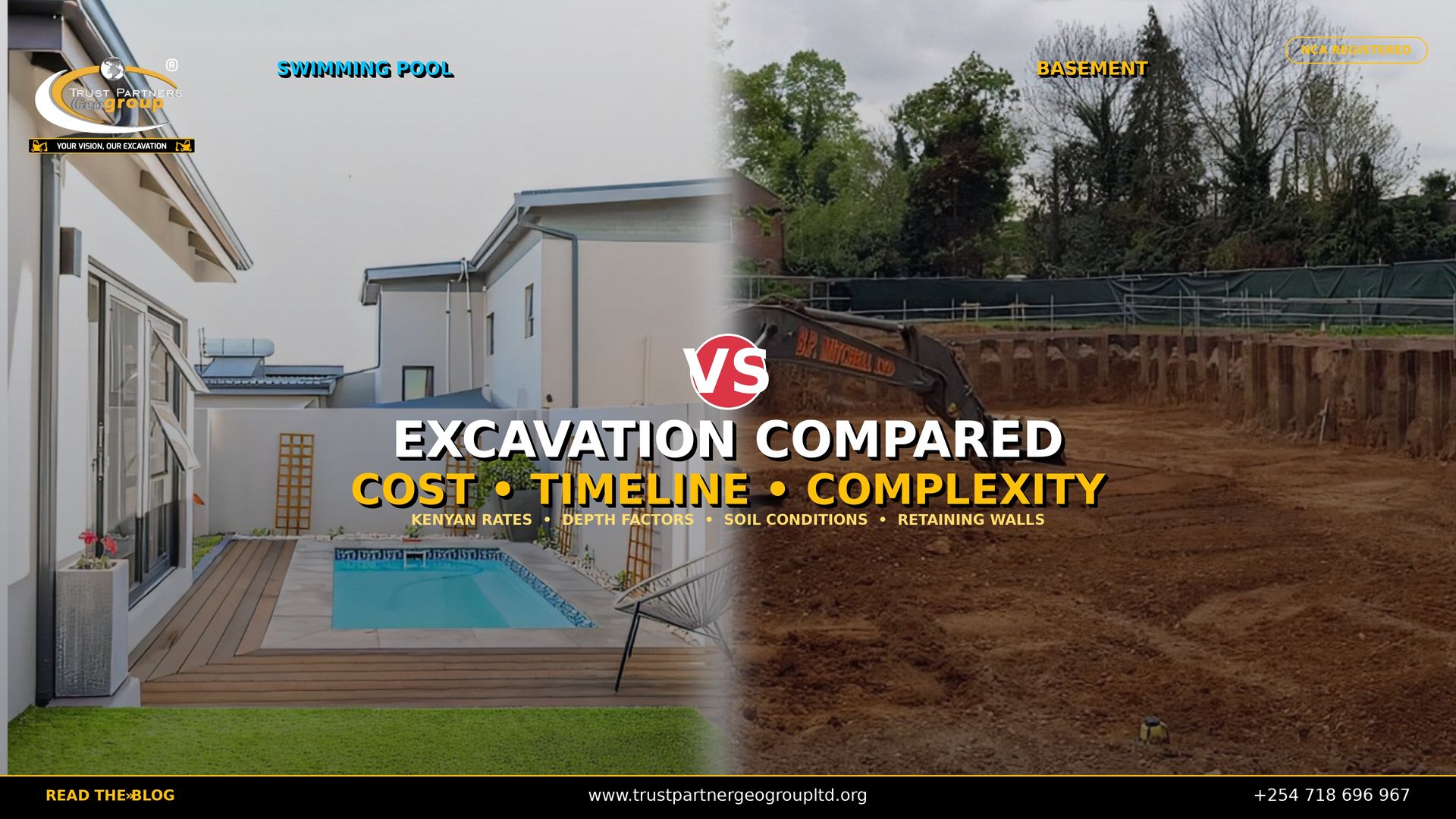
Swimming Pool Excavation vs. Basement Excavation: Cost, Timeline and Complexity Compared in Kenya [2026]
Complete comparison guide for homeowners and developers: which excavation is cheaper, faster, and right for your Nairobi property?
Table of Contents
- 1. The Excavation Dilemma: Pool or Basement?
- 2. What is Swimming Pool Excavation?
- 3. What is Basement Excavation?
- 4. Cost Comparison: Pool vs Basement Excavation [2026]
- 5. Timeline and Programme Comparison
- 6. Complexity and Technical Challenges
- 7. Equipment and Methodology Differences
- 8. Regulatory and Compliance Requirements
- 9. Maintenance and Lifecycle Considerations
- 10. Making the Decision: Which Excavation is Right?
- 11. Frequently Asked Questions
- 12. Conclusion
You have the plot in Runda, Karen, or Kitisuru. The architect has presented two visions that both require significant earthworks: a sparkling infinity pool that catches the Ngong Hills sunset, or a full basement that doubles your living space with a home cinema, wine cellar, and gym. Both involve excavators, dump trucks, and piles of red coffee soil. Both disrupt your garden for weeks. Both trigger questions from neighbours and county inspectors. But the similarities end there. Swimming pool excavation and basement excavation in Kenya are fundamentally different engineering challenges with vastly different cost structures, timelines, technical complexities, and long-term implications. A pool is a contained hole that holds water. A basement is a structural box that resists earth pressure, excludes groundwater, and supports building loads. The homeowner who assumes they are comparable excavation jobs risks budget blowouts, programme delays, and structural failures that devalue the property. This guide provides a comprehensive, data-driven comparison of pool excavation cost in Nairobi versus basement excavation in Kenya. We analyse cost per cubic metre, programme duration, soil sensitivity, equipment requirements, waterproofing demands, regulatory burdens, and lifecycle value. Whether you are building a 5-star residence in Lavington or a family home in Kiambu, Trust Partners Geo-Group Ltd provides the excavation in Kenya expertise and heavy equipment for hire capacity to execute either project with precision, transparency, and structural integrity.
Trust Partners Geo-Group Ltd - Residential Excavation & Basement Specialists
NCA-registered contractor with 15+ years in swimming pool excavation, basement excavation, luxury residential earthworks and structural excavation across Nairobi, Kiambu, Kajiado, Karen, Runda, Kitisuru and Lavington.
1. The Excavation Dilemma: Pool or Basement?
Kenyan luxury residential construction has entered an era where outdoor leisure space and underground expansion are no longer optional extras. They are expected features in premium neighbourhoods. The decision between a swimming pool and a basement is rarely either-or for high-net-worth homeowners; often, both are constructed. But for the majority of developers and homeowners operating with constrained budgets, limited plot sizes, or restrictive estate covenants, the choice matters profoundly.
The Real Question
The question is not simply "which is cheaper?" but "which delivers greater value per shilling invested?" A pool excavated for KES 250,000 may add KES 2 million in property appeal but costs KES 200,000 annually to maintain. A basement excavated for KES 600,000 may add KES 5 million in usable floor area and increase rental yield by 15%, with annual maintenance below KES 50,000. The excavation cost is merely the entry fee; the total cost of ownership determines the wisdom of the investment. This guide compares both excavation types across every dimension that affects your decision.
2. What is Swimming Pool Excavation?
Swimming pool excavation is the process of digging a contained, waterproof basin into the ground for recreational water storage. It is fundamentally an open excavation with sloped or vertical walls that will later be lined with concrete, fibreglass, or vinyl.
Pool Excavation Scope
A standard residential pool excavation in Nairobi involves: site survey and layout marking; bulk excavation to the pool profile (shallow end, deep end, and transition slope); trimming of walls and floor to achieve the design profile (typically ±50mm tolerance); disposal of excavated spoil or stockpiling for landscape reinstatement; and preparation of the subgrade for steel reinforcement and concrete shell placement. Typical dimensions for a luxury residential pool are 8-12 metres length, 4-6 metres width, 1.2-1.5 metres shallow end depth, and 1.8-2.5 metres deep end depth. Excavated volumes range from 60m3 for a compact pool to 150m3 for a large entertainment pool.
Soil and Slope Considerations
Pool excavations are relatively forgiving of soil conditions because the excavation depth rarely exceeds 2.5 metres and the structural loads are modest (water pressure, not building weight). In stable red coffee soils, slopes of 1:1.5 are standard and require no shoring. In loose or sandy soils, temporary benching may be required. Rock within the excavation profile adds cost but is manageable with hydraulic breakers. Groundwater is rarely encountered at 1.5-2.5 metres in Nairobi's elevated areas, though seasonal perched water can appear in low-lying zones like parts of Karen and Lavington.
3. What is Basement Excavation?
Basement excavation is the process of creating a subterranean structural space that supports building loads, resists lateral earth pressure, and excludes groundwater. It is a structural excavation requiring engineering design, retaining systems, and waterproofing integration.
Basement Excavation Scope
A residential basement excavation in Nairobi typically involves: bulk excavation to basement formation level (2.5-3.5 metres below ground level); installation of retaining walls (reinforced concrete, masonry, or sheet piles) to support adjacent ground; dewatering system installation where groundwater is present; underpinning or protection of adjacent foundations where the basement is near boundaries; structural blinding and base slab preparation; and backfilling and compaction around completed walls. Excavated volumes range from 80m3 for a small under-house basement to 300m3 for a full-underground entertainment level. The critical difference from pool excavation is that basements are structural elements integrated with the building frame, not standalone excavations.
Structural and Geotechnical Demands
Basements must withstand: lateral earth pressure from retained soil (typically 20-50 kN/m2 for 3-metre depth); hydrostatic pressure from groundwater; surcharge loads from adjacent buildings, vehicles, or stored materials; and vertical building loads transferred through columns and walls. This requires retaining wall design by a structural engineer, often involving reinforced concrete walls 200-300mm thick with steel reinforcement. In expansive black cotton soils, basements require special attention to swelling pressure and drainage behind walls. In high water table areas, permanent dewatering or tanking systems are essential. Trust Partners Geo-Group has excavated basements across Nairobi's most challenging soil profiles, from the rocky volcanic tuff of Kitisuru to the swelling clays of Athi River.
4. Cost Comparison: Pool vs Basement Excavation [2026]
The cost differential between pool and basement excavation is the primary decision driver for most homeowners. The following benchmarks reflect 2026 Nairobi market conditions for standard residential projects on typical red coffee soil.
| Cost Element | Swimming Pool (8m x 4m x 1.5m avg) | Basement (8m x 4m x 2.5m) | Difference |
|---|---|---|---|
| Excavation volume | ~48-60 m3 | ~80-100 m3 | Basement 65% larger |
| Bulk excavation cost | KES 180,000-250,000 | KES 280,000-420,000 | Basement +60-70% |
| Rock breaking (if required) | KES 40,000-80,000 | KES 120,000-250,000 | Basement 3x higher |
| Retaining walls / shoring | Not required (sloped sides) | KES 180,000-350,000 | Pool: zero |
| Dewatering system | Rarely required | KES 80,000-180,000 | Pool: typically zero |
| Spoil disposal | KES 25,000-45,000 | KES 45,000-85,000 | Basement +80% |
| Compaction and backfill | Minimal (landscape use) | KES 60,000-120,000 | Pool: minimal |
| Total excavation package | KES 180,000-320,000 | KES 450,000-750,000 | Basement 2.3x higher |
| Total construction cost | KES 1.2-2.5 million | KES 3.5-8.0 million | Basement 2.5-3.2x higher |
Cost Drivers Explained
The 2.3x cost multiplier for basement excavation is driven by three factors absent in pool work: structural retaining walls that resist earth pressure and support adjacent ground; dewatering systems that manage groundwater during and after construction; and greater depth (2.5-3.5m vs 1.5m) that increases excavation volume, spoil disposal, and labour intensity. Additionally, basements require engineering supervision, structural inspections, and waterproofing integration that pools do not. However, basements deliver proportionally greater value: they add usable floor area permanently, while pools add recreational amenity with ongoing maintenance liability.
Soil-Specific Cost Variations
In black cotton soil zones (Kajiado, Athi River), basement costs escalate to KES 700,000-1,200,000 due to soil replacement and specialized retaining wall design, while pool costs increase only modestly to KES 220,000-350,000. In rocky areas (Kitisuru, Limuru), rock breaking adds disproportionately to basement costs due to greater volume. In high water table areas (Parklands, Westlands), basement dewatering adds KES 150,000-300,000, while pools at 1.5m depth rarely require pumping. Trust Partners Geo-Group provides soil-specific quotations that account for these variations, ensuring no budget surprises after breaking ground.
5. Timeline and Programme Comparison
Time is money in construction, and the programme difference between pool and basement excavation affects overall project cash flow and completion dates.
| Phase | Swimming Pool | Basement |
|---|---|---|
| Site setup and survey | 0.5 days | 1-2 days |
| Bulk excavation | 1-2 days | 3-5 days |
| Trimming and profiling | 0.5-1 day | 2-3 days |
| Retaining wall construction | Not applicable | 5-10 days |
| Dewatering installation | Not applicable | 1-2 days |
| Structural blinding and slab | 1 day (pool base) | 2-3 days |
| Waterproofing application | 1-2 days (pool lining) | 3-5 days |
| Backfill and compaction | 0.5 days (landscape) | 2-3 days |
| Total programme | 3-5 days excavation; 4-6 weeks total build | 10-20 days excavation; 8-12 weeks total build |
Programme Integration
Pool excavation is typically a standalone operation that can occur during the landscaping phase, long after the main house is complete. It causes minimal disruption to occupied buildings and can be scheduled during dry seasons for optimal concrete curing. Basement excavation is on the critical path of building construction: it must be completed before ground floor slab casting, and delays cascade through the entire programme. For new builds, basement excavation is integrated into the foundation programme. For retrofits under existing houses, basement excavation requires temporary structural support, underpinning, and phased digging that extends the programme to 12-16 weeks. Trust Partners Geo-Group programmes pool excavation as a discrete package and basement excavation as an integrated structural operation, with programme guarantees tied to soil conditions.
6. Complexity and Technical Challenges
Complexity determines risk. The more complex the excavation, the higher the chance of cost overruns, programme delays, and structural defects.
Pool Excavation Complexity
Pool excavation is technically straightforward: the profile is simple (rectangular or freeform with sloped transitions); there are no adjacent structures to support; groundwater is rarely an issue at pool depth; and the structural requirements are limited to a concrete shell that contains water pressure. The main complexities are: achieving the correct slope from shallow to deep end for diving safety; ensuring the floor falls to the main drain for cleaning; and protecting the excavation from rainwater infiltration before concrete placement. These are manageable with standard excavation practice and do not require structural engineering input.
Basement Excavation Complexity
Basement excavation is among the most complex residential earthworks in Kenya. Challenges include: lateral support of adjacent ground and neighbouring foundations, particularly on zero-lot-line plots in Lavington, Kileleshwa, and Upper Hill; management of groundwater through dewatering, tanking, or drainage membranes; coordination with structural engineers for retaining wall design and foundation integration; underpinning of existing structures when basements are retrofitted; and waterproofing that must perform for the building's lifetime. A single error in basement excavation—under-designed retaining walls, inadequate dewatering, or poor waterproofing—can cause structural failure, mould infestation, and property devaluation that costs multiples of the original excavation budget to remediate. Trust Partners Geo-Group employs structural engineers on all basement projects, ensuring that excavation methodology aligns with retaining wall design and waterproofing specifications.
7. Equipment and Methodology Differences
Both excavations use similar machinery, but the deployment and duration differ significantly.
| Equipment | Pool Excavation Role | Basement Excavation Role |
|---|---|---|
| 20-tonne excavator | Bulk dig to profile in 1-2 days | Bulk dig in stages over 3-5 days; near-boundary precision work |
| 5-tonne compact excavator | Trimming corners and slope transitions | Confined access near walls, underpinning trenches, utility avoidance |
| Hydraulic breaker | Occasional rock in pool floor | Systematic rock breaking for full footprint and wall trenches |
| Dump trucks | 2-4 truck loads for spoil disposal | 8-15 truck loads; continuous spoil removal |
| Dewatering pumps | Rarely needed | Essential in high water table; wellpoint or sump systems |
| Vibratory plate compactor | Pool surround preparation | Structural backfill compaction in 150mm layers |
| Shoring/trench boxes | Not required | Required for deep trenches near boundaries or utilities |
Methodology Contrast
Pool excavation is a single-phase bulk dig: the excavator opens the hole to full depth in continuous passes, then trims slopes and floor. Basement excavation is staged: bulk dig to 1.5 metres; install first bench of retaining support; dig to 2.5 metres; install second bench or wall section; dig to final level; install base slab blinding. This staging protects workers, adjacent structures, and excavation stability. The equipment operator for basement work must understand structural sequencing, not merely digging. Trust Partners Geo-Group assigns NCA-certified operators with specific basement excavation experience to all basement projects, never using pool crews for structural basement work without additional training and supervision.
8. Regulatory and Compliance Requirements
Both excavations trigger regulatory requirements, but basements face significantly greater scrutiny.
County Building Approvals
Nairobi County requires building plan approval for both swimming pools and basements before excavation. Pool plans must show: location relative to boundaries and septic systems; drainage and overflow design; and fence or barrier requirements for child safety. Basement plans must show: structural retaining wall design signed by a registered engineer; waterproofing and damp-proofing specifications; ventilation and emergency egress requirements; and foundation integration with the main building structure. Basement approvals take 4-8 weeks; pool approvals take 2-4 weeks. Trust Partners Geo-Group coordinates with architects and structural engineers to ensure excavation commencement aligns with approved plans.
NEMA and Environmental Compliance
Individual residential pool and basement excavations on developed plots under 1 acre typically do not require NEMA Environmental Impact Assessment. However, NEMA approval is required for: commercial pool complexes or hotel pools exceeding 500m2; basement excavations in wetlands, riparian zones, or coastal areas; and any excavation that disturbs more than 1 acre or generates significant spoil disposal challenges. All excavations require sediment control (silt fences, dust suppression) and proper spoil disposal at licensed sites. Trust Partners Geo-Group implements NEMA-compliant sediment control on all residential excavations, with documentation available for county and environmental inspections.
Estate and Neighbourhood Covenants
Premium estates in Nairobi often impose additional restrictions: Runda and Karen estates may prohibit pool placement within 3 metres of boundaries or specify maximum basement depths to protect estate drainage patterns. Kitisuru and Loresho estates may require estate architectural committee approval for any excavation affecting site levels. Basement excavations near boundaries require party wall agreements with neighbours and protection of adjacent foundations. Trust Partners Geo-Group reviews estate covenants and obtains necessary approvals before mobilising equipment, preventing costly stop-work orders from estate management.
9. Maintenance and Lifecycle Considerations
The excavation cost is merely the beginning. Lifecycle cost determines true value.
| Lifecycle Factor | Swimming Pool | Basement |
|---|---|---|
| Annual maintenance cost | KES 150,000-300,000 | KES 30,000-60,000 |
| Major renovation cycle | 10-15 years (resurfacing) | 25-40 years (waterproofing refresh) |
| Major renovation cost | KES 800,000-1.5 million | KES 400,000-800,000 |
| Property value addition | 5-10% in luxury market | 15-25% (usable floor area) |
| Rental yield impact | Attracts tenants; no direct yield | +15-25% rentable space |
| Insurance liability | Higher (drowning risk, structural failure) | Standard building coverage |
| Energy consumption | KES 80,000-150,000/year (pump, heater) | KES 20,000-40,000/year (lighting, ventilation) |
Value Analysis
Over a 20-year ownership period, a pool costs KES 3-6 million in maintenance and renovation, while a basement costs KES 600,000-1.2 million. Yet the pool delivers lifestyle value that cannot be monetized: family recreation, entertainment appeal, and luxury status. The basement delivers monetizable value: rentable space, storage, or additional bedrooms that generate income or reduce main-floor congestion. For rental properties, basements are unequivocally superior investments. For owner-occupied luxury homes, the choice depends on lifestyle priorities. Trust Partners Geo-Group advises clients on lifecycle cost analysis during the quotation phase, ensuring excavation decisions align with long-term ownership strategy.
10. Making the Decision: Which Excavation is Right for Your Project?
The decision matrix is straightforward when reduced to objective criteria.
Choose Swimming Pool Excavation If:
- Your budget for earthworks and construction is under KES 2.5 million
- You prioritize outdoor lifestyle, entertainment, and family recreation
- Your plot has stable red coffee soil with no rock or groundwater issues
- You want minimal disruption to existing landscaping and occupied buildings
- You are building in an estate that restricts basement depths or boundary proximity
- You accept ongoing maintenance costs as a lifestyle expense
Choose Basement Excavation If:
- Your budget for earthworks and construction exceeds KES 4 million
- You need additional usable floor area (gym, cinema, store, staff quarters, garage)
- You are building a new home where basement integrates with foundation design
- Your plot is small and vertical expansion is restricted by zoning or covenants
- You want to increase property value and rental yield measurably
- You prefer low-maintenance, high-utility space over recreational amenities
The Hybrid Approach
Many luxury homeowners in Runda, Karen, and Kitisuru choose both: a modest plunge pool for cooling and a full basement for utility and entertainment. The key is programme sequencing: basement excavation and construction first, followed by pool excavation during landscaping phase. This avoids equipment interference and soil contamination of the pool excavation by basement spoil. Trust Partners Geo-Group has delivered numerous hybrid pool-and-basement projects, coordinating earthworks to minimize site disruption and cost duplication.
11. Frequently Asked Questions: Swimming Pool vs Basement Excavation in Kenya
Which is cheaper: swimming pool excavation or basement excavation in Kenya?
Swimming pool excavation is generally cheaper than basement excavation in Kenya. A standard residential swimming pool (8m x 4m x 1.5m deep) costs KES 180,000-320,000 to excavate in Nairobi in 2026. A comparable basement excavation (8m x 4m footprint, 2.5m deep) costs KES 450,000-750,000. The cost difference arises because basements require structural retaining walls, dewatering systems, waterproofing, and shoring that pools do not. However, deep pools exceeding 2.5 metres with complex shapes can approach basement costs due to rock breaking and dewatering requirements. Trust Partners Geo-Group provides fixed-price quotations for both pool and basement excavation with transparent cost breakdowns.
How long does swimming pool excavation take compared to basement excavation?
Swimming pool excavation takes 2-4 days for a standard residential pool (8m x 4m x 1.5m) in good soil conditions in Nairobi. Basement excavation takes 10-20 days for a comparable footprint at 2.5-3.0m depth, depending on soil conditions, shoring requirements, and dewatering complexity. The timeline difference is explained by basement requirements: installation of retaining wall support systems, progressive excavation in benches or stages, dewatering pump installation and continuous operation, and structural backfill against walls. Pool excavation is simpler: bulk dig to profile, trim slopes, and prepare for steel and concrete. Trust Partners Geo-Group programmes pool excavation as a 3-5 day operation and basement excavation as a 2-3 week operation with staged handovers.
What is the depth difference between pool excavation and basement excavation?
Standard residential swimming pools in Kenya are excavated to 1.2-1.8 metres depth for the shallow end and 1.8-2.5 metres for the deep end, with an average depth of 1.5 metres. Residential basements are typically excavated to 2.5-3.5 metres depth to provide 2.4-2.7 metres of clear headroom plus floor slab and ceiling structure thickness. Commercial basements for parking may reach 3.5-4.5 metres depth. The critical difference is not just depth but function: pools are open excavations that hold water, while basements are enclosed excavations that exclude groundwater and support building loads. This functional difference drives the complexity and cost gap between the two excavation types.
Do I need NEMA approval for swimming pool excavation in Kenya?
Individual residential swimming pool excavation typically does not require NEMA Environmental Impact Assessment if the project is within an already-developed residential plot and does not exceed 1 acre of disturbance. However, NEMA approval is required for commercial pool complexes, hotel pools exceeding 500m2 surface area, or pool excavation in ecologically sensitive areas such as wetlands, riparian zones, or coastal zones. All pool excavations require sediment control measures: silt fences, dust suppression, and proper disposal of excavated material. Basement excavation requires NEMA approval when part of a larger development exceeding 20 acres or 100 units, or when located in sensitive areas. Nairobi County requires building plan approval for both pools and basements before excavation. Trust Partners Geo-Group assists homeowners and developers with NEMA and county compliance documentation for both pool and basement projects.
Can the same excavator dig both a pool and a basement?
Yes, the same 20-tonne excavator can efficiently dig both swimming pools and basements in Kenyan residential construction. For pools, a 20-tonne excavator with a grading bucket completes bulk excavation in 1-2 days, followed by a 5-tonne compact excavator for trimming corners and slopes. For basements, a 20-tonne excavator handles bulk excavation while a 5-tonne machine works in confined areas near boundaries and existing structures. The key difference is attachment selection: pools require slope-finishing buckets for curved walls; basements require trenching buckets for narrow footings and rock breakers for hard strata. Trust Partners Geo-Group deploys versatile excavator fleets that transition between pool and basement excavation without downtime, reducing mobilisation costs for homeowners undertaking both projects.
What soil conditions affect pool vs basement excavation costs in Nairobi?
Soil conditions dramatically affect both pool and basement excavation costs, but basements are more sensitive due to greater depth and structural requirements. In Nairobi's red coffee soil zones (Runda, Karen, Kiambu), pool excavation costs KES 180,000-250,000 and basement excavation costs KES 450,000-650,000. In black cotton soil zones (Athi River, parts of Kajiado), expansive clay requires complete removal and replacement under basements, increasing costs to KES 700,000-1,200,000, while pools require soil replacement only under the pool base at KES 220,000-350,000. In rocky areas (Kitisuru, Limuru), rock breaking adds KES 80,000-150,000 to pool excavation and KES 250,000-450,000 to basement excavation due to greater volume. High water table areas (Parklands, Westlands, Lavington) require dewatering for basements (KES 150,000-300,000 additional) but rarely affect pools at 1.5m depth. Trust Partners Geo-Group conducts preliminary soil assessment before quoting to ensure accurate cost estimation.
Where can I hire excavation equipment for pools and basements in Nairobi?
Trust Partners Geo-Group Ltd provides heavy equipment for hire for both swimming pool excavation and basement excavation across Nairobi, Kiambu, Kajiado, Machakos, Nakuru and all Kenyan counties. Our residential excavation fleet includes: 20-tonne excavators with grading and trenching buckets for bulk pool and basement digging; 5-tonne compact excavators for trimming, confined access, and boundary work; hydraulic breakers for rock excavation in Kitisuru, Karen and Limuru; dewatering pumps and wellpoint systems for high water table basement sites; and 10-tonne dump trucks for spoil removal and backfill delivery. All equipment includes NCA-certified operators experienced in residential excavation, slope control, and structural protection of adjacent buildings. We provide fixed-price packages for pool excavation (KES 180,000-320,000) and basement excavation (KES 450,000-750,000) with no hidden costs. Contact +254 718 68 69 67 for residential excavation quotations.
12. Conclusion: Digging Beneath the Surface
The choice between swimming pool excavation and basement excavation is not merely a question of cost. It is a question of lifestyle, property strategy, soil reality, and long-term value. Pools deliver immediate gratification: the splash of children, the shimmer of evening light, the status of luxury living. Basements deliver enduring utility: space that generates income, stores memories, and expands possibility without expanding footprint.
From an excavation perspective, the comparison is clear. Pool excavation is simpler, faster, and cheaper. It requires no retaining walls, no dewatering systems, and no structural engineering. Basement excavation is complex, time-consuming, and expensive. It demands retaining structures, groundwater management, waterproofing integration, and structural supervision. The cost gap of 2.3x is justified by the functional gap: a basement is a room; a pool is a hole.
Yet both excavations share a common requirement: they must be executed by contractors who understand Kenyan soils, respect structural boundaries, and deliver precision that protects your investment. A poorly excavated pool cracks, leaks, and becomes a mosquito breeding ground. A poorly excavated basement floods, settles, and undermines the house above it. The excavation contractor is not merely a digger; they are the guardian of your property's structural integrity.
Trust Partners Geo-Group Ltd has excavated hundreds of residential pools and basements across Nairobi's most demanding neighbourhoods. We understand the difference between a pool profile and a basement retaining wall. We know when dewatering is essential and when it is unnecessary. We coordinate with structural engineers, waterproofing specialists, and county inspectors to ensure that every cubic metre of excavation serves the final structure. Our heavy equipment for hire fleet includes machines configured for both pool precision and basement structural work. And our operators are trained to recognise soil changes, groundwater signs, and rock formations that affect excavation methodology.
For homeowners in Runda, Karen, Kitisuru, Lavington, Kilimani, or any Nairobi neighbourhood contemplating pool or basement excavation, we provide the site assessment, soil evaluation, and transparent quotation that turns uncertainty into confident decision-making. Contact Trust Partners Geo-Group Ltd to discuss your project, compare options, and schedule excavation that delivers exactly what your property requires.
Pool & Basement Excavation in Nairobi
Swimming pool excavation and basement excavation services across Nairobi, Kiambu, Kajiado, Machakos and Nakuru. Fixed-price packages, soil-specific methodology, and structural excavation expertise.
Free lead magnet: ask for our Pool vs Basement Excavation Decision Matrix (PDF) - cost calculator, soil condition guide, programme planner and 2026 rate benchmarks for Kenyan residential projects.
Related Resources
Basement Excavation Cost in Nairobi 2026: Complete Price Guide Per m3
Detailed per-cubic-metre pricing for basement excavation across Nairobi soil conditions, depths, and complexity levels.
READ MOREBasement Excavation Depth Guide in Kenya: From 4 Meters to 30 Meters
Technical depth guide for residential and commercial basement excavation, shoring requirements, and equipment selection.
READ MOREAffordable Housing Project Excavation: Foundation Solutions for Kenya's Mass Housing Program
Government guide to mass housing foundation excavation, bulk earthworks, and cost optimization for Kenya's housing programme.
READ MOREPlot Cutting and Subdivision Earthworks: From Bush to Build-Ready in Nairobi
Step-by-step guide to land preparation, plot leveling, access roads and utility trenches for residential subdivisions.
READ MOREExcavation in Kenya: Complete Guide to Costs, Methods and Contractors 2026
Comprehensive national guide to excavation costs, methods, equipment selection and contractor evaluation for all construction sectors.
READ MOREFoundation Excavation Cost Comparison Between Strip, Raft and Pile 2026
Detailed cost breakdown and selection guide for foundation types across Kenyan soil conditions, with per-unit pricing.
READ MORETRUST PARTNERS GEO-GROUP LTD | YOUR EXCAVATION IS OUR FUTURE
WEBSITE: WWW.TRUSTPARTNERGEOGROUPLTD.ORG | EMAIL: INFO@TRUSTPARTNERGEOGROUPLTD.ORG | PHONE: +254 718 68 69 67
FOLLOW US: FACEBOOK | TIKTOK | INSTAGRAM | LINKEDIN
© 2026 TRUST PARTNERS GEO-GROUP LTD. ALL RIGHTS RESERVED.
Swimming Pool Excavation vs. Basement Excavation: Cost, Timeline and Complexity Compared in Kenya [2026]
Complete comparison guide for homeowners and developers: which excavation is cheaper, faster, and right for your Nairobi property?
Table of Contents
- 1. The Excavation Dilemma: Pool or Basement?
- 2. What is Swimming Pool Excavation?
- 3. What is Basement Excavation?
- 4. Cost Comparison: Pool vs Basement Excavation [2026]
- 5. Timeline and Programme Comparison
- 6. Complexity and Technical Challenges
- 7. Equipment and Methodology Differences
- 8. Regulatory and Compliance Requirements
- 9. Maintenance and Lifecycle Considerations
- 10. Making the Decision: Which Excavation is Right?
- 11. Frequently Asked Questions
- 12. Conclusion
You have the plot in Runda, Karen, or Kitisuru. The architect has presented two visions that both require significant earthworks: a sparkling infinity pool that catches the Ngong Hills sunset, or a full basement that doubles your living space with a home cinema, wine cellar, and gym. Both involve excavators, dump trucks, and piles of red coffee soil. Both disrupt your garden for weeks. Both trigger questions from neighbours and county inspectors. But the similarities end there. Swimming pool excavation and basement excavation in Kenya are fundamentally different engineering challenges with vastly different cost structures, timelines, technical complexities, and long-term implications. A pool is a contained hole that holds water. A basement is a structural box that resists earth pressure, excludes groundwater, and supports building loads. The homeowner who assumes they are comparable excavation jobs risks budget blowouts, programme delays, and structural failures that devalue the property. This guide provides a comprehensive, data-driven comparison of pool excavation cost in Nairobi versus basement excavation in Kenya. We analyse cost per cubic metre, programme duration, soil sensitivity, equipment requirements, waterproofing demands, regulatory burdens, and lifecycle value. Whether you are building a 5-star residence in Lavington or a family home in Kiambu, Trust Partners Geo-Group Ltd provides the excavation in Kenya expertise and heavy equipment for hire capacity to execute either project with precision, transparency, and structural integrity.
Trust Partners Geo-Group Ltd - Residential Excavation & Basement Specialists
NCA-registered contractor with 15+ years in swimming pool excavation, basement excavation, luxury residential earthworks and structural excavation across Nairobi, Kiambu, Kajiado, Karen, Runda, Kitisuru and Lavington.
1. The Excavation Dilemma: Pool or Basement?
Kenyan luxury residential construction has entered an era where outdoor leisure space and underground expansion are no longer optional extras. They are expected features in premium neighbourhoods. The decision between a swimming pool and a basement is rarely either-or for high-net-worth homeowners; often, both are constructed. But for the majority of developers and homeowners operating with constrained budgets, limited plot sizes, or restrictive estate covenants, the choice matters profoundly.
The Real Question
The question is not simply "which is cheaper?" but "which delivers greater value per shilling invested?" A pool excavated for KES 250,000 may add KES 2 million in property appeal but costs KES 200,000 annually to maintain. A basement excavated for KES 600,000 may add KES 5 million in usable floor area and increase rental yield by 15%, with annual maintenance below KES 50,000. The excavation cost is merely the entry fee; the total cost of ownership determines the wisdom of the investment. This guide compares both excavation types across every dimension that affects your decision.
2. What is Swimming Pool Excavation?
Swimming pool excavation is the process of digging a contained, waterproof basin into the ground for recreational water storage. It is fundamentally an open excavation with sloped or vertical walls that will later be lined with concrete, fibreglass, or vinyl.
Pool Excavation Scope
A standard residential pool excavation in Nairobi involves: site survey and layout marking; bulk excavation to the pool profile (shallow end, deep end, and transition slope); trimming of walls and floor to achieve the design profile (typically ±50mm tolerance); disposal of excavated spoil or stockpiling for landscape reinstatement; and preparation of the subgrade for steel reinforcement and concrete shell placement. Typical dimensions for a luxury residential pool are 8-12 metres length, 4-6 metres width, 1.2-1.5 metres shallow end depth, and 1.8-2.5 metres deep end depth. Excavated volumes range from 60m3 for a compact pool to 150m3 for a large entertainment pool.
Soil and Slope Considerations
Pool excavations are relatively forgiving of soil conditions because the excavation depth rarely exceeds 2.5 metres and the structural loads are modest (water pressure, not building weight). In stable red coffee soils, slopes of 1:1.5 are standard and require no shoring. In loose or sandy soils, temporary benching may be required. Rock within the excavation profile adds cost but is manageable with hydraulic breakers. Groundwater is rarely encountered at 1.5-2.5 metres in Nairobi's elevated areas, though seasonal perched water can appear in low-lying zones like parts of Karen and Lavington.
3. What is Basement Excavation?
Basement excavation is the process of creating a subterranean structural space that supports building loads, resists lateral earth pressure, and excludes groundwater. It is a structural excavation requiring engineering design, retaining systems, and waterproofing integration.
Basement Excavation Scope
A residential basement excavation in Nairobi typically involves: bulk excavation to basement formation level (2.5-3.5 metres below ground level); installation of retaining walls (reinforced concrete, masonry, or sheet piles) to support adjacent ground; dewatering system installation where groundwater is present; underpinning or protection of adjacent foundations where the basement is near boundaries; structural blinding and base slab preparation; and backfilling and compaction around completed walls. Excavated volumes range from 80m3 for a small under-house basement to 300m3 for a full-underground entertainment level. The critical difference from pool excavation is that basements are structural elements integrated with the building frame, not standalone excavations.
Structural and Geotechnical Demands
Basements must withstand: lateral earth pressure from retained soil (typically 20-50 kN/m2 for 3-metre depth); hydrostatic pressure from groundwater; surcharge loads from adjacent buildings, vehicles, or stored materials; and vertical building loads transferred through columns and walls. This requires retaining wall design by a structural engineer, often involving reinforced concrete walls 200-300mm thick with steel reinforcement. In expansive black cotton soils, basements require special attention to swelling pressure and drainage behind walls. In high water table areas, permanent dewatering or tanking systems are essential. Trust Partners Geo-Group has excavated basements across Nairobi's most challenging soil profiles, from the rocky volcanic tuff of Kitisuru to the swelling clays of Athi River.
4. Cost Comparison: Pool vs Basement Excavation [2026]
The cost differential between pool and basement excavation is the primary decision driver for most homeowners. The following benchmarks reflect 2026 Nairobi market conditions for standard residential projects on typical red coffee soil.
| Cost Element | Swimming Pool (8m x 4m x 1.5m avg) | Basement (8m x 4m x 2.5m) | Difference |
|---|---|---|---|
| Excavation volume | ~48-60 m3 | ~80-100 m3 | Basement 65% larger |
| Bulk excavation cost | KES 180,000-250,000 | KES 280,000-420,000 | Basement +60-70% |
| Rock breaking (if required) | KES 40,000-80,000 | KES 120,000-250,000 | Basement 3x higher |
| Retaining walls / shoring | Not required (sloped sides) | KES 180,000-350,000 | Pool: zero |
| Dewatering system | Rarely required | KES 80,000-180,000 | Pool: typically zero |
| Spoil disposal | KES 25,000-45,000 | KES 45,000-85,000 | Basement +80% |
| Compaction and backfill | Minimal (landscape use) | KES 60,000-120,000 | Pool: minimal |
| Total excavation package | KES 180,000-320,000 | KES 450,000-750,000 | Basement 2.3x higher |
| Total construction cost | KES 1.2-2.5 million | KES 3.5-8.0 million | Basement 2.5-3.2x higher |
Cost Drivers Explained
The 2.3x cost multiplier for basement excavation is driven by three factors absent in pool work: structural retaining walls that resist earth pressure and support adjacent ground; dewatering systems that manage groundwater during and after construction; and greater depth (2.5-3.5m vs 1.5m) that increases excavation volume, spoil disposal, and labour intensity. Additionally, basements require engineering supervision, structural inspections, and waterproofing integration that pools do not. However, basements deliver proportionally greater value: they add usable floor area permanently, while pools add recreational amenity with ongoing maintenance liability.
Soil-Specific Cost Variations
In black cotton soil zones (Kajiado, Athi River), basement costs escalate to KES 700,000-1,200,000 due to soil replacement and specialized retaining wall design, while pool costs increase only modestly to KES 220,000-350,000. In rocky areas (Kitisuru, Limuru), rock breaking adds disproportionately to basement costs due to greater volume. In high water table areas (Parklands, Westlands), basement dewatering adds KES 150,000-300,000, while pools at 1.5m depth rarely require pumping. Trust Partners Geo-Group provides soil-specific quotations that account for these variations, ensuring no budget surprises after breaking ground.
5. Timeline and Programme Comparison
Time is money in construction, and the programme difference between pool and basement excavation affects overall project cash flow and completion dates.
| Phase | Swimming Pool | Basement |
|---|---|---|
| Site setup and survey | 0.5 days | 1-2 days |
| Bulk excavation | 1-2 days | 3-5 days |
| Trimming and profiling | 0.5-1 day | 2-3 days |
| Retaining wall construction | Not applicable | 5-10 days |
| Dewatering installation | Not applicable | 1-2 days |
| Structural blinding and slab | 1 day (pool base) | 2-3 days |
| Waterproofing application | 1-2 days (pool lining) | 3-5 days |
| Backfill and compaction | 0.5 days (landscape) | 2-3 days |
| Total programme | 3-5 days excavation; 4-6 weeks total build | 10-20 days excavation; 8-12 weeks total build |
Programme Integration
Pool excavation is typically a standalone operation that can occur during the landscaping phase, long after the main house is complete. It causes minimal disruption to occupied buildings and can be scheduled during dry seasons for optimal concrete curing. Basement excavation is on the critical path of building construction: it must be completed before ground floor slab casting, and delays cascade through the entire programme. For new builds, basement excavation is integrated into the foundation programme. For retrofits under existing houses, basement excavation requires temporary structural support, underpinning, and phased digging that extends the programme to 12-16 weeks. Trust Partners Geo-Group programmes pool excavation as a discrete package and basement excavation as an integrated structural operation, with programme guarantees tied to soil conditions.
6. Complexity and Technical Challenges
Complexity determines risk. The more complex the excavation, the higher the chance of cost overruns, programme delays, and structural defects.
Pool Excavation Complexity
Pool excavation is technically straightforward: the profile is simple (rectangular or freeform with sloped transitions); there are no adjacent structures to support; groundwater is rarely an issue at pool depth; and the structural requirements are limited to a concrete shell that contains water pressure. The main complexities are: achieving the correct slope from shallow to deep end for diving safety; ensuring the floor falls to the main drain for cleaning; and protecting the excavation from rainwater infiltration before concrete placement. These are manageable with standard excavation practice and do not require structural engineering input.
Basement Excavation Complexity
Basement excavation is among the most complex residential earthworks in Kenya. Challenges include: lateral support of adjacent ground and neighbouring foundations, particularly on zero-lot-line plots in Lavington, Kileleshwa, and Upper Hill; management of groundwater through dewatering, tanking, or drainage membranes; coordination with structural engineers for retaining wall design and foundation integration; underpinning of existing structures when basements are retrofitted; and waterproofing that must perform for the building's lifetime. A single error in basement excavation—under-designed retaining walls, inadequate dewatering, or poor waterproofing—can cause structural failure, mould infestation, and property devaluation that costs multiples of the original excavation budget to remediate. Trust Partners Geo-Group employs structural engineers on all basement projects, ensuring that excavation methodology aligns with retaining wall design and waterproofing specifications.
7. Equipment and Methodology Differences
Both excavations use similar machinery, but the deployment and duration differ significantly.
| Equipment | Pool Excavation Role | Basement Excavation Role |
|---|---|---|
| 20-tonne excavator | Bulk dig to profile in 1-2 days | Bulk dig in stages over 3-5 days; near-boundary precision work |
| 5-tonne compact excavator | Trimming corners and slope transitions | Confined access near walls, underpinning trenches, utility avoidance |
| Hydraulic breaker | Occasional rock in pool floor | Systematic rock breaking for full footprint and wall trenches |
| Dump trucks | 2-4 truck loads for spoil disposal | 8-15 truck loads; continuous spoil removal |
| Dewatering pumps | Rarely needed | Essential in high water table; wellpoint or sump systems |
| Vibratory plate compactor | Pool surround preparation | Structural backfill compaction in 150mm layers |
| Shoring/trench boxes | Not required | Required for deep trenches near boundaries or utilities |
Methodology Contrast
Pool excavation is a single-phase bulk dig: the excavator opens the hole to full depth in continuous passes, then trims slopes and floor. Basement excavation is staged: bulk dig to 1.5 metres; install first bench of retaining support; dig to 2.5 metres; install second bench or wall section; dig to final level; install base slab blinding. This staging protects workers, adjacent structures, and excavation stability. The equipment operator for basement work must understand structural sequencing, not merely digging. Trust Partners Geo-Group assigns NCA-certified operators with specific basement excavation experience to all basement projects, never using pool crews for structural basement work without additional training and supervision.
8. Regulatory and Compliance Requirements
Both excavations trigger regulatory requirements, but basements face significantly greater scrutiny.
County Building Approvals
Nairobi County requires building plan approval for both swimming pools and basements before excavation. Pool plans must show: location relative to boundaries and septic systems; drainage and overflow design; and fence or barrier requirements for child safety. Basement plans must show: structural retaining wall design signed by a registered engineer; waterproofing and damp-proofing specifications; ventilation and emergency egress requirements; and foundation integration with the main building structure. Basement approvals take 4-8 weeks; pool approvals take 2-4 weeks. Trust Partners Geo-Group coordinates with architects and structural engineers to ensure excavation commencement aligns with approved plans.
NEMA and Environmental Compliance
Individual residential pool and basement excavations on developed plots under 1 acre typically do not require NEMA Environmental Impact Assessment. However, NEMA approval is required for: commercial pool complexes or hotel pools exceeding 500m2; basement excavations in wetlands, riparian zones, or coastal areas; and any excavation that disturbs more than 1 acre or generates significant spoil disposal challenges. All excavations require sediment control (silt fences, dust suppression) and proper spoil disposal at licensed sites. Trust Partners Geo-Group implements NEMA-compliant sediment control on all residential excavations, with documentation available for county and environmental inspections.
Estate and Neighbourhood Covenants
Premium estates in Nairobi often impose additional restrictions: Runda and Karen estates may prohibit pool placement within 3 metres of boundaries or specify maximum basement depths to protect estate drainage patterns. Kitisuru and Loresho estates may require estate architectural committee approval for any excavation affecting site levels. Basement excavations near boundaries require party wall agreements with neighbours and protection of adjacent foundations. Trust Partners Geo-Group reviews estate covenants and obtains necessary approvals before mobilising equipment, preventing costly stop-work orders from estate management.
9. Maintenance and Lifecycle Considerations
The excavation cost is merely the beginning. Lifecycle cost determines true value.
| Lifecycle Factor | Swimming Pool | Basement |
|---|---|---|
| Annual maintenance cost | KES 150,000-300,000 | KES 30,000-60,000 |
| Major renovation cycle | 10-15 years (resurfacing) | 25-40 years (waterproofing refresh) |
| Major renovation cost | KES 800,000-1.5 million | KES 400,000-800,000 |
| Property value addition | 5-10% in luxury market | 15-25% (usable floor area) |
| Rental yield impact | Attracts tenants; no direct yield | +15-25% rentable space |
| Insurance liability | Higher (drowning risk, structural failure) | Standard building coverage |
| Energy consumption | KES 80,000-150,000/year (pump, heater) | KES 20,000-40,000/year (lighting, ventilation) |
Value Analysis
Over a 20-year ownership period, a pool costs KES 3-6 million in maintenance and renovation, while a basement costs KES 600,000-1.2 million. Yet the pool delivers lifestyle value that cannot be monetized: family recreation, entertainment appeal, and luxury status. The basement delivers monetizable value: rentable space, storage, or additional bedrooms that generate income or reduce main-floor congestion. For rental properties, basements are unequivocally superior investments. For owner-occupied luxury homes, the choice depends on lifestyle priorities. Trust Partners Geo-Group advises clients on lifecycle cost analysis during the quotation phase, ensuring excavation decisions align with long-term ownership strategy.
10. Making the Decision: Which Excavation is Right for Your Project?
The decision matrix is straightforward when reduced to objective criteria.
Choose Swimming Pool Excavation If:
- Your budget for earthworks and construction is under KES 2.5 million
- You prioritize outdoor lifestyle, entertainment, and family recreation
- Your plot has stable red coffee soil with no rock or groundwater issues
- You want minimal disruption to existing landscaping and occupied buildings
- You are building in an estate that restricts basement depths or boundary proximity
- You accept ongoing maintenance costs as a lifestyle expense
Choose Basement Excavation If:
- Your budget for earthworks and construction exceeds KES 4 million
- You need additional usable floor area (gym, cinema, store, staff quarters, garage)
- You are building a new home where basement integrates with foundation design
- Your plot is small and vertical expansion is restricted by zoning or covenants
- You want to increase property value and rental yield measurably
- You prefer low-maintenance, high-utility space over recreational amenities
The Hybrid Approach
Many luxury homeowners in Runda, Karen, and Kitisuru choose both: a modest plunge pool for cooling and a full basement for utility and entertainment. The key is programme sequencing: basement excavation and construction first, followed by pool excavation during landscaping phase. This avoids equipment interference and soil contamination of the pool excavation by basement spoil. Trust Partners Geo-Group has delivered numerous hybrid pool-and-basement projects, coordinating earthworks to minimize site disruption and cost duplication.
11. Frequently Asked Questions: Swimming Pool vs Basement Excavation in Kenya
Which is cheaper: swimming pool excavation or basement excavation in Kenya?
Swimming pool excavation is generally cheaper than basement excavation in Kenya. A standard residential swimming pool (8m x 4m x 1.5m deep) costs KES 180,000-320,000 to excavate in Nairobi in 2026. A comparable basement excavation (8m x 4m footprint, 2.5m deep) costs KES 450,000-750,000. The cost difference arises because basements require structural retaining walls, dewatering systems, waterproofing, and shoring that pools do not. However, deep pools exceeding 2.5 metres with complex shapes can approach basement costs due to rock breaking and dewatering requirements. Trust Partners Geo-Group provides fixed-price quotations for both pool and basement excavation with transparent cost breakdowns.
How long does swimming pool excavation take compared to basement excavation?
Swimming pool excavation takes 2-4 days for a standard residential pool (8m x 4m x 1.5m) in good soil conditions in Nairobi. Basement excavation takes 10-20 days for a comparable footprint at 2.5-3.0m depth, depending on soil conditions, shoring requirements, and dewatering complexity. The timeline difference is explained by basement requirements: installation of retaining wall support systems, progressive excavation in benches or stages, dewatering pump installation and continuous operation, and structural backfill against walls. Pool excavation is simpler: bulk dig to profile, trim slopes, and prepare for steel and concrete. Trust Partners Geo-Group programmes pool excavation as a 3-5 day operation and basement excavation as a 2-3 week operation with staged handovers.
What is the depth difference between pool excavation and basement excavation?
Standard residential swimming pools in Kenya are excavated to 1.2-1.8 metres depth for the shallow end and 1.8-2.5 metres for the deep end, with an average depth of 1.5 metres. Residential basements are typically excavated to 2.5-3.5 metres depth to provide 2.4-2.7 metres of clear headroom plus floor slab and ceiling structure thickness. Commercial basements for parking may reach 3.5-4.5 metres depth. The critical difference is not just depth but function: pools are open excavations that hold water, while basements are enclosed excavations that exclude groundwater and support building loads. This functional difference drives the complexity and cost gap between the two excavation types.
Do I need NEMA approval for swimming pool excavation in Kenya?
Individual residential swimming pool excavation typically does not require NEMA Environmental Impact Assessment if the project is within an already-developed residential plot and does not exceed 1 acre of disturbance. However, NEMA approval is required for commercial pool complexes, hotel pools exceeding 500m2 surface area, or pool excavation in ecologically sensitive areas such as wetlands, riparian zones, or coastal zones. All pool excavations require sediment control measures: silt fences, dust suppression, and proper disposal of excavated material. Basement excavation requires NEMA approval when part of a larger development exceeding 20 acres or 100 units, or when located in sensitive areas. Nairobi County requires building plan approval for both pools and basements before excavation. Trust Partners Geo-Group assists homeowners and developers with NEMA and county compliance documentation for both pool and basement projects.
Can the same excavator dig both a pool and a basement?
Yes, the same 20-tonne excavator can efficiently dig both swimming pools and basements in Kenyan residential construction. For pools, a 20-tonne excavator with a grading bucket completes bulk excavation in 1-2 days, followed by a 5-tonne compact excavator for trimming corners and slopes. For basements, a 20-tonne excavator handles bulk excavation while a 5-tonne machine works in confined areas near boundaries and existing structures. The key difference is attachment selection: pools require slope-finishing buckets for curved walls; basements require trenching buckets for narrow footings and rock breakers for hard strata. Trust Partners Geo-Group deploys versatile excavator fleets that transition between pool and basement excavation without downtime, reducing mobilisation costs for homeowners undertaking both projects.
What soil conditions affect pool vs basement excavation costs in Nairobi?
Soil conditions dramatically affect both pool and basement excavation costs, but basements are more sensitive due to greater depth and structural requirements. In Nairobi's red coffee soil zones (Runda, Karen, Kiambu), pool excavation costs KES 180,000-250,000 and basement excavation costs KES 450,000-650,000. In black cotton soil zones (Athi River, parts of Kajiado), expansive clay requires complete removal and replacement under basements, increasing costs to KES 700,000-1,200,000, while pools require soil replacement only under the pool base at KES 220,000-350,000. In rocky areas (Kitisuru, Limuru), rock breaking adds KES 80,000-150,000 to pool excavation and KES 250,000-450,000 to basement excavation due to greater volume. High water table areas (Parklands, Westlands, Lavington) require dewatering for basements (KES 150,000-300,000 additional) but rarely affect pools at 1.5m depth. Trust Partners Geo-Group conducts preliminary soil assessment before quoting to ensure accurate cost estimation.
Where can I hire excavation equipment for pools and basements in Nairobi?
Trust Partners Geo-Group Ltd provides heavy equipment for hire for both swimming pool excavation and basement excavation across Nairobi, Kiambu, Kajiado, Machakos, Nakuru and all Kenyan counties. Our residential excavation fleet includes: 20-tonne excavators with grading and trenching buckets for bulk pool and basement digging; 5-tonne compact excavators for trimming, confined access, and boundary work; hydraulic breakers for rock excavation in Kitisuru, Karen and Limuru; dewatering pumps and wellpoint systems for high water table basement sites; and 10-tonne dump trucks for spoil removal and backfill delivery. All equipment includes NCA-certified operators experienced in residential excavation, slope control, and structural protection of adjacent buildings. We provide fixed-price packages for pool excavation (KES 180,000-320,000) and basement excavation (KES 450,000-750,000) with no hidden costs. Contact +254 718 68 69 67 for residential excavation quotations.
12. Conclusion: Digging Beneath the Surface
The choice between swimming pool excavation and basement excavation is not merely a question of cost. It is a question of lifestyle, property strategy, soil reality, and long-term value. Pools deliver immediate gratification: the splash of children, the shimmer of evening light, the status of luxury living. Basements deliver enduring utility: space that generates income, stores memories, and expands possibility without expanding footprint.
From an excavation perspective, the comparison is clear. Pool excavation is simpler, faster, and cheaper. It requires no retaining walls, no dewatering systems, and no structural engineering. Basement excavation is complex, time-consuming, and expensive. It demands retaining structures, groundwater management, waterproofing integration, and structural supervision. The cost gap of 2.3x is justified by the functional gap: a basement is a room; a pool is a hole.
Yet both excavations share a common requirement: they must be executed by contractors who understand Kenyan soils, respect structural boundaries, and deliver precision that protects your investment. A poorly excavated pool cracks, leaks, and becomes a mosquito breeding ground. A poorly excavated basement floods, settles, and undermines the house above it. The excavation contractor is not merely a digger; they are the guardian of your property's structural integrity.
Trust Partners Geo-Group Ltd has excavated hundreds of residential pools and basements across Nairobi's most demanding neighbourhoods. We understand the difference between a pool profile and a basement retaining wall. We know when dewatering is essential and when it is unnecessary. We coordinate with structural engineers, waterproofing specialists, and county inspectors to ensure that every cubic metre of excavation serves the final structure. Our heavy equipment for hire fleet includes machines configured for both pool precision and basement structural work. And our operators are trained to recognise soil changes, groundwater signs, and rock formations that affect excavation methodology.
For homeowners in Runda, Karen, Kitisuru, Lavington, Kilimani, or any Nairobi neighbourhood contemplating pool or basement excavation, we provide the site assessment, soil evaluation, and transparent quotation that turns uncertainty into confident decision-making. Contact Trust Partners Geo-Group Ltd to discuss your project, compare options, and schedule excavation that delivers exactly what your property requires.
Pool & Basement Excavation in Nairobi
Swimming pool excavation and basement excavation services across Nairobi, Kiambu, Kajiado, Machakos and Nakuru. Fixed-price packages, soil-specific methodology, and structural excavation expertise.
Free lead magnet: ask for our Pool vs Basement Excavation Decision Matrix (PDF) - cost calculator, soil condition guide, programme planner and 2026 rate benchmarks for Kenyan residential projects.
Related Resources
Basement Excavation Cost in Nairobi 2026: Complete Price Guide Per m3
Detailed per-cubic-metre pricing for basement excavation across Nairobi soil conditions, depths, and complexity levels.
READ MOREBasement Excavation Depth Guide in Kenya: From 4 Meters to 30 Meters
Technical depth guide for residential and commercial basement excavation, shoring requirements, and equipment selection.
READ MOREAffordable Housing Project Excavation: Foundation Solutions for Kenya's Mass Housing Program
Government guide to mass housing foundation excavation, bulk earthworks, and cost optimization for Kenya's housing programme.
READ MOREPlot Cutting and Subdivision Earthworks: From Bush to Build-Ready in Nairobi
Step-by-step guide to land preparation, plot leveling, access roads and utility trenches for residential subdivisions.
READ MOREExcavation in Kenya: Complete Guide to Costs, Methods and Contractors 2026
Comprehensive national guide to excavation costs, methods, equipment selection and contractor evaluation for all construction sectors.
READ MOREFoundation Excavation Cost Comparison Between Strip, Raft and Pile 2026
Detailed cost breakdown and selection guide for foundation types across Kenyan soil conditions, with per-unit pricing.
READ MORETRUST PARTNERS GEO-GROUP LTD | YOUR EXCAVATION IS OUR FUTURE
WEBSITE: WWW.TRUSTPARTNERGEOGROUPLTD.ORG | EMAIL: INFO@TRUSTPARTNERGEOGROUPLTD.ORG | PHONE: +254 718 68 69 67
FOLLOW US: FACEBOOK | TIKTOK | INSTAGRAM | LINKEDIN
© 2026 TRUST PARTNERS GEO-GROUP LTD. ALL RIGHTS RESERVED.