
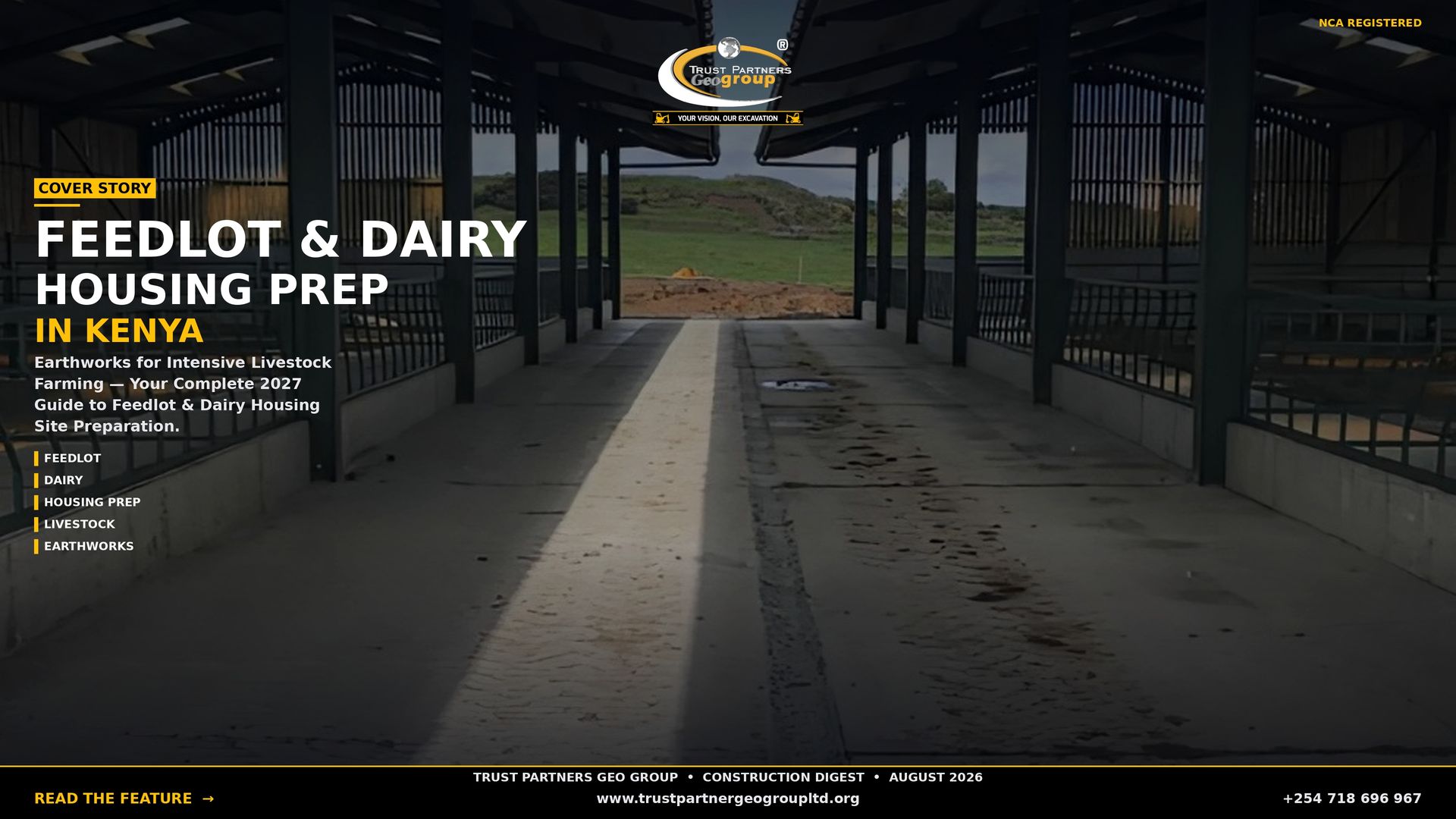
Feedlot and Dairy Housing Site Preparation: Earthworks for Intensive Livestock Farming in Kenya [2027]
Zero Grazing Foundations, Manure Pit Excavation, Silage Pits & Livestock Drainage for Kenyan Dairy and Beef Farms
From the zero grazing units squeezed onto 1/8-acre plots in Kiambu to the commercial feedlots finishing 500 head in the Rift Valley, Kenya's livestock sector is undergoing an intensive transformation. With demand for milk and beef outpacing supply and land fragmentation making open grazing impossible, farmers are turning to confined housing, cut-and-carry feeding and precision waste management. But every thriving dairy unit or feedlot starts with earthworks: foundations that keep cattle dry, manure pits that prevent disease, silage pits that preserve fodder, and drainage systems that protect both animal health and groundwater. As a leading excavation company Kenya, Trust Partners Geo-Group provides comprehensive excavation services Kenya for livestock farms nationwide. This guide covers everything farmers and agribusiness investors need to know about dairy housing and feedlot site preparation.

NCA-registered excavation company Kenya with 15+ years of livestock farm earthworks. We provide zero grazing foundations, manure pit excavation, silage pits, biogas digester pits and feedlot grading for dairy and beef farms across all 47 counties.
Kenya's Intensive Livestock Revolution
Kenya's dairy and beef sectors are shifting from open grazing to intensive systems driven by land pressure and market demand:
- Land fragmentation: Average farm size in Central Kenya has fallen below 0.5 hectares, making zero grazing the only viable dairy model. Over 80% of Kenyan dairy farmers now use some form of confined housing.
- Milk demand surge: Kenya's milk consumption grows 4–5% annually, driven by urbanization and population growth. Domestic production meets only 60% of demand, creating strong incentives for herd expansion.
- Beef feedlot emergence: Commercial beef finishing is expanding in Nakuru, Uasin Gishu and Kajiado, supplying Nairobi and Mombasa markets with grain-fed beef. Feedlots of 200–1,000 head are becoming common.
- Climate adaptation: Erratic rainfall and pasture degradation make cut-and-carry feeding more reliable than open grazing. Silage and hay preservation require dedicated storage infrastructure.
- Waste-to-energy: Biogas digester adoption is rising, with over 1,500 digesters installed on Kenyan dairy farms. Government subsidies and carbon credit programs accelerate uptake.
- Veterinary standards: Export markets and premium domestic buyers demand hygienic housing, proper drainage and waste management — all requiring engineered earthworks from the start.
Six Key Earthworks for Dairy and Feedlot Construction
1. Site Clearing and Leveling
All vegetation, stumps and organic topsoil are removed from the housing footprint plus a 3–5 metre buffer for drainage and access. The site is graded to achieve a 1–2% slope away from structures for surface drainage. A standard zero grazing unit for 6 cows requires 80–150 m² of leveled ground. Commercial dairies of 50+ cows need 500–1,000 m². Feedlots require 1–5 acres of graded land depending on herd size.
2. Foundation Excavation
Trenches are excavated for perimeter walls, column bases and concrete flooring. Depths range 30–60 cm depending on wall height and soil type. Foundation width is typically 20–30 cm for strip footings. Internal column pads support roof structures. All trenches require immediate blinding concrete to protect exposed soil from rain erosion and to provide a clean base for reinforcement.
3. Manure Pit and Lagoon Excavation
Manure collection is critical for hygiene and biogas feedstock. Smallholder zero grazing units use pits 2–3 metres deep (3m x 2m x 2m for 6 cows). Commercial dairies use concrete-lined pits 10m x 5m x 3m for 50+ cows. Large feedlots require lagoons 5–10 metres deep with 1,000+ m³ capacity, often lined with geomembrane or compacted clay to prevent groundwater contamination.
4. Silage Pit Excavation
Underground or semi-underground pits preserve fodder through anaerobic fermentation. Standard dimensions: 4m x 3m x 2.5m for 20–30 tonnes of silage — sufficient for 6–10 cows for 3 months. Walls are sloped at 1:0.5 to prevent collapse and lined with concrete or plastic sheeting for airtight sealing. Large commercial dairies construct multiple pits or above-ground bunker silos.
5. Biogas Digester Pit Excavation
Fixed-dome or floating-dome digesters require circular pits 3–5 metres diameter and 2–3 metres deep. Inlet channels connect from the manure pit; outlet channels discharge digestate to storage or fields. Digester foundations must be on stable, well-drained soil — expansive clay or high water tables require soil replacement or elevated platforms.
6. Drainage and Water System Trenches
Perimeter and internal drainage channels (15–20 cm wide, 10–15 cm deep) run the length of housing to channel urine and wash water into soak pits or biogas inlets. Water trough foundations and automatic drinker pads require small excavations with concrete blinding. Feedlot runoff collection channels direct stormwater and wash water to settling ponds before discharge.
Foundation Systems for Zero Grazing Units
| Foundation Type | Best For | Construction Method | Cost (KES) |
|---|---|---|---|
| Strip footing on murram | Smallholder zero grazing on stable red loam/murram | Continuous concrete trench 30–45 cm deep x 20 cm wide; pad footings for columns | 2,000–3,500 per linear m |
| Raft on replaced soil | Black cotton or expansive clay sites | Soil removed to 1–1.5 m; replaced with compacted murram; reinforced concrete slab poured | 4,000–6,500 per m² incl. replacement |
| Elevated platform on piers | High water table or waterlogged areas | Short columns from pad footings through wet soil to support raised concrete platform | 3,500–5,500 per m² |
| Feedlot pen pad | Beef feedlots on variable soil | Large-area grading, 200–400 mm compacted murram or concrete pad, sloped 2–3% to drains | 350–600 per m² |
All dairy housing foundations require non-slip grooved concrete floors sloped at 2–3% toward drains, minimum roof height of 2.5–3 metres for ventilation, and cubicle spacing of 2.5 m² per cow minimum. Trust Partners Geo-Group excavates to veterinary and structural engineer specifications for all livestock foundation types.
Livestock Drainage and Waste Management
Drainage is the single most important element of livestock housing earthworks. Poor drainage causes hoof disease, mastitis, floor degradation and groundwater contamination:
- Sloped concrete floors: Floors must slope 2–3% toward collection channels to prevent standing water. Non-slip grooving prevents cattle injuries and worker accidents. Grooves run perpendicular to the slope direction for traction.
- Internal drainage channels: Channels 15–20 cm wide and 10–15 cm deep run the length of the housing, collecting urine and wash water. Channels connect to manure pits, biogas inlets or soak pits. Concrete or masonry lining prevents erosion.
- Urine diversion: Separating liquid waste from solid manure improves manure quality for composting and reduces pit volume requirements. Diversion channels direct urine to biogas digesters or soak pits while solids remain in the pit.
- Perimeter French drains: Trenches 60 cm deep with perforated pipe and gravel backfill intercept groundwater and surface runoff before it reaches housing foundations. Critical in high-rainfall counties like Nyandarua and Bungoma.
- Soak pits: For farms without biogas, liquid waste drains into lined soak pits (2m x 2m x 3m deep) filled with broken stone and gravel. Pits must be sited minimum 15 metres from water sources and 10 metres from housing.
- Feedlot settling ponds: Runoff from feedlot pens carries manure, sediment and nutrients. Settling ponds (excavated basins 2–3 metres deep) allow solids to settle before discharge. Multiple ponds in series improve treatment. NEMA may require this for feedlots over 100 head.
- Roof gutter drainage: In high-rainfall areas, roof runoff must be directed away from housing foundations and pens via gutters and downspouts discharging into surface drains at least 5 metres from structures.
Dairy Housing and Feedlot Earthworks Rates 2027
| Service | Rate (KES) | Notes |
|---|---|---|
| Site clearing and leveling (per m²) | 150 – 300 | Upper end for bush removal and stump grinding |
| Foundation trench excavation (per linear m) | 2,000 – 3,500 | Incl. blinding concrete base preparation |
| Manure pit excavation (per m³) | 1,500 – 2,800 | Incl. disposal or lining prep; concrete lining extra |
| Silage pit excavation (per m³) | 1,800 – 3,000 | Incl. sloped walls and concrete lining prep |
| Biogas digester pit (per m³) | 2,500 – 4,000 | Incl. inlet/outlet channels and base preparation |
| Drainage trench (per linear m) | 400 – 700 | Incl. bedding and backfill for pipe/channel |
| Soak pit excavation (per unit) | 18,000 – 35,000 | Incl. stone and gravel filling |
| Feedlot pen pad (per m²) | 350 – 600 | Grading, murram/compaction, slope to drains |
| Manure lagoon excavation (per m³) | 1,200 – 2,200 | Large volume; geomembrane or clay lining extra |
| Water trough foundation (per unit) | 800 – 1,500 | Concrete pad with drainage connection |
| Black cotton removal + replacement (per m³) | 1,800 – 3,000 | For sites on expansive clay |
| Mini-excavator wet hire (daily) | 22,000 – 32,000 | For smallholder precision work |
| 30-ton excavator wet hire (daily) | 38,000 – 52,000 | For commercial dairies and feedlots |
County-Specific Livestock Construction Zones
Kiambu and Nairobi Outskirts: The Smallholder Dairy Belt
Kiambu has Kenya's highest density of zero grazing units, with farmers keeping 2–10 cows on 1/8 to 1/4 acre plots. Land prices drive intensive systems. Murram soils are generally stable but black cotton patches in Thika and Ruiru require foundation replacement. Water scarcity in Kajiado drives integrated water pan excavation with dairy housing. As a trusted excavation company Kenya, Trust Partners Geo-Group has completed hundreds of smallholder dairy earthworks in this corridor.
Murang'a and Nyeri: Coffee-to-Dairy Diversification
Traditional coffee zones are diversifying into dairy as coffee prices stagnate. Steep volcanic slopes require benching before housing construction. Cooperative society-supported dairy units are expanding rapidly. Phonolite outcrops add breaker costs to foundation work. High rainfall demands robust drainage with stone-lined outlets.
Nyandarua: Kenya's Milk Capital
Nyandarua is Kenya's leading milk-producing county with large-scale commercial dairies and dense smallholder units. Cool climate supports high-yielding Friesian herds. Red loam soils are ideal for foundations but 1,200+ mm annual rainfall demands extensive drainage. Many farms integrate biogas digesters with dairy housing.
Nakuru and Uasin Gishu: Rift Valley Dairy and Feedlots
The Rift Valley dairy belt has extensive zero grazing and emerging commercial feedlots. Mixed black cotton and red loam soils require soil-specific foundation design. Large commercial farms of 100+ cows are common. Feedlots of 200–500 head supply Nairobi beef markets. Our excavation services Kenya cover all Rift Valley livestock developments.
Nandi and Bomet: Emerging Dairy Counties
These counties are rapidly expanding dairy production with cooperative-supported units. Rolling terrain and high rainfall create drainage challenges. Tea-zone diversification into dairy is common, requiring conversion of tea land to housing and fodder production.
Bungoma and Kakamega: Western Kenya Dairy Expansion
Western Kenya's dairy sector is growing on smallholder plots. High rainfall and black cotton soils in lower areas require elevated platforms or complete soil replacement. Manure management is critical due to dense settlement and water source proximity.
Machakos and Kajiado: Peri-Urban Supply
Semi-arid dairy farming supplies Nairobi and Mombasa markets. Black cotton soil is prevalent, requiring complete removal and replacement with murram. Water storage tank excavation is essential. Zero grazing is the only viable model due to pasture scarcity.
Prepare Your Dairy or Feedlot Site with Professional Earthworks
Trust Partners Geo-Group provides dairy housing foundations, feedlot grading, manure pit excavation, silage pits, biogas digester pits and livestock drainage across all 47 Kenyan counties. Free farm survey and itemised quote.
Call +254 718 686 967 Email for QuoteFrequently Asked Questions
What earthworks are needed for dairy housing and feedlot construction in Kenya?
Dairy housing and feedlot construction in Kenya requires six key earthworks phases: (1) Site clearing and leveling — removing vegetation, stripping topsoil and grading the site to achieve a 1–2% slope for drainage. A standard zero grazing unit for 6 cows requires 80–150 m² of leveled ground. (2) Foundation excavation — trenches for perimeter walls, column bases and concrete flooring. Depths range 30–60 cm depending on wall height and soil type. (3) Manure pit excavation — lined or unlined pits 2–3 metres deep for waste collection. A 6-cow unit needs a 3m x 2m x 2m pit; commercial dairies of 50+ cows need 10m x 5m x 3m pits with concrete lining. (4) Silage pit excavation — underground or semi-underground pits 2–4 metres deep with sloped walls and concrete lining for airtight fermentation. Standard pit: 4m x 3m x 2.5m for 20–30 tonnes of silage. (5) Drainage trenches — perimeter and internal drains to channel urine and wash water away from housing into soak pits or biogas digesters. (6) Biogas digester pit excavation — fixed-dome or floating-dome digesters require circular pits 3–5 metres diameter and 2–3 metres deep, with inlet and outlet channels. Trust Partners Geo-Group, a leading excavation company Kenya, provides all these excavation services Kenya for livestock farms nationwide.
How much does dairy housing site preparation cost in Kenya?
Dairy housing and feedlot site preparation costs in Kenya vary by scale, soil type and infrastructure requirements. Site clearing and leveling costs KES 150–300 per m². Foundation trench excavation costs KES 2,000–3,500 per linear metre. Manure pit excavation costs KES 1,500–2,800 per m³ including disposal or lining. Silage pit excavation costs KES 1,800–3,000 per m³ with concrete lining. Biogas digester pit excavation costs KES 2,500–4,000 per m³ including inlet/outlet channels. Drainage trench excavation costs KES 400–700 per linear metre. Water trough and feed pad foundations cost KES 800–1,500 per unit. For a standard zero grazing unit (4–6 cows), total earthworks cost KES 80,000–180,000 including site prep, foundations, manure pit and drainage. A commercial dairy unit (20–50 cows) costs KES 350,000–750,000 for earthworks. A large feedlot (200+ cattle) costs KES 1.2–2.5 million for grading, drainage, manure lagoons and water systems. Key cost drivers: soil type (black cotton removal adds 40–60%), rock breaking (phonolite in Central Highlands), water table depth (dewatering in high-rainfall areas), and mobilization distance. Trust Partners Geo-Group provides fixed-price quotes for all dairy and feedlot excavation services Kenya.
What foundation types are used for zero grazing units in Kenya?
Three foundation systems are standard for Kenyan zero grazing units and dairy housing: (1) Strip footing on compacted murram — continuous concrete trenches 30–45 cm deep and 20 cm wide around the unit perimeter, with isolated pad footings for internal columns. Used on stable red loam and murram soils. Cost: KES 2,000–3,500 per linear metre. (2) Raft foundation on replaced soil — for black cotton or expansive clay sites, all topsoil and active clay is removed to 1–1.5 m depth and replaced with compacted murram before pouring a reinforced concrete slab. Cost: KES 4,000–6,500 per m² including replacement. Essential in Machakos, Makueni and parts of Kiambu. (3) Elevated platform on piers — short columns extend from pad footings through expansive or waterlogged soil to support a raised concrete platform. Used in high-water-table areas like Naivasha and Ahero. Cost: KES 3,500–5,500 per m². All dairy housing foundations require: non-slip grooved concrete floors sloped at 2–3% toward drains; minimum roof height of 2.5–3 metres for ventilation; and drainage channels integrated into the foundation design. Cubicles require 2.5 m² per cow minimum. Trust Partners Geo-Group excavates to veterinary and structural engineer specifications for all livestock foundation types.
Why is drainage critical for dairy housing and feedlots?
Drainage is the most important yet most neglected element of livestock housing earthworks. Poor drainage causes: (1) Hoof disease and mastitis — standing water and mud promote bacterial growth causing foot rot, digital dermatitis and environmental mastitis. These are the leading causes of dairy cow morbidity in Kenya. (2) Floor degradation — constant moisture weakens concrete, causing cracks and potholes that injure cattle and create hygiene dead zones. (3) Manure management failure — liquid manure that cannot drain away creates anaerobic ponds that attract flies, produce ammonia and contaminate groundwater. (4) Feed spoilage — waterlogged feed pads and trough areas cause mold growth and aflatoxin contamination. (5) Worker safety — slippery floors cause injuries to farm workers and increase accident insurance costs. Proper livestock drainage includes: sloped concrete floors at 2–3% gradient toward collection channels; perimeter French drains 60 cm deep with perforated pipe; internal drainage channels (15–20 cm wide, 10–15 cm deep) running the length of the housing; urine diversion channels separating liquid waste from solid manure; soak pits or biogas inlets for liquid waste disposal; and raised feed pads (20–30 cm above floor level) to keep feed dry. In high-rainfall areas like Kericho and Bungoma, roof gutter drainage must also be directed away from housing foundations. Trust Partners Geo-Group designs drainage systems specific to each farm's soil, rainfall and herd size.
Which counties have the most dairy and feedlot construction in Kenya?
Intensive dairy farming and feedlot construction is concentrated in Kenya's high-potential agricultural zones: (1) Kiambu and Nairobi outskirts — dense smallholder dairy with zero grazing units on 1/8 to 1/4 acre plots. High land prices drive intensive systems. Murram soils are stable but black cotton patches require foundation replacement. (2) Murang'a and Nyeri — traditional coffee zones diversifying into dairy. Steep volcanic slopes require benching before housing construction. Cooperative society-supported dairy units are expanding rapidly. (3) Nyandarua — Kenya's leading milk-producing county with large-scale commercial dairies and smallholder units. Cool climate supports high-yielding Friesian herds. Red loam soils are ideal but high rainfall demands robust drainage. (4) Nakuru and Uasin Gishu — Rift Valley dairy belt with extensive zero grazing and open grazing systems. Mixed black cotton and red loam soils require soil-specific foundation design. Large commercial farms of 100+ cows are common. (5) Nandi and Bomet — emerging dairy counties with cooperative-supported units. Rolling terrain and high rainfall create drainage challenges. (6) Bungoma and Kakamega — Western Kenya dairy expansion on smallholder plots. High rainfall and black cotton soils in lower areas require elevated platforms or complete soil replacement. (7) Machakos and Kajiado — peri-urban dairy supplying Nairobi and Mombasa markets. Water scarcity drives integrated water pan excavation with dairy housing. Black cotton soil is prevalent, requiring murram replacement. Each county has distinct soil, rainfall and infrastructure challenges that affect earthworks design and cost.
What is the difference between zero grazing and feedlot earthworks?
Zero grazing and feedlot construction have fundamentally different earthworks requirements: Zero grazing units (dairy) house cattle permanently in confined structures with cut-and-carry feeding. Earthworks focus on: compact housing foundations (2.5 m² per cow), concrete sloped floors with drainage channels, manure pits for daily waste collection, silage pits for fodder storage, biogas digester pits for energy recovery, and water trough foundations. Units are typically 50–300 m² for smallholder to medium commercial scale. Feedlots (beef) are open-yard systems where cattle are finished on concentrate diets in pens. Earthworks focus on: large-scale site grading (1–2% slope across 1–5 acres), pen construction with compacted murram or concrete pads, manure lagoon excavation (5–10 metres deep, 1,000+ m³ capacity for large feedlots), runoff collection channels and settling ponds, feed mill and storage pad foundations, and water system trenches for automatic drinkers. Feedlots require 8–15 m² per animal in pens plus additional area for feed storage and handling. The earthwork volumes for a 500-head feedlot can exceed 5,000 m³ — comparable to a small residential estate. Trust Partners Geo-Group provides specialized excavation services Kenya for both zero grazing dairy units and commercial beef feedlots.
What equipment is used for livestock farm earthworks?
Livestock farm earthworks in Kenya require specialized equipment scaled to farm size and terrain: (1) Mini-excavators (5 ton) — for zero grazing foundation trenches, manure pits, silage pits and drainage channels on smallholder plots. Essential for precision work near existing structures and in confined spaces. (2) 20–30 ton excavators — for commercial dairy foundations, large manure lagoons, feedlot pen grading and biogas digester pits. Long-reach arms useful for deep lagoon excavation. (3) Bulldozers — for feedlot site clearing, rough grading and pushing spoil on large commercial farms. (4) Motor graders — for achieving precise 1–2% slopes on feedlot pads and access roads. (5) Vibratory rollers and plate compactors — for compacting murram replacement layers under foundations and feedlot pens to 95% Mod AASHTO density. (6) Dump trucks — for hauling black cotton soil disposal and importing murram replacement fill. (7) Concrete equipment — portable mixers and vibrators for pouring manure pit floors, silage pit walls and foundation blinding. (8) Water bowsers — for dust suppression and concrete curing water in water-scarce areas. All Trust Partners Geo-Group livestock earthworks equipment is available wet hire with NITA-certified operators experienced in agricultural construction and animal welfare compliance.
How long does dairy housing site preparation take?
Dairy housing and feedlot site preparation timelines depend on scale, soil and season. A smallholder zero grazing unit (4–6 cows) on stable murram soil takes 3–5 days: 1 day clearing, 1 day foundation trenching, 1 day manure pit excavation, and 1–2 days drainage and backfill. A medium commercial dairy (20–50 cows) takes 1–2 weeks including site prep, foundations, manure lagoon, silage pits and drainage. A large feedlot (200+ cattle) takes 3–6 weeks: 3–5 days clearing and rough grading, 5–7 days pen pad preparation and compaction, 4–6 days manure lagoon excavation and lining, 3–4 days feed pad and water system foundations, and 3–5 days drainage and finishing. Seasonal factors: dry season (January–March, June–September) is optimal — stable soils, achievable compaction and predictable concrete curing. Wet season work extends timelines by 30–50% due to muddy conditions, inability to compact saturated soils and delayed concrete curing. In high-rainfall counties like Nyandarua and Bungoma, shelter construction must follow immediately after foundation completion to protect fresh concrete. Trust Partners Geo-Group schedules livestock earthworks in dry months where possible and maintains covered curing areas for all-weather sites.
Related Resources
Start Your Dairy Housing or Feedlot Earthworks Project
Contact Trust Partners Geo-Group at +254 718 686 967 for a free livestock farm site survey and itemised quote. Serving dairy and beef farms across all 47 Kenyan counties.
Call +254 718 686 967 Request QuoteFeedlot and Dairy Housing Site Preparation: Earthworks for Intensive Livestock Farming in Kenya [2027]
Zero Grazing Foundations, Manure Pit Excavation, Silage Pits & Livestock Drainage for Kenyan Dairy and Beef Farms
From the zero grazing units squeezed onto 1/8-acre plots in Kiambu to the commercial feedlots finishing 500 head in the Rift Valley, Kenya's livestock sector is undergoing an intensive transformation. With demand for milk and beef outpacing supply and land fragmentation making open grazing impossible, farmers are turning to confined housing, cut-and-carry feeding and precision waste management. But every thriving dairy unit or feedlot starts with earthworks: foundations that keep cattle dry, manure pits that prevent disease, silage pits that preserve fodder, and drainage systems that protect both animal health and groundwater. As a leading excavation company Kenya, Trust Partners Geo-Group provides comprehensive excavation services Kenya for livestock farms nationwide. This guide covers everything farmers and agribusiness investors need to know about dairy housing and feedlot site preparation.
NCA-registered excavation company Kenya with 15+ years of livestock farm earthworks. We provide zero grazing foundations, manure pit excavation, silage pits, biogas digester pits and feedlot grading for dairy and beef farms across all 47 counties.
Kenya's Intensive Livestock Revolution
Kenya's dairy and beef sectors are shifting from open grazing to intensive systems driven by land pressure and market demand:
- Land fragmentation: Average farm size in Central Kenya has fallen below 0.5 hectares, making zero grazing the only viable dairy model. Over 80% of Kenyan dairy farmers now use some form of confined housing.
- Milk demand surge: Kenya's milk consumption grows 4–5% annually, driven by urbanization and population growth. Domestic production meets only 60% of demand, creating strong incentives for herd expansion.
- Beef feedlot emergence: Commercial beef finishing is expanding in Nakuru, Uasin Gishu and Kajiado, supplying Nairobi and Mombasa markets with grain-fed beef. Feedlots of 200–1,000 head are becoming common.
- Climate adaptation: Erratic rainfall and pasture degradation make cut-and-carry feeding more reliable than open grazing. Silage and hay preservation require dedicated storage infrastructure.
- Waste-to-energy: Biogas digester adoption is rising, with over 1,500 digesters installed on Kenyan dairy farms. Government subsidies and carbon credit programs accelerate uptake.
- Veterinary standards: Export markets and premium domestic buyers demand hygienic housing, proper drainage and waste management — all requiring engineered earthworks from the start.
Six Key Earthworks for Dairy and Feedlot Construction
1. Site Clearing and Leveling
All vegetation, stumps and organic topsoil are removed from the housing footprint plus a 3–5 metre buffer for drainage and access. The site is graded to achieve a 1–2% slope away from structures for surface drainage. A standard zero grazing unit for 6 cows requires 80–150 m² of leveled ground. Commercial dairies of 50+ cows need 500–1,000 m². Feedlots require 1–5 acres of graded land depending on herd size.
2. Foundation Excavation
Trenches are excavated for perimeter walls, column bases and concrete flooring. Depths range 30–60 cm depending on wall height and soil type. Foundation width is typically 20–30 cm for strip footings. Internal column pads support roof structures. All trenches require immediate blinding concrete to protect exposed soil from rain erosion and to provide a clean base for reinforcement.
3. Manure Pit and Lagoon Excavation
Manure collection is critical for hygiene and biogas feedstock. Smallholder zero grazing units use pits 2–3 metres deep (3m x 2m x 2m for 6 cows). Commercial dairies use concrete-lined pits 10m x 5m x 3m for 50+ cows. Large feedlots require lagoons 5–10 metres deep with 1,000+ m³ capacity, often lined with geomembrane or compacted clay to prevent groundwater contamination.
4. Silage Pit Excavation
Underground or semi-underground pits preserve fodder through anaerobic fermentation. Standard dimensions: 4m x 3m x 2.5m for 20–30 tonnes of silage — sufficient for 6–10 cows for 3 months. Walls are sloped at 1:0.5 to prevent collapse and lined with concrete or plastic sheeting for airtight sealing. Large commercial dairies construct multiple pits or above-ground bunker silos.
5. Biogas Digester Pit Excavation
Fixed-dome or floating-dome digesters require circular pits 3–5 metres diameter and 2–3 metres deep. Inlet channels connect from the manure pit; outlet channels discharge digestate to storage or fields. Digester foundations must be on stable, well-drained soil — expansive clay or high water tables require soil replacement or elevated platforms.
6. Drainage and Water System Trenches
Perimeter and internal drainage channels (15–20 cm wide, 10–15 cm deep) run the length of housing to channel urine and wash water into soak pits or biogas inlets. Water trough foundations and automatic drinker pads require small excavations with concrete blinding. Feedlot runoff collection channels direct stormwater and wash water to settling ponds before discharge.
Foundation Systems for Zero Grazing Units
| Foundation Type | Best For | Construction Method | Cost (KES) |
|---|---|---|---|
| Strip footing on murram | Smallholder zero grazing on stable red loam/murram | Continuous concrete trench 30–45 cm deep x 20 cm wide; pad footings for columns | 2,000–3,500 per linear m |
| Raft on replaced soil | Black cotton or expansive clay sites | Soil removed to 1–1.5 m; replaced with compacted murram; reinforced concrete slab poured | 4,000–6,500 per m² incl. replacement |
| Elevated platform on piers | High water table or waterlogged areas | Short columns from pad footings through wet soil to support raised concrete platform | 3,500–5,500 per m² |
| Feedlot pen pad | Beef feedlots on variable soil | Large-area grading, 200–400 mm compacted murram or concrete pad, sloped 2–3% to drains | 350–600 per m² |
All dairy housing foundations require non-slip grooved concrete floors sloped at 2–3% toward drains, minimum roof height of 2.5–3 metres for ventilation, and cubicle spacing of 2.5 m² per cow minimum. Trust Partners Geo-Group excavates to veterinary and structural engineer specifications for all livestock foundation types.
Livestock Drainage and Waste Management
Drainage is the single most important element of livestock housing earthworks. Poor drainage causes hoof disease, mastitis, floor degradation and groundwater contamination:
- Sloped concrete floors: Floors must slope 2–3% toward collection channels to prevent standing water. Non-slip grooving prevents cattle injuries and worker accidents. Grooves run perpendicular to the slope direction for traction.
- Internal drainage channels: Channels 15–20 cm wide and 10–15 cm deep run the length of the housing, collecting urine and wash water. Channels connect to manure pits, biogas inlets or soak pits. Concrete or masonry lining prevents erosion.
- Urine diversion: Separating liquid waste from solid manure improves manure quality for composting and reduces pit volume requirements. Diversion channels direct urine to biogas digesters or soak pits while solids remain in the pit.
- Perimeter French drains: Trenches 60 cm deep with perforated pipe and gravel backfill intercept groundwater and surface runoff before it reaches housing foundations. Critical in high-rainfall counties like Nyandarua and Bungoma.
- Soak pits: For farms without biogas, liquid waste drains into lined soak pits (2m x 2m x 3m deep) filled with broken stone and gravel. Pits must be sited minimum 15 metres from water sources and 10 metres from housing.
- Feedlot settling ponds: Runoff from feedlot pens carries manure, sediment and nutrients. Settling ponds (excavated basins 2–3 metres deep) allow solids to settle before discharge. Multiple ponds in series improve treatment. NEMA may require this for feedlots over 100 head.
- Roof gutter drainage: In high-rainfall areas, roof runoff must be directed away from housing foundations and pens via gutters and downspouts discharging into surface drains at least 5 metres from structures.
Dairy Housing and Feedlot Earthworks Rates 2027
| Service | Rate (KES) | Notes |
|---|---|---|
| Site clearing and leveling (per m²) | 150 – 300 | Upper end for bush removal and stump grinding |
| Foundation trench excavation (per linear m) | 2,000 – 3,500 | Incl. blinding concrete base preparation |
| Manure pit excavation (per m³) | 1,500 – 2,800 | Incl. disposal or lining prep; concrete lining extra |
| Silage pit excavation (per m³) | 1,800 – 3,000 | Incl. sloped walls and concrete lining prep |
| Biogas digester pit (per m³) | 2,500 – 4,000 | Incl. inlet/outlet channels and base preparation |
| Drainage trench (per linear m) | 400 – 700 | Incl. bedding and backfill for pipe/channel |
| Soak pit excavation (per unit) | 18,000 – 35,000 | Incl. stone and gravel filling |
| Feedlot pen pad (per m²) | 350 – 600 | Grading, murram/compaction, slope to drains |
| Manure lagoon excavation (per m³) | 1,200 – 2,200 | Large volume; geomembrane or clay lining extra |
| Water trough foundation (per unit) | 800 – 1,500 | Concrete pad with drainage connection |
| Black cotton removal + replacement (per m³) | 1,800 – 3,000 | For sites on expansive clay |
| Mini-excavator wet hire (daily) | 22,000 – 32,000 | For smallholder precision work |
| 30-ton excavator wet hire (daily) | 38,000 – 52,000 | For commercial dairies and feedlots |
County-Specific Livestock Construction Zones
Kiambu and Nairobi Outskirts: The Smallholder Dairy Belt
Kiambu has Kenya's highest density of zero grazing units, with farmers keeping 2–10 cows on 1/8 to 1/4 acre plots. Land prices drive intensive systems. Murram soils are generally stable but black cotton patches in Thika and Ruiru require foundation replacement. Water scarcity in Kajiado drives integrated water pan excavation with dairy housing. As a trusted excavation company Kenya, Trust Partners Geo-Group has completed hundreds of smallholder dairy earthworks in this corridor.
Murang'a and Nyeri: Coffee-to-Dairy Diversification
Traditional coffee zones are diversifying into dairy as coffee prices stagnate. Steep volcanic slopes require benching before housing construction. Cooperative society-supported dairy units are expanding rapidly. Phonolite outcrops add breaker costs to foundation work. High rainfall demands robust drainage with stone-lined outlets.
Nyandarua: Kenya's Milk Capital
Nyandarua is Kenya's leading milk-producing county with large-scale commercial dairies and dense smallholder units. Cool climate supports high-yielding Friesian herds. Red loam soils are ideal for foundations but 1,200+ mm annual rainfall demands extensive drainage. Many farms integrate biogas digesters with dairy housing.
Nakuru and Uasin Gishu: Rift Valley Dairy and Feedlots
The Rift Valley dairy belt has extensive zero grazing and emerging commercial feedlots. Mixed black cotton and red loam soils require soil-specific foundation design. Large commercial farms of 100+ cows are common. Feedlots of 200–500 head supply Nairobi beef markets. Our excavation services Kenya cover all Rift Valley livestock developments.
Nandi and Bomet: Emerging Dairy Counties
These counties are rapidly expanding dairy production with cooperative-supported units. Rolling terrain and high rainfall create drainage challenges. Tea-zone diversification into dairy is common, requiring conversion of tea land to housing and fodder production.
Bungoma and Kakamega: Western Kenya Dairy Expansion
Western Kenya's dairy sector is growing on smallholder plots. High rainfall and black cotton soils in lower areas require elevated platforms or complete soil replacement. Manure management is critical due to dense settlement and water source proximity.
Machakos and Kajiado: Peri-Urban Supply
Semi-arid dairy farming supplies Nairobi and Mombasa markets. Black cotton soil is prevalent, requiring complete removal and replacement with murram. Water storage tank excavation is essential. Zero grazing is the only viable model due to pasture scarcity.
Prepare Your Dairy or Feedlot Site with Professional Earthworks
Trust Partners Geo-Group provides dairy housing foundations, feedlot grading, manure pit excavation, silage pits, biogas digester pits and livestock drainage across all 47 Kenyan counties. Free farm survey and itemised quote.
Call +254 718 686 967 Email for QuoteFrequently Asked Questions
What earthworks are needed for dairy housing and feedlot construction in Kenya?
Dairy housing and feedlot construction in Kenya requires six key earthworks phases: (1) Site clearing and leveling — removing vegetation, stripping topsoil and grading the site to achieve a 1–2% slope for drainage. A standard zero grazing unit for 6 cows requires 80–150 m² of leveled ground. (2) Foundation excavation — trenches for perimeter walls, column bases and concrete flooring. Depths range 30–60 cm depending on wall height and soil type. (3) Manure pit excavation — lined or unlined pits 2–3 metres deep for waste collection. A 6-cow unit needs a 3m x 2m x 2m pit; commercial dairies of 50+ cows need 10m x 5m x 3m pits with concrete lining. (4) Silage pit excavation — underground or semi-underground pits 2–4 metres deep with sloped walls and concrete lining for airtight fermentation. Standard pit: 4m x 3m x 2.5m for 20–30 tonnes of silage. (5) Drainage trenches — perimeter and internal drains to channel urine and wash water away from housing into soak pits or biogas digesters. (6) Biogas digester pit excavation — fixed-dome or floating-dome digesters require circular pits 3–5 metres diameter and 2–3 metres deep, with inlet and outlet channels. Trust Partners Geo-Group, a leading excavation company Kenya, provides all these excavation services Kenya for livestock farms nationwide.
How much does dairy housing site preparation cost in Kenya?
Dairy housing and feedlot site preparation costs in Kenya vary by scale, soil type and infrastructure requirements. Site clearing and leveling costs KES 150–300 per m². Foundation trench excavation costs KES 2,000–3,500 per linear metre. Manure pit excavation costs KES 1,500–2,800 per m³ including disposal or lining. Silage pit excavation costs KES 1,800–3,000 per m³ with concrete lining. Biogas digester pit excavation costs KES 2,500–4,000 per m³ including inlet/outlet channels. Drainage trench excavation costs KES 400–700 per linear metre. Water trough and feed pad foundations cost KES 800–1,500 per unit. For a standard zero grazing unit (4–6 cows), total earthworks cost KES 80,000–180,000 including site prep, foundations, manure pit and drainage. A commercial dairy unit (20–50 cows) costs KES 350,000–750,000 for earthworks. A large feedlot (200+ cattle) costs KES 1.2–2.5 million for grading, drainage, manure lagoons and water systems. Key cost drivers: soil type (black cotton removal adds 40–60%), rock breaking (phonolite in Central Highlands), water table depth (dewatering in high-rainfall areas), and mobilization distance. Trust Partners Geo-Group provides fixed-price quotes for all dairy and feedlot excavation services Kenya.
What foundation types are used for zero grazing units in Kenya?
Three foundation systems are standard for Kenyan zero grazing units and dairy housing: (1) Strip footing on compacted murram — continuous concrete trenches 30–45 cm deep and 20 cm wide around the unit perimeter, with isolated pad footings for internal columns. Used on stable red loam and murram soils. Cost: KES 2,000–3,500 per linear metre. (2) Raft foundation on replaced soil — for black cotton or expansive clay sites, all topsoil and active clay is removed to 1–1.5 m depth and replaced with compacted murram before pouring a reinforced concrete slab. Cost: KES 4,000–6,500 per m² including replacement. Essential in Machakos, Makueni and parts of Kiambu. (3) Elevated platform on piers — short columns extend from pad footings through expansive or waterlogged soil to support a raised concrete platform. Used in high-water-table areas like Naivasha and Ahero. Cost: KES 3,500–5,500 per m². All dairy housing foundations require: non-slip grooved concrete floors sloped at 2–3% toward drains; minimum roof height of 2.5–3 metres for ventilation; and drainage channels integrated into the foundation design. Cubicles require 2.5 m² per cow minimum. Trust Partners Geo-Group excavates to veterinary and structural engineer specifications for all livestock foundation types.
Why is drainage critical for dairy housing and feedlots?
Drainage is the most important yet most neglected element of livestock housing earthworks. Poor drainage causes: (1) Hoof disease and mastitis — standing water and mud promote bacterial growth causing foot rot, digital dermatitis and environmental mastitis. These are the leading causes of dairy cow morbidity in Kenya. (2) Floor degradation — constant moisture weakens concrete, causing cracks and potholes that injure cattle and create hygiene dead zones. (3) Manure management failure — liquid manure that cannot drain away creates anaerobic ponds that attract flies, produce ammonia and contaminate groundwater. (4) Feed spoilage — waterlogged feed pads and trough areas cause mold growth and aflatoxin contamination. (5) Worker safety — slippery floors cause injuries to farm workers and increase accident insurance costs. Proper livestock drainage includes: sloped concrete floors at 2–3% gradient toward collection channels; perimeter French drains 60 cm deep with perforated pipe; internal drainage channels (15–20 cm wide, 10–15 cm deep) running the length of the housing; urine diversion channels separating liquid waste from solid manure; soak pits or biogas inlets for liquid waste disposal; and raised feed pads (20–30 cm above floor level) to keep feed dry. In high-rainfall areas like Kericho and Bungoma, roof gutter drainage must also be directed away from housing foundations. Trust Partners Geo-Group designs drainage systems specific to each farm's soil, rainfall and herd size.
Which counties have the most dairy and feedlot construction in Kenya?
Intensive dairy farming and feedlot construction is concentrated in Kenya's high-potential agricultural zones: (1) Kiambu and Nairobi outskirts — dense smallholder dairy with zero grazing units on 1/8 to 1/4 acre plots. High land prices drive intensive systems. Murram soils are stable but black cotton patches require foundation replacement. (2) Murang'a and Nyeri — traditional coffee zones diversifying into dairy. Steep volcanic slopes require benching before housing construction. Cooperative society-supported dairy units are expanding rapidly. (3) Nyandarua — Kenya's leading milk-producing county with large-scale commercial dairies and smallholder units. Cool climate supports high-yielding Friesian herds. Red loam soils are ideal but high rainfall demands robust drainage. (4) Nakuru and Uasin Gishu — Rift Valley dairy belt with extensive zero grazing and open grazing systems. Mixed black cotton and red loam soils require soil-specific foundation design. Large commercial farms of 100+ cows are common. (5) Nandi and Bomet — emerging dairy counties with cooperative-supported units. Rolling terrain and high rainfall create drainage challenges. (6) Bungoma and Kakamega — Western Kenya dairy expansion on smallholder plots. High rainfall and black cotton soils in lower areas require elevated platforms or complete soil replacement. (7) Machakos and Kajiado — peri-urban dairy supplying Nairobi and Mombasa markets. Water scarcity drives integrated water pan excavation with dairy housing. Black cotton soil is prevalent, requiring murram replacement. Each county has distinct soil, rainfall and infrastructure challenges that affect earthworks design and cost.
What is the difference between zero grazing and feedlot earthworks?
Zero grazing and feedlot construction have fundamentally different earthworks requirements: Zero grazing units (dairy) house cattle permanently in confined structures with cut-and-carry feeding. Earthworks focus on: compact housing foundations (2.5 m² per cow), concrete sloped floors with drainage channels, manure pits for daily waste collection, silage pits for fodder storage, biogas digester pits for energy recovery, and water trough foundations. Units are typically 50–300 m² for smallholder to medium commercial scale. Feedlots (beef) are open-yard systems where cattle are finished on concentrate diets in pens. Earthworks focus on: large-scale site grading (1–2% slope across 1–5 acres), pen construction with compacted murram or concrete pads, manure lagoon excavation (5–10 metres deep, 1,000+ m³ capacity for large feedlots), runoff collection channels and settling ponds, feed mill and storage pad foundations, and water system trenches for automatic drinkers. Feedlots require 8–15 m² per animal in pens plus additional area for feed storage and handling. The earthwork volumes for a 500-head feedlot can exceed 5,000 m³ — comparable to a small residential estate. Trust Partners Geo-Group provides specialized excavation services Kenya for both zero grazing dairy units and commercial beef feedlots.
What equipment is used for livestock farm earthworks?
Livestock farm earthworks in Kenya require specialized equipment scaled to farm size and terrain: (1) Mini-excavators (5 ton) — for zero grazing foundation trenches, manure pits, silage pits and drainage channels on smallholder plots. Essential for precision work near existing structures and in confined spaces. (2) 20–30 ton excavators — for commercial dairy foundations, large manure lagoons, feedlot pen grading and biogas digester pits. Long-reach arms useful for deep lagoon excavation. (3) Bulldozers — for feedlot site clearing, rough grading and pushing spoil on large commercial farms. (4) Motor graders — for achieving precise 1–2% slopes on feedlot pads and access roads. (5) Vibratory rollers and plate compactors — for compacting murram replacement layers under foundations and feedlot pens to 95% Mod AASHTO density. (6) Dump trucks — for hauling black cotton soil disposal and importing murram replacement fill. (7) Concrete equipment — portable mixers and vibrators for pouring manure pit floors, silage pit walls and foundation blinding. (8) Water bowsers — for dust suppression and concrete curing water in water-scarce areas. All Trust Partners Geo-Group livestock earthworks equipment is available wet hire with NITA-certified operators experienced in agricultural construction and animal welfare compliance.
How long does dairy housing site preparation take?
Dairy housing and feedlot site preparation timelines depend on scale, soil and season. A smallholder zero grazing unit (4–6 cows) on stable murram soil takes 3–5 days: 1 day clearing, 1 day foundation trenching, 1 day manure pit excavation, and 1–2 days drainage and backfill. A medium commercial dairy (20–50 cows) takes 1–2 weeks including site prep, foundations, manure lagoon, silage pits and drainage. A large feedlot (200+ cattle) takes 3–6 weeks: 3–5 days clearing and rough grading, 5–7 days pen pad preparation and compaction, 4–6 days manure lagoon excavation and lining, 3–4 days feed pad and water system foundations, and 3–5 days drainage and finishing. Seasonal factors: dry season (January–March, June–September) is optimal — stable soils, achievable compaction and predictable concrete curing. Wet season work extends timelines by 30–50% due to muddy conditions, inability to compact saturated soils and delayed concrete curing. In high-rainfall counties like Nyandarua and Bungoma, shelter construction must follow immediately after foundation completion to protect fresh concrete. Trust Partners Geo-Group schedules livestock earthworks in dry months where possible and maintains covered curing areas for all-weather sites.
Related Resources
Start Your Dairy Housing or Feedlot Earthworks Project
Contact Trust Partners Geo-Group at +254 718 686 967 for a free livestock farm site survey and itemised quote. Serving dairy and beef farms across all 47 Kenyan counties.
Call +254 718 686 967 Request Quote