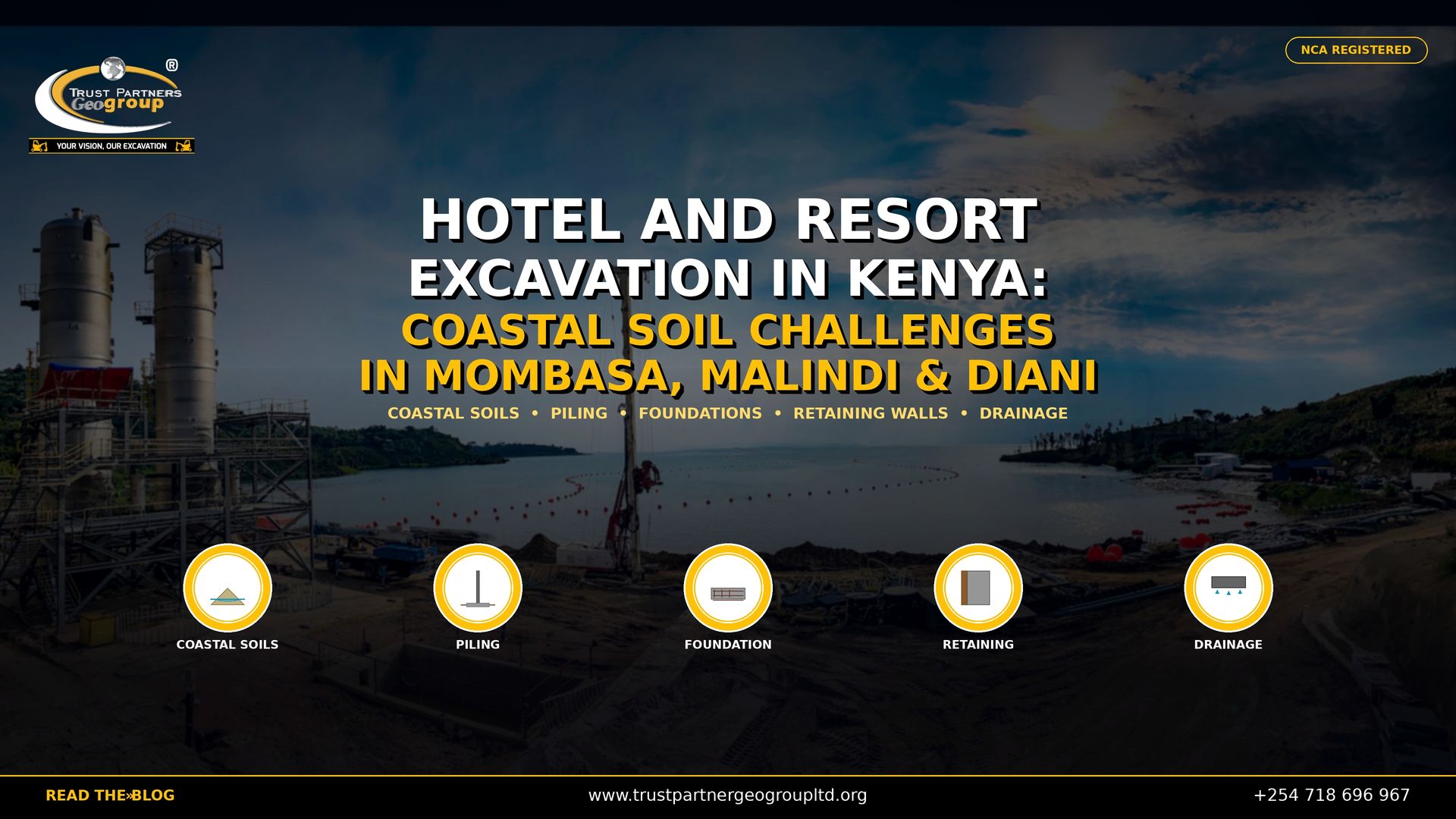
Hotel and Resort Excavation in Kenya: Coastal Soil Challenges in Mombasa, Malindi and Diani [2026]
Location guide to coastal hospitality construction: coral rock, marine sands, high water tables and beachfront foundation solutions
Table of Contents
- 1. The Kenyan Coast: Paradise with a Foundation Problem
- 2. Coastal Soil Geology: Coral, Sand, Salt and Water
- 3. Mombasa: Island Fill, Coral Rock and Urban Constraints
- 4. Malindi: Ancient Reefs and Estuarine Challenges
- 5. Diani: Deep Sands, Dunes and Beachfront Dynamics
- 6. Foundation Solutions for Coastal Hotels and Resorts
- 7. Marine Structures: Jetties, Piers and Over-Water Villas
- 8. Dewatering and Tidal Management
- 9. Equipment for Coastal and Marine Excavation
- 10. Cost Analysis and Budget Benchmarks [2026]
- 11. Coastal Regulatory Compliance and Environmental Protection
- 12. Frequently Asked Questions
- 13. Conclusion
The Indian Ocean laps at white coral sand twenty metres from the construction hoarding. Behind it, an excavator bucket strikes ancient coral limestone with a sound like gunfire, sending fragments flying across a site where a 200-room luxury resort will rise in eighteen months. The developer stands at the boundary, watching tide water seep into the foundation trench he thought was dry at 8:00 AM. By noon, the trench will be a swimming pool. By high tide at 2:30 PM, it will be underwater. This is hotel excavation in Kenya's coastal region—not the predictable red coffee soils of Nairobi, but a geological lottery of coral rock, marine sand, saline groundwater, and tidal forces that transform construction sites twice daily. Kenya's coastal tourism corridor from Mombasa to Lamu is experiencing unprecedented hotel and resort development. International brands are expanding into Diani and Watamu. Local developers are building boutique resorts in Malindi and Kilifi. And the government's Blue Economy agenda is driving marine infrastructure investment that supports coastal hospitality. Every one of these projects faces the same earthworks challenge: how to build stable foundations on ground that was ocean floor within the last ten thousand years, where coral reefs became limestone, where dunes shift with monsoon winds, and where the water table rises and falls with the tide. This location guide provides a comprehensive technical methodology for resort foundation construction in Mombasa, coastal soil excavation in Malindi, and Diani construction excavation. We cover coral rock management, marine piling, beachfront foundation design, dewatering systems, coastal regulatory compliance, and cost benchmarks for 2026. Whether you are breaking ground on a beachfront villa complex in Diani, expanding a historic hotel on Mombasa Island, or constructing an eco-resort in Malindi's mangrove estuary, Trust Partners Geo-Group Ltd provides the heavy equipment for hire and excavation in Kenya expertise that turns coastal construction challenges into structurally sound, environmentally compliant, and commercially successful hospitality developments.
Trust Partners Geo-Group Ltd - Coastal Construction & Marine Excavation Division
NCA-registered contractor with 15+ years in hotel excavation, resort foundation construction, coastal soil excavation, marine piling and beachfront earthworks across Mombasa, Malindi, Diani, Watamu, Kilifi and Lamu.
1. The Kenyan Coast: Paradise with a Foundation Problem
Kenya's 536-kilometre coastline is one of East Africa's most valuable tourism assets. The white sand beaches, coral reefs, and warm Indian Ocean waters attract over 1.5 million international visitors annually, generating KES 120 billion in tourism revenue. This economic engine depends on hotels, resorts, and marine infrastructure that must be built on some of the most challenging construction soils in Kenya.
The Coastal Construction Boom
Post-pandemic tourism recovery, combined with Kenya's marketing as a premium beach destination, has triggered a wave of hospitality construction: 5-star resorts in Diani and Watamu expanding by 200-400 rooms; boutique eco-lodges in Malindi and Kilifi targeting high-yield niche markets; Mombasa city hotels renovating and expanding to capture business and MICE tourism; and marine infrastructure including jetties, boat landings, and breakwaters supporting coastal access. Each project requires earthworks that confront geological conditions unknown in Nairobi or the Rift Valley. The contractor who arrives from inland Kenya with standard equipment and inland methodologies will fail. The contractor who understands coastal geology, tidal dynamics, and marine regulatory frameworks will thrive.
2. Coastal Soil Geology: Coral, Sand, Salt and Water
The Kenyan coastal plain is a complex geological environment formed by marine deposition, coral reef growth, and sea-level change over the last 10,000 years. Understanding this geology is essential for successful foundation design and excavation programming.
Coral Limestone and Reef Rock
Ancient coral reefs that grew during higher sea-level stands now form irregular limestone bedrock beneath coastal sands. This coral rock is: highly variable in depth, appearing at 0.5 metres in some locations and 8 metres in others within the same site; extremely hard (compressive strength 30-80 MPa), requiring specialized breaking equipment; cavernous and porous, creating unpredictable voids and groundwater channels; and irregular in profile, with pinnacles and troughs that make uniform foundation depths impossible. In Malindi and Watamu, coral rock is often exposed at surface level. In Diani, it is typically buried beneath 5-15 metres of sand. In Mombasa Island, fill material over coral creates highly variable conditions. Trust Partners Geo-Group conducts ground-penetrating radar (GPR) surveys and marine boreholes before excavation to map coral rock profiles and design foundation strategies that avoid costly surprises.
Marine Sands and Liquefaction Risk
Coastal sands are loose, poorly graded, and saturated. Standard penetration tests (SPT) often show N-values of 5-15, indicating low relative density. These sands are susceptible to liquefaction during seismic events—a critical consideration for multi-storey hotel structures. Foundation excavation in loose sands requires: dewatering to prevent trench collapse and boiling; careful slope control to prevent slumping; and compaction of backfill to densify sand around foundations. In Diani, where sand depths exceed 10 metres, ground improvement using vibro-compaction or dynamic compaction may be required before foundation construction.
Saline Groundwater and Corrosion
Coastal groundwater is saline, with chloride concentrations of 5,000-20,000 mg/l near the beach. This salinity attacks standard construction materials: reinforcing steel corrodes at accelerated rates, requiring epoxy coating or stainless steel; concrete suffers sulphate attack, requiring sulphate-resistant cement (SRPC) and reduced water-cement ratios; and buried metal pipes and tanks require cathodic protection or non-metallic alternatives. The excavation contractor must ensure that foundation subgrades are protected from saline groundwater infiltration before concrete placement, and that dewatering discharge does not contaminate freshwater lenses used for resort water supply.
3. Mombasa: Island Fill, Coral Rock and Urban Constraints
Mombasa Island and the adjacent mainland coast present the most urbanized coastal construction environment in Kenya, with additional challenges from existing infrastructure, traffic, and dense development.
Mombasa Island Geology
Mombasa Island is composed of raised coral limestone surrounded by mangrove swamps and tidal flats. Historic fill material—often uncontrolled and heterogeneous—covers much of the island's developed areas. Hotel construction on the island typically encounters: 1-3 metres of fill material (rubble, ash, organic waste) requiring removal and replacement; irregular coral rock at 2-5 metres depth with voids and solution features; and high water tables influenced by tidal fluctuations in the surrounding creeks. The iconic Fort Jesus and Old Town area imposes additional constraints: archaeological clearance requirements; heritage buffer zones restricting excavation depth and equipment access; and vibration limits protecting historic structures. Trust Partners Geo-Group has excavated foundations for hotels and commercial developments on Mombasa Island, navigating the complex interplay of geology, heritage, and urban logistics.
Nyali, Bamburi and Shanzu Mainland
The north coast mainland from Nyali to Shanzu offers more space but presents its own challenges: deep sandy profiles extending 8-12 metres before coral rock; seasonal groundwater fluctuations that flood excavations during rains; and coastal erosion that undermines beachfront foundations if not protected. The 2024 expansion of the Dongo Kundu Special Economic Zone is driving hotel and logistics construction in this corridor, with earthworks requiring coordination with port infrastructure and road projects. Trust Partners Geo-Group provides coastal excavation services across the entire Mombasa metropolitan area, from island heritage sites to mainland beachfront resorts.
4. Malindi: Ancient Reefs and Estuarine Challenges
Malindi's construction environment is defined by exposed coral rock, estuarine mangroves, and the legacy of centuries of coastal settlement.
Coral Rock Dominance
Malindi sits on one of Kenya's most extensive coral limestone platforms. In many areas, coral rock is exposed at surface level or lies within 1-2 metres of the surface. This creates: difficult excavation requiring hydraulic breakers, rock splitters, or chemical cracking for even shallow foundations; irregular bearing surfaces that require leveling with lean concrete blinding before foundation construction; and limited soak pit effectiveness due to coral rock's low permeability, requiring alternative drainage solutions. The famous Vasco da Gama Pillar area and Marine Park zone impose additional environmental restrictions on excavation methods, noise, and sediment control. Trust Partners Geo-Group has delivered resort foundations in Malindi using specialized coral rock excavation techniques that minimize environmental impact while achieving structural requirements.
Sabaki Estuary and Mangrove Areas
Resorts near the Sabaki River mouth or in Malindi's mangrove creeks face organic soil challenges: peat and organic clay deposits with bearing capacity below 80 kPa; high acidity that attacks standard construction materials; and tidal inundation that requires raised platforms or pile foundations. Mangrove protection laws prohibit excavation within 30 metres of mangrove stands without Kenya Forest Service approval. Trust Partners Geo-Group coordinates with environmental authorities to design foundation solutions that avoid mangrove disturbance while providing stable support for estuarine resort construction.
5. Diani: Deep Sands, Dunes and Beachfront Dynamics
Diani Beach, south of Mombasa, is Kenya's premier beach tourism destination. Its construction geology is dominated by deep marine sands, active dunes, and dynamic beach processes.
Deep Sand Profiles
Diani's sand extends 10-20 metres deep before reaching coral rock or clay layers. This creates: loose, compressible soils that settle under building loads unless densified or piled; high water tables at 1-3 metres depth requiring continuous dewatering; and difficult access for heavy equipment on soft sand, requiring geotextile road mats or temporary aggregate platforms. Multi-storey hotels in Diani almost universally require pile foundations extending through sand to coral rock. Single-storey villas may use raft foundations on improved ground. Trust Partners Geo-Group has excavated foundations for resorts along the entire Diani beachfront, from the Kongo River to Galu Beach, managing deep sand conditions with specialized dewatering and piling coordination.
Dune Dynamics and Coastal Erosion
Diani's sand dunes are active geomorphological features that shift with monsoon winds. Construction on or behind dunes requires: careful dune stabilization using indigenous vegetation rather than hard structures; setback compliance (typically 30 metres from high-water mark) that pushes construction into dune fields; and scour protection for beachfront foundations against storm waves and longshore currents. The 2020-2024 coastal erosion events in Diani highlighted the vulnerability of poorly designed beachfront foundations. Trust Partners Geo-Group designs beachfront excavations with scour protection integrated into foundation earthworks, preventing the undermining that destroys inadequately protected structures.
6. Foundation Solutions for Coastal Hotels and Resorts
Coastal foundation selection must balance structural requirements, soil conditions, corrosion protection, and construction practicality.
| Foundation Type | Application | Coastal Suitability | Cost/m2 (KES) |
|---|---|---|---|
| Bored piles | Multi-storey hotels, heavy loads | Excellent through sand to coral rock | 4,500-7,500 |
| Driven precast piles | Fast-track hotel construction | Good, but vibration restrictions apply | 3,800-6,500 |
| Raft/mat foundations | Low-rise villas, restaurants | Good on improved sand or shallow coral | 2,800-4,500 |
| Strip foundations | Single-storey bungalows | Limited to stable inland soils | 1,800-3,200 |
| Marine piles | Jetties, over-water villas | Essential for marine structures | 8,000-15,000/m |
| Ground improvement + raft | Medium-rise on deep sand | Good with vibro-compaction | 3,500-5,500 |
Pile Foundation Design for Coastal Hotels
Bored cast-in-situ piles are the preferred solution for coastal hotels exceeding 2 storeys. Typical specifications: 400-600mm diameter piles; 8-15 metres depth through sand to coral rock or dense bearing strata; sulphate-resistant concrete (minimum 35 MPa) with 50mm cover to reinforcement; and pile cap integration with ground beams and basement slabs. In Diani's deep sands, piles may extend 18-25 metres to reach competent strata, requiring continuous flight auger (CFA) or rotary bored piling techniques. Trust Partners Geo-Group coordinates pile installation with bulk excavation, ensuring that pile caps are excavated to correct levels without damaging completed piles.
Corrosion Protection
All coastal foundations require enhanced corrosion protection: sulphate-resistant Portland cement (SRPC) for all concrete below ground level; epoxy-coated reinforcement or stainless steel for critical structural elements; cathodic protection systems for marine steel piles; and bituminous coating or waterproof membranes on basement walls and slabs. The excavation contractor must ensure that foundation subgrades are clean, dry, and free of saline contamination before blinding concrete placement. Trust Partners Geo-Group implements saline soil management protocols that protect foundation durability from the moment of excavation.
7. Marine Structures: Jetties, Piers and Over-Water Villas
Coastal hospitality increasingly includes marine structures that extend construction from land into water, requiring specialized marine excavation and piling.
Marine Piling Techniques
Marine piles for jetties, boat landings, and over-water villas are installed using: barge-mounted piling rigs for open water with 3-5 metre depth; jack-up platforms for areas with soft seabed that cannot support barge loads; and temporary cofferdams for dry-condition pile cap construction in shallow water. Pile materials include: precast concrete piles with dense sulphate-resistant concrete and epoxy-coated reinforcement; steel piles with cathodic protection and marine-grade coatings; and timber piles (treated hardwood) for eco-resorts emphasizing natural materials. Trust Partners Geo-Group has installed marine piles for coastal resorts, coordinating with Kenya Maritime Authority for navigation safety and environmental compliance.
Shoreline Protection Earthworks
Beachfront hotels require shoreline protection to prevent erosion undermining foundations: rock armour (1-3 tonne stones) placed on geotextile filters along the beachfront; gabion baskets filled with coral rock for revetment walls; geotextile containers (sand-filled tubes) for temporary or permanent beach nourishment; and retaining walls with drainage behind to prevent hydrostatic pressure buildup. These protection structures require excavation for foundation trenches, filter layers, and drainage systems that extend below potential scour depth. Trust Partners Geo-Group designs and constructs shoreline protection as an integrated component of beachfront resort earthworks.
8. Dewatering and Tidal Management
Water is the constant enemy of coastal excavation. The water table fluctuates with the tide, seasonal rains flood sites from inland, and marine sand allows rapid water migration into open trenches.
Dewatering System Design
Coastal dewatering requires systems more robust than inland construction: wellpoint systems with 2-3 metre spacing around excavation perimeters; deep well pumps with submersible electric pumps in high-capacity sandy soils; sump pumping with automatic float switches for localized water collection; and tidal flap valves on discharge pipes to prevent seawater backflow during high tide. Dewatering must be continuous from excavation commencement until foundation concrete achieves sufficient strength to resist hydrostatic pressure—typically 7-14 days for blinding and 28 days for structural concrete. Trust Partners Geo-Group designs dewatering systems with backup power (generators) and standby pumps to ensure uninterrupted operation through power outages and equipment failures.
Tidal Construction Windows
Marine excavation is constrained by tides. In Mombasa, the tidal range is 2.5-3.5 metres, creating 4-6 hour windows of low water for marine work. Programming must align with tide tables: spring tides (highest high, lowest low) offer the best marine access; neap tides (minimal range) provide limited windows and require more equipment mobility; and monsoon seasons (April-May, October-November) generate storm surges that can halt marine work for days. Trust Partners Geo-Group programmes marine excavation using detailed tide tables and weather forecasting, maximizing productive hours and minimizing standby costs.
9. Equipment for Coastal and Marine Excavation
Coastal excavation requires equipment modifications and specialized machinery that inland contractors rarely possess.
| Equipment | Coastal Application | Specification |
|---|---|---|
| 30-tonne excavator | Coral rock breaking, bulk excavation | Heavy-duty breaker, salt-resistant coatings |
| 20-tonne long-reach excavator | Beachfront slope trimming, marine access | 15-18m reach, amphibious option |
| Hydraulic rock splitter | Coral breaking near sensitive structures | Low vibration, precision cracking |
| Marine piling rig | Jetty and over-water villa piles | Barge-mounted or jack-up platform |
| Dewatering pumps | Continuous groundwater control | Electric submersible, 50-100m3/hr |
| Motor grader | Sandy platform leveling | Corrosion-resistant components |
| 10-tonne roller | Sand compaction and densification | Vibratory or static, sealed bearings |
| Dump trucks | Spoil haulage on soft sand | 6x6 or 8x4 drive, low ground pressure |
Corrosion Protection for Equipment
Coastal salt air destroys unprotected machinery. Trust Partners Geo-Group implements: daily freshwater washdown of all equipment after operation; sacrificial anodes on steel components; sealed electrical systems protected from salt spray; and specialized lubricants for bearings and joints exposed to saline conditions. These maintenance protocols extend equipment life by 40-60% in coastal environments and prevent the breakdowns that delay construction programmes.
10. Cost Analysis and Budget Benchmarks [2026]
Coastal construction costs reflect the technical complexity, equipment specialization, and regulatory burden of marine and beachfront earthworks.
| Cost Element | Unit | 2026 Rate (KES) | Notes |
|---|---|---|---|
| Site clearing (coastal scrub) | m2 | 55-95 | Casuarina, palm, scrub |
| Topsoil/sand strip | m3 | 180-280 | Marine sand conservation |
| Bulk earthworks (sand) | m3 | 280-450 | Cut, haul, place, compact |
| Coral rock breaking | m3 | 1,800-3,200 | Breaker or splitter |
| Chemical cracking agent | kg | 450-650 | Zero-vibration coral removal |
| Bored pile (400-600mm) | linear m | 8,500-14,000 | Through sand to coral |
| Marine pile | linear m | 12,000-18,000 | Concrete or steel, installed |
| Raft foundation excavation | m3 | 650-1,100 | Shallow coral or improved sand |
| Dewatering system | project | 250,000-500,000 | Wellpoints, pumps, discharge |
| Shoreline protection (rock armour) | tonne | 2,500-4,000 | Supply and placement |
| Compaction testing | test | 10,000-16,000 | KEBS-accredited lab |
| Ground improvement (vibro) | m2 | 850-1,400 | Sand densification |
Typical project costs: A 50-room beachfront boutique resort in Diani costs KES 2.5-4.5 million for foundation excavation and bulk earthworks. A 200-room 5-star resort with marine jetty and over-water restaurant costs KES 8-15 million. A city hotel expansion in Mombasa on coral rock costs KES 4-7 million. Programme: boutique resort = 4-6 weeks; large resort = 10-16 weeks; marine structures = 6-10 weeks tide-dependent. Trust Partners Geo-Group provides fixed-price coastal contracts with coral rock contingencies and tide-schedule guarantees.
11. Coastal Regulatory Compliance and Environmental Protection
Coastal construction operates under Kenya's most stringent environmental regulatory framework, designed to protect marine ecosystems, tourism assets, and coastal community livelihoods.
NEMA Coastal Zone Management
NEMA requires Environmental Impact Assessment for all construction within 200 metres of the high-water mark. Key requirements include: coastal setback compliance (typically 30-60 metres from high-water mark for hotels); mangrove protection buffers (30 metres minimum); coral reef protection during marine construction; and turtle nesting season restrictions (May-October) limiting beachfront work. The 2024 National Spatial Plan further restricts development on dunes, wetlands, and fragile coastal ecosystems. Trust Partners Geo-Group implements NEMA-compliant coastal construction management plans on all resort projects, with dedicated environmental officers monitoring compliance.
Kenya Maritime Authority (KMA)
Marine structures require KMA approval for: navigation safety (lighting, marking, channel clearance); marine pollution prevention (fuel spill containment, waste management); and structural safety of jetties, piers, and boat landings. KMA inspectors review marine piling programmes, barge operations, and temporary navigation measures. Trust Partners Geo-Group coordinates KMA approvals and maintains marine safety protocols during all marine excavation and piling operations.
County and National Agency Requirements
Mombasa County and Kilifi County issue building permits for coastal construction, with additional requirements from: Kenya Forest Service for mangrove and coastal forest areas; Kenya Wildlife Service for projects near marine parks or reserves; Water Resource Management Authority (WRMA) for dewatering discharge and groundwater abstraction; and National Museums of Kenya for archaeological clearance in historic coastal areas. Trust Partners Geo-Group coordinates the multi-agency approval process, ensuring that excavation commences only when all permits are secured.
12. Frequently Asked Questions: Hotel and Resort Excavation in Kenya
How much does hotel and resort excavation cost on the Kenyan coast in 2026?
Hotel and resort excavation on the Kenyan coast in 2026 costs KES 550-950 per m3 depending on soil conditions, proximity to the beach, and foundation type. A standard 100-room beachfront resort with 5,000m2 built area typically requires KES 3.5-6.5 million for foundation excavation and bulk earthworks in Mombasa. In Malindi and Diani, where coral rock is prevalent, costs increase to KES 650-1,100 per m3 due to rock breaking requirements. Beachfront pile foundations for over-water bungalows or coastal structures cost KES 8,000-15,000 per linear metre for driven or bored piles. Dewatering in high water table areas adds KES 250,000-500,000 per project. Marine excavation for jetties, breakwaters and boat landings costs KES 1,200-2,000 per m3. Trust Partners Geo-Group provides fixed-price coastal excavation contracts with coral rock contingencies and tide-schedule guarantees.
What foundation type is best for beachfront hotels in Mombasa and Diani?
Pile foundations are the best solution for beachfront hotels in Mombasa, Diani and Malindi due to coastal soil conditions. Bored cast-in-situ piles extending 8-15 metres through sandy soils to coral rock or competent strata provide stable support against tidal fluctuations, storm surges and coastal erosion. Driven precast concrete piles are faster but generate vibration that may disturb adjacent resort operations. Raft foundations are suitable for back-of-house areas, restaurants and conference facilities set back from the beach where coral rock is shallow. Strip foundations are only viable for single-storey bungalows on stable inland soils with bearing capacity exceeding 150 kPa. For over-water villas and beachfront decks, marine pile foundations with corrosion-protected steel or concrete piles are essential. Trust Partners Geo-Group recommends geotechnical investigation with marine boreholes before selecting coastal foundation types.
What are the main soil challenges for coastal construction excavation in Kenya?
Coastal construction in Kenya faces five primary soil challenges: coral rock and limestone formations that obstruct standard excavation and require specialized breaking or drilling; loose marine sands with low bearing capacity (80-120 kPa) and high liquefaction potential during seismic events; high water tables within 1-2 metres of surface that require continuous dewatering and tidal management; saline groundwater and soil that corrodes standard steel reinforcement and requires epoxy-coated or stainless steel; and organic peat and mangrove deposits in estuarine areas that require complete removal and replacement with engineered fill. In Mombasa Island, fill material over coral rock creates variable conditions within single sites. In Diani, deep sandy profiles extend 10-20 metres before competent strata. In Malindi, ancient coral reefs create irregular hardpan at unpredictable depths. Trust Partners Geo-Group conducts marine geotechnical investigation before coastal excavation to map these challenges and design appropriate foundation solutions.
How long does hotel foundation excavation take on the Kenyan coast?
Hotel foundation excavation on the Kenyan coast typically takes 6-12 weeks for a 100-room resort, depending on soil conditions, foundation type, and tidal constraints. The programme breaks down as: site clearance and topsoil removal (3-5 days); bulk earthworks and platform grading (1-2 weeks); foundation excavation for main building, villas and facilities (2-4 weeks); coral rock breaking or pile installation (2-4 weeks); drainage and utility trenching (1-2 weeks); and dewatering, compaction testing and certification (1 week). Marine excavation for jetties and beachfront structures is tide-dependent, restricted to 2-3 hours per tide cycle, extending programmes by 50-100%. Rain during April-May and October-November monsoons can halt coastal excavation for 1-2 weeks. Trust Partners Geo-Group programmes coastal hotel excavation around tide tables and seasonal weather patterns, maximizing productive hours during favourable conditions.
Do coastal hotel projects in Kenya require special NEMA and county approvals?
Yes. Coastal hotel projects in Kenya require stringent environmental and regulatory approvals: NEMA Environmental Impact Assessment is mandatory for all beachfront construction within 200 metres of the high-water mark under the Environmental Management and Coordination Act; Kenya Maritime Authority (KMA) approval is required for marine structures including jetties, boat landings, and seawalls; Mombasa County or Kilifi County building plan approval including coastal setback compliance (typically 30-60 metres from high-water mark); National Environment Management Authority (NEMA) coastal zone management compliance including mangrove protection and turtle nesting season restrictions (May-October); Water Resource Management Authority (WRMA) approval for dewatering discharge and groundwater abstraction; and Kenya Forest Service approval where construction affects coastal forests or mangroves. Trust Partners Geo-Group coordinates all coastal regulatory approvals and maintains NEMA compliance capability for marine and beachfront earthworks.
What equipment is used for coastal hotel and resort excavation in Kenya?
Coastal hotel excavation requires specialized equipment for marine and coral rock conditions: 30-tonne excavators with rock-breaking attachments for coral limestone excavation; 20-tonne long-reach excavators for beachfront work and slope trimming; hydraulic rock drills and splitters for precision coral breaking without vibration damage to adjacent resort structures; marine piling rigs on barges or jack-up platforms for over-water foundations; dewatering systems with wellpoint pumps and tidal flap valves; motor graders with corrosion-resistant components for sandy platform leveling; 10-tonne rollers for compaction of engineered fill; and dump trucks with sealed beds for spoil transport through coastal roads. All coastal equipment requires salt-resistant coatings and daily freshwater washdown to prevent corrosion. Trust Partners Geo-Group maintains a coastal-certified equipment fleet with marine piling capability and coral rock excavation expertise for Mombasa, Malindi, Diani and all Kenyan coastal resorts.
Where can I hire excavation contractors for coastal hotel construction in Mombasa, Malindi and Diani?
Trust Partners Geo-Group Ltd provides specialized coastal hotel and resort excavation services across Mombasa, Malindi, Diani, Watamu, Kilifi, Lamu and all Kenyan coastal resorts. Our coastal construction fleet includes: 30-tonne excavators with rock breakers for coral limestone; marine piling rigs for jetty and over-water villa foundations; long-reach excavators for beachfront slope stabilization; dewatering systems with tidal management; and corrosion-resistant graders and rollers for sandy platform preparation. All operators are NCA-certified and trained in coastal construction protocols including tidal safety, marine environmental protection, and salt-corrosion equipment maintenance. We provide fixed-price coastal excavation contracts with coral rock contingencies, tide-schedule programming, and NEMA compliance documentation. Contact +254 718 68 69 67 for coastal hotel and resort excavation quotations in Mombasa, Malindi, Diani and the Kenyan coast.
13. Conclusion: Building on Shifting Sands and Ancient Reefs
The Kenyan coast is where geology meets tourism economics. Every hotel foundation, every resort villa, every beachfront restaurant, and every marine jetty must contend with soils that were ocean floor within human memory—sands that shift, coral that resists, water that rises twice daily, and salt that corrodes. The developer who underestimates these challenges discovers them in the most expensive way possible: foundation failures that crack walls, dewatering costs that blow budgets, regulatory stop-work orders that delay openings, and coastal erosion that undermines multi-million-shilling investments.
Successful coastal hotel construction requires excavation contractors who understand that the Kenyan coast is not merely Nairobi with an ocean view. It is a distinct geological and regulatory environment demanding specialized equipment, marine expertise, corrosion awareness, tidal programming, and environmental sensitivity. The contractor who arrives with standard inland equipment and inland methodologies will fail on cost, programme, and quality. The contractor who brings coral rock breakers, marine piling rigs, salt-resistant fleets, and NEMA coastal compliance expertise will deliver foundations that withstand monsoons, storm surges, and decades of tidal cycles.
Trust Partners Geo-Group Ltd has excavated foundations for hotels, resorts, and marine structures across Kenya's entire coastline—from Mombasa Island's urban coral rock to Diani's deep white sands, from Malindi's ancient reefs to Lamu's mangrove estuaries. We understand the unique demands of coastal construction: the coral breaking that requires patience and precision; the dewatering that must operate continuously through power outages and spring tides; the marine piling that must align with tide tables and navigation safety; and the environmental compliance that protects the coral reefs and beaches that attract the tourists our clients serve. Our heavy equipment for hire fleet includes machines configured for coastal conditions—salt-resistant, corrosion-protected, and capable of operating on soft sand. Our marine division provides barge-mounted piling and jack-up platforms for over-water construction. And our environmental team ensures that every cubic metre of excavation complies with NEMA, KMA, and county coastal regulations.
For hotel developers, resort investors, and marine contractors planning coastal construction in Mombasa, Malindi, Diani, Watamu, Kilifi, or Lamu, we provide the hotel excavation partnership that transforms coastal geological challenges into structurally sound, environmentally compliant, and commercially successful hospitality foundations. Contact Trust Partners Geo-Group Ltd for a marine geotechnical assessment, coastal foundation design review, and fixed-price quotation for your resort excavation project.
Hotel & Resort Excavation on the Kenyan Coast
Coastal hospitality construction: coral rock breaking, marine piling, beachfront foundations and resort earthworks across Mombasa, Malindi, Diani, Watamu, Kilifi and Lamu.
Free lead magnet: ask for our Coastal Resort Excavation Cost Calculator (PDF) - coral rock estimator, marine piling cost guide, tide-schedule planner and 2026 rate benchmarks for Kenyan coastal construction.
Related Resources
School and University Construction Excavation: Hostels, Classrooms and Sports Facilities
Sector guide to institutional earthworks for Kenya's education infrastructure with academic calendar-sensitive construction strategies.
READ MOREExcavation Contractors in Mombasa County: Basement, Roads, Marine Construction Specialist
Local guide to excavation services in Mombasa County with marine construction, coastal foundations and coral rock expertise.
READ MOREBasement Excavation for Mixed-Use Developments: Retail, Office and Residential Below Ground
Technical guide to multi-use basement excavation for commercial and hospitality developments with complex foundation requirements.
READ MOREFoundation Excavation Cost Comparison Between Strip, Raft and Pile 2026
Detailed cost breakdown and selection guide for foundation types across Kenyan soil conditions including coastal applications.
READ MOREGravity Retaining Wall Construction in Kenya: Excavation, Footing Design and Drainage
Technical guide to retaining wall earthworks for coastal slopes, beachfront stabilization and resort landscape construction.
READ MOREEarthworks Cost Per Cubic Meter in Kenya 2026 Rate Breakdown
Transparent rate analysis for cut-and-fill, compaction, testing and disposal costs across Nairobi, coastal regions and Kenyan counties.
READ MORETRUST PARTNERS GEO-GROUP LTD | YOUR EXCAVATION IS OUR FUTURE
WEBSITE: WWW.TRUSTPARTNERGEOGROUPLTD.ORG | EMAIL: INFO@TRUSTPARTNERGEOGROUPLTD.ORG | PHONE: +254 718 68 69 67
FOLLOW US: FACEBOOK | TIKTOK | INSTAGRAM | LINKEDIN
© 2026 TRUST PARTNERS GEO-GROUP LTD. ALL RIGHTS RESERVED.
Hotel and Resort Excavation in Kenya: Coastal Soil Challenges in Mombasa, Malindi and Diani [2026]
Location guide to coastal hospitality construction: coral rock, marine sands, high water tables and beachfront foundation solutions
Table of Contents
- 1. The Kenyan Coast: Paradise with a Foundation Problem
- 2. Coastal Soil Geology: Coral, Sand, Salt and Water
- 3. Mombasa: Island Fill, Coral Rock and Urban Constraints
- 4. Malindi: Ancient Reefs and Estuarine Challenges
- 5. Diani: Deep Sands, Dunes and Beachfront Dynamics
- 6. Foundation Solutions for Coastal Hotels and Resorts
- 7. Marine Structures: Jetties, Piers and Over-Water Villas
- 8. Dewatering and Tidal Management
- 9. Equipment for Coastal and Marine Excavation
- 10. Cost Analysis and Budget Benchmarks [2026]
- 11. Coastal Regulatory Compliance and Environmental Protection
- 12. Frequently Asked Questions
- 13. Conclusion
The Indian Ocean laps at white coral sand twenty metres from the construction hoarding. Behind it, an excavator bucket strikes ancient coral limestone with a sound like gunfire, sending fragments flying across a site where a 200-room luxury resort will rise in eighteen months. The developer stands at the boundary, watching tide water seep into the foundation trench he thought was dry at 8:00 AM. By noon, the trench will be a swimming pool. By high tide at 2:30 PM, it will be underwater. This is hotel excavation in Kenya's coastal region—not the predictable red coffee soils of Nairobi, but a geological lottery of coral rock, marine sand, saline groundwater, and tidal forces that transform construction sites twice daily. Kenya's coastal tourism corridor from Mombasa to Lamu is experiencing unprecedented hotel and resort development. International brands are expanding into Diani and Watamu. Local developers are building boutique resorts in Malindi and Kilifi. And the government's Blue Economy agenda is driving marine infrastructure investment that supports coastal hospitality. Every one of these projects faces the same earthworks challenge: how to build stable foundations on ground that was ocean floor within the last ten thousand years, where coral reefs became limestone, where dunes shift with monsoon winds, and where the water table rises and falls with the tide. This location guide provides a comprehensive technical methodology for resort foundation construction in Mombasa, coastal soil excavation in Malindi, and Diani construction excavation. We cover coral rock management, marine piling, beachfront foundation design, dewatering systems, coastal regulatory compliance, and cost benchmarks for 2026. Whether you are breaking ground on a beachfront villa complex in Diani, expanding a historic hotel on Mombasa Island, or constructing an eco-resort in Malindi's mangrove estuary, Trust Partners Geo-Group Ltd provides the heavy equipment for hire and excavation in Kenya expertise that turns coastal construction challenges into structurally sound, environmentally compliant, and commercially successful hospitality developments.
Trust Partners Geo-Group Ltd - Coastal Construction & Marine Excavation Division
NCA-registered contractor with 15+ years in hotel excavation, resort foundation construction, coastal soil excavation, marine piling and beachfront earthworks across Mombasa, Malindi, Diani, Watamu, Kilifi and Lamu.
1. The Kenyan Coast: Paradise with a Foundation Problem
Kenya's 536-kilometre coastline is one of East Africa's most valuable tourism assets. The white sand beaches, coral reefs, and warm Indian Ocean waters attract over 1.5 million international visitors annually, generating KES 120 billion in tourism revenue. This economic engine depends on hotels, resorts, and marine infrastructure that must be built on some of the most challenging construction soils in Kenya.
The Coastal Construction Boom
Post-pandemic tourism recovery, combined with Kenya's marketing as a premium beach destination, has triggered a wave of hospitality construction: 5-star resorts in Diani and Watamu expanding by 200-400 rooms; boutique eco-lodges in Malindi and Kilifi targeting high-yield niche markets; Mombasa city hotels renovating and expanding to capture business and MICE tourism; and marine infrastructure including jetties, boat landings, and breakwaters supporting coastal access. Each project requires earthworks that confront geological conditions unknown in Nairobi or the Rift Valley. The contractor who arrives from inland Kenya with standard equipment and inland methodologies will fail. The contractor who understands coastal geology, tidal dynamics, and marine regulatory frameworks will thrive.
2. Coastal Soil Geology: Coral, Sand, Salt and Water
The Kenyan coastal plain is a complex geological environment formed by marine deposition, coral reef growth, and sea-level change over the last 10,000 years. Understanding this geology is essential for successful foundation design and excavation programming.
Coral Limestone and Reef Rock
Ancient coral reefs that grew during higher sea-level stands now form irregular limestone bedrock beneath coastal sands. This coral rock is: highly variable in depth, appearing at 0.5 metres in some locations and 8 metres in others within the same site; extremely hard (compressive strength 30-80 MPa), requiring specialized breaking equipment; cavernous and porous, creating unpredictable voids and groundwater channels; and irregular in profile, with pinnacles and troughs that make uniform foundation depths impossible. In Malindi and Watamu, coral rock is often exposed at surface level. In Diani, it is typically buried beneath 5-15 metres of sand. In Mombasa Island, fill material over coral creates highly variable conditions. Trust Partners Geo-Group conducts ground-penetrating radar (GPR) surveys and marine boreholes before excavation to map coral rock profiles and design foundation strategies that avoid costly surprises.
Marine Sands and Liquefaction Risk
Coastal sands are loose, poorly graded, and saturated. Standard penetration tests (SPT) often show N-values of 5-15, indicating low relative density. These sands are susceptible to liquefaction during seismic events—a critical consideration for multi-storey hotel structures. Foundation excavation in loose sands requires: dewatering to prevent trench collapse and boiling; careful slope control to prevent slumping; and compaction of backfill to densify sand around foundations. In Diani, where sand depths exceed 10 metres, ground improvement using vibro-compaction or dynamic compaction may be required before foundation construction.
Saline Groundwater and Corrosion
Coastal groundwater is saline, with chloride concentrations of 5,000-20,000 mg/l near the beach. This salinity attacks standard construction materials: reinforcing steel corrodes at accelerated rates, requiring epoxy coating or stainless steel; concrete suffers sulphate attack, requiring sulphate-resistant cement (SRPC) and reduced water-cement ratios; and buried metal pipes and tanks require cathodic protection or non-metallic alternatives. The excavation contractor must ensure that foundation subgrades are protected from saline groundwater infiltration before concrete placement, and that dewatering discharge does not contaminate freshwater lenses used for resort water supply.
3. Mombasa: Island Fill, Coral Rock and Urban Constraints
Mombasa Island and the adjacent mainland coast present the most urbanized coastal construction environment in Kenya, with additional challenges from existing infrastructure, traffic, and dense development.
Mombasa Island Geology
Mombasa Island is composed of raised coral limestone surrounded by mangrove swamps and tidal flats. Historic fill material—often uncontrolled and heterogeneous—covers much of the island's developed areas. Hotel construction on the island typically encounters: 1-3 metres of fill material (rubble, ash, organic waste) requiring removal and replacement; irregular coral rock at 2-5 metres depth with voids and solution features; and high water tables influenced by tidal fluctuations in the surrounding creeks. The iconic Fort Jesus and Old Town area imposes additional constraints: archaeological clearance requirements; heritage buffer zones restricting excavation depth and equipment access; and vibration limits protecting historic structures. Trust Partners Geo-Group has excavated foundations for hotels and commercial developments on Mombasa Island, navigating the complex interplay of geology, heritage, and urban logistics.
Nyali, Bamburi and Shanzu Mainland
The north coast mainland from Nyali to Shanzu offers more space but presents its own challenges: deep sandy profiles extending 8-12 metres before coral rock; seasonal groundwater fluctuations that flood excavations during rains; and coastal erosion that undermines beachfront foundations if not protected. The 2024 expansion of the Dongo Kundu Special Economic Zone is driving hotel and logistics construction in this corridor, with earthworks requiring coordination with port infrastructure and road projects. Trust Partners Geo-Group provides coastal excavation services across the entire Mombasa metropolitan area, from island heritage sites to mainland beachfront resorts.
4. Malindi: Ancient Reefs and Estuarine Challenges
Malindi's construction environment is defined by exposed coral rock, estuarine mangroves, and the legacy of centuries of coastal settlement.
Coral Rock Dominance
Malindi sits on one of Kenya's most extensive coral limestone platforms. In many areas, coral rock is exposed at surface level or lies within 1-2 metres of the surface. This creates: difficult excavation requiring hydraulic breakers, rock splitters, or chemical cracking for even shallow foundations; irregular bearing surfaces that require leveling with lean concrete blinding before foundation construction; and limited soak pit effectiveness due to coral rock's low permeability, requiring alternative drainage solutions. The famous Vasco da Gama Pillar area and Marine Park zone impose additional environmental restrictions on excavation methods, noise, and sediment control. Trust Partners Geo-Group has delivered resort foundations in Malindi using specialized coral rock excavation techniques that minimize environmental impact while achieving structural requirements.
Sabaki Estuary and Mangrove Areas
Resorts near the Sabaki River mouth or in Malindi's mangrove creeks face organic soil challenges: peat and organic clay deposits with bearing capacity below 80 kPa; high acidity that attacks standard construction materials; and tidal inundation that requires raised platforms or pile foundations. Mangrove protection laws prohibit excavation within 30 metres of mangrove stands without Kenya Forest Service approval. Trust Partners Geo-Group coordinates with environmental authorities to design foundation solutions that avoid mangrove disturbance while providing stable support for estuarine resort construction.
5. Diani: Deep Sands, Dunes and Beachfront Dynamics
Diani Beach, south of Mombasa, is Kenya's premier beach tourism destination. Its construction geology is dominated by deep marine sands, active dunes, and dynamic beach processes.
Deep Sand Profiles
Diani's sand extends 10-20 metres deep before reaching coral rock or clay layers. This creates: loose, compressible soils that settle under building loads unless densified or piled; high water tables at 1-3 metres depth requiring continuous dewatering; and difficult access for heavy equipment on soft sand, requiring geotextile road mats or temporary aggregate platforms. Multi-storey hotels in Diani almost universally require pile foundations extending through sand to coral rock. Single-storey villas may use raft foundations on improved ground. Trust Partners Geo-Group has excavated foundations for resorts along the entire Diani beachfront, from the Kongo River to Galu Beach, managing deep sand conditions with specialized dewatering and piling coordination.
Dune Dynamics and Coastal Erosion
Diani's sand dunes are active geomorphological features that shift with monsoon winds. Construction on or behind dunes requires: careful dune stabilization using indigenous vegetation rather than hard structures; setback compliance (typically 30 metres from high-water mark) that pushes construction into dune fields; and scour protection for beachfront foundations against storm waves and longshore currents. The 2020-2024 coastal erosion events in Diani highlighted the vulnerability of poorly designed beachfront foundations. Trust Partners Geo-Group designs beachfront excavations with scour protection integrated into foundation earthworks, preventing the undermining that destroys inadequately protected structures.
6. Foundation Solutions for Coastal Hotels and Resorts
Coastal foundation selection must balance structural requirements, soil conditions, corrosion protection, and construction practicality.
| Foundation Type | Application | Coastal Suitability | Cost/m2 (KES) |
|---|---|---|---|
| Bored piles | Multi-storey hotels, heavy loads | Excellent through sand to coral rock | 4,500-7,500 |
| Driven precast piles | Fast-track hotel construction | Good, but vibration restrictions apply | 3,800-6,500 |
| Raft/mat foundations | Low-rise villas, restaurants | Good on improved sand or shallow coral | 2,800-4,500 |
| Strip foundations | Single-storey bungalows | Limited to stable inland soils | 1,800-3,200 |
| Marine piles | Jetties, over-water villas | Essential for marine structures | 8,000-15,000/m |
| Ground improvement + raft | Medium-rise on deep sand | Good with vibro-compaction | 3,500-5,500 |
Pile Foundation Design for Coastal Hotels
Bored cast-in-situ piles are the preferred solution for coastal hotels exceeding 2 storeys. Typical specifications: 400-600mm diameter piles; 8-15 metres depth through sand to coral rock or dense bearing strata; sulphate-resistant concrete (minimum 35 MPa) with 50mm cover to reinforcement; and pile cap integration with ground beams and basement slabs. In Diani's deep sands, piles may extend 18-25 metres to reach competent strata, requiring continuous flight auger (CFA) or rotary bored piling techniques. Trust Partners Geo-Group coordinates pile installation with bulk excavation, ensuring that pile caps are excavated to correct levels without damaging completed piles.
Corrosion Protection
All coastal foundations require enhanced corrosion protection: sulphate-resistant Portland cement (SRPC) for all concrete below ground level; epoxy-coated reinforcement or stainless steel for critical structural elements; cathodic protection systems for marine steel piles; and bituminous coating or waterproof membranes on basement walls and slabs. The excavation contractor must ensure that foundation subgrades are clean, dry, and free of saline contamination before blinding concrete placement. Trust Partners Geo-Group implements saline soil management protocols that protect foundation durability from the moment of excavation.
7. Marine Structures: Jetties, Piers and Over-Water Villas
Coastal hospitality increasingly includes marine structures that extend construction from land into water, requiring specialized marine excavation and piling.
Marine Piling Techniques
Marine piles for jetties, boat landings, and over-water villas are installed using: barge-mounted piling rigs for open water with 3-5 metre depth; jack-up platforms for areas with soft seabed that cannot support barge loads; and temporary cofferdams for dry-condition pile cap construction in shallow water. Pile materials include: precast concrete piles with dense sulphate-resistant concrete and epoxy-coated reinforcement; steel piles with cathodic protection and marine-grade coatings; and timber piles (treated hardwood) for eco-resorts emphasizing natural materials. Trust Partners Geo-Group has installed marine piles for coastal resorts, coordinating with Kenya Maritime Authority for navigation safety and environmental compliance.
Shoreline Protection Earthworks
Beachfront hotels require shoreline protection to prevent erosion undermining foundations: rock armour (1-3 tonne stones) placed on geotextile filters along the beachfront; gabion baskets filled with coral rock for revetment walls; geotextile containers (sand-filled tubes) for temporary or permanent beach nourishment; and retaining walls with drainage behind to prevent hydrostatic pressure buildup. These protection structures require excavation for foundation trenches, filter layers, and drainage systems that extend below potential scour depth. Trust Partners Geo-Group designs and constructs shoreline protection as an integrated component of beachfront resort earthworks.
8. Dewatering and Tidal Management
Water is the constant enemy of coastal excavation. The water table fluctuates with the tide, seasonal rains flood sites from inland, and marine sand allows rapid water migration into open trenches.
Dewatering System Design
Coastal dewatering requires systems more robust than inland construction: wellpoint systems with 2-3 metre spacing around excavation perimeters; deep well pumps with submersible electric pumps in high-capacity sandy soils; sump pumping with automatic float switches for localized water collection; and tidal flap valves on discharge pipes to prevent seawater backflow during high tide. Dewatering must be continuous from excavation commencement until foundation concrete achieves sufficient strength to resist hydrostatic pressure—typically 7-14 days for blinding and 28 days for structural concrete. Trust Partners Geo-Group designs dewatering systems with backup power (generators) and standby pumps to ensure uninterrupted operation through power outages and equipment failures.
Tidal Construction Windows
Marine excavation is constrained by tides. In Mombasa, the tidal range is 2.5-3.5 metres, creating 4-6 hour windows of low water for marine work. Programming must align with tide tables: spring tides (highest high, lowest low) offer the best marine access; neap tides (minimal range) provide limited windows and require more equipment mobility; and monsoon seasons (April-May, October-November) generate storm surges that can halt marine work for days. Trust Partners Geo-Group programmes marine excavation using detailed tide tables and weather forecasting, maximizing productive hours and minimizing standby costs.
9. Equipment for Coastal and Marine Excavation
Coastal excavation requires equipment modifications and specialized machinery that inland contractors rarely possess.
| Equipment | Coastal Application | Specification |
|---|---|---|
| 30-tonne excavator | Coral rock breaking, bulk excavation | Heavy-duty breaker, salt-resistant coatings |
| 20-tonne long-reach excavator | Beachfront slope trimming, marine access | 15-18m reach, amphibious option |
| Hydraulic rock splitter | Coral breaking near sensitive structures | Low vibration, precision cracking |
| Marine piling rig | Jetty and over-water villa piles | Barge-mounted or jack-up platform |
| Dewatering pumps | Continuous groundwater control | Electric submersible, 50-100m3/hr |
| Motor grader | Sandy platform leveling | Corrosion-resistant components |
| 10-tonne roller | Sand compaction and densification | Vibratory or static, sealed bearings |
| Dump trucks | Spoil haulage on soft sand | 6x6 or 8x4 drive, low ground pressure |
Corrosion Protection for Equipment
Coastal salt air destroys unprotected machinery. Trust Partners Geo-Group implements: daily freshwater washdown of all equipment after operation; sacrificial anodes on steel components; sealed electrical systems protected from salt spray; and specialized lubricants for bearings and joints exposed to saline conditions. These maintenance protocols extend equipment life by 40-60% in coastal environments and prevent the breakdowns that delay construction programmes.
10. Cost Analysis and Budget Benchmarks [2026]
Coastal construction costs reflect the technical complexity, equipment specialization, and regulatory burden of marine and beachfront earthworks.
| Cost Element | Unit | 2026 Rate (KES) | Notes |
|---|---|---|---|
| Site clearing (coastal scrub) | m2 | 55-95 | Casuarina, palm, scrub |
| Topsoil/sand strip | m3 | 180-280 | Marine sand conservation |
| Bulk earthworks (sand) | m3 | 280-450 | Cut, haul, place, compact |
| Coral rock breaking | m3 | 1,800-3,200 | Breaker or splitter |
| Chemical cracking agent | kg | 450-650 | Zero-vibration coral removal |
| Bored pile (400-600mm) | linear m | 8,500-14,000 | Through sand to coral |
| Marine pile | linear m | 12,000-18,000 | Concrete or steel, installed |
| Raft foundation excavation | m3 | 650-1,100 | Shallow coral or improved sand |
| Dewatering system | project | 250,000-500,000 | Wellpoints, pumps, discharge |
| Shoreline protection (rock armour) | tonne | 2,500-4,000 | Supply and placement |
| Compaction testing | test | 10,000-16,000 | KEBS-accredited lab |
| Ground improvement (vibro) | m2 | 850-1,400 | Sand densification |
Typical project costs: A 50-room beachfront boutique resort in Diani costs KES 2.5-4.5 million for foundation excavation and bulk earthworks. A 200-room 5-star resort with marine jetty and over-water restaurant costs KES 8-15 million. A city hotel expansion in Mombasa on coral rock costs KES 4-7 million. Programme: boutique resort = 4-6 weeks; large resort = 10-16 weeks; marine structures = 6-10 weeks tide-dependent. Trust Partners Geo-Group provides fixed-price coastal contracts with coral rock contingencies and tide-schedule guarantees.
11. Coastal Regulatory Compliance and Environmental Protection
Coastal construction operates under Kenya's most stringent environmental regulatory framework, designed to protect marine ecosystems, tourism assets, and coastal community livelihoods.
NEMA Coastal Zone Management
NEMA requires Environmental Impact Assessment for all construction within 200 metres of the high-water mark. Key requirements include: coastal setback compliance (typically 30-60 metres from high-water mark for hotels); mangrove protection buffers (30 metres minimum); coral reef protection during marine construction; and turtle nesting season restrictions (May-October) limiting beachfront work. The 2024 National Spatial Plan further restricts development on dunes, wetlands, and fragile coastal ecosystems. Trust Partners Geo-Group implements NEMA-compliant coastal construction management plans on all resort projects, with dedicated environmental officers monitoring compliance.
Kenya Maritime Authority (KMA)
Marine structures require KMA approval for: navigation safety (lighting, marking, channel clearance); marine pollution prevention (fuel spill containment, waste management); and structural safety of jetties, piers, and boat landings. KMA inspectors review marine piling programmes, barge operations, and temporary navigation measures. Trust Partners Geo-Group coordinates KMA approvals and maintains marine safety protocols during all marine excavation and piling operations.
County and National Agency Requirements
Mombasa County and Kilifi County issue building permits for coastal construction, with additional requirements from: Kenya Forest Service for mangrove and coastal forest areas; Kenya Wildlife Service for projects near marine parks or reserves; Water Resource Management Authority (WRMA) for dewatering discharge and groundwater abstraction; and National Museums of Kenya for archaeological clearance in historic coastal areas. Trust Partners Geo-Group coordinates the multi-agency approval process, ensuring that excavation commences only when all permits are secured.
12. Frequently Asked Questions: Hotel and Resort Excavation in Kenya
How much does hotel and resort excavation cost on the Kenyan coast in 2026?
Hotel and resort excavation on the Kenyan coast in 2026 costs KES 550-950 per m3 depending on soil conditions, proximity to the beach, and foundation type. A standard 100-room beachfront resort with 5,000m2 built area typically requires KES 3.5-6.5 million for foundation excavation and bulk earthworks in Mombasa. In Malindi and Diani, where coral rock is prevalent, costs increase to KES 650-1,100 per m3 due to rock breaking requirements. Beachfront pile foundations for over-water bungalows or coastal structures cost KES 8,000-15,000 per linear metre for driven or bored piles. Dewatering in high water table areas adds KES 250,000-500,000 per project. Marine excavation for jetties, breakwaters and boat landings costs KES 1,200-2,000 per m3. Trust Partners Geo-Group provides fixed-price coastal excavation contracts with coral rock contingencies and tide-schedule guarantees.
What foundation type is best for beachfront hotels in Mombasa and Diani?
Pile foundations are the best solution for beachfront hotels in Mombasa, Diani and Malindi due to coastal soil conditions. Bored cast-in-situ piles extending 8-15 metres through sandy soils to coral rock or competent strata provide stable support against tidal fluctuations, storm surges and coastal erosion. Driven precast concrete piles are faster but generate vibration that may disturb adjacent resort operations. Raft foundations are suitable for back-of-house areas, restaurants and conference facilities set back from the beach where coral rock is shallow. Strip foundations are only viable for single-storey bungalows on stable inland soils with bearing capacity exceeding 150 kPa. For over-water villas and beachfront decks, marine pile foundations with corrosion-protected steel or concrete piles are essential. Trust Partners Geo-Group recommends geotechnical investigation with marine boreholes before selecting coastal foundation types.
What are the main soil challenges for coastal construction excavation in Kenya?
Coastal construction in Kenya faces five primary soil challenges: coral rock and limestone formations that obstruct standard excavation and require specialized breaking or drilling; loose marine sands with low bearing capacity (80-120 kPa) and high liquefaction potential during seismic events; high water tables within 1-2 metres of surface that require continuous dewatering and tidal management; saline groundwater and soil that corrodes standard steel reinforcement and requires epoxy-coated or stainless steel; and organic peat and mangrove deposits in estuarine areas that require complete removal and replacement with engineered fill. In Mombasa Island, fill material over coral rock creates variable conditions within single sites. In Diani, deep sandy profiles extend 10-20 metres before competent strata. In Malindi, ancient coral reefs create irregular hardpan at unpredictable depths. Trust Partners Geo-Group conducts marine geotechnical investigation before coastal excavation to map these challenges and design appropriate foundation solutions.
How long does hotel foundation excavation take on the Kenyan coast?
Hotel foundation excavation on the Kenyan coast typically takes 6-12 weeks for a 100-room resort, depending on soil conditions, foundation type, and tidal constraints. The programme breaks down as: site clearance and topsoil removal (3-5 days); bulk earthworks and platform grading (1-2 weeks); foundation excavation for main building, villas and facilities (2-4 weeks); coral rock breaking or pile installation (2-4 weeks); drainage and utility trenching (1-2 weeks); and dewatering, compaction testing and certification (1 week). Marine excavation for jetties and beachfront structures is tide-dependent, restricted to 2-3 hours per tide cycle, extending programmes by 50-100%. Rain during April-May and October-November monsoons can halt coastal excavation for 1-2 weeks. Trust Partners Geo-Group programmes coastal hotel excavation around tide tables and seasonal weather patterns, maximizing productive hours during favourable conditions.
Do coastal hotel projects in Kenya require special NEMA and county approvals?
Yes. Coastal hotel projects in Kenya require stringent environmental and regulatory approvals: NEMA Environmental Impact Assessment is mandatory for all beachfront construction within 200 metres of the high-water mark under the Environmental Management and Coordination Act; Kenya Maritime Authority (KMA) approval is required for marine structures including jetties, boat landings, and seawalls; Mombasa County or Kilifi County building plan approval including coastal setback compliance (typically 30-60 metres from high-water mark); National Environment Management Authority (NEMA) coastal zone management compliance including mangrove protection and turtle nesting season restrictions (May-October); Water Resource Management Authority (WRMA) approval for dewatering discharge and groundwater abstraction; and Kenya Forest Service approval where construction affects coastal forests or mangroves. Trust Partners Geo-Group coordinates all coastal regulatory approvals and maintains NEMA compliance capability for marine and beachfront earthworks.
What equipment is used for coastal hotel and resort excavation in Kenya?
Coastal hotel excavation requires specialized equipment for marine and coral rock conditions: 30-tonne excavators with rock-breaking attachments for coral limestone excavation; 20-tonne long-reach excavators for beachfront work and slope trimming; hydraulic rock drills and splitters for precision coral breaking without vibration damage to adjacent resort structures; marine piling rigs on barges or jack-up platforms for over-water foundations; dewatering systems with wellpoint pumps and tidal flap valves; motor graders with corrosion-resistant components for sandy platform leveling; 10-tonne rollers for compaction of engineered fill; and dump trucks with sealed beds for spoil transport through coastal roads. All coastal equipment requires salt-resistant coatings and daily freshwater washdown to prevent corrosion. Trust Partners Geo-Group maintains a coastal-certified equipment fleet with marine piling capability and coral rock excavation expertise for Mombasa, Malindi, Diani and all Kenyan coastal resorts.
Where can I hire excavation contractors for coastal hotel construction in Mombasa, Malindi and Diani?
Trust Partners Geo-Group Ltd provides specialized coastal hotel and resort excavation services across Mombasa, Malindi, Diani, Watamu, Kilifi, Lamu and all Kenyan coastal resorts. Our coastal construction fleet includes: 30-tonne excavators with rock breakers for coral limestone; marine piling rigs for jetty and over-water villa foundations; long-reach excavators for beachfront slope stabilization; dewatering systems with tidal management; and corrosion-resistant graders and rollers for sandy platform preparation. All operators are NCA-certified and trained in coastal construction protocols including tidal safety, marine environmental protection, and salt-corrosion equipment maintenance. We provide fixed-price coastal excavation contracts with coral rock contingencies, tide-schedule programming, and NEMA compliance documentation. Contact +254 718 68 69 67 for coastal hotel and resort excavation quotations in Mombasa, Malindi, Diani and the Kenyan coast.
13. Conclusion: Building on Shifting Sands and Ancient Reefs
The Kenyan coast is where geology meets tourism economics. Every hotel foundation, every resort villa, every beachfront restaurant, and every marine jetty must contend with soils that were ocean floor within human memory—sands that shift, coral that resists, water that rises twice daily, and salt that corrodes. The developer who underestimates these challenges discovers them in the most expensive way possible: foundation failures that crack walls, dewatering costs that blow budgets, regulatory stop-work orders that delay openings, and coastal erosion that undermines multi-million-shilling investments.
Successful coastal hotel construction requires excavation contractors who understand that the Kenyan coast is not merely Nairobi with an ocean view. It is a distinct geological and regulatory environment demanding specialized equipment, marine expertise, corrosion awareness, tidal programming, and environmental sensitivity. The contractor who arrives with standard inland equipment and inland methodologies will fail on cost, programme, and quality. The contractor who brings coral rock breakers, marine piling rigs, salt-resistant fleets, and NEMA coastal compliance expertise will deliver foundations that withstand monsoons, storm surges, and decades of tidal cycles.
Trust Partners Geo-Group Ltd has excavated foundations for hotels, resorts, and marine structures across Kenya's entire coastline—from Mombasa Island's urban coral rock to Diani's deep white sands, from Malindi's ancient reefs to Lamu's mangrove estuaries. We understand the unique demands of coastal construction: the coral breaking that requires patience and precision; the dewatering that must operate continuously through power outages and spring tides; the marine piling that must align with tide tables and navigation safety; and the environmental compliance that protects the coral reefs and beaches that attract the tourists our clients serve. Our heavy equipment for hire fleet includes machines configured for coastal conditions—salt-resistant, corrosion-protected, and capable of operating on soft sand. Our marine division provides barge-mounted piling and jack-up platforms for over-water construction. And our environmental team ensures that every cubic metre of excavation complies with NEMA, KMA, and county coastal regulations.
For hotel developers, resort investors, and marine contractors planning coastal construction in Mombasa, Malindi, Diani, Watamu, Kilifi, or Lamu, we provide the hotel excavation partnership that transforms coastal geological challenges into structurally sound, environmentally compliant, and commercially successful hospitality foundations. Contact Trust Partners Geo-Group Ltd for a marine geotechnical assessment, coastal foundation design review, and fixed-price quotation for your resort excavation project.
Hotel & Resort Excavation on the Kenyan Coast
Coastal hospitality construction: coral rock breaking, marine piling, beachfront foundations and resort earthworks across Mombasa, Malindi, Diani, Watamu, Kilifi and Lamu.
Free lead magnet: ask for our Coastal Resort Excavation Cost Calculator (PDF) - coral rock estimator, marine piling cost guide, tide-schedule planner and 2026 rate benchmarks for Kenyan coastal construction.
Related Resources
School and University Construction Excavation: Hostels, Classrooms and Sports Facilities
Sector guide to institutional earthworks for Kenya's education infrastructure with academic calendar-sensitive construction strategies.
READ MOREExcavation Contractors in Mombasa County: Basement, Roads, Marine Construction Specialist
Local guide to excavation services in Mombasa County with marine construction, coastal foundations and coral rock expertise.
READ MOREBasement Excavation for Mixed-Use Developments: Retail, Office and Residential Below Ground
Technical guide to multi-use basement excavation for commercial and hospitality developments with complex foundation requirements.
READ MOREFoundation Excavation Cost Comparison Between Strip, Raft and Pile 2026
Detailed cost breakdown and selection guide for foundation types across Kenyan soil conditions including coastal applications.
READ MOREGravity Retaining Wall Construction in Kenya: Excavation, Footing Design and Drainage
Technical guide to retaining wall earthworks for coastal slopes, beachfront stabilization and resort landscape construction.
READ MOREEarthworks Cost Per Cubic Meter in Kenya 2026 Rate Breakdown
Transparent rate analysis for cut-and-fill, compaction, testing and disposal costs across Nairobi, coastal regions and Kenyan counties.
READ MORETRUST PARTNERS GEO-GROUP LTD | YOUR EXCAVATION IS OUR FUTURE
WEBSITE: WWW.TRUSTPARTNERGEOGROUPLTD.ORG | EMAIL: INFO@TRUSTPARTNERGEOGROUPLTD.ORG | PHONE: +254 718 68 69 67
FOLLOW US: FACEBOOK | TIKTOK | INSTAGRAM | LINKEDIN
© 2026 TRUST PARTNERS GEO-GROUP LTD. ALL RIGHTS RESERVED.