
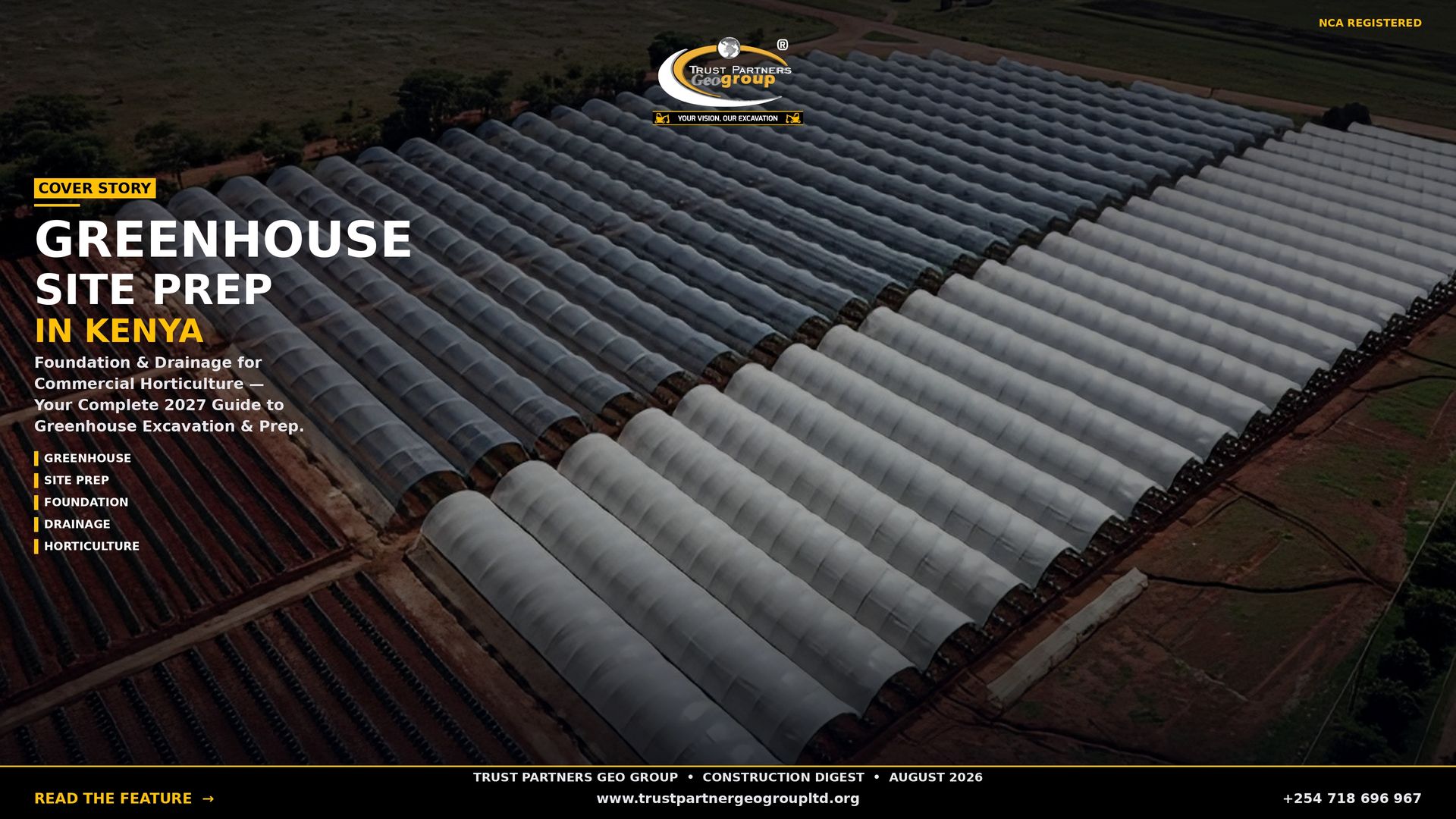
Greenhouse Site Preparation and Excavation in Kenya: Foundation and Drainage for Commercial Horticulture [2027]
Precision Earthworks, Foundation Excavation & Drainage for Flower Farms, Vegetable Greenhouses and Export Crop Production
Kenya is Africa's greenhouse horticulture powerhouse — supplying roses to Amsterdam, French beans to London and cherry tomatoes to Dubai. From the flower farms ringing Lake Naivasha to the vegetable tunnels of Athi River and Kiambu, greenhouse construction is one of the fastest-growing sectors in Kenyan agriculture. But beneath every thriving greenhouse lies a critical earthworks phase that most growers underestimate: site preparation, foundation excavation and drainage construction. Get it wrong and waterlogged soil destroys crops, corroded frames collapse, and concrete footings crack within seasons. This guide covers everything greenhouse developers need to know about precision earthworks for commercial horticulture in Kenya.

NCA-registered excavation contractor with 15+ years of agricultural earthworks across Kenya. We provide greenhouse site preparation, foundation excavation, drainage construction and irrigation infrastructure for flower farms, vegetable greenhouses and export crop operations nationwide.
Kenya's Greenhouse Horticulture Boom
Commercial greenhouse horticulture has transformed Kenya's agricultural landscape over the past two decades:
- Export dominance: Kenya is the world's fourth-largest flower exporter and Africa's leading supplier of fresh vegetables to Europe. Over 75% of production comes from large-scale commercial greenhouses concentrated around Lake Naivasha, Athi River and Kiambu.
- Domestic market growth: Urban demand for year-round tomatoes, capsicum, cucumbers and strawberries has driven a 300% increase in small-to-medium greenhouse construction around Nairobi, Mombasa, Kisumu and Nakuru.
- Geothermal advantage: Naivasha's flower farms leverage geothermal energy from the Rift Valley to power climate control, reducing operational costs by 30–40% compared to diesel-powered greenhouses.
- Climate resilience: Greenhouse farming protects crops from Kenya's increasingly erratic rainfall, extending growing seasons and reducing weather-related crop losses by 50–70%.
- County investment: Kiambu, Nakuru, Kajiado and Machakos counties have designated agribusiness zones with subsidized land, tax incentives and streamlined permitting for greenhouse developments.
- Technology transfer: Israeli, Dutch and South African greenhouse technology firms have established partnerships in Kenya, raising construction standards and demanding precision earthworks for automated systems.
The Five Phases of Greenhouse Site Preparation
Phase 1: Site Clearing and Bush Removal
All vegetation, stumps, rocks and debris must be removed from the greenhouse footprint plus a 3–5 metre buffer for drainage and access. On former farmland, this includes removing crop residues and ploughing to 30 cm depth to eliminate pest habitats. On bushland, acacia removal and stump grinding are required. Vegetation is either chipped for mulch, burned (with county fire permits) or hauled to disposal sites.
Phase 2: Topographic Survey and Precision Leveling
A GPS topographic survey maps existing contours, drainage patterns and utility locations. The site is then graded to achieve a 1–2% slope away from the greenhouse structure — critical for surface drainage. Laser leveling equipment achieves ±2 cm accuracy across the greenhouse pad. For multi-greenhouse complexes, internal roads and loading bays are graded simultaneously.
Phase 3: Foundation Excavation
Foundation work depends on the greenhouse frame type and soil conditions. Driven ground post holes are augered 60–90 cm deep at precise bay spacing (typically 4 m intervals). Concrete pier footings require excavated holes with formwork and anchor bolt placement. Perimeter wall trenches are dug 30–45 cm deep for permanent structures. All foundations require immediate blinding concrete to protect exposed soil from rain erosion.
Phase 4: Drainage Construction
Perimeter French drains (60 cm deep with perforated pipe and gravel backfill) intercept groundwater and surface runoff. Subsoil drainage channels connect to collection sumps or soak pits. Surface grading directs roof runoff and irrigation overflow away from foundations. In high-water-table areas, dewatering wells may be required during construction.
Phase 5: Utility Trenching
Trenches are excavated for irrigation mains (typically 50–75 mm HDPE), electrical conduits (for climate control, lighting and automation), fertigation lines and gas supply (for heating systems). Trenches are backfilled with sand bedding to protect pipes and compacted in layers to prevent settlement.
Greenhouse Foundation Systems
| Foundation Type | Best For | Construction Method | Cost (KES) |
|---|---|---|---|
| Driven ground posts | Tunnel-style and steel-frame greenhouses on stable murram/red loam | Galvanized steel posts driven 60–90 cm deep with hydraulic post driver; concrete collar at ground level | 800–1,500 per post |
| Concrete pier footings | Sandy coastal soils, loose lake sediment, shallow bedrock areas | Auger-drilled holes filled with 2,000+ PSI concrete; anchor bolts for baseplate connection | 2,500–4,500 per pier |
| Perimeter wall foundation | Permanent glass/polycarbonate structures; integrated packing sheds | Continuous concrete trench 30–45 cm deep x 20 cm wide with reinforcement | 2,000–3,500 per linear m |
| Raised pad on engineered fill | Black cotton soil sites; waterlogged areas | Expansive soil removed to 1–1.5 m; replaced with compacted murram; greenhouse pad constructed on fill | 3,500–6,000 per m² |
All foundations require 7-day minimum concrete curing before steel erection. Trust Partners Geo-Group excavates to structural engineer specifications and provides compaction testing for all greenhouse foundation types.
Drainage Design for Greenhouse Sites
Drainage is the single most critical — and most overlooked — element of greenhouse earthworks. Waterlogged soil causes foundation failure, root disease, structural corrosion and concrete degradation:
- Perimeter French drains: Excavated trenches 60 cm deep and 30 cm wide, lined with geotextile, filled with 20 mm gravel and perforated 100 mm HDPE pipe. Installed 1–2 m from the greenhouse perimeter to intercept groundwater before it reaches foundations.
- Surface grading: The greenhouse pad and surrounding area graded at 1–2% slope away from the structure. Prevents ponding against walls and under floors. Critical in high-rainfall zones like Kericho and Western Kenya.
- Subsoil drainage channels: Deep trenches (80–120 cm) with agricultural drainage pipe connecting to collection sumps or soak pits. Used in high-water-table areas like Naivasha and parts of Kiambu where groundwater sits within 1 m of surface.
- Gutter downspout drainage: Roof runoff from greenhouse gutters is directed through downspouts into surface drains or underground pipes, discharging at least 5 m from foundations. A 500 m² greenhouse roof can generate 50,000+ litres during a heavy storm.
- Irrigation runoff collection: Drip irrigation overflow and hydroponic drainage is collected in lined channels or underground pipes for recycling or safe disposal. NEMA requires containment for nutrient-rich runoff to prevent groundwater contamination.
- Dewatering systems: In Naivasha and other high-water-table zones, well-point dewatering or sump pumping may be required during foundation excavation. Post-construction, permanent submersible pumps maintain drainage.
Greenhouse Site Preparation Rates 2027
| Service | Rate (KES) | Notes |
|---|---|---|
| Site clearing and bush removal (per m²) | 150 – 300 | Upper end for acacia removal and stump grinding |
| Laser land leveling (per acre) | 25,000 – 55,000 | Precision grading for greenhouse pads; ±2 cm accuracy |
| Ground post hole augering (per post) | 800 – 1,500 | Incl. concrete collar and backfill compaction |
| Concrete pier excavation (per pier) | 2,500 – 4,500 | Incl. formwork, concrete, anchor bolts |
| Perimeter wall trench (per linear m) | 2,000 – 3,500 | Incl. reinforcement, concrete, curing protection |
| Perimeter French drain (per linear m) | 1,200 – 2,200 | Incl. geotextile, gravel, perforated pipe, backfill |
| Subsoil drainage channel (per m³) | 400 – 700 | Deep trench, agricultural pipe, gravel bedding |
| Irrigation/electrical trenching (per linear m) | 300 – 500 | Incl. sand bedding, pipe protection, backfill |
| Black cotton soil removal + replacement (per m³) | 1,800 – 3,000 | For sites on expansive clay; includes murram import |
| Water storage tank excavation (per m³) | 400 – 700 | Underground cisterns for irrigation supply |
| Access road grading (per m²) | 300 – 500 | Murram subgrade for farm vehicle access |
| Mini-excavator wet hire (daily) | 22,000 – 32,000 | For precision foundation and trench work |
| Laser leveling equipment (daily) | 18,000 – 28,000 | Tractor-pulled scraper with laser receiver |
County-Specific Greenhouse Construction Zones
Naivasha and Nakuru: The Flower Farm Capital
Over 20 large-scale flower farms operate around Lake Naivasha, producing roses, carnations and summer flowers for export. Greenhouses here face high water tables (0.5–1.5 m depth), lake sediment soils and geothermal areas requiring special foundation protection. Dewatering is often essential during construction. Geothermal energy powers climate control, but sulfur-rich soils accelerate steel corrosion — requiring galvanized posts with enhanced coating.
Kiambu and Nairobi Outskirts: The Domestic Supply Belt
Athi River, Kajiado and Kiambu have the densest concentration of vegetable greenhouses supplying Nairobi's domestic market. Soils are a mix of black cotton and red loam, requiring careful foundation selection. Proximity to JKIA supports export of high-value produce. County agribusiness zones offer streamlined permitting. Water scarcity in Kajiado requires integrated water storage excavation.
Kericho and Bomet: Tea Zone Diversification
Traditional tea-growing areas are diversifying into flower and vegetable greenhouses on converted tea land. Cool climate (1,800–2,200 m elevation) suits certain flower varieties and extends growing seasons. Steep terrain requires bench terrace preparation before greenhouse construction. High rainfall demands robust drainage with stone-lined outlets.
Meru Central and Laikipia: Emerging Export Corridors
New greenhouse clusters are developing for export vegetables and herbs, benefiting from devolution investment and improved road infrastructure. Variable volcanic soils require soil testing on every site. Lower land costs than Naivasha attract new entrants, but water infrastructure (boreholes, pans, dams) must be excavated concurrently.
Machakos and Makueni: Semi-Arid Greenhouse Farming
Semi-arid greenhouse farming using drip irrigation and water harvesting is expanding rapidly. Tomatoes, capsicum and cucumbers are produced for Nairobi and Mombasa markets. Black cotton soil is prevalent, requiring complete removal and replacement with murram before greenhouse construction. Water storage tank excavation is essential — a 10,000 m³ pan may be needed for a 2-acre complex.
Integrating Irrigation and Utility Infrastructure
Modern Kenyan greenhouses require integrated utility earthworks:
- Water storage tanks: Underground cisterns or elevated tank foundations excavated to structural specifications. A 120 m² greenhouse requires 500–800 litres per day; commercial complexes need 50,000–200,000 litre storage.
- Borehole pad construction: Level platforms for drilling rigs, drainage sumps for pump installations and access roads to remote borehole sites.
- Fertigation trenches: Dedicated trenches for fertilizer injection lines, separated from irrigation mains to prevent cross-contamination.
- Climate control conduits: Trenches for electrical cables powering exhaust fans, ridge vents, HAF fans, heating systems and environmental controllers.
- Packaging shed foundations: Where greenhouses integrate with packing sheds, cold rooms or processing facilities, combined foundation and drainage systems are excavated to support heavy concrete floors.
- Solar pump pad excavation: Level platforms for solar panel arrays powering irrigation pumps, common in off-grid greenhouse developments in Laikipia and Samburu.
Prepare Your Greenhouse Site with Precision Earthworks
Trust Partners Geo-Group provides greenhouse site preparation, foundation excavation and drainage construction for commercial horticulture across all 47 Kenyan counties. Free site survey, soil assessment and itemised quote.
Call +254 718 686 967 Email for QuoteFrequently Asked Questions
What does greenhouse site preparation involve in Kenya?
Greenhouse site preparation in Kenya involves five key earthworks phases: (1) Site clearing and bush removal — removing all vegetation, stumps and debris from the greenhouse footprint and access roads. (2) Topographic survey and leveling — grading the site to achieve a 1–2% slope away from the structure for drainage. Laser leveling is used for precision on commercial sites. (3) Foundation excavation — digging anchor holes for driven ground posts, concrete pier footings or perimeter wall trenches depending on the greenhouse frame type and soil conditions. (4) Drainage construction — excavating perimeter drains, subsoil drainage channels and collection sumps to prevent waterlogging. (5) Utility trenching — excavating trenches for irrigation mains, electrical conduits and fertigation lines. A standard 8m x 30m commercial greenhouse requires 200–400 m² of site preparation and 20–40 foundation anchor points. Trust Partners Geo-Group completes all phases with GPS-guided excavators and laser leveling equipment.
How much does greenhouse site preparation cost in Kenya?
Greenhouse site preparation costs in Kenya vary by size, soil type and location. Site clearing and bush removal costs KES 150–300 per m². Precision laser land leveling costs KES 25,000–55,000 per acre. Foundation excavation for driven ground posts costs KES 800–1,500 per post (including auger drilling and concrete backfill). Concrete pier foundations cost KES 2,500–4,500 per pier. Perimeter wall foundation trenches cost KES 2,000–3,500 per linear metre. Drainage channel excavation costs KES 400–700 per m³. Irrigation trenching costs KES 300–500 per linear metre. For a typical 1-acre commercial greenhouse complex (5–10 greenhouses), total site preparation costs range KES 350,000–750,000 including clearing, leveling, foundations, drainage and utility trenches. Key cost drivers include: soil type (black cotton adds 40–60% for replacement), rock presence (phonolite in Nyeri/Murang'a adds breaker costs), water table depth (dewatering in Naivasha adds costs), and mobilization distance (remote farms in Laikipia or Kitui have higher transport). Trust Partners Geo-Group provides fixed-price quotes after site survey.
What foundation types are used for greenhouses in Kenya?
Three foundation systems are standard for Kenyan greenhouses: (1) Driven ground posts — galvanized steel posts driven 60–90 cm into the ground using a hydraulic post driver. Most common for tunnel-style and commercial steel-frame greenhouses. Cost: KES 800–1,500 per post including concrete collar. Best for stable murram and red loam soils. Not suitable for black cotton or loose sand without modification. (2) Concrete pier footings — excavated holes filled with concrete (minimum 2,000 PSI) with anchor bolts for baseplate connection. Used where ground posts cannot achieve adequate embedment depth. Cost: KES 2,500–4,500 per pier. Required in sandy coastal soils, loose lake sediment and areas with shallow bedrock. (3) Perimeter wall foundations — continuous concrete trench 30–45 cm deep and 20 cm wide around the greenhouse perimeter. Used for permanent glass or polycarbonate structures and where the greenhouse integrates with packing sheds or cold rooms. Cost: KES 2,000–3,500 per linear metre. All foundations require 7-day minimum curing before steel erection. Trust Partners Geo-Group excavates to structural engineer specifications for all greenhouse foundation types.
Why is drainage critical for greenhouse construction in Kenya?
Drainage is the most overlooked and most destructive factor in Kenyan greenhouse construction. Waterlogged soil causes: (1) Foundation failure — saturated ground reduces bearing capacity by 50–70%, causing posts to tilt and frames to distort. (2) Root disease — standing water around greenhouse perimeters creates humid conditions that promote fungal diseases like Phytophthora and Pythium, which can destroy entire crops. (3) Structural corrosion — moisture trapped against galvanized steel posts accelerates rust, reducing frame lifespan from 15 years to under 5. (4) Concrete degradation — waterlogging causes sulfate attack on concrete footings, particularly in volcanic soils with high sulfur content. (5) Access problems — muddy sites prevent equipment and harvest carts from operating efficiently. Proper greenhouse drainage includes: perimeter French drains 60 cm deep with perforated pipe and gravel backfill; surface grading at 1–2% slope away from the structure; subsoil drainage channels connecting to collection sumps or soak pits; and gutter downspout drainage directing roof runoff away from foundations. In high-water-table areas like Naivasha and parts of Kiambu, dewatering wells may be required during construction. Trust Partners Geo-Group designs drainage systems specific to each site's soil, rainfall and water table conditions.
Which counties have the most greenhouse construction in Kenya?
Commercial greenhouse horticulture is concentrated in five main corridors: (1) Naivasha and Nakuru — over 20 large-scale flower farms around Lake Naivasha, with greenhouses for roses, carnations and summer flowers. Geothermal energy, abundant water and export logistics via JKIA make this the national hub. (2) Kiambu and Nairobi outskirts — dense clustering in Athi River, Kajiado and Kiambu for vegetable greenhouses supplying Nairobi's domestic market. Proximity to JKIA supports export of high-value produce. (3) Kericho and Bomet — tea-zone diversification into flower and vegetable greenhouses on converted tea land. Cool climate suits certain flower varieties. (4) Meru Central and Laikipia — emerging greenhouse clusters for export vegetables and herbs, benefiting from devolution investment and new road infrastructure. (5) Machakos and Makueni — semi-arid greenhouse farming using drip irrigation and water harvesting, producing tomatoes, capsicum and cucumbers for Nairobi and Mombasa markets. Each county has distinct soil and drainage challenges: Naivasha has high water tables and lake sediment; Kiambu has black cotton and red loam mix; Kericho has steep volcanic slopes; Meru has variable depth volcanic soils; Machakos has expansive clay and water scarcity.
Do I need NEMA approval for greenhouse construction in Kenya?
NEMA Environmental Impact Assessment requirements for greenhouses in Kenya depend on scale and location: (1) Smallholder greenhouses under 0.5 hectares on private farmland generally do not require NEMA approval, though county agricultural officer notification is recommended. (2) Commercial greenhouses 0.5–5 hectares require a NEMA Environmental Management Plan (EMP) — a simplified screening process costing KES 15,000–40,000 and taking 2–4 weeks. (3) Large-scale greenhouse complexes over 5 hectares, or projects near wetlands, rivers or lakes (common in Naivasha), require a full Environmental Impact Assessment (EIA) costing KES 80,000–200,000 and taking 6–12 weeks. (4) Greenhouses within 30 metres of Lake Naivasha, Lake Elementaita or other designated wetlands face additional KWS and Water Authority scrutiny due to water abstraction and runoff concerns. (5) County building permits are required for all permanent greenhouse structures with concrete foundations — Kiambu, Nakuru and Kajiado have the strictest enforcement. (6) Water Authority permits are required for borehole drilling, lake water abstraction or dam construction to supply greenhouse irrigation. Trust Partners Geo-Group coordinates NEMA screening, county permits and Water Authority applications for all greenhouse earthworks projects.
What equipment is needed for greenhouse site preparation?
Greenhouse site preparation requires precision earthmoving equipment: (1) Mini-excavators (5 ton) — for foundation post holes, drainage trenches and utility trenches in confined greenhouse layouts. Essential for precision work between existing structures. (2) 20–30 ton excavators with GPS — for bulk site clearing, rough grading and large-scale leveling on commercial flower farms. GPS systems maintain 1–2% drainage slopes to within 2 cm accuracy. (3) Bulldozers — for clearing dense bush, rough grading and ripping hardpan on large sites. (4) Motor graders — for final precision grading of greenhouse pads and access roads. (5) Laser leveling equipment — tractor-pulled scrapers with laser receivers for achieving the flat, cambered surfaces required for greenhouse construction. (6) Auger attachments — for drilling uniform post holes 60–90 cm deep for driven ground post foundations. (7) Vibratory plate compactors — for compacting backfill around posts and in trench bottoms. (8) Water bowsers — for dust suppression and moisture conditioning during compaction. (9) Dump trucks — for hauling cleared vegetation and excess spoil. All Trust Partners Geo-Group greenhouse preparation equipment is available wet hire with NITA-certified operators experienced in agricultural precision earthworks.
How long does greenhouse site preparation take?
Greenhouse site preparation timelines depend on size, soil and season: A single 8m x 30m greenhouse on flat murram soil takes 3–5 days: 1 day clearing, 1 day leveling, 1 day foundation excavation, 1 day drainage, and 1 day utility trenching. A 1-acre commercial complex (5–10 greenhouses) takes 2–4 weeks including clearing, laser leveling, all foundations, drainage and access roads. Large flower farm expansions of 5+ acres take 6–10 weeks with multiple machine crews. Seasonal factors: dry season (January–March, June–September) is optimal — soils are workable, compaction is achievable and concrete curing is predictable. Wet season work extends timelines by 30–50% due to waterlogged trenches, slippery access and delayed concrete curing. In high-water-table areas like Naivasha, dewatering during foundation work adds 2–4 days per greenhouse. Trust Partners Geo-Group schedules greenhouse earthworks in dry months where possible and maintains pumping equipment for all-weather sites.
Related Resources
Plan Your Greenhouse Site Preparation Project
Contact Trust Partners Geo-Group at +254 718 686 967 for a free greenhouse site survey and itemised excavation quote. Serving Naivasha, Kiambu, Nakuru, Athi River, Kericho and all 47 counties.
Call +254 718 686 967 Request QuoteGreenhouse Site Preparation and Excavation in Kenya: Foundation and Drainage for Commercial Horticulture [2027]
Precision Earthworks, Foundation Excavation & Drainage for Flower Farms, Vegetable Greenhouses and Export Crop Production
Kenya is Africa's greenhouse horticulture powerhouse — supplying roses to Amsterdam, French beans to London and cherry tomatoes to Dubai. From the flower farms ringing Lake Naivasha to the vegetable tunnels of Athi River and Kiambu, greenhouse construction is one of the fastest-growing sectors in Kenyan agriculture. But beneath every thriving greenhouse lies a critical earthworks phase that most growers underestimate: site preparation, foundation excavation and drainage construction. Get it wrong and waterlogged soil destroys crops, corroded frames collapse, and concrete footings crack within seasons. This guide covers everything greenhouse developers need to know about precision earthworks for commercial horticulture in Kenya.
NCA-registered excavation contractor with 15+ years of agricultural earthworks across Kenya. We provide greenhouse site preparation, foundation excavation, drainage construction and irrigation infrastructure for flower farms, vegetable greenhouses and export crop operations nationwide.
Kenya's Greenhouse Horticulture Boom
Commercial greenhouse horticulture has transformed Kenya's agricultural landscape over the past two decades:
- Export dominance: Kenya is the world's fourth-largest flower exporter and Africa's leading supplier of fresh vegetables to Europe. Over 75% of production comes from large-scale commercial greenhouses concentrated around Lake Naivasha, Athi River and Kiambu.
- Domestic market growth: Urban demand for year-round tomatoes, capsicum, cucumbers and strawberries has driven a 300% increase in small-to-medium greenhouse construction around Nairobi, Mombasa, Kisumu and Nakuru.
- Geothermal advantage: Naivasha's flower farms leverage geothermal energy from the Rift Valley to power climate control, reducing operational costs by 30–40% compared to diesel-powered greenhouses.
- Climate resilience: Greenhouse farming protects crops from Kenya's increasingly erratic rainfall, extending growing seasons and reducing weather-related crop losses by 50–70%.
- County investment: Kiambu, Nakuru, Kajiado and Machakos counties have designated agribusiness zones with subsidized land, tax incentives and streamlined permitting for greenhouse developments.
- Technology transfer: Israeli, Dutch and South African greenhouse technology firms have established partnerships in Kenya, raising construction standards and demanding precision earthworks for automated systems.
The Five Phases of Greenhouse Site Preparation
Phase 1: Site Clearing and Bush Removal
All vegetation, stumps, rocks and debris must be removed from the greenhouse footprint plus a 3–5 metre buffer for drainage and access. On former farmland, this includes removing crop residues and ploughing to 30 cm depth to eliminate pest habitats. On bushland, acacia removal and stump grinding are required. Vegetation is either chipped for mulch, burned (with county fire permits) or hauled to disposal sites.
Phase 2: Topographic Survey and Precision Leveling
A GPS topographic survey maps existing contours, drainage patterns and utility locations. The site is then graded to achieve a 1–2% slope away from the greenhouse structure — critical for surface drainage. Laser leveling equipment achieves ±2 cm accuracy across the greenhouse pad. For multi-greenhouse complexes, internal roads and loading bays are graded simultaneously.
Phase 3: Foundation Excavation
Foundation work depends on the greenhouse frame type and soil conditions. Driven ground post holes are augered 60–90 cm deep at precise bay spacing (typically 4 m intervals). Concrete pier footings require excavated holes with formwork and anchor bolt placement. Perimeter wall trenches are dug 30–45 cm deep for permanent structures. All foundations require immediate blinding concrete to protect exposed soil from rain erosion.
Phase 4: Drainage Construction
Perimeter French drains (60 cm deep with perforated pipe and gravel backfill) intercept groundwater and surface runoff. Subsoil drainage channels connect to collection sumps or soak pits. Surface grading directs roof runoff and irrigation overflow away from foundations. In high-water-table areas, dewatering wells may be required during construction.
Phase 5: Utility Trenching
Trenches are excavated for irrigation mains (typically 50–75 mm HDPE), electrical conduits (for climate control, lighting and automation), fertigation lines and gas supply (for heating systems). Trenches are backfilled with sand bedding to protect pipes and compacted in layers to prevent settlement.
Greenhouse Foundation Systems
| Foundation Type | Best For | Construction Method | Cost (KES) |
|---|---|---|---|
| Driven ground posts | Tunnel-style and steel-frame greenhouses on stable murram/red loam | Galvanized steel posts driven 60–90 cm deep with hydraulic post driver; concrete collar at ground level | 800–1,500 per post |
| Concrete pier footings | Sandy coastal soils, loose lake sediment, shallow bedrock areas | Auger-drilled holes filled with 2,000+ PSI concrete; anchor bolts for baseplate connection | 2,500–4,500 per pier |
| Perimeter wall foundation | Permanent glass/polycarbonate structures; integrated packing sheds | Continuous concrete trench 30–45 cm deep x 20 cm wide with reinforcement | 2,000–3,500 per linear m |
| Raised pad on engineered fill | Black cotton soil sites; waterlogged areas | Expansive soil removed to 1–1.5 m; replaced with compacted murram; greenhouse pad constructed on fill | 3,500–6,000 per m² |
All foundations require 7-day minimum concrete curing before steel erection. Trust Partners Geo-Group excavates to structural engineer specifications and provides compaction testing for all greenhouse foundation types.
Drainage Design for Greenhouse Sites
Drainage is the single most critical — and most overlooked — element of greenhouse earthworks. Waterlogged soil causes foundation failure, root disease, structural corrosion and concrete degradation:
- Perimeter French drains: Excavated trenches 60 cm deep and 30 cm wide, lined with geotextile, filled with 20 mm gravel and perforated 100 mm HDPE pipe. Installed 1–2 m from the greenhouse perimeter to intercept groundwater before it reaches foundations.
- Surface grading: The greenhouse pad and surrounding area graded at 1–2% slope away from the structure. Prevents ponding against walls and under floors. Critical in high-rainfall zones like Kericho and Western Kenya.
- Subsoil drainage channels: Deep trenches (80–120 cm) with agricultural drainage pipe connecting to collection sumps or soak pits. Used in high-water-table areas like Naivasha and parts of Kiambu where groundwater sits within 1 m of surface.
- Gutter downspout drainage: Roof runoff from greenhouse gutters is directed through downspouts into surface drains or underground pipes, discharging at least 5 m from foundations. A 500 m² greenhouse roof can generate 50,000+ litres during a heavy storm.
- Irrigation runoff collection: Drip irrigation overflow and hydroponic drainage is collected in lined channels or underground pipes for recycling or safe disposal. NEMA requires containment for nutrient-rich runoff to prevent groundwater contamination.
- Dewatering systems: In Naivasha and other high-water-table zones, well-point dewatering or sump pumping may be required during foundation excavation. Post-construction, permanent submersible pumps maintain drainage.
Greenhouse Site Preparation Rates 2027
| Service | Rate (KES) | Notes |
|---|---|---|
| Site clearing and bush removal (per m²) | 150 – 300 | Upper end for acacia removal and stump grinding |
| Laser land leveling (per acre) | 25,000 – 55,000 | Precision grading for greenhouse pads; ±2 cm accuracy |
| Ground post hole augering (per post) | 800 – 1,500 | Incl. concrete collar and backfill compaction |
| Concrete pier excavation (per pier) | 2,500 – 4,500 | Incl. formwork, concrete, anchor bolts |
| Perimeter wall trench (per linear m) | 2,000 – 3,500 | Incl. reinforcement, concrete, curing protection |
| Perimeter French drain (per linear m) | 1,200 – 2,200 | Incl. geotextile, gravel, perforated pipe, backfill |
| Subsoil drainage channel (per m³) | 400 – 700 | Deep trench, agricultural pipe, gravel bedding |
| Irrigation/electrical trenching (per linear m) | 300 – 500 | Incl. sand bedding, pipe protection, backfill |
| Black cotton soil removal + replacement (per m³) | 1,800 – 3,000 | For sites on expansive clay; includes murram import |
| Water storage tank excavation (per m³) | 400 – 700 | Underground cisterns for irrigation supply |
| Access road grading (per m²) | 300 – 500 | Murram subgrade for farm vehicle access |
| Mini-excavator wet hire (daily) | 22,000 – 32,000 | For precision foundation and trench work |
| Laser leveling equipment (daily) | 18,000 – 28,000 | Tractor-pulled scraper with laser receiver |
County-Specific Greenhouse Construction Zones
Naivasha and Nakuru: The Flower Farm Capital
Over 20 large-scale flower farms operate around Lake Naivasha, producing roses, carnations and summer flowers for export. Greenhouses here face high water tables (0.5–1.5 m depth), lake sediment soils and geothermal areas requiring special foundation protection. Dewatering is often essential during construction. Geothermal energy powers climate control, but sulfur-rich soils accelerate steel corrosion — requiring galvanized posts with enhanced coating.
Kiambu and Nairobi Outskirts: The Domestic Supply Belt
Athi River, Kajiado and Kiambu have the densest concentration of vegetable greenhouses supplying Nairobi's domestic market. Soils are a mix of black cotton and red loam, requiring careful foundation selection. Proximity to JKIA supports export of high-value produce. County agribusiness zones offer streamlined permitting. Water scarcity in Kajiado requires integrated water storage excavation.
Kericho and Bomet: Tea Zone Diversification
Traditional tea-growing areas are diversifying into flower and vegetable greenhouses on converted tea land. Cool climate (1,800–2,200 m elevation) suits certain flower varieties and extends growing seasons. Steep terrain requires bench terrace preparation before greenhouse construction. High rainfall demands robust drainage with stone-lined outlets.
Meru Central and Laikipia: Emerging Export Corridors
New greenhouse clusters are developing for export vegetables and herbs, benefiting from devolution investment and improved road infrastructure. Variable volcanic soils require soil testing on every site. Lower land costs than Naivasha attract new entrants, but water infrastructure (boreholes, pans, dams) must be excavated concurrently.
Machakos and Makueni: Semi-Arid Greenhouse Farming
Semi-arid greenhouse farming using drip irrigation and water harvesting is expanding rapidly. Tomatoes, capsicum and cucumbers are produced for Nairobi and Mombasa markets. Black cotton soil is prevalent, requiring complete removal and replacement with murram before greenhouse construction. Water storage tank excavation is essential — a 10,000 m³ pan may be needed for a 2-acre complex.
Integrating Irrigation and Utility Infrastructure
Modern Kenyan greenhouses require integrated utility earthworks:
- Water storage tanks: Underground cisterns or elevated tank foundations excavated to structural specifications. A 120 m² greenhouse requires 500–800 litres per day; commercial complexes need 50,000–200,000 litre storage.
- Borehole pad construction: Level platforms for drilling rigs, drainage sumps for pump installations and access roads to remote borehole sites.
- Fertigation trenches: Dedicated trenches for fertilizer injection lines, separated from irrigation mains to prevent cross-contamination.
- Climate control conduits: Trenches for electrical cables powering exhaust fans, ridge vents, HAF fans, heating systems and environmental controllers.
- Packaging shed foundations: Where greenhouses integrate with packing sheds, cold rooms or processing facilities, combined foundation and drainage systems are excavated to support heavy concrete floors.
- Solar pump pad excavation: Level platforms for solar panel arrays powering irrigation pumps, common in off-grid greenhouse developments in Laikipia and Samburu.
Prepare Your Greenhouse Site with Precision Earthworks
Trust Partners Geo-Group provides greenhouse site preparation, foundation excavation and drainage construction for commercial horticulture across all 47 Kenyan counties. Free site survey, soil assessment and itemised quote.
Call +254 718 686 967 Email for QuoteFrequently Asked Questions
What does greenhouse site preparation involve in Kenya?
Greenhouse site preparation in Kenya involves five key earthworks phases: (1) Site clearing and bush removal — removing all vegetation, stumps and debris from the greenhouse footprint and access roads. (2) Topographic survey and leveling — grading the site to achieve a 1–2% slope away from the structure for drainage. Laser leveling is used for precision on commercial sites. (3) Foundation excavation — digging anchor holes for driven ground posts, concrete pier footings or perimeter wall trenches depending on the greenhouse frame type and soil conditions. (4) Drainage construction — excavating perimeter drains, subsoil drainage channels and collection sumps to prevent waterlogging. (5) Utility trenching — excavating trenches for irrigation mains, electrical conduits and fertigation lines. A standard 8m x 30m commercial greenhouse requires 200–400 m² of site preparation and 20–40 foundation anchor points. Trust Partners Geo-Group completes all phases with GPS-guided excavators and laser leveling equipment.
How much does greenhouse site preparation cost in Kenya?
Greenhouse site preparation costs in Kenya vary by size, soil type and location. Site clearing and bush removal costs KES 150–300 per m². Precision laser land leveling costs KES 25,000–55,000 per acre. Foundation excavation for driven ground posts costs KES 800–1,500 per post (including auger drilling and concrete backfill). Concrete pier foundations cost KES 2,500–4,500 per pier. Perimeter wall foundation trenches cost KES 2,000–3,500 per linear metre. Drainage channel excavation costs KES 400–700 per m³. Irrigation trenching costs KES 300–500 per linear metre. For a typical 1-acre commercial greenhouse complex (5–10 greenhouses), total site preparation costs range KES 350,000–750,000 including clearing, leveling, foundations, drainage and utility trenches. Key cost drivers include: soil type (black cotton adds 40–60% for replacement), rock presence (phonolite in Nyeri/Murang'a adds breaker costs), water table depth (dewatering in Naivasha adds costs), and mobilization distance (remote farms in Laikipia or Kitui have higher transport). Trust Partners Geo-Group provides fixed-price quotes after site survey.
What foundation types are used for greenhouses in Kenya?
Three foundation systems are standard for Kenyan greenhouses: (1) Driven ground posts — galvanized steel posts driven 60–90 cm into the ground using a hydraulic post driver. Most common for tunnel-style and commercial steel-frame greenhouses. Cost: KES 800–1,500 per post including concrete collar. Best for stable murram and red loam soils. Not suitable for black cotton or loose sand without modification. (2) Concrete pier footings — excavated holes filled with concrete (minimum 2,000 PSI) with anchor bolts for baseplate connection. Used where ground posts cannot achieve adequate embedment depth. Cost: KES 2,500–4,500 per pier. Required in sandy coastal soils, loose lake sediment and areas with shallow bedrock. (3) Perimeter wall foundations — continuous concrete trench 30–45 cm deep and 20 cm wide around the greenhouse perimeter. Used for permanent glass or polycarbonate structures and where the greenhouse integrates with packing sheds or cold rooms. Cost: KES 2,000–3,500 per linear metre. All foundations require 7-day minimum curing before steel erection. Trust Partners Geo-Group excavates to structural engineer specifications for all greenhouse foundation types.
Why is drainage critical for greenhouse construction in Kenya?
Drainage is the most overlooked and most destructive factor in Kenyan greenhouse construction. Waterlogged soil causes: (1) Foundation failure — saturated ground reduces bearing capacity by 50–70%, causing posts to tilt and frames to distort. (2) Root disease — standing water around greenhouse perimeters creates humid conditions that promote fungal diseases like Phytophthora and Pythium, which can destroy entire crops. (3) Structural corrosion — moisture trapped against galvanized steel posts accelerates rust, reducing frame lifespan from 15 years to under 5. (4) Concrete degradation — waterlogging causes sulfate attack on concrete footings, particularly in volcanic soils with high sulfur content. (5) Access problems — muddy sites prevent equipment and harvest carts from operating efficiently. Proper greenhouse drainage includes: perimeter French drains 60 cm deep with perforated pipe and gravel backfill; surface grading at 1–2% slope away from the structure; subsoil drainage channels connecting to collection sumps or soak pits; and gutter downspout drainage directing roof runoff away from foundations. In high-water-table areas like Naivasha and parts of Kiambu, dewatering wells may be required during construction. Trust Partners Geo-Group designs drainage systems specific to each site's soil, rainfall and water table conditions.
Which counties have the most greenhouse construction in Kenya?
Commercial greenhouse horticulture is concentrated in five main corridors: (1) Naivasha and Nakuru — over 20 large-scale flower farms around Lake Naivasha, with greenhouses for roses, carnations and summer flowers. Geothermal energy, abundant water and export logistics via JKIA make this the national hub. (2) Kiambu and Nairobi outskirts — dense clustering in Athi River, Kajiado and Kiambu for vegetable greenhouses supplying Nairobi's domestic market. Proximity to JKIA supports export of high-value produce. (3) Kericho and Bomet — tea-zone diversification into flower and vegetable greenhouses on converted tea land. Cool climate suits certain flower varieties. (4) Meru Central and Laikipia — emerging greenhouse clusters for export vegetables and herbs, benefiting from devolution investment and new road infrastructure. (5) Machakos and Makueni — semi-arid greenhouse farming using drip irrigation and water harvesting, producing tomatoes, capsicum and cucumbers for Nairobi and Mombasa markets. Each county has distinct soil and drainage challenges: Naivasha has high water tables and lake sediment; Kiambu has black cotton and red loam mix; Kericho has steep volcanic slopes; Meru has variable depth volcanic soils; Machakos has expansive clay and water scarcity.
Do I need NEMA approval for greenhouse construction in Kenya?
NEMA Environmental Impact Assessment requirements for greenhouses in Kenya depend on scale and location: (1) Smallholder greenhouses under 0.5 hectares on private farmland generally do not require NEMA approval, though county agricultural officer notification is recommended. (2) Commercial greenhouses 0.5–5 hectares require a NEMA Environmental Management Plan (EMP) — a simplified screening process costing KES 15,000–40,000 and taking 2–4 weeks. (3) Large-scale greenhouse complexes over 5 hectares, or projects near wetlands, rivers or lakes (common in Naivasha), require a full Environmental Impact Assessment (EIA) costing KES 80,000–200,000 and taking 6–12 weeks. (4) Greenhouses within 30 metres of Lake Naivasha, Lake Elementaita or other designated wetlands face additional KWS and Water Authority scrutiny due to water abstraction and runoff concerns. (5) County building permits are required for all permanent greenhouse structures with concrete foundations — Kiambu, Nakuru and Kajiado have the strictest enforcement. (6) Water Authority permits are required for borehole drilling, lake water abstraction or dam construction to supply greenhouse irrigation. Trust Partners Geo-Group coordinates NEMA screening, county permits and Water Authority applications for all greenhouse earthworks projects.
What equipment is needed for greenhouse site preparation?
Greenhouse site preparation requires precision earthmoving equipment: (1) Mini-excavators (5 ton) — for foundation post holes, drainage trenches and utility trenches in confined greenhouse layouts. Essential for precision work between existing structures. (2) 20–30 ton excavators with GPS — for bulk site clearing, rough grading and large-scale leveling on commercial flower farms. GPS systems maintain 1–2% drainage slopes to within 2 cm accuracy. (3) Bulldozers — for clearing dense bush, rough grading and ripping hardpan on large sites. (4) Motor graders — for final precision grading of greenhouse pads and access roads. (5) Laser leveling equipment — tractor-pulled scrapers with laser receivers for achieving the flat, cambered surfaces required for greenhouse construction. (6) Auger attachments — for drilling uniform post holes 60–90 cm deep for driven ground post foundations. (7) Vibratory plate compactors — for compacting backfill around posts and in trench bottoms. (8) Water bowsers — for dust suppression and moisture conditioning during compaction. (9) Dump trucks — for hauling cleared vegetation and excess spoil. All Trust Partners Geo-Group greenhouse preparation equipment is available wet hire with NITA-certified operators experienced in agricultural precision earthworks.
How long does greenhouse site preparation take?
Greenhouse site preparation timelines depend on size, soil and season: A single 8m x 30m greenhouse on flat murram soil takes 3–5 days: 1 day clearing, 1 day leveling, 1 day foundation excavation, 1 day drainage, and 1 day utility trenching. A 1-acre commercial complex (5–10 greenhouses) takes 2–4 weeks including clearing, laser leveling, all foundations, drainage and access roads. Large flower farm expansions of 5+ acres take 6–10 weeks with multiple machine crews. Seasonal factors: dry season (January–March, June–September) is optimal — soils are workable, compaction is achievable and concrete curing is predictable. Wet season work extends timelines by 30–50% due to waterlogged trenches, slippery access and delayed concrete curing. In high-water-table areas like Naivasha, dewatering during foundation work adds 2–4 days per greenhouse. Trust Partners Geo-Group schedules greenhouse earthworks in dry months where possible and maintains pumping equipment for all-weather sites.
Related Resources
Plan Your Greenhouse Site Preparation Project
Contact Trust Partners Geo-Group at +254 718 686 967 for a free greenhouse site survey and itemised excavation quote. Serving Naivasha, Kiambu, Nakuru, Athi River, Kericho and all 47 counties.
Call +254 718 686 967 Request Quote