
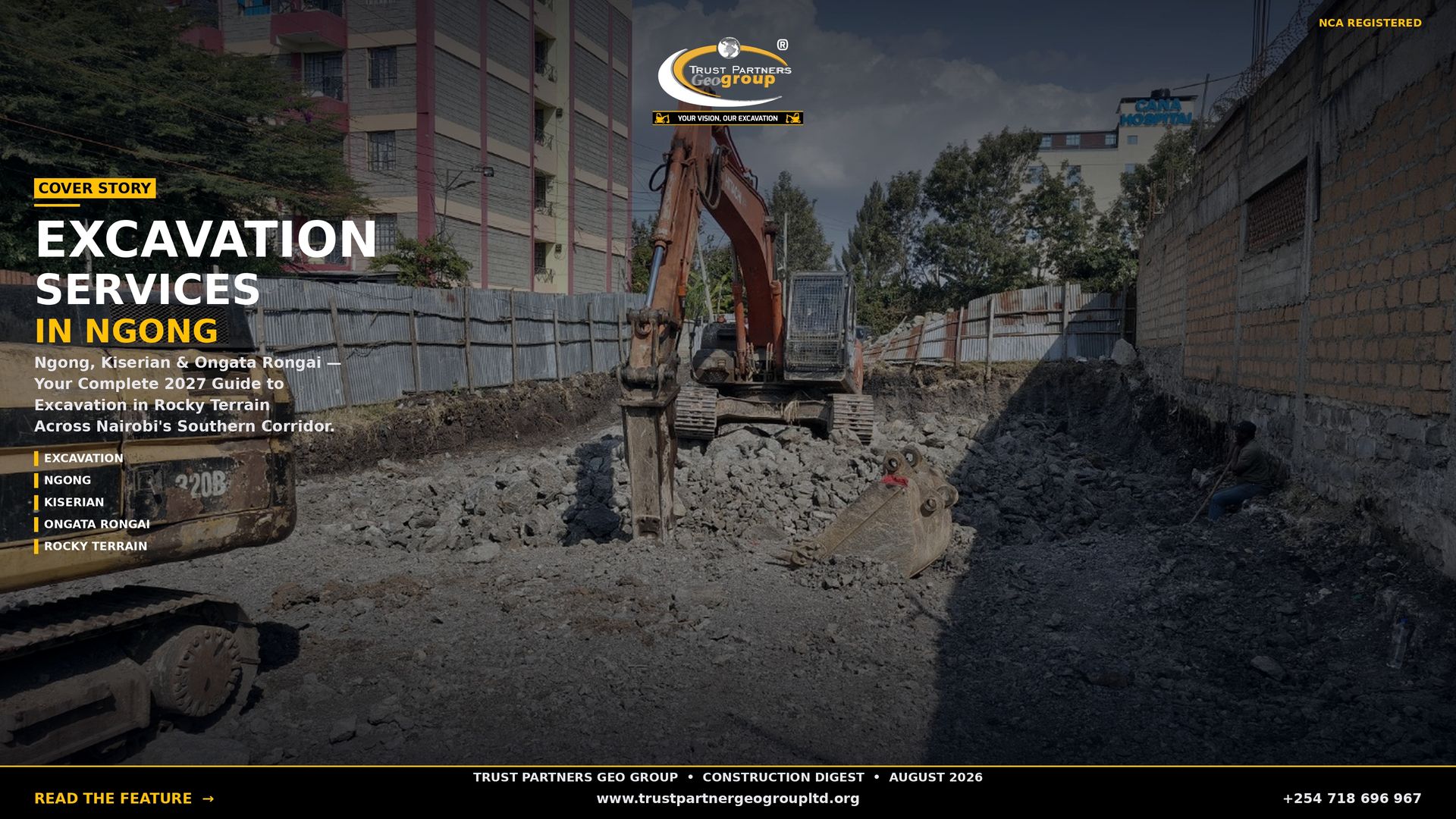
Excavation Services in Ngong, Kiserian and Ongata Rongai: Rocky Terrain Challenges [2027]
Rock Excavation, Basement Digging & Earthworks for Kajiado County's Volcanic Frontier
Southwest of Nairobi, the Ngong Hills corridor is Kenya's most geologically challenging construction frontier. Ngong, Kiserian and Ongata Rongai — once pastoral grazing lands and volcanic footslopes — now host some of the fastest-growing residential and commercial developments in the metropolitan region. But beneath the red soil and savanna grass lies a contractor's nightmare: shallow phonolite bedrock, boulder fields and steep volcanic ridges that demand specialised rock excavation expertise. This guide covers everything developers need to know about excavation in Kajiado County's rocky terrain — from breaker attachments and controlled blasting to county permits and 2027 hire rates.

NCA-registered excavation and heavy equipment hire contractor with 15+ years operating across Kenya. We maintain a dedicated Rift Valley fleet with rock-breaking and drilling capability for rapid-response excavation in Ngong, Kiserian, Ongata Rongai and all Kajiado County projects.
Why Ngong, Kiserian and Ongata Rongai Are Expanding
The Ngong Hills corridor is experiencing explosive growth driven by six key factors:
- Proximity to Nairobi CBD: Ongata Rongai sits 18 km southwest, Ngong is 22 km west, and Kiserian is 25 km south — all within 35–50 minutes via the dualled Ngong Road, Southern Bypass and Magadi Road. This rivals commute times from Karen and Langata.
- Affordable land with upside: A 50×100 ft plot in Ongata Rongai costs KES 2.5–5 million, while Ngong hillside plots with panoramic views trade at KES 4–8 million. Comparable plots in Kilimani or Lavington command KES 15–25 million.
- Diaspora investment pipeline: Ongata Rongai and Ngong are consistently ranked as the top destinations for Kenyans abroad building retirement homes, rental apartments and gated family compounds.
- Major infrastructure upgrades: The Ngong Road dualling, Kiserian–Isinya tarmac upgrade, Southern Bypass link roads and planned Ngong–Kajiado dual carriageway have transformed accessibility.
- Institutional and commercial expansion: Kiserian is emerging as a logistics and light-industrial hub serving the greater Rift Valley, while universities, hospitals and boarding schools across the corridor drive staff housing demand.
- Scenic and climatic appeal: Ngong's elevation (1,900–2,200 metres) delivers cooler temperatures and dramatic hillside views that attract upmarket residential estates, eco-lodges and wellness retreats.
The Rocky Terrain Challenge: Geology of the Ngong Hills
Unlike Nairobi's red volcanic soils or Kiambu's coffee-belt loam, the Ngong Hills corridor sits on an extinct volcanic complex that creates uniquely difficult excavation conditions:
- Shallow bedrock: In Ngong and upper Kiserian, hard phonolite and trachyte bedrock lies just 0.5–2.0 metres below surface. Standard excavator buckets strike rock within the first few passes, immediately requiring breaker attachments or blasting.
- Boulder fields: Ongata Rongai and lower Kiserian are notorious for volcanic bomb fields — massive rounded boulders embedded in clay-rich matrix. These cannot be ripped and must be broken or extracted individually.
- Variable rock hardness: The corridor spans fresh phonolite (120 MPa compressive strength) through weathered trachyte and soft tuff. Contractors must adapt methods daily as rock quality changes across a single plot.
- Steep volcanic slopes: Ngong's ridges rise at 15–30° gradients. Building platforms require extensive benching, and road access demands cut-and-fill earthworks through solid rock.
- Black cotton soil valleys: Between ridges, seasonal drainage lines contain expansive black cotton clay that swells during rains and shrinks in dry spells — requiring careful foundation design alongside rock work.
- Seasonal watercourses: Rainwater concentrates in gullies carved through volcanic rock, creating flash-flood risks and undermining excavations if drainage is not engineered from day one.
Excavation Services for Rocky Sites
Rock Excavation for Foundations
Strip, raft and pile foundations in Ngong almost always encounter bedrock. Trust Partners Geo-Group excavates to design depth using hydraulic breakers, rock splitting or controlled blasting, then prepares level rock platforms for concrete placement. In Ongata Rongai's boulder fields, we extract individual volcanic bombs and backfill with engineered hardcore.
Plot Cutting and Site Clearing
Converting raw Kajiado bushland into buildable plots requires more than bush clearing. Our teams remove acacia scrub, break surface rock, strip topsoil for reuse, and rip or blast shallow bedrock to achieve level platforms. On Ngong's steeper plots, we construct access tracks and bench terraces before the main building excavation begins.
Basement Excavation in Hard Rock
As Ngong and Ongata Rongai shift from single-storey homes to multi-storey apartments and mixed-use buildings, basement demand is rising. Excavating 2–3 level basements in phonolite is a specialist operation requiring breaker-equipped 30-ton excavators, tight shoring in urban plots, and dust and vibration control near neighbouring buildings.
Road and Drainage Earthworks
Estate roads through the Ngong Hills require cutting through volcanic ridges and filling valleys with compacted rock spoil. Drainage channels must handle high-velocity runoff from steep slopes. We profile roads with motor graders, install culverts through rock, and construct gabion-lined channels where gully erosion threatens.
Utility Trenching in Rock
Water, sewer and power lines in Kajiado County often run through solid rock rather than soil. We trench using rock saws, breaker hammers and narrow-bucket mini-excavators, then bed pipes in sand and backfill with crushed rock to prevent point-loading.
Rock Excavation Methods and Equipment
| Method | Best For | Equipment | Relative Cost |
|---|---|---|---|
| Hydraulic breaking | Phonolite, trachyte, boulder fields; urban sites where blasting is restricted | 30-ton excavator + hydraulic breaker (1,500–2,500 J output) | Moderate — KES 2,000–3,500/m³ |
| Controlled blasting | Deep cuts, large-volume rock removal, remote hillside sites | Drill rig, explosives, blast mats, monitoring equipment | High — KES 3,500–5,500/m³ including permits |
| Mechanical rock splitting | Precision work near buildings, sensitive infrastructure, final trimming | Hydraulic splitters, wedge and feather sets | Moderate — KES 2,500–4,000/m³ |
| Dozer ripping | Weathered trachyte, soft tuff, thin hardpan layers | Bulldozer with single or multi-shank ripper | Low — KES 1,200–2,000/m³ |
| Drilling and blasting | Quarry-scale rock removal, road cuttings, mass benching | Pneumatic or hydraulic drill rig, compressor, explosives | High — KES 3,000–5,000/m³ |
Method selection depends on rock type, proximity to structures, volume, and permit status. Trust Partners Geo-Group conducts pre-site rock assessment before recommending the most cost-effective approach.
Excavation Rates in Ngong, Kiserian and Ongata Rongai 2027
| Service | Rate (KES) | Notes |
|---|---|---|
| Plot cutting and clearing (per m²) | 250 – 500 | Upper end for boulder-strewn Ongata Rongai plots with rock breaking |
| Topsoil stripping (per m²) | 90 – 160 | Includes haul to on-site stockpile |
| Bulk excavation — soft soil (per m³) | 900 – 1,400 | Valley floors and weathered zones only |
| Bulk excavation — rock with breaker (per m³) | 2,000 – 3,500 | Phonolite and trachyte; includes breaker wear |
| Basement excavation — rock (per m³) | 2,800 – 4,800 | Trimmed excavation; shoring if adjacent buildings |
| Controlled blasting (per m³) | 3,500 – 5,500 | Includes drilling, explosives, safety supervision and permits |
| Boulder extraction (per boulder) | 3,500 – 8,000 | Depends on size (0.5–3.0 m diameter) and access |
| Hillside benching (per m³) | 1,500 – 2,500 | Cut-and-fill with compaction; includes drainage |
| Road subgrade through rock (per m²) | 750 – 1,200 | Cut to level, breaker work, sub-base, compaction |
| Utility trenching in rock (per metre) | 1,200 – 2,200 | Includes backfill with crushed rock |
| Spoil disposal — rock (per 20-ton truck) | 4,500 – 9,000 | Haul to Kajiado or Isinya quarries; rock is heavier than soil |
| 30-ton excavator + breaker wet hire (daily) | 45,000 – 60,000 | Operator, fuel, breaker wear, maintenance included |
| Drilling rig wet hire (daily) | 35,000 – 50,000 | Operator, compressor, fuel, drill bits included |
Key Neighbourhoods and Development Zones
Ngong Town: Hillside High-Rises and Gated Estates
Ngong Town centre and its surrounding ridges are seeing rapid vertical growth. Apartment blocks of 6–12 storeys with 2-level basements are replacing single-family homes. The combination of shallow bedrock and tight urban plots makes basement excavation a specialist undertaking. Views of the Great Rift Valley command premium prices, driving developers to maximise floor area ratio with deep foundations.
Ongata Rongai: Dense Residential and Student Housing
Ongata Rongai — commonly called Rongai — is the most populous satellite town in Kajiado County. Its flat-to-gently-rolling terrain is deceptive: boulder fields and thin rock lenses lie just below the red topsoil. Multi-storey residential blocks and university hostels require foundation excavation through unpredictable rock. The Pipeline area offers flatter plots but shares the same boulder challenges.
Kiserian: Commercial Hub and Logistics Corridor
Kiserian is transforming from a rural trading centre into a commercial and light-industrial gateway. The Kiserian–Isinya Road upgrade has unlocked large parcels for warehouses, logistics yards and wholesale markets. Excavation here involves both rock cutting for road access and mass earthworks for level industrial platforms. The Suswa Road corridor is seeing the fastest pace of new development.
Rimpa, Matasia and Environs
These peri-urban zones on Ngong's lower slopes offer larger plots for gated communities and rural-style estates. The terrain is steeper and rockier than Rongai, requiring extensive benching, retaining walls and private road construction through volcanic ridges. Water pan excavation for estate supply is also common in these higher-elevation areas.
Hillside and Slope Stability Considerations
Ngong's volcanic ridges present slope stability challenges that flat-site contractors often underestimate:
- Benching and terracing: Slopes over 15° must be cut into stepped terraces to create level building pads. Each bench requires drainage at the crest and a stable batter angle — typically 1:1 to 1.5:1 in weathered volcanic rock.
- Retaining structures: Where benching is insufficient, gabion, concrete cantilever or anchored retaining walls hold back cut slopes and create usable space. Foundation trenches for these walls often drill into solid phonolite.
- Surface drainage: Ngong's 1,000+ mm annual rainfall concentrates into fast-flowing runoff on bare rock slopes. Excavation must include interceptor drains, downpipes and energy dissipators to prevent gully erosion.
- Rock fall protection: Upslope excavation can loosen boulders on steep faces. Catch fences, rock nets and controlled scaling are necessary on high-gradient plots above roads or neighbouring properties.
- Access road engineering: Hillside developments require switchback roads or steep grades with concrete surfacing. Road cuttings through phonolite often produce more rock spoil than the building excavation itself.
Trust Partners Geo-Group has completed rock excavation and benching for over 35 hillside projects in Ngong and Kiserian — from single-home platforms to 30-unit estate earthworks exceeding 25,000 m³ of cut-and-fill.
Permits for Kajiado County and NEMA
Excavation in Kajiado County involves a multi-layer compliance framework:
- Kajiado County building permits: Required for all construction. Submissions must include excavation depth specifications, rock disposal plans, drainage designs and slope stability reports for hillside plots. Processing takes 2–4 weeks.
- NEMA Environmental Impact Assessment: Mandatory for projects over 1 hectare, development on slopes over 15 degrees, or work within 500 metres of the Ngong Hills forest reserve or seasonal watercourses.
- Blasting permits: Controlled blasting requires county approval, police notification, a licensed blasting officer, and public liability insurance. Trust Partners Geo-Group holds all required blasting licences.
- NCA registration: All structural excavation and rock breaking must be carried out by NCA-registered contractors. Our registration covers all building categories and rock excavation specialisations.
- Dust and vibration control: NEMA mandates dust suppression along Magadi Road, Ngong Road and in densely populated Ongata Rongai estates. Vibration monitoring is required when blasting within 200 metres of existing buildings.
- Tree preservation: Kajiado County protects indigenous acacia and olive species on undeveloped plots. Removal requires compensatory planting or county forester approval.
Trust Partners Geo-Group Rift Valley Fleet
Our dedicated Rift Valley fleet is configured specifically for Kajiado County's volcanic terrain, mobilised from our Nairobi depot to Ngong, Kiserian and Ongata Rongai within 4–6 hours:
- Hyundai HX300SL 30-ton Excavators (4 units): Primary rock-breaking machines fitted with 2,500-joule hydraulic breakers for phonolite and trachyte. Quick-coupler systems allow rapid switching between buckets, breakers and ripper attachments.
- Pneumatic and Hydraulic Drill Rigs (2 units): For controlled blasting, rock anchoring and micropile drilling in steep Ngong slopes. Capable of drilling 50–100 mm diameter holes to 6 metres depth.
- Komatsu D65 Bulldozers with Ripper (2 units): Site clearing, rough grading and ripping weathered rock on upper slopes and ridge tops.
- Shacman 30-ton Tippers (10 units): Rock spoil removal fleet. Rock loads are 15–20% heavier than soil, requiring additional truck rotations on large projects.
- Mobile Compressors (2 units): Power pneumatic drilling and breaking tools on remote Ngong Hills sites without grid power.
- Sany Motor Grader (1 unit): Estate road profiling and drainage channel grading through rock cuts.
- Water Bowser 15,000 litres (2 units): Dust suppression mandatory along Ngong Road and Magadi Road frontage.
- Mini-Excavators (5-ton, 3 units): Restricted-access work on narrow Ongata Rongai plots and precision trenching near existing structures.
All operators are NITA-certified with specific rock excavation and blasting safety training. Projects receive dedicated supervisors, daily progress reports, blast monitoring logs and photographic documentation.
Start Your Ngong, Kiserian or Ongata Rongai Project Today
Trust Partners Geo-Group is Kajiado County's leading rock excavation contractor. Free site assessment, rock type identification, itemised quote and rapid mobilisation.
Call +254 718 686 967 Email for QuoteFrequently Asked Questions
Why are Ngong, Kiserian and Ongata Rongai growing so fast?
Ngong, Kiserian and Ongata Rongai are among Nairobi's fastest-growing satellite corridors due to: (1) Proximity to the CBD — Ongata Rongai is 18 km southwest, Ngong is 22 km west, and Kiserian is 25 km south, all connected via Ngong Road, the Southern Bypass and Magadi Road. (2) Affordable land — a 50×100 ft plot in Ongata Rongai costs KES 2.5–5 million versus KES 15–25 million in Kilimani or Lavington. Ngong hillside plots with views trade at KES 4–8 million. (3) Major infrastructure — the Ngong Road dualling, Southern Bypass link roads and Kajiado County road upgrades have cut commute times to under 40 minutes. (4) Diaspora investment — Ongata Rongai and Ngong are favourites for Kenyans abroad building retirement and rental homes. (5) Institutional growth — universities, hospitals and logistics hubs along the Kiserian–Isinya corridor are driving commercial and residential demand. (6) Scenic appeal — Ngong Hills views and cooler temperatures attract upmarket gated communities and eco-resorts.
What makes excavation difficult in Ngong and Kiserian?
The Ngong Hills are an extinct volcanic range. Bedrock lies at shallow depths — often 0.5 to 2.0 metres below surface — and consists of hard phonolite, trachyte and agglomerate that standard excavator buckets cannot penetrate. Boulder fields are common in Ongata Rongai and Kiserian, where volcanic bombs and weathered rock fragments are embedded in clay-rich soils. Hillside plots on Ngong's slopes require benching and retaining structures before any foundation work begins. Seasonal streams carve gullies through developed areas, creating drainage and erosion challenges. Black cotton soil in valleys between ridges swells when wet, complicating foundation design. Together, these conditions make Ngong, Kiserian and Ongata Rongai among the most technically demanding excavation environments in the Nairobi metropolitan area.
What rock types are found in the Ngong Hills?
The Ngong Hills volcanic complex produces four main rock types that affect excavation: (1) Phonolite — a hard, fine-grained igneous rock forming the core of the Ngong ridges. Uniaxial compressive strength 60–120 MPa. Requires hydraulic breakers or controlled blasting. (2) Trachyte — slightly weathered volcanic flow rock found on upper slopes. Hard but often fractured, allowing breaker penetration. (3) Tuff and agglomerate — consolidated volcanic ash and bombs found on lower slopes and in Ongata Rongai. Variable hardness; some tuff is soft enough for ripping, while agglomerate contains hard boulders. (4) Laterite and murram — iron-cemented hardpan capping flat areas and ridge tops. Resists bucket excavation but provides excellent foundation bearing once broken. Trust Partners Geo-Group adjusts equipment attachments based on site-specific rock identification.
How much does rock excavation cost in Ngong and Ongata Rongai?
Rock excavation in the Ngong Hills corridor costs KES 2,000–3,500 per cubic metre for bulk work using hydraulic breakers, and KES 2,800–4,800 per cubic metre for basement excavation in hard phonolite. Controlled blasting ranges from KES 3,500–5,500 per m³ including permits, drilling and safety supervision. By comparison, soft soil excavation in the same area costs KES 900–1,400 per m³. A typical 2-level basement on a 1,000 m² plot in Ngong costs KES 22–40 million all-in due to rock premiums. Plot cutting on boulder-strewn land costs KES 250–500 per m² — roughly double the rate for clear agricultural land. Key cost drivers include: rock hardness (phonolite adds 40–70% premium), haul distance to disposal (Kajiado quarries charge KES 500–900 per 20-ton truck), blasting permit delays, and hillside benching requirements. Trust Partners Geo-Group provides fixed-price quotes after site-specific rock assessment.
Do I need a blasting permit for rock excavation in Kajiado County?
Yes. Controlled blasting in Kajiado County requires: (1) A blasting permit from the Kajiado County Government — application includes blast design, safety plan, neighbouring property notifications and insurance. Processing takes 2–3 weeks. (2) Police notification 48 hours before each blast, supervised by an licensed blasting officer. (3) NEMA approval for blasting on slopes over 15 degrees, within 500 metres of protected areas, or near the Ngong Hills forest reserve boundary. (4) NCA-registered contractor status — only NCA-registered firms may undertake structural rock excavation. (5) Dust and vibration monitoring — mandatory along Magadi Road, Ngong Road and in densely populated Ongata Rongai estates. Trust Partners Geo-Group holds all blasting licenses and manages the full permit chain from county application to post-blast inspection.
How long does basement excavation take on rocky sites?
Basement excavation on rocky Ngong and Kiserian sites takes 30–50% longer than equivalent work in Nairobi's red-soil zones. A 2-level basement (5–7 metres deep) on 1,000 m² requires 5–7 weeks in phonolite using hydraulic breakers, versus 3–4 weeks in soft soil. Controlled blasting can reduce this to 4–6 weeks but adds permit lead times of 2–3 weeks before breaking ground. Ongata Rongai's boulder-rich soils typically take 4–6 weeks for equivalent basements. Multi-storey apartment basements (3 levels, 8–10 metres) in Ngong's hard rock take 8–12 weeks. Rainy season work (March–May, October–December) extends timelines by 25–35% due to water ingress into fractures, mud on access roads and restricted blasting windows. Trust Partners Geo-Group programmes rock excavation in dry-season phases where possible.
What equipment is needed for rock excavation in Ngong?
Ngong Hills rock excavation requires specialised fleet: (1) 30-ton excavators with hydraulic breakers — primary tool for phonolite and trachyte breaking. Breaker output of 1,500–2,500 joules is required for hard volcanic rock. (2) Drilling rigs — pneumatic or hydraulic drill rigs create blast holes for controlled blasting in deep cuts. (3) Bulldozers with ripper attachments — for weathered trachyte and tuff that can be ripped rather than broken. (4) 20–30 ton tippers — spoil removal; rock is heavier than soil, so payloads are 15–20% lower, requiring more truck rotations. (5) Compressors — power pneumatic drilling and breaking tools on remote sites. (6) Motor graders — for estate road subgrade preparation through rock cuts. (7) Water bowsers — dust suppression mandatory along Ngong Road and Magadi Road frontage. (8) Mini-excavators (5-ton) — for tight Ongata Rongai plots and precision trenching near existing buildings. All equipment is available wet hire with NITA-certified operators from Trust Partners Geo-Group, mobilised within 4–6 hours to Ngong, Kiserian and Ongata Rongai.
Where does excavated rock from Ngong and Rongai go?
Excavated rock from Kajiado County sites is disposed of at: (1) Kajiado and Isinya quarries — active quarries accept hard rock for aggregate production at KES 500–900 per 20-ton truck. Phonolite from Ngong is particularly valued for road base and concrete aggregate. (2) On-site re-use — broken rock is crushed and used as hardcore for foundations, access roads and drainage layers within the same development. Mobile crusher hire reduces haul costs by 40–60%. (3) County road projects — Kajiado County contractors source rock fill for Magadi Road, Kiserian–Isinya Road and local estate road upgrades. (4) neighbouring farm terracing — agricultural properties use surplus rock for contour bunds and gully control structures. (5) Nairobi construction market — high-quality phonolite aggregate is trucked to Nairobi for concrete batching plants. Trust Partners Geo-Group manages disposal logistics including county transport permits, weighbridge documentation and mobile crushing where economically justified.
Related Resources
Planning a Project in Ngong, Kiserian or Ongata Rongai?
Contact Trust Partners Geo-Group at +254 718 686 967 for a free site assessment and itemised rock excavation quote. Serving Ngong, Kiserian, Ongata Rongai, Kajiado County and all 47 counties.
Call +254 718 686 967 Request QuoteExcavation Services in Ngong, Kiserian and Ongata Rongai: Rocky Terrain Challenges [2027]
Rock Excavation, Basement Digging & Earthworks for Kajiado County's Volcanic Frontier
Southwest of Nairobi, the Ngong Hills corridor is Kenya's most geologically challenging construction frontier. Ngong, Kiserian and Ongata Rongai — once pastoral grazing lands and volcanic footslopes — now host some of the fastest-growing residential and commercial developments in the metropolitan region. But beneath the red soil and savanna grass lies a contractor's nightmare: shallow phonolite bedrock, boulder fields and steep volcanic ridges that demand specialised rock excavation expertise. This guide covers everything developers need to know about excavation in Kajiado County's rocky terrain — from breaker attachments and controlled blasting to county permits and 2027 hire rates.
NCA-registered excavation and heavy equipment hire contractor with 15+ years operating across Kenya. We maintain a dedicated Rift Valley fleet with rock-breaking and drilling capability for rapid-response excavation in Ngong, Kiserian, Ongata Rongai and all Kajiado County projects.
Why Ngong, Kiserian and Ongata Rongai Are Expanding
The Ngong Hills corridor is experiencing explosive growth driven by six key factors:
- Proximity to Nairobi CBD: Ongata Rongai sits 18 km southwest, Ngong is 22 km west, and Kiserian is 25 km south — all within 35–50 minutes via the dualled Ngong Road, Southern Bypass and Magadi Road. This rivals commute times from Karen and Langata.
- Affordable land with upside: A 50×100 ft plot in Ongata Rongai costs KES 2.5–5 million, while Ngong hillside plots with panoramic views trade at KES 4–8 million. Comparable plots in Kilimani or Lavington command KES 15–25 million.
- Diaspora investment pipeline: Ongata Rongai and Ngong are consistently ranked as the top destinations for Kenyans abroad building retirement homes, rental apartments and gated family compounds.
- Major infrastructure upgrades: The Ngong Road dualling, Kiserian–Isinya tarmac upgrade, Southern Bypass link roads and planned Ngong–Kajiado dual carriageway have transformed accessibility.
- Institutional and commercial expansion: Kiserian is emerging as a logistics and light-industrial hub serving the greater Rift Valley, while universities, hospitals and boarding schools across the corridor drive staff housing demand.
- Scenic and climatic appeal: Ngong's elevation (1,900–2,200 metres) delivers cooler temperatures and dramatic hillside views that attract upmarket residential estates, eco-lodges and wellness retreats.
The Rocky Terrain Challenge: Geology of the Ngong Hills
Unlike Nairobi's red volcanic soils or Kiambu's coffee-belt loam, the Ngong Hills corridor sits on an extinct volcanic complex that creates uniquely difficult excavation conditions:
- Shallow bedrock: In Ngong and upper Kiserian, hard phonolite and trachyte bedrock lies just 0.5–2.0 metres below surface. Standard excavator buckets strike rock within the first few passes, immediately requiring breaker attachments or blasting.
- Boulder fields: Ongata Rongai and lower Kiserian are notorious for volcanic bomb fields — massive rounded boulders embedded in clay-rich matrix. These cannot be ripped and must be broken or extracted individually.
- Variable rock hardness: The corridor spans fresh phonolite (120 MPa compressive strength) through weathered trachyte and soft tuff. Contractors must adapt methods daily as rock quality changes across a single plot.
- Steep volcanic slopes: Ngong's ridges rise at 15–30° gradients. Building platforms require extensive benching, and road access demands cut-and-fill earthworks through solid rock.
- Black cotton soil valleys: Between ridges, seasonal drainage lines contain expansive black cotton clay that swells during rains and shrinks in dry spells — requiring careful foundation design alongside rock work.
- Seasonal watercourses: Rainwater concentrates in gullies carved through volcanic rock, creating flash-flood risks and undermining excavations if drainage is not engineered from day one.
Excavation Services for Rocky Sites
Rock Excavation for Foundations
Strip, raft and pile foundations in Ngong almost always encounter bedrock. Trust Partners Geo-Group excavates to design depth using hydraulic breakers, rock splitting or controlled blasting, then prepares level rock platforms for concrete placement. In Ongata Rongai's boulder fields, we extract individual volcanic bombs and backfill with engineered hardcore.
Plot Cutting and Site Clearing
Converting raw Kajiado bushland into buildable plots requires more than bush clearing. Our teams remove acacia scrub, break surface rock, strip topsoil for reuse, and rip or blast shallow bedrock to achieve level platforms. On Ngong's steeper plots, we construct access tracks and bench terraces before the main building excavation begins.
Basement Excavation in Hard Rock
As Ngong and Ongata Rongai shift from single-storey homes to multi-storey apartments and mixed-use buildings, basement demand is rising. Excavating 2–3 level basements in phonolite is a specialist operation requiring breaker-equipped 30-ton excavators, tight shoring in urban plots, and dust and vibration control near neighbouring buildings.
Road and Drainage Earthworks
Estate roads through the Ngong Hills require cutting through volcanic ridges and filling valleys with compacted rock spoil. Drainage channels must handle high-velocity runoff from steep slopes. We profile roads with motor graders, install culverts through rock, and construct gabion-lined channels where gully erosion threatens.
Utility Trenching in Rock
Water, sewer and power lines in Kajiado County often run through solid rock rather than soil. We trench using rock saws, breaker hammers and narrow-bucket mini-excavators, then bed pipes in sand and backfill with crushed rock to prevent point-loading.
Rock Excavation Methods and Equipment
| Method | Best For | Equipment | Relative Cost |
|---|---|---|---|
| Hydraulic breaking | Phonolite, trachyte, boulder fields; urban sites where blasting is restricted | 30-ton excavator + hydraulic breaker (1,500–2,500 J output) | Moderate — KES 2,000–3,500/m³ |
| Controlled blasting | Deep cuts, large-volume rock removal, remote hillside sites | Drill rig, explosives, blast mats, monitoring equipment | High — KES 3,500–5,500/m³ including permits |
| Mechanical rock splitting | Precision work near buildings, sensitive infrastructure, final trimming | Hydraulic splitters, wedge and feather sets | Moderate — KES 2,500–4,000/m³ |
| Dozer ripping | Weathered trachyte, soft tuff, thin hardpan layers | Bulldozer with single or multi-shank ripper | Low — KES 1,200–2,000/m³ |
| Drilling and blasting | Quarry-scale rock removal, road cuttings, mass benching | Pneumatic or hydraulic drill rig, compressor, explosives | High — KES 3,000–5,000/m³ |
Method selection depends on rock type, proximity to structures, volume, and permit status. Trust Partners Geo-Group conducts pre-site rock assessment before recommending the most cost-effective approach.
Excavation Rates in Ngong, Kiserian and Ongata Rongai 2027
| Service | Rate (KES) | Notes |
|---|---|---|
| Plot cutting and clearing (per m²) | 250 – 500 | Upper end for boulder-strewn Ongata Rongai plots with rock breaking |
| Topsoil stripping (per m²) | 90 – 160 | Includes haul to on-site stockpile |
| Bulk excavation — soft soil (per m³) | 900 – 1,400 | Valley floors and weathered zones only |
| Bulk excavation — rock with breaker (per m³) | 2,000 – 3,500 | Phonolite and trachyte; includes breaker wear |
| Basement excavation — rock (per m³) | 2,800 – 4,800 | Trimmed excavation; shoring if adjacent buildings |
| Controlled blasting (per m³) | 3,500 – 5,500 | Includes drilling, explosives, safety supervision and permits |
| Boulder extraction (per boulder) | 3,500 – 8,000 | Depends on size (0.5–3.0 m diameter) and access |
| Hillside benching (per m³) | 1,500 – 2,500 | Cut-and-fill with compaction; includes drainage |
| Road subgrade through rock (per m²) | 750 – 1,200 | Cut to level, breaker work, sub-base, compaction |
| Utility trenching in rock (per metre) | 1,200 – 2,200 | Includes backfill with crushed rock |
| Spoil disposal — rock (per 20-ton truck) | 4,500 – 9,000 | Haul to Kajiado or Isinya quarries; rock is heavier than soil |
| 30-ton excavator + breaker wet hire (daily) | 45,000 – 60,000 | Operator, fuel, breaker wear, maintenance included |
| Drilling rig wet hire (daily) | 35,000 – 50,000 | Operator, compressor, fuel, drill bits included |
Key Neighbourhoods and Development Zones
Ngong Town: Hillside High-Rises and Gated Estates
Ngong Town centre and its surrounding ridges are seeing rapid vertical growth. Apartment blocks of 6–12 storeys with 2-level basements are replacing single-family homes. The combination of shallow bedrock and tight urban plots makes basement excavation a specialist undertaking. Views of the Great Rift Valley command premium prices, driving developers to maximise floor area ratio with deep foundations.
Ongata Rongai: Dense Residential and Student Housing
Ongata Rongai — commonly called Rongai — is the most populous satellite town in Kajiado County. Its flat-to-gently-rolling terrain is deceptive: boulder fields and thin rock lenses lie just below the red topsoil. Multi-storey residential blocks and university hostels require foundation excavation through unpredictable rock. The Pipeline area offers flatter plots but shares the same boulder challenges.
Kiserian: Commercial Hub and Logistics Corridor
Kiserian is transforming from a rural trading centre into a commercial and light-industrial gateway. The Kiserian–Isinya Road upgrade has unlocked large parcels for warehouses, logistics yards and wholesale markets. Excavation here involves both rock cutting for road access and mass earthworks for level industrial platforms. The Suswa Road corridor is seeing the fastest pace of new development.
Rimpa, Matasia and Environs
These peri-urban zones on Ngong's lower slopes offer larger plots for gated communities and rural-style estates. The terrain is steeper and rockier than Rongai, requiring extensive benching, retaining walls and private road construction through volcanic ridges. Water pan excavation for estate supply is also common in these higher-elevation areas.
Hillside and Slope Stability Considerations
Ngong's volcanic ridges present slope stability challenges that flat-site contractors often underestimate:
- Benching and terracing: Slopes over 15° must be cut into stepped terraces to create level building pads. Each bench requires drainage at the crest and a stable batter angle — typically 1:1 to 1.5:1 in weathered volcanic rock.
- Retaining structures: Where benching is insufficient, gabion, concrete cantilever or anchored retaining walls hold back cut slopes and create usable space. Foundation trenches for these walls often drill into solid phonolite.
- Surface drainage: Ngong's 1,000+ mm annual rainfall concentrates into fast-flowing runoff on bare rock slopes. Excavation must include interceptor drains, downpipes and energy dissipators to prevent gully erosion.
- Rock fall protection: Upslope excavation can loosen boulders on steep faces. Catch fences, rock nets and controlled scaling are necessary on high-gradient plots above roads or neighbouring properties.
- Access road engineering: Hillside developments require switchback roads or steep grades with concrete surfacing. Road cuttings through phonolite often produce more rock spoil than the building excavation itself.
Trust Partners Geo-Group has completed rock excavation and benching for over 35 hillside projects in Ngong and Kiserian — from single-home platforms to 30-unit estate earthworks exceeding 25,000 m³ of cut-and-fill.
Permits for Kajiado County and NEMA
Excavation in Kajiado County involves a multi-layer compliance framework:
- Kajiado County building permits: Required for all construction. Submissions must include excavation depth specifications, rock disposal plans, drainage designs and slope stability reports for hillside plots. Processing takes 2–4 weeks.
- NEMA Environmental Impact Assessment: Mandatory for projects over 1 hectare, development on slopes over 15 degrees, or work within 500 metres of the Ngong Hills forest reserve or seasonal watercourses.
- Blasting permits: Controlled blasting requires county approval, police notification, a licensed blasting officer, and public liability insurance. Trust Partners Geo-Group holds all required blasting licences.
- NCA registration: All structural excavation and rock breaking must be carried out by NCA-registered contractors. Our registration covers all building categories and rock excavation specialisations.
- Dust and vibration control: NEMA mandates dust suppression along Magadi Road, Ngong Road and in densely populated Ongata Rongai estates. Vibration monitoring is required when blasting within 200 metres of existing buildings.
- Tree preservation: Kajiado County protects indigenous acacia and olive species on undeveloped plots. Removal requires compensatory planting or county forester approval.
Trust Partners Geo-Group Rift Valley Fleet
Our dedicated Rift Valley fleet is configured specifically for Kajiado County's volcanic terrain, mobilised from our Nairobi depot to Ngong, Kiserian and Ongata Rongai within 4–6 hours:
- Hyundai HX300SL 30-ton Excavators (4 units): Primary rock-breaking machines fitted with 2,500-joule hydraulic breakers for phonolite and trachyte. Quick-coupler systems allow rapid switching between buckets, breakers and ripper attachments.
- Pneumatic and Hydraulic Drill Rigs (2 units): For controlled blasting, rock anchoring and micropile drilling in steep Ngong slopes. Capable of drilling 50–100 mm diameter holes to 6 metres depth.
- Komatsu D65 Bulldozers with Ripper (2 units): Site clearing, rough grading and ripping weathered rock on upper slopes and ridge tops.
- Shacman 30-ton Tippers (10 units): Rock spoil removal fleet. Rock loads are 15–20% heavier than soil, requiring additional truck rotations on large projects.
- Mobile Compressors (2 units): Power pneumatic drilling and breaking tools on remote Ngong Hills sites without grid power.
- Sany Motor Grader (1 unit): Estate road profiling and drainage channel grading through rock cuts.
- Water Bowser 15,000 litres (2 units): Dust suppression mandatory along Ngong Road and Magadi Road frontage.
- Mini-Excavators (5-ton, 3 units): Restricted-access work on narrow Ongata Rongai plots and precision trenching near existing structures.
All operators are NITA-certified with specific rock excavation and blasting safety training. Projects receive dedicated supervisors, daily progress reports, blast monitoring logs and photographic documentation.
Start Your Ngong, Kiserian or Ongata Rongai Project Today
Trust Partners Geo-Group is Kajiado County's leading rock excavation contractor. Free site assessment, rock type identification, itemised quote and rapid mobilisation.
Call +254 718 686 967 Email for QuoteFrequently Asked Questions
Why are Ngong, Kiserian and Ongata Rongai growing so fast?
Ngong, Kiserian and Ongata Rongai are among Nairobi's fastest-growing satellite corridors due to: (1) Proximity to the CBD — Ongata Rongai is 18 km southwest, Ngong is 22 km west, and Kiserian is 25 km south, all connected via Ngong Road, the Southern Bypass and Magadi Road. (2) Affordable land — a 50×100 ft plot in Ongata Rongai costs KES 2.5–5 million versus KES 15–25 million in Kilimani or Lavington. Ngong hillside plots with views trade at KES 4–8 million. (3) Major infrastructure — the Ngong Road dualling, Southern Bypass link roads and Kajiado County road upgrades have cut commute times to under 40 minutes. (4) Diaspora investment — Ongata Rongai and Ngong are favourites for Kenyans abroad building retirement and rental homes. (5) Institutional growth — universities, hospitals and logistics hubs along the Kiserian–Isinya corridor are driving commercial and residential demand. (6) Scenic appeal — Ngong Hills views and cooler temperatures attract upmarket gated communities and eco-resorts.
What makes excavation difficult in Ngong and Kiserian?
The Ngong Hills are an extinct volcanic range. Bedrock lies at shallow depths — often 0.5 to 2.0 metres below surface — and consists of hard phonolite, trachyte and agglomerate that standard excavator buckets cannot penetrate. Boulder fields are common in Ongata Rongai and Kiserian, where volcanic bombs and weathered rock fragments are embedded in clay-rich soils. Hillside plots on Ngong's slopes require benching and retaining structures before any foundation work begins. Seasonal streams carve gullies through developed areas, creating drainage and erosion challenges. Black cotton soil in valleys between ridges swells when wet, complicating foundation design. Together, these conditions make Ngong, Kiserian and Ongata Rongai among the most technically demanding excavation environments in the Nairobi metropolitan area.
What rock types are found in the Ngong Hills?
The Ngong Hills volcanic complex produces four main rock types that affect excavation: (1) Phonolite — a hard, fine-grained igneous rock forming the core of the Ngong ridges. Uniaxial compressive strength 60–120 MPa. Requires hydraulic breakers or controlled blasting. (2) Trachyte — slightly weathered volcanic flow rock found on upper slopes. Hard but often fractured, allowing breaker penetration. (3) Tuff and agglomerate — consolidated volcanic ash and bombs found on lower slopes and in Ongata Rongai. Variable hardness; some tuff is soft enough for ripping, while agglomerate contains hard boulders. (4) Laterite and murram — iron-cemented hardpan capping flat areas and ridge tops. Resists bucket excavation but provides excellent foundation bearing once broken. Trust Partners Geo-Group adjusts equipment attachments based on site-specific rock identification.
How much does rock excavation cost in Ngong and Ongata Rongai?
Rock excavation in the Ngong Hills corridor costs KES 2,000–3,500 per cubic metre for bulk work using hydraulic breakers, and KES 2,800–4,800 per cubic metre for basement excavation in hard phonolite. Controlled blasting ranges from KES 3,500–5,500 per m³ including permits, drilling and safety supervision. By comparison, soft soil excavation in the same area costs KES 900–1,400 per m³. A typical 2-level basement on a 1,000 m² plot in Ngong costs KES 22–40 million all-in due to rock premiums. Plot cutting on boulder-strewn land costs KES 250–500 per m² — roughly double the rate for clear agricultural land. Key cost drivers include: rock hardness (phonolite adds 40–70% premium), haul distance to disposal (Kajiado quarries charge KES 500–900 per 20-ton truck), blasting permit delays, and hillside benching requirements. Trust Partners Geo-Group provides fixed-price quotes after site-specific rock assessment.
Do I need a blasting permit for rock excavation in Kajiado County?
Yes. Controlled blasting in Kajiado County requires: (1) A blasting permit from the Kajiado County Government — application includes blast design, safety plan, neighbouring property notifications and insurance. Processing takes 2–3 weeks. (2) Police notification 48 hours before each blast, supervised by an licensed blasting officer. (3) NEMA approval for blasting on slopes over 15 degrees, within 500 metres of protected areas, or near the Ngong Hills forest reserve boundary. (4) NCA-registered contractor status — only NCA-registered firms may undertake structural rock excavation. (5) Dust and vibration monitoring — mandatory along Magadi Road, Ngong Road and in densely populated Ongata Rongai estates. Trust Partners Geo-Group holds all blasting licenses and manages the full permit chain from county application to post-blast inspection.
How long does basement excavation take on rocky sites?
Basement excavation on rocky Ngong and Kiserian sites takes 30–50% longer than equivalent work in Nairobi's red-soil zones. A 2-level basement (5–7 metres deep) on 1,000 m² requires 5–7 weeks in phonolite using hydraulic breakers, versus 3–4 weeks in soft soil. Controlled blasting can reduce this to 4–6 weeks but adds permit lead times of 2–3 weeks before breaking ground. Ongata Rongai's boulder-rich soils typically take 4–6 weeks for equivalent basements. Multi-storey apartment basements (3 levels, 8–10 metres) in Ngong's hard rock take 8–12 weeks. Rainy season work (March–May, October–December) extends timelines by 25–35% due to water ingress into fractures, mud on access roads and restricted blasting windows. Trust Partners Geo-Group programmes rock excavation in dry-season phases where possible.
What equipment is needed for rock excavation in Ngong?
Ngong Hills rock excavation requires specialised fleet: (1) 30-ton excavators with hydraulic breakers — primary tool for phonolite and trachyte breaking. Breaker output of 1,500–2,500 joules is required for hard volcanic rock. (2) Drilling rigs — pneumatic or hydraulic drill rigs create blast holes for controlled blasting in deep cuts. (3) Bulldozers with ripper attachments — for weathered trachyte and tuff that can be ripped rather than broken. (4) 20–30 ton tippers — spoil removal; rock is heavier than soil, so payloads are 15–20% lower, requiring more truck rotations. (5) Compressors — power pneumatic drilling and breaking tools on remote sites. (6) Motor graders — for estate road subgrade preparation through rock cuts. (7) Water bowsers — dust suppression mandatory along Ngong Road and Magadi Road frontage. (8) Mini-excavators (5-ton) — for tight Ongata Rongai plots and precision trenching near existing buildings. All equipment is available wet hire with NITA-certified operators from Trust Partners Geo-Group, mobilised within 4–6 hours to Ngong, Kiserian and Ongata Rongai.
Where does excavated rock from Ngong and Rongai go?
Excavated rock from Kajiado County sites is disposed of at: (1) Kajiado and Isinya quarries — active quarries accept hard rock for aggregate production at KES 500–900 per 20-ton truck. Phonolite from Ngong is particularly valued for road base and concrete aggregate. (2) On-site re-use — broken rock is crushed and used as hardcore for foundations, access roads and drainage layers within the same development. Mobile crusher hire reduces haul costs by 40–60%. (3) County road projects — Kajiado County contractors source rock fill for Magadi Road, Kiserian–Isinya Road and local estate road upgrades. (4) neighbouring farm terracing — agricultural properties use surplus rock for contour bunds and gully control structures. (5) Nairobi construction market — high-quality phonolite aggregate is trucked to Nairobi for concrete batching plants. Trust Partners Geo-Group manages disposal logistics including county transport permits, weighbridge documentation and mobile crushing where economically justified.
Related Resources
Planning a Project in Ngong, Kiserian or Ongata Rongai?
Contact Trust Partners Geo-Group at +254 718 686 967 for a free site assessment and itemised rock excavation quote. Serving Ngong, Kiserian, Ongata Rongai, Kajiado County and all 47 counties.
Call +254 718 686 967 Request Quote