Excavation Contractors in Kitengela and Athi River: Serving the EPZ and Housing Boom [2027]
Kenya's Fastest-Growing Construction Corridor — Basement Excavation, Earthworks & Site Preparation
Twenty kilometres south of Nairobi, Kitengela and Athi River have become the engine room of Kenya's construction boom. Affordable land, EPZ manufacturing expansion, improved transport links and satellite-town zoning have created a perfect storm of demand for excavation, earthworks and basement construction. This guide covers everything developers, contractors and landowners need to know about excavation in Kitengela and Athi River — from soil conditions and hire rates to EPZ compliance and neighbourhood-specific earthworks.

NCA-registered excavation and heavy equipment hire contractor with 15+ years operating across Kenya. We maintain a dedicated southern corridor fleet and crew for rapid-response excavation in Kitengela, Athi River and the greater Nairobi southern corridor.
Why Kitengela and Athi River Are Kenya's Hottest Construction Corridor
Kitengela and Athi River are no longer sleepy outposts — they are Kenya's fastest-growing urban frontier. Four forces are driving this transformation:
- Land affordability: Plot prices in Kitengela are 40–60% below equivalent Nairobi neighbourhoods. A 50×100 ft plot in Kitengela costs KES 2–4 million versus KES 8–15 million in Karen or Lavington. This price gap has attracted mass housing developers, individual homebuyers and speculative investors in equal measure.
- Athi River EPZ expansion: The Export Processing Zone hosts over 50 manufacturing, logistics and agro-processing firms including textile mills, pharmaceutical plants and cold-storage facilities. Constant factory expansion, warehouse construction and infrastructure upgrades drive year-round earthworks demand.
- Transport connectivity: The Nairobi Expressway, upgraded Mombasa Road and the planned Greater Nairobi Commuter Rail have reduced travel time to Nairobi CBD to under 45 minutes. Kitengela is now a viable commuter town for middle-income professionals priced out of Nairobi.
- County zoning encouragement: Both Kajiado County (Kitengela) and Machakos County (Athi River) have adopted pro-development zoning that permits high-density residential, mixed-use and light industrial construction — a stark contrast to Nairobi's restrictive building codes.
The result is a construction pipeline that includes over 200 active residential estates, 30+ EPZ factory expansions, 15 shopping centres and 8 school complexes — all requiring excavation, earthworks and foundation preparation.
Excavation Services in Demand
Plot Cutting and Site Clearing
The first step on any Kitengela or Athi River plot is converting bushland into a build-ready platform. This involves bush clearing, topsoil stripping, tree removal (where permitted) and rough grading. On sloped plots, cut-and-fill earthworks balance the site to achieve a level building platform. Trust Partners Geo-Group clears 500–2,000 m² plots in 1–3 days with a 20-ton excavator and bulldozer team.
Basement Excavation
Multi-storey apartment buildings, EPZ factories and commercial developments require basements for parking, plant rooms and storage. Kitengela's black cotton soil in low-lying areas and murram-tuff mix in elevated zones create varying excavation conditions. Typical basement depths range from 3 metres (single-level parking) to 10 metres (3-level basement with mechanical plant). Trust Partners Geo-Group has excavated basements for 12-storey towers, EPZ pharmaceutical plants and shopping mall podiums in the corridor.
Road and Accessway Earthworks
Every estate, factory and commercial park needs internal roads, drainage channels and parking areas. This involves cut-and-fill balancing, murram placement, compaction to 95% Mod AASHTO density and culvert installation. Estate road widths range from 6 metres (residential) to 12 metres (commercial/EPZ access).
Utility Trenching
Water, sewer, power and fibre-optic infrastructure requires trench excavation 1–3 metres deep across entire developments. In Athi River's EPZ, utility corridors are pre-planned with dedicated trench routes. In residential estates, trenching follows road alignments and plot boundaries.
Water Pan and Dam Excavation
Farms and residential estates across Kitengela and Athi River excavate water pans for irrigation, livestock and domestic supply. Sizes range from 500 m³ (small farm ponds) to 20,000 m³ (estate reservoirs). Trust Partners Geo-Group provides cut-and-fill design, liner installation and spillway construction.
Soil Conditions and Excavation Challenges
| Soil Type | Location | Characteristics | Excavation Impact |
|---|---|---|---|
| Black cotton soil | Low-lying areas near Athi River | Highly plastic expansive clay; swells when wet, shrinks when dry | Requires careful slope angles; may need piling or raft foundations; dewatering essential |
| Murram / volcanic tuff | Elevated Kitengela plateau | Good bearing capacity; contains hard rock lenses | Excavation slower; breaker attachment needed; excellent for foundations |
| Loose surface soils | Recently subdivided plots | Uncompacted fill and topsoil; variable density | Must be stripped and replaced with compacted engineered fill |
| Seasonal water table | Athi River floodplain | High groundwater during rains; perched water lenses | Dewatering pumps required for deep excavations; discharge permits needed |
| Rock outcrops | Isinya and elevated ridges | Hard phonolite and basalt | Drilling and blasting or hydraulic breaker required; increases cost 30–50% |
Excavation Rates in Kitengela and Athi River 2027
| Service | Rate (KES) | Notes |
|---|---|---|
| Plot cutting and clearing (per m²) | 150 – 350 | Depends on bush density, rock content and plot size |
| Topsoil stripping (per m²) | 80 – 150 | Includes haul to stockpile or disposal |
| Bulk excavation — soft soil (per m³) | 800 – 1,200 | Standard soil, no rock; includes loading and haul |
| Bulk excavation — murram with rock (per m³) | 1,400 – 2,200 | Includes hydraulic breaker time and slower production |
| Basement excavation — soft soil (per m³) | 1,200 – 1,800 | Trimmed excavation with shoring support |
| Basement excavation — hard ground (per m³) | 2,000 – 3,500 | Rock breaking, dewatering, tight access |
| Cut-and-fill balancing (per m³) | 600 – 1,000 | On-site reuse of excavated material |
| Road subgrade preparation (per m²) | 450 – 750 | Cut to level, compacted murram sub-base |
| Utility trenching (per metre) | 800 – 1,500 | Includes backfill and compaction |
| Water pan excavation (per m³) | 500 – 900 | Large volume bulk earthworks |
| Spoil disposal (per 20-ton truck) | 3,000 – 6,000 | Haul to licensed quarry or reclamation site |
| 20-ton excavator wet hire (daily) | 35,000 – 50,000 | Operator, fuel, maintenance included |
| Bulldozer wet hire (daily) | 28,000 – 40,000 | Operator, fuel, maintenance included |
| 30-ton tipper wet hire (daily) | 18,000 – 28,000 | Driver, fuel, maintenance included |
Key Neighbourhoods and Development Zones
Kitengela Town Centre and Environs
The original Kitengela town centre and surrounding areas (Milimani, Acacia, Yukos) are seeing dense mixed-use development — apartment blocks over retail podiums, office parks and educational institutions. Basement excavations here are typically 2–3 levels deep on compact ¼-acre plots. Access is constrained by narrow roads, requiring careful logistics planning.
Isinya and Kajiado Road Corridor
West of Kitengela along Kajiado Road, large-scale residential estates and gated communities dominate. Plot sizes are generous (½ to 2 acres) with sloped terrain requiring extensive cut-and-fill. Rock outcrops are common, increasing breaker costs. Water pan excavation is popular for farm-estate developments.
Athi River EPZ and Mombasa Road Frontage
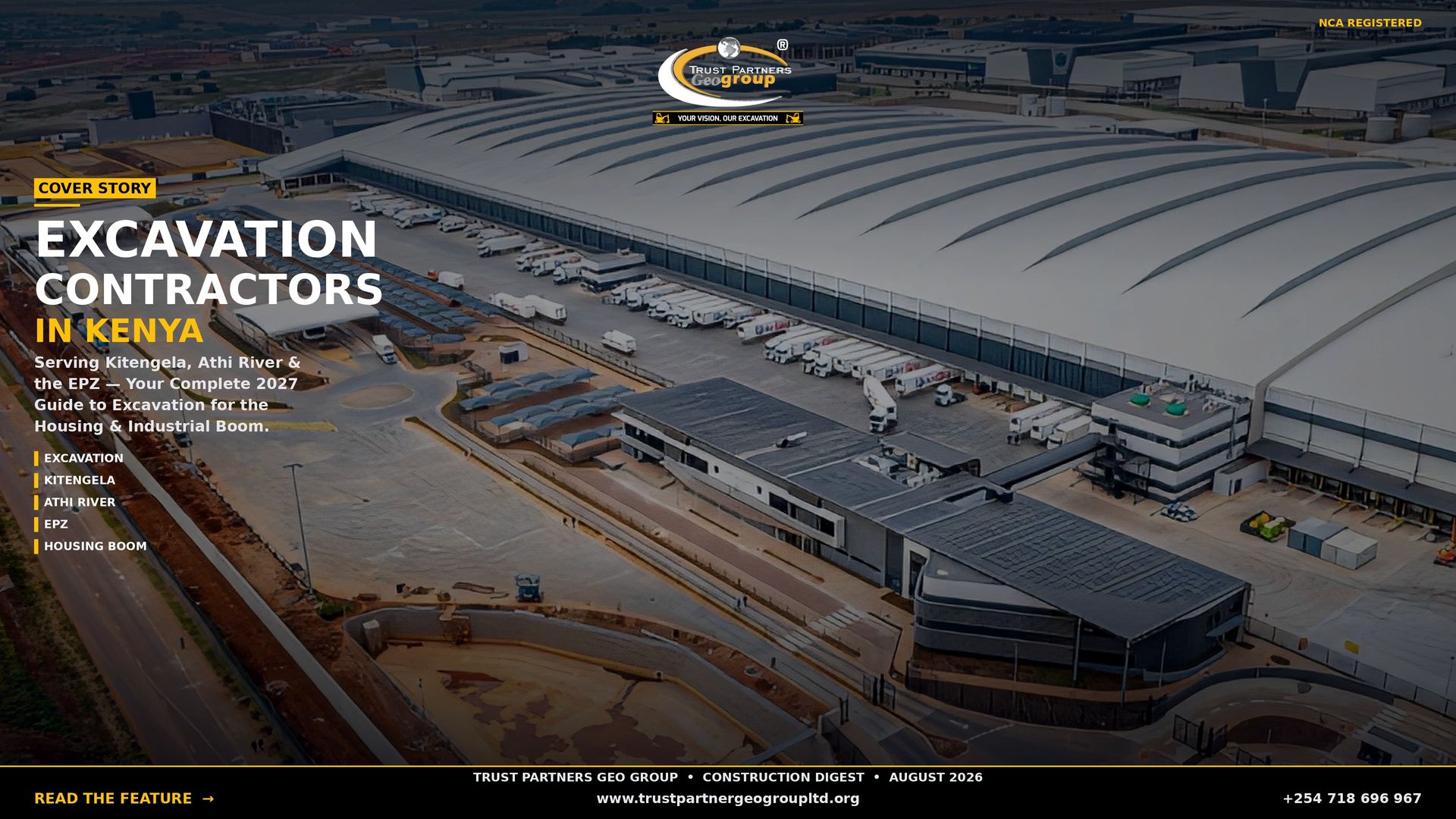
The EPZ and adjacent Mombasa Road frontage are Kenya's busiest industrial earthworks zone. Factory foundations, warehouse slabs, container yards and internal road networks require continuous excavation and grading. Many sites operate 24/7, demanding flexible equipment scheduling and night-shift capability.
Greatwall Gardens, Greenpark and Satellite Estates
These master-planned residential estates between Kitengela and Athi River feature hundreds of individual plots with uniform infrastructure. Excavation work is repetitive and high-volume — plot cutting, foundation trenches, soak pits and estate road subgrades. Trust Partners Geo-Group has completed earthworks on over 150 plots across these estates.
Athi River EPZ: Industrial Earthworks at Scale
The Athi River Export Processing Zone is unique in Kenya's excavation landscape. Unlike residential projects with variable schedules, EPZ factories operate on tight construction timelines tied to export orders and investor commitments. Key characteristics of EPZ earthworks:
- Large footprints: Factory buildings typically cover 2,000–10,000 m² with extensive parking, loading yards and utility compounds. Total site earthworks often exceed 20,000 m³.
- High-specification floors: Pharmaceutical, textile and food-processing factories require floor slabs with minimal settlement tolerance. Subgrade preparation involves deep stripping, replacement with engineered fill, proof-rolling and geotechnical testing.
- Utility intensity: EPZ sites require extensive underground utilities — high-capacity water, sewer, power and data corridors. Trench networks can exceed 2 km per site.
- Environmental compliance: EPZ developments require NEMA EIA clearance, effluent discharge permits and noise/vibration monitoring during construction.
- 24/7 operations: Many EPZ factories continue production during adjacent expansion works. Excavation must be sequenced to avoid disrupting active manufacturing.
Trust Partners Geo-Group has completed earthworks for textile mills, pharmaceutical plants, cold-storage facilities and logistics warehouses within the Athi River EPZ — all on programme and within NEMA compliance.
Permits and Compliance for Kajiado & Machakos Counties
Excavation projects in Kitengela and Athi River span two counties — Kajiado (Kitengela, Isinya) and Machakos (Athi River, Mavoko) — each with distinct permitting requirements:
- County building permits: Both Kajiado and Machakos counties require building permits before excavation begins. Applications must include site plans, excavation depth specifications, soil disposal plans and drainage designs. Processing takes 2–4 weeks.
- NEMA EIA: Projects exceeding 1 hectare, involving wetland disturbance, or located within 30 metres of the Athi River require NEMA environmental impact assessment clearance.
- Water Resources Authority (WRA): Dewatering discharge into the Athi River, seasonal streams or public drains requires a WRA permit. Discharge must meet turbidity standards — settlement ponds or silt fences are mandatory.
- NCA contractor registration: All structural excavation and foundation work must be carried out by NCA-registered contractors. Trust Partners Geo-Group holds NCA registration for NBO 1, NBO 2 and NBO 3 categories.
- Tree preservation orders: Both counties have tree protection regulations. Removal of indigenous trees requires county forester approval and compensatory planting.
Trust Partners Geo-Group Kitengela & Athi River Operations
Trust Partners Geo-Group maintains a dedicated southern corridor operations team with equipment stationed for 24-hour mobilisation to Kitengela, Athi River, Isinya and the greater Kajiado/Machakos region:
- Hyundai HX300SL 30-ton Excavators (4 units): Primary machines for bulk basement excavation, rock breaking and trenching. Equipped with hydraulic breaker, ripper and bucket attachments.
- Komatsu D65 Bulldozers (2 units): Site clearing, topsoil stripping, rough grading and cut-and-fill balancing.
- Shacman 30-ton Tippers (12 units): Spoil removal fleet for bulk earthworks. Licensed for disposal at Athi River quarries and reclamation sites.
- Sany Motor Grader (1 unit): Estate road profiling, subgrade preparation and final grading.
- Water Bowser 15,000 litres (2 units): Dust suppression on haul roads and soil moisture conditioning for compaction.
- Dewatering Pumps and Wellpoint Systems: Submersible and diesel trash pumps for basement dewatering during rainy seasons.
All operators are NITA-certified with site-specific safety inductions. Every project receives a dedicated site supervisor, daily progress reporting and photographic documentation.
Response time: Equipment mobilises from our Nairobi depot to Kitengela/Athi River within 4–6 hours. Emergency call-outs available 24/7.
Start Your Kitengela or Athi River Excavation Project Today
Trust Partners Geo-Group is the leading excavation contractor in Kenya's southern corridor. Free site assessment, itemised quote and rapid mobilisation.
Call +254 718 686 967 Email for QuoteFrequently Asked Questions
Why is Kitengela and Athi River Kenya's fastest-growing construction corridor?
Kitengela and Athi River have become Kenya's fastest-growing construction corridor due to four converging factors: (1) Affordable land prices 40–60% below Nairobi rates, attracting developers and homebuyers priced out of the capital. (2) The Athi River Export Processing Zone (EPZ), which hosts over 50 manufacturing and logistics firms requiring constant expansion, warehouse construction and infrastructure upgrades. (3) Improved transport links via Mombasa Road, the Nairobi Expressway and the planned Greater Nairobi Commuter Rail, reducing commute times to Nairobi CBD to under 45 minutes. (4) Satellite town zoning by Kiambu and Kajiado counties that encourages high-density residential, commercial and industrial development. This combination has created a construction boom that shows no signs of slowing through 2027 and beyond.
What excavation services are most in demand in Kitengela and Athi River?
The most in-demand excavation services in Kitengela and Athi River are: (1) Plot cutting and site clearing — converting bushland into build-ready plots for residential estates and commercial developments. (2) Basement excavation — multi-storey apartment buildings and EPZ factories require 2–3 level basements for parking and plant rooms. (3) Road and accessway earthworks — grading, murram placement and compaction for estate roads, EPZ internal roads and highway frontage. (4) Utility trenching — water, sewer, power and fibre-optic trenches for new estates and industrial parks. (5) Dam and water pan excavation — farms and residential estates excavate water pans for irrigation and domestic supply. (6) Bulk earthworks — cut-and-fill balancing for large-scale developments on sloped terrain. Trust Partners Geo-Group provides all these services with equipment stationed for rapid response in Kitengela and Athi River.
What soil conditions affect excavation in Kitengela and Athi River?
Kitengela and Athi River sit on a mix of black cotton soil, volcanic tuff and murram that creates specific excavation challenges: (1) Black cotton soil (expansive clay) dominates low-lying areas near Athi River — highly plastic, it swells when wet and shrinks when dry, causing foundation movement. Basement excavations in this soil require careful slope management and often need piling or raft foundations. (2) Murram and volcanic tuff in elevated areas provide excellent bearing capacity but contain hard rock lenses that slow excavation and increase breaker costs. (3) Seasonal water table fluctuation — the Athi River floodplain has a high water table during rainy seasons, requiring dewatering for deep excavations. (4) Loose surface soils on recently subdivided plots need stripping and replacement with compacted fill before foundation work. Trust Partners Geo-Group conducts site-specific geotechnical assessments and adjusts excavation methods accordingly.
How much does basement excavation cost in Kitengela and Athi River?
Basement excavation costs in Kitengela and Athi River range from KES 2,800–4,500 per cubic metre depending on soil type, depth, access and disposal distance. For a typical 3-level basement (8–10 metres deep) on a 1,000 m² plot, total excavation volume is 8,000–10,000 m³, costing KES 22–45 million all-in. Factors affecting price include: soil hardness (murram with rock lenses costs 30–50% more than soft soils), haul distance to disposal sites (Athi River quarries accept fill at KES 300–600 per truck), dewatering requirements during rainy seasons, and proximity to existing buildings requiring vibration control. Plot cutting and site clearing on undeveloped land costs KES 150–350 per square metre depending on bush density and rock content. Trust Partners Geo-Group provides itemised quotes with no hidden costs.
Do I need NEMA approval for excavation in Kitengela and Athi River?
Yes, most excavation projects in Kitengela and Athi River require NEMA environmental compliance. Requirements include: (1) NEMA EIA licence for projects exceeding 1 hectare or involving wetland disturbance, riverbank works or significant tree removal. (2) County building permits from Kajiado County (Kitengela) and Machakos County (Athi River) that specify excavation depth, soil disposal arrangements and drainage plans. (3) Water Resources Authority (WRA) permit if dewatering discharge enters the Athi River or seasonal streams. (4) NEMA dust control compliance — active dust suppression is mandatory on all sites generating visible dust, particularly along Mombasa Road where NEMA monitors air quality. Trust Partners Geo-Group coordinates NEMA submissions, county permit applications and WRA discharge permits as part of our turnkey excavation service.
How long does basement excavation take in Kitengela and Athi River?
Basement excavation timelines in Kitengela and Athi River depend on size, depth, soil conditions and weather. A typical 2-level basement (5–7 metres deep) on a 1,000 m² commercial plot takes 3–4 weeks including site clearing, bulk excavation, trimming and disposal. A 3-level basement (8–10 metres deep) takes 5–7 weeks. Delays from hard rock requiring hydraulic breaker work can add 1–2 weeks. Rainy season work (March–May, October–December) often requires dewatering and slope protection, extending timelines by 20–30%. EPZ factory foundations with large footprints (2,000+ m²) and extensive utility trenches take 8–12 weeks. Trust Partners Geo-Group provides detailed programmes with milestone dates before mobilisation.
Where does excavated soil from Kitengela and Athi River sites go?
Excavated soil from Kitengela and Athi River sites is disposed of at licensed quarries, borrow pits and reclamation sites within a 10–25 km radius. Common disposal options include: (1) Athi River quarries — active quarries accept fill material for reclamation at KES 300–600 per 20-ton tipper load. (2) Road construction projects — county road contractors often source fill from nearby excavation sites, reducing haul costs. (3) On-site cut-and-fill balance — sloped plots allow excavated material from basements to be used for site grading and backfill, eliminating disposal entirely. (4) Farm and ranch land levelling — agricultural properties in Isinya and Kajiado use surplus fill for terracing and dam construction. Trust Partners Geo-Group manages disposal logistics, including county permits for soil transport, weighbridge tickets and NEMA-compliant disposal certificates.
What equipment is used for excavation in Kitengela and Athi River?
Kitengela and Athi River excavation projects typically require: (1) 20–30 ton excavators for bulk basement excavation and rock breaking — Trust Partners Geo-Group deploys Hyundai, Komatsu and Sany machines with hydraulic breaker attachments. (2) Bulldozers for site clearing, topsoil stripping and rough grading. (3) Motor graders for estate road profiling and subgrade preparation. (4) Tippers and dump trucks (20–30 ton) for spoil removal — fleet sizes range from 5 trucks for small plots to 25+ for bulk earthworks. (5) Compactors (vibratory rollers and plate compactors) for fill placement and subgrade compaction. (6) Water bowsers for dust suppression and moisture conditioning. (7) Dewatering pumps for basement excavations below the water table. All equipment is available on wet hire with certified operators from Trust Partners Geo-Group's Nairobi depot, mobilised to Kitengela and Athi River within 24 hours.
Related Resources
Planning a Project in Kitengela or Athi River?
Contact Trust Partners Geo-Group at +254 718 686 967 for a free site assessment and itemised excavation quote. Serving Kitengela, Athi River, Isinya, Mavoko and all 47 counties.
Call +254 718 686 967 Request QuoteExcavation Contractors in Kitengela and Athi River: Serving the EPZ and Housing Boom [2027]
Kenya's Fastest-Growing Construction Corridor — Basement Excavation, Earthworks & Site Preparation
Twenty kilometres south of Nairobi, Kitengela and Athi River have become the engine room of Kenya's construction boom. Affordable land, EPZ manufacturing expansion, improved transport links and satellite-town zoning have created a perfect storm of demand for excavation, earthworks and basement construction. This guide covers everything developers, contractors and landowners need to know about excavation in Kitengela and Athi River — from soil conditions and hire rates to EPZ compliance and neighbourhood-specific earthworks.
NCA-registered excavation and heavy equipment hire contractor with 15+ years operating across Kenya. We maintain a dedicated southern corridor fleet and crew for rapid-response excavation in Kitengela, Athi River and the greater Nairobi southern corridor.
Why Kitengela and Athi River Are Kenya's Hottest Construction Corridor
Kitengela and Athi River are no longer sleepy outposts — they are Kenya's fastest-growing urban frontier. Four forces are driving this transformation:
- Land affordability: Plot prices in Kitengela are 40–60% below equivalent Nairobi neighbourhoods. A 50×100 ft plot in Kitengela costs KES 2–4 million versus KES 8–15 million in Karen or Lavington. This price gap has attracted mass housing developers, individual homebuyers and speculative investors in equal measure.
- Athi River EPZ expansion: The Export Processing Zone hosts over 50 manufacturing, logistics and agro-processing firms including textile mills, pharmaceutical plants and cold-storage facilities. Constant factory expansion, warehouse construction and infrastructure upgrades drive year-round earthworks demand.
- Transport connectivity: The Nairobi Expressway, upgraded Mombasa Road and the planned Greater Nairobi Commuter Rail have reduced travel time to Nairobi CBD to under 45 minutes. Kitengela is now a viable commuter town for middle-income professionals priced out of Nairobi.
- County zoning encouragement: Both Kajiado County (Kitengela) and Machakos County (Athi River) have adopted pro-development zoning that permits high-density residential, mixed-use and light industrial construction — a stark contrast to Nairobi's restrictive building codes.
The result is a construction pipeline that includes over 200 active residential estates, 30+ EPZ factory expansions, 15 shopping centres and 8 school complexes — all requiring excavation, earthworks and foundation preparation.
Excavation Services in Demand
Plot Cutting and Site Clearing
The first step on any Kitengela or Athi River plot is converting bushland into a build-ready platform. This involves bush clearing, topsoil stripping, tree removal (where permitted) and rough grading. On sloped plots, cut-and-fill earthworks balance the site to achieve a level building platform. Trust Partners Geo-Group clears 500–2,000 m² plots in 1–3 days with a 20-ton excavator and bulldozer team.
Basement Excavation
Multi-storey apartment buildings, EPZ factories and commercial developments require basements for parking, plant rooms and storage. Kitengela's black cotton soil in low-lying areas and murram-tuff mix in elevated zones create varying excavation conditions. Typical basement depths range from 3 metres (single-level parking) to 10 metres (3-level basement with mechanical plant). Trust Partners Geo-Group has excavated basements for 12-storey towers, EPZ pharmaceutical plants and shopping mall podiums in the corridor.
Road and Accessway Earthworks
Every estate, factory and commercial park needs internal roads, drainage channels and parking areas. This involves cut-and-fill balancing, murram placement, compaction to 95% Mod AASHTO density and culvert installation. Estate road widths range from 6 metres (residential) to 12 metres (commercial/EPZ access).
Utility Trenching
Water, sewer, power and fibre-optic infrastructure requires trench excavation 1–3 metres deep across entire developments. In Athi River's EPZ, utility corridors are pre-planned with dedicated trench routes. In residential estates, trenching follows road alignments and plot boundaries.
Water Pan and Dam Excavation
Farms and residential estates across Kitengela and Athi River excavate water pans for irrigation, livestock and domestic supply. Sizes range from 500 m³ (small farm ponds) to 20,000 m³ (estate reservoirs). Trust Partners Geo-Group provides cut-and-fill design, liner installation and spillway construction.
Soil Conditions and Excavation Challenges
| Soil Type | Location | Characteristics | Excavation Impact |
|---|---|---|---|
| Black cotton soil | Low-lying areas near Athi River | Highly plastic expansive clay; swells when wet, shrinks when dry | Requires careful slope angles; may need piling or raft foundations; dewatering essential |
| Murram / volcanic tuff | Elevated Kitengela plateau | Good bearing capacity; contains hard rock lenses | Excavation slower; breaker attachment needed; excellent for foundations |
| Loose surface soils | Recently subdivided plots | Uncompacted fill and topsoil; variable density | Must be stripped and replaced with compacted engineered fill |
| Seasonal water table | Athi River floodplain | High groundwater during rains; perched water lenses | Dewatering pumps required for deep excavations; discharge permits needed |
| Rock outcrops | Isinya and elevated ridges | Hard phonolite and basalt | Drilling and blasting or hydraulic breaker required; increases cost 30–50% |
Excavation Rates in Kitengela and Athi River 2027
| Service | Rate (KES) | Notes |
|---|---|---|
| Plot cutting and clearing (per m²) | 150 – 350 | Depends on bush density, rock content and plot size |
| Topsoil stripping (per m²) | 80 – 150 | Includes haul to stockpile or disposal |
| Bulk excavation — soft soil (per m³) | 800 – 1,200 | Standard soil, no rock; includes loading and haul |
| Bulk excavation — murram with rock (per m³) | 1,400 – 2,200 | Includes hydraulic breaker time and slower production |
| Basement excavation — soft soil (per m³) | 1,200 – 1,800 | Trimmed excavation with shoring support |
| Basement excavation — hard ground (per m³) | 2,000 – 3,500 | Rock breaking, dewatering, tight access |
| Cut-and-fill balancing (per m³) | 600 – 1,000 | On-site reuse of excavated material |
| Road subgrade preparation (per m²) | 450 – 750 | Cut to level, compacted murram sub-base |
| Utility trenching (per metre) | 800 – 1,500 | Includes backfill and compaction |
| Water pan excavation (per m³) | 500 – 900 | Large volume bulk earthworks |
| Spoil disposal (per 20-ton truck) | 3,000 – 6,000 | Haul to licensed quarry or reclamation site |
| 20-ton excavator wet hire (daily) | 35,000 – 50,000 | Operator, fuel, maintenance included |
| Bulldozer wet hire (daily) | 28,000 – 40,000 | Operator, fuel, maintenance included |
| 30-ton tipper wet hire (daily) | 18,000 – 28,000 | Driver, fuel, maintenance included |
Key Neighbourhoods and Development Zones
Kitengela Town Centre and Environs
The original Kitengela town centre and surrounding areas (Milimani, Acacia, Yukos) are seeing dense mixed-use development — apartment blocks over retail podiums, office parks and educational institutions. Basement excavations here are typically 2–3 levels deep on compact ¼-acre plots. Access is constrained by narrow roads, requiring careful logistics planning.
Isinya and Kajiado Road Corridor
West of Kitengela along Kajiado Road, large-scale residential estates and gated communities dominate. Plot sizes are generous (½ to 2 acres) with sloped terrain requiring extensive cut-and-fill. Rock outcrops are common, increasing breaker costs. Water pan excavation is popular for farm-estate developments.
Athi River EPZ and Mombasa Road Frontage
The EPZ and adjacent Mombasa Road frontage are Kenya's busiest industrial earthworks zone. Factory foundations, warehouse slabs, container yards and internal road networks require continuous excavation and grading. Many sites operate 24/7, demanding flexible equipment scheduling and night-shift capability.
Greatwall Gardens, Greenpark and Satellite Estates
These master-planned residential estates between Kitengela and Athi River feature hundreds of individual plots with uniform infrastructure. Excavation work is repetitive and high-volume — plot cutting, foundation trenches, soak pits and estate road subgrades. Trust Partners Geo-Group has completed earthworks on over 150 plots across these estates.
Athi River EPZ: Industrial Earthworks at Scale
The Athi River Export Processing Zone is unique in Kenya's excavation landscape. Unlike residential projects with variable schedules, EPZ factories operate on tight construction timelines tied to export orders and investor commitments. Key characteristics of EPZ earthworks:
- Large footprints: Factory buildings typically cover 2,000–10,000 m² with extensive parking, loading yards and utility compounds. Total site earthworks often exceed 20,000 m³.
- High-specification floors: Pharmaceutical, textile and food-processing factories require floor slabs with minimal settlement tolerance. Subgrade preparation involves deep stripping, replacement with engineered fill, proof-rolling and geotechnical testing.
- Utility intensity: EPZ sites require extensive underground utilities — high-capacity water, sewer, power and data corridors. Trench networks can exceed 2 km per site.
- Environmental compliance: EPZ developments require NEMA EIA clearance, effluent discharge permits and noise/vibration monitoring during construction.
- 24/7 operations: Many EPZ factories continue production during adjacent expansion works. Excavation must be sequenced to avoid disrupting active manufacturing.
Trust Partners Geo-Group has completed earthworks for textile mills, pharmaceutical plants, cold-storage facilities and logistics warehouses within the Athi River EPZ — all on programme and within NEMA compliance.
Permits and Compliance for Kajiado & Machakos Counties
Excavation projects in Kitengela and Athi River span two counties — Kajiado (Kitengela, Isinya) and Machakos (Athi River, Mavoko) — each with distinct permitting requirements:
- County building permits: Both Kajiado and Machakos counties require building permits before excavation begins. Applications must include site plans, excavation depth specifications, soil disposal plans and drainage designs. Processing takes 2–4 weeks.
- NEMA EIA: Projects exceeding 1 hectare, involving wetland disturbance, or located within 30 metres of the Athi River require NEMA environmental impact assessment clearance.
- Water Resources Authority (WRA): Dewatering discharge into the Athi River, seasonal streams or public drains requires a WRA permit. Discharge must meet turbidity standards — settlement ponds or silt fences are mandatory.
- NCA contractor registration: All structural excavation and foundation work must be carried out by NCA-registered contractors. Trust Partners Geo-Group holds NCA registration for NBO 1, NBO 2 and NBO 3 categories.
- Tree preservation orders: Both counties have tree protection regulations. Removal of indigenous trees requires county forester approval and compensatory planting.
Trust Partners Geo-Group Kitengela & Athi River Operations
Trust Partners Geo-Group maintains a dedicated southern corridor operations team with equipment stationed for 24-hour mobilisation to Kitengela, Athi River, Isinya and the greater Kajiado/Machakos region:
- Hyundai HX300SL 30-ton Excavators (4 units): Primary machines for bulk basement excavation, rock breaking and trenching. Equipped with hydraulic breaker, ripper and bucket attachments.
- Komatsu D65 Bulldozers (2 units): Site clearing, topsoil stripping, rough grading and cut-and-fill balancing.
- Shacman 30-ton Tippers (12 units): Spoil removal fleet for bulk earthworks. Licensed for disposal at Athi River quarries and reclamation sites.
- Sany Motor Grader (1 unit): Estate road profiling, subgrade preparation and final grading.
- Water Bowser 15,000 litres (2 units): Dust suppression on haul roads and soil moisture conditioning for compaction.
- Dewatering Pumps and Wellpoint Systems: Submersible and diesel trash pumps for basement dewatering during rainy seasons.
All operators are NITA-certified with site-specific safety inductions. Every project receives a dedicated site supervisor, daily progress reporting and photographic documentation.
Response time: Equipment mobilises from our Nairobi depot to Kitengela/Athi River within 4–6 hours. Emergency call-outs available 24/7.
Start Your Kitengela or Athi River Excavation Project Today
Trust Partners Geo-Group is the leading excavation contractor in Kenya's southern corridor. Free site assessment, itemised quote and rapid mobilisation.
Call +254 718 686 967 Email for QuoteFrequently Asked Questions
Why is Kitengela and Athi River Kenya's fastest-growing construction corridor?
Kitengela and Athi River have become Kenya's fastest-growing construction corridor due to four converging factors: (1) Affordable land prices 40–60% below Nairobi rates, attracting developers and homebuyers priced out of the capital. (2) The Athi River Export Processing Zone (EPZ), which hosts over 50 manufacturing and logistics firms requiring constant expansion, warehouse construction and infrastructure upgrades. (3) Improved transport links via Mombasa Road, the Nairobi Expressway and the planned Greater Nairobi Commuter Rail, reducing commute times to Nairobi CBD to under 45 minutes. (4) Satellite town zoning by Kiambu and Kajiado counties that encourages high-density residential, commercial and industrial development. This combination has created a construction boom that shows no signs of slowing through 2027 and beyond.
What excavation services are most in demand in Kitengela and Athi River?
The most in-demand excavation services in Kitengela and Athi River are: (1) Plot cutting and site clearing — converting bushland into build-ready plots for residential estates and commercial developments. (2) Basement excavation — multi-storey apartment buildings and EPZ factories require 2–3 level basements for parking and plant rooms. (3) Road and accessway earthworks — grading, murram placement and compaction for estate roads, EPZ internal roads and highway frontage. (4) Utility trenching — water, sewer, power and fibre-optic trenches for new estates and industrial parks. (5) Dam and water pan excavation — farms and residential estates excavate water pans for irrigation and domestic supply. (6) Bulk earthworks — cut-and-fill balancing for large-scale developments on sloped terrain. Trust Partners Geo-Group provides all these services with equipment stationed for rapid response in Kitengela and Athi River.
What soil conditions affect excavation in Kitengela and Athi River?
Kitengela and Athi River sit on a mix of black cotton soil, volcanic tuff and murram that creates specific excavation challenges: (1) Black cotton soil (expansive clay) dominates low-lying areas near Athi River — highly plastic, it swells when wet and shrinks when dry, causing foundation movement. Basement excavations in this soil require careful slope management and often need piling or raft foundations. (2) Murram and volcanic tuff in elevated areas provide excellent bearing capacity but contain hard rock lenses that slow excavation and increase breaker costs. (3) Seasonal water table fluctuation — the Athi River floodplain has a high water table during rainy seasons, requiring dewatering for deep excavations. (4) Loose surface soils on recently subdivided plots need stripping and replacement with compacted fill before foundation work. Trust Partners Geo-Group conducts site-specific geotechnical assessments and adjusts excavation methods accordingly.
How much does basement excavation cost in Kitengela and Athi River?
Basement excavation costs in Kitengela and Athi River range from KES 2,800–4,500 per cubic metre depending on soil type, depth, access and disposal distance. For a typical 3-level basement (8–10 metres deep) on a 1,000 m² plot, total excavation volume is 8,000–10,000 m³, costing KES 22–45 million all-in. Factors affecting price include: soil hardness (murram with rock lenses costs 30–50% more than soft soils), haul distance to disposal sites (Athi River quarries accept fill at KES 300–600 per truck), dewatering requirements during rainy seasons, and proximity to existing buildings requiring vibration control. Plot cutting and site clearing on undeveloped land costs KES 150–350 per square metre depending on bush density and rock content. Trust Partners Geo-Group provides itemised quotes with no hidden costs.
Do I need NEMA approval for excavation in Kitengela and Athi River?
Yes, most excavation projects in Kitengela and Athi River require NEMA environmental compliance. Requirements include: (1) NEMA EIA licence for projects exceeding 1 hectare or involving wetland disturbance, riverbank works or significant tree removal. (2) County building permits from Kajiado County (Kitengela) and Machakos County (Athi River) that specify excavation depth, soil disposal arrangements and drainage plans. (3) Water Resources Authority (WRA) permit if dewatering discharge enters the Athi River or seasonal streams. (4) NEMA dust control compliance — active dust suppression is mandatory on all sites generating visible dust, particularly along Mombasa Road where NEMA monitors air quality. Trust Partners Geo-Group coordinates NEMA submissions, county permit applications and WRA discharge permits as part of our turnkey excavation service.
How long does basement excavation take in Kitengela and Athi River?
Basement excavation timelines in Kitengela and Athi River depend on size, depth, soil conditions and weather. A typical 2-level basement (5–7 metres deep) on a 1,000 m² commercial plot takes 3–4 weeks including site clearing, bulk excavation, trimming and disposal. A 3-level basement (8–10 metres deep) takes 5–7 weeks. Delays from hard rock requiring hydraulic breaker work can add 1–2 weeks. Rainy season work (March–May, October–December) often requires dewatering and slope protection, extending timelines by 20–30%. EPZ factory foundations with large footprints (2,000+ m²) and extensive utility trenches take 8–12 weeks. Trust Partners Geo-Group provides detailed programmes with milestone dates before mobilisation.
Where does excavated soil from Kitengela and Athi River sites go?
Excavated soil from Kitengela and Athi River sites is disposed of at licensed quarries, borrow pits and reclamation sites within a 10–25 km radius. Common disposal options include: (1) Athi River quarries — active quarries accept fill material for reclamation at KES 300–600 per 20-ton tipper load. (2) Road construction projects — county road contractors often source fill from nearby excavation sites, reducing haul costs. (3) On-site cut-and-fill balance — sloped plots allow excavated material from basements to be used for site grading and backfill, eliminating disposal entirely. (4) Farm and ranch land levelling — agricultural properties in Isinya and Kajiado use surplus fill for terracing and dam construction. Trust Partners Geo-Group manages disposal logistics, including county permits for soil transport, weighbridge tickets and NEMA-compliant disposal certificates.
What equipment is used for excavation in Kitengela and Athi River?
Kitengela and Athi River excavation projects typically require: (1) 20–30 ton excavators for bulk basement excavation and rock breaking — Trust Partners Geo-Group deploys Hyundai, Komatsu and Sany machines with hydraulic breaker attachments. (2) Bulldozers for site clearing, topsoil stripping and rough grading. (3) Motor graders for estate road profiling and subgrade preparation. (4) Tippers and dump trucks (20–30 ton) for spoil removal — fleet sizes range from 5 trucks for small plots to 25+ for bulk earthworks. (5) Compactors (vibratory rollers and plate compactors) for fill placement and subgrade compaction. (6) Water bowsers for dust suppression and moisture conditioning. (7) Dewatering pumps for basement excavations below the water table. All equipment is available on wet hire with certified operators from Trust Partners Geo-Group's Nairobi depot, mobilised to Kitengela and Athi River within 24 hours.
Related Resources
Planning a Project in Kitengela or Athi River?
Contact Trust Partners Geo-Group at +254 718 686 967 for a free site assessment and itemised excavation quote. Serving Kitengela, Athi River, Isinya, Mavoko and all 47 counties.
Call +254 718 686 967 Request Quote