
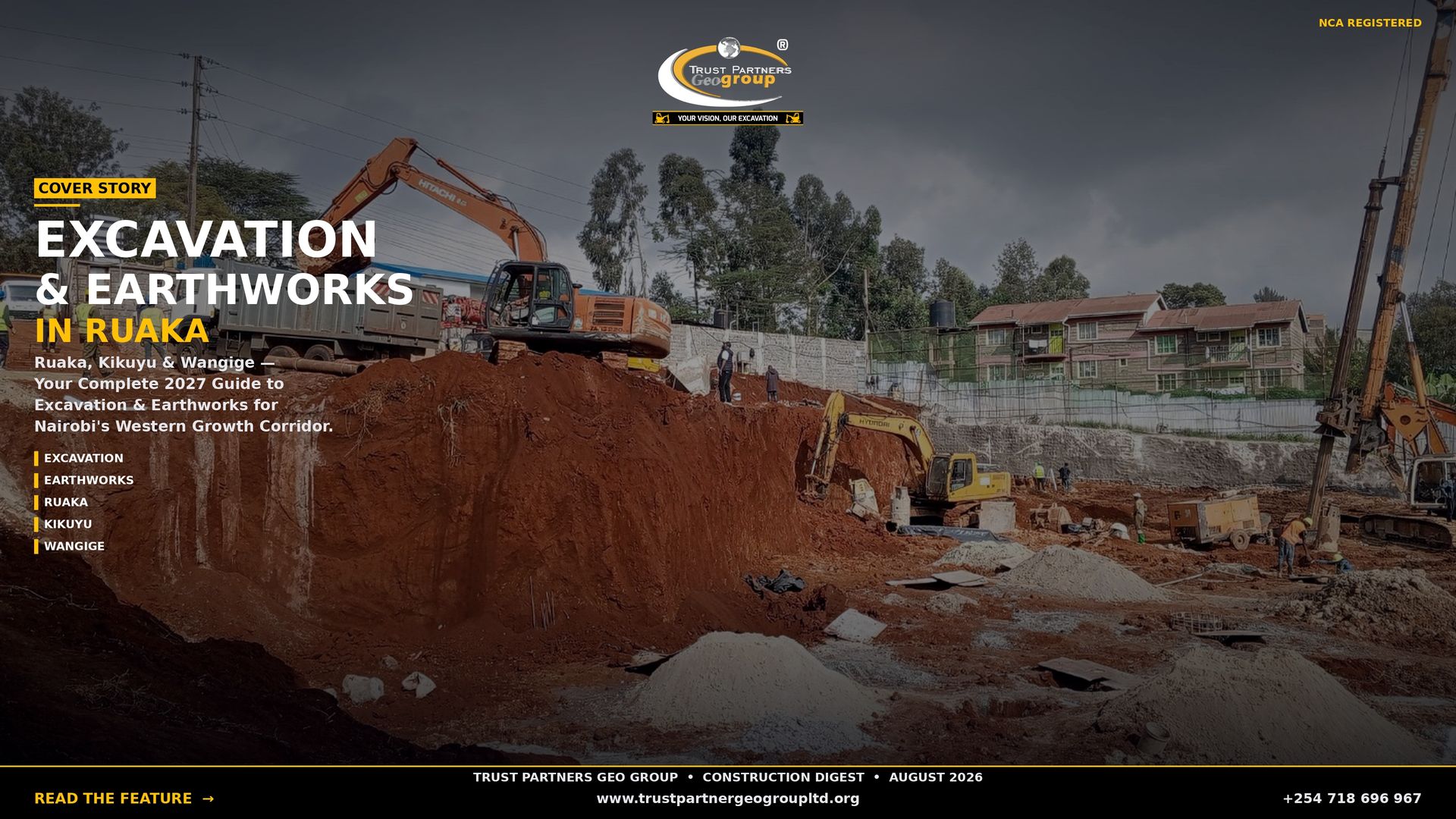
Excavation and Earthworks in Ruaka, Kikuyu and Wangige: Nairobi's Western Growth Corridor [2027]
Basement Excavation, Hillside Earthworks & Site Preparation for Nairobi's Fastest-Growing Western Towns
West of Nairobi, a new city is rising. Ruaka, Kikuyu and Wangige — once quiet farming communities — have become the capital's most dynamic construction frontier. From Ruaka's high-rise apartment towers near Two Rivers Mall to Kikuyu's hillside gated communities and Wangige's expanding residential estates, the western corridor is reshaping Nairobi's urban footprint. This guide covers everything developers, contractors and landowners need to know about excavation and earthworks in Ruaka, Kikuyu and Wangige — from red volcanic soil and steep slopes to hire rates and county compliance.

NCA-registered excavation and heavy equipment hire contractor with 15+ years operating across Kenya. We maintain a dedicated western corridor fleet for rapid-response excavation in Ruaka, Kikuyu, Wangige and the greater Nairobi western suburbs.
Why Ruaka, Kikuyu and Wangige Are Booming
The western corridor's growth is driven by five interconnected forces:
- Proximity to Nairobi CBD: Wangige is 12 km west, Ruaka is 15 km northwest, and Kikuyu is 18 km west — all within 30–45 minutes via Waiyaki Way, Red Hill Road and the Southern Bypass. This commute time is competitive with Nairobi's eastern and northern suburbs.
- Major infrastructure investment: The Nairobi Western Bypass, Ruaka Road upgrades and the Two Rivers Mall precinct have transformed Ruaka into a commercial and residential hub. Kikuyu's road network has expanded to serve new estates and university campuses.
- Affordable land: A 50×100 ft plot in Wangige costs KES 3–6 million versus KES 15–25 million in Kilimani or Lavington. Kikuyu's former coffee farms sell at KES 5–10 million per acre for subdivision — a fraction of Karen's KES 30–50 million per acre.
- Institutional and educational demand: Kikuyu hosts major university campuses, research institutions and hospitals driving staff housing, student accommodation and medical facility construction.
- Agricultural land conversion: Former coffee, tea and dairy farms across Kikuyu and Wangige are being subdivided into residential plots at an unprecedented rate — creating hundreds of new construction sites annually.
Excavation Services in the Western Corridor
Basement Excavation
Ruaka's high-rise apartments and Kikuyu's multi-storey student housing require 2–3 level basements for parking and services. Wangige's mixed residential-commercial developments typically need 1–2 level basements. The western corridor's red volcanic soil provides excellent bearing capacity but can contain hard tuff lenses requiring breaker work.
Hillside Cut-and-Fill and Benching
Kikuyu's undulating terrain and Wangige's sloped plots require extensive earthworks to create level building platforms. This involves benching (cutting stepped terraces into slopes), constructing retaining walls, and managing surface water runoff. Cut-and-fill volumes on hillside plots can exceed 5,000 m³ per acre — significantly more than flat sites.
Plot Cutting and Site Clearing
Hundreds of subdivided farm plots in Kikuyu and Wangige need conversion from agricultural land to construction-ready platforms. Work includes bush clearing, stump removal, topsoil stripping and rough grading. On former coffee farms, mature root systems and volcanic rock near the surface slow clearing operations.
Road and Drainage Earthworks
New estates require internal roads, stormwater channels and culverts. Kikuyu's high rainfall (1,200+ mm annually) demands robust drainage design — open channels, subsurface drains and retention ponds. Road subgrades must handle heavy clay moisture content during rainy seasons.
Rock Excavation
Kikuyu's volcanic geology includes hard phonolite, tuff and agglomerate that resists standard bucket excavation. Hydraulic breaker attachments, controlled blasting (where permitted) and rock splitting are required for foundation pits and road cuttings in rocky areas.
Soil Conditions and Hillside Challenges
| Soil / Terrain Type | Location | Characteristics | Excavation Impact |
|---|---|---|---|
| Red volcanic soil | Kikuyu highlands, upper Ruaka | Well-drained, high iron content, good bearing capacity (150–250 kPa) | Excellent for foundations; may contain hard tuff lenses requiring breakers |
| Black cotton soil | Valleys, lower Wangige | Expansive clay; high plasticity; swells when wet | Requires raft or pile foundations; careful drainage design; slope protection |
| Murram / laterite | Wangige slopes, lower Kikuyu | Iron-rich hardpan; cemented gravel layer | Hard to excavate; breaker often needed; excellent subgrade when broken |
| Steep slopes (15–35°) | Kikuyu escarpment, Wangige ridges | Erosion-prone; unstable when saturated | Requires benching, retaining walls, surface drainage and erosion control |
| Seasonal springs | Valley bottoms, slope toes | Perched water tables; emerge during rains | Dewatering needed for deep excavations; spring capture for drainage |
| Volcanic rock (tuff, phonolite) | Upper Kikuyu, Ruaka rock outcrops | Hard, fractured igneous rock | Hydraulic breaker or controlled blasting; 40–80% cost premium |
Excavation Rates in Ruaka, Kikuyu and Wangige 2027
| Service | Rate (KES) | Notes |
|---|---|---|
| Plot cutting and clearing (per m²) | 180 – 400 | Higher for rocky Kikuyu plots with stump removal |
| Topsoil stripping (per m²) | 90 – 160 | Includes haul to stockpile |
| Bulk excavation — red soil (per m³) | 900 – 1,400 | Soft to medium soil; standard bucket work |
| Bulk excavation — rock/tuff (per m³) | 1,800 – 3,000 | Includes hydraulic breaker or splitting |
| Basement excavation — red soil (per m³) | 1,400 – 2,200 | Trimmed excavation; shoring if adjacent buildings |
| Basement excavation — rock (per m³) | 2,500 – 4,500 | Hard tuff/phonolite; breaker or blasting |
| Hillside benching (per m³) | 1,200 – 2,000 | Cut-and-fill with compaction; includes drainage |
| Retaining wall foundation (per metre) | 3,500 – 6,500 | Trench excavation for concrete/masonry walls |
| Road subgrade (per m²) | 500 – 850 | Cut to level, murram sub-base, compaction |
| Utility trenching (per metre) | 900 – 1,600 | Includes backfill and compaction |
| Spoil disposal (per 20-ton truck) | 4,000 – 8,000 | Haul to Kikuyu/Limuru quarries |
| 20-ton excavator wet hire (daily) | 35,000 – 50,000 | Operator, fuel, maintenance included |
| Bulldozer wet hire (daily) | 28,000 – 40,000 | Operator, fuel, maintenance included |
| 20-ton tipper wet hire (daily) | 18,000 – 28,000 | Driver, fuel, maintenance included |
Key Neighbourhoods and Development Zones
Ruaka: The New CBD
Ruaka has emerged as Nairobi's most dynamic satellite town. Anchored by Two Rivers Mall, the neighbourhood features high-rise apartments, office parks, hotels and international schools. Basement excavations here are deep (2–3 levels) on compact plots with tight access. The Northern Bypass and Ruaka Road upgrades have triggered a wave of commercial development along the transport corridors.
Kikuyu: Hillside Living and Student Housing
Kikuyu's appeal lies in its elevation (1,800–2,000 metres), cooler climate and red soil views. New developments cluster along the Kikuyu–Nairobi Road, Waiyaki Way frontage and the Southern Bypass interchanges. Student housing near university campuses drives multi-storey apartment construction. Hillside plots require extensive benching, retaining walls and access road earthworks.
Wangige: Affordable Suburbia
Wangige offers the most affordable entry point into Nairobi's western corridor. Former farmland is being subdivided into 40×80 and 50×100 ft plots for mass housing. The terrain is gentler than Kikuyu but still sloped in areas. Black cotton soil in valley bottoms and murram on ridges create mixed excavation conditions. The Wangige–Uthiru Road upgrade has improved access significantly.
Lower Kabete, Uthiru and Kinoo
These transitional zones between Wangige and Nairobi proper are seeing infill development — replacing single-family homes with apartment blocks and mixed-use buildings. Excavation work is constrained by narrow access roads, proximity to existing structures and limited spoil storage space.
Hillside Construction: Benching, Retaining Walls and Slope Stability
Kikuyu's hilly terrain presents unique engineering challenges that flat-site contractors often underestimate:
- Benching: Steep slopes are cut into stepped terraces (typically 1.5–2.0 metres high with 1:1 to 2:1 horizontal slopes) to create level building platforms. Each bench requires cut-and-fill balancing, compaction and surface drainage.
- Retaining walls: Where benching is insufficient, retaining walls (gravity, cantilever or anchored) hold back soil and create usable space. Foundation trenches for retaining walls require precise excavation to design levels — often in rock.
- Surface drainage: Kikuyu's 1,200+ mm annual rainfall concentrates runoff on slopes. Excavation must include interceptor drains at bench crests, downpipes between benches and discharge channels at slope toes.
- Erosion control: Exposed soil during construction is highly erodible. Silt fences, hay bales and sediment traps are mandatory until permanent drainage and landscaping are established.
- Access roads: Hillside developments require switchback roads or steep straight grades with concrete surfacing. Road earthworks often exceed building excavation volumes on Kikuyu sites.
Trust Partners Geo-Group has completed hillside excavation for over 40 projects in Kikuyu — from single-home benching to 50-unit estate cut-and-fill earthworks exceeding 30,000 m³.
Permits for Kiambu and Nairobi Counties
The western corridor spans two counties with different requirements:
- Kiambu County (Kikuyu, Wangige, Uthiru, Kinoo): Building permits require site plans, excavation depth specifications, soil disposal plans, drainage designs and slope stability assessments for hillside plots. Processing takes 2–4 weeks. Kiambu has strict tree preservation rules — indigenous tree removal requires county forester approval.
- Nairobi County (Ruaka, parts of Lower Kabete): Nairobi's permitting process is more complex, requiring NEMA EIA for projects over 0.5 hectares, Nairobi City Water and Sewerage Company (NCWSC) approval for sewer connections, and Kenya Power clearance for electrical infrastructure.
- NEMA EIA: Required for projects over 1 hectare, hillside development on slopes over 15 degrees, or work near the Nairobi River tributaries (including the Ruaka River and Kikuyu streams).
- WRA permits: Dewatering discharge into streams or storm drains requires Water Resources Authority approval. Kikuyu's seasonal springs and streams are protected watercourses.
- NCA registration: All structural excavation must be carried out by NCA-registered contractors. Trust Partners Geo-Group holds NCA registration for all building categories.
Trust Partners Geo-Group Western Corridor Fleet
Trust Partners Geo-Group maintains dedicated equipment for western corridor projects, mobilised from our Nairobi depot to Ruaka, Kikuyu and Wangige within 4–6 hours:
- Hyundai HX300SL 30-ton Excavators (4 units): Primary machines for bulk basement excavation, rock breaking and trenching. Equipped with hydraulic breaker, ripper and tilt-bucket attachments for hillside work.
- Komatsu D65 Bulldozers (2 units): Site clearing, rough grading, cut-and-fill balancing and bench cutting on Kikuyu slopes.
- Shacman 30-ton Tippers (10 units): Spoil removal fleet. Licensed for disposal at Kikuyu and Limuru quarries.
- Sany Motor Grader (1 unit): Estate road profiling, subgrade preparation and drainage channel grading.
- Water Bowser 15,000 litres (2 units): Dust suppression on Waiyaki Way and Red Hill Road frontage; soil moisture conditioning.
- Compaction Equipment: Vibratory rollers and plate compactors for subgrade and fill compaction to 95% Mod AASHTO.
- Mini-Excavators (5-ton): Restricted-access work on narrow Kikuyu farm roads and tight Ruaka plots.
All operators are NITA-certified with western corridor site experience. Projects receive dedicated supervisors, daily progress reports and photographic documentation.
Start Your Ruaka, Kikuyu or Wangige Project Today
Trust Partners Geo-Group is the leading excavation contractor in Nairobi's western corridor. Free site assessment, itemised quote and rapid mobilisation.
Call +254 718 686 967 Email for QuoteFrequently Asked Questions
Why are Ruaka, Kikuyu and Wangige growing so fast?
Ruaka, Kikuyu and Wangige are Nairobi's fastest-growing western corridor due to: (1) Proximity to Nairobi CBD — Wangige is 12 km west, Ruaka is 15 km northwest, and Kikuyu is 18 km west, all within 30–45 minutes via Waiyaki Way, Red Hill Road and the Southern Bypass. (2) Major infrastructure investment — the Nairobi Western Bypass, Ruaka Road upgrades and the Two Rivers Mall precinct have transformed Ruaka into a commercial hub. (3) Affordable land relative to Karen, Lavington and Kilimani — 50×100 ft plots in Wangige cost KES 3–6 million versus KES 15–25 million in Kilimani. (4) University and institutional presence — Kikuyu hosts major campuses and research institutions driving staff housing and student accommodation demand. (5) Agricultural transition — former coffee and tea farms in Kikuyu are being subdivided into residential plots, creating a wave of development.
What excavation services are needed in Ruaka, Kikuyu and Wangige?
The western corridor demands: (1) Basement excavation — Ruaka's high-rise apartments and Kikuyu's multi-storey student housing require 2–3 level basements for parking. (2) Hillside cut-and-fill — Kikuyu's sloped terrain requires extensive benching, retaining walls and terracing for road access and building platforms. (3) Plot cutting and clearing — hundreds of subdivided farm plots in Kikuyu and Wangige need bush clearing, topsoil stripping and grading. (4) Road and drainage earthworks — estate roads, stormwater channels and culverts for new developments on former agricultural land. (5) Rock excavation — Kikuyu's volcanic geology includes hard phonolite and tuff requiring breaker attachments. (6) Water pan and tank excavation — farms and estates excavate storage for irrigation and domestic supply. Trust Partners Geo-Group provides all these services with equipment mobilised from our Nairobi depot.
What soil conditions affect excavation in Ruaka, Kikuyu and Wangige?
The western corridor has diverse geology: (1) Red volcanic soil (Kikuyu highlands) — well-drained, high bearing capacity, excellent for foundations but can be rocky with hard tuff lenses. (2) Black cotton soil (valleys and lowlands) — expansive clay that swells and shrinks, requiring careful foundation design and drainage. (3) Murram and laterite (Wangige and lower slopes) — iron-rich hardpan that provides good support but is difficult to excavate without breakers. (4) Steep slopes (Kikuyu escarpment) — require benching, retaining structures and erosion control during construction. (5) Seasonal springs (valley bottoms) — perched water tables emerge during rains, requiring dewatering for deep excavations. Trust Partners Geo-Group adjusts excavation methods based on site-specific soil profiles.
How much does basement excavation cost in Ruaka, Kikuyu and Wangige?
Basement excavation costs in the western corridor range from KES 3,200–5,500 per cubic metre depending on soil type, access and slope. Ruaka's relatively flat red soil sites average KES 3,200–4,200 per m³. Kikuyu's rocky, sloped terrain pushes costs to KES 4,000–5,500 per m³ due to breaker work and benching. Wangige's mixed murram and clay soils fall in the middle at KES 3,500–4,800 per m³. A typical 2-level basement (5–7 metres deep) on a 1,000 m² plot costs KES 18–35 million all-in. Factors include: rock content (30–60% premium for hard tuff), haul distance to disposal (Kikuyu quarries charge KES 400–800 per truck), slope stabilisation requirements, and dewatering in valley sites. Plot cutting costs KES 200–400 per m² depending on bush density and rock.
Do I need NEMA approval for excavation in Ruaka, Kikuyu and Wangige?
Yes. Requirements include: (1) NEMA EIA for projects over 1 hectare, hillside development on slopes over 15 degrees, or work near the Nairobi River tributaries and seasonal streams that drain the Kikuyu escarpment. (2) Kiambu County building permits for Kikuyu and Wangige, and Nairobi County permits for Ruaka — both require excavation depth specifications, soil disposal plans and drainage designs. (3) Water Resources Authority (WRA) permits for dewatering discharge into streams or storm drains. (4) NEMA dust control compliance — mandatory on all sites generating visible dust, especially along Waiyaki Way and Red Hill Road where air quality is monitored. (5) Tree preservation orders — Kiambu County protects indigenous trees on former farmland; removal requires compensatory planting. Trust Partners Geo-Group handles all permit applications and compliance documentation.
How long does basement excavation take in Ruaka, Kikuyu and Wangige?
Timelines vary by location and soil: Ruaka's flat red soil allows a 2-level basement on 1,000 m² to be completed in 3–4 weeks. Kikuyu's rocky, sloped terrain extends this to 5–7 weeks due to breaker work and benching. Wangige's mixed conditions typically take 4–5 weeks. Rainy season work (March–May, October–December) adds 20–30% to timelines due to mud, dewatering and slope protection. Multi-storey apartment basements (3 levels, 8–10 metres) take 6–9 weeks. Access constraints on narrow farm roads in Kikuyu can delay equipment mobilisation by 1–2 days. Trust Partners Geo-Group provides detailed programmes before starting work.
Where does excavated soil from Ruaka, Kikuyu and Wangige go?
Excavated soil is disposed of at: (1) Kikuyu and Limuru quarries — active quarries accept fill for reclamation at KES 400–800 per 20-ton truck. (2) Road construction projects — county contractors source fill for Waiyaki Way upgrades and local road works. (3) On-site cut-and-fill — Kikuyu's sloped plots allow basement spoil to be used for benching, access roads and landscaping. (4) Farm terracing — neighbouring agricultural properties use surplus fill for contour bunds and drainage channels. (5) Nairobi River restoration — some fill is used for embankment stabilisation and wetland reclamation projects with NEMA approval. Trust Partners Geo-Group manages disposal logistics including county transport permits and weighbridge documentation.
What equipment is used for excavation in Ruaka, Kikuyu and Wangige?
Western corridor projects require: (1) 20–30 ton excavators with hydraulic breakers for rock excavation in Kikuyu. (2) Bulldozers for site clearing and rough grading on agricultural land. (3) Motor graders for estate road profiling and Waiyaki Way access roads. (4) Tippers (20–30 ton) for spoil removal — 5–15 trucks depending on project size. (5) Compactors for subgrade preparation and fill compaction. (6) Water bowsers for dust suppression on Waiyaki Way frontage and Red Hill Road access. (7) Dewatering pumps for valley sites with high water tables. (8) Drilling rigs for rock anchoring and micropiles on steep Kikuyu slopes. All equipment is available wet hire with NITA-certified operators from Trust Partners Geo-Group, mobilised within 4–6 hours to Ruaka, Kikuyu and Wangige.
Related Resources
Planning a Project in Ruaka, Kikuyu or Wangige?
Contact Trust Partners Geo-Group at +254 718 686 967 for a free site assessment and itemised excavation quote. Serving Ruaka, Kikuyu, Wangige, Uthiru, Kinoo and all 47 counties.
Call +254 718 686 967 Request QuoteExcavation and Earthworks in Ruaka, Kikuyu and Wangige: Nairobi's Western Growth Corridor [2027]
Basement Excavation, Hillside Earthworks & Site Preparation for Nairobi's Fastest-Growing Western Towns
West of Nairobi, a new city is rising. Ruaka, Kikuyu and Wangige — once quiet farming communities — have become the capital's most dynamic construction frontier. From Ruaka's high-rise apartment towers near Two Rivers Mall to Kikuyu's hillside gated communities and Wangige's expanding residential estates, the western corridor is reshaping Nairobi's urban footprint. This guide covers everything developers, contractors and landowners need to know about excavation and earthworks in Ruaka, Kikuyu and Wangige — from red volcanic soil and steep slopes to hire rates and county compliance.
NCA-registered excavation and heavy equipment hire contractor with 15+ years operating across Kenya. We maintain a dedicated western corridor fleet for rapid-response excavation in Ruaka, Kikuyu, Wangige and the greater Nairobi western suburbs.
Why Ruaka, Kikuyu and Wangige Are Booming
The western corridor's growth is driven by five interconnected forces:
- Proximity to Nairobi CBD: Wangige is 12 km west, Ruaka is 15 km northwest, and Kikuyu is 18 km west — all within 30–45 minutes via Waiyaki Way, Red Hill Road and the Southern Bypass. This commute time is competitive with Nairobi's eastern and northern suburbs.
- Major infrastructure investment: The Nairobi Western Bypass, Ruaka Road upgrades and the Two Rivers Mall precinct have transformed Ruaka into a commercial and residential hub. Kikuyu's road network has expanded to serve new estates and university campuses.
- Affordable land: A 50×100 ft plot in Wangige costs KES 3–6 million versus KES 15–25 million in Kilimani or Lavington. Kikuyu's former coffee farms sell at KES 5–10 million per acre for subdivision — a fraction of Karen's KES 30–50 million per acre.
- Institutional and educational demand: Kikuyu hosts major university campuses, research institutions and hospitals driving staff housing, student accommodation and medical facility construction.
- Agricultural land conversion: Former coffee, tea and dairy farms across Kikuyu and Wangige are being subdivided into residential plots at an unprecedented rate — creating hundreds of new construction sites annually.
Excavation Services in the Western Corridor
Basement Excavation
Ruaka's high-rise apartments and Kikuyu's multi-storey student housing require 2–3 level basements for parking and services. Wangige's mixed residential-commercial developments typically need 1–2 level basements. The western corridor's red volcanic soil provides excellent bearing capacity but can contain hard tuff lenses requiring breaker work.
Hillside Cut-and-Fill and Benching
Kikuyu's undulating terrain and Wangige's sloped plots require extensive earthworks to create level building platforms. This involves benching (cutting stepped terraces into slopes), constructing retaining walls, and managing surface water runoff. Cut-and-fill volumes on hillside plots can exceed 5,000 m³ per acre — significantly more than flat sites.
Plot Cutting and Site Clearing
Hundreds of subdivided farm plots in Kikuyu and Wangige need conversion from agricultural land to construction-ready platforms. Work includes bush clearing, stump removal, topsoil stripping and rough grading. On former coffee farms, mature root systems and volcanic rock near the surface slow clearing operations.
Road and Drainage Earthworks
New estates require internal roads, stormwater channels and culverts. Kikuyu's high rainfall (1,200+ mm annually) demands robust drainage design — open channels, subsurface drains and retention ponds. Road subgrades must handle heavy clay moisture content during rainy seasons.
Rock Excavation
Kikuyu's volcanic geology includes hard phonolite, tuff and agglomerate that resists standard bucket excavation. Hydraulic breaker attachments, controlled blasting (where permitted) and rock splitting are required for foundation pits and road cuttings in rocky areas.
Soil Conditions and Hillside Challenges
| Soil / Terrain Type | Location | Characteristics | Excavation Impact |
|---|---|---|---|
| Red volcanic soil | Kikuyu highlands, upper Ruaka | Well-drained, high iron content, good bearing capacity (150–250 kPa) | Excellent for foundations; may contain hard tuff lenses requiring breakers |
| Black cotton soil | Valleys, lower Wangige | Expansive clay; high plasticity; swells when wet | Requires raft or pile foundations; careful drainage design; slope protection |
| Murram / laterite | Wangige slopes, lower Kikuyu | Iron-rich hardpan; cemented gravel layer | Hard to excavate; breaker often needed; excellent subgrade when broken |
| Steep slopes (15–35°) | Kikuyu escarpment, Wangige ridges | Erosion-prone; unstable when saturated | Requires benching, retaining walls, surface drainage and erosion control |
| Seasonal springs | Valley bottoms, slope toes | Perched water tables; emerge during rains | Dewatering needed for deep excavations; spring capture for drainage |
| Volcanic rock (tuff, phonolite) | Upper Kikuyu, Ruaka rock outcrops | Hard, fractured igneous rock | Hydraulic breaker or controlled blasting; 40–80% cost premium |
Excavation Rates in Ruaka, Kikuyu and Wangige 2027
| Service | Rate (KES) | Notes |
|---|---|---|
| Plot cutting and clearing (per m²) | 180 – 400 | Higher for rocky Kikuyu plots with stump removal |
| Topsoil stripping (per m²) | 90 – 160 | Includes haul to stockpile |
| Bulk excavation — red soil (per m³) | 900 – 1,400 | Soft to medium soil; standard bucket work |
| Bulk excavation — rock/tuff (per m³) | 1,800 – 3,000 | Includes hydraulic breaker or splitting |
| Basement excavation — red soil (per m³) | 1,400 – 2,200 | Trimmed excavation; shoring if adjacent buildings |
| Basement excavation — rock (per m³) | 2,500 – 4,500 | Hard tuff/phonolite; breaker or blasting |
| Hillside benching (per m³) | 1,200 – 2,000 | Cut-and-fill with compaction; includes drainage |
| Retaining wall foundation (per metre) | 3,500 – 6,500 | Trench excavation for concrete/masonry walls |
| Road subgrade (per m²) | 500 – 850 | Cut to level, murram sub-base, compaction |
| Utility trenching (per metre) | 900 – 1,600 | Includes backfill and compaction |
| Spoil disposal (per 20-ton truck) | 4,000 – 8,000 | Haul to Kikuyu/Limuru quarries |
| 20-ton excavator wet hire (daily) | 35,000 – 50,000 | Operator, fuel, maintenance included |
| Bulldozer wet hire (daily) | 28,000 – 40,000 | Operator, fuel, maintenance included |
| 20-ton tipper wet hire (daily) | 18,000 – 28,000 | Driver, fuel, maintenance included |
Key Neighbourhoods and Development Zones
Ruaka: The New CBD
Ruaka has emerged as Nairobi's most dynamic satellite town. Anchored by Two Rivers Mall, the neighbourhood features high-rise apartments, office parks, hotels and international schools. Basement excavations here are deep (2–3 levels) on compact plots with tight access. The Northern Bypass and Ruaka Road upgrades have triggered a wave of commercial development along the transport corridors.
Kikuyu: Hillside Living and Student Housing
Kikuyu's appeal lies in its elevation (1,800–2,000 metres), cooler climate and red soil views. New developments cluster along the Kikuyu–Nairobi Road, Waiyaki Way frontage and the Southern Bypass interchanges. Student housing near university campuses drives multi-storey apartment construction. Hillside plots require extensive benching, retaining walls and access road earthworks.
Wangige: Affordable Suburbia
Wangige offers the most affordable entry point into Nairobi's western corridor. Former farmland is being subdivided into 40×80 and 50×100 ft plots for mass housing. The terrain is gentler than Kikuyu but still sloped in areas. Black cotton soil in valley bottoms and murram on ridges create mixed excavation conditions. The Wangige–Uthiru Road upgrade has improved access significantly.
Lower Kabete, Uthiru and Kinoo
These transitional zones between Wangige and Nairobi proper are seeing infill development — replacing single-family homes with apartment blocks and mixed-use buildings. Excavation work is constrained by narrow access roads, proximity to existing structures and limited spoil storage space.
Hillside Construction: Benching, Retaining Walls and Slope Stability
Kikuyu's hilly terrain presents unique engineering challenges that flat-site contractors often underestimate:
- Benching: Steep slopes are cut into stepped terraces (typically 1.5–2.0 metres high with 1:1 to 2:1 horizontal slopes) to create level building platforms. Each bench requires cut-and-fill balancing, compaction and surface drainage.
- Retaining walls: Where benching is insufficient, retaining walls (gravity, cantilever or anchored) hold back soil and create usable space. Foundation trenches for retaining walls require precise excavation to design levels — often in rock.
- Surface drainage: Kikuyu's 1,200+ mm annual rainfall concentrates runoff on slopes. Excavation must include interceptor drains at bench crests, downpipes between benches and discharge channels at slope toes.
- Erosion control: Exposed soil during construction is highly erodible. Silt fences, hay bales and sediment traps are mandatory until permanent drainage and landscaping are established.
- Access roads: Hillside developments require switchback roads or steep straight grades with concrete surfacing. Road earthworks often exceed building excavation volumes on Kikuyu sites.
Trust Partners Geo-Group has completed hillside excavation for over 40 projects in Kikuyu — from single-home benching to 50-unit estate cut-and-fill earthworks exceeding 30,000 m³.
Permits for Kiambu and Nairobi Counties
The western corridor spans two counties with different requirements:
- Kiambu County (Kikuyu, Wangige, Uthiru, Kinoo): Building permits require site plans, excavation depth specifications, soil disposal plans, drainage designs and slope stability assessments for hillside plots. Processing takes 2–4 weeks. Kiambu has strict tree preservation rules — indigenous tree removal requires county forester approval.
- Nairobi County (Ruaka, parts of Lower Kabete): Nairobi's permitting process is more complex, requiring NEMA EIA for projects over 0.5 hectares, Nairobi City Water and Sewerage Company (NCWSC) approval for sewer connections, and Kenya Power clearance for electrical infrastructure.
- NEMA EIA: Required for projects over 1 hectare, hillside development on slopes over 15 degrees, or work near the Nairobi River tributaries (including the Ruaka River and Kikuyu streams).
- WRA permits: Dewatering discharge into streams or storm drains requires Water Resources Authority approval. Kikuyu's seasonal springs and streams are protected watercourses.
- NCA registration: All structural excavation must be carried out by NCA-registered contractors. Trust Partners Geo-Group holds NCA registration for all building categories.
Trust Partners Geo-Group Western Corridor Fleet
Trust Partners Geo-Group maintains dedicated equipment for western corridor projects, mobilised from our Nairobi depot to Ruaka, Kikuyu and Wangige within 4–6 hours:
- Hyundai HX300SL 30-ton Excavators (4 units): Primary machines for bulk basement excavation, rock breaking and trenching. Equipped with hydraulic breaker, ripper and tilt-bucket attachments for hillside work.
- Komatsu D65 Bulldozers (2 units): Site clearing, rough grading, cut-and-fill balancing and bench cutting on Kikuyu slopes.
- Shacman 30-ton Tippers (10 units): Spoil removal fleet. Licensed for disposal at Kikuyu and Limuru quarries.
- Sany Motor Grader (1 unit): Estate road profiling, subgrade preparation and drainage channel grading.
- Water Bowser 15,000 litres (2 units): Dust suppression on Waiyaki Way and Red Hill Road frontage; soil moisture conditioning.
- Compaction Equipment: Vibratory rollers and plate compactors for subgrade and fill compaction to 95% Mod AASHTO.
- Mini-Excavators (5-ton): Restricted-access work on narrow Kikuyu farm roads and tight Ruaka plots.
All operators are NITA-certified with western corridor site experience. Projects receive dedicated supervisors, daily progress reports and photographic documentation.
Start Your Ruaka, Kikuyu or Wangige Project Today
Trust Partners Geo-Group is the leading excavation contractor in Nairobi's western corridor. Free site assessment, itemised quote and rapid mobilisation.
Call +254 718 686 967 Email for QuoteFrequently Asked Questions
Why are Ruaka, Kikuyu and Wangige growing so fast?
Ruaka, Kikuyu and Wangige are Nairobi's fastest-growing western corridor due to: (1) Proximity to Nairobi CBD — Wangige is 12 km west, Ruaka is 15 km northwest, and Kikuyu is 18 km west, all within 30–45 minutes via Waiyaki Way, Red Hill Road and the Southern Bypass. (2) Major infrastructure investment — the Nairobi Western Bypass, Ruaka Road upgrades and the Two Rivers Mall precinct have transformed Ruaka into a commercial hub. (3) Affordable land relative to Karen, Lavington and Kilimani — 50×100 ft plots in Wangige cost KES 3–6 million versus KES 15–25 million in Kilimani. (4) University and institutional presence — Kikuyu hosts major campuses and research institutions driving staff housing and student accommodation demand. (5) Agricultural transition — former coffee and tea farms in Kikuyu are being subdivided into residential plots, creating a wave of development.
What excavation services are needed in Ruaka, Kikuyu and Wangige?
The western corridor demands: (1) Basement excavation — Ruaka's high-rise apartments and Kikuyu's multi-storey student housing require 2–3 level basements for parking. (2) Hillside cut-and-fill — Kikuyu's sloped terrain requires extensive benching, retaining walls and terracing for road access and building platforms. (3) Plot cutting and clearing — hundreds of subdivided farm plots in Kikuyu and Wangige need bush clearing, topsoil stripping and grading. (4) Road and drainage earthworks — estate roads, stormwater channels and culverts for new developments on former agricultural land. (5) Rock excavation — Kikuyu's volcanic geology includes hard phonolite and tuff requiring breaker attachments. (6) Water pan and tank excavation — farms and estates excavate storage for irrigation and domestic supply. Trust Partners Geo-Group provides all these services with equipment mobilised from our Nairobi depot.
What soil conditions affect excavation in Ruaka, Kikuyu and Wangige?
The western corridor has diverse geology: (1) Red volcanic soil (Kikuyu highlands) — well-drained, high bearing capacity, excellent for foundations but can be rocky with hard tuff lenses. (2) Black cotton soil (valleys and lowlands) — expansive clay that swells and shrinks, requiring careful foundation design and drainage. (3) Murram and laterite (Wangige and lower slopes) — iron-rich hardpan that provides good support but is difficult to excavate without breakers. (4) Steep slopes (Kikuyu escarpment) — require benching, retaining structures and erosion control during construction. (5) Seasonal springs (valley bottoms) — perched water tables emerge during rains, requiring dewatering for deep excavations. Trust Partners Geo-Group adjusts excavation methods based on site-specific soil profiles.
How much does basement excavation cost in Ruaka, Kikuyu and Wangige?
Basement excavation costs in the western corridor range from KES 3,200–5,500 per cubic metre depending on soil type, access and slope. Ruaka's relatively flat red soil sites average KES 3,200–4,200 per m³. Kikuyu's rocky, sloped terrain pushes costs to KES 4,000–5,500 per m³ due to breaker work and benching. Wangige's mixed murram and clay soils fall in the middle at KES 3,500–4,800 per m³. A typical 2-level basement (5–7 metres deep) on a 1,000 m² plot costs KES 18–35 million all-in. Factors include: rock content (30–60% premium for hard tuff), haul distance to disposal (Kikuyu quarries charge KES 400–800 per truck), slope stabilisation requirements, and dewatering in valley sites. Plot cutting costs KES 200–400 per m² depending on bush density and rock.
Do I need NEMA approval for excavation in Ruaka, Kikuyu and Wangige?
Yes. Requirements include: (1) NEMA EIA for projects over 1 hectare, hillside development on slopes over 15 degrees, or work near the Nairobi River tributaries and seasonal streams that drain the Kikuyu escarpment. (2) Kiambu County building permits for Kikuyu and Wangige, and Nairobi County permits for Ruaka — both require excavation depth specifications, soil disposal plans and drainage designs. (3) Water Resources Authority (WRA) permits for dewatering discharge into streams or storm drains. (4) NEMA dust control compliance — mandatory on all sites generating visible dust, especially along Waiyaki Way and Red Hill Road where air quality is monitored. (5) Tree preservation orders — Kiambu County protects indigenous trees on former farmland; removal requires compensatory planting. Trust Partners Geo-Group handles all permit applications and compliance documentation.
How long does basement excavation take in Ruaka, Kikuyu and Wangige?
Timelines vary by location and soil: Ruaka's flat red soil allows a 2-level basement on 1,000 m² to be completed in 3–4 weeks. Kikuyu's rocky, sloped terrain extends this to 5–7 weeks due to breaker work and benching. Wangige's mixed conditions typically take 4–5 weeks. Rainy season work (March–May, October–December) adds 20–30% to timelines due to mud, dewatering and slope protection. Multi-storey apartment basements (3 levels, 8–10 metres) take 6–9 weeks. Access constraints on narrow farm roads in Kikuyu can delay equipment mobilisation by 1–2 days. Trust Partners Geo-Group provides detailed programmes before starting work.
Where does excavated soil from Ruaka, Kikuyu and Wangige go?
Excavated soil is disposed of at: (1) Kikuyu and Limuru quarries — active quarries accept fill for reclamation at KES 400–800 per 20-ton truck. (2) Road construction projects — county contractors source fill for Waiyaki Way upgrades and local road works. (3) On-site cut-and-fill — Kikuyu's sloped plots allow basement spoil to be used for benching, access roads and landscaping. (4) Farm terracing — neighbouring agricultural properties use surplus fill for contour bunds and drainage channels. (5) Nairobi River restoration — some fill is used for embankment stabilisation and wetland reclamation projects with NEMA approval. Trust Partners Geo-Group manages disposal logistics including county transport permits and weighbridge documentation.
What equipment is used for excavation in Ruaka, Kikuyu and Wangige?
Western corridor projects require: (1) 20–30 ton excavators with hydraulic breakers for rock excavation in Kikuyu. (2) Bulldozers for site clearing and rough grading on agricultural land. (3) Motor graders for estate road profiling and Waiyaki Way access roads. (4) Tippers (20–30 ton) for spoil removal — 5–15 trucks depending on project size. (5) Compactors for subgrade preparation and fill compaction. (6) Water bowsers for dust suppression on Waiyaki Way frontage and Red Hill Road access. (7) Dewatering pumps for valley sites with high water tables. (8) Drilling rigs for rock anchoring and micropiles on steep Kikuyu slopes. All equipment is available wet hire with NITA-certified operators from Trust Partners Geo-Group, mobilised within 4–6 hours to Ruaka, Kikuyu and Wangige.
Related Resources
Planning a Project in Ruaka, Kikuyu or Wangige?
Contact Trust Partners Geo-Group at +254 718 686 967 for a free site assessment and itemised excavation quote. Serving Ruaka, Kikuyu, Wangige, Uthiru, Kinoo and all 47 counties.
Call +254 718 686 967 Request Quote