
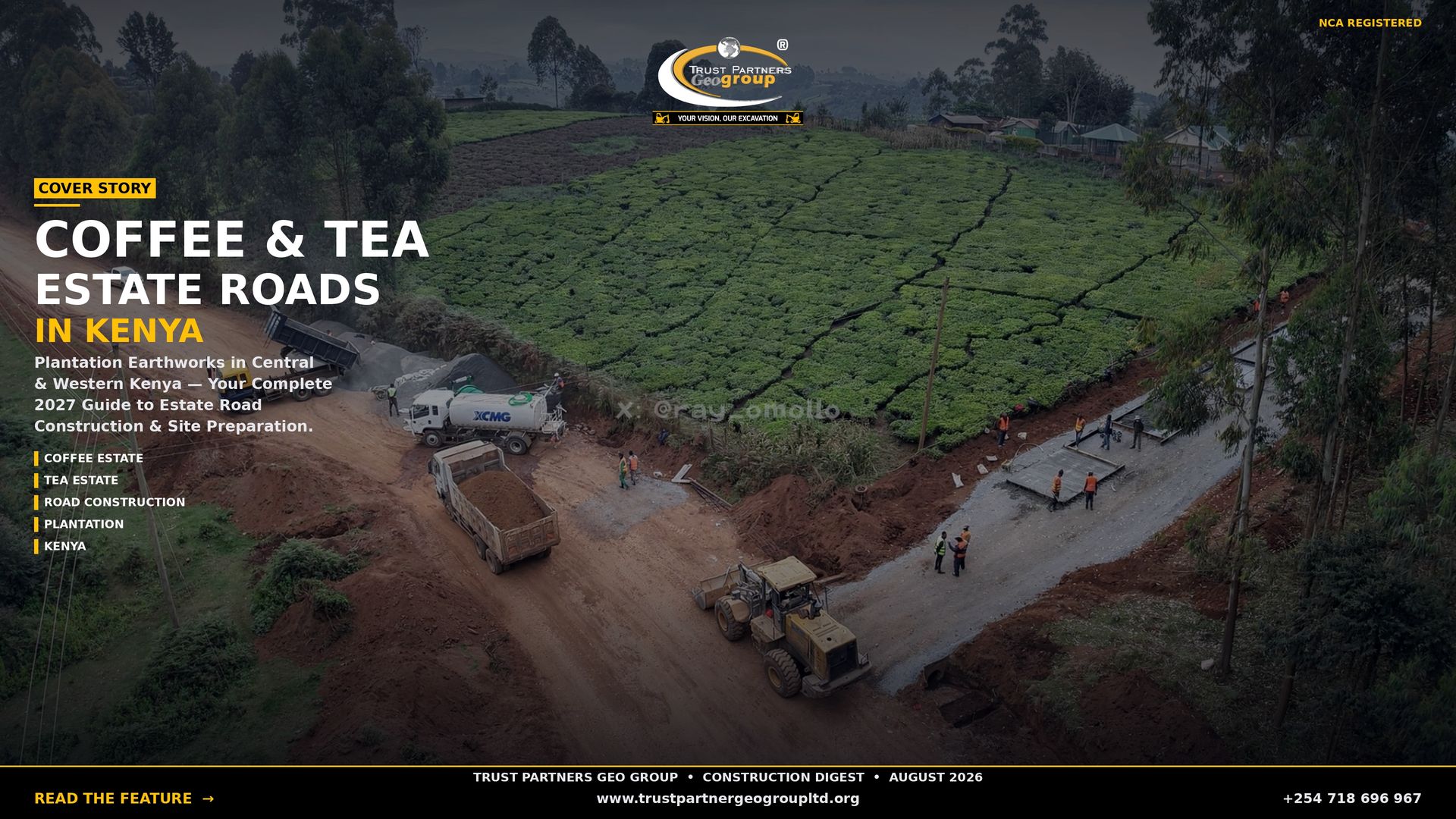
Coffee and Tea Estate Road Construction: Plantation Earthworks in Central and Western Kenya [2027]
Murram Road Grading, Farm Access Earthworks & Drainage for Kenya's Highland Plantation Belt
From the mist-covered tea hills of Kericho to the volcanic coffee slopes of Nyeri and Murang'a, Kenya's plantation belt is woven together by a network of farm tracks that most outsiders never see. But for estate managers, cooperative societies and smallholder factory boards, these roads are the arteries of production — carrying fertilizer uphill, transporting cherry and leaf downhill, and connecting remote fields to collection centres, factories and markets. Get the earthworks wrong and a single rainy season turns a farm track into an impassable gully, halting harvests and rotting crops before they reach the factory. This guide covers everything plantation developers need to know about estate road construction in Kenya's Central and Western Highlands — from cut-and-fill earthworks and murram surfacing to drainage structures and erosion control.

NCA-registered excavation contractor with 15+ years of plantation road construction across Kenya's Central and Western Highlands. We provide estate road earthworks, murram grading, drainage installation and farm access construction for coffee and tea estates nationwide.
Why Estate Roads Need Specialized Construction
Coffee and tea estate roads in Kenya operate under conditions that destroy standard farm tracks within a single season:
- Heavy farm traffic: Tractor-pulled spraying equipment, fertilizer spreaders, cherry collection trailers and tea-picking transport carry loads of 5–15 tonnes on narrow, winding tracks. Standard farm roads are designed for light vehicles; estate roads need engineered subgrades and surfacing.
- Year-round access demand: Tea is picked every 7–14 days throughout the year; coffee harvesting concentrates in October–December and March–May. Roads must remain passable during the long rains (April–May) and short rains (October–November) when standard tracks turn to impassable mud.
- Steep gradients: Estate roads in Kericho, Nyeri and Murang'a traverse slopes of 10–25 degrees. Without switchback design, cambered surfaces and drainage structures, cuts collapse and fills wash out under the first heavy storm.
- Extreme rainfall: Central Highlands receive 1,200–2,000 mm annually; Western Highlands 1,500–2,200 mm. Unprotected cut slopes erode within weeks and saturated subgrades fail under loaded farm vehicles.
- Environmental sensitivity: Estate roads cross indigenous forest buffers, riparian zones and steep gullies where uncontrolled runoff causes landslides and sedimentation into rivers — triggering NEMA enforcement and downstream liability.
- Economic pressure: A single day of impassable roads during harvest can cost a large estate KES 50,000–150,000 in delayed picking, spoiled cherry and factory penalties. Proper road construction pays for itself in one season.
The Six Phases of Plantation Road Construction
Phase 1: Route Survey and Alignment
GPS topographic survey identifies the optimal route minimizing cut volumes, gradient (ideally under 12%), and environmental impact. Switchbacks are designed for slopes over 15 degrees, with hairpin curves graded to 6–8% crossfall. The alignment avoids mature coffee trees and tea bushes where possible, and identifies all stream crossings, wetland areas and rock outcrops before earthworks begin.
Phase 2: Clearing and Grubbing
All vegetation, stumps and organic topsoil are removed from the road corridor — typically 6–8 metres wide for single-lane estate roads, 10–12 metres for factory access routes. Topsoil is stockpiled for reuse on embankments, cut slope stabilization and landscaping. In indigenous forest zones, clearing is minimized to the road prism plus drainage corridor, with KFS oversight where required.
Phase 3: Cut-and-Fill Earthworks
Excavating cuts on uphill sides and using spoil to build embankments on downhill sides. Cut slopes are benched on steep terrain and battered at 1:1.5 to prevent collapse. Fill embankments are constructed in 200 mm layers, each compacted to 90% Mod AASHTO density. On steep slopes, embankments are reinforced with geotextile or gabion mattresses to prevent slip failure. Excess spoil is hauled to approved disposal sites or used for farm terracing.
Phase 4: Subgrade Preparation
The natural ground is scarified to 150–200 mm depth and compacted to 95% Mod AASHTO density. Black cotton soil, organic material and soft volcanic ash are removed and replaced with compacted murram. In high-rainfall zones, a 100 mm sub-base of crushed stone or hardcore provides additional stability. Subgrade camber of 4–6% is established before base course placement.
Phase 5: Murram Base Course
Hard, angular murram with CBR minimum 30% is imported from approved borrow pits and spread in 150–200 mm layers. Each layer is watered to optimum moisture content and compacted with vibratory rollers to 95% density. Total base thickness ranges 200–400 mm depending on traffic load — 200 mm for light farm access, 400 mm for factory haul routes carrying 10+ tonne loads daily. Final grading achieves uniform camber and longitudinal gradient under 12%.
Phase 6: Drainage Structures
Side drains (V-shaped or trapezoidal) run parallel to the road, sized to handle peak storm flows. Mitre drains at 30–45 degree angles discharge water away from the road at 20–50 m intervals. Culverts across streams (minimum 600 mm diameter concrete or HDPE) include headwalls and wingwalls. Stone-paved outlets prevent scouring at all drain discharges. Rolling dips on gentle gradients shed surface water without culverts.
Erosion Control and Drainage Design
Erosion control is the defining challenge of estate road construction in Kenya's high-rainfall zones. Without proper drainage, a KES 2 million road investment can be destroyed in a single wet season:
- Camber and crossfall: Maintaining 4–6% camber on the road surface ensures rainfall drains to side channels within 24 hours, preventing ponding and subgrade saturation. In Kericho where rain falls 200+ days per year, camber maintenance is a continuous requirement.
- Side drains: V-shaped or trapezoidal drains excavated parallel to the road, 40–60 cm deep with 1:1 side slopes in Kericho and Bomet. Drain capacity is calculated for 1-in-10 year storm intensity — typically 100–150 mm/hour in the highlands.
- Mitre drains: Diagonal channels at 30–45 degrees from the side drain, spaced every 20–50 m depending on gradient. They direct water away from the road into natural drainage or grassed waterways, preventing channel erosion alongside the road.
- Culverts and stream crossings: Minimum 600 mm diameter for seasonal streams; 900–1,200 mm for perennial watercourses. Concrete box culverts are preferred for factory access routes; HDPE pipes suit lighter farm tracks. All crossings include energy dissipators downstream.
- Stone-lined outlets: Drain outlets and culvert discharges paved with hard stone to prevent scouring and gully formation. In Murang'a and Nyeri where volcanic rock is available, hand-laid stone is cost-effective and durable.
- Cut slope protection: Steep cuts benched into 2–3 m terraces and planted with grass or covered with geotextile. In Nandi Hills where slopes exceed 25 degrees, retaining walls or soil-nailed slopes may be required.
- Embankment protection: Downhill embankments grassed with local species (Kikuyu grass, Guatemala grass) or protected with gabion mattresses where steep. Bio-engineering with vetiver grass is increasingly used for low-cost stabilization.
Estate Road Construction Rates 2027
| Service | Rate (KES/km) | Notes |
|---|---|---|
| Site clearing and grubbing | 80,000 – 150,000 | Per km of road corridor; upper end for dense bush/forest |
| Cut-and-fill earthworks (gentle terrain) | 300,000 – 600,000 | Slopes under 10°; balanced cut-and-fill |
| Cut-and-fill earthworks (steep terrain) | 600,000 – 1,200,000 | Slopes 15–25°; switchbacks, benching, high volumes |
| Rock breaking (phonolite/basalt) | 1,500,000 – 2,500,000 | Per km where rock outcrops encountered; breaker + disposal |
| Subgrade preparation and compaction | 150,000 – 300,000 | Scarifying, replacement of unsuitable soil, 95% compaction |
| Murram base course (200 mm) | 400,000 – 700,000 | Light farm access; haul from borrow pit included |
| Murram base course (400 mm) | 750,000 – 1,200,000 | Factory haul routes; heavy traffic load |
| Side drain excavation | 80,000 – 150,000 | V-shaped or trapezoidal; per km both sides |
| Mitre drains | 15,000 – 30,000 | Per drain; stone-lined or grassed |
| Concrete culvert (600 mm) | 45,000 – 85,000 | Per crossing; incl. headwalls, bedding, backfill |
| Concrete culvert (900–1,200 mm) | 120,000 – 220,000 | Per crossing; factory access routes |
| Camber grading and finishing | 80,000 – 150,000 | Final motor grader profiling; 4–6% crossfall |
| Complete murram road (gentle) | 800,000 – 1,500,000 | Per km all-inclusive; light farm access |
| Complete murram road (steep) | 1,500,000 – 2,800,000 | Per km all-inclusive; switchbacks, heavy drainage |
County-Specific Estate Road Challenges
Kericho County: The Tea Capital
Kericho is Kenya's tea heartland with over 100,000 hectares under tea. Estates like James Finlay, Unilever (Lipton), George Williamson and hundreds of smallholder factories require continuous road maintenance and new access construction. Terrain is rolling to steep with deep red loam soils that become slippery when wet. Rain falls 200+ days per year, making drainage the overriding priority. Roads must support daily tractor-picked leaf transport to factories running 18–20 hours during peak season.
Bomet County: Emerging Tea Zone
Bomet is rapidly expanding tea production with new factory construction and smallholder road networks. Terrain is similar to Kericho but with more volcanic rock outcrops requiring breaker work. The Siongiroi and Longisa areas have steep escarpments where switchback roads need extensive benching. County government has invested in feeder roads, but estate access remains largely private.
Nandi Hills: High-Altitude Steep Terrain
Tea at 2,000+ metres elevation on some of Kenya's steepest plantation slopes. Roads require extensive benching, retaining structures and drainage. Cold, wet conditions slow earthworks and extend curing times for concrete culverts. Murram sources are often distant, increasing haul costs.
Nyeri County: Premier Coffee Zone
Nyeri's coffee estates (Karatina, Mukurweini, Othaya) operate on steep volcanic slopes with phonolite outcrops. Estate roads are narrow, winding and prone to landslides during heavy rains. Coffee cherry must reach factories within 8 hours of picking — road reliability is non-negotiable. Volcanic rock is abundant for stone lining and culvert construction.
Murang'a County: Dense Smallholder Network
Murang'a has Kenya's densest smallholder coffee concentration, with narrow farm tracks requiring widening and drainage. High rainfall (1,500–2,000 mm) creates constant erosion challenges. Cooperative society roads connect hundreds of small farms to collection centres and factories — any failure disrupts thousands of farmers.
Kirinyaga, Embu and Meru: Mixed Coffee and Tea
These counties have mixed coffee and tea production with estate roads connecting factories to collection centres. Variable volcanic soils with frequent stream crossings require culvert-heavy construction. Meru's Nyambene Hills have particularly steep access roads and high landslide risk during rains.
Road Maintenance and Rehabilitation
Even well-constructed estate roads require ongoing maintenance to survive Kenya's high-rainfall highlands:
- Annual grading: Motor grader passes to restore camber, clear drain blockages and reshape surface ruts. Costs KES 80,000–150,000 per km annually for active routes.
- Murram replenishment: Surface murram is lost to erosion and vehicle wear. Replenishment of 50–100 mm every 2–3 years costs KES 200,000–400,000 per km.
- Drainage clearing: Side drains and mitre drains must be cleared of sediment and vegetation before each rainy season. Neglected drains overflow and destroy the road surface.
- Culvert inspection: Annual inspection for blockage, scour and structural damage. Replacement of failed culverts before rainy season prevents catastrophic washouts.
- Spot repairs: Pothole filling, rut reshaping and slip failure repair using excavators and compactors. Addressed immediately to prevent expansion.
- Rehabilitation vs. reconstruction: Roads neglected for 5+ years often require complete reconstruction — costing 2–3x more than consistent maintenance. Trust Partners Geo-Group offers annual maintenance contracts for estate road networks.
Build or Maintain Your Estate Road Network
Trust Partners Geo-Group provides plantation road construction, murram grading, drainage installation and maintenance for coffee and tea estates across Central and Western Kenya. Free route survey and itemised quote.
Call +254 718 686 967 Email for QuoteFrequently Asked Questions
Why do coffee and tea estates need specialized road construction?
Coffee and tea estates in Central and Western Kenya operate on steep, high-rainfall terrain that destroys standard farm tracks within a single wet season. Estate roads must support: (1) Heavy farm vehicles — tractor-pulled spraying equipment, fertilizer spreaders, cherry collection trailers and tea-picking transport carry loads of 5–15 tonnes on narrow tracks. (2) Daily all-weather access — tea is picked every 7–14 days year-round; coffee harvesting is concentrated in October–December and March–May. Roads must remain passable during the long rains (April–May) and short rains (October–November). (3) Steep gradients — estate roads in Kericho, Nyeri and Murang'a traverse slopes of 10–25 degrees, requiring switchback design, cambered surfaces and drainage structures that prevent washout. (4) High rainfall — Central Highlands receive 1,200–2,000 mm annually; Western Highlands 1,500–2,200 mm. Unprotected cuts erode rapidly and saturated subgrades fail under load. (5) Sensitive ecosystems — estate roads cross indigenous forest buffers, riparian zones and steep gullies where uncontrolled runoff causes landslides and sedimentation into rivers. Standard farm tracks lack the drainage, compaction and surfacing to survive these conditions. Proper estate road construction uses engineered earthworks: cut-and-fill balancing, compacted murram subgrades, cambered surfaces with 4–6% crossfall, side drains, culverts across streams, and stone-lined outlets.
What does plantation road construction involve?
Coffee and tea estate road construction involves six earthworks phases: (1) Route survey and alignment — GPS topographic survey to identify the optimal route minimizing cut volumes, gradient (ideally under 12%), and environmental impact. Switchbacks are designed for slopes over 15 degrees. (2) Clearing and grubbing — removal of vegetation, stumps and organic topsoil from the road corridor. Topsoil is stockpiled for reuse on embankments and landscaping. (3) Cut-and-fill earthworks — excavating cuts on uphill sides and using spoil to build embankments on downhill sides. Cut slopes are benched on steep terrain and battered at 1:1.5 to prevent collapse. (4) Subgrade preparation — scarifying and compacting the natural ground to 95% Mod AASHTO density. Black cotton soil or organic material is removed and replaced with compacted murram. (5) Murram base course — importing and spreading hard, angular murram (CBR minimum 30%) in 150–200 mm layers, each compacted to 95% density. Total base thickness ranges 200–400 mm depending on traffic load. (6) Drainage structures — side drains (V-shaped or trapezoidal), mitre drains at 30–45 degree angles, culverts across streams (minimum 600 mm diameter), and stone-paved outlets to prevent scouring. Camber of 4–6% ensures surface runoff drains to side channels rather than ponding on the road.
How much does estate road construction cost per kilometre in Kenya?
Estate road construction costs in Central and Western Kenya vary by terrain, material haul distance and drainage requirements. Murram farm access roads on gentle terrain cost KES 800,000–1,500,000 per km including earthworks, drainage and murram surfacing. Steep-terrain estate roads with switchbacks and extensive cut-and-fill cost KES 1,500,000–2,800,000 per km. Roads with concrete culverts and stone-lined drains cost KES 2,000,000–3,500,000 per km. Key cost components: site clearing KES 80,000–150,000 per km; cut-and-fill earthworks KES 300,000–800,000 per km depending on volumes; subgrade preparation and compaction KES 150,000–300,000 per km; murram import and placement KES 400,000–900,000 per km (haul distance dependent); drainage structures KES 200,000–600,000 per km; and camber grading and finishing KES 80,000–150,000 per km. Cost drivers include: slope steepness (switchbacks add 30–50% to earthwork volumes), rock presence (phonolite in Nyeri/Murang'a adds breaker costs), rainfall intensity (heavier drainage needed in Kericho/Bomet), murram source distance (KES 800–1,500 per 20-ton truck), and stream crossings (culverts add KES 45,000–120,000 per crossing). Trust Partners Geo-Group provides fixed-price quotes after route survey and material assessment.
What equipment is used for plantation road construction?
Tea and coffee estate road construction requires specialized earthmoving fleet for steep, high-rainfall terrain: (1) 30-ton excavators — for cut excavation, benching steep slopes, culvert foundation trenches and rock breaking. Essential for switchback construction on gradients over 15 degrees. (2) Bulldozers with rippers — for clearing dense vegetation, rough grading, ripping weathered volcanic rock and pushing spoil to fill embankments. (3) Motor graders — for precision camber grading (4–6% crossfall), side drain profiling and final surface preparation. Critical for achieving the drainage falls that prevent ponding. (4) Vibratory rollers 10-ton — for compacting subgrade and murram base courses to 95% Mod AASHTO density. Smooth-drum rollers for subgrade; padfoot rollers for cohesive soils. (5) 20–30 ton tippers — for importing murram from borrow pits and hauling excess cut material to disposal. Low-range gears essential for steep, wet access. (6) Water bowsers — for dust suppression during dry-season work and moisture conditioning for compaction. (7) Mini-excavators 5-ton — for confined culvert trenches, drain outlet construction and precision work near mature coffee trees and tea bushes. (8) Plate compactors — for trench backfill around culverts and confined drain areas. All Trust Partners Geo-Group plantation equipment is available wet hire with NITA-certified operators experienced in agricultural terrain and tree preservation.
Which counties have the most coffee and tea estate road construction?
Coffee and tea estate road construction is concentrated in Kenya's highland agricultural belt: (1) Kericho County — Kenya's tea capital with over 100,000 hectares under tea. Estates like James Finlay, Unilever (Lipton), George Williamson and numerous smallholder factories require continuous road maintenance and new access construction. Terrain is rolling to steep with deep red loam soils. (2) Bomet County — emerging tea zone with factory expansion and smallholder road networks. Similar terrain to Kericho but with more volcanic rock outcrops. (3) Nandi Hills — high-altitude tea (2,000+ metres) with some of the steepest estate roads in Kenya. Roads require extensive benching and drainage. (4) Nyeri County — premier coffee zone with large estates (Karatina, Mukurweini, Othaya) and cooperative society roads. Terrain is steep volcanic slopes with phonolite outcrops. (5) Murang'a County — dense smallholder coffee with narrow farm tracks requiring widening and drainage. High rainfall (1,500–2,000 mm) creates constant erosion challenges. (6) Kirinyaga and Embu — mixed coffee and tea with estate roads connecting factories to collection centres. Variable volcanic soils with frequent stream crossings. (7) Meru — tea estates on the Nyambene Hills with steep access roads and high rainfall. Each county has distinct challenges: Kericho/Bomet have deep red loam that becomes slippery when wet; Nyeri/Murang'a have volcanic rock and extreme slopes; Meru has high rainfall and landslide risk.
How do you prevent road erosion on coffee and tea estates?
Erosion control is the defining challenge of estate road construction in Kenya's high-rainfall zones. Effective strategies include: (1) Camber and crossfall — maintaining 4–6% camber on the road surface so rainfall drains to side channels within 24 hours, preventing ponding and subgrade saturation. (2) Side drains — V-shaped or trapezoidal drains excavated parallel to the road, sized to handle peak storm flows. In Kericho and Bomet, drains are 40–60 cm deep with 1:1 side slopes. (3) Mitre drains — diagonal channels at 30–45 degrees from the side drain, spaced every 20–50 m depending on gradient, directing water away from the road into natural drainage or grassed waterways. (4) Culverts — minimum 600 mm diameter concrete or HDPE pipes across seasonal streams and gullies, with headwalls and wingwalls to prevent scour. (5) Stone-lined outlets — drain outlets and culvert discharges paved with hard stone to prevent scouring and gully formation. (6) Cut slope protection — benching steep cuts into 2–3 m terraces, planting grass or covering with geotextile to prevent surface erosion. (7) Embankment protection — downhill embankments grassed with local species or protected with gabion mattresses where steep. (8) Rolling dips — gentle depressions in the road profile that shed surface water to the side without requiring culverts, effective on gentle gradients. Trust Partners Geo-Group designs drainage systems specific to each estate's rainfall, slope and soil conditions.
How long does estate road construction take?
Estate road construction timelines depend on length, terrain and season. A 1 km murram access road on gentle terrain (under 10 degrees) with minimal drainage takes 2–3 weeks: 3–4 days clearing and grubbing, 4–5 days cut-and-fill earthworks, 2–3 days subgrade compaction, 3–4 days murram placement and compaction, and 2–3 days drainage and camber finishing. A 1 km steep-terrain road (15–25 degrees) with switchbacks and multiple culverts takes 4–6 weeks: benching and cut-and-fill volumes are 2–3x higher, rock breaking may be required, and drainage structures are more complex. Large estate networks of 5–10 km take 3–6 months with dedicated crews. Seasonal factors are critical: dry season (January–March, June–September) is optimal — soils are workable, compaction achieves density and concrete culverts cure properly. Wet season work extends timelines by 40–60% due to saturated soils, slippery access for tippers and inability to achieve compaction. In Kericho and Bomet where rain falls year-round, scheduling around dry windows is essential. Trust Partners Geo-Group plans estate road programs to complete earthworks in dry months, leaving drainage and finishing for marginal weather.
Do I need permits for estate road construction in Kenya?
Estate road construction on private farmland generally does not require a county building permit, but several regulatory considerations apply: (1) NEMA Environmental Impact Assessment — required for road construction over 5 km, roads crossing wetlands or rivers, or within 30 metres of forest reserves. Most large estates in Kericho and Nyeri trigger this threshold. (2) Kenya Forest Service (KFS) — required if roads pass through indigenous forest or forest reserve boundaries, common in Mount Kenya and Aberdare foothills. (3) Water Authority — required if culverts or bridges alter stream flow, affect downstream water rights, or cross designated watercourses. (4) County agricultural officer — some counties require notification for large-scale land modification that could affect downstream farms through sedimentation. (5) KeRRA or county roads department — if estate roads connect to public road networks, intersection design and drainage must meet KeRHA/KeRRA standards to prevent public road damage. (6) Tea and coffee factory boards — estates supplying factories may need board approval for road alignments affecting factory access or collection routes. Trust Partners Geo-Group coordinates all permit requirements for estate road projects, including NEMA screening, KFS clearance, Water Authority applications and county agricultural notifications.
Related Resources
Plan Your Estate Road Construction or Maintenance Project
Contact Trust Partners Geo-Group at +254 718 686 967 for a free estate road survey and itemised quote. Serving Kericho, Nyeri, Murang'a, Bomet, Nandi, Kirinyaga, Embu, Meru and all highland plantation zones.
Call +254 718 686 967 Request QuoteCoffee and Tea Estate Road Construction: Plantation Earthworks in Central and Western Kenya [2027]
Murram Road Grading, Farm Access Earthworks & Drainage for Kenya's Highland Plantation Belt
From the mist-covered tea hills of Kericho to the volcanic coffee slopes of Nyeri and Murang'a, Kenya's plantation belt is woven together by a network of farm tracks that most outsiders never see. But for estate managers, cooperative societies and smallholder factory boards, these roads are the arteries of production — carrying fertilizer uphill, transporting cherry and leaf downhill, and connecting remote fields to collection centres, factories and markets. Get the earthworks wrong and a single rainy season turns a farm track into an impassable gully, halting harvests and rotting crops before they reach the factory. This guide covers everything plantation developers need to know about estate road construction in Kenya's Central and Western Highlands — from cut-and-fill earthworks and murram surfacing to drainage structures and erosion control.
NCA-registered excavation contractor with 15+ years of plantation road construction across Kenya's Central and Western Highlands. We provide estate road earthworks, murram grading, drainage installation and farm access construction for coffee and tea estates nationwide.
Why Estate Roads Need Specialized Construction
Coffee and tea estate roads in Kenya operate under conditions that destroy standard farm tracks within a single season:
- Heavy farm traffic: Tractor-pulled spraying equipment, fertilizer spreaders, cherry collection trailers and tea-picking transport carry loads of 5–15 tonnes on narrow, winding tracks. Standard farm roads are designed for light vehicles; estate roads need engineered subgrades and surfacing.
- Year-round access demand: Tea is picked every 7–14 days throughout the year; coffee harvesting concentrates in October–December and March–May. Roads must remain passable during the long rains (April–May) and short rains (October–November) when standard tracks turn to impassable mud.
- Steep gradients: Estate roads in Kericho, Nyeri and Murang'a traverse slopes of 10–25 degrees. Without switchback design, cambered surfaces and drainage structures, cuts collapse and fills wash out under the first heavy storm.
- Extreme rainfall: Central Highlands receive 1,200–2,000 mm annually; Western Highlands 1,500–2,200 mm. Unprotected cut slopes erode within weeks and saturated subgrades fail under loaded farm vehicles.
- Environmental sensitivity: Estate roads cross indigenous forest buffers, riparian zones and steep gullies where uncontrolled runoff causes landslides and sedimentation into rivers — triggering NEMA enforcement and downstream liability.
- Economic pressure: A single day of impassable roads during harvest can cost a large estate KES 50,000–150,000 in delayed picking, spoiled cherry and factory penalties. Proper road construction pays for itself in one season.
The Six Phases of Plantation Road Construction
Phase 1: Route Survey and Alignment
GPS topographic survey identifies the optimal route minimizing cut volumes, gradient (ideally under 12%), and environmental impact. Switchbacks are designed for slopes over 15 degrees, with hairpin curves graded to 6–8% crossfall. The alignment avoids mature coffee trees and tea bushes where possible, and identifies all stream crossings, wetland areas and rock outcrops before earthworks begin.
Phase 2: Clearing and Grubbing
All vegetation, stumps and organic topsoil are removed from the road corridor — typically 6–8 metres wide for single-lane estate roads, 10–12 metres for factory access routes. Topsoil is stockpiled for reuse on embankments, cut slope stabilization and landscaping. In indigenous forest zones, clearing is minimized to the road prism plus drainage corridor, with KFS oversight where required.
Phase 3: Cut-and-Fill Earthworks
Excavating cuts on uphill sides and using spoil to build embankments on downhill sides. Cut slopes are benched on steep terrain and battered at 1:1.5 to prevent collapse. Fill embankments are constructed in 200 mm layers, each compacted to 90% Mod AASHTO density. On steep slopes, embankments are reinforced with geotextile or gabion mattresses to prevent slip failure. Excess spoil is hauled to approved disposal sites or used for farm terracing.
Phase 4: Subgrade Preparation
The natural ground is scarified to 150–200 mm depth and compacted to 95% Mod AASHTO density. Black cotton soil, organic material and soft volcanic ash are removed and replaced with compacted murram. In high-rainfall zones, a 100 mm sub-base of crushed stone or hardcore provides additional stability. Subgrade camber of 4–6% is established before base course placement.
Phase 5: Murram Base Course
Hard, angular murram with CBR minimum 30% is imported from approved borrow pits and spread in 150–200 mm layers. Each layer is watered to optimum moisture content and compacted with vibratory rollers to 95% density. Total base thickness ranges 200–400 mm depending on traffic load — 200 mm for light farm access, 400 mm for factory haul routes carrying 10+ tonne loads daily. Final grading achieves uniform camber and longitudinal gradient under 12%.
Phase 6: Drainage Structures
Side drains (V-shaped or trapezoidal) run parallel to the road, sized to handle peak storm flows. Mitre drains at 30–45 degree angles discharge water away from the road at 20–50 m intervals. Culverts across streams (minimum 600 mm diameter concrete or HDPE) include headwalls and wingwalls. Stone-paved outlets prevent scouring at all drain discharges. Rolling dips on gentle gradients shed surface water without culverts.
Erosion Control and Drainage Design
Erosion control is the defining challenge of estate road construction in Kenya's high-rainfall zones. Without proper drainage, a KES 2 million road investment can be destroyed in a single wet season:
- Camber and crossfall: Maintaining 4–6% camber on the road surface ensures rainfall drains to side channels within 24 hours, preventing ponding and subgrade saturation. In Kericho where rain falls 200+ days per year, camber maintenance is a continuous requirement.
- Side drains: V-shaped or trapezoidal drains excavated parallel to the road, 40–60 cm deep with 1:1 side slopes in Kericho and Bomet. Drain capacity is calculated for 1-in-10 year storm intensity — typically 100–150 mm/hour in the highlands.
- Mitre drains: Diagonal channels at 30–45 degrees from the side drain, spaced every 20–50 m depending on gradient. They direct water away from the road into natural drainage or grassed waterways, preventing channel erosion alongside the road.
- Culverts and stream crossings: Minimum 600 mm diameter for seasonal streams; 900–1,200 mm for perennial watercourses. Concrete box culverts are preferred for factory access routes; HDPE pipes suit lighter farm tracks. All crossings include energy dissipators downstream.
- Stone-lined outlets: Drain outlets and culvert discharges paved with hard stone to prevent scouring and gully formation. In Murang'a and Nyeri where volcanic rock is available, hand-laid stone is cost-effective and durable.
- Cut slope protection: Steep cuts benched into 2–3 m terraces and planted with grass or covered with geotextile. In Nandi Hills where slopes exceed 25 degrees, retaining walls or soil-nailed slopes may be required.
- Embankment protection: Downhill embankments grassed with local species (Kikuyu grass, Guatemala grass) or protected with gabion mattresses where steep. Bio-engineering with vetiver grass is increasingly used for low-cost stabilization.
Estate Road Construction Rates 2027
| Service | Rate (KES/km) | Notes |
|---|---|---|
| Site clearing and grubbing | 80,000 – 150,000 | Per km of road corridor; upper end for dense bush/forest |
| Cut-and-fill earthworks (gentle terrain) | 300,000 – 600,000 | Slopes under 10°; balanced cut-and-fill |
| Cut-and-fill earthworks (steep terrain) | 600,000 – 1,200,000 | Slopes 15–25°; switchbacks, benching, high volumes |
| Rock breaking (phonolite/basalt) | 1,500,000 – 2,500,000 | Per km where rock outcrops encountered; breaker + disposal |
| Subgrade preparation and compaction | 150,000 – 300,000 | Scarifying, replacement of unsuitable soil, 95% compaction |
| Murram base course (200 mm) | 400,000 – 700,000 | Light farm access; haul from borrow pit included |
| Murram base course (400 mm) | 750,000 – 1,200,000 | Factory haul routes; heavy traffic load |
| Side drain excavation | 80,000 – 150,000 | V-shaped or trapezoidal; per km both sides |
| Mitre drains | 15,000 – 30,000 | Per drain; stone-lined or grassed |
| Concrete culvert (600 mm) | 45,000 – 85,000 | Per crossing; incl. headwalls, bedding, backfill |
| Concrete culvert (900–1,200 mm) | 120,000 – 220,000 | Per crossing; factory access routes |
| Camber grading and finishing | 80,000 – 150,000 | Final motor grader profiling; 4–6% crossfall |
| Complete murram road (gentle) | 800,000 – 1,500,000 | Per km all-inclusive; light farm access |
| Complete murram road (steep) | 1,500,000 – 2,800,000 | Per km all-inclusive; switchbacks, heavy drainage |
County-Specific Estate Road Challenges
Kericho County: The Tea Capital
Kericho is Kenya's tea heartland with over 100,000 hectares under tea. Estates like James Finlay, Unilever (Lipton), George Williamson and hundreds of smallholder factories require continuous road maintenance and new access construction. Terrain is rolling to steep with deep red loam soils that become slippery when wet. Rain falls 200+ days per year, making drainage the overriding priority. Roads must support daily tractor-picked leaf transport to factories running 18–20 hours during peak season.
Bomet County: Emerging Tea Zone
Bomet is rapidly expanding tea production with new factory construction and smallholder road networks. Terrain is similar to Kericho but with more volcanic rock outcrops requiring breaker work. The Siongiroi and Longisa areas have steep escarpments where switchback roads need extensive benching. County government has invested in feeder roads, but estate access remains largely private.
Nandi Hills: High-Altitude Steep Terrain
Tea at 2,000+ metres elevation on some of Kenya's steepest plantation slopes. Roads require extensive benching, retaining structures and drainage. Cold, wet conditions slow earthworks and extend curing times for concrete culverts. Murram sources are often distant, increasing haul costs.
Nyeri County: Premier Coffee Zone
Nyeri's coffee estates (Karatina, Mukurweini, Othaya) operate on steep volcanic slopes with phonolite outcrops. Estate roads are narrow, winding and prone to landslides during heavy rains. Coffee cherry must reach factories within 8 hours of picking — road reliability is non-negotiable. Volcanic rock is abundant for stone lining and culvert construction.
Murang'a County: Dense Smallholder Network
Murang'a has Kenya's densest smallholder coffee concentration, with narrow farm tracks requiring widening and drainage. High rainfall (1,500–2,000 mm) creates constant erosion challenges. Cooperative society roads connect hundreds of small farms to collection centres and factories — any failure disrupts thousands of farmers.
Kirinyaga, Embu and Meru: Mixed Coffee and Tea
These counties have mixed coffee and tea production with estate roads connecting factories to collection centres. Variable volcanic soils with frequent stream crossings require culvert-heavy construction. Meru's Nyambene Hills have particularly steep access roads and high landslide risk during rains.
Road Maintenance and Rehabilitation
Even well-constructed estate roads require ongoing maintenance to survive Kenya's high-rainfall highlands:
- Annual grading: Motor grader passes to restore camber, clear drain blockages and reshape surface ruts. Costs KES 80,000–150,000 per km annually for active routes.
- Murram replenishment: Surface murram is lost to erosion and vehicle wear. Replenishment of 50–100 mm every 2–3 years costs KES 200,000–400,000 per km.
- Drainage clearing: Side drains and mitre drains must be cleared of sediment and vegetation before each rainy season. Neglected drains overflow and destroy the road surface.
- Culvert inspection: Annual inspection for blockage, scour and structural damage. Replacement of failed culverts before rainy season prevents catastrophic washouts.
- Spot repairs: Pothole filling, rut reshaping and slip failure repair using excavators and compactors. Addressed immediately to prevent expansion.
- Rehabilitation vs. reconstruction: Roads neglected for 5+ years often require complete reconstruction — costing 2–3x more than consistent maintenance. Trust Partners Geo-Group offers annual maintenance contracts for estate road networks.
Build or Maintain Your Estate Road Network
Trust Partners Geo-Group provides plantation road construction, murram grading, drainage installation and maintenance for coffee and tea estates across Central and Western Kenya. Free route survey and itemised quote.
Call +254 718 686 967 Email for QuoteFrequently Asked Questions
Why do coffee and tea estates need specialized road construction?
Coffee and tea estates in Central and Western Kenya operate on steep, high-rainfall terrain that destroys standard farm tracks within a single wet season. Estate roads must support: (1) Heavy farm vehicles — tractor-pulled spraying equipment, fertilizer spreaders, cherry collection trailers and tea-picking transport carry loads of 5–15 tonnes on narrow tracks. (2) Daily all-weather access — tea is picked every 7–14 days year-round; coffee harvesting is concentrated in October–December and March–May. Roads must remain passable during the long rains (April–May) and short rains (October–November). (3) Steep gradients — estate roads in Kericho, Nyeri and Murang'a traverse slopes of 10–25 degrees, requiring switchback design, cambered surfaces and drainage structures that prevent washout. (4) High rainfall — Central Highlands receive 1,200–2,000 mm annually; Western Highlands 1,500–2,200 mm. Unprotected cuts erode rapidly and saturated subgrades fail under load. (5) Sensitive ecosystems — estate roads cross indigenous forest buffers, riparian zones and steep gullies where uncontrolled runoff causes landslides and sedimentation into rivers. Standard farm tracks lack the drainage, compaction and surfacing to survive these conditions. Proper estate road construction uses engineered earthworks: cut-and-fill balancing, compacted murram subgrades, cambered surfaces with 4–6% crossfall, side drains, culverts across streams, and stone-lined outlets.
What does plantation road construction involve?
Coffee and tea estate road construction involves six earthworks phases: (1) Route survey and alignment — GPS topographic survey to identify the optimal route minimizing cut volumes, gradient (ideally under 12%), and environmental impact. Switchbacks are designed for slopes over 15 degrees. (2) Clearing and grubbing — removal of vegetation, stumps and organic topsoil from the road corridor. Topsoil is stockpiled for reuse on embankments and landscaping. (3) Cut-and-fill earthworks — excavating cuts on uphill sides and using spoil to build embankments on downhill sides. Cut slopes are benched on steep terrain and battered at 1:1.5 to prevent collapse. (4) Subgrade preparation — scarifying and compacting the natural ground to 95% Mod AASHTO density. Black cotton soil or organic material is removed and replaced with compacted murram. (5) Murram base course — importing and spreading hard, angular murram (CBR minimum 30%) in 150–200 mm layers, each compacted to 95% density. Total base thickness ranges 200–400 mm depending on traffic load. (6) Drainage structures — side drains (V-shaped or trapezoidal), mitre drains at 30–45 degree angles, culverts across streams (minimum 600 mm diameter), and stone-paved outlets to prevent scouring. Camber of 4–6% ensures surface runoff drains to side channels rather than ponding on the road.
How much does estate road construction cost per kilometre in Kenya?
Estate road construction costs in Central and Western Kenya vary by terrain, material haul distance and drainage requirements. Murram farm access roads on gentle terrain cost KES 800,000–1,500,000 per km including earthworks, drainage and murram surfacing. Steep-terrain estate roads with switchbacks and extensive cut-and-fill cost KES 1,500,000–2,800,000 per km. Roads with concrete culverts and stone-lined drains cost KES 2,000,000–3,500,000 per km. Key cost components: site clearing KES 80,000–150,000 per km; cut-and-fill earthworks KES 300,000–800,000 per km depending on volumes; subgrade preparation and compaction KES 150,000–300,000 per km; murram import and placement KES 400,000–900,000 per km (haul distance dependent); drainage structures KES 200,000–600,000 per km; and camber grading and finishing KES 80,000–150,000 per km. Cost drivers include: slope steepness (switchbacks add 30–50% to earthwork volumes), rock presence (phonolite in Nyeri/Murang'a adds breaker costs), rainfall intensity (heavier drainage needed in Kericho/Bomet), murram source distance (KES 800–1,500 per 20-ton truck), and stream crossings (culverts add KES 45,000–120,000 per crossing). Trust Partners Geo-Group provides fixed-price quotes after route survey and material assessment.
What equipment is used for plantation road construction?
Tea and coffee estate road construction requires specialized earthmoving fleet for steep, high-rainfall terrain: (1) 30-ton excavators — for cut excavation, benching steep slopes, culvert foundation trenches and rock breaking. Essential for switchback construction on gradients over 15 degrees. (2) Bulldozers with rippers — for clearing dense vegetation, rough grading, ripping weathered volcanic rock and pushing spoil to fill embankments. (3) Motor graders — for precision camber grading (4–6% crossfall), side drain profiling and final surface preparation. Critical for achieving the drainage falls that prevent ponding. (4) Vibratory rollers 10-ton — for compacting subgrade and murram base courses to 95% Mod AASHTO density. Smooth-drum rollers for subgrade; padfoot rollers for cohesive soils. (5) 20–30 ton tippers — for importing murram from borrow pits and hauling excess cut material to disposal. Low-range gears essential for steep, wet access. (6) Water bowsers — for dust suppression during dry-season work and moisture conditioning for compaction. (7) Mini-excavators 5-ton — for confined culvert trenches, drain outlet construction and precision work near mature coffee trees and tea bushes. (8) Plate compactors — for trench backfill around culverts and confined drain areas. All Trust Partners Geo-Group plantation equipment is available wet hire with NITA-certified operators experienced in agricultural terrain and tree preservation.
Which counties have the most coffee and tea estate road construction?
Coffee and tea estate road construction is concentrated in Kenya's highland agricultural belt: (1) Kericho County — Kenya's tea capital with over 100,000 hectares under tea. Estates like James Finlay, Unilever (Lipton), George Williamson and numerous smallholder factories require continuous road maintenance and new access construction. Terrain is rolling to steep with deep red loam soils. (2) Bomet County — emerging tea zone with factory expansion and smallholder road networks. Similar terrain to Kericho but with more volcanic rock outcrops. (3) Nandi Hills — high-altitude tea (2,000+ metres) with some of the steepest estate roads in Kenya. Roads require extensive benching and drainage. (4) Nyeri County — premier coffee zone with large estates (Karatina, Mukurweini, Othaya) and cooperative society roads. Terrain is steep volcanic slopes with phonolite outcrops. (5) Murang'a County — dense smallholder coffee with narrow farm tracks requiring widening and drainage. High rainfall (1,500–2,000 mm) creates constant erosion challenges. (6) Kirinyaga and Embu — mixed coffee and tea with estate roads connecting factories to collection centres. Variable volcanic soils with frequent stream crossings. (7) Meru — tea estates on the Nyambene Hills with steep access roads and high rainfall. Each county has distinct challenges: Kericho/Bomet have deep red loam that becomes slippery when wet; Nyeri/Murang'a have volcanic rock and extreme slopes; Meru has high rainfall and landslide risk.
How do you prevent road erosion on coffee and tea estates?
Erosion control is the defining challenge of estate road construction in Kenya's high-rainfall zones. Effective strategies include: (1) Camber and crossfall — maintaining 4–6% camber on the road surface so rainfall drains to side channels within 24 hours, preventing ponding and subgrade saturation. (2) Side drains — V-shaped or trapezoidal drains excavated parallel to the road, sized to handle peak storm flows. In Kericho and Bomet, drains are 40–60 cm deep with 1:1 side slopes. (3) Mitre drains — diagonal channels at 30–45 degrees from the side drain, spaced every 20–50 m depending on gradient, directing water away from the road into natural drainage or grassed waterways. (4) Culverts — minimum 600 mm diameter concrete or HDPE pipes across seasonal streams and gullies, with headwalls and wingwalls to prevent scour. (5) Stone-lined outlets — drain outlets and culvert discharges paved with hard stone to prevent scouring and gully formation. (6) Cut slope protection — benching steep cuts into 2–3 m terraces, planting grass or covering with geotextile to prevent surface erosion. (7) Embankment protection — downhill embankments grassed with local species or protected with gabion mattresses where steep. (8) Rolling dips — gentle depressions in the road profile that shed surface water to the side without requiring culverts, effective on gentle gradients. Trust Partners Geo-Group designs drainage systems specific to each estate's rainfall, slope and soil conditions.
How long does estate road construction take?
Estate road construction timelines depend on length, terrain and season. A 1 km murram access road on gentle terrain (under 10 degrees) with minimal drainage takes 2–3 weeks: 3–4 days clearing and grubbing, 4–5 days cut-and-fill earthworks, 2–3 days subgrade compaction, 3–4 days murram placement and compaction, and 2–3 days drainage and camber finishing. A 1 km steep-terrain road (15–25 degrees) with switchbacks and multiple culverts takes 4–6 weeks: benching and cut-and-fill volumes are 2–3x higher, rock breaking may be required, and drainage structures are more complex. Large estate networks of 5–10 km take 3–6 months with dedicated crews. Seasonal factors are critical: dry season (January–March, June–September) is optimal — soils are workable, compaction achieves density and concrete culverts cure properly. Wet season work extends timelines by 40–60% due to saturated soils, slippery access for tippers and inability to achieve compaction. In Kericho and Bomet where rain falls year-round, scheduling around dry windows is essential. Trust Partners Geo-Group plans estate road programs to complete earthworks in dry months, leaving drainage and finishing for marginal weather.
Do I need permits for estate road construction in Kenya?
Estate road construction on private farmland generally does not require a county building permit, but several regulatory considerations apply: (1) NEMA Environmental Impact Assessment — required for road construction over 5 km, roads crossing wetlands or rivers, or within 30 metres of forest reserves. Most large estates in Kericho and Nyeri trigger this threshold. (2) Kenya Forest Service (KFS) — required if roads pass through indigenous forest or forest reserve boundaries, common in Mount Kenya and Aberdare foothills. (3) Water Authority — required if culverts or bridges alter stream flow, affect downstream water rights, or cross designated watercourses. (4) County agricultural officer — some counties require notification for large-scale land modification that could affect downstream farms through sedimentation. (5) KeRRA or county roads department — if estate roads connect to public road networks, intersection design and drainage must meet KeRHA/KeRRA standards to prevent public road damage. (6) Tea and coffee factory boards — estates supplying factories may need board approval for road alignments affecting factory access or collection routes. Trust Partners Geo-Group coordinates all permit requirements for estate road projects, including NEMA screening, KFS clearance, Water Authority applications and county agricultural notifications.
Related Resources
Plan Your Estate Road Construction or Maintenance Project
Contact Trust Partners Geo-Group at +254 718 686 967 for a free estate road survey and itemised quote. Serving Kericho, Nyeri, Murang'a, Bomet, Nandi, Kirinyaga, Embu, Meru and all highland plantation zones.
Call +254 718 686 967 Request Quote