
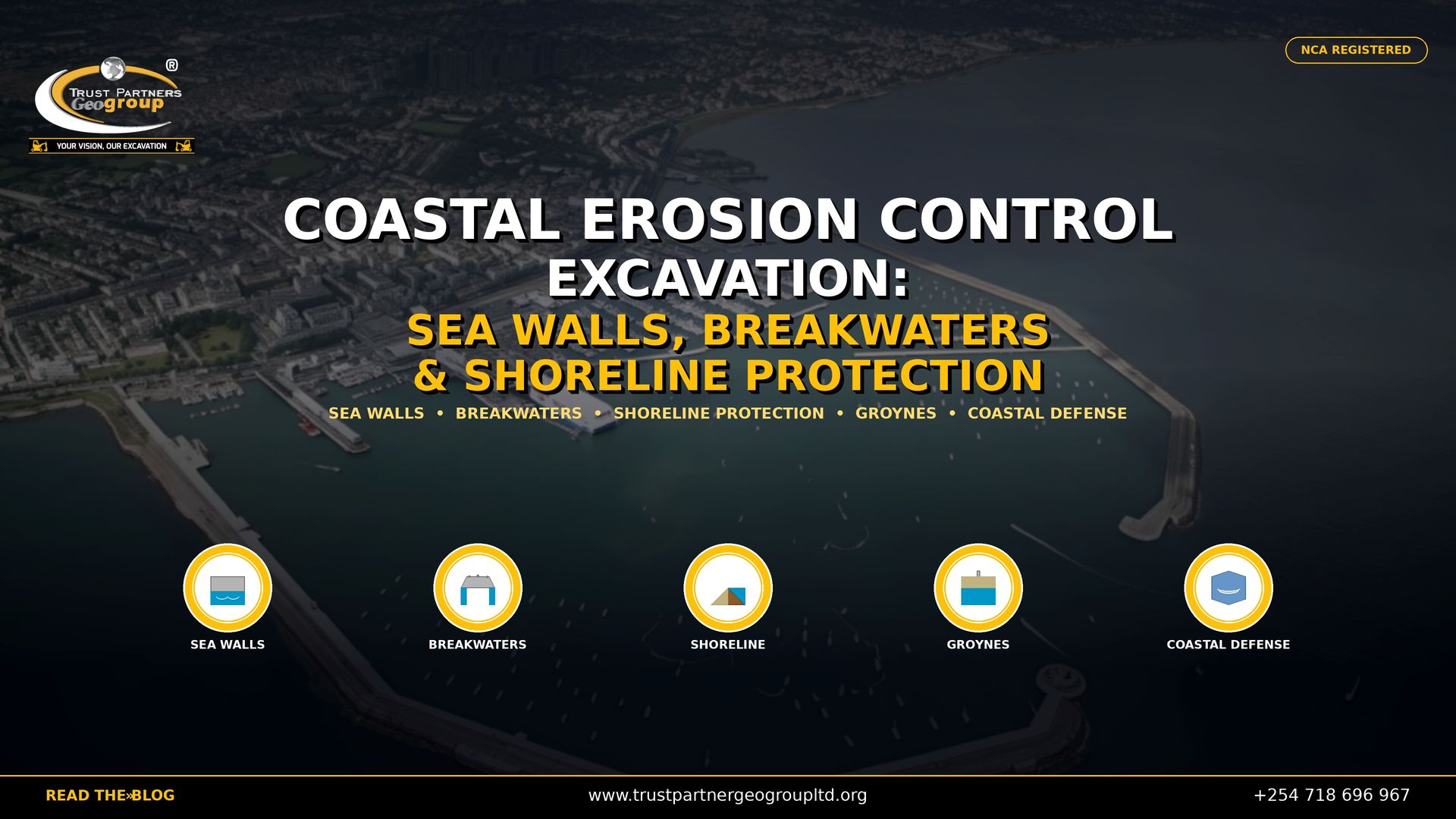
Coastal Erosion Control Excavation: Sea Walls, Breakwaters and Shoreline Protection in Mombasa and Lamu [2026]
Shoreline Protection & Marine Earthworks for Kenya's Coast — Hotels, Ports, Roads & Communities
Kenya's 536-kilometre coastline is losing ground — hotel frontages in Diani and Malindi, road edges in Mombasa and Kilifi, community land on the Lamu archipelago. Coastal erosion control excavation is the engineered response: sea wall foundations keyed into coral ragstone below scour depth, breakwaters that kill wave energy offshore, and shoreline protection that holds the beach instead of surrendering it. This 2026 engineering guide covers sea wall foundations in Mombasa, breakwater construction in Lamu, shoreline protection excavation and marine construction in Kenya — from Diani to Watamu to the Lamu channel — with methods, specifications, costs and the NEMA/KMA compliance pathway. With 15+ years of excavation experience across Kenya, Trust Partners Geo-Group delivers both programmed coastal works and emergency storm response.

From hotel-frontage sea walls to channel breakwaters, our team delivers coastal protection across Kenya's shoreline — founded below scour depth, armoured for the storm season, and built around the tide table.
1. Coastal Erosion in Kenya: The 2026 Landscape
The Kenyan coast earns its living from the edge — tourism frontages, port infrastructure, coastal roads and fishing communities all sit within metres of the waterline. That edge is moving. Four forces are driving the 2026 coastal protection workload:
- Sea level rise and storm intensity: higher baseline sea levels put storm waves further up the beach profile; frontages that flooded once a decade now flood several times a year.
- Interruption of sediment supply: dammed rivers, dredged channels and hard structures starve beaches of the sand that used to rebuild them naturally after each storm season.
- Legacy hard structures: poorly designed vertical walls from previous decades reflect wave energy, scour their own toes and export erosion to the neighbouring plot — the coast's most expensive lesson.
- Coastal development pressure: hotels, apartments and roads press against the active beach zone, leaving no natural buffer and making engineered protection the only remaining option.
Coastal protection is the saltwater sibling of the riverbank works we covered in our riverbank protection excavation guide — the same foundation-and-armour logic, but with tides, wave energy and a far more aggressive construction environment.
2. What Is Coastal Erosion Control Excavation?
Coastal erosion control excavation is the marine earthworks discipline that prepares and constructs engineered defences along eroding shorelines. It combines five toolkits, selected by the coastal assessment:
- Sea walls — onshore structures that protect the land directly behind them; modern designs are sloped or stepped to absorb rather than reflect wave energy.
- Breakwaters — offshore or shore-connected rubble-mound structures that dissipate wave energy before it reaches the beach, often allowing sand to accrete in their lee.
- Groynes — shore-perpendicular structures that interrupt longshore drift and hold sand on the beach.
- Revetments — sloped armour layers (rock, gabion mattresses, concrete units) on the shoreline face — the most beach-friendly hard option.
- Beach nourishment support works — dune reconstruction, access earthworks and containment structures that make soft nourishment schemes hold.
Every option stands or falls on the same principle as our highland slope stabilization work: manage the driving force first — here, wave energy and scour instead of pore pressure — then build structure on a foundation the sea cannot excavate.
3. Sea Wall Foundation Excavation: Building on the Tide Line
Wave scour is to a sea wall what flood scour is to a gabion weir — the failure mechanism that decides everything. Sea wall foundation excavation in Mombasa and along the coast follows a consistent specification:
| Element | Typical Specification | Why It Matters |
|---|---|---|
| Foundation depth | Below design scour depth — typically 1.0–2.5 m below beach level; keyed into coral ragstone where present | Wave scour at the toe is the number-one killer of coastal walls |
| Toe protection | Armour-stone toe trench or launch apron seaward of the wall face | Absorbs the scour hole that develops in front of every hard structure |
| Bed preparation | Excavate loose sand and coral debris to dense strata or ragstone; level to tight tolerance | Prevents settlement, rotation and armour displacement |
| Filter layers | Geotextile plus graded stone underlayers beneath all armour | Stops wave action pumping sand out through the structure |
| Armour stone | Hard, dense rock — typically 1–3 tonnes per unit for revetments, larger for exposed breakwaters | Undersized armour is plucked out by the first major swell |
| Flank returns | Return walls keyed well into the backshore at both ends | Stops the sea outflanking the structure at its ends |
| Materials durability | Marine-grade concrete, PVC-coated or heavily galvanised gabion mesh, corrosion-resistant reinforcement | Salt water attacks ordinary steel and mesh within years |
Intertidal foundation excavation is a tide-table discipline: sections are opened at low tide, founded and armoured before the tide returns, working in short lengths with plant that never stands where a rising tide can trap it. Where the foundation is coral ragstone — the coast's near-surface rock — our hydraulic breaking and controlled rock removal methods shape the foundation bench without blasting in the marine environment.
4. Breakwater and Groyne Construction: Stopping the Wave Before the Shore
Where a frontage must keep its beach — hotel strips, public beaches, port approaches — offshore and shore-perpendicular structures do what no onshore wall can:
- Detached offshore breakwaters: rubble-mound structures placed 50–150 m off the beach. Waves break on the mound; the calmer water behind drops its sand load, and the beach actually grows seaward (a salient or tombolo). The preferred solution for eroding hotel frontages that cannot afford to lose beach.
- Shore-connected breakwaters: for harbour entrances and channel protection — Lamu's port and jetty works, Mombasa's creek crossings — built by landward extension, tipping and placing armour from the advancing structure itself.
- Groynes: low shore-perpendicular walls that interrupt longshore sand transport. Effective where drift is the dominant erosion driver; always designed as a field (several groynes), because each one starves the downdrift neighbour of sand.
- Construction method: core material end-tipped from the advancing crest, underlayers and armour placed by long-reach excavator and crane; marine survey controls position and profile. Construction windows follow the calm-sea season — breakwater construction in Lamu and the north coast typically programmes the kaskazi months (December–March).
5. Shoreline Protection: Revetments, Gabions and Beach Works
Most Kenyan coastal projects are not grand breakwater schemes — they are practical shoreline protection on real budgets:
- Rock revetments: a sloped armour face (1V:2H or flatter) of sized rock over geotextile and underlayers, founded in a toe trench below scour depth. The most forgiving, most repairable, and most beach-compatible hard protection — and the default for coastal roads and community frontages.
- Gabion revetments and walls: PVC-coated gabion mattresses and stepped gabion walls using imported hard stone — the same technology as our riverbank gabion works, with marine-grade mesh and heavier foundation keying. Ideal for creek edges, estuary banks and lower-energy shorelines.
- Sea wall stems and crest works: where a wall is unavoidable — tight urban frontages, road edges — sloped or recurved faces, deep toes and generous armour aprons replace the reflective vertical walls of the past.
- Dune and beach works: regrading scarped dunes to stable profiles, replanting with indigenous dune vegetation, and access earthworks for nourishment sand placement — the soft measures that extend the life of every hard structure.
- Drainage behind the line: storm runoff overtopping from the landward side destroys protection from behind; crest drains and outfalls are part of every section we build. The same drainage-first logic runs through our flood mitigation work in Nairobi.
6. Marine Excavation Challenges: Tides, Salt Water and Coral Ragstone
Coastal excavation punishes generic practice. The environment-specific challenges, and how we handle them:
- Tide programming: intertidal excavation is scheduled to the hour — spring/neap cycles decide which days foundation work is possible at all. Plant positioning, refuelling and maintenance all happen above the highest tide line.
- Salt-water exposure: plant working marine jobs gets accelerated corrosion regimes — daily washdowns, greasing schedules, and hydraulic hose inspection. Machines that skip this discipline do not last a season.
- Coral ragstone: the coast's near-surface rock is both obstacle and opportunity — it must be broken for foundations, but a keyed-into-ragstone foundation is the best base a coastal structure can have.
- Soft seabeds: creek and estuary sites often sit on metres of soft marine silt; foundation excavation may need to reach depth, or switch to piled structures with earthworks limited to scour aprons and embankments.
- Weather-triggered stoppages: swell forecasts govern the site. An unplanned storm into an open foundation section is the defining risk of coastal earthworks — sections are kept short and closed out daily.
- Environmental sensitivity: turtle nesting beaches, coral reefs, mangroves and seagrass beds all impose method and timing conditions in the EIA licence — silt curtains, no-work windows and exclusion zones are standard.
7. Kenya's Coastal Protection Hotspots: Mombasa to Lamu
| Location | County | Dominant Problem | Typical Protection Works |
|---|---|---|---|
| Diani & South Coast | Kwale | Hotel-frontage beach loss; storm scarping | Detached breakwaters, rock revetments, dune reconstruction |
| Mombasa Island & creeks | Mombasa | Road and property edges on creek shorelines; tidal scour | Gabion and rock revetments, sea wall renewal, crest drainage |
| Nyali–Bamburi–Shanzu | Mombasa | Hotel strip erosion; legacy reflective walls failing | Revetted slopes replacing vertical walls; toe trenching |
| Kilifi Creek & bridge approaches | Kilifi | Creek-bank scour at infrastructure and estates | Gabion mattresses, armour revetments, approach protection |
| Watamu & Malindi | Kilifi | Beach loss at resorts; Sabaki-mouth sediment shifts | Groyne fields, breakwaters, nourishment support works |
| Lamu archipelago | Lamu | Community frontage erosion; port and jetty protection for LAPSSET-related growth | Breakwaters, stone revetments, causeway protection |
| Tana Delta shoreline | Tana River / Lamu | River-mouth bank migration and coastal flooding | Combined riverbank-coastal revetments, dyke raising |
8. Equipment Selection for Coastal Works
| Machine | Role on Coastal Projects |
|---|---|
| Long-reach excavator (15–22 m) | Toe trench excavation, armour and gabion placement from above the tide line — the core marine machine |
| Heavy excavators (30–45 t) with grabs | Armour stone handling and precise placement; breakwater core works |
| Excavator with hydraulic breaker | Coral ragstone foundation shaping and oversized armour splitting |
| Crawler crane | Heavy armour units and precast elements beyond excavator capacity |
| Wheel loaders + tippers | Armour stone haulage — coastal projects live and die on stone logistics to remote shorelines |
| Dewatering pumps | Foundation trench and behind-wall drainage control |
| Barges & work boats (hired in) | Offshore breakwater placement and waterborne survey on major schemes |
Plant for coastal work is drawn from our heavy equipment for hire fleet with marine-duty preparation — corrosion discipline, tide-safe operating procedures and operators with intertidal experience. For storm damage, our 24/7 emergency dispatch mobilises to the coast for scour emergencies and breached defences.
9. Coastal Protection Costs: 2026 Budget Benchmarks
| Work Item | Typical 2026 Range (KES) | Cost Driver |
|---|---|---|
| Rock revetment, supplied & placed | 12,000–30,000 per m² of face | Armour size, stone source, tidal access |
| Sea wall (sloped/stepped), complete | 25,000–60,000 per m² of face | Foundation depth, marine concrete, toe armour |
| Gabion revetment (PVC marine grade) | 9,000–20,000 per m² | Mesh spec, imported stone, access |
| Toe trench excavation (intertidal) | 800–2,000 per m³ | Tide window losses, ragstone breaking |
| Detached breakwater | 150M–600M+ per unit | Water depth, armour weight, marine plant |
| Groyne | 20M–80M each | Length, depth at tip, armour spec |
| Hotel frontage protection (100 m) | 15M–60M | Structure type and beach-works scope |
| Community/county reach protection | 8M–30M per 100 m | Revetted slopes vs structural walls |
| Emergency storm repair | Quoted per event | Mobilization speed, sea state |
10. NEMA, KMA and County Compliance for Coastal Works
The coast is Kenya's most environmentally regulated construction environment:
- NEMA: a full Environmental Impact Assessment licence is effectively mandatory for coastal protection works — with method and timing conditions covering turbidity, mangroves, reefs, seagrass and turtle nesting beaches.
- Kenya Maritime Authority (KMA) & Kenya Ports Authority (KPA): consultation and approvals where works affect navigation channels, port waters or anchorages — standard for breakwater and channel-adjacent construction.
- County governments: Mombasa, Kilifi, Kwale, Lamu and Tana River county approvals, plus public participation for community shorelines — the beach is public land, and designs must preserve access.
- Neighbouring effects: hard structures export erosion downdrift; credible designs include a sediment-transport assessment, and licences increasingly require it.
- NCA: contractor and project registration — see our NCA registration requirements guide.
- Site safety: water plus excavation plus tides — life jackets at the waterline, tide-aware working windows, no lone intertidal work, swell-triggered stoppages and rescue equipment on every coastal site.
11. Frequently Asked Questions
How much does a sea wall cost in Kenya?
In 2026: KES 25,000–60,000 per m² of wall face depending on foundation depth, armour and tidal access — a 100-metre hotel frontage typically runs KES 15–60 million. Rock revetments are cheaper per metre where a sloped section fits. Emergency storm repairs are quoted per event.
What is involved in sea wall foundation excavation in Mombasa?
Excavating the wall base below scour depth into stable material — usually coral ragstone or dense sand — working to tide windows with cofferdams or dewatering where needed, and keying into bedrock so wave scour cannot undermine the wall.
What is the difference between a sea wall and a breakwater?
A sea wall protects the land directly behind it from the shoreline; a breakwater sits offshore and absorbs wave energy before it reaches the beach, often letting sand rebuild in its lee. Many Kenyan projects combine offshore breakwaters with shoreline revetments.
Do I need approval to build a sea wall in Kenya?
Yes — a NEMA EIA licence, county approval, and KMA/KPA consultation where navigation or port waters are affected. Designs must respect the beach as public land and must not transfer erosion to neighbouring properties.
When is the best time for marine construction on the Kenyan coast?
Calm-sea windows — typically December to March (kaskazi) — with intertidal excavation programmed daily around neap low tides. The long rains (April–June) bring the heaviest seas and are reserved for emergency response.
Can erosion control protect a hotel or beachfront plot without losing the beach?
Yes — sloped revetments, offshore breakwaters and beach nourishment protect frontage while preserving the beach. Poorly designed vertical walls reflect wave energy and accelerate beach loss, so current practice favours softer, sloped, combined solutions.
Who does breakwater and shoreline construction in Kenya?
NCA-registered marine and earthworks contractors with coastal experience. Trust Partners Geo-Group delivers sea wall foundations, breakwaters, groynes, revetments and shoreline protection across Mombasa, Lamu, Kilifi, Malindi, Watamu and Diani — call +254 718 686 967.
12. Conclusion: Key the Toe, Slope the Face, Work the Tide
Durable coastal protection in Kenya follows the same three disciplines everywhere from Diani to Lamu: excavate the foundation below scour depth and key it into ragstone or dense strata, face the sea with sloped armour that absorbs rather than reflects, and programme every intertidal hour around the tide table and the calm-sea season — with emergency capability for the storms that ignore the programme.
For hotels, coastal counties, port operators and shoreline communities, the 2026 reality is clear: the sea is taking ground faster, and reflective legacy walls are failing. Modern protection — breakwaters, revetments and properly founded sea walls, often combined with beach works — protects the frontage and the beach at once. It connects directly to our riverbank protection and flood mitigation capability — one integrated water-defence service from the highlands to the coast.
Trust Partners Geo-Group delivers coastal erosion control end-to-end: coastal assessment support, NEMA/KMA compliance guidance, sea wall foundation excavation, breakwater and groyne construction, revetments, beach works and 24/7 storm response — Mombasa, Lamu and the whole Kenyan coast.
Sea Taking Your Shoreline? Protect It Before the Next Storm Season.
Trust Partners Geo-Group delivers NEMA-compliant coastal protection — sea wall foundations, breakwaters, revetments and 24/7 storm response — across Mombasa, Lamu and the entire Kenyan coast.
Call +254 718 686 967 — 24/7 Request a Coastal AssessmentCoastal Erosion Control Excavation: Sea Walls, Breakwaters and Shoreline Protection in Mombasa and Lamu [2026]
Shoreline Protection & Marine Earthworks for Kenya's Coast — Hotels, Ports, Roads & Communities
Kenya's 536-kilometre coastline is losing ground — hotel frontages in Diani and Malindi, road edges in Mombasa and Kilifi, community land on the Lamu archipelago. Coastal erosion control excavation is the engineered response: sea wall foundations keyed into coral ragstone below scour depth, breakwaters that kill wave energy offshore, and shoreline protection that holds the beach instead of surrendering it. This 2026 engineering guide covers sea wall foundations in Mombasa, breakwater construction in Lamu, shoreline protection excavation and marine construction in Kenya — from Diani to Watamu to the Lamu channel — with methods, specifications, costs and the NEMA/KMA compliance pathway. With 15+ years of excavation experience across Kenya, Trust Partners Geo-Group delivers both programmed coastal works and emergency storm response.
From hotel-frontage sea walls to channel breakwaters, our team delivers coastal protection across Kenya's shoreline — founded below scour depth, armoured for the storm season, and built around the tide table.
1. Coastal Erosion in Kenya: The 2026 Landscape
The Kenyan coast earns its living from the edge — tourism frontages, port infrastructure, coastal roads and fishing communities all sit within metres of the waterline. That edge is moving. Four forces are driving the 2026 coastal protection workload:
- Sea level rise and storm intensity: higher baseline sea levels put storm waves further up the beach profile; frontages that flooded once a decade now flood several times a year.
- Interruption of sediment supply: dammed rivers, dredged channels and hard structures starve beaches of the sand that used to rebuild them naturally after each storm season.
- Legacy hard structures: poorly designed vertical walls from previous decades reflect wave energy, scour their own toes and export erosion to the neighbouring plot — the coast's most expensive lesson.
- Coastal development pressure: hotels, apartments and roads press against the active beach zone, leaving no natural buffer and making engineered protection the only remaining option.
Coastal protection is the saltwater sibling of the riverbank works we covered in our riverbank protection excavation guide — the same foundation-and-armour logic, but with tides, wave energy and a far more aggressive construction environment.
2. What Is Coastal Erosion Control Excavation?
Coastal erosion control excavation is the marine earthworks discipline that prepares and constructs engineered defences along eroding shorelines. It combines five toolkits, selected by the coastal assessment:
- Sea walls — onshore structures that protect the land directly behind them; modern designs are sloped or stepped to absorb rather than reflect wave energy.
- Breakwaters — offshore or shore-connected rubble-mound structures that dissipate wave energy before it reaches the beach, often allowing sand to accrete in their lee.
- Groynes — shore-perpendicular structures that interrupt longshore drift and hold sand on the beach.
- Revetments — sloped armour layers (rock, gabion mattresses, concrete units) on the shoreline face — the most beach-friendly hard option.
- Beach nourishment support works — dune reconstruction, access earthworks and containment structures that make soft nourishment schemes hold.
Every option stands or falls on the same principle as our highland slope stabilization work: manage the driving force first — here, wave energy and scour instead of pore pressure — then build structure on a foundation the sea cannot excavate.
3. Sea Wall Foundation Excavation: Building on the Tide Line
Wave scour is to a sea wall what flood scour is to a gabion weir — the failure mechanism that decides everything. Sea wall foundation excavation in Mombasa and along the coast follows a consistent specification:
| Element | Typical Specification | Why It Matters |
|---|---|---|
| Foundation depth | Below design scour depth — typically 1.0–2.5 m below beach level; keyed into coral ragstone where present | Wave scour at the toe is the number-one killer of coastal walls |
| Toe protection | Armour-stone toe trench or launch apron seaward of the wall face | Absorbs the scour hole that develops in front of every hard structure |
| Bed preparation | Excavate loose sand and coral debris to dense strata or ragstone; level to tight tolerance | Prevents settlement, rotation and armour displacement |
| Filter layers | Geotextile plus graded stone underlayers beneath all armour | Stops wave action pumping sand out through the structure |
| Armour stone | Hard, dense rock — typically 1–3 tonnes per unit for revetments, larger for exposed breakwaters | Undersized armour is plucked out by the first major swell |
| Flank returns | Return walls keyed well into the backshore at both ends | Stops the sea outflanking the structure at its ends |
| Materials durability | Marine-grade concrete, PVC-coated or heavily galvanised gabion mesh, corrosion-resistant reinforcement | Salt water attacks ordinary steel and mesh within years |
Intertidal foundation excavation is a tide-table discipline: sections are opened at low tide, founded and armoured before the tide returns, working in short lengths with plant that never stands where a rising tide can trap it. Where the foundation is coral ragstone — the coast's near-surface rock — our hydraulic breaking and controlled rock removal methods shape the foundation bench without blasting in the marine environment.
4. Breakwater and Groyne Construction: Stopping the Wave Before the Shore
Where a frontage must keep its beach — hotel strips, public beaches, port approaches — offshore and shore-perpendicular structures do what no onshore wall can:
- Detached offshore breakwaters: rubble-mound structures placed 50–150 m off the beach. Waves break on the mound; the calmer water behind drops its sand load, and the beach actually grows seaward (a salient or tombolo). The preferred solution for eroding hotel frontages that cannot afford to lose beach.
- Shore-connected breakwaters: for harbour entrances and channel protection — Lamu's port and jetty works, Mombasa's creek crossings — built by landward extension, tipping and placing armour from the advancing structure itself.
- Groynes: low shore-perpendicular walls that interrupt longshore sand transport. Effective where drift is the dominant erosion driver; always designed as a field (several groynes), because each one starves the downdrift neighbour of sand.
- Construction method: core material end-tipped from the advancing crest, underlayers and armour placed by long-reach excavator and crane; marine survey controls position and profile. Construction windows follow the calm-sea season — breakwater construction in Lamu and the north coast typically programmes the kaskazi months (December–March).
5. Shoreline Protection: Revetments, Gabions and Beach Works
Most Kenyan coastal projects are not grand breakwater schemes — they are practical shoreline protection on real budgets:
- Rock revetments: a sloped armour face (1V:2H or flatter) of sized rock over geotextile and underlayers, founded in a toe trench below scour depth. The most forgiving, most repairable, and most beach-compatible hard protection — and the default for coastal roads and community frontages.
- Gabion revetments and walls: PVC-coated gabion mattresses and stepped gabion walls using imported hard stone — the same technology as our riverbank gabion works, with marine-grade mesh and heavier foundation keying. Ideal for creek edges, estuary banks and lower-energy shorelines.
- Sea wall stems and crest works: where a wall is unavoidable — tight urban frontages, road edges — sloped or recurved faces, deep toes and generous armour aprons replace the reflective vertical walls of the past.
- Dune and beach works: regrading scarped dunes to stable profiles, replanting with indigenous dune vegetation, and access earthworks for nourishment sand placement — the soft measures that extend the life of every hard structure.
- Drainage behind the line: storm runoff overtopping from the landward side destroys protection from behind; crest drains and outfalls are part of every section we build. The same drainage-first logic runs through our flood mitigation work in Nairobi.
6. Marine Excavation Challenges: Tides, Salt Water and Coral Ragstone
Coastal excavation punishes generic practice. The environment-specific challenges, and how we handle them:
- Tide programming: intertidal excavation is scheduled to the hour — spring/neap cycles decide which days foundation work is possible at all. Plant positioning, refuelling and maintenance all happen above the highest tide line.
- Salt-water exposure: plant working marine jobs gets accelerated corrosion regimes — daily washdowns, greasing schedules, and hydraulic hose inspection. Machines that skip this discipline do not last a season.
- Coral ragstone: the coast's near-surface rock is both obstacle and opportunity — it must be broken for foundations, but a keyed-into-ragstone foundation is the best base a coastal structure can have.
- Soft seabeds: creek and estuary sites often sit on metres of soft marine silt; foundation excavation may need to reach depth, or switch to piled structures with earthworks limited to scour aprons and embankments.
- Weather-triggered stoppages: swell forecasts govern the site. An unplanned storm into an open foundation section is the defining risk of coastal earthworks — sections are kept short and closed out daily.
- Environmental sensitivity: turtle nesting beaches, coral reefs, mangroves and seagrass beds all impose method and timing conditions in the EIA licence — silt curtains, no-work windows and exclusion zones are standard.
7. Kenya's Coastal Protection Hotspots: Mombasa to Lamu
| Location | County | Dominant Problem | Typical Protection Works |
|---|---|---|---|
| Diani & South Coast | Kwale | Hotel-frontage beach loss; storm scarping | Detached breakwaters, rock revetments, dune reconstruction |
| Mombasa Island & creeks | Mombasa | Road and property edges on creek shorelines; tidal scour | Gabion and rock revetments, sea wall renewal, crest drainage |
| Nyali–Bamburi–Shanzu | Mombasa | Hotel strip erosion; legacy reflective walls failing | Revetted slopes replacing vertical walls; toe trenching |
| Kilifi Creek & bridge approaches | Kilifi | Creek-bank scour at infrastructure and estates | Gabion mattresses, armour revetments, approach protection |
| Watamu & Malindi | Kilifi | Beach loss at resorts; Sabaki-mouth sediment shifts | Groyne fields, breakwaters, nourishment support works |
| Lamu archipelago | Lamu | Community frontage erosion; port and jetty protection for LAPSSET-related growth | Breakwaters, stone revetments, causeway protection |
| Tana Delta shoreline | Tana River / Lamu | River-mouth bank migration and coastal flooding | Combined riverbank-coastal revetments, dyke raising |
8. Equipment Selection for Coastal Works
| Machine | Role on Coastal Projects |
|---|---|
| Long-reach excavator (15–22 m) | Toe trench excavation, armour and gabion placement from above the tide line — the core marine machine |
| Heavy excavators (30–45 t) with grabs | Armour stone handling and precise placement; breakwater core works |
| Excavator with hydraulic breaker | Coral ragstone foundation shaping and oversized armour splitting |
| Crawler crane | Heavy armour units and precast elements beyond excavator capacity |
| Wheel loaders + tippers | Armour stone haulage — coastal projects live and die on stone logistics to remote shorelines |
| Dewatering pumps | Foundation trench and behind-wall drainage control |
| Barges & work boats (hired in) | Offshore breakwater placement and waterborne survey on major schemes |
Plant for coastal work is drawn from our heavy equipment for hire fleet with marine-duty preparation — corrosion discipline, tide-safe operating procedures and operators with intertidal experience. For storm damage, our 24/7 emergency dispatch mobilises to the coast for scour emergencies and breached defences.
9. Coastal Protection Costs: 2026 Budget Benchmarks
| Work Item | Typical 2026 Range (KES) | Cost Driver |
|---|---|---|
| Rock revetment, supplied & placed | 12,000–30,000 per m² of face | Armour size, stone source, tidal access |
| Sea wall (sloped/stepped), complete | 25,000–60,000 per m² of face | Foundation depth, marine concrete, toe armour |
| Gabion revetment (PVC marine grade) | 9,000–20,000 per m² | Mesh spec, imported stone, access |
| Toe trench excavation (intertidal) | 800–2,000 per m³ | Tide window losses, ragstone breaking |
| Detached breakwater | 150M–600M+ per unit | Water depth, armour weight, marine plant |
| Groyne | 20M–80M each | Length, depth at tip, armour spec |
| Hotel frontage protection (100 m) | 15M–60M | Structure type and beach-works scope |
| Community/county reach protection | 8M–30M per 100 m | Revetted slopes vs structural walls |
| Emergency storm repair | Quoted per event | Mobilization speed, sea state |
10. NEMA, KMA and County Compliance for Coastal Works
The coast is Kenya's most environmentally regulated construction environment:
- NEMA: a full Environmental Impact Assessment licence is effectively mandatory for coastal protection works — with method and timing conditions covering turbidity, mangroves, reefs, seagrass and turtle nesting beaches.
- Kenya Maritime Authority (KMA) & Kenya Ports Authority (KPA): consultation and approvals where works affect navigation channels, port waters or anchorages — standard for breakwater and channel-adjacent construction.
- County governments: Mombasa, Kilifi, Kwale, Lamu and Tana River county approvals, plus public participation for community shorelines — the beach is public land, and designs must preserve access.
- Neighbouring effects: hard structures export erosion downdrift; credible designs include a sediment-transport assessment, and licences increasingly require it.
- NCA: contractor and project registration — see our NCA registration requirements guide.
- Site safety: water plus excavation plus tides — life jackets at the waterline, tide-aware working windows, no lone intertidal work, swell-triggered stoppages and rescue equipment on every coastal site.
11. Frequently Asked Questions
How much does a sea wall cost in Kenya?
In 2026: KES 25,000–60,000 per m² of wall face depending on foundation depth, armour and tidal access — a 100-metre hotel frontage typically runs KES 15–60 million. Rock revetments are cheaper per metre where a sloped section fits. Emergency storm repairs are quoted per event.
What is involved in sea wall foundation excavation in Mombasa?
Excavating the wall base below scour depth into stable material — usually coral ragstone or dense sand — working to tide windows with cofferdams or dewatering where needed, and keying into bedrock so wave scour cannot undermine the wall.
What is the difference between a sea wall and a breakwater?
A sea wall protects the land directly behind it from the shoreline; a breakwater sits offshore and absorbs wave energy before it reaches the beach, often letting sand rebuild in its lee. Many Kenyan projects combine offshore breakwaters with shoreline revetments.
Do I need approval to build a sea wall in Kenya?
Yes — a NEMA EIA licence, county approval, and KMA/KPA consultation where navigation or port waters are affected. Designs must respect the beach as public land and must not transfer erosion to neighbouring properties.
When is the best time for marine construction on the Kenyan coast?
Calm-sea windows — typically December to March (kaskazi) — with intertidal excavation programmed daily around neap low tides. The long rains (April–June) bring the heaviest seas and are reserved for emergency response.
Can erosion control protect a hotel or beachfront plot without losing the beach?
Yes — sloped revetments, offshore breakwaters and beach nourishment protect frontage while preserving the beach. Poorly designed vertical walls reflect wave energy and accelerate beach loss, so current practice favours softer, sloped, combined solutions.
Who does breakwater and shoreline construction in Kenya?
NCA-registered marine and earthworks contractors with coastal experience. Trust Partners Geo-Group delivers sea wall foundations, breakwaters, groynes, revetments and shoreline protection across Mombasa, Lamu, Kilifi, Malindi, Watamu and Diani — call +254 718 686 967.
12. Conclusion: Key the Toe, Slope the Face, Work the Tide
Durable coastal protection in Kenya follows the same three disciplines everywhere from Diani to Lamu: excavate the foundation below scour depth and key it into ragstone or dense strata, face the sea with sloped armour that absorbs rather than reflects, and programme every intertidal hour around the tide table and the calm-sea season — with emergency capability for the storms that ignore the programme.
For hotels, coastal counties, port operators and shoreline communities, the 2026 reality is clear: the sea is taking ground faster, and reflective legacy walls are failing. Modern protection — breakwaters, revetments and properly founded sea walls, often combined with beach works — protects the frontage and the beach at once. It connects directly to our riverbank protection and flood mitigation capability — one integrated water-defence service from the highlands to the coast.
Trust Partners Geo-Group delivers coastal erosion control end-to-end: coastal assessment support, NEMA/KMA compliance guidance, sea wall foundation excavation, breakwater and groyne construction, revetments, beach works and 24/7 storm response — Mombasa, Lamu and the whole Kenyan coast.
Sea Taking Your Shoreline? Protect It Before the Next Storm Season.
Trust Partners Geo-Group delivers NEMA-compliant coastal protection — sea wall foundations, breakwaters, revetments and 24/7 storm response — across Mombasa, Lamu and the entire Kenyan coast.
Call +254 718 686 967 — 24/7 Request a Coastal Assessment