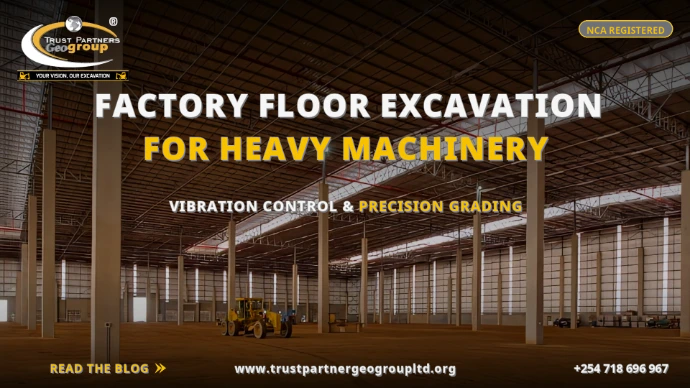
Factory Floor Excavation for Heavy Machinery: Vibration Control & Precision Grading in Kenya
Machine foundations, inertia blocks, vibration isolation & precision grading for manufacturing plants in Nairobi, Athi River, Thika & Nakuru
Table of Contents
- 1. Why Factory Floor Excavation Is Precision Work
- 2. Soil Investigation for Dynamic Machine Loads
- 3. Excavation Depths by Machine Type
- 4. Vibration Control: Mass, Isolation & Damping
- 5. Precision Grading for Machine Baseplates
- 6. Subgrade Compaction & Bearing Standards
- 7. Anchor Bolts, Templates & Positioning Accuracy
- 8. Utility Trenches & Under-Floor Services
- 9. Equipment for Precision Industrial Earthworks
- 10. NEMA, OSHA & County Compliance
- 11. Construction Costs & Programme [2026]
- 12. Frequently Asked Questions
- 13. Conclusion
A forging press that stamps metal with 500 tonnes of force does not tolerate a foundation that settles 2 millimetres. A CNC machining centre that holds tolerances of 0.01mm cannot sit on a floor that heaves with the seasons. In Kenya's growing manufacturing sector - from steel mills in Athi River to textile plants in Eldoret to assembly lines in Nairobi's Special Economic Zones - factory floor excavation Kenya contractors perform is as much about precision metrology as it is about moving dirt. This guide covers the earthworks discipline behind heavy machinery foundation construction: vibration control, inertia blocks, precision grading industrial tolerances, and the subgrade preparation that ensures a machine installed on Monday is still aligned on Monday three years later.
Trust Partners Geo-Group Ltd - Engineering Team
NCA-registered excavation & civil engineering contractor with 15+ years of industrial earthworks, machine foundation construction and precision grading experience across East Africa. Reviewed by registered engineers.
1. Why Factory Floor Excavation Is Precision Work
Most people think of excavation as bulk earthmoving: cut, haul, dump, compact. But machine base excavation Nairobi industrial contractors perform is closer to machining than mining:
- Positional accuracy: a machine foundation 50mm out of position means the production line does not align;
- Level tolerance: a baseplate that is 10mm low at one corner requires expensive epoxy grouting or steel shimming to achieve the manufacturer's flatness specification;
- Vibration control: the earthworks must create a stable mass that does not resonate with the machine's operating frequency;
- Services integration: trenches for power, hydraulics, coolant and compressed air must be positioned exactly where the machine layout dictates - moving a trench after the floor is poured is prohibitively expensive.
The earthworks contractor on a factory project is not just digging holes - they are creating the geometric framework within which every subsequent trade operates. A 5mm error in excavation becomes a 5mm error in concrete, a 5mm error in steel, and a 5mm error in the finished machine installation. In precision manufacturing, that is the difference between a part that fits and scrap.
2. Soil Investigation for Dynamic Machine Loads
Standard geotechnical investigations report bearing capacity and soil type. For heavy machinery, the investigation must also report:
- Dynamic soil properties: shear wave velocity and damping ratio, which determine how vibration propagates through the ground;
- Resonant frequency: the natural frequency of the soil-foundation system must not coincide with the machine's operating frequency (typically 10-50 Hz for rotating equipment, 1-5 Hz for forging hammers);
- Groundwater and seasonal variation: a subgrade that is firm in January may soften in April; machines cannot tolerate seasonal re-leveling;
- Organic content: any decomposing material must be removed entirely - it creates voids that cause differential settlement under cyclic loading.
In Nairobi's industrial belt (Athi River, Kitengela, Ruiru), laterite and murram generally provide excellent bearing (200-400 kPa) and good dynamic characteristics. In contrast, areas with black cotton soil or fill (parts of Mombasa's industrial zone, reclaimed land around Kisumu) require complete soil replacement or pile-supported foundations. The investigation should include plate load tests at the exact foundation locations, not just general boreholes.
3. Excavation Depths by Machine Type
Machine foundations are not one-size-fits-all. The excavation depth and volume depend on the dynamic load case:
| Machine Type | Excavation Depth | Foundation Type | Dynamic Consideration |
|---|---|---|---|
| CNC lathes, mills (light) | 1.0-1.5m | Isolated footing or ribbed block | Low vibration; precision is key |
| Injection moulding presses | 1.5-2.5m | Thick block foundation | Cyclic clamping force; minimal vibration |
| Metal stamping presses | 2.0-3.0m | Inertia block on isolators | High impact; isolation essential |
| Forging hammers | 2.5-4.0m | Massive inertia block (5-8x machine mass) | Extreme impact; wave propagation |
| Large generators | 1.5-2.5m | Block with anti-vibration mounts | Continuous vibration; frequency match |
| Vibrating screens / compactors | 2.0-3.5m | Reinforced block with spring isolators | High-frequency vibration |
The excavation profile must accommodate not just the foundation block but also the working space for formwork, reinforcement, and concrete pouring. A 2m x 2m machine base may require a 3m x 3m excavation to allow for formwork and access. The earthworks contractor must work from structural drawings that show both the net foundation dimensions and the gross excavation dimensions.
4. Vibration Control: Mass, Isolation & Damping
Vibration from heavy machinery affects three things: the machine itself (causing premature wear and poor product quality), neighbouring machines (transmitting error into precision processes), and the building structure (causing fatigue and occupant discomfort). The earthworks phase addresses this through foundation design:
Mass Foundations (Inertia Blocks)
The simplest and most common approach in Kenyan industry: cast a massive reinforced concrete block that is 3-8 times the mass of the machine. The block's inertia resists movement, and its weight dissipates vibration energy into the ground. The earthworks contractor excavates the pit, prepares the subgrade, and often casts a blinding layer that serves as the formwork base. The block is cast directly against the blinding or against temporary formwork.
Vibration Isolation
For sensitive equipment or machines that would otherwise transmit vibration to the building, the foundation block sits on isolation pads: cork, rubber, neoprene, or steel spring mounts. The earthworks contractor must excavate to a precise level because the isolator thickness is fixed - a subgrade that is 10mm too high compresses the isolator and reduces its effectiveness; 10mm too low leaves a gap and creates impact loading.
Trenches and Barriers
Where multiple machines operate in one hall, vibration trenches (open trenches or backfilled with loose material) are sometimes excavated between foundations to interrupt wave propagation. These are typically 300-600mm wide and excavated to 1.5-2m depth, filled with sand or left as air gaps.
5. Precision Grading for Machine Baseplates
Precision grading is what separates industrial earthworks from civil earthworks:
| Application | Level Tolerance | Flatness Tolerance | Verification Method |
|---|---|---|---|
| General factory floor (ambient) | +/- 25mm over 20m | 10mm under 3m straightedge | Dumpy level, visual |
| Assembly line floor | +/- 15mm over 20m | 5mm under 3m straightedge | Laser level, grid survey |
| Machine baseplate (standard) | +/- 10mm over base area | 3mm under 1m straightedge | Auto level, grid at 1m |
| CNC / precision machine base | +/- 5mm over base area | 2mm under 1m straightedge | Precision level, total station |
| Machine rails (overhead cranes, gantries) | +/- 3mm over rail length | 1mm under 1m straightedge | Total station, rail gauge |
Achieving these tolerances in earthworks requires:
- GPS machine control on dozers and graders for rough grading to +/- 50mm;
- Laser-guided fine grading for the final 100mm of subgrade;
- Total station verification of every machine centreline and elevation before blinding;
- No organic or loose material in the final 300mm - any soft spot causes local settlement that breaches tolerance after the machine is installed.
The cost of imprecision
A machine base that is 15mm out of level requires either grinding the concrete (expensive, dusty, slow) or installing steel shims (creates hard points that distort the baseplate). For a large press or CNC machine, re-leveling after installation can cost KES 500,000-2,000,000 in downtime and specialist labor. Achieving +/- 5mm in the earthworks phase costs a fraction of that.
6. Subgrade Compaction & Bearing Standards
Machine foundations demand higher compaction than standard floors because cyclic loads cause ratcheting settlement in loose material:
- General factory floor: 95% Mod AASHTO MDD, upper 300mm at 98%;
- Machine foundation subgrade: 98% MDD for full depth, upper 300mm at 100% MDD;
- Backfill around inertia blocks: selected granular material (crushed stone or graded murram) compacted in 150mm layers to 98% MDD - native clay backfill is prohibited because it consolidates under vibration;
- Bearing capacity: minimum 200 kPa for light machines, 300 kPa for heavy dynamic equipment. Plate load tests verify this at representative locations.
Testing frequency: one nuclear density test per 250 m2 per layer for floor areas, and one test per machine foundation. Proof-rolling with a loaded 10-tonne roller is mandatory - any visible deflection or pumping indicates a soft zone that must be excavated and re-compacted. Our earthworks QA/QC guide details the full testing protocol.
7. Anchor Bolts, Templates & Positioning Accuracy
Anchor bolts are the mechanical connection between machine and foundation. Their position is set during the earthworks/blinding phase and locked in during the concrete pour:
- Template method: a steel template (jig) holds the bolts in exact position while concrete is cast. The template rests on the blinding layer or on temporary supports;
- Positional tolerance: typically +/- 3mm on plan, +/- 5mm on elevation for heavy machinery. CNC machines may demand +/- 2mm;
- Bolt length and embedment: heavy machine bolts are 30-60mm diameter and 1.5-3.0m long, cast into the concrete with hook ends or welded to reinforcement;
- Post-installed anchors: chemical or mechanical anchors drilled into cured concrete are used for lighter equipment but are generally avoided for heavy dynamic loads because the bond can degrade under vibration.
The earthworks contractor's critical contribution is a level, stable blinding layer at the correct elevation. If the blinding is 20mm low, the template sits low, the bolts are low, and the machine installer cannot achieve the required grout thickness beneath the baseplate. If the blinding is uneven, the template rocks and bolt positions shift during concrete vibration.
8. Utility Trenches & Under-Floor Services
Modern factories run services beneath the floor: electrical trunking, compressed air, coolant lines, hydraulic power packs, and data cables. These must be installed during the earthworks phase before the floor slab is cast:
- Trench excavation: typically 300-600mm wide, 400-800mm deep, with graded falls to drainage points where liquids are involved;
- Trench backfill: selected granular material compacted in 150mm layers to 95% MDD - trenches are common settlement points if backfilled with uncontrolled material;
- Coordination: trench routes must be surveyed and marked before general floor grading begins. A trench that is 500mm off the drawing clashes with a machine foundation or column base;
- Floor boxes and pits: electrical floor boxes, drain pits, and sump pits are excavated as part of the earthworks package and cast into the slab.
The earthworks contractor must maintain accurate as-built records of every trench position and depth. When a machine is relocated five years later, the as-built drawing prevents a backhoe from slicing through a live power cable.
9. Equipment for Precision Industrial Earthworks
The fleet for machine base excavation Nairobi projects emphasizes control over volume:
| Equipment | Role | Precision Feature |
|---|---|---|
| Excavator (13-20t) with GPS bucket | Foundation digging, trenching | Bucket position accuracy +/- 20mm prevents over-dig |
| GPS dozer | Rough grading, fill spreading | Automated blade control to design levels |
| Laser-guided motor grader | Final floor trim | +/- 10mm tolerance on 10m run |
| Smooth drum roller (10t) | Subgrade compaction | Vibratory mode for granular, static for final pass |
| Plate compactor | Trench backfill, confined areas | High-frequency compaction near structures |
| Total station / laser level | Setting out and verification | Machine centreline and bolt template checks |
For the tightest tolerances, the final 50mm of subgrade is often trimmed with small equipment and checked with a dumpy level at 1-meter grid intervals. This is labor-intensive but essential for CNC machines and automated assembly lines where the manufacturer specifies a flatness that the concrete contractor cannot achieve if the subgrade is irregular.
10. NEMA, OSHA & County Compliance
Factory construction in Kenya operates under multiple regulators:
| Requirement | Authority | What It Covers |
|---|---|---|
| Building plan approval | County government | Structural, architectural, fire safety, access |
| EIA license | NEMA | Required for factories above threshold size or with hazardous processes |
| NCA registration | National Construction Authority | Contractor registration for civil and structural works |
| OSHA registration | Directorate of Occupational Safety & Health | Workplace safety, machine guarding, noise exposure |
| Fire clearance | County fire services | Access roads, hydrants, fire-rated compartments |
| Power connection | Kenya Power / ERA | Transformer yards, substation foundations |
The earthworks phase must comply with NEMA conditions on dust suppression (particularly when cutting rock or dry murram), erosion control, and sediment containment. In industrial zones near residential areas (parts of Nairobi's Outer Ring Road, Mombasa's Changamwe), noise and vibration from excavation and compaction may be restricted to daytime hours by county bylaws.
11. Construction Costs & Programme [2026]
Indicative earthworks costs for factory floor and machine foundation preparation in Kenya:
| Item | 2026 Rate | Notes |
|---|---|---|
| Clearing and topsoil strip | KES 70-150/m2 | Full factory footprint plus external works |
| General floor excavation | KES 250-450/m3 | Shallow cut for slab-on-grade floors |
| Machine foundation excavation | KES 400-700/m3 | Includes access for formwork |
| Precision grading and trim | KES 300-500/m2 | Laser-controlled final trim for machine areas |
| Blinding concrete | KES 800-1,200/m2 | 50-100mm lean concrete or sand |
| Trench excavation | KES 1,500-3,000/m | Services trenches, backfill extra |
| Vibration trench (isolation) | KES 2,000-4,000/m | Open or sand-filled trench between machines |
| Granular backfill (selected) | KES 500-800/m3 | Crushed stone or graded murram |
| Density testing and reporting | KES 15,000-30,000/day | Nuclear gauge technician |
All-in project estimates:
- Small factory (1,000 m2, 3-4 machines): KES 3-6 million earthworks;
- Medium plant (3,000 m2, 8-10 machines): KES 8-15 million;
- Large manufacturing complex (5,000+ m2, heavy presses): KES 20-35 million.
Programme: small factories 3-5 weeks; medium plants 6-10 weeks; large complexes 12-18 weeks. Machine foundation excavation is typically on the critical path because steel erection and equipment installation cannot begin until the inertia blocks are cast and cured. Dry-season execution is preferred - compacting trench backfill or blinding subgrades during heavy rain is inefficient and risks substandard density.
12. Frequently Asked Questions: Factory Floor Excavation in Kenya
How deep are machine foundations excavated for heavy factory equipment?
Machine foundation excavation depths in Kenya vary by equipment type and dynamic loading: light machine tools and CNC mills typically require 1.0-1.5m deep isolated footings; medium presses and lathes need 1.5-2.5m deep block foundations; heavy forging hammers and stamping presses require 2.5-4.0m deep inertia blocks with mass concrete; and vibrating screens, crushers and generators need 2.0-3.5m deep foundations with anti-vibration mounts. The key factor is not just static weight but the dynamic force generated during operation - a 50-tonne forging hammer generates impact forces that require a foundation mass 5-8 times the machine weight to absorb vibration and prevent resonance.
What is precision grading and why does it matter for machine installation?
Precision grading is the earthworks discipline of achieving extremely tight level and flatness tolerances on subgrades and blinding layers so that machine baseplates can be installed without shimming or grinding. For heavy machinery, typical tolerances are +/- 5mm over 3 meters for machine rails and +/- 10mm over 10 meters for general floor areas. CNC machine tools may require +/- 2mm over the entire baseplate area. If the earthworks contractor delivers a subgrade that is 20mm high in one corner, the machine installer must either grind concrete, add expensive epoxy shims, or shim the baseplate - all of which compromise alignment accuracy and void manufacturer warranties. Precision grading is achieved with laser levels, total stations and GPS machine control on final trim passes.
How is vibration controlled in heavy machinery foundations?
Vibration control uses three strategies: mass - large inertia blocks of reinforced concrete that absorb and dissipate vibration energy through their own weight; isolation - elastomer pads, spring mounts or cork layers between the machine base and foundation that prevent vibration transmission; and damping - tuned mass dampers or viscoelastic materials that absorb resonant frequencies. In Kenya's industrial plants, inertia blocks are most common: the machine is bolted to a massive concrete block (typically 3-5 times the machine mass) that sits on engineered fill or piles, sometimes with a cork or rubber isolation layer. The earthworks contractor must excavate to precise dimensions because the block is cast against earth faces or formwork that depends on accurate excavation profiles.
What does factory floor excavation cost in Kenya in 2026?
2026 indicative costs for factory floor earthworks in Kenya: clearing and topsoil strip KES 70-150/m2; general floor excavation KES 250-450/m3; machine foundation excavation KES 400-700/m3; precision grading and leveling KES 300-500/m2; blinding concrete KES 800-1,200/m2; inertia block backfill and compaction KES 500-800/m3; utility trench excavation KES 1,500-3,000/m. A small factory (1,000 m2) with 3-4 machine foundations typically runs KES 3-6 million in earthworks. A large manufacturing plant (5,000+ m2) with multiple heavy machine bases, precision floors and extensive trenches can reach KES 20-35 million before structural steel or equipment installation.
What compaction standard applies to machine foundations?
Machine foundations in Kenya are compacted to 98% of maximum dry density (Mod AASHTO) for the full depth of excavation, with the upper 300mm often compacted to 100% MDD where machine baseplates bear directly on engineered fill. Field density tests are performed every 250 m2 per layer, and plate load tests may be required to verify bearing capacity exceeds 200-300 kPa. For vibration-sensitive equipment, the subgrade is sometimes proof-rolled with a 10-tonne vibratory roller to identify loose zones. Backfill around inertia blocks uses selected granular material (crushed stone or graded murram) compacted in 150mm layers - never native clay, which consolidates under cyclic loading and causes settlement that misaligns the machine.
How are anchor bolts installed in machine foundations?
Anchor bolts for heavy machinery are set using steel templates or jigs that hold the bolts in exact position while concrete is poured. The earthworks contractor prepares the excavation and blinding; the structural contractor places the template on the blinding, checks bolt positions with a total station (tolerance typically +/- 3mm on plan, +/- 5mm on elevation), and pours the foundation around it. For very large machines, anchor bolts may be 40-60mm diameter and 2-3 meters long, cast into the concrete or grouted into drilled holes after concrete curing. Post-installed chemical anchors are sometimes used for lighter equipment but are not recommended for heavy dynamic loads. The critical interface is between the earthworks contractor's level blinding and the structural contractor's template accuracy - any error in excavation depth or level propagates into bolt position errors.
What equipment is used for precision factory floor grading?
Precision factory floor grading in Kenya relies on: GPS machine control on dozers and graders for initial rough grading to +/- 50mm; laser-guided screeds or motor graders with laser receivers for final trim to +/- 10mm; total stations for setting out machine centrelines and bolt positions; 10-tonne smooth drum rollers for compaction; and plate compactors for confined areas around foundations. For the tightest tolerances (CNC machine bases, automated assembly lines), the final 50mm of subgrade is often trimmed by hand or with small equipment and checked with a dumpy level or laser level at 1-meter grid intervals. Excavators with GPS bucket control are increasingly used for machine foundation digging to avoid over-excavation that requires expensive concrete fill.
Do factory foundations need special permits in Kenya?
Factory construction in Kenya requires: county building plan approval including structural drawings with foundation details; NEMA EIA license if the factory exceeds threshold size or involves hazardous processes; NCA contractor registration for all civil and structural works; Energy Regulatory Authority approval for plants with significant power demand or captive generation; Occupational Safety and Health (OSHA) registration for manufacturing operations; and county fire safety approval. The earthworks phase itself must comply with NEMA dust and erosion controls, particularly where excavation generates silica dust from rock or concrete aggregate. If the factory uses hazardous chemicals or heavy presses that generate significant vibration, additional structural engineering review and neighbor notification may be required under county physical planning bylaws.
13. Conclusion: Precision in the Ground, Accuracy in the Product
A factory floor is not a car park. It is a dimensional reference plane that must remain stable and level while tonnes of steel stamp, forge, cut and assemble above it. The earthworks contractor who treats machine foundation excavation as precision engineering - maintaining +/- 5mm on baseplates, compacting to 100% MDD under dynamic loads, and backfilling with selected granular material - prevents the settlement, vibration and misalignment that destroy machine accuracy and product quality.
Trust Partners Geo-Group Ltd delivers precision factory floor earthworks across Kenya: machine foundation excavation with GPS bucket control, laser-guided final grading to +/- 10mm, subgrade compaction to 98-100% MDD with documented testing, blinding and template preparation for anchor bolts, and utility trench excavation with as-built survey. We work to your structural engineer's hold points and deliver subgrades ready for machines that hold tolerances measured in microns - on unit-rate or lump-sum contracts, with NCA-registered crews and precision equipment.
Factory Floor Excavation & Machine Foundation Groundworks
Precision machine foundation excavation, vibration isolation groundworks, laser-graded floors and utility trenches for manufacturing plants across Kenya.
Free lead magnet: ask for our Machine Foundation Earthworks Checklist (PDF) - excavation tolerances, compaction frequencies, bolt template hold points and precision grading records your machine installer will require.
Related Resources
Cold Storage Facility Excavation: Insulated Foundations & Frost Line Considerations in Kenya
The previous blog in our industrial series - deep excavation, thermal breaks and insulation for refrigerated warehouses.
READ MOREWarehouse Foundation Excavation in Kenya: Slab-on-Grade vs. Raised Floor Systems
Industrial floor earthworks for ambient warehouses, logistics parks and distribution centres.
READ MOREAggregate Crushing Plant Site Preparation: Excavation, Grading & Foundation Works
Heavy dynamic equipment foundations for quarry and aggregate processing plants.
READ MOREEarthworks QA/QC: Compaction Testing & Density Control
The layer-by-layer testing regime every machine foundation and factory floor demands.
READ MOREBulk Excavation Cost Per Cubic Meter in Kenya [2026 Updated Rates]
Transparent pricing for the mass earthworks behind every industrial platform and machine base.
READ MOREFoundation Excavation in Black Cotton Soil: Stabilization Techniques
Handling expansive clays that must be removed before precision machine foundations are cast.
READ MORETRUST PARTNERS GEO-GROUP LTD | YOUR VISION, OUR EXCAVATION
WEBSITE: WWW.TRUSTPARTNERGEOGROUPLTD.ORG | EMAIL: INFO@TRUSTPARTNERGEOGROUPLTD.ORG | PHONE: +254 718 68 69 67
FOLLOW US: FACEBOOK | TIKTOK | INSTAGRAM | YOUTUBE | LINKEDIN
© 2026 TRUST PARTNERS GEO-GROUP LTD. ALL RIGHTS RESERVED.
Factory Floor Excavation for Heavy Machinery: Vibration Control & Precision Grading in Kenya
Machine foundations, inertia blocks, vibration isolation & precision grading for manufacturing plants in Nairobi, Athi River, Thika & Nakuru
Table of Contents
- 1. Why Factory Floor Excavation Is Precision Work
- 2. Soil Investigation for Dynamic Machine Loads
- 3. Excavation Depths by Machine Type
- 4. Vibration Control: Mass, Isolation & Damping
- 5. Precision Grading for Machine Baseplates
- 6. Subgrade Compaction & Bearing Standards
- 7. Anchor Bolts, Templates & Positioning Accuracy
- 8. Utility Trenches & Under-Floor Services
- 9. Equipment for Precision Industrial Earthworks
- 10. NEMA, OSHA & County Compliance
- 11. Construction Costs & Programme [2026]
- 12. Frequently Asked Questions
- 13. Conclusion
A forging press that stamps metal with 500 tonnes of force does not tolerate a foundation that settles 2 millimetres. A CNC machining centre that holds tolerances of 0.01mm cannot sit on a floor that heaves with the seasons. In Kenya's growing manufacturing sector - from steel mills in Athi River to textile plants in Eldoret to assembly lines in Nairobi's Special Economic Zones - factory floor excavation Kenya contractors perform is as much about precision metrology as it is about moving dirt. This guide covers the earthworks discipline behind heavy machinery foundation construction: vibration control, inertia blocks, precision grading industrial tolerances, and the subgrade preparation that ensures a machine installed on Monday is still aligned on Monday three years later.
Trust Partners Geo-Group Ltd - Engineering Team
NCA-registered excavation & civil engineering contractor with 15+ years of industrial earthworks, machine foundation construction and precision grading experience across East Africa. Reviewed by registered engineers.
1. Why Factory Floor Excavation Is Precision Work
Most people think of excavation as bulk earthmoving: cut, haul, dump, compact. But machine base excavation Nairobi industrial contractors perform is closer to machining than mining:
- Positional accuracy: a machine foundation 50mm out of position means the production line does not align;
- Level tolerance: a baseplate that is 10mm low at one corner requires expensive epoxy grouting or steel shimming to achieve the manufacturer's flatness specification;
- Vibration control: the earthworks must create a stable mass that does not resonate with the machine's operating frequency;
- Services integration: trenches for power, hydraulics, coolant and compressed air must be positioned exactly where the machine layout dictates - moving a trench after the floor is poured is prohibitively expensive.
The earthworks contractor on a factory project is not just digging holes - they are creating the geometric framework within which every subsequent trade operates. A 5mm error in excavation becomes a 5mm error in concrete, a 5mm error in steel, and a 5mm error in the finished machine installation. In precision manufacturing, that is the difference between a part that fits and scrap.
2. Soil Investigation for Dynamic Machine Loads
Standard geotechnical investigations report bearing capacity and soil type. For heavy machinery, the investigation must also report:
- Dynamic soil properties: shear wave velocity and damping ratio, which determine how vibration propagates through the ground;
- Resonant frequency: the natural frequency of the soil-foundation system must not coincide with the machine's operating frequency (typically 10-50 Hz for rotating equipment, 1-5 Hz for forging hammers);
- Groundwater and seasonal variation: a subgrade that is firm in January may soften in April; machines cannot tolerate seasonal re-leveling;
- Organic content: any decomposing material must be removed entirely - it creates voids that cause differential settlement under cyclic loading.
In Nairobi's industrial belt (Athi River, Kitengela, Ruiru), laterite and murram generally provide excellent bearing (200-400 kPa) and good dynamic characteristics. In contrast, areas with black cotton soil or fill (parts of Mombasa's industrial zone, reclaimed land around Kisumu) require complete soil replacement or pile-supported foundations. The investigation should include plate load tests at the exact foundation locations, not just general boreholes.
3. Excavation Depths by Machine Type
Machine foundations are not one-size-fits-all. The excavation depth and volume depend on the dynamic load case:
| Machine Type | Excavation Depth | Foundation Type | Dynamic Consideration |
|---|---|---|---|
| CNC lathes, mills (light) | 1.0-1.5m | Isolated footing or ribbed block | Low vibration; precision is key |
| Injection moulding presses | 1.5-2.5m | Thick block foundation | Cyclic clamping force; minimal vibration |
| Metal stamping presses | 2.0-3.0m | Inertia block on isolators | High impact; isolation essential |
| Forging hammers | 2.5-4.0m | Massive inertia block (5-8x machine mass) | Extreme impact; wave propagation |
| Large generators | 1.5-2.5m | Block with anti-vibration mounts | Continuous vibration; frequency match |
| Vibrating screens / compactors | 2.0-3.5m | Reinforced block with spring isolators | High-frequency vibration |
The excavation profile must accommodate not just the foundation block but also the working space for formwork, reinforcement, and concrete pouring. A 2m x 2m machine base may require a 3m x 3m excavation to allow for formwork and access. The earthworks contractor must work from structural drawings that show both the net foundation dimensions and the gross excavation dimensions.
4. Vibration Control: Mass, Isolation & Damping
Vibration from heavy machinery affects three things: the machine itself (causing premature wear and poor product quality), neighbouring machines (transmitting error into precision processes), and the building structure (causing fatigue and occupant discomfort). The earthworks phase addresses this through foundation design:
Mass Foundations (Inertia Blocks)
The simplest and most common approach in Kenyan industry: cast a massive reinforced concrete block that is 3-8 times the mass of the machine. The block's inertia resists movement, and its weight dissipates vibration energy into the ground. The earthworks contractor excavates the pit, prepares the subgrade, and often casts a blinding layer that serves as the formwork base. The block is cast directly against the blinding or against temporary formwork.
Vibration Isolation
For sensitive equipment or machines that would otherwise transmit vibration to the building, the foundation block sits on isolation pads: cork, rubber, neoprene, or steel spring mounts. The earthworks contractor must excavate to a precise level because the isolator thickness is fixed - a subgrade that is 10mm too high compresses the isolator and reduces its effectiveness; 10mm too low leaves a gap and creates impact loading.
Trenches and Barriers
Where multiple machines operate in one hall, vibration trenches (open trenches or backfilled with loose material) are sometimes excavated between foundations to interrupt wave propagation. These are typically 300-600mm wide and excavated to 1.5-2m depth, filled with sand or left as air gaps.
5. Precision Grading for Machine Baseplates
Precision grading is what separates industrial earthworks from civil earthworks:
| Application | Level Tolerance | Flatness Tolerance | Verification Method |
|---|---|---|---|
| General factory floor (ambient) | +/- 25mm over 20m | 10mm under 3m straightedge | Dumpy level, visual |
| Assembly line floor | +/- 15mm over 20m | 5mm under 3m straightedge | Laser level, grid survey |
| Machine baseplate (standard) | +/- 10mm over base area | 3mm under 1m straightedge | Auto level, grid at 1m |
| CNC / precision machine base | +/- 5mm over base area | 2mm under 1m straightedge | Precision level, total station |
| Machine rails (overhead cranes, gantries) | +/- 3mm over rail length | 1mm under 1m straightedge | Total station, rail gauge |
Achieving these tolerances in earthworks requires:
- GPS machine control on dozers and graders for rough grading to +/- 50mm;
- Laser-guided fine grading for the final 100mm of subgrade;
- Total station verification of every machine centreline and elevation before blinding;
- No organic or loose material in the final 300mm - any soft spot causes local settlement that breaches tolerance after the machine is installed.
The cost of imprecision
A machine base that is 15mm out of level requires either grinding the concrete (expensive, dusty, slow) or installing steel shims (creates hard points that distort the baseplate). For a large press or CNC machine, re-leveling after installation can cost KES 500,000-2,000,000 in downtime and specialist labor. Achieving +/- 5mm in the earthworks phase costs a fraction of that.
6. Subgrade Compaction & Bearing Standards
Machine foundations demand higher compaction than standard floors because cyclic loads cause ratcheting settlement in loose material:
- General factory floor: 95% Mod AASHTO MDD, upper 300mm at 98%;
- Machine foundation subgrade: 98% MDD for full depth, upper 300mm at 100% MDD;
- Backfill around inertia blocks: selected granular material (crushed stone or graded murram) compacted in 150mm layers to 98% MDD - native clay backfill is prohibited because it consolidates under vibration;
- Bearing capacity: minimum 200 kPa for light machines, 300 kPa for heavy dynamic equipment. Plate load tests verify this at representative locations.
Testing frequency: one nuclear density test per 250 m2 per layer for floor areas, and one test per machine foundation. Proof-rolling with a loaded 10-tonne roller is mandatory - any visible deflection or pumping indicates a soft zone that must be excavated and re-compacted. Our earthworks QA/QC guide details the full testing protocol.
7. Anchor Bolts, Templates & Positioning Accuracy
Anchor bolts are the mechanical connection between machine and foundation. Their position is set during the earthworks/blinding phase and locked in during the concrete pour:
- Template method: a steel template (jig) holds the bolts in exact position while concrete is cast. The template rests on the blinding layer or on temporary supports;
- Positional tolerance: typically +/- 3mm on plan, +/- 5mm on elevation for heavy machinery. CNC machines may demand +/- 2mm;
- Bolt length and embedment: heavy machine bolts are 30-60mm diameter and 1.5-3.0m long, cast into the concrete with hook ends or welded to reinforcement;
- Post-installed anchors: chemical or mechanical anchors drilled into cured concrete are used for lighter equipment but are generally avoided for heavy dynamic loads because the bond can degrade under vibration.
The earthworks contractor's critical contribution is a level, stable blinding layer at the correct elevation. If the blinding is 20mm low, the template sits low, the bolts are low, and the machine installer cannot achieve the required grout thickness beneath the baseplate. If the blinding is uneven, the template rocks and bolt positions shift during concrete vibration.
8. Utility Trenches & Under-Floor Services
Modern factories run services beneath the floor: electrical trunking, compressed air, coolant lines, hydraulic power packs, and data cables. These must be installed during the earthworks phase before the floor slab is cast:
- Trench excavation: typically 300-600mm wide, 400-800mm deep, with graded falls to drainage points where liquids are involved;
- Trench backfill: selected granular material compacted in 150mm layers to 95% MDD - trenches are common settlement points if backfilled with uncontrolled material;
- Coordination: trench routes must be surveyed and marked before general floor grading begins. A trench that is 500mm off the drawing clashes with a machine foundation or column base;
- Floor boxes and pits: electrical floor boxes, drain pits, and sump pits are excavated as part of the earthworks package and cast into the slab.
The earthworks contractor must maintain accurate as-built records of every trench position and depth. When a machine is relocated five years later, the as-built drawing prevents a backhoe from slicing through a live power cable.
9. Equipment for Precision Industrial Earthworks
The fleet for machine base excavation Nairobi projects emphasizes control over volume:
| Equipment | Role | Precision Feature |
|---|---|---|
| Excavator (13-20t) with GPS bucket | Foundation digging, trenching | Bucket position accuracy +/- 20mm prevents over-dig |
| GPS dozer | Rough grading, fill spreading | Automated blade control to design levels |
| Laser-guided motor grader | Final floor trim | +/- 10mm tolerance on 10m run |
| Smooth drum roller (10t) | Subgrade compaction | Vibratory mode for granular, static for final pass |
| Plate compactor | Trench backfill, confined areas | High-frequency compaction near structures |
| Total station / laser level | Setting out and verification | Machine centreline and bolt template checks |
For the tightest tolerances, the final 50mm of subgrade is often trimmed with small equipment and checked with a dumpy level at 1-meter grid intervals. This is labor-intensive but essential for CNC machines and automated assembly lines where the manufacturer specifies a flatness that the concrete contractor cannot achieve if the subgrade is irregular.
10. NEMA, OSHA & County Compliance
Factory construction in Kenya operates under multiple regulators:
| Requirement | Authority | What It Covers |
|---|---|---|
| Building plan approval | County government | Structural, architectural, fire safety, access |
| EIA license | NEMA | Required for factories above threshold size or with hazardous processes |
| NCA registration | National Construction Authority | Contractor registration for civil and structural works |
| OSHA registration | Directorate of Occupational Safety & Health | Workplace safety, machine guarding, noise exposure |
| Fire clearance | County fire services | Access roads, hydrants, fire-rated compartments |
| Power connection | Kenya Power / ERA | Transformer yards, substation foundations |
The earthworks phase must comply with NEMA conditions on dust suppression (particularly when cutting rock or dry murram), erosion control, and sediment containment. In industrial zones near residential areas (parts of Nairobi's Outer Ring Road, Mombasa's Changamwe), noise and vibration from excavation and compaction may be restricted to daytime hours by county bylaws.
11. Construction Costs & Programme [2026]
Indicative earthworks costs for factory floor and machine foundation preparation in Kenya:
| Item | 2026 Rate | Notes |
|---|---|---|
| Clearing and topsoil strip | KES 70-150/m2 | Full factory footprint plus external works |
| General floor excavation | KES 250-450/m3 | Shallow cut for slab-on-grade floors |
| Machine foundation excavation | KES 400-700/m3 | Includes access for formwork |
| Precision grading and trim | KES 300-500/m2 | Laser-controlled final trim for machine areas |
| Blinding concrete | KES 800-1,200/m2 | 50-100mm lean concrete or sand |
| Trench excavation | KES 1,500-3,000/m | Services trenches, backfill extra |
| Vibration trench (isolation) | KES 2,000-4,000/m | Open or sand-filled trench between machines |
| Granular backfill (selected) | KES 500-800/m3 | Crushed stone or graded murram |
| Density testing and reporting | KES 15,000-30,000/day | Nuclear gauge technician |
All-in project estimates:
- Small factory (1,000 m2, 3-4 machines): KES 3-6 million earthworks;
- Medium plant (3,000 m2, 8-10 machines): KES 8-15 million;
- Large manufacturing complex (5,000+ m2, heavy presses): KES 20-35 million.
Programme: small factories 3-5 weeks; medium plants 6-10 weeks; large complexes 12-18 weeks. Machine foundation excavation is typically on the critical path because steel erection and equipment installation cannot begin until the inertia blocks are cast and cured. Dry-season execution is preferred - compacting trench backfill or blinding subgrades during heavy rain is inefficient and risks substandard density.
12. Frequently Asked Questions: Factory Floor Excavation in Kenya
How deep are machine foundations excavated for heavy factory equipment?
Machine foundation excavation depths in Kenya vary by equipment type and dynamic loading: light machine tools and CNC mills typically require 1.0-1.5m deep isolated footings; medium presses and lathes need 1.5-2.5m deep block foundations; heavy forging hammers and stamping presses require 2.5-4.0m deep inertia blocks with mass concrete; and vibrating screens, crushers and generators need 2.0-3.5m deep foundations with anti-vibration mounts. The key factor is not just static weight but the dynamic force generated during operation - a 50-tonne forging hammer generates impact forces that require a foundation mass 5-8 times the machine weight to absorb vibration and prevent resonance.
What is precision grading and why does it matter for machine installation?
Precision grading is the earthworks discipline of achieving extremely tight level and flatness tolerances on subgrades and blinding layers so that machine baseplates can be installed without shimming or grinding. For heavy machinery, typical tolerances are +/- 5mm over 3 meters for machine rails and +/- 10mm over 10 meters for general floor areas. CNC machine tools may require +/- 2mm over the entire baseplate area. If the earthworks contractor delivers a subgrade that is 20mm high in one corner, the machine installer must either grind concrete, add expensive epoxy shims, or shim the baseplate - all of which compromise alignment accuracy and void manufacturer warranties. Precision grading is achieved with laser levels, total stations and GPS machine control on final trim passes.
How is vibration controlled in heavy machinery foundations?
Vibration control uses three strategies: mass - large inertia blocks of reinforced concrete that absorb and dissipate vibration energy through their own weight; isolation - elastomer pads, spring mounts or cork layers between the machine base and foundation that prevent vibration transmission; and damping - tuned mass dampers or viscoelastic materials that absorb resonant frequencies. In Kenya's industrial plants, inertia blocks are most common: the machine is bolted to a massive concrete block (typically 3-5 times the machine mass) that sits on engineered fill or piles, sometimes with a cork or rubber isolation layer. The earthworks contractor must excavate to precise dimensions because the block is cast against earth faces or formwork that depends on accurate excavation profiles.
What does factory floor excavation cost in Kenya in 2026?
2026 indicative costs for factory floor earthworks in Kenya: clearing and topsoil strip KES 70-150/m2; general floor excavation KES 250-450/m3; machine foundation excavation KES 400-700/m3; precision grading and leveling KES 300-500/m2; blinding concrete KES 800-1,200/m2; inertia block backfill and compaction KES 500-800/m3; utility trench excavation KES 1,500-3,000/m. A small factory (1,000 m2) with 3-4 machine foundations typically runs KES 3-6 million in earthworks. A large manufacturing plant (5,000+ m2) with multiple heavy machine bases, precision floors and extensive trenches can reach KES 20-35 million before structural steel or equipment installation.
What compaction standard applies to machine foundations?
Machine foundations in Kenya are compacted to 98% of maximum dry density (Mod AASHTO) for the full depth of excavation, with the upper 300mm often compacted to 100% MDD where machine baseplates bear directly on engineered fill. Field density tests are performed every 250 m2 per layer, and plate load tests may be required to verify bearing capacity exceeds 200-300 kPa. For vibration-sensitive equipment, the subgrade is sometimes proof-rolled with a 10-tonne vibratory roller to identify loose zones. Backfill around inertia blocks uses selected granular material (crushed stone or graded murram) compacted in 150mm layers - never native clay, which consolidates under cyclic loading and causes settlement that misaligns the machine.
How are anchor bolts installed in machine foundations?
Anchor bolts for heavy machinery are set using steel templates or jigs that hold the bolts in exact position while concrete is poured. The earthworks contractor prepares the excavation and blinding; the structural contractor places the template on the blinding, checks bolt positions with a total station (tolerance typically +/- 3mm on plan, +/- 5mm on elevation), and pours the foundation around it. For very large machines, anchor bolts may be 40-60mm diameter and 2-3 meters long, cast into the concrete or grouted into drilled holes after concrete curing. Post-installed chemical anchors are sometimes used for lighter equipment but are not recommended for heavy dynamic loads. The critical interface is between the earthworks contractor's level blinding and the structural contractor's template accuracy - any error in excavation depth or level propagates into bolt position errors.
What equipment is used for precision factory floor grading?
Precision factory floor grading in Kenya relies on: GPS machine control on dozers and graders for initial rough grading to +/- 50mm; laser-guided screeds or motor graders with laser receivers for final trim to +/- 10mm; total stations for setting out machine centrelines and bolt positions; 10-tonne smooth drum rollers for compaction; and plate compactors for confined areas around foundations. For the tightest tolerances (CNC machine bases, automated assembly lines), the final 50mm of subgrade is often trimmed by hand or with small equipment and checked with a dumpy level or laser level at 1-meter grid intervals. Excavators with GPS bucket control are increasingly used for machine foundation digging to avoid over-excavation that requires expensive concrete fill.
Do factory foundations need special permits in Kenya?
Factory construction in Kenya requires: county building plan approval including structural drawings with foundation details; NEMA EIA license if the factory exceeds threshold size or involves hazardous processes; NCA contractor registration for all civil and structural works; Energy Regulatory Authority approval for plants with significant power demand or captive generation; Occupational Safety and Health (OSHA) registration for manufacturing operations; and county fire safety approval. The earthworks phase itself must comply with NEMA dust and erosion controls, particularly where excavation generates silica dust from rock or concrete aggregate. If the factory uses hazardous chemicals or heavy presses that generate significant vibration, additional structural engineering review and neighbor notification may be required under county physical planning bylaws.
13. Conclusion: Precision in the Ground, Accuracy in the Product
A factory floor is not a car park. It is a dimensional reference plane that must remain stable and level while tonnes of steel stamp, forge, cut and assemble above it. The earthworks contractor who treats machine foundation excavation as precision engineering - maintaining +/- 5mm on baseplates, compacting to 100% MDD under dynamic loads, and backfilling with selected granular material - prevents the settlement, vibration and misalignment that destroy machine accuracy and product quality.
Trust Partners Geo-Group Ltd delivers precision factory floor earthworks across Kenya: machine foundation excavation with GPS bucket control, laser-guided final grading to +/- 10mm, subgrade compaction to 98-100% MDD with documented testing, blinding and template preparation for anchor bolts, and utility trench excavation with as-built survey. We work to your structural engineer's hold points and deliver subgrades ready for machines that hold tolerances measured in microns - on unit-rate or lump-sum contracts, with NCA-registered crews and precision equipment.
Factory Floor Excavation & Machine Foundation Groundworks
Precision machine foundation excavation, vibration isolation groundworks, laser-graded floors and utility trenches for manufacturing plants across Kenya.
Free lead magnet: ask for our Machine Foundation Earthworks Checklist (PDF) - excavation tolerances, compaction frequencies, bolt template hold points and precision grading records your machine installer will require.
Related Resources
Cold Storage Facility Excavation: Insulated Foundations & Frost Line Considerations in Kenya
The previous blog in our industrial series - deep excavation, thermal breaks and insulation for refrigerated warehouses.
READ MOREWarehouse Foundation Excavation in Kenya: Slab-on-Grade vs. Raised Floor Systems
Industrial floor earthworks for ambient warehouses, logistics parks and distribution centres.
READ MOREAggregate Crushing Plant Site Preparation: Excavation, Grading & Foundation Works
Heavy dynamic equipment foundations for quarry and aggregate processing plants.
READ MOREEarthworks QA/QC: Compaction Testing & Density Control
The layer-by-layer testing regime every machine foundation and factory floor demands.
READ MOREBulk Excavation Cost Per Cubic Meter in Kenya [2026 Updated Rates]
Transparent pricing for the mass earthworks behind every industrial platform and machine base.
READ MOREFoundation Excavation in Black Cotton Soil: Stabilization Techniques
Handling expansive clays that must be removed before precision machine foundations are cast.
READ MORETRUST PARTNERS GEO-GROUP LTD | YOUR VISION, OUR EXCAVATION
WEBSITE: WWW.TRUSTPARTNERGEOGROUPLTD.ORG | EMAIL: INFO@TRUSTPARTNERGEOGROUPLTD.ORG | PHONE: +254 718 68 69 67
FOLLOW US: FACEBOOK | TIKTOK | INSTAGRAM | YOUTUBE | LINKEDIN
© 2026 TRUST PARTNERS GEO-GROUP LTD. ALL RIGHTS RESERVED.