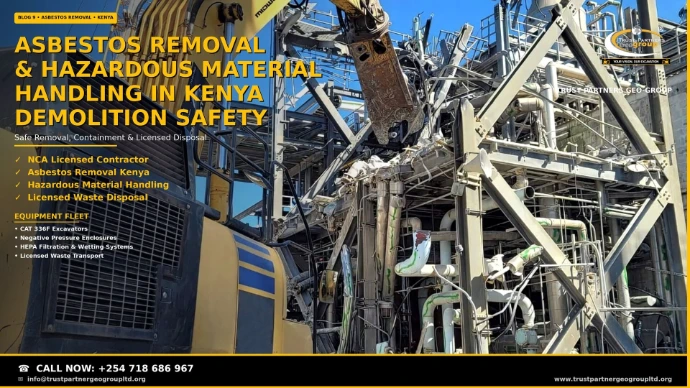
Asbestos Removal and Hazardous Material Handling During Demolition in Kenya
The survey, the containment, the paper trail: how hazardous materials are found, removed and lawfully disposed of before demolition touches them — and what it costs in 2026.

1. Why Hazardous Materials Change the Equation
Ordinary demolition is a production problem; hazardous materials make it a containment problem — the machines wait while specialists in sealed suits work inside engineered enclosures, and the paper trail matters as much as the pickaxe. The materials are invisible to the untrained eye, lethal to the careless, and entirely manageable by the prepared: the difference between a contained line item and an environmental incident is a survey done before mobilisation. This guide covers the full discipline as practised under our services by Trust Partners Geo-Group within our controlled demolition operations — and where hazardous findings move the budget, the demolition cost guide prices exactly how.
2. The Survey First: What Your Building Hides
Asbestos was the default cheap fibre of Kenyan construction for decades — especially 1960s through 1990s — and it hides in predictable places:
- Roofing and cladding: corrugated asbestos-cement sheets on industrial sheds, schools, older residential blocks and estate houses nationwide.
- Ceilings: asbestos-cement boards and tiles, often concealed behind later finishes.
- Pipe lagging and boiler insulation — hospitals, institutions and industrial plant; the most dangerous form, loose and airborne on disturbance.
- Water tanks and gutters — asbestos-cement again.
- Vinyl floor tiles and adhesives — beneath older floors.
- Fire doors and flue pipes — older commercial stock.
The rule: any pre-2000 building carries an asbestos survey before demolition or major renovation touches it — and many later buildings inherited legacy materials in extensions and plant rooms.
3. Asbestos Removal: Method & Containment
The licensed method, step by step:
- Survey and assessment — a refurbishment/demolition survey mapping material, condition and removal scope.
- Isolation and notification — the zone sealed, personnel briefed, neighbours notified.
- Enclosure and negative pressure — interior and insulation work runs inside sealed enclosures with HEPA-filtered negative-air units; no fibre escapes the workspace.
- Wetting and controlled removal — bonded products wetted down, removed whole where possible, handled gently: danger multiplies when sheets crack.
- Decontamination — rated RPE and protective clothing through decontamination units; nobody walks fibres out of the zone.
- Packaging and sealed transport — double-wrapped, labelled, to licensed facilities only.
- Air monitoring and clearance — the zone is tested and certified before reoccupation.
Every step is documented — the paper trail is what NEMA and the health authorities examine, and what protects the client and the next trade.
4. Other Hazardous Materials in Kenyan Demolitions
Asbestos is the headline, not the list. Lead paint — older steelwork, tanks and timber, toxic on abrasive stripping. Chemical and fuel stores — underground tanks and drums at petrol stations, factories and institutions, emptied, cleaned and certified before demolition. Refrigerants — recovered by licensed handlers before plant is scrapped. Fluorescent tubes and batteries — mercury and lead to specialist recycling, never general waste. Medical and laboratory waste — hospitals and research buildings under their own strict rules. Contaminated ground — spills and industrial residues that convert the excavation phase into remediation. Each carries its own method, licensed route and paper trail — the survey's job is to find them all before the machines arrive, because discovery during demolition turns a line item into a programme.
5. Packaging, Transport & Licensed Disposal
The back end of hazardous work is logistics and law. Asbestos waste travels double-wrapped and labelled in sealed vehicles to the small number of facilities licensed for hazardous waste — consigned with documentation at every handover: who generated it, what it is, where it went, who received it. The chain of custody is unbroken or it is non-compliant; the manifests are the proof, and they are examined. For developers, the practical point: disposal certificates and consignment notes belong in the handover file beside the clearance certificate — they are the asset that answers the question an inspector, a buyer or a lender asks years later.
6. Costs & Timelines 2026
| Item | Basis | 2026 Band (KES) |
|---|---|---|
| Asbestos survey (commercial/institutional) | per building | 60,000–150,000 |
| Bonded products removed whole (roofing, cladding, tanks) | per m² of material | 500–1,200 |
| Loose insulation / lagging (enclosed work) | per project | 2–4× the bonded band |
| Negative-pressure enclosures & air management | per work zone | Within removal scope |
| Licensed disposal & manifests | per consignment | Per licensed facility rates |
| Clearance testing & certificate | per zone | Included in professional scope |
The budget insight: asbestos removed before demolition is cheaper than asbestos discovered during demolition — every time. Discovery mid-job stops the machines, erects the enclosures at programme prices and converts a priced scope into a negotiated one.
7. The Compliance File: What NEMA Expects
The file that answers the inspection: the survey report and material register; the removal method statement and crew training records; air-monitoring logs through the work; the waste consignment notes and disposal certificates; the clearance certificate closing each zone; and the contractor's NCA registration and standing — the same registration discipline covered in our guide to NCA contractor registration requirements. Professionals assemble the file as the work proceeds; assembling it afterwards is reconstruction, not documentation.
8. Frequently Asked Questions
Asbestos was the default cheap reinforcing and insulation fibre in Kenyan construction for decades — especially from the 1960s through the 1990s — and it hides in predictable places. Roofing and cladding: the corrugated asbestos-cement sheets ('mabati ya zamani') on industrial sheds, schools, older residential blocks and estate houses across the country. Ceilings: asbestos-cement ceiling boards and tiles, often behind later finishes. Pipe lagging and insulation: around boilers, steam pipes and calorifiers in hospitals, institutions and industrial plant — often the most dangerous form, as insulation fibres are loose and airborne on disturbance. Water tanks and gutters: asbestos-cement products again. Floor tiles and adhesives: vinyl asbestos tiles and the bitumen adhesives beneath older floors. And fire doors and flue pipes in older commercial buildings. The rule: any pre-2000 building should carry an asbestos survey before demolition or major renovation touches it — and many post-2000 buildings inherited legacy materials in extensions and plant rooms.
By containment and discipline, because the material itself cannot be made safe — only the exposure can be prevented. The licensed method: survey and assessment first — a management or refurbishment/demolition survey mapping the material, its condition and its removal scope. Isolation and notification — the work zone sealed, personnel briefed, neighbours notified. Enclosure and negative pressure — removal work, particularly of insulation and interior products, runs inside sealed enclosures with HEPA-filtered negative-air units, so no fibre escapes the workspace. Wetting and controlled removal — bonded products like roofing sheets are wetted down, removed whole where possible, and handled gently: the danger multiplies when sheets crack or are broken. Decontamination — workers in rated RPE and protective clothing pass through decontamination units; no one walks fibres out of the zone. Packaging and sealed transport — double-wrapped, labelled, to licensed facilities only. And air monitoring and clearance — the zone is tested before reoccupation. Every step is documented, because the paper trail is what NEMA and the health authorities examine — and what protects the contractor, the client and the next trade.
Only trained, equipped and documented teams should touch asbestos — and on significant scopes, only licensed specialists. The competence markers: survey competence first — the initial survey itself is a specialist discipline, and its quality decides the safety of everything after it; trained removal crews — workers with documented asbestos-specific training, medical surveillance and fit-tested respiratory protection; method statements — site-specific removal plans, enclosures and emergency procedures; equipment — negative-air machines, HEPA filtration, decontamination units and wetting systems, all testable on site; and documentation — waste consignments, disposal certificates, air-monitoring records and the clearance certificate. The verification habit that protects developers: ask for the clearance certificate and the disposal manifests from the last comparable job. Teams that cannot produce them are telling you exactly how your job will run.
Asbestos is the headline, not the whole list. Lead paint — on older steelwork, tanks and timber, toxic on abrasive stripping and burning. Chemical and fuel stores — underground tanks and drums in petrol stations, factories and institutions, requiring emptying, cleaning and certified disposal before demolition touches them. Refrigerants and gases — CFC and HCFC refrigerants in plant and cold rooms must be recovered by licensed handlers before equipment is scrapped. Fluorescent tubes and batteries — mercury-containing tubes and lead-acid batteries route to specialist recycling, never general waste. Medical and laboratory waste in hospitals and research buildings — sharps, pharmaceuticals and biological waste under their own strict rules. Contaminated ground — fuel spills and industrial residues that turn the excavation phase into a remediation project. Each material carries its own handling method, its own licensed route and its own paper trail — and the survey's job is to find them all before the machines arrive, because discovery during demolition converts a line item into a programme.
Pricing follows the material's form and condition more than its quantity. Surveys — the essential first step — run KES 60,000–150,000 for typical commercial and institutional buildings depending on size and access. Bonded products, removed whole — roofing sheets, cladding, tanks in good condition — typically KES 500–1,200 per m² of material area, the band set by access, height and enclosure needs. Loose insulation and lagging — the high-hazard interior work inside enclosures — prices per project, commonly two to four times the bonded-product band, because labour, air management and monitoring dominate. Disposal rides on top: sealed packaging, licensed transport and gate fees at the small number of facilities licensed for hazardous waste, with consignment documentation. The budget insight: asbestos removal before demolition is cheaper than asbestos discovery during demolition — every time. The demolition cost guide prices how hazardous findings move the overall budget when they arrive late.
Survey First. Remove Licensed. Dispose Documented.
Trust Partners Geo-Group Ltd manages hazardous materials within demolition across Kenya — surveys, enclosed removal, sealed transport, licensed disposal and the compliance file your inspector, buyer or lender will ask for.
Start With a Site Assessment✉️ Contact Us
📞 +254 718 68 69 67
Asbestos Removal and Hazardous Material Handling During Demolition in Kenya
The survey, the containment, the paper trail: how hazardous materials are found, removed and lawfully disposed of before demolition touches them — and what it costs in 2026.
1. Why Hazardous Materials Change the Equation
Ordinary demolition is a production problem; hazardous materials make it a containment problem — the machines wait while specialists in sealed suits work inside engineered enclosures, and the paper trail matters as much as the pickaxe. The materials are invisible to the untrained eye, lethal to the careless, and entirely manageable by the prepared: the difference between a contained line item and an environmental incident is a survey done before mobilisation. This guide covers the full discipline as practised under our services by Trust Partners Geo-Group within our controlled demolition operations — and where hazardous findings move the budget, the demolition cost guide prices exactly how.
2. The Survey First: What Your Building Hides
Asbestos was the default cheap fibre of Kenyan construction for decades — especially 1960s through 1990s — and it hides in predictable places:
- Roofing and cladding: corrugated asbestos-cement sheets on industrial sheds, schools, older residential blocks and estate houses nationwide.
- Ceilings: asbestos-cement boards and tiles, often concealed behind later finishes.
- Pipe lagging and boiler insulation — hospitals, institutions and industrial plant; the most dangerous form, loose and airborne on disturbance.
- Water tanks and gutters — asbestos-cement again.
- Vinyl floor tiles and adhesives — beneath older floors.
- Fire doors and flue pipes — older commercial stock.
The rule: any pre-2000 building carries an asbestos survey before demolition or major renovation touches it — and many later buildings inherited legacy materials in extensions and plant rooms.
3. Asbestos Removal: Method & Containment
The licensed method, step by step:
- Survey and assessment — a refurbishment/demolition survey mapping material, condition and removal scope.
- Isolation and notification — the zone sealed, personnel briefed, neighbours notified.
- Enclosure and negative pressure — interior and insulation work runs inside sealed enclosures with HEPA-filtered negative-air units; no fibre escapes the workspace.
- Wetting and controlled removal — bonded products wetted down, removed whole where possible, handled gently: danger multiplies when sheets crack.
- Decontamination — rated RPE and protective clothing through decontamination units; nobody walks fibres out of the zone.
- Packaging and sealed transport — double-wrapped, labelled, to licensed facilities only.
- Air monitoring and clearance — the zone is tested and certified before reoccupation.
Every step is documented — the paper trail is what NEMA and the health authorities examine, and what protects the client and the next trade.
4. Other Hazardous Materials in Kenyan Demolitions
Asbestos is the headline, not the list. Lead paint — older steelwork, tanks and timber, toxic on abrasive stripping. Chemical and fuel stores — underground tanks and drums at petrol stations, factories and institutions, emptied, cleaned and certified before demolition. Refrigerants — recovered by licensed handlers before plant is scrapped. Fluorescent tubes and batteries — mercury and lead to specialist recycling, never general waste. Medical and laboratory waste — hospitals and research buildings under their own strict rules. Contaminated ground — spills and industrial residues that convert the excavation phase into remediation. Each carries its own method, licensed route and paper trail — the survey's job is to find them all before the machines arrive, because discovery during demolition turns a line item into a programme.
5. Packaging, Transport & Licensed Disposal
The back end of hazardous work is logistics and law. Asbestos waste travels double-wrapped and labelled in sealed vehicles to the small number of facilities licensed for hazardous waste — consigned with documentation at every handover: who generated it, what it is, where it went, who received it. The chain of custody is unbroken or it is non-compliant; the manifests are the proof, and they are examined. For developers, the practical point: disposal certificates and consignment notes belong in the handover file beside the clearance certificate — they are the asset that answers the question an inspector, a buyer or a lender asks years later.
6. Costs & Timelines 2026
| Item | Basis | 2026 Band (KES) |
|---|---|---|
| Asbestos survey (commercial/institutional) | per building | 60,000–150,000 |
| Bonded products removed whole (roofing, cladding, tanks) | per m² of material | 500–1,200 |
| Loose insulation / lagging (enclosed work) | per project | 2–4× the bonded band |
| Negative-pressure enclosures & air management | per work zone | Within removal scope |
| Licensed disposal & manifests | per consignment | Per licensed facility rates |
| Clearance testing & certificate | per zone | Included in professional scope |
The budget insight: asbestos removed before demolition is cheaper than asbestos discovered during demolition — every time. Discovery mid-job stops the machines, erects the enclosures at programme prices and converts a priced scope into a negotiated one.
7. The Compliance File: What NEMA Expects
The file that answers the inspection: the survey report and material register; the removal method statement and crew training records; air-monitoring logs through the work; the waste consignment notes and disposal certificates; the clearance certificate closing each zone; and the contractor's NCA registration and standing — the same registration discipline covered in our guide to NCA contractor registration requirements. Professionals assemble the file as the work proceeds; assembling it afterwards is reconstruction, not documentation.
8. Frequently Asked Questions
Asbestos was the default cheap reinforcing and insulation fibre in Kenyan construction for decades — especially from the 1960s through the 1990s — and it hides in predictable places. Roofing and cladding: the corrugated asbestos-cement sheets ('mabati ya zamani') on industrial sheds, schools, older residential blocks and estate houses across the country. Ceilings: asbestos-cement ceiling boards and tiles, often behind later finishes. Pipe lagging and insulation: around boilers, steam pipes and calorifiers in hospitals, institutions and industrial plant — often the most dangerous form, as insulation fibres are loose and airborne on disturbance. Water tanks and gutters: asbestos-cement products again. Floor tiles and adhesives: vinyl asbestos tiles and the bitumen adhesives beneath older floors. And fire doors and flue pipes in older commercial buildings. The rule: any pre-2000 building should carry an asbestos survey before demolition or major renovation touches it — and many post-2000 buildings inherited legacy materials in extensions and plant rooms.
By containment and discipline, because the material itself cannot be made safe — only the exposure can be prevented. The licensed method: survey and assessment first — a management or refurbishment/demolition survey mapping the material, its condition and its removal scope. Isolation and notification — the work zone sealed, personnel briefed, neighbours notified. Enclosure and negative pressure — removal work, particularly of insulation and interior products, runs inside sealed enclosures with HEPA-filtered negative-air units, so no fibre escapes the workspace. Wetting and controlled removal — bonded products like roofing sheets are wetted down, removed whole where possible, and handled gently: the danger multiplies when sheets crack or are broken. Decontamination — workers in rated RPE and protective clothing pass through decontamination units; no one walks fibres out of the zone. Packaging and sealed transport — double-wrapped, labelled, to licensed facilities only. And air monitoring and clearance — the zone is tested before reoccupation. Every step is documented, because the paper trail is what NEMA and the health authorities examine — and what protects the contractor, the client and the next trade.
Only trained, equipped and documented teams should touch asbestos — and on significant scopes, only licensed specialists. The competence markers: survey competence first — the initial survey itself is a specialist discipline, and its quality decides the safety of everything after it; trained removal crews — workers with documented asbestos-specific training, medical surveillance and fit-tested respiratory protection; method statements — site-specific removal plans, enclosures and emergency procedures; equipment — negative-air machines, HEPA filtration, decontamination units and wetting systems, all testable on site; and documentation — waste consignments, disposal certificates, air-monitoring records and the clearance certificate. The verification habit that protects developers: ask for the clearance certificate and the disposal manifests from the last comparable job. Teams that cannot produce them are telling you exactly how your job will run.
Asbestos is the headline, not the whole list. Lead paint — on older steelwork, tanks and timber, toxic on abrasive stripping and burning. Chemical and fuel stores — underground tanks and drums in petrol stations, factories and institutions, requiring emptying, cleaning and certified disposal before demolition touches them. Refrigerants and gases — CFC and HCFC refrigerants in plant and cold rooms must be recovered by licensed handlers before equipment is scrapped. Fluorescent tubes and batteries — mercury-containing tubes and lead-acid batteries route to specialist recycling, never general waste. Medical and laboratory waste in hospitals and research buildings — sharps, pharmaceuticals and biological waste under their own strict rules. Contaminated ground — fuel spills and industrial residues that turn the excavation phase into a remediation project. Each material carries its own handling method, its own licensed route and its own paper trail — and the survey's job is to find them all before the machines arrive, because discovery during demolition converts a line item into a programme.
Pricing follows the material's form and condition more than its quantity. Surveys — the essential first step — run KES 60,000–150,000 for typical commercial and institutional buildings depending on size and access. Bonded products, removed whole — roofing sheets, cladding, tanks in good condition — typically KES 500–1,200 per m² of material area, the band set by access, height and enclosure needs. Loose insulation and lagging — the high-hazard interior work inside enclosures — prices per project, commonly two to four times the bonded-product band, because labour, air management and monitoring dominate. Disposal rides on top: sealed packaging, licensed transport and gate fees at the small number of facilities licensed for hazardous waste, with consignment documentation. The budget insight: asbestos removal before demolition is cheaper than asbestos discovery during demolition — every time. The demolition cost guide prices how hazardous findings move the overall budget when they arrive late.
Survey First. Remove Licensed. Dispose Documented.
Trust Partners Geo-Group Ltd manages hazardous materials within demolition across Kenya — surveys, enclosed removal, sealed transport, licensed disposal and the compliance file your inspector, buyer or lender will ask for.
Start With a Site Assessment✉️ Contact Us
📞 +254 718 68 69 67