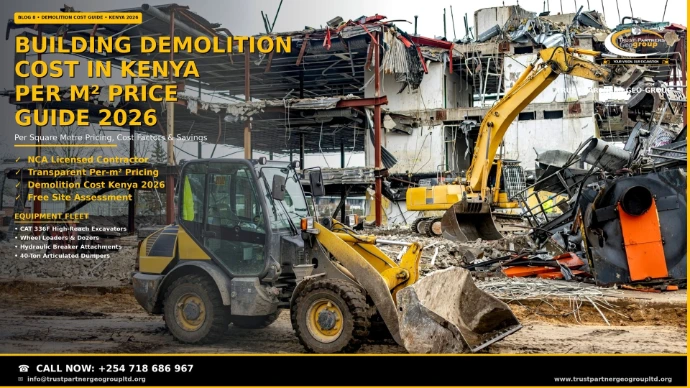
How Much Does Building Demolition Cost in Kenya? Per m² and Per Structure Price Guide 2026
The question every developer asks first — answered with real 2026 numbers: per m² bands by structure type, the eight cost drivers, salvage credits, three worked examples, and the line-by-line method for comparing quotes.

1. The Short Answer: Per m² Bands 2026
| Scope | 2026 Rate (KES/m²) | What Defines It |
|---|---|---|
| Light demolition (single storey, sheds, walls) | 80–150 | Simple structure, open access |
| Medium demolition (2–4 storey framed) | 150–300 | The common urban scope |
| Heavy / high-reach (towers, silos, industrial) | from 800 | Long-reach or top-down methods |
| Strip-out only (interior, structure retained) | 150–450 | See our strip-out guide |
The cross-check that never lies: demolition should total roughly 2–5% of the replacement structure's cost. Everything this article adds — drivers, lines, credits, examples — explains the spread inside those bands, so the quote you sign matches the project you have. The full method sits behind our services, practised by Trust Partners Geo-Group across Kenya under our controlled demolition service.
2. The Eight Cost Drivers
- Access — machines driving straight in can halve the cost of sites where debris crans or winds through live neighbours.
- Height and method — long-reach, top-down and propped sequences multiply the medium base by two to four.
- Adjacency — occupied neighbours add monitoring, protection and sequencing at a 20–50% premium.
- Hazardous materials — asbestos or contamination converts demolition into licensed remediation rates.
- Debris haul distance — KES 300–600 per m³, multiplied by kilometres and gate fees.
- Salvage value — steel at KES 20–35/kg credits real money; planned sequences come out cleaner.
- Below-ground scope — basements, tanks and foundations price separately from the m² rate.
- Programme pressure — nights, weekends and crash schedules carry their premiums.
3. Structure Type by Type
Light scopes — bungalows, sheds, warehouses, boundary works — run KES 80–150 per m²: machines strip and load in days, and the quote's texture is haulage more than method. Medium scopes — the two-to-four storey framed buildings that define Nairobi's renewal — run KES 150–300 per m², the spread set by reinforcement density (steel content drives both the breaking effort and the salvage credit), access, and the neighbour envelope. Heavy and high-reach scopes — towers, silos, industrial frames — price from KES 800 per m² or per structure, where long-reach machines, top-down sequences and extended programmes dominate; these are engineered procurements, not rate-card jobs, and the method statement is the price.
4. The Lines Inside the Quote
The itemisation that separates honest quotes from cheap ones: pre-works surveys (structural, asbestos, services — KES 80,000–250,000); method statement and engineering supervision; protection and monitoring (neighbour condition surveys, vibration meters, dust controls); the demolition operation itself (machines, operators, days); propping and temporary works where structure is retained or undermined; debris management — segregation, crushing where justified, carting at KES 300–600 per m³, gate fees; and demobilisation and making good. A quote missing any line is not cheaper; it is unpriced. The calculator structures the comparison the way this table does.
5. Salvage & Credits: The Offset Ledger
Three credits reduce the net demolition bill. Steel: rebar and sections at KES 20–35 per kilogram through licensed scrap dealers — on a framed building, the single largest credit, planned through the cutting sequence so the steel comes out clean. Crushed aggregate: clean rubble crushed on site at KES 25,000–40,000 per crusher-day replaces bought-in fill and cancels carting — the full economics sit in our demolition waste management guide. Fixtures and fittings: doors, windows, sanitary ware and joinery with resale value through the second-hand market. Netted against the quote, the debris line frequently moves from the project's largest demolition cost to a modest credit.
6. Three Worked Examples
| Project | Basis | Indicative Total (KES) |
|---|---|---|
| Bungalow on open plot (~120 m²) | Light band + haulage | 150K–350K, under 1 week |
| 4-storey framed block (~2,000 m², urban) | Medium band + protection + debris − steel credit | 2.5M–4.5M, 3–6 weeks |
| Commercial strip & re-build prep (~5,000 m²) | Strip-out + partial + phased demolition | 8M–15M, programme-scoped |
Each example is a planning figure, not a quotation — site-specific drivers move every number, which is why the site walk precedes the quote in professional practice.
7. How to Compare Quotes Without Getting Burned
- Restate every bidder's quote on the same lines from Section 4 — fill gaps with written clarifications, not assumptions.
- Check the survey lines exist; their absence is the classic setup for mid-job variations.
- Net the salvage credits explicitly — a higher gross quote with honest credits can be the cheaper net.
- Verify NCA registration, insurance and references — the cheapest unqualified quote prices your risk, not their work.
- Compare totals against the 2–5% rule, then sign the honest number.
8. Frequently Asked Questions
The honest bands for 2026, per square metre of floor area: light demolition — single-storey masonry, sheds, boundary walls, simple warehouses — at KES 80–150 per m². Medium demolition — two-to-four storey framed buildings, the most common urban scope — at KES 150–300 per m², the spread driven by reinforcement density, access and neighbour proximity. High-reach and heavy demolition — towers, silos, industrial structures requiring long-reach machines or top-down methods — priced from KES 800 per m², or per structure, where the plant and programme dominate. Inside every legitimate quote: pre-works surveys (KES 80,000–250,000), the method statement and supervision, dust and vibration controls, debris handling at KES 300–600 per m³, and salvage credits where steel and fixtures have resale value. The cross-check that protects you: demolition should total roughly 2–5% of the replacement structure's cost — a quote far below the bands is missing lines, and the missing lines arrive later as variations.
Eight drivers, in rough order of impact. Access: machines that drive straight in halve the cost of sites where debris must be craned or wheeled out through live neighbours. Height and method: long-reach machines, top-down dismantling and propping multiply the medium-scope base by two to four. Adjacency: working beside occupied buildings or across party walls adds monitoring, protection and sequencing — a 20–50% premium. Hazardous materials: asbestos or contaminated ground turns a demolition job into a remediation programme with licensed disposal rates. Debris haul distance: carting at KES 300–600 per m³ multiplies with kilometres and gate fees. Salvage value: steel at KES 20–35 per kilogram credits real money against the total. Groundwater and rock: below-ground elements and basements price separately. Programme pressure: night work, weekend work and crash programmes carry their premiums. A site walk against these eight produces a quote that survives contact with the project.
Renovation usually wins on cost for structurally sound buildings — retrofitting a sound frame beats rebuilding it almost everywhere. The demolition conversation starts when the structure itself fails the argument: foundations that cannot carry the new programme, layouts that cannot be re-planned economically, frames at end of life, or contamination that remediation cannot rescue at sensible cost. The honest arithmetic weighs the renovation quote against the demolition-plus-rebuild total — demolition at 2–5% of replacement cost is rarely the deciding line; the structure beneath it is. Where demolition wins, the strip-out and salvage discipline decides how much of the cost returns: our companion guide on interior strip-out and partial demolition covers the renovation-side scope, and the waste ledger in our recycling guide prices what the demolition can recover.
Five levers, all pulled before the machines arrive. Get the surveys done early — asbestos, structural and services findings after mobilisation are variations; before it, they are pricing facts. Design for access: one meeting about gate positions and haul routes can save a machine-day a week through the programme. Plan the salvage: steel segregation and fixture recovery at KES 20–35 per kilogram of rebar turn tonnes into credits — plan the sequence so the steel comes out clean. Crush on site: clean rubble to aggregate at KES 25,000–40,000 per crusher-day replaces carting fees and bought-in fill simultaneously. Compare total quotes, not rates: itemise every bidder to the same lines — surveys, method, controls, debris, haulage, credits — and the cheapest true total usually announces itself. What does not reduce cost: skipping the method statement, the dust control or the engineer — those are the lines that convert a saving into a claim.
Duration scales with method and adjacency as much as size. Light single-storey demolition on open sites: days — a machine and two tippers clear a bungalow plot in under a week including carting. Medium framed buildings: two to six weeks for a typical urban block, the top-down sequence, protection works and neighbour logistics setting the pace more than the iron. High-reach and heavy structures: one to three months, sequenced floor by floor. The schedule shape that matters to budgets: demolition rarely exceeds 5% of project cost but routinely sits on its critical path — every week it overruns delays trades priced for standing time. Book the method, the surveys and the permits together at programme stage, and the demolition finishes when the drawing said it would.
Get a Demolition Quote That Survives the Project.
Trust Partners Geo-Group Ltd quotes demolition across Kenya on the full line structure above — surveys, method, protection, debris, credits — with NCA registration, insurance and references presented with every bid. Price yours now.
Estimate Demolition Cost on the Calculator✉️ Contact Us
📞 +254 718 68 69 67
How Much Does Building Demolition Cost in Kenya? Per m² and Per Structure Price Guide 2026
The question every developer asks first — answered with real 2026 numbers: per m² bands by structure type, the eight cost drivers, salvage credits, three worked examples, and the line-by-line method for comparing quotes.
1. The Short Answer: Per m² Bands 2026
| Scope | 2026 Rate (KES/m²) | What Defines It |
|---|---|---|
| Light demolition (single storey, sheds, walls) | 80–150 | Simple structure, open access |
| Medium demolition (2–4 storey framed) | 150–300 | The common urban scope |
| Heavy / high-reach (towers, silos, industrial) | from 800 | Long-reach or top-down methods |
| Strip-out only (interior, structure retained) | 150–450 | See our strip-out guide |
The cross-check that never lies: demolition should total roughly 2–5% of the replacement structure's cost. Everything this article adds — drivers, lines, credits, examples — explains the spread inside those bands, so the quote you sign matches the project you have. The full method sits behind our services, practised by Trust Partners Geo-Group across Kenya under our controlled demolition service.
2. The Eight Cost Drivers
- Access — machines driving straight in can halve the cost of sites where debris crans or winds through live neighbours.
- Height and method — long-reach, top-down and propped sequences multiply the medium base by two to four.
- Adjacency — occupied neighbours add monitoring, protection and sequencing at a 20–50% premium.
- Hazardous materials — asbestos or contamination converts demolition into licensed remediation rates.
- Debris haul distance — KES 300–600 per m³, multiplied by kilometres and gate fees.
- Salvage value — steel at KES 20–35/kg credits real money; planned sequences come out cleaner.
- Below-ground scope — basements, tanks and foundations price separately from the m² rate.
- Programme pressure — nights, weekends and crash schedules carry their premiums.
3. Structure Type by Type
Light scopes — bungalows, sheds, warehouses, boundary works — run KES 80–150 per m²: machines strip and load in days, and the quote's texture is haulage more than method. Medium scopes — the two-to-four storey framed buildings that define Nairobi's renewal — run KES 150–300 per m², the spread set by reinforcement density (steel content drives both the breaking effort and the salvage credit), access, and the neighbour envelope. Heavy and high-reach scopes — towers, silos, industrial frames — price from KES 800 per m² or per structure, where long-reach machines, top-down sequences and extended programmes dominate; these are engineered procurements, not rate-card jobs, and the method statement is the price.
4. The Lines Inside the Quote
The itemisation that separates honest quotes from cheap ones: pre-works surveys (structural, asbestos, services — KES 80,000–250,000); method statement and engineering supervision; protection and monitoring (neighbour condition surveys, vibration meters, dust controls); the demolition operation itself (machines, operators, days); propping and temporary works where structure is retained or undermined; debris management — segregation, crushing where justified, carting at KES 300–600 per m³, gate fees; and demobilisation and making good. A quote missing any line is not cheaper; it is unpriced. The calculator structures the comparison the way this table does.
5. Salvage & Credits: The Offset Ledger
Three credits reduce the net demolition bill. Steel: rebar and sections at KES 20–35 per kilogram through licensed scrap dealers — on a framed building, the single largest credit, planned through the cutting sequence so the steel comes out clean. Crushed aggregate: clean rubble crushed on site at KES 25,000–40,000 per crusher-day replaces bought-in fill and cancels carting — the full economics sit in our demolition waste management guide. Fixtures and fittings: doors, windows, sanitary ware and joinery with resale value through the second-hand market. Netted against the quote, the debris line frequently moves from the project's largest demolition cost to a modest credit.
6. Three Worked Examples
| Project | Basis | Indicative Total (KES) |
|---|---|---|
| Bungalow on open plot (~120 m²) | Light band + haulage | 150K–350K, under 1 week |
| 4-storey framed block (~2,000 m², urban) | Medium band + protection + debris − steel credit | 2.5M–4.5M, 3–6 weeks |
| Commercial strip & re-build prep (~5,000 m²) | Strip-out + partial + phased demolition | 8M–15M, programme-scoped |
Each example is a planning figure, not a quotation — site-specific drivers move every number, which is why the site walk precedes the quote in professional practice.
7. How to Compare Quotes Without Getting Burned
- Restate every bidder's quote on the same lines from Section 4 — fill gaps with written clarifications, not assumptions.
- Check the survey lines exist; their absence is the classic setup for mid-job variations.
- Net the salvage credits explicitly — a higher gross quote with honest credits can be the cheaper net.
- Verify NCA registration, insurance and references — the cheapest unqualified quote prices your risk, not their work.
- Compare totals against the 2–5% rule, then sign the honest number.
8. Frequently Asked Questions
The honest bands for 2026, per square metre of floor area: light demolition — single-storey masonry, sheds, boundary walls, simple warehouses — at KES 80–150 per m². Medium demolition — two-to-four storey framed buildings, the most common urban scope — at KES 150–300 per m², the spread driven by reinforcement density, access and neighbour proximity. High-reach and heavy demolition — towers, silos, industrial structures requiring long-reach machines or top-down methods — priced from KES 800 per m², or per structure, where the plant and programme dominate. Inside every legitimate quote: pre-works surveys (KES 80,000–250,000), the method statement and supervision, dust and vibration controls, debris handling at KES 300–600 per m³, and salvage credits where steel and fixtures have resale value. The cross-check that protects you: demolition should total roughly 2–5% of the replacement structure's cost — a quote far below the bands is missing lines, and the missing lines arrive later as variations.
Eight drivers, in rough order of impact. Access: machines that drive straight in halve the cost of sites where debris must be craned or wheeled out through live neighbours. Height and method: long-reach machines, top-down dismantling and propping multiply the medium-scope base by two to four. Adjacency: working beside occupied buildings or across party walls adds monitoring, protection and sequencing — a 20–50% premium. Hazardous materials: asbestos or contaminated ground turns a demolition job into a remediation programme with licensed disposal rates. Debris haul distance: carting at KES 300–600 per m³ multiplies with kilometres and gate fees. Salvage value: steel at KES 20–35 per kilogram credits real money against the total. Groundwater and rock: below-ground elements and basements price separately. Programme pressure: night work, weekend work and crash programmes carry their premiums. A site walk against these eight produces a quote that survives contact with the project.
Renovation usually wins on cost for structurally sound buildings — retrofitting a sound frame beats rebuilding it almost everywhere. The demolition conversation starts when the structure itself fails the argument: foundations that cannot carry the new programme, layouts that cannot be re-planned economically, frames at end of life, or contamination that remediation cannot rescue at sensible cost. The honest arithmetic weighs the renovation quote against the demolition-plus-rebuild total — demolition at 2–5% of replacement cost is rarely the deciding line; the structure beneath it is. Where demolition wins, the strip-out and salvage discipline decides how much of the cost returns: our companion guide on interior strip-out and partial demolition covers the renovation-side scope, and the waste ledger in our recycling guide prices what the demolition can recover.
Five levers, all pulled before the machines arrive. Get the surveys done early — asbestos, structural and services findings after mobilisation are variations; before it, they are pricing facts. Design for access: one meeting about gate positions and haul routes can save a machine-day a week through the programme. Plan the salvage: steel segregation and fixture recovery at KES 20–35 per kilogram of rebar turn tonnes into credits — plan the sequence so the steel comes out clean. Crush on site: clean rubble to aggregate at KES 25,000–40,000 per crusher-day replaces carting fees and bought-in fill simultaneously. Compare total quotes, not rates: itemise every bidder to the same lines — surveys, method, controls, debris, haulage, credits — and the cheapest true total usually announces itself. What does not reduce cost: skipping the method statement, the dust control or the engineer — those are the lines that convert a saving into a claim.
Duration scales with method and adjacency as much as size. Light single-storey demolition on open sites: days — a machine and two tippers clear a bungalow plot in under a week including carting. Medium framed buildings: two to six weeks for a typical urban block, the top-down sequence, protection works and neighbour logistics setting the pace more than the iron. High-reach and heavy structures: one to three months, sequenced floor by floor. The schedule shape that matters to budgets: demolition rarely exceeds 5% of project cost but routinely sits on its critical path — every week it overruns delays trades priced for standing time. Book the method, the surveys and the permits together at programme stage, and the demolition finishes when the drawing said it would.
Get a Demolition Quote That Survives the Project.
Trust Partners Geo-Group Ltd quotes demolition across Kenya on the full line structure above — surveys, method, protection, debris, credits — with NCA registration, insurance and references presented with every bid. Price yours now.
Estimate Demolition Cost on the Calculator✉️ Contact Us
📞 +254 718 68 69 67