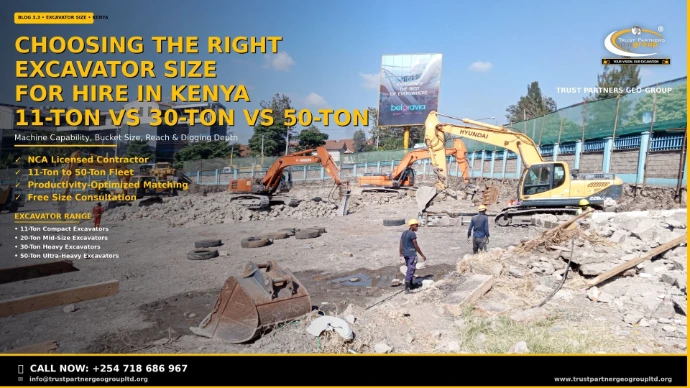
Choosing the Right Excavator Size For Hire in Kenya: 11-Ton vs 30-Ton vs 50-Ton Guide
The wrong size costs you twice — too small stretches the programme, too big burns money and breaks your site. Here is how to match the machine to the job, class by class.

1. Why Size Is the First Decision
Every other hire decision — rate, operator, attachments, truck matching — flows from machine size. Get it right and the job produces; get it wrong and no amount of skilled operating recovers the economics. The sizing mistake runs in both directions: sites rent machines that are too small and watch programmes stretch, or too large and pay for capacity the site cannot use while the machine swings in spaces it should never have entered. This guide gives you the comparison tables and the decision framework to size correctly the first time — our detailed companion analysis walks the same logic with cost worked examples.
2. The Size Classes: Specs Compared
| Parameter | 11-Ton Compact | 30-Ton Heavy | 50-Ton Ultra-Heavy |
|---|---|---|---|
| Typical bucket | 0.3–0.6 m³ | 1.2–1.8 m³ | 2.5–3.5 m³ |
| Max dig depth | 4.5–5.5 m | 6.5–8 m | 8 m+ |
| Hourly output (soil) | 20–40 m³ | 60–120 m³ | 150–250 m³ |
| Access footprint | Standard gates, tight plots | Open sites, wide gates | Major access only |
| Breaker suitability | Light breaking only | Standard rock class | Heavy rock & demolition |
| Daily hire (with operator) | 12,000–20,000 KES | 15,000–25,000 KES | 28,000–40,000 KES |
Rates are indicative wet-hire figures; current numbers in our 2026 price guide. The headline insight from the table: the 30-ton class moves roughly 3× the volume of an 11-ton for barely 25% more money — which is why it dominates Kenya's hire market.
3. Digging Depth, Reach & Bucket Size
Three envelope parameters decide whether a machine can physically do your job:
- Digging depth sets the basement and utility limit. Add the trench or formation depth to the working room needed below it — a 6-metre basement needs a machine whose envelope reaches 7+ metres comfortably.
- Reach governs slope work, loading over edges and demolition. Long-reach variants extend standard booms dramatically for dredging and high-reach demolition.
- Bucket size drives hourly volume — and must match the trucks: a 1.8 m³ bucket loading 20 m³ tippers cycles efficiently; the same bucket against 7 m³ tippers waits all day.
Precision work adds a modern option: GPS machine control turns any class into a finishing tool, digging to design levels without constant survey checks.
4. Matching Size to Scope: The Framework
- Start with depth — the one parameter that can disqualify a class outright. Below 5 metres: compact class viable. 5–8 metres: 30-ton territory. Beyond 8: 50-ton or long-reach.
- Check access — gates, walls, overhead lines and working room. Estate plots cap you at compacts regardless of volume dreams.
- Size volume honestly — thousands of m³ at pace favours the heavy classes; hundreds of m³ on tight ground favours compacts even at equal cost per hour.
- Match the trucks — bucket capacity should fill a tipper in 3–6 passes; adjust machine or fleet together.
- Consider ground — rock breaking, demolition and hard digging all reward carrier weight and breakout force.
5. Cost-per-m³: The Only Fair Comparison
Translate every quote into the same unit: cost per m³ moved = total daily cost ÷ daily production. Example: a 30-ton machine at KES 25,000 all-in producing 90 m³/day costs KES 278 per m³; an 11-ton at KES 15,000 producing 30 m³ costs KES 500 per m³. On bulk work, the bigger machine wins decisively; on a 200 m³ estate plot where the 30-ton cannot swing freely and the 11-ton produces its 30 m³ comfortably, the compact wins its own comparison. The framework never changes — only the site's answer does.
6. Common Sizing Mistakes
- The yard default — hiring whatever the hirer has idle rather than what the job needs; the hirer's convenience is not your specification.
- The bigger-is-better reflex — over-sized machines on tight sites damage drains, walls and pavements, and idle at swing-radius prices.
- Depth amnesia — booking the compact for the basement because 'it dug the septic tank fine'; the last metre costs more than the first five.
- Truck mismatch — a heavy excavator starved by small tippers achieves a fraction of its rated output.
- No size consultation — skipping the free sizing conversation that fleet owners like ours offer; twenty minutes with an experienced foreman prevents the most expensive mistake in hire.
💡 Productivity needs a certified operator
Every figure in this guide assumes a certified operator. The same machine produces 50–100% more with a professional than a casual driver — the cheapest capacity upgrade available on any site.
7. The Fleet That Covers Every Class
The right hirer owns all three classes and profits from recommending correctly — which is the structure of honest advice. Our own range runs 11-ton compacts through 30-ton workhorses — the fleet recently strengthened with four Hyundai HX300SL units — to 50-ton ultra-heavy machines, with the attachments and certified operators to run each at its design productivity. One call covers the sizing conversation, the quote and the mobilisation.
8. Frequently Asked Questions
Match the machine to four project parameters and the answer usually falls out on its own. Depth: residential foundations and drainage need 4–6 metres of dig — an 11–20 ton class; two-level basements and deep services need 6–8 metres — the 30-ton class; mega-basements and quarry work beyond that need 50 tons. Volume: high-production bulk work favours bigger buckets — a 30-ton machine moves roughly 2.5–3 times the m³ per hour of an 11-ton. Access: estate plots and confined sites cap you at the compact class regardless of volume. Ground: heavy rock breaking demands carrier weight behind the breaker. Our detailed size comparison walks the decision with worked examples.
The classes differ on every parameter that matters. An 11-ton compact runs a 0.3–0.6 m³ bucket, digs to about 4–5 metres and fits through standard gates; its value is access, not volume. The 30-ton class — Kenya's hire market backbone — runs 1.2–1.8 m³ buckets, digs to 6–8 metres, and pairs with 20–30 ton tippers in matched production cycles. The 50-ton class runs 2.5–3.5 m³ buckets, digs beyond 8 metres, and carries the heavy breakers and massive flows of quarry and mega-basement work. Digging depth, reach, breakout force, and stability all scale with weight; so do hire rates and mobilisation costs — which is why matching class to scope is a money decision, not just a technical one.
Indicative maximum digging depths on standard booms: 5–8 ton minis reach 3–4.5 metres; 11–15 ton compacts reach 4.5–5.5 metres — the residential workhorse band covering most foundations, septic systems and drainage; 20–25 ton units reach 6–7 metres; the 30-ton class reaches 6.5–8 metres — two-level basements and deep services; and 45–50 ton machines exceed 8 metres with long-reach variants going far deeper for dredging and slope work. Depth matters most for basements and utilities: always match the machine's dig envelope to the design formation level plus working room, or you will pay for a machine that cannot finish its own trench.
No — bigger is only better when the site can feed it. A 50-ton machine on a confined estate plot achieves a fraction of its potential while damaging everything within its swing radius; a 30-ton with a waiting tipper fleet out-produces a 50-ton whose trucks cannot cycle fast enough. Productivity is a system: machine size, bucket capacity, truck matching, ground conditions and operator skill multiply together. The correct question is not 'what is the biggest machine I can afford' but 'what is the cheapest cost per m³ this site can sustain' — and that answer changes site by site. Fleet hirers with every class in their yard, like our 11-to-50-ton range, profit from proposing correctly, which is why their advice is worth taking.
The 30-ton class — the market's workhorse — hires at KES 15,000–25,000 per day with a certified operator in the current market, with weekly packages discounting 5–10% and monthly contracts 10–20%. Add the honest extras: mobilisation (KES 30K–80K regional), fuel at 80–120 litres per productive day, and attachments like breakers at KES 4,000–8,000 per day where rock applies. The full rate picture, including hourly structures, is in our 2026 excavator hire prices guide. Compare quotes on cost per m³ moved, not the daily rate — that is where the real economics live.
Not Sure Which Size? Ask the Fleet That Owns All Three.
Trust Partners Geo-Group Ltd runs 11-ton to 50-ton excavators with certified operators and free size consultation. Describe your job; we will propose the machine that hits your cost per m³.
Get a Free Excavator Size Consultation📞 +254 718 68 69 67
Choosing the Right Excavator Size For Hire in Kenya: 11-Ton vs 30-Ton vs 50-Ton Guide
The wrong size costs you twice — too small stretches the programme, too big burns money and breaks your site. Here is how to match the machine to the job, class by class.
1. Why Size Is the First Decision
Every other hire decision — rate, operator, attachments, truck matching — flows from machine size. Get it right and the job produces; get it wrong and no amount of skilled operating recovers the economics. The sizing mistake runs in both directions: sites rent machines that are too small and watch programmes stretch, or too large and pay for capacity the site cannot use while the machine swings in spaces it should never have entered. This guide gives you the comparison tables and the decision framework to size correctly the first time — our detailed companion analysis walks the same logic with cost worked examples.
2. The Size Classes: Specs Compared
| Parameter | 11-Ton Compact | 30-Ton Heavy | 50-Ton Ultra-Heavy |
|---|---|---|---|
| Typical bucket | 0.3–0.6 m³ | 1.2–1.8 m³ | 2.5–3.5 m³ |
| Max dig depth | 4.5–5.5 m | 6.5–8 m | 8 m+ |
| Hourly output (soil) | 20–40 m³ | 60–120 m³ | 150–250 m³ |
| Access footprint | Standard gates, tight plots | Open sites, wide gates | Major access only |
| Breaker suitability | Light breaking only | Standard rock class | Heavy rock & demolition |
| Daily hire (with operator) | 12,000–20,000 KES | 15,000–25,000 KES | 28,000–40,000 KES |
Rates are indicative wet-hire figures; current numbers in our 2026 price guide. The headline insight from the table: the 30-ton class moves roughly 3× the volume of an 11-ton for barely 25% more money — which is why it dominates Kenya's hire market.
3. Digging Depth, Reach & Bucket Size
Three envelope parameters decide whether a machine can physically do your job:
- Digging depth sets the basement and utility limit. Add the trench or formation depth to the working room needed below it — a 6-metre basement needs a machine whose envelope reaches 7+ metres comfortably.
- Reach governs slope work, loading over edges and demolition. Long-reach variants extend standard booms dramatically for dredging and high-reach demolition.
- Bucket size drives hourly volume — and must match the trucks: a 1.8 m³ bucket loading 20 m³ tippers cycles efficiently; the same bucket against 7 m³ tippers waits all day.
Precision work adds a modern option: GPS machine control turns any class into a finishing tool, digging to design levels without constant survey checks.
4. Matching Size to Scope: The Framework
- Start with depth — the one parameter that can disqualify a class outright. Below 5 metres: compact class viable. 5–8 metres: 30-ton territory. Beyond 8: 50-ton or long-reach.
- Check access — gates, walls, overhead lines and working room. Estate plots cap you at compacts regardless of volume dreams.
- Size volume honestly — thousands of m³ at pace favours the heavy classes; hundreds of m³ on tight ground favours compacts even at equal cost per hour.
- Match the trucks — bucket capacity should fill a tipper in 3–6 passes; adjust machine or fleet together.
- Consider ground — rock breaking, demolition and hard digging all reward carrier weight and breakout force.
5. Cost-per-m³: The Only Fair Comparison
Translate every quote into the same unit: cost per m³ moved = total daily cost ÷ daily production. Example: a 30-ton machine at KES 25,000 all-in producing 90 m³/day costs KES 278 per m³; an 11-ton at KES 15,000 producing 30 m³ costs KES 500 per m³. On bulk work, the bigger machine wins decisively; on a 200 m³ estate plot where the 30-ton cannot swing freely and the 11-ton produces its 30 m³ comfortably, the compact wins its own comparison. The framework never changes — only the site's answer does.
6. Common Sizing Mistakes
- The yard default — hiring whatever the hirer has idle rather than what the job needs; the hirer's convenience is not your specification.
- The bigger-is-better reflex — over-sized machines on tight sites damage drains, walls and pavements, and idle at swing-radius prices.
- Depth amnesia — booking the compact for the basement because 'it dug the septic tank fine'; the last metre costs more than the first five.
- Truck mismatch — a heavy excavator starved by small tippers achieves a fraction of its rated output.
- No size consultation — skipping the free sizing conversation that fleet owners like ours offer; twenty minutes with an experienced foreman prevents the most expensive mistake in hire.
💡 Productivity needs a certified operator
Every figure in this guide assumes a certified operator. The same machine produces 50–100% more with a professional than a casual driver — the cheapest capacity upgrade available on any site.
7. The Fleet That Covers Every Class
The right hirer owns all three classes and profits from recommending correctly — which is the structure of honest advice. Our own range runs 11-ton compacts through 30-ton workhorses — the fleet recently strengthened with four Hyundai HX300SL units — to 50-ton ultra-heavy machines, with the attachments and certified operators to run each at its design productivity. One call covers the sizing conversation, the quote and the mobilisation.
8. Frequently Asked Questions
Match the machine to four project parameters and the answer usually falls out on its own. Depth: residential foundations and drainage need 4–6 metres of dig — an 11–20 ton class; two-level basements and deep services need 6–8 metres — the 30-ton class; mega-basements and quarry work beyond that need 50 tons. Volume: high-production bulk work favours bigger buckets — a 30-ton machine moves roughly 2.5–3 times the m³ per hour of an 11-ton. Access: estate plots and confined sites cap you at the compact class regardless of volume. Ground: heavy rock breaking demands carrier weight behind the breaker. Our detailed size comparison walks the decision with worked examples.
The classes differ on every parameter that matters. An 11-ton compact runs a 0.3–0.6 m³ bucket, digs to about 4–5 metres and fits through standard gates; its value is access, not volume. The 30-ton class — Kenya's hire market backbone — runs 1.2–1.8 m³ buckets, digs to 6–8 metres, and pairs with 20–30 ton tippers in matched production cycles. The 50-ton class runs 2.5–3.5 m³ buckets, digs beyond 8 metres, and carries the heavy breakers and massive flows of quarry and mega-basement work. Digging depth, reach, breakout force, and stability all scale with weight; so do hire rates and mobilisation costs — which is why matching class to scope is a money decision, not just a technical one.
Indicative maximum digging depths on standard booms: 5–8 ton minis reach 3–4.5 metres; 11–15 ton compacts reach 4.5–5.5 metres — the residential workhorse band covering most foundations, septic systems and drainage; 20–25 ton units reach 6–7 metres; the 30-ton class reaches 6.5–8 metres — two-level basements and deep services; and 45–50 ton machines exceed 8 metres with long-reach variants going far deeper for dredging and slope work. Depth matters most for basements and utilities: always match the machine's dig envelope to the design formation level plus working room, or you will pay for a machine that cannot finish its own trench.
No — bigger is only better when the site can feed it. A 50-ton machine on a confined estate plot achieves a fraction of its potential while damaging everything within its swing radius; a 30-ton with a waiting tipper fleet out-produces a 50-ton whose trucks cannot cycle fast enough. Productivity is a system: machine size, bucket capacity, truck matching, ground conditions and operator skill multiply together. The correct question is not 'what is the biggest machine I can afford' but 'what is the cheapest cost per m³ this site can sustain' — and that answer changes site by site. Fleet hirers with every class in their yard, like our 11-to-50-ton range, profit from proposing correctly, which is why their advice is worth taking.
The 30-ton class — the market's workhorse — hires at KES 15,000–25,000 per day with a certified operator in the current market, with weekly packages discounting 5–10% and monthly contracts 10–20%. Add the honest extras: mobilisation (KES 30K–80K regional), fuel at 80–120 litres per productive day, and attachments like breakers at KES 4,000–8,000 per day where rock applies. The full rate picture, including hourly structures, is in our 2026 excavator hire prices guide. Compare quotes on cost per m³ moved, not the daily rate — that is where the real economics live.
Not Sure Which Size? Ask the Fleet That Owns All Three.
Trust Partners Geo-Group Ltd runs 11-ton to 50-ton excavators with certified operators and free size consultation. Describe your job; we will propose the machine that hits your cost per m³.
Get a Free Excavator Size Consultation📞 +254 718 68 69 67