
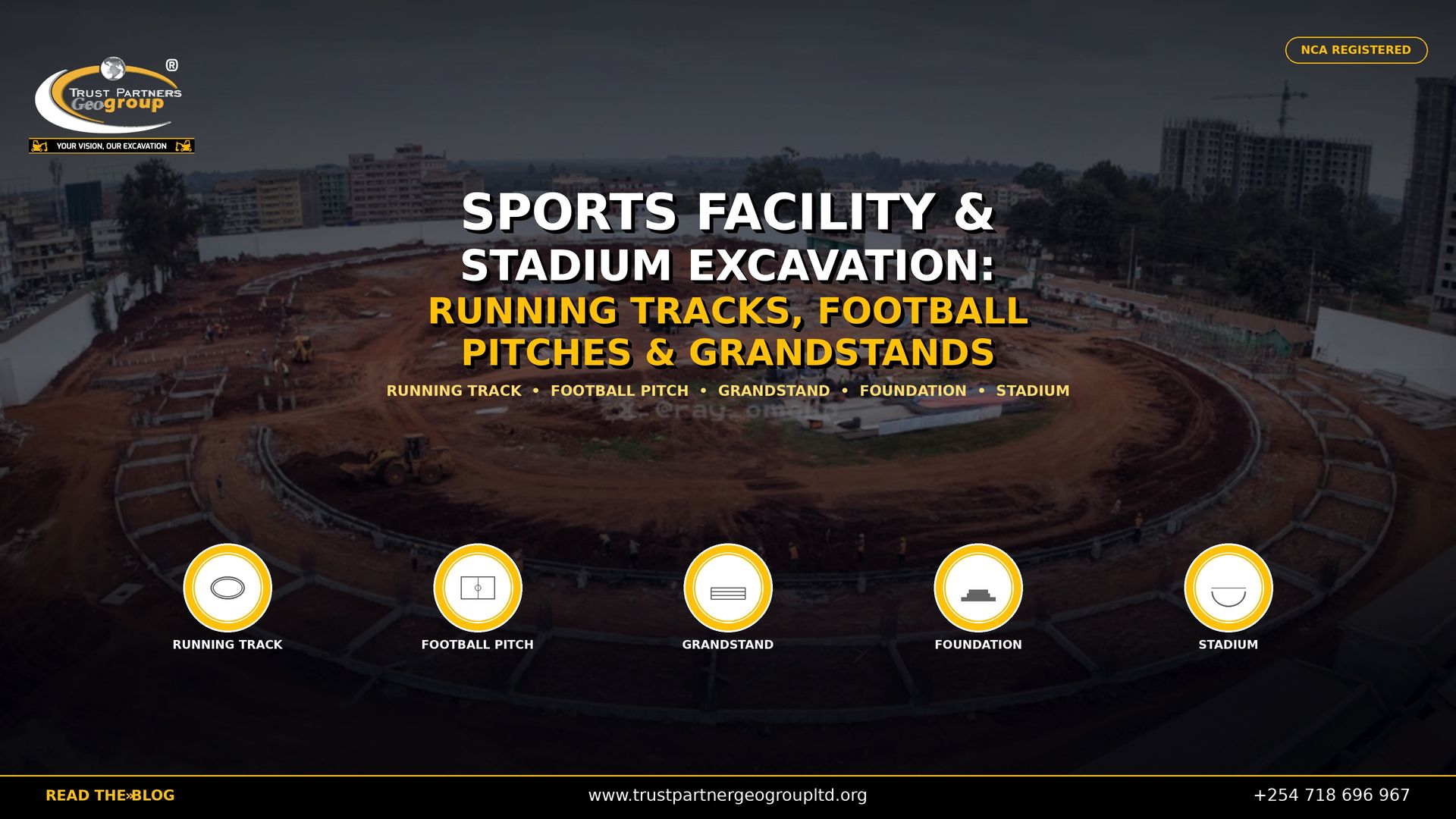
Sports Facility and Stadium Excavation in Kenya: Running Tracks, Football Pitches & Grandstand Foundations [2026]
The Commercial Earthworks Guide for Stadiums, Pitches, Athletics Tracks & Sports Complexes
Kenya is building the venues that will host continental championships, elite club football and school sports for a generation. From county stadia in Nakuru and Eldoret to academies in Nairobi and waterfront sports complexes in Mombasa, every facility shares a common foundation: earthworks executed to sporting tolerance. A football pitch that drains poorly, a running track with a 5mm grade error, or a grandstand that settles after opening day destroys the investment. This 2026 commercial guide covers stadium excavation in Kenya, sports facility foundation work in Nairobi, running track construction, football pitch excavation and grandstand foundation earthworks — the specifications, precision controls, soil challenges and costs that county governments, sports federations and private academies need to budget for. With 15+ years of precision earthworks across Kenya, Trust Partners Geo-Group delivers sports facilities that meet FIFA, World Athletics and KSSS standards.

From county stadia to school pitches, our teams deliver sports facility earthworks with GPS precision, integrated drainage and the tolerance discipline that synthetic tracks and natural turf both demand.
1. Kenya's Sports Infrastructure Boom: Where the Sector Stands in 2026
Kenya's sports construction pipeline is deeper than at any point in the country's history. The earthworks opportunity spans multiple client types and scales:
- County stadia upgrades: devolved funding is renovating or replacing ageing municipal grounds in Kisumu, Nakuru, Eldoret, Meru and beyond — each requiring full reconstruction of pitches, tracks and spectator facilities.
- Private sports academies: football and athletics academies across Nairobi, Kiambu and Kajiado building multiple pitches, tartan tracks and high-performance training facilities.
- School and university sports complexes: institutional clients expanding from dusty fields to all-weather pitches and standard athletics tracks — steady, financeable programmes.
- Elite club facilities: Kenyan Premier League and National Super League clubs investing in training grounds and stadium improvements to meet CAF licensing standards.
- Multi-purpose community centres: county and NGO-funded facilities combining football, rugby, netball and athletics on shared sites — complex earthworks coordination.
2. The Stadium Earthworks Map: Component by Component
| Component | Location | Earthworks Scope |
|---|---|---|
| Stadium bowl and pitch | Central field area | Bulk cut-to-fill, subgrade preparation, integrated drainage, root-zone or artificial turf substrate |
| Football pitch | Within bowl or standalone | Precision grading to 1–1.5% fall, perimeter drainage, sand slit installation |
| Running track | Oval around pitch | Precision grading to IAAF tolerance, crown control, drainage gullies |
| Grandstand foundations | Pitch perimeter | Pad, strip or pile cap excavation; vibration control if near live facilities |
| Access roads and parking | Site periphery | Cut-to-fill, drainage, sub-base preparation — our road construction discipline |
| Stormwater management | Site-wide | Perimeter channels, soak pits, retention ponds — sized for intense rainfall on large impervious areas |
| Floodlight foundations | Corners and straights | Piled or pad foundations for 30–50m masts; precision setting out critical |
3. Football Pitch Excavation: Formation, Drainage and Turf Preparation
A football pitch is not a flat field — it is a precision drainage and growing medium system built from the bottom up. The excavation and earthworks layer determines whether the pitch is playable in April or a swamp:
Formation Grading
The pitch formation must achieve a uniform gradient — typically 1.0–1.5% fall from centre to sidelines, or crown-to-edge — to shed water without creating hollows where grass dies and play stops. Excavation requirements:
- Precision tolerance: ±25mm across the entire 105m x 68m playing surface. GPS machine control or laser-guided buckets are standard.
- Cross-fall consistency: the gradient must be uniform in both directions; any dip or hump creates standing water or dry patches.
- Edge detailing: perimeter areas excavated to receive drainage channels, kerbs and fencing footings without disrupting the playing surface fall.
Integrated Drainage
Modern pitch construction places drainage at the excavation stage, not as an afterthought:
- Primary drains: perforated pipes laid in trenches across the pitch at 5–10m centres, backfilled with gravel and wrapped in geotextile.
- Sand slits: narrow trenches filled with coarse sand, connecting the surface to the primary drainage network — excavated to precise depth and spacing.
- Collector drains: perimeter trenches carrying water from the pitch to outfall points — requiring excavated gradients of 1:200 minimum to maintain flow velocity.
Soil Challenges for Football Pitches
Kenya's varied soils each threaten pitch performance:
- Black cotton soils (Nairobi, Kisumu, Nakuru): shrink-swell behaviour cracks the surface and blocks drains. Standard response: excavate 300–600mm and replace with free-draining sand-gravel mix — the same black cotton replacement discipline applied to sports.
- Volcanic soils (Rift Valley): free-draining but often rocky. Excavation must de-rock to formation without over-breaking, and import root-zone material.
- Coastal sands (Mombasa, Malindi): drain too freely and lack nutrient retention. Excavation includes amelioration layers and irrigation trenching.
4. Running Track Construction: Precision Grading for Athletics
Athletics tracks are among the most tolerance-critical earthworks in construction. The synthetic surface — polyurethane or latex — is only as good as the formation beneath it:
Tolerance Standards
- Longitudinal grade: ±10mm over the full 400m length. Even a 15mm hump creates a visible and measurable irregularity.
- Cross-fall: 1.0–1.5% from inner kerb to outer edge, held to ±6mm. Incorrect cross-fall pools water on the inside lane or dries the outside.
- Crown and super-elevation: curved sections require precise super-elevation calculation and execution — the excavation must match the design geometry exactly.
Excavation and Formation
Track construction typically proceeds in layers, each an excavation and compaction discipline:
- Subgrade excavation: the track oval is cut to formation level, often through variable ground requiring cut-to-fill balance around the stadium bowl.
- Sub-base placement: 150–300mm of selected granular material, compacted to 95% MDD — placed and graded with the same precision as the final layer.
- Base course: crushed stone or asphalt base, laid to tighter tolerance than the sub-base. On some projects, the base course is machine-laid asphalt requiring the earthworks contractor to hand over a surface ready for paving.
- Final tolerance verification: survey teams check the base course at 5m intervals before synthetic surfacing is approved.
Drainage Integration
Tracks cannot tolerate standing water. The earthworks must include:
- Internal drainage gullies: at the inner edge of the track, collecting water from both pitch and track surface.
- Perimeter channels: external channels preventing site runoff from entering the track formation.
- Subsurface drainage: where groundwater is encountered, French drains or well-point systems maintain a dry formation during construction and operation.
Field Event Facilities
Throwing areas, jumping pits and vault boxes each require specific excavation:
- Long jump and triple jump runways: 40m x 1.22m strips graded to ±5mm tolerance — essentially miniature tracks.
- Shot put and discus circles: excavated and concreted to exact diameter and fall.
- High jump fan-shaped aprons: graded areas with specific approach gradients.
- Javelin runways: 30–36.5m strips with the same precision as sprint tracks.
5. Grandstand and Spectator Facility Foundations
Grandstands concentrate thousands of spectators on a relatively small footprint — and their foundations must resist both vertical loads and crowd-induced lateral forces. Excavation scope includes:
Foundation Types
- Isolated pad foundations: for smaller stands (500–2,000 capacity), excavated pads under each column. Tolerance ±10mm at formation to ensure steel or precast erection fits.
- Strip foundations: continuous footings under raker beams and back walls, requiring long, level trenches with uniform bearing.
- Pile-supported foundations: where soils are poor or stands are large (5,000+ capacity), bored or driven piles carry the load. Excavation includes pile cap pits — often 1.5–2.5m deep — with side stability and dewatering.
- Raft foundations: for VIP boxes, media centres and commercial facilities integrated into the stand structure — requiring large-area excavation and precision grading similar to mat foundation discipline.
Vibration and Access Constraints
Stadium upgrades often build new stands adjacent to existing pitches or facilities. Excavation must manage:
- Vibration limits: pile driving or heavy breaking near live pitches can damage drainage or turf. Low-impact methods and real-time monitoring apply.
- Tight site access: urban stadia offer minimal working space. Excavated material is often hauled directly from site to avoid stockpiling on the pitch.
- Utility conflicts: floodlight cables, drainage outfalls and sewer lines run beneath stand footprints — located and diverted before bulk excavation.
6. Supporting Infrastructure: Parking, Drainage and Access
The stadium experience begins in the parking lot — and the earthworks extend well beyond the pitch:
Access Roads and Parking
- Cut-to-fill for parking areas: large flat areas requiring the same drainage discipline as the pitch, but with vehicle-loading compaction standards.
- Access road alignment: roads must handle match-day traffic and emergency vehicle access — requiring cut-to-fill, culverts and drainage structures sized for intense rainfall.
- Service yards: excavated and compacted platforms for generator sets, water tanks and maintenance facilities.
Stormwater Management
Stadiums create enormous impervious surfaces. The earthworks must manage runoff before it floods the pitch or parking:
- Perimeter channels: excavated V-drains or box channels carrying runoff from roofs, concourses and parking to outfalls.
- Retention ponds: excavated ponds that attenuate peak flow before releasing to municipal drains — increasingly required by NEMA for large developments.
- Soak pits: where municipal drainage is insufficient, excavated soakaways manage pitch and roof runoff on site.
Floodlight and Scoreboard Foundations
Modern stadia require 30–50m floodlight masts and large LED scoreboards. Each needs precision foundation excavation:
- Mast bases: large reinforced concrete pads or pile groups, excavated to resist overturning moments from wind loads on tall masts.
- Scoreboard plinths: excavated and formed to exact elevation and alignment — out-of-position scoreboards are visible errors that embarrass the client on live television.
7. Sports Facility Excavation Costs: 2026 Kenya Benchmarks
| Work Item | Typical 2026 Range (KES) | Notes |
|---|---|---|
| Bulk earthworks (stadium bowl) | 350–950 per m³ | Cut-to-fill balance; haul distance drives cost |
| Football pitch formation and drainage | 2.5M–8M per pitch | Includes excavation, primary drains, sand slits, perimeter channels |
| Running track precision grading | 450–1,200 per linear metre | 400m oval plus straights; IAAF tolerance verification included |
| Grandstand foundation excavation | 6M–35M per stand | Capacity and foundation type dependent; piles increase cost significantly |
| Field event facilities (jump pits, throws) | 800K–3.5M per facility | Precision excavation and concrete forming |
| Access roads and parking | 2.5M–6M per km | Formation, drainage, sub-base; surfacing extra |
| Stormwater retention pond | 1.5M–8M per pond | Size, lining, spillway and outfall works |
| Black cotton soil replacement | 1,800–3,200 per m³ | Excavation, haul away, imported granular fill, compaction |
| Floodlight mast foundation | 800K–4M per mast | Pad or pile cap; height and wind load dependent |
8. Frequently Asked Questions
What excavation work does stadium construction in Kenya involve?
Stadium excavation includes bulk earthworks for the stadium bowl, football pitch formation with integrated drainage, precision grading for running tracks to IAAF standards, grandstand and spectator terrace foundation excavation, parking and access road earthworks, stormwater management, and floodlight mast foundations.
How much does sports facility excavation cost in Kenya?
Bulk earthworks KES 350–950 per m³. Football pitch formation KES 2.5M–8M. Running track grading KES 450–1,200 per linear metre. Grandstand foundations KES 6M–35M. Black cotton soil replacement adds 30–60%. The precision premium is typically under 15% of total facility cost.
What is the typical timeline for stadium earthworks?
Community stadia require 8–16 weeks from site strip to handover: bulk earthworks 2–4 weeks, pitch and track grading 2–3 weeks, grandstand foundations 2–4 weeks, drainage 1–2 weeks, and testing 1 week. Rain and poor soils can extend by 25–40%.
What are the soil challenges for sports facilities in Kenya?
Black cotton soils in Nairobi, Kisumu and Nakuru cause differential settlement and poor drainage. Volcanic Rift Valley soils drain well but may be rocky. Coastal saline soils affect turf and reinforcement. Each requires specific replacement, drainage or amelioration.
How precise must running track excavation be?
±10mm longitudinal tolerance and ±6mm cross-fall over the 400m oval. GPS machine control or laser-guided graders are essential. Errors cause ponding, uneven bounce and athlete injury — and require costly resurfacing if discovered after synthetic layer installation.
What equipment is used for stadium and sports facility earthworks?
GPS-guided excavators and motor graders for precision work, bulldozers for bulk bowl earthworks, articulated dump trucks, trenchers for drainage, rollers for subgrade compaction, and laser screeds for concrete concourses. Every machine must protect the final tolerance layer.
Who provides stadium and sports facility excavation in Kenya?
NCA-registered contractors with precision grading, sports facility experience and documented QA. Trust Partners Geo-Group delivers stadium earthworks, pitch formation, track grading and grandstand foundations across Nairobi, Mombasa, Kisumu, Nakuru and Eldoret. Call +254 718 686 967.
9. Conclusion: The Game Is Won or Lost at Formation Level
A stadium is judged by its pitch, its track and its stands — but all three are only as good as the earthworks beneath them. The football pitch that waterlogs in April was not necessarily poorly grassed; it was likely poorly graded. The running track that bubbles and cracks was not necessarily badly surfaced; the formation beneath it probably carried a 12mm error that telegraphed through. The grandstand that settles and cracks was not necessarily badly designed; the foundation excavation may have left a soft spot that compacted under crowd load.
Kenya's sports infrastructure investment — county stadia, private academies, school complexes and elite club facilities — deserves earthworks contractors who understand that sport is played on surfaces measured in millimetres. The tolerance is tighter, the drainage is integrated, and the handover documentation is the difference between a facility that hosts championships and one that hosts complaints.
Trust Partners Geo-Group delivers sports facility earthworks end-to-end: stadium bowl bulk earthworks, GPS precision grading for pitches and tracks, grandstand foundation excavation, integrated drainage and documented handover — across Nairobi, Mombasa, Kisumu, Nakuru, Eldoret and all 47 counties.
Building a Stadium or Sports Complex? Start With Earthworks That Meet Sporting Standards.
Trust Partners Geo-Group delivers precision sports facility excavation — pitches, tracks, grandstands and drainage — across all 47 counties with GPS accuracy and tolerance-guaranteed handover.
Call +254 718 686 967 — 24/7 Request a Sports Facility QuoteSports Facility and Stadium Excavation in Kenya: Running Tracks, Football Pitches & Grandstand Foundations [2026]
The Commercial Earthworks Guide for Stadiums, Pitches, Athletics Tracks & Sports Complexes
Kenya is building the venues that will host continental championships, elite club football and school sports for a generation. From county stadia in Nakuru and Eldoret to academies in Nairobi and waterfront sports complexes in Mombasa, every facility shares a common foundation: earthworks executed to sporting tolerance. A football pitch that drains poorly, a running track with a 5mm grade error, or a grandstand that settles after opening day destroys the investment. This 2026 commercial guide covers stadium excavation in Kenya, sports facility foundation work in Nairobi, running track construction, football pitch excavation and grandstand foundation earthworks — the specifications, precision controls, soil challenges and costs that county governments, sports federations and private academies need to budget for. With 15+ years of precision earthworks across Kenya, Trust Partners Geo-Group delivers sports facilities that meet FIFA, World Athletics and KSSS standards.
From county stadia to school pitches, our teams deliver sports facility earthworks with GPS precision, integrated drainage and the tolerance discipline that synthetic tracks and natural turf both demand.
1. Kenya's Sports Infrastructure Boom: Where the Sector Stands in 2026
Kenya's sports construction pipeline is deeper than at any point in the country's history. The earthworks opportunity spans multiple client types and scales:
- County stadia upgrades: devolved funding is renovating or replacing ageing municipal grounds in Kisumu, Nakuru, Eldoret, Meru and beyond — each requiring full reconstruction of pitches, tracks and spectator facilities.
- Private sports academies: football and athletics academies across Nairobi, Kiambu and Kajiado building multiple pitches, tartan tracks and high-performance training facilities.
- School and university sports complexes: institutional clients expanding from dusty fields to all-weather pitches and standard athletics tracks — steady, financeable programmes.
- Elite club facilities: Kenyan Premier League and National Super League clubs investing in training grounds and stadium improvements to meet CAF licensing standards.
- Multi-purpose community centres: county and NGO-funded facilities combining football, rugby, netball and athletics on shared sites — complex earthworks coordination.
2. The Stadium Earthworks Map: Component by Component
| Component | Location | Earthworks Scope |
|---|---|---|
| Stadium bowl and pitch | Central field area | Bulk cut-to-fill, subgrade preparation, integrated drainage, root-zone or artificial turf substrate |
| Football pitch | Within bowl or standalone | Precision grading to 1–1.5% fall, perimeter drainage, sand slit installation |
| Running track | Oval around pitch | Precision grading to IAAF tolerance, crown control, drainage gullies |
| Grandstand foundations | Pitch perimeter | Pad, strip or pile cap excavation; vibration control if near live facilities |
| Access roads and parking | Site periphery | Cut-to-fill, drainage, sub-base preparation — our road construction discipline |
| Stormwater management | Site-wide | Perimeter channels, soak pits, retention ponds — sized for intense rainfall on large impervious areas |
| Floodlight foundations | Corners and straights | Piled or pad foundations for 30–50m masts; precision setting out critical |
3. Football Pitch Excavation: Formation, Drainage and Turf Preparation
A football pitch is not a flat field — it is a precision drainage and growing medium system built from the bottom up. The excavation and earthworks layer determines whether the pitch is playable in April or a swamp:
Formation Grading
The pitch formation must achieve a uniform gradient — typically 1.0–1.5% fall from centre to sidelines, or crown-to-edge — to shed water without creating hollows where grass dies and play stops. Excavation requirements:
- Precision tolerance: ±25mm across the entire 105m x 68m playing surface. GPS machine control or laser-guided buckets are standard.
- Cross-fall consistency: the gradient must be uniform in both directions; any dip or hump creates standing water or dry patches.
- Edge detailing: perimeter areas excavated to receive drainage channels, kerbs and fencing footings without disrupting the playing surface fall.
Integrated Drainage
Modern pitch construction places drainage at the excavation stage, not as an afterthought:
- Primary drains: perforated pipes laid in trenches across the pitch at 5–10m centres, backfilled with gravel and wrapped in geotextile.
- Sand slits: narrow trenches filled with coarse sand, connecting the surface to the primary drainage network — excavated to precise depth and spacing.
- Collector drains: perimeter trenches carrying water from the pitch to outfall points — requiring excavated gradients of 1:200 minimum to maintain flow velocity.
Soil Challenges for Football Pitches
Kenya's varied soils each threaten pitch performance:
- Black cotton soils (Nairobi, Kisumu, Nakuru): shrink-swell behaviour cracks the surface and blocks drains. Standard response: excavate 300–600mm and replace with free-draining sand-gravel mix — the same black cotton replacement discipline applied to sports.
- Volcanic soils (Rift Valley): free-draining but often rocky. Excavation must de-rock to formation without over-breaking, and import root-zone material.
- Coastal sands (Mombasa, Malindi): drain too freely and lack nutrient retention. Excavation includes amelioration layers and irrigation trenching.
4. Running Track Construction: Precision Grading for Athletics
Athletics tracks are among the most tolerance-critical earthworks in construction. The synthetic surface — polyurethane or latex — is only as good as the formation beneath it:
Tolerance Standards
- Longitudinal grade: ±10mm over the full 400m length. Even a 15mm hump creates a visible and measurable irregularity.
- Cross-fall: 1.0–1.5% from inner kerb to outer edge, held to ±6mm. Incorrect cross-fall pools water on the inside lane or dries the outside.
- Crown and super-elevation: curved sections require precise super-elevation calculation and execution — the excavation must match the design geometry exactly.
Excavation and Formation
Track construction typically proceeds in layers, each an excavation and compaction discipline:
- Subgrade excavation: the track oval is cut to formation level, often through variable ground requiring cut-to-fill balance around the stadium bowl.
- Sub-base placement: 150–300mm of selected granular material, compacted to 95% MDD — placed and graded with the same precision as the final layer.
- Base course: crushed stone or asphalt base, laid to tighter tolerance than the sub-base. On some projects, the base course is machine-laid asphalt requiring the earthworks contractor to hand over a surface ready for paving.
- Final tolerance verification: survey teams check the base course at 5m intervals before synthetic surfacing is approved.
Drainage Integration
Tracks cannot tolerate standing water. The earthworks must include:
- Internal drainage gullies: at the inner edge of the track, collecting water from both pitch and track surface.
- Perimeter channels: external channels preventing site runoff from entering the track formation.
- Subsurface drainage: where groundwater is encountered, French drains or well-point systems maintain a dry formation during construction and operation.
Field Event Facilities
Throwing areas, jumping pits and vault boxes each require specific excavation:
- Long jump and triple jump runways: 40m x 1.22m strips graded to ±5mm tolerance — essentially miniature tracks.
- Shot put and discus circles: excavated and concreted to exact diameter and fall.
- High jump fan-shaped aprons: graded areas with specific approach gradients.
- Javelin runways: 30–36.5m strips with the same precision as sprint tracks.
5. Grandstand and Spectator Facility Foundations
Grandstands concentrate thousands of spectators on a relatively small footprint — and their foundations must resist both vertical loads and crowd-induced lateral forces. Excavation scope includes:
Foundation Types
- Isolated pad foundations: for smaller stands (500–2,000 capacity), excavated pads under each column. Tolerance ±10mm at formation to ensure steel or precast erection fits.
- Strip foundations: continuous footings under raker beams and back walls, requiring long, level trenches with uniform bearing.
- Pile-supported foundations: where soils are poor or stands are large (5,000+ capacity), bored or driven piles carry the load. Excavation includes pile cap pits — often 1.5–2.5m deep — with side stability and dewatering.
- Raft foundations: for VIP boxes, media centres and commercial facilities integrated into the stand structure — requiring large-area excavation and precision grading similar to mat foundation discipline.
Vibration and Access Constraints
Stadium upgrades often build new stands adjacent to existing pitches or facilities. Excavation must manage:
- Vibration limits: pile driving or heavy breaking near live pitches can damage drainage or turf. Low-impact methods and real-time monitoring apply.
- Tight site access: urban stadia offer minimal working space. Excavated material is often hauled directly from site to avoid stockpiling on the pitch.
- Utility conflicts: floodlight cables, drainage outfalls and sewer lines run beneath stand footprints — located and diverted before bulk excavation.
6. Supporting Infrastructure: Parking, Drainage and Access
The stadium experience begins in the parking lot — and the earthworks extend well beyond the pitch:
Access Roads and Parking
- Cut-to-fill for parking areas: large flat areas requiring the same drainage discipline as the pitch, but with vehicle-loading compaction standards.
- Access road alignment: roads must handle match-day traffic and emergency vehicle access — requiring cut-to-fill, culverts and drainage structures sized for intense rainfall.
- Service yards: excavated and compacted platforms for generator sets, water tanks and maintenance facilities.
Stormwater Management
Stadiums create enormous impervious surfaces. The earthworks must manage runoff before it floods the pitch or parking:
- Perimeter channels: excavated V-drains or box channels carrying runoff from roofs, concourses and parking to outfalls.
- Retention ponds: excavated ponds that attenuate peak flow before releasing to municipal drains — increasingly required by NEMA for large developments.
- Soak pits: where municipal drainage is insufficient, excavated soakaways manage pitch and roof runoff on site.
Floodlight and Scoreboard Foundations
Modern stadia require 30–50m floodlight masts and large LED scoreboards. Each needs precision foundation excavation:
- Mast bases: large reinforced concrete pads or pile groups, excavated to resist overturning moments from wind loads on tall masts.
- Scoreboard plinths: excavated and formed to exact elevation and alignment — out-of-position scoreboards are visible errors that embarrass the client on live television.
7. Sports Facility Excavation Costs: 2026 Kenya Benchmarks
| Work Item | Typical 2026 Range (KES) | Notes |
|---|---|---|
| Bulk earthworks (stadium bowl) | 350–950 per m³ | Cut-to-fill balance; haul distance drives cost |
| Football pitch formation and drainage | 2.5M–8M per pitch | Includes excavation, primary drains, sand slits, perimeter channels |
| Running track precision grading | 450–1,200 per linear metre | 400m oval plus straights; IAAF tolerance verification included |
| Grandstand foundation excavation | 6M–35M per stand | Capacity and foundation type dependent; piles increase cost significantly |
| Field event facilities (jump pits, throws) | 800K–3.5M per facility | Precision excavation and concrete forming |
| Access roads and parking | 2.5M–6M per km | Formation, drainage, sub-base; surfacing extra |
| Stormwater retention pond | 1.5M–8M per pond | Size, lining, spillway and outfall works |
| Black cotton soil replacement | 1,800–3,200 per m³ | Excavation, haul away, imported granular fill, compaction |
| Floodlight mast foundation | 800K–4M per mast | Pad or pile cap; height and wind load dependent |
8. Frequently Asked Questions
What excavation work does stadium construction in Kenya involve?
Stadium excavation includes bulk earthworks for the stadium bowl, football pitch formation with integrated drainage, precision grading for running tracks to IAAF standards, grandstand and spectator terrace foundation excavation, parking and access road earthworks, stormwater management, and floodlight mast foundations.
How much does sports facility excavation cost in Kenya?
Bulk earthworks KES 350–950 per m³. Football pitch formation KES 2.5M–8M. Running track grading KES 450–1,200 per linear metre. Grandstand foundations KES 6M–35M. Black cotton soil replacement adds 30–60%. The precision premium is typically under 15% of total facility cost.
What is the typical timeline for stadium earthworks?
Community stadia require 8–16 weeks from site strip to handover: bulk earthworks 2–4 weeks, pitch and track grading 2–3 weeks, grandstand foundations 2–4 weeks, drainage 1–2 weeks, and testing 1 week. Rain and poor soils can extend by 25–40%.
What are the soil challenges for sports facilities in Kenya?
Black cotton soils in Nairobi, Kisumu and Nakuru cause differential settlement and poor drainage. Volcanic Rift Valley soils drain well but may be rocky. Coastal saline soils affect turf and reinforcement. Each requires specific replacement, drainage or amelioration.
How precise must running track excavation be?
±10mm longitudinal tolerance and ±6mm cross-fall over the 400m oval. GPS machine control or laser-guided graders are essential. Errors cause ponding, uneven bounce and athlete injury — and require costly resurfacing if discovered after synthetic layer installation.
What equipment is used for stadium and sports facility earthworks?
GPS-guided excavators and motor graders for precision work, bulldozers for bulk bowl earthworks, articulated dump trucks, trenchers for drainage, rollers for subgrade compaction, and laser screeds for concrete concourses. Every machine must protect the final tolerance layer.
Who provides stadium and sports facility excavation in Kenya?
NCA-registered contractors with precision grading, sports facility experience and documented QA. Trust Partners Geo-Group delivers stadium earthworks, pitch formation, track grading and grandstand foundations across Nairobi, Mombasa, Kisumu, Nakuru and Eldoret. Call +254 718 686 967.
9. Conclusion: The Game Is Won or Lost at Formation Level
A stadium is judged by its pitch, its track and its stands — but all three are only as good as the earthworks beneath them. The football pitch that waterlogs in April was not necessarily poorly grassed; it was likely poorly graded. The running track that bubbles and cracks was not necessarily badly surfaced; the formation beneath it probably carried a 12mm error that telegraphed through. The grandstand that settles and cracks was not necessarily badly designed; the foundation excavation may have left a soft spot that compacted under crowd load.
Kenya's sports infrastructure investment — county stadia, private academies, school complexes and elite club facilities — deserves earthworks contractors who understand that sport is played on surfaces measured in millimetres. The tolerance is tighter, the drainage is integrated, and the handover documentation is the difference between a facility that hosts championships and one that hosts complaints.
Trust Partners Geo-Group delivers sports facility earthworks end-to-end: stadium bowl bulk earthworks, GPS precision grading for pitches and tracks, grandstand foundation excavation, integrated drainage and documented handover — across Nairobi, Mombasa, Kisumu, Nakuru, Eldoret and all 47 counties.
Building a Stadium or Sports Complex? Start With Earthworks That Meet Sporting Standards.
Trust Partners Geo-Group delivers precision sports facility excavation — pitches, tracks, grandstands and drainage — across all 47 counties with GPS accuracy and tolerance-guaranteed handover.
Call +254 718 686 967 — 24/7 Request a Sports Facility Quote