
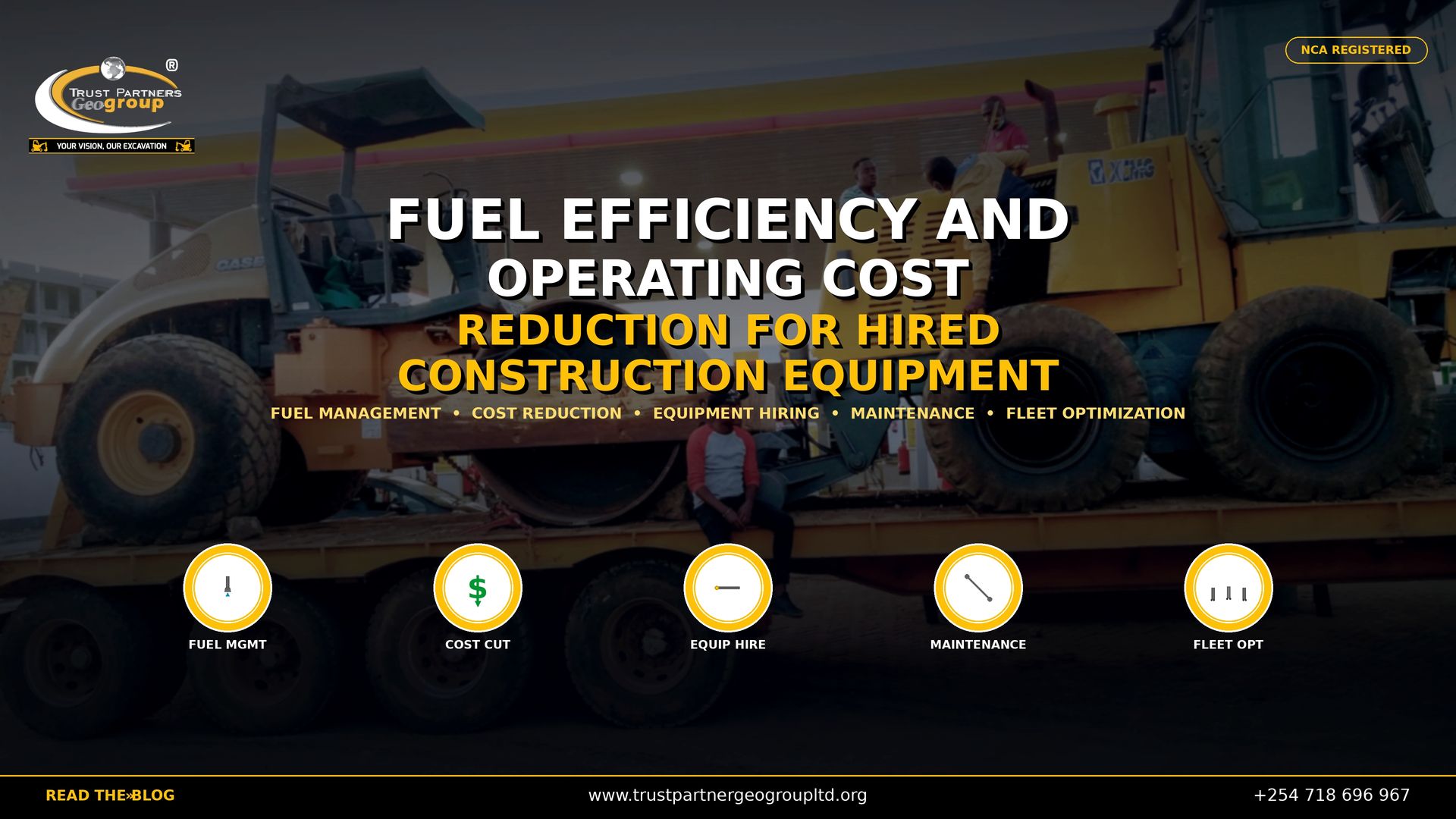
Fuel Efficiency and Operating Cost Reduction for Hired Construction Equipment in Kenya [2026]
The Cost-Saving Guide to Running Hired Excavators, Graders & Dozers Leaner
On most Kenyan excavation projects, fuel is 30–45% of the total machine operating cost — and on unmanaged sites, a quarter of that fuel is burned producing nothing at all. The gap between a well-run fleet and a typical one is not small: it is 15–30% of everything you spend on plant. This 2026 cost-saving guide covers construction equipment fuel efficiency in Kenya, reducing equipment operating costs in Nairobi, fuel saving on hired excavators and equipment hire cost reduction — fuel benchmarks by machine class, machine-to-task matching, idle discipline, cycle planning, maintenance, telematics and the hire terms that protect your budget. With 15+ years of excavation experience across Kenya, Trust Partners Geo-Group runs one of the country's most closely monitored hire fleets — and this is how the savings are made.

Our fleet runs on telematics, benchmarked fuel rates and disciplined maintenance — because the cheapest cubic metre is the one you move with the right machine, running only when it is working.
1. The Real Cost of Running Plant in Kenya: 2026 Landscape
Every hired machine on a Kenyan site burns money through four channels, and understanding their split tells you where the savings live:
- Fuel (30–45%): the largest single operating cost — and the one with the most waste baked in on unmanaged sites.
- Operator (10–15%): fixed per shift regardless of output — output per operator-hour is what matters, as we covered in our operator standards guide.
- Maintenance and wear (15–25%): tracks, tyres, cutting edges, oils and unplanned breakdowns — heavily influenced by how the machine is operated and serviced.
- Ownership/hire rate and logistics (20–35%): the fixed hire rate plus mobilization — minimized by utilization, because an idle hired machine still charges. See our transport and logistics guide for the mobilization side.
2. Fuel Consumption Benchmarks by Machine Class
Budget and audit against these typical Kenyan-condition figures (hard digging, breaker work and high idle push toward the top of each band):
| Machine | Typical Fuel Burn (litres/hour) | High-Burn Conditions |
|---|---|---|
| Mini excavator (5–8 t) | 6–10 | Continuous hard trenching |
| Excavator 13–15 t | 10–16 | Deep basement digging, loaded cycles |
| Excavator 20 t (site workhorse) | 14–22 | Hard digging, hydraulic breaker work (18–28) |
| Excavator 30 t | 22–32 | Rock and bulk hard excavation |
| Long-reach excavator | 16–26 | Continuous deep or long-cycle work |
| Motor grader | 12–20 | Heavy ripping and reshaping vs light finishing |
| Dozer | 18–30 | Long uphill pushes, ripping |
| Vibratory roller | 8–14 | Thick lifts at high amplitude |
| Wheel loader | 12–20 | Long load-and-carry cycles |
| Mobile crane | 8–15 (working) / 4–6 (standby) | Continuous lifting vs holding |
Put these numbers in your hire documentation as the agreed benchmark. A machine drifting 15–20% above benchmark is telling you something — worn injectors, track tension, operator technique or a fuel leak into somebody's drum.
3. Machine Matching: The Biggest Single Saving
Nothing wastes fuel like the wrong machine on the task:
- Oversized machines: a 30-tonne excavator on a 13-tonne job burns nearly double the fuel per hour for the same output. Oversizing feels safe; it is simply expensive.
- Undersized machines: a small machine straining at its limit moves less material per litre than a right-sized one working comfortably — and wears itself out doing it.
- Wrong tool entirely: ripping soft rock with a bucket instead of a breaker or ripper; loading with an excavator where a wheel loader halves the cycle; pushing long distances with a loader instead of a dozer.
- Attachment matching: bucket width and type matched to material — a trenching bucket in bulk dig wastes every cycle; a bulk bucket on a narrow trench wastes every backfill.
4. Idle Discipline: Free Fuel Savings on Every Site
Idling is the purest waste in construction: full fuel burn, zero production, plus accelerated engine wear. Unmanaged Kenyan sites commonly run 25–40% idle time; managed sites hold 10–15%:
- Use the technology: modern machines ship with auto-idle and auto-shutdown — specify them enabled in the hire terms.
- Kill discretionary idling: machines shut down over breaks and while waiting for instructions; the "it takes fuel to restart" myth costs far more than any start cycle.
- Schedule so machines never wait: the excavator that idles waiting for trucks is a scheduling failure, not an operator failure.
- Measure it: telematics idle percentage, reviewed weekly and published on the site noticeboard, changes behaviour faster than any memo.
5. Cycle Planning and Site Layout
Fuel per cubic metre is decided as much by the site plan as by the machine:
- Swing angles: position trucks and stockpiles for 60–90° excavator swings, not 180°. Every extra degree of swing is fuel and seconds on every cycle of every day.
- Haul routes: smooth, graded, watered haul roads cut rolling resistance — a tippers-burning-fuel-on-corrugations problem is a grader problem, cheaply fixed.
- Gravity: plan cuts and pushes downhill where ground allows; dozing downhill moves dramatically more per litre.
- Double-handling: every material moved twice costs twice. Stockpile positions and cut-fill balance belong in the earthworks plan before the first machine moves — the discipline behind our SuDS earthworks and bulk cut-to-fill sites alike.
- Truck-excavator matching: 3–5 passes to fill a truck is the efficient band; an excavator waiting on trucks, or trucks queuing on the excavator, both burn money.
6. Maintenance: The Hidden Fuel Bill
A neglected machine is a fuel leak you cannot see:
| Neglected Item | Fuel / Cost Impact |
|---|---|
| Clogged air and fuel filters | 3–7% fuel penalty; power loss that operators compensate with throttle |
| Worn injectors / poor combustion | 5–15% fuel penalty and rising — the classic "drinking machine" |
| Loose or worn tracks | 2–5% travel efficiency loss plus accelerated undercarriage wear |
| Under-inflated tyres (wheeled plant) | 3–8% rolling resistance penalty |
| Dull bucket teeth and cutting edges | 5–10% dig penalty — the machine works harder for every bucketful |
| Hydraulic leaks and worn pumps | Direct loss plus heat — the system burns fuel making pressure it throws away |
| Skipped services | Compounds all of the above; the "saving" from a deferred service returns as fuel and breakdowns with interest |
This is why hire-fleet quality matters more than hire rate: a disciplined fleet's machines hold their benchmark fuel burn; a neglected fleet's drift upward month by month. Our hire fleet runs scheduled servicing to the hour, not the breakdown.
7. Telematics and Fuel Monitoring
You cannot manage what you do not measure. Modern fleet telematics turns fuel from a mystery into a managed variable:
- What it reports: fuel burn per hour and per day, idle percentage, working vs travelling vs idle hours, location, fault codes, harsh operation events.
- What it catches: fuel theft (tank-level vs burn-rate discrepancies), excessive idling, machines drifting off benchmark, emerging faults before they become breakdowns, and under-utilized machines that should be off-hired.
- What it is worth: fleets under active telematics management typically run 8–15% lower total operating cost than unmanaged equivalents — the system pays for itself within weeks.
- Weekly rhythm: fuel-per-hour against benchmark per machine, idle percentage, utilization — fifteen minutes of review that directs the next week's savings.
8. Hire Terms That Reduce Your Costs
- Benchmarked fuel rates in writing: litres-per-hour for your application stated in the hire agreement — the audit baseline for the whole job.
- Wet hire with fuel included: one rate, supplier-incentivized efficiency — the supplier who pays for fuel maintains machines that do not waste it.
- Off-hire flexibility: machines you are not using should leave; hire agreements should allow prompt off-hire without penalty games.
- Right-size guarantees: a supplier who will swap an over- or under-sized machine early is protecting your fuel bill, not just their fleet.
- Telematics transparency: ask for the fuel and utilization reports. A supplier who shares data runs a tight fleet; one who hides it, does not.
9. The Savings Model: What Good Management Is Worth
Typical savings stack on a Kenyan excavation project, against an unmanaged baseline:
| Measure | Typical Saving on Machine Operating Cost |
|---|---|
| Machine-to-task matching (incl. early swaps) | 5–12% |
| Idle discipline (auto-idle + supervision) | 4–8% |
| Cycle planning and site layout | 3–8% |
| Disciplined maintenance holding benchmarks | 3–7% |
| Telematics monitoring and accountability | 2–5% (enables and protects all the above) |
| Combined, well-run site | 15–30% |
10. Fuel Efficiency, Emissions and Kenya's Green Direction
Fuel saved is emissions avoided — and Kenya's construction sector is moving:
- Client requirements: institutional and international-funded projects increasingly request fuel and emissions reporting on plant — telematics data answers this without extra work.
- NEMA direction: environmental management expectations on major projects now routinely include plant efficiency and spill discipline. See our compliance coverage in the NCA registration guide.
- Modern fleet economics: current-generation machines burn 10–20% less fuel than ten-year-old equivalents doing the same work — fleet renewal is an environmental policy that pays for itself.
- The green infrastructure connection: efficient earthworks pair naturally with the sustainable drainage systems in our SuDS guide — projects that manage water and fuel well tend to be the same well-run projects.
11. Frequently Asked Questions
How much fuel does an excavator use per hour in Kenya?
In 2026 Kenyan conditions: roughly 6–10 l/hr for a 5–8 t machine, 14–22 l/hr for a 20 t excavator in general excavation (18–28 with a breaker), and 22–32 l/hr for a 30 t class. Hard digging and high idle push consumption toward the top of each band.
What is the biggest fuel waste on Kenyan construction sites?
Idling — machines running between trucks, over breaks and while awaiting instructions commonly idle 25–40% of engine hours on unmanaged sites. Second is wrong machine sizing: an oversized excavator burns nearly double the fuel for the same output.
How can I reduce fuel costs when hiring equipment in Nairobi?
Match machine size to task, enforce idle shutdown, plan truck cycles, keep machines serviced, use telematics fuel reports, and hire modern machines — a current well-maintained excavator burns 10–20% less than a tired older unit.
Is fuel included in equipment hire rates in Kenya?
For wet (operated) hire, yes — fuel is normally in the rate with consumption benchmarks stated. For dry hire, the hirer fuels the machine. Either way, get expected litres-per-hour for your application in writing.
Do bigger excavators use more fuel per cubic metre moved?
No — when correctly matched. A large excavator within its capacity moves more per litre than a small machine straining. Fuel per cubic metre is the metric that matters; right-sizing means the biggest machine the site genuinely supports.
What is telematics and how does it cut equipment operating costs?
Factory-fitted monitoring reporting location, hours, fuel burn, idle time and fault codes. It catches fuel theft, excess idling, emerging faults and under-utilized machines — typically cutting total operating costs 8–15%. Trust Partners Geo-Group runs telematics across its hire fleet.
How much can a site realistically save on equipment operating costs?
Sites implementing machine matching, idle discipline, cycle planning and telematics typically save 15–30% against unmanaged baselines — KES 300,000–600,000 per month on a project burning KES 2 million monthly in machine costs.
12. Conclusion: Measure the Litres, Match the Machine, Mind the Idle
Equipment cost reduction is not about finding cheaper machines — it is about running the right machines, working whenever they are running. Benchmark the fuel, match the machine to the task, kill the idle, plan the cycles, maintain to the hour, and watch the telematics. Do those six things and 15–30% of your plant budget comes back.
The leanest approach of all is to hire from a fleet that already runs this way — modern machines, telematics on every unit, fuel benchmarks in the paperwork, and certified operators trained in efficient technique, delivered by disciplined logistics.
Trust Partners Geo-Group supplies fuel-efficient operated equipment across Kenya — benchmarked consumption, telematics reporting, right-size matching and 24/7 support from Nairobi to all 47 counties.
Paying Too Much for Plant? Hire a Fleet That Watches Every Litre.
Trust Partners Geo-Group supplies telematics-monitored, fuel-benchmarked operated equipment — excavators, graders, dozers and rollers — across Nairobi and all 47 counties.
Call +254 718 686 967 — 24/7 Request a Fuel-Efficient Hire QuoteFuel Efficiency and Operating Cost Reduction for Hired Construction Equipment in Kenya [2026]
The Cost-Saving Guide to Running Hired Excavators, Graders & Dozers Leaner
On most Kenyan excavation projects, fuel is 30–45% of the total machine operating cost — and on unmanaged sites, a quarter of that fuel is burned producing nothing at all. The gap between a well-run fleet and a typical one is not small: it is 15–30% of everything you spend on plant. This 2026 cost-saving guide covers construction equipment fuel efficiency in Kenya, reducing equipment operating costs in Nairobi, fuel saving on hired excavators and equipment hire cost reduction — fuel benchmarks by machine class, machine-to-task matching, idle discipline, cycle planning, maintenance, telematics and the hire terms that protect your budget. With 15+ years of excavation experience across Kenya, Trust Partners Geo-Group runs one of the country's most closely monitored hire fleets — and this is how the savings are made.
Our fleet runs on telematics, benchmarked fuel rates and disciplined maintenance — because the cheapest cubic metre is the one you move with the right machine, running only when it is working.
1. The Real Cost of Running Plant in Kenya: 2026 Landscape
Every hired machine on a Kenyan site burns money through four channels, and understanding their split tells you where the savings live:
- Fuel (30–45%): the largest single operating cost — and the one with the most waste baked in on unmanaged sites.
- Operator (10–15%): fixed per shift regardless of output — output per operator-hour is what matters, as we covered in our operator standards guide.
- Maintenance and wear (15–25%): tracks, tyres, cutting edges, oils and unplanned breakdowns — heavily influenced by how the machine is operated and serviced.
- Ownership/hire rate and logistics (20–35%): the fixed hire rate plus mobilization — minimized by utilization, because an idle hired machine still charges. See our transport and logistics guide for the mobilization side.
2. Fuel Consumption Benchmarks by Machine Class
Budget and audit against these typical Kenyan-condition figures (hard digging, breaker work and high idle push toward the top of each band):
| Machine | Typical Fuel Burn (litres/hour) | High-Burn Conditions |
|---|---|---|
| Mini excavator (5–8 t) | 6–10 | Continuous hard trenching |
| Excavator 13–15 t | 10–16 | Deep basement digging, loaded cycles |
| Excavator 20 t (site workhorse) | 14–22 | Hard digging, hydraulic breaker work (18–28) |
| Excavator 30 t | 22–32 | Rock and bulk hard excavation |
| Long-reach excavator | 16–26 | Continuous deep or long-cycle work |
| Motor grader | 12–20 | Heavy ripping and reshaping vs light finishing |
| Dozer | 18–30 | Long uphill pushes, ripping |
| Vibratory roller | 8–14 | Thick lifts at high amplitude |
| Wheel loader | 12–20 | Long load-and-carry cycles |
| Mobile crane | 8–15 (working) / 4–6 (standby) | Continuous lifting vs holding |
Put these numbers in your hire documentation as the agreed benchmark. A machine drifting 15–20% above benchmark is telling you something — worn injectors, track tension, operator technique or a fuel leak into somebody's drum.
3. Machine Matching: The Biggest Single Saving
Nothing wastes fuel like the wrong machine on the task:
- Oversized machines: a 30-tonne excavator on a 13-tonne job burns nearly double the fuel per hour for the same output. Oversizing feels safe; it is simply expensive.
- Undersized machines: a small machine straining at its limit moves less material per litre than a right-sized one working comfortably — and wears itself out doing it.
- Wrong tool entirely: ripping soft rock with a bucket instead of a breaker or ripper; loading with an excavator where a wheel loader halves the cycle; pushing long distances with a loader instead of a dozer.
- Attachment matching: bucket width and type matched to material — a trenching bucket in bulk dig wastes every cycle; a bulk bucket on a narrow trench wastes every backfill.
4. Idle Discipline: Free Fuel Savings on Every Site
Idling is the purest waste in construction: full fuel burn, zero production, plus accelerated engine wear. Unmanaged Kenyan sites commonly run 25–40% idle time; managed sites hold 10–15%:
- Use the technology: modern machines ship with auto-idle and auto-shutdown — specify them enabled in the hire terms.
- Kill discretionary idling: machines shut down over breaks and while waiting for instructions; the "it takes fuel to restart" myth costs far more than any start cycle.
- Schedule so machines never wait: the excavator that idles waiting for trucks is a scheduling failure, not an operator failure.
- Measure it: telematics idle percentage, reviewed weekly and published on the site noticeboard, changes behaviour faster than any memo.
5. Cycle Planning and Site Layout
Fuel per cubic metre is decided as much by the site plan as by the machine:
- Swing angles: position trucks and stockpiles for 60–90° excavator swings, not 180°. Every extra degree of swing is fuel and seconds on every cycle of every day.
- Haul routes: smooth, graded, watered haul roads cut rolling resistance — a tippers-burning-fuel-on-corrugations problem is a grader problem, cheaply fixed.
- Gravity: plan cuts and pushes downhill where ground allows; dozing downhill moves dramatically more per litre.
- Double-handling: every material moved twice costs twice. Stockpile positions and cut-fill balance belong in the earthworks plan before the first machine moves — the discipline behind our SuDS earthworks and bulk cut-to-fill sites alike.
- Truck-excavator matching: 3–5 passes to fill a truck is the efficient band; an excavator waiting on trucks, or trucks queuing on the excavator, both burn money.
6. Maintenance: The Hidden Fuel Bill
A neglected machine is a fuel leak you cannot see:
| Neglected Item | Fuel / Cost Impact |
|---|---|
| Clogged air and fuel filters | 3–7% fuel penalty; power loss that operators compensate with throttle |
| Worn injectors / poor combustion | 5–15% fuel penalty and rising — the classic "drinking machine" |
| Loose or worn tracks | 2–5% travel efficiency loss plus accelerated undercarriage wear |
| Under-inflated tyres (wheeled plant) | 3–8% rolling resistance penalty |
| Dull bucket teeth and cutting edges | 5–10% dig penalty — the machine works harder for every bucketful |
| Hydraulic leaks and worn pumps | Direct loss plus heat — the system burns fuel making pressure it throws away |
| Skipped services | Compounds all of the above; the "saving" from a deferred service returns as fuel and breakdowns with interest |
This is why hire-fleet quality matters more than hire rate: a disciplined fleet's machines hold their benchmark fuel burn; a neglected fleet's drift upward month by month. Our hire fleet runs scheduled servicing to the hour, not the breakdown.
7. Telematics and Fuel Monitoring
You cannot manage what you do not measure. Modern fleet telematics turns fuel from a mystery into a managed variable:
- What it reports: fuel burn per hour and per day, idle percentage, working vs travelling vs idle hours, location, fault codes, harsh operation events.
- What it catches: fuel theft (tank-level vs burn-rate discrepancies), excessive idling, machines drifting off benchmark, emerging faults before they become breakdowns, and under-utilized machines that should be off-hired.
- What it is worth: fleets under active telematics management typically run 8–15% lower total operating cost than unmanaged equivalents — the system pays for itself within weeks.
- Weekly rhythm: fuel-per-hour against benchmark per machine, idle percentage, utilization — fifteen minutes of review that directs the next week's savings.
8. Hire Terms That Reduce Your Costs
- Benchmarked fuel rates in writing: litres-per-hour for your application stated in the hire agreement — the audit baseline for the whole job.
- Wet hire with fuel included: one rate, supplier-incentivized efficiency — the supplier who pays for fuel maintains machines that do not waste it.
- Off-hire flexibility: machines you are not using should leave; hire agreements should allow prompt off-hire without penalty games.
- Right-size guarantees: a supplier who will swap an over- or under-sized machine early is protecting your fuel bill, not just their fleet.
- Telematics transparency: ask for the fuel and utilization reports. A supplier who shares data runs a tight fleet; one who hides it, does not.
9. The Savings Model: What Good Management Is Worth
Typical savings stack on a Kenyan excavation project, against an unmanaged baseline:
| Measure | Typical Saving on Machine Operating Cost |
|---|---|
| Machine-to-task matching (incl. early swaps) | 5–12% |
| Idle discipline (auto-idle + supervision) | 4–8% |
| Cycle planning and site layout | 3–8% |
| Disciplined maintenance holding benchmarks | 3–7% |
| Telematics monitoring and accountability | 2–5% (enables and protects all the above) |
| Combined, well-run site | 15–30% |
10. Fuel Efficiency, Emissions and Kenya's Green Direction
Fuel saved is emissions avoided — and Kenya's construction sector is moving:
- Client requirements: institutional and international-funded projects increasingly request fuel and emissions reporting on plant — telematics data answers this without extra work.
- NEMA direction: environmental management expectations on major projects now routinely include plant efficiency and spill discipline. See our compliance coverage in the NCA registration guide.
- Modern fleet economics: current-generation machines burn 10–20% less fuel than ten-year-old equivalents doing the same work — fleet renewal is an environmental policy that pays for itself.
- The green infrastructure connection: efficient earthworks pair naturally with the sustainable drainage systems in our SuDS guide — projects that manage water and fuel well tend to be the same well-run projects.
11. Frequently Asked Questions
How much fuel does an excavator use per hour in Kenya?
In 2026 Kenyan conditions: roughly 6–10 l/hr for a 5–8 t machine, 14–22 l/hr for a 20 t excavator in general excavation (18–28 with a breaker), and 22–32 l/hr for a 30 t class. Hard digging and high idle push consumption toward the top of each band.
What is the biggest fuel waste on Kenyan construction sites?
Idling — machines running between trucks, over breaks and while awaiting instructions commonly idle 25–40% of engine hours on unmanaged sites. Second is wrong machine sizing: an oversized excavator burns nearly double the fuel for the same output.
How can I reduce fuel costs when hiring equipment in Nairobi?
Match machine size to task, enforce idle shutdown, plan truck cycles, keep machines serviced, use telematics fuel reports, and hire modern machines — a current well-maintained excavator burns 10–20% less than a tired older unit.
Is fuel included in equipment hire rates in Kenya?
For wet (operated) hire, yes — fuel is normally in the rate with consumption benchmarks stated. For dry hire, the hirer fuels the machine. Either way, get expected litres-per-hour for your application in writing.
Do bigger excavators use more fuel per cubic metre moved?
No — when correctly matched. A large excavator within its capacity moves more per litre than a small machine straining. Fuel per cubic metre is the metric that matters; right-sizing means the biggest machine the site genuinely supports.
What is telematics and how does it cut equipment operating costs?
Factory-fitted monitoring reporting location, hours, fuel burn, idle time and fault codes. It catches fuel theft, excess idling, emerging faults and under-utilized machines — typically cutting total operating costs 8–15%. Trust Partners Geo-Group runs telematics across its hire fleet.
How much can a site realistically save on equipment operating costs?
Sites implementing machine matching, idle discipline, cycle planning and telematics typically save 15–30% against unmanaged baselines — KES 300,000–600,000 per month on a project burning KES 2 million monthly in machine costs.
12. Conclusion: Measure the Litres, Match the Machine, Mind the Idle
Equipment cost reduction is not about finding cheaper machines — it is about running the right machines, working whenever they are running. Benchmark the fuel, match the machine to the task, kill the idle, plan the cycles, maintain to the hour, and watch the telematics. Do those six things and 15–30% of your plant budget comes back.
The leanest approach of all is to hire from a fleet that already runs this way — modern machines, telematics on every unit, fuel benchmarks in the paperwork, and certified operators trained in efficient technique, delivered by disciplined logistics.
Trust Partners Geo-Group supplies fuel-efficient operated equipment across Kenya — benchmarked consumption, telematics reporting, right-size matching and 24/7 support from Nairobi to all 47 counties.
Paying Too Much for Plant? Hire a Fleet That Watches Every Litre.
Trust Partners Geo-Group supplies telematics-monitored, fuel-benchmarked operated equipment — excavators, graders, dozers and rollers — across Nairobi and all 47 counties.
Call +254 718 686 967 — 24/7 Request a Fuel-Efficient Hire Quote