
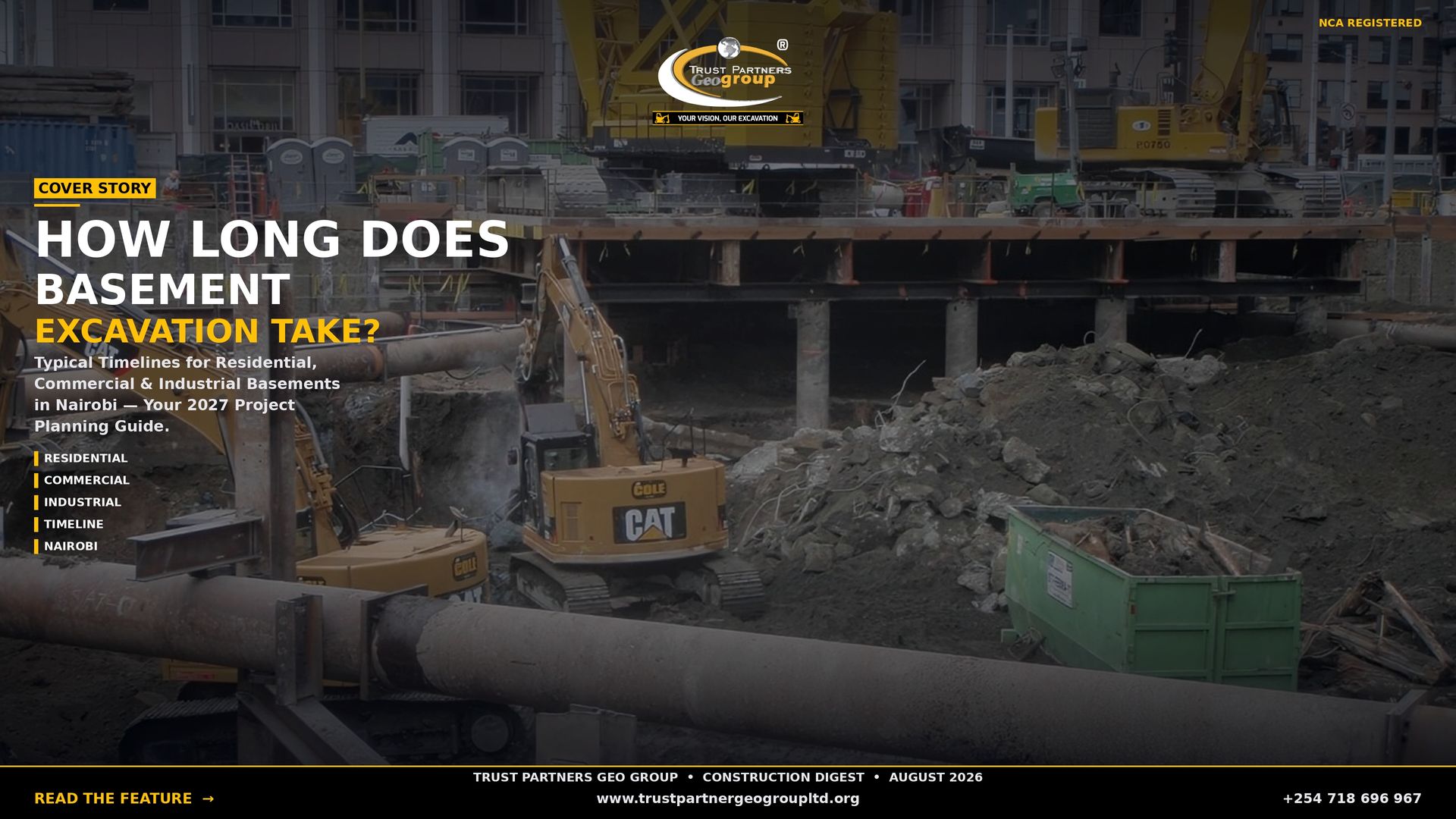
How Long Does Basement Excavation Take? Typical Timelines for Residential, Commercial and Industrial Basements in Nairobi [2027]
The Developer's Timeline Reference for Basement Construction Planning
The question every developer asks after "how much does it cost?" is "how long will it take?" Basement excavation timelines in Nairobi are not fixed — they stretch and compress based on building type, depth, soil, season and the invisible variable that destroys programmes: permit delays. This guide gives you the 2027 baseline durations for residential, commercial and industrial basement excavation in Nairobi, Kiambu, Kajiado and Machakos, with the real-world factors that add weeks or save them. For cost benchmarks by depth, see our 2027 basement cost per m² guide.

NCA-registered excavation contractors serving Nairobi, Kiambu, Kajiado, Machakos and all 47 counties. 15+ years of basement excavation scheduling from residential podiums to industrial substructures across Kenya and East Africa.
Timeline Summary: Residential, Commercial and Industrial at a Glance
The following matrix summarizes 2027 Trust Partners Geo-Group baseline timelines for standard conditions — loose material, dry season, adequate working space, no rock surprises:
| Building Type | Basement Levels | Depth | Typical Footprint | Excavation Timeline | Total with Shoring & Handover |
|---|---|---|---|---|---|
| Residential (Townhouse / Villa) | One-level | 2.5 – 4.0 m | 200 – 500 m² | 3 – 5 weeks | 4 – 6 weeks |
| Residential (Luxury / Estate) | Two-level | 5.0 – 7.0 m | 400 – 800 m² | 8 – 12 weeks | 10 – 14 weeks |
| Commercial (Office / Retail) | Two-level | 6.0 – 8.0 m | 1,000 – 3,000 m² | 8 – 14 weeks | 12 – 18 weeks |
| Commercial (High-Rise Podium) | Three-level | 10.0 – 15.0 m | 1,500 – 4,000 m² | 16 – 28 weeks | 22 – 36 weeks |
| Industrial (Warehouse / Factory) | One to Two-level | 4.0 – 8.0 m | 3,000 – 10,000 m² | 10 – 18 weeks | 14 – 24 weeks |
| Industrial (Heavy Plant) | Two to Three-level | 8.0 – 15.0 m | 5,000 – 15,000 m² | 18 – 30 weeks | 26 – 42 weeks |
Residential Basement Excavation Timeline
One-Level Residential Basement (3–5 Weeks)
The standard Nairobi townhouse or villa basement is a single level at 2.5–4.0 meters depth, providing parking for 2–6 vehicles plus storage. On a 300–500 m² footprint in loose material, the excavation itself takes 2–3 weeks. Add 1 week for site clearance and topsoil strip, and 1 week for trimming, compaction testing and handover. Residential estates in Runda, Karen and Kitisuru often encounter weathered rock at 3–4 meters, adding 1–2 weeks of hydraulic hammer work.
Typical Programme Breakdown:
- Week 1: Site clearance, setting out, topsoil strip
- Weeks 2–3: Bulk excavation to formation level
- Week 4: Trimming, tolerance check, compaction testing
- Week 5: Formation handover to structural contractor
Two-Level Residential Basement (8–12 Weeks)
Luxury homes in Lavington, Muthaiga and parts of Karen increasingly specify two-level basements for wine cellars, home cinemas, staff quarters and expanded parking. At 5–7 meters deep, these require shoring — typically soldier piles or contiguous bored piles — which adds 2–3 weeks before excavation begins. Vertical muck handling slows production, and dewatering is often needed in high-water-table zones.
Typical Programme Breakdown:
- Weeks 1–2: Shoring installation (soldier piles or contiguous bored piles)
- Weeks 3–5: First-level excavation (0 to -4m)
- Weeks 6–8: Second-level excavation (-4m to -7m) with crane-and-skip
- Weeks 9–10: Trimming, tolerance verification, testing
- Weeks 11–12: Formation handover and basement waterproofing start
Commercial Basement Excavation Timeline
Two-Level Commercial Basement (8–14 Weeks)
Mid-rise office buildings, retail podiums and apartment blocks in Kilimani, Westlands and Ngong Road typically require two-level basements at 6–8 meters for parking and services. The 2027 programme assumes a 1,000–3,000 m² footprint with staged excavation and active dewatering.
Commercial timelines are more sensitive to location constraints than residential. CBD-adjacent sites in Upper Hill face traffic management restrictions that limit haulage to night hours, effectively halving daily production. Parklands, Kilimani and Upper Hill basement projects routinely add 2–4 weeks for logistics alone.
Typical Programme Breakdown:
- Weeks 1–2: Site clearance, shoring installation (sheet piles or contiguous bored piles)
- Weeks 3–5: First-level excavation and dewatering commissioning
- Weeks 6–9: Second-level excavation with vertical muck hoisting
- Weeks 10–12: Trimming, extensive compaction testing, formation handover
- Weeks 13–14: Basement slab preparation and waterproofing commencement
Three-Level Commercial Basement (16–28 Weeks)
High-rise towers in Upper Hill, Westlands and the emerging Mombasa Road corridor require three-level basements at 10–15 meters. These are programme-defining activities. The excavation itself is only part of the story — diaphragm wall construction or top-down sequencing adds 6–10 weeks before bulk excavation even begins.
Typical Programme Breakdown:
- Weeks 1–4: Guide wall construction, diaphragm wall panel excavation and concreting
- Weeks 5–8: First-level excavation, dewatering system activation
- Weeks 9–14: Second and third-level excavation with crane tower muck hoisting
- Weeks 15–20: Trimming, tolerance verification, multi-point compaction testing
- Weeks 21–24: Formation handover, basement slab casting (top-down level 1)
- Weeks 25–28: Waterproofing, drainage installation, backfill commencement
Compare one-level, two-level and three-level timelines in detail for multi-basement project planning.
Industrial Basement Excavation Timeline
One to Two-Level Industrial Basement (10–18 Weeks)
Warehouses, distribution centres and light manufacturing facilities in Athi River, Kitengela and Ruiru typically require one or two-level basements at 4–8 meters for heavy machinery foundations, loading docks and service tunnels. The large footprint (3,000–10,000 m²) allows bulk excavation at high production rates — 800–1,200 m³ per day with two 30-ton excavators and a fleet of ADTs.
However, industrial basements often require heavier compaction standards (95% Mod AASHTO vs 90% for residential) and more extensive testing, adding 1–2 weeks to the handover phase. Vibration control for sensitive adjacent production lines may also require slower excavation sequences.
Two to Three-Level Heavy Industrial Basement (18–30 Weeks)
Processing plants, cold storage facilities and heavy manufacturing in EPZ areas and Naivasha may require basements at 8–15 meters for vibration-isolated foundations, deep utility tunnels and fire suppression tanks. These projects combine the depth challenges of commercial three-level basements with the footprint scale of industrial sites.
Cold storage facility excavation adds further complexity with frost-line considerations and insulated foundation requirements that extend the programme.
What Factors Extend or Compress Basement Excavation Time?
| Factor | Timeline Impact | Mitigation Strategy |
|---|---|---|
| Weathered rock encountered | +1–3 weeks residential; +3–6 weeks commercial | Pre-excavation geotechnical probing; have hydraulic hammer on standby |
| Hard rock requiring blasting | +4–10 weeks (including permit processing) | Blasting permit application before contract award; consider chemical breaking |
| High water table | +1–4 weeks for dewatering system commissioning | Well-point or deep-well system designed before excavation starts |
| Adjacent building underpinning | +2–6 weeks | Pre-construction survey; underpinning design ready before breaking ground |
| Utility conflicts | +1–3 weeks per conflict | Detailed GPR survey; trial pits; diversion agreements signed pre-contract |
| Contaminated soil discovery | +4–12 weeks (stop-work, testing, disposal) | Phase II environmental assessment before excavation; selective method |
| Night-work restrictions | +20–30% to total duration | Schedule bulk excavation for unrestricted periods; reserve night work for haulage only |
| Large uniform footprint | -10–20% (economies of scale in bulk excavation) | Use GPS machine control; deploy multiple excavators; optimize haul routes |
| Dry season scheduling | -15–25% vs rainy season | Plan bulk excavation for January–February or June–September windows |
Seasonal Impact: Dry Season vs Rainy Season
Kenya's two rainy seasons are the single biggest external variable affecting basement excavation timelines. Trust Partners Geo-Group's 2027 scheduling data shows the following seasonal modifiers:
| Season | Months | Timeline Impact | Primary Causes |
|---|---|---|---|
| Short Dry | January – February | Baseline (0%) | Optimal conditions; schedule critical path excavation here |
| Long Rains | March – May | +20 – 40% | Black cotton soil saturation; haul road degradation; NEMA sediment restrictions |
| Long Dry | June – September | Baseline (0%) | Best production window; ideal for bulk excavation and rock breaking |
| Short Rains | October – November | +15 – 25% | Intermittent heavy showers; flash flooding risk in low-lying sites |
| Transition | December | +5 – 10% | Holiday labour shortages; unpredictable early rains |
How Rock and Soil Conditions Change the Schedule
Soil type is the second-largest timeline variable after season. The 2027 production rates by material class are:
| Material Class | Equipment | Daily Production | Timeline vs Loose Material |
|---|---|---|---|
| Loose material (murram, fill, topsoil) | 30-ton excavator, 1.4 m³ bucket | 400 – 600 m³/day | Baseline |
| Medium-dense soil (compacted fill, sandy clay) | 30-ton excavator, ripper attachment | 300 – 450 m³/day | +15 – 25% |
| Weathered rock (decomposed, rippable) | 30-ton excavator + hydraulic hammer | 150 – 250 m³/day | +50 – 100% |
| Hard rock (blasting or chemical breaking) | Drill rigs, explosives, chemical agents | 50 – 100 m³/day | +300 – 500% |
| Black cotton soil (wet season) | 30-ton excavator + dewatering | 200 – 350 m³/day | +40 – 70% |
Expansive soils in Kikuyu, Redhill and Limuru present a special case: they are excavatable in the dry season at near-baseline rates, but become unworkable within 48 hours of heavy rain, requiring complete shutdown until the moisture content drops below 25%.
Permit Timelines: What Happens Before Breaking Ground
Excavation cannot begin until permits are in place. These are pre-construction timelines that must be built into the master programme:
| Permit / Approval | Timeline | When to Start | Risk of Delay |
|---|---|---|---|
| NEMA EIA Licence | 12 – 16 weeks | Before land purchase completion | High — cannot proceed without |
| NEMA Environmental Audit | 4 – 8 weeks | 4 weeks before site mobilization | Moderate — most residential projects |
| County Building Permit | 2 – 6 weeks | After structural drawings approved | Moderate — common delay source |
| NCA Project Registration | 1 – 2 weeks | After contractor selection | Low — online process |
| Dewatering Discharge Permit | 3 – 4 weeks | After geotechnical report | High — required before pumping |
| Blasting Permit | 4 – 8 weeks | Before excavation contract signed | Very High — if rock is probable |
| Traffic Management Permit | 2 – 4 weeks | Before haulage begins | Moderate — CBD projects |
Basement excavation safety standards and permit compliance are covered in our dedicated regulatory guide.
Sample Construction Schedule Integration
Here is how basement excavation fits into a typical 24-month commercial high-rise programme in Nairobi:
| Phase | Duration | Cumulative | Notes |
|---|---|---|---|
| Permits and approvals | Weeks 1–12 | Week 12 | NEMA, county, NCA, dewatering |
| Site mobilization | Weeks 13–14 | Week 14 | Fencing, access roads, utilities diversion |
| Shoring installation | Weeks 15–18 | Week 18 | Diaphragm walls or contiguous bored piles |
| Basement excavation | Weeks 19–38 | Week 38 | Critical path — 20 weeks for three levels |
| Basement structure (slabs, walls) | Weeks 36–52 | Week 52 | Overlaps with final excavation weeks |
| Superstructure | Weeks 48–96 | Week 96 | Ground floor starts at week 48 |
| MEP and finishes | Weeks 88–104 | Week 104 | 24-month programme complete |
Frequently Asked Questions
How long does basement excavation take for a residential house in Nairobi?
Residential basement excavation in Nairobi typically takes 3 to 8 weeks depending on depth, soil and footprint. A one-level basement up to 4 meters deep on a 300–500 m² plot takes 3–5 weeks in loose material. If weathered rock is encountered, add 1–3 weeks for hydraulic hammer work. Two-level residential basements in high-end estates like Karen or Runda take 8–12 weeks due to deeper excavation, shoring installation and precision trimming.
How long does commercial basement excavation take in Nairobi?
Commercial basement excavation in Nairobi takes 8 to 16 weeks for typical mid-rise developments. A two-level basement (6–8 meters deep) on a 1,000–2,000 m² footprint requires 8–12 weeks including shoring installation, staged excavation and dewatering. Three-level commercial basements in Upper Hill or Westlands take 14–20 weeks due to diaphragm wall construction, multi-stage dewatering and vertical muck hoisting. CBD projects with night-work restrictions may add 20–30% to the timeline.
How long does industrial basement excavation take in Kenya?
Industrial basement excavation for factories, warehouses and processing plants takes 12 to 30 weeks depending on depth and loading requirements. Industrial basements are typically deeper (8–15 meters) to accommodate heavy machinery foundations, vibration isolation pads and service tunnels. Large footprints (5,000+ m²) with uniform soil allow bulk excavation at 800–1,200 m³ per day, but rock breaking, contamination handling or high water table can extend the programme by 4–8 weeks.
Does the rainy season affect basement excavation timelines in Kenya?
Yes significantly. The long rains (March–May) and short rains (October–November) add 20–40% to basement excavation timelines in Nairobi and surrounding counties. Black cotton soil becomes unworkable when saturated, requiring dewatering intensification and haul road stabilization. NEMA may impose sediment control restrictions that limit working hours. Trust Partners Geo-Group schedules critical bulk excavation during the dry season (January–February and June–September) and reserves rainy-season work for shoring installation and indoor activities where possible.
What is the fastest way to complete basement excavation in Nairobi?
The fastest approach is bulk excavation during the dry season on a site with uniform loose material, adequate working space and no utility conflicts. Using two 30-ton excavators with GPS machine control and a fleet of articulated dump trucks, Trust Partners Geo-Group has completed 10,000 m³ one-level basement excavations in under 3 weeks. However, speed must never compromise safety — shoring, daily inspections and dewatering cannot be compressed without risking cave-ins or groundwater flooding.
How does rock affect basement excavation timelines?
Weathered rock slows production by 30–50% compared to loose material, adding 1–3 weeks to a residential basement and 3–6 weeks to a commercial project. Hard rock beyond the weathered layer requires hydraulic hammering or controlled blasting, which can add 4–10 weeks including permit processing. Blasting permits from the Chief Inspector of Explosives take 4–8 weeks alone, and blast monitoring adds further programme constraints in urban areas.
How long after basement excavation can construction of the superstructure begin?
Superstructure construction can begin 2–4 weeks after excavation handover, provided the formation level passes compaction testing, the structural blinding layer is cast, and permanent retaining walls or basement slabs are in progress. For top-down construction, the ground floor slab is cast before full excavation is complete, allowing superstructure work to begin while lower levels are still being excavated — a programme advantage of 4–8 weeks.
Can basement excavation be done 24/7 in Nairobi?
24-hour basement excavation is possible in Nairobi's industrial zones and some commercial areas with the correct county noise permits and NEMA approval. However, most residential areas restrict earthworks to 7:00 AM – 6:00 PM on weekdays and 8:00 AM – 1:00 PM on Saturdays, with no work on Sundays. CBD projects in Upper Hill and Kilimani may have additional traffic management restrictions that limit haulage to off-peak hours (10:00 PM – 5:00 AM), effectively creating a night-shift excavation programme with reduced productivity.
Get Your Basement Excavation Timeline Estimate
Planning a 2027 project? Contact Trust Partners Geo-Group at +254 718 686 967 for a site-specific timeline estimate and programme-critical path analysis. Serving Nairobi, Kitengela, Athi River, Ruaka, Ngong, Naivasha, Nanyuki and all 47 counties.
Call +254 718 686 967 Request Timeline EstimateHow Long Does Basement Excavation Take? Typical Timelines for Residential, Commercial and Industrial Basements in Nairobi [2027]
The Developer's Timeline Reference for Basement Construction Planning
The question every developer asks after "how much does it cost?" is "how long will it take?" Basement excavation timelines in Nairobi are not fixed — they stretch and compress based on building type, depth, soil, season and the invisible variable that destroys programmes: permit delays. This guide gives you the 2027 baseline durations for residential, commercial and industrial basement excavation in Nairobi, Kiambu, Kajiado and Machakos, with the real-world factors that add weeks or save them. For cost benchmarks by depth, see our 2027 basement cost per m² guide.
NCA-registered excavation contractors serving Nairobi, Kiambu, Kajiado, Machakos and all 47 counties. 15+ years of basement excavation scheduling from residential podiums to industrial substructures across Kenya and East Africa.
Timeline Summary: Residential, Commercial and Industrial at a Glance
The following matrix summarizes 2027 Trust Partners Geo-Group baseline timelines for standard conditions — loose material, dry season, adequate working space, no rock surprises:
| Building Type | Basement Levels | Depth | Typical Footprint | Excavation Timeline | Total with Shoring & Handover |
|---|---|---|---|---|---|
| Residential (Townhouse / Villa) | One-level | 2.5 – 4.0 m | 200 – 500 m² | 3 – 5 weeks | 4 – 6 weeks |
| Residential (Luxury / Estate) | Two-level | 5.0 – 7.0 m | 400 – 800 m² | 8 – 12 weeks | 10 – 14 weeks |
| Commercial (Office / Retail) | Two-level | 6.0 – 8.0 m | 1,000 – 3,000 m² | 8 – 14 weeks | 12 – 18 weeks |
| Commercial (High-Rise Podium) | Three-level | 10.0 – 15.0 m | 1,500 – 4,000 m² | 16 – 28 weeks | 22 – 36 weeks |
| Industrial (Warehouse / Factory) | One to Two-level | 4.0 – 8.0 m | 3,000 – 10,000 m² | 10 – 18 weeks | 14 – 24 weeks |
| Industrial (Heavy Plant) | Two to Three-level | 8.0 – 15.0 m | 5,000 – 15,000 m² | 18 – 30 weeks | 26 – 42 weeks |
Residential Basement Excavation Timeline
One-Level Residential Basement (3–5 Weeks)
The standard Nairobi townhouse or villa basement is a single level at 2.5–4.0 meters depth, providing parking for 2–6 vehicles plus storage. On a 300–500 m² footprint in loose material, the excavation itself takes 2–3 weeks. Add 1 week for site clearance and topsoil strip, and 1 week for trimming, compaction testing and handover. Residential estates in Runda, Karen and Kitisuru often encounter weathered rock at 3–4 meters, adding 1–2 weeks of hydraulic hammer work.
Typical Programme Breakdown:
- Week 1: Site clearance, setting out, topsoil strip
- Weeks 2–3: Bulk excavation to formation level
- Week 4: Trimming, tolerance check, compaction testing
- Week 5: Formation handover to structural contractor
Two-Level Residential Basement (8–12 Weeks)
Luxury homes in Lavington, Muthaiga and parts of Karen increasingly specify two-level basements for wine cellars, home cinemas, staff quarters and expanded parking. At 5–7 meters deep, these require shoring — typically soldier piles or contiguous bored piles — which adds 2–3 weeks before excavation begins. Vertical muck handling slows production, and dewatering is often needed in high-water-table zones.
Typical Programme Breakdown:
- Weeks 1–2: Shoring installation (soldier piles or contiguous bored piles)
- Weeks 3–5: First-level excavation (0 to -4m)
- Weeks 6–8: Second-level excavation (-4m to -7m) with crane-and-skip
- Weeks 9–10: Trimming, tolerance verification, testing
- Weeks 11–12: Formation handover and basement waterproofing start
Commercial Basement Excavation Timeline
Two-Level Commercial Basement (8–14 Weeks)
Mid-rise office buildings, retail podiums and apartment blocks in Kilimani, Westlands and Ngong Road typically require two-level basements at 6–8 meters for parking and services. The 2027 programme assumes a 1,000–3,000 m² footprint with staged excavation and active dewatering.
Commercial timelines are more sensitive to location constraints than residential. CBD-adjacent sites in Upper Hill face traffic management restrictions that limit haulage to night hours, effectively halving daily production. Parklands, Kilimani and Upper Hill basement projects routinely add 2–4 weeks for logistics alone.
Typical Programme Breakdown:
- Weeks 1–2: Site clearance, shoring installation (sheet piles or contiguous bored piles)
- Weeks 3–5: First-level excavation and dewatering commissioning
- Weeks 6–9: Second-level excavation with vertical muck hoisting
- Weeks 10–12: Trimming, extensive compaction testing, formation handover
- Weeks 13–14: Basement slab preparation and waterproofing commencement
Three-Level Commercial Basement (16–28 Weeks)
High-rise towers in Upper Hill, Westlands and the emerging Mombasa Road corridor require three-level basements at 10–15 meters. These are programme-defining activities. The excavation itself is only part of the story — diaphragm wall construction or top-down sequencing adds 6–10 weeks before bulk excavation even begins.
Typical Programme Breakdown:
- Weeks 1–4: Guide wall construction, diaphragm wall panel excavation and concreting
- Weeks 5–8: First-level excavation, dewatering system activation
- Weeks 9–14: Second and third-level excavation with crane tower muck hoisting
- Weeks 15–20: Trimming, tolerance verification, multi-point compaction testing
- Weeks 21–24: Formation handover, basement slab casting (top-down level 1)
- Weeks 25–28: Waterproofing, drainage installation, backfill commencement
Compare one-level, two-level and three-level timelines in detail for multi-basement project planning.
Industrial Basement Excavation Timeline
One to Two-Level Industrial Basement (10–18 Weeks)
Warehouses, distribution centres and light manufacturing facilities in Athi River, Kitengela and Ruiru typically require one or two-level basements at 4–8 meters for heavy machinery foundations, loading docks and service tunnels. The large footprint (3,000–10,000 m²) allows bulk excavation at high production rates — 800–1,200 m³ per day with two 30-ton excavators and a fleet of ADTs.
However, industrial basements often require heavier compaction standards (95% Mod AASHTO vs 90% for residential) and more extensive testing, adding 1–2 weeks to the handover phase. Vibration control for sensitive adjacent production lines may also require slower excavation sequences.
Two to Three-Level Heavy Industrial Basement (18–30 Weeks)
Processing plants, cold storage facilities and heavy manufacturing in EPZ areas and Naivasha may require basements at 8–15 meters for vibration-isolated foundations, deep utility tunnels and fire suppression tanks. These projects combine the depth challenges of commercial three-level basements with the footprint scale of industrial sites.
Cold storage facility excavation adds further complexity with frost-line considerations and insulated foundation requirements that extend the programme.
What Factors Extend or Compress Basement Excavation Time?
| Factor | Timeline Impact | Mitigation Strategy |
|---|---|---|
| Weathered rock encountered | +1–3 weeks residential; +3–6 weeks commercial | Pre-excavation geotechnical probing; have hydraulic hammer on standby |
| Hard rock requiring blasting | +4–10 weeks (including permit processing) | Blasting permit application before contract award; consider chemical breaking |
| High water table | +1–4 weeks for dewatering system commissioning | Well-point or deep-well system designed before excavation starts |
| Adjacent building underpinning | +2–6 weeks | Pre-construction survey; underpinning design ready before breaking ground |
| Utility conflicts | +1–3 weeks per conflict | Detailed GPR survey; trial pits; diversion agreements signed pre-contract |
| Contaminated soil discovery | +4–12 weeks (stop-work, testing, disposal) | Phase II environmental assessment before excavation; selective method |
| Night-work restrictions | +20–30% to total duration | Schedule bulk excavation for unrestricted periods; reserve night work for haulage only |
| Large uniform footprint | -10–20% (economies of scale in bulk excavation) | Use GPS machine control; deploy multiple excavators; optimize haul routes |
| Dry season scheduling | -15–25% vs rainy season | Plan bulk excavation for January–February or June–September windows |
Seasonal Impact: Dry Season vs Rainy Season
Kenya's two rainy seasons are the single biggest external variable affecting basement excavation timelines. Trust Partners Geo-Group's 2027 scheduling data shows the following seasonal modifiers:
| Season | Months | Timeline Impact | Primary Causes |
|---|---|---|---|
| Short Dry | January – February | Baseline (0%) | Optimal conditions; schedule critical path excavation here |
| Long Rains | March – May | +20 – 40% | Black cotton soil saturation; haul road degradation; NEMA sediment restrictions |
| Long Dry | June – September | Baseline (0%) | Best production window; ideal for bulk excavation and rock breaking |
| Short Rains | October – November | +15 – 25% | Intermittent heavy showers; flash flooding risk in low-lying sites |
| Transition | December | +5 – 10% | Holiday labour shortages; unpredictable early rains |
How Rock and Soil Conditions Change the Schedule
Soil type is the second-largest timeline variable after season. The 2027 production rates by material class are:
| Material Class | Equipment | Daily Production | Timeline vs Loose Material |
|---|---|---|---|
| Loose material (murram, fill, topsoil) | 30-ton excavator, 1.4 m³ bucket | 400 – 600 m³/day | Baseline |
| Medium-dense soil (compacted fill, sandy clay) | 30-ton excavator, ripper attachment | 300 – 450 m³/day | +15 – 25% |
| Weathered rock (decomposed, rippable) | 30-ton excavator + hydraulic hammer | 150 – 250 m³/day | +50 – 100% |
| Hard rock (blasting or chemical breaking) | Drill rigs, explosives, chemical agents | 50 – 100 m³/day | +300 – 500% |
| Black cotton soil (wet season) | 30-ton excavator + dewatering | 200 – 350 m³/day | +40 – 70% |
Expansive soils in Kikuyu, Redhill and Limuru present a special case: they are excavatable in the dry season at near-baseline rates, but become unworkable within 48 hours of heavy rain, requiring complete shutdown until the moisture content drops below 25%.
Permit Timelines: What Happens Before Breaking Ground
Excavation cannot begin until permits are in place. These are pre-construction timelines that must be built into the master programme:
| Permit / Approval | Timeline | When to Start | Risk of Delay |
|---|---|---|---|
| NEMA EIA Licence | 12 – 16 weeks | Before land purchase completion | High — cannot proceed without |
| NEMA Environmental Audit | 4 – 8 weeks | 4 weeks before site mobilization | Moderate — most residential projects |
| County Building Permit | 2 – 6 weeks | After structural drawings approved | Moderate — common delay source |
| NCA Project Registration | 1 – 2 weeks | After contractor selection | Low — online process |
| Dewatering Discharge Permit | 3 – 4 weeks | After geotechnical report | High — required before pumping |
| Blasting Permit | 4 – 8 weeks | Before excavation contract signed | Very High — if rock is probable |
| Traffic Management Permit | 2 – 4 weeks | Before haulage begins | Moderate — CBD projects |
Basement excavation safety standards and permit compliance are covered in our dedicated regulatory guide.
Sample Construction Schedule Integration
Here is how basement excavation fits into a typical 24-month commercial high-rise programme in Nairobi:
| Phase | Duration | Cumulative | Notes |
|---|---|---|---|
| Permits and approvals | Weeks 1–12 | Week 12 | NEMA, county, NCA, dewatering |
| Site mobilization | Weeks 13–14 | Week 14 | Fencing, access roads, utilities diversion |
| Shoring installation | Weeks 15–18 | Week 18 | Diaphragm walls or contiguous bored piles |
| Basement excavation | Weeks 19–38 | Week 38 | Critical path — 20 weeks for three levels |
| Basement structure (slabs, walls) | Weeks 36–52 | Week 52 | Overlaps with final excavation weeks |
| Superstructure | Weeks 48–96 | Week 96 | Ground floor starts at week 48 |
| MEP and finishes | Weeks 88–104 | Week 104 | 24-month programme complete |
Frequently Asked Questions
How long does basement excavation take for a residential house in Nairobi?
Residential basement excavation in Nairobi typically takes 3 to 8 weeks depending on depth, soil and footprint. A one-level basement up to 4 meters deep on a 300–500 m² plot takes 3–5 weeks in loose material. If weathered rock is encountered, add 1–3 weeks for hydraulic hammer work. Two-level residential basements in high-end estates like Karen or Runda take 8–12 weeks due to deeper excavation, shoring installation and precision trimming.
How long does commercial basement excavation take in Nairobi?
Commercial basement excavation in Nairobi takes 8 to 16 weeks for typical mid-rise developments. A two-level basement (6–8 meters deep) on a 1,000–2,000 m² footprint requires 8–12 weeks including shoring installation, staged excavation and dewatering. Three-level commercial basements in Upper Hill or Westlands take 14–20 weeks due to diaphragm wall construction, multi-stage dewatering and vertical muck hoisting. CBD projects with night-work restrictions may add 20–30% to the timeline.
How long does industrial basement excavation take in Kenya?
Industrial basement excavation for factories, warehouses and processing plants takes 12 to 30 weeks depending on depth and loading requirements. Industrial basements are typically deeper (8–15 meters) to accommodate heavy machinery foundations, vibration isolation pads and service tunnels. Large footprints (5,000+ m²) with uniform soil allow bulk excavation at 800–1,200 m³ per day, but rock breaking, contamination handling or high water table can extend the programme by 4–8 weeks.
Does the rainy season affect basement excavation timelines in Kenya?
Yes significantly. The long rains (March–May) and short rains (October–November) add 20–40% to basement excavation timelines in Nairobi and surrounding counties. Black cotton soil becomes unworkable when saturated, requiring dewatering intensification and haul road stabilization. NEMA may impose sediment control restrictions that limit working hours. Trust Partners Geo-Group schedules critical bulk excavation during the dry season (January–February and June–September) and reserves rainy-season work for shoring installation and indoor activities where possible.
What is the fastest way to complete basement excavation in Nairobi?
The fastest approach is bulk excavation during the dry season on a site with uniform loose material, adequate working space and no utility conflicts. Using two 30-ton excavators with GPS machine control and a fleet of articulated dump trucks, Trust Partners Geo-Group has completed 10,000 m³ one-level basement excavations in under 3 weeks. However, speed must never compromise safety — shoring, daily inspections and dewatering cannot be compressed without risking cave-ins or groundwater flooding.
How does rock affect basement excavation timelines?
Weathered rock slows production by 30–50% compared to loose material, adding 1–3 weeks to a residential basement and 3–6 weeks to a commercial project. Hard rock beyond the weathered layer requires hydraulic hammering or controlled blasting, which can add 4–10 weeks including permit processing. Blasting permits from the Chief Inspector of Explosives take 4–8 weeks alone, and blast monitoring adds further programme constraints in urban areas.
How long after basement excavation can construction of the superstructure begin?
Superstructure construction can begin 2–4 weeks after excavation handover, provided the formation level passes compaction testing, the structural blinding layer is cast, and permanent retaining walls or basement slabs are in progress. For top-down construction, the ground floor slab is cast before full excavation is complete, allowing superstructure work to begin while lower levels are still being excavated — a programme advantage of 4–8 weeks.
Can basement excavation be done 24/7 in Nairobi?
24-hour basement excavation is possible in Nairobi's industrial zones and some commercial areas with the correct county noise permits and NEMA approval. However, most residential areas restrict earthworks to 7:00 AM – 6:00 PM on weekdays and 8:00 AM – 1:00 PM on Saturdays, with no work on Sundays. CBD projects in Upper Hill and Kilimani may have additional traffic management restrictions that limit haulage to off-peak hours (10:00 PM – 5:00 AM), effectively creating a night-shift excavation programme with reduced productivity.
Get Your Basement Excavation Timeline Estimate
Planning a 2027 project? Contact Trust Partners Geo-Group at +254 718 686 967 for a site-specific timeline estimate and programme-critical path analysis. Serving Nairobi, Kitengela, Athi River, Ruaka, Ngong, Naivasha, Nanyuki and all 47 counties.
Call +254 718 686 967 Request Timeline Estimate