
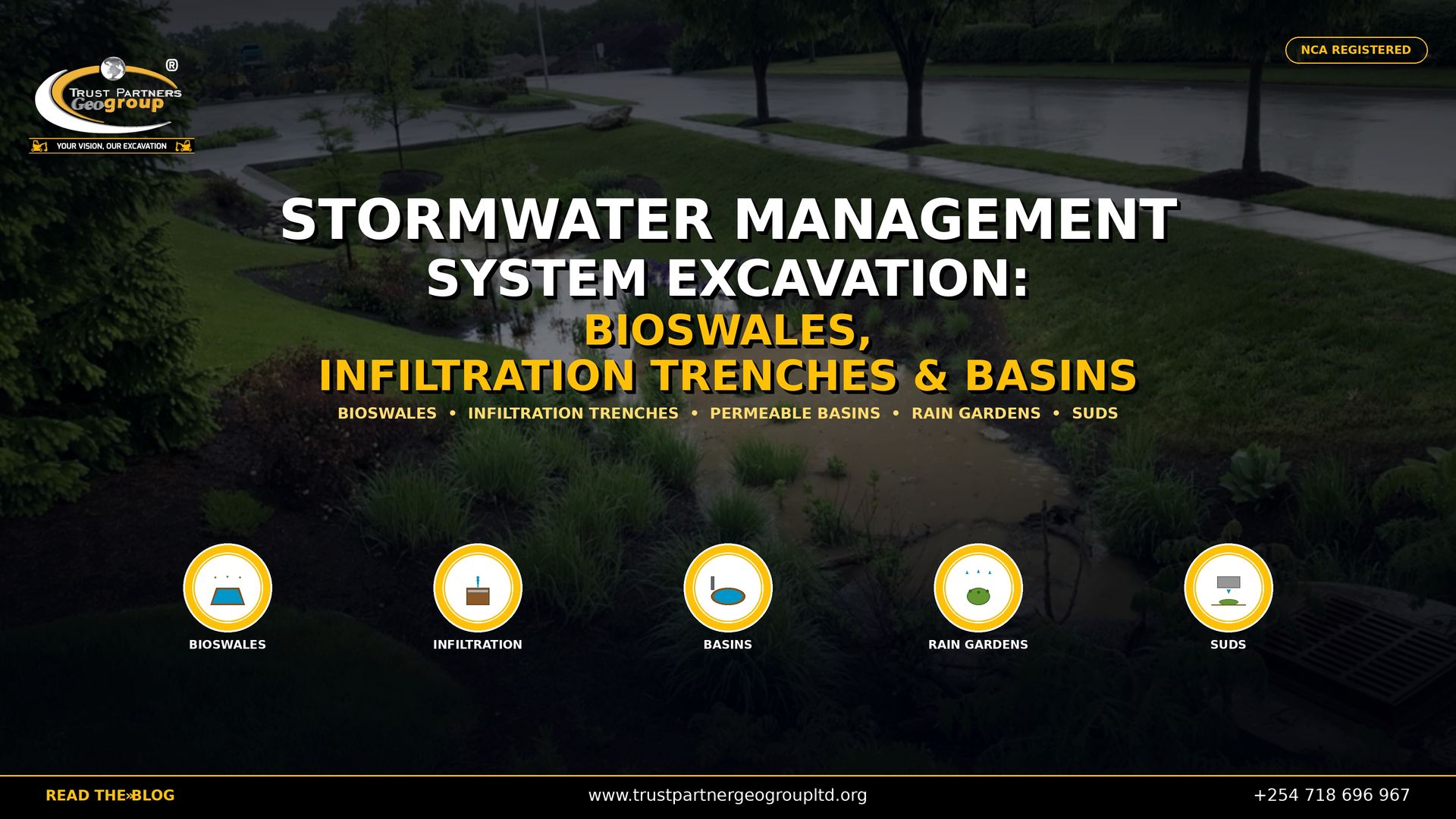
Stormwater Management System Excavation: Bioswales, Infiltration Trenches and Permeable Basins [2026]
Sustainable Drainage (SuDS) Earthworks for Kenya's Estates, Developments & County Roads
Every long rains season, Nairobi floods — and every flood is a stormwater design failure somewhere upstream: a paved estate with nowhere for water to go, a drain discharging at full peak into a watercourse, a site that treated rain as a nuisance instead of a resource. Stormwater management system excavation builds the alternative: bioswales that slow and filter runoff, infiltration trenches that return it to the ground, and permeable basins that store and release it gently. This 2026 engineering guide covers bioswale construction in Nairobi, infiltration trench excavation, permeable basin construction in Kenya and sustainable drainage (SuDS) — for estates, commercial developments, industrial parks and county roads — with methods, specifications, costs and the compliance pathway. With 15+ years of excavation experience across Kenya, Trust Partners Geo-Group delivers complete SuDS earthworks from percolation test to planting.

From estate bioswales to industrial detention basins, our team delivers stormwater systems across Kenya — sized for the design storm, built for the soil that is actually on site, and handed over with a maintenance plan.
1. Stormwater in Kenya: Why 2026 Demands Engineered Drainage
Kenya's urban flooding is not a rainfall problem — it is a runoff management problem. Impermeable development converts rain that once soaked into red soil into instant peak flows that overwhelm drains built for a smaller, greener city. Three pressures make engineered stormwater systems standard practice in 2026:
- Approval conditions: NEMA EIA licences and county development approvals now routinely require stormwater management plans — post-development peak flows must not exceed pre-development rates.
- Flood liability: estates and commercial parks that discharge untreated peak flows onto neighbours or roads face real legal and reputational exposure after every flood event.
- Water scarcity: infiltrated stormwater recharges the groundwater that Nairobi's boreholes depend on. Throwing rain into a drain and then buying water is a double loss.
This guide is the development-scale companion to our flood mitigation excavation guide — where that article handles flood-scale channels and retention, this one handles the site-scale systems that stop developments from causing the floods in the first place.
2. What Is Stormwater Management System Excavation?
Stormwater management excavation builds the Sustainable Drainage Systems (SuDS) that capture runoff at source, treat it, and either infiltrate it or release it slowly. The four core components, usually combined in a treatment train:
- Bioswales — shallow vegetated channels that convey, slow and filter runoff along roads and parking areas.
- Infiltration trenches — stone-filled trenches that store runoff and let it soak into the ground.
- Permeable (infiltration) basins — shallow excavated basins that hold storm events and infiltrate them over hours to days.
- Detention basins — lined or impermeable basins that store peak flows and release them through controlled outlets where infiltration is impossible.
The excavation disciplines overlap heavily with our pipeline trenching work — controlled trenches, bedding, geotextiles and layered backfill — applied to water that stays on site rather than passing through it.
3. Bioswale Construction: Vegetated Channels That Work
Bioswales are the most visible SuDS element — and the most commonly built badly. A bioswale is an engineered channel, not a ditch with grass:
| Element | Typical Specification | Why It Matters |
|---|---|---|
| Longitudinal gradient | 1–4% (check dams above 4%) | Too flat ponds permanently; too steep erodes instead of filtering |
| Cross-section | Trapezoidal, side slopes 1V:3H or flatter, bottom width 0.6–2.4 m | Flat slopes are mowable, safe and slow the water |
| Depth | 300–600 mm below adjacent ground | Enough capacity for the design storm without becoming a hazard |
| Engineered media | 300–450 mm amended soil (sandy loam + compost); geotextile separation below | Filtration and infiltration happen in the media, not the subsoil |
| Underdrain | Perforated pipe in aggregate where subsoil infiltration is slow (black cotton) | Prevents waterlogging; discharges filtered water downstream |
| Check dams | Stone or timber weirs at intervals on steeper reaches | Create ponding cells that slow flow and boost infiltration |
| Inlets & forebays | Level spreaders or stone aprons at entry points | Concentrated inflow erodes swales — entry energy must be spread |
| Vegetation | Dense hardy grasses and sedges; no bare soil at handover | Plants are the treatment mechanism and the erosion armour |
Excavation discipline matters: swales are cut in dry conditions, the base is scarified — never compacted — media is placed in loose layers, and the swale stays offline (blocked inlets) until the contributing site is stabilised. A swale that receives construction sediment in its first month is clogged for life.
4. Infiltration Trench Excavation: Putting Water Back in the Ground
Infiltration trenches are the workhorse for plot-scale drainage — along boundaries, around buildings, beneath parking edges:
- Geometry: typically 0.6–1.5 m wide, 1.0–2.0 m deep, sized to store the design storm's runoff volume in the stone voids (about 30–40% void ratio).
- Structure: geotextile lining on all faces, clean 20–40 mm single-size stone fill, perforated distribution pipe at the top, 150–300 mm aggregate or stone-cover above, then topsoil or paving.
- Excavation rules: vertical sides in stable ground, base trimmed level, smeared or compacted soil faces scarified before geotextile — the machine's bucket glaze would otherwise seal the very surface meant to infiltrate.
- Setbacks: typically 5 m+ from building foundations, clear of septic systems, and only where percolation tests confirm the subsoil can take the water.
- Pre-treatment: every trench is fed through a silt trap, forebay or bioswale — sediment is the terminal disease of infiltration systems.
5. Permeable and Detention Basins: The Big Storage
At estate and industrial-park scale, stormwater needs volume — and volume means basins:
- Permeable (infiltration) basins: shallow (0.6–1.5 m), broad, flat-floored excavations in permeable ground that store a storm and soak it away within 24–72 hours. Excavated with plant working from the perimeter — never trafficking the floor — with the final 150–300 mm trimmed by light machine or hand.
- Detention basins: engineered storage with a controlled outlet (orifice/weir structure) where infiltration is not viable — black cotton soils, high groundwater, contaminated catchments. May be dry (grassed, dual-use as open space) or wet (permanent pool with wetland edges).
- Embankments and spillways: basin bunds are placed in compacted 150–200 mm layers with keyed foundations; every basin gets an emergency spillway sized for the extreme event — the storm that exceeds design must leave safely, not through the embankment.
- Safety and amenity: gentle side slopes (1V:4H or flatter at the water's edge), dense marginal planting, and fencing where depth and public access demand it. Well-built basins are landscape assets, not fenced scars.
- Maintenance access: ramps for desilting plant, forebays that concentrate sediment where it can be removed, and hard standing for the excavator that will visit every few years.
Basin excavation reuses the bulk-earthworks and compaction discipline of our large-site infrastructure work — tight level control, layer compaction and erosion-free handover.
6. Kenyan Soils Reality Check: Red Coffee vs Black Cotton
Stormwater design in Kenya is decided by the soil map more than by the rainfall map:
| Soil | Where | Infiltration Behaviour | Right System |
|---|---|---|---|
| Red coffee / red volcanic loams | Nairobi's west and north (Karen, Runda, Westlands fringe), Kiambu highlands | Good to excellent infiltration | Full SuDS: bioswales, infiltration trenches, permeable basins |
| Black cotton (expansive clays) | Nairobi east and south, Athi River plains, Kajiado, Machakos lowlands | Very poor — swells when wet | Detention basins with outlets; swales with underdrains; no infiltration near foundations |
| Sandy alluvial soils | Athi/Tana corridors, coastal strip | Rapid infiltration, sometimes too rapid (contamination risk) | Infiltration with pre-treatment; watch groundwater protection |
| Shallow rock / murram over rock | Western Nairobi ridges, Rift escarpment fringes | Variable — rockhead controls | Shallow swales and trenches following rockhead; detention where storage depth is impossible |
Every SuDS project we build starts with percolation tests and trial pits — the soil report is the design. Infiltrating into black cotton does not drain the site; it soaks the clay, swells it, and moves the neighbour's wall.
7. Where SuDS Are Being Built: Applications Across Kenya
| Application | Typical SuDS Package | Driver |
|---|---|---|
| Residential estates & gated communities | Roadside bioswales, plot infiltration trenches, central detention/amenity basin | County approval conditions; flood-free marketing |
| Commercial & retail developments | Parking-lot swales, permeable paving sub-bases, underground attenuation where land is tight | Large impermeable areas; NEMA conditions |
| Industrial parks & logistics | Oil/water separation pre-treatment, lined detention basins, controlled discharge | Water quality + peak flow control |
| County & access roads | Swale drains replacing open ditches, check dams, culvert outfall protection | Road-edge erosion and downstream flooding |
| Institutions (schools, hospitals, campuses) | Swales, rain gardens, infiltration basins doubling as landscape | Compliance plus water-conscious grounds management |
| Solar farms & remote facilities | Contour swales, infiltration basins at discharge points | Sheet-flow erosion control on large graded sites |
8. Equipment Selection for Stormwater Works
| Machine | Role on Stormwater Projects |
|---|---|
| 5–14 t excavators | Bioswale shaping, infiltration trenches, media placement — precision over power |
| 20 t excavator | Basin bulk excavation, embankment construction, outlet structures |
| Long-reach excavator | Basin floor trimming from the perimeter — keeps plant off infiltration surfaces |
| Motor grader | Swale longitudinal grading, basin floor levels, verge shaping |
| Vibratory roller & plate compactors | Embankment layers and backfill — never on infiltration faces |
| Tippers & loaders | Engineered media, aggregate and stone logistics |
| Trench rollers / remote compactors | Trench backfill compaction where required |
All plant is available through our heavy equipment for hire fleet, with grading-accurate machines and operators briefed on SuDS-specific rules — no trafficking basin floors, no compacting infiltration faces, no early connection of live drains.
9. Stormwater System Costs: 2026 Budget Benchmarks
| Work Item | Typical 2026 Range (KES) | Cost Driver |
|---|---|---|
| Bioswale construction, complete | 3,500–9,000 per metre | Media depth, underdrain, check dams |
| Infiltration trench, complete | 2,500–6,500 per metre | Depth, stone volume, geotextile |
| Permeable basin | 1.5M–8M per basin | Volume, trimming method, planting |
| Detention basin with outlet structure | 3M–15M per basin | Volume, embankment, control structure |
| Bulk excavation (SuDS earthworks) | 250–600 per m³ | Haul distance, material |
| Engineered media supply & place | 4,500–9,000 per m³ | Blend specification |
| Estate-wide SuDS package | 5M–40M per development | Site area, soil, storage volume required |
| Percolation testing & drainage assessment | 80,000–250,000 per site | Number of test pits, reporting |
10. NEMA, County and Design Compliance
- NEMA: EIA licence conditions for most developments include stormwater management, water quality at discharge points, and construction-phase erosion and sediment control.
- County approvals: Nairobi and most counties require drainage plans at building approval; several now require attenuation to pre-development peak flows as a condition.
- Watercourse rules: discharges to rivers and riparian land attract WRA attention and riparian setback rules — SuDS reduce or eliminate the direct discharge entirely.
- Design standards: systems are sized to design storms (typically 1-in-10 to 1-in-25 year events with climate uplift) with safe overflow for exceedance events.
- NCA: contractor registration — see our NCA registration requirements guide.
- Maintenance duty: SuDS are handed over with desilting, vegetation and inspection schedules — an unmaintained bioswale silently reverts to a ditch.
11. Frequently Asked Questions
How much does stormwater management excavation cost in Kenya?
In 2026: bioswales KES 3,500–9,000 per metre, infiltration trenches KES 2,500–6,500 per metre, and basins KES 1.5–15 million. Full estate SuDS packages run KES 5–40 million — typically 3–8% of site civil works.
What is a bioswale and how is it constructed in Nairobi?
A shallow vegetated channel that slows, filters and partially infiltrates runoff. Construction: excavate a gently graded trapezoidal channel, place 300–450 mm engineered soil media, add check dams and underdrains where needed, spread inflow energy at entries, and plant densely. It stays offline until the site is stabilised.
What is the difference between a detention basin and an infiltration basin?
A detention basin stores stormwater and releases it slowly through an outlet — managing peak flows. An infiltration (permeable) basin soaks stormwater into the ground — needing permeable soils and safe groundwater depth. Many Kenyan sites combine both, decided by percolation testing.
Is stormwater management mandatory for new developments in Kenya?
Effectively yes — NEMA EIA licences impose stormwater conditions, counties require drainage plans at approval, and post-development peak flows generally must not exceed pre-development rates. SuDS are how compliant developments meet that condition.
Can infiltration systems work in Nairobi's black cotton and red coffee soils?
Red coffee soils infiltrate well with standard trenches and basins. Black cotton soils do not — designs there use engineered media, underdrains and detention. A percolation test on site decides which system the ground supports.
How are permeable basins excavated without clogging the soil?
Excavate dry, never traffic the basin floor (perimeter plant or long-reach machines), never compact the base, scarify smeared faces, and keep the basin offline until the site is stabilised. The final 150–300 mm is often trimmed by hand or light machine.
Who builds bioswales and stormwater systems in Kenya?
NCA-registered earthworks and civil contractors with drainage experience. Trust Partners Geo-Group delivers bioswales, infiltration trenches, permeable basins and full SuDS packages across Nairobi, Kiambu, Kajiado, Machakos and all 47 counties — call +254 718 686 967.
12. Conclusion: Slow It, Spread It, Sink It
Every working stormwater system in Kenya follows the SuDS mantra: slow the water down, spread it out, sink it into the ground where the soil allows — and store and release it gently where it does not. Bioswales convey and filter, infiltration trenches recharge, permeable basins soak storms away, and detention basins hold the peak where clay soils refuse the water.
For developers, counties and institutions, the 2026 direction is set: approvals demand it, floods punish its absence, and water scarcity rewards every litre infiltrated. Stormwater SuDS connect directly to our flood mitigation works and our coastal protection programme — one integrated water-management capability from the site drain to the shoreline.
Trust Partners Geo-Group delivers stormwater systems end-to-end: percolation testing support, SuDS earthworks, bioswale construction, infiltration trenches, basin excavation, outlet structures, planting and handover maintenance plans — Nairobi and all 47 counties.
Planning a Development? Get Stormwater Right Before the Paving Goes Down.
Trust Partners Geo-Group delivers approval-ready SuDS — bioswales, infiltration trenches, permeable and detention basins — across Nairobi and all 47 counties.
Call +254 718 686 967 — 24/7 Request a Drainage AssessmentStormwater Management System Excavation: Bioswales, Infiltration Trenches and Permeable Basins [2026]
Sustainable Drainage (SuDS) Earthworks for Kenya's Estates, Developments & County Roads
Every long rains season, Nairobi floods — and every flood is a stormwater design failure somewhere upstream: a paved estate with nowhere for water to go, a drain discharging at full peak into a watercourse, a site that treated rain as a nuisance instead of a resource. Stormwater management system excavation builds the alternative: bioswales that slow and filter runoff, infiltration trenches that return it to the ground, and permeable basins that store and release it gently. This 2026 engineering guide covers bioswale construction in Nairobi, infiltration trench excavation, permeable basin construction in Kenya and sustainable drainage (SuDS) — for estates, commercial developments, industrial parks and county roads — with methods, specifications, costs and the compliance pathway. With 15+ years of excavation experience across Kenya, Trust Partners Geo-Group delivers complete SuDS earthworks from percolation test to planting.
From estate bioswales to industrial detention basins, our team delivers stormwater systems across Kenya — sized for the design storm, built for the soil that is actually on site, and handed over with a maintenance plan.
1. Stormwater in Kenya: Why 2026 Demands Engineered Drainage
Kenya's urban flooding is not a rainfall problem — it is a runoff management problem. Impermeable development converts rain that once soaked into red soil into instant peak flows that overwhelm drains built for a smaller, greener city. Three pressures make engineered stormwater systems standard practice in 2026:
- Approval conditions: NEMA EIA licences and county development approvals now routinely require stormwater management plans — post-development peak flows must not exceed pre-development rates.
- Flood liability: estates and commercial parks that discharge untreated peak flows onto neighbours or roads face real legal and reputational exposure after every flood event.
- Water scarcity: infiltrated stormwater recharges the groundwater that Nairobi's boreholes depend on. Throwing rain into a drain and then buying water is a double loss.
This guide is the development-scale companion to our flood mitigation excavation guide — where that article handles flood-scale channels and retention, this one handles the site-scale systems that stop developments from causing the floods in the first place.
2. What Is Stormwater Management System Excavation?
Stormwater management excavation builds the Sustainable Drainage Systems (SuDS) that capture runoff at source, treat it, and either infiltrate it or release it slowly. The four core components, usually combined in a treatment train:
- Bioswales — shallow vegetated channels that convey, slow and filter runoff along roads and parking areas.
- Infiltration trenches — stone-filled trenches that store runoff and let it soak into the ground.
- Permeable (infiltration) basins — shallow excavated basins that hold storm events and infiltrate them over hours to days.
- Detention basins — lined or impermeable basins that store peak flows and release them through controlled outlets where infiltration is impossible.
The excavation disciplines overlap heavily with our pipeline trenching work — controlled trenches, bedding, geotextiles and layered backfill — applied to water that stays on site rather than passing through it.
3. Bioswale Construction: Vegetated Channels That Work
Bioswales are the most visible SuDS element — and the most commonly built badly. A bioswale is an engineered channel, not a ditch with grass:
| Element | Typical Specification | Why It Matters |
|---|---|---|
| Longitudinal gradient | 1–4% (check dams above 4%) | Too flat ponds permanently; too steep erodes instead of filtering |
| Cross-section | Trapezoidal, side slopes 1V:3H or flatter, bottom width 0.6–2.4 m | Flat slopes are mowable, safe and slow the water |
| Depth | 300–600 mm below adjacent ground | Enough capacity for the design storm without becoming a hazard |
| Engineered media | 300–450 mm amended soil (sandy loam + compost); geotextile separation below | Filtration and infiltration happen in the media, not the subsoil |
| Underdrain | Perforated pipe in aggregate where subsoil infiltration is slow (black cotton) | Prevents waterlogging; discharges filtered water downstream |
| Check dams | Stone or timber weirs at intervals on steeper reaches | Create ponding cells that slow flow and boost infiltration |
| Inlets & forebays | Level spreaders or stone aprons at entry points | Concentrated inflow erodes swales — entry energy must be spread |
| Vegetation | Dense hardy grasses and sedges; no bare soil at handover | Plants are the treatment mechanism and the erosion armour |
Excavation discipline matters: swales are cut in dry conditions, the base is scarified — never compacted — media is placed in loose layers, and the swale stays offline (blocked inlets) until the contributing site is stabilised. A swale that receives construction sediment in its first month is clogged for life.
4. Infiltration Trench Excavation: Putting Water Back in the Ground
Infiltration trenches are the workhorse for plot-scale drainage — along boundaries, around buildings, beneath parking edges:
- Geometry: typically 0.6–1.5 m wide, 1.0–2.0 m deep, sized to store the design storm's runoff volume in the stone voids (about 30–40% void ratio).
- Structure: geotextile lining on all faces, clean 20–40 mm single-size stone fill, perforated distribution pipe at the top, 150–300 mm aggregate or stone-cover above, then topsoil or paving.
- Excavation rules: vertical sides in stable ground, base trimmed level, smeared or compacted soil faces scarified before geotextile — the machine's bucket glaze would otherwise seal the very surface meant to infiltrate.
- Setbacks: typically 5 m+ from building foundations, clear of septic systems, and only where percolation tests confirm the subsoil can take the water.
- Pre-treatment: every trench is fed through a silt trap, forebay or bioswale — sediment is the terminal disease of infiltration systems.
5. Permeable and Detention Basins: The Big Storage
At estate and industrial-park scale, stormwater needs volume — and volume means basins:
- Permeable (infiltration) basins: shallow (0.6–1.5 m), broad, flat-floored excavations in permeable ground that store a storm and soak it away within 24–72 hours. Excavated with plant working from the perimeter — never trafficking the floor — with the final 150–300 mm trimmed by light machine or hand.
- Detention basins: engineered storage with a controlled outlet (orifice/weir structure) where infiltration is not viable — black cotton soils, high groundwater, contaminated catchments. May be dry (grassed, dual-use as open space) or wet (permanent pool with wetland edges).
- Embankments and spillways: basin bunds are placed in compacted 150–200 mm layers with keyed foundations; every basin gets an emergency spillway sized for the extreme event — the storm that exceeds design must leave safely, not through the embankment.
- Safety and amenity: gentle side slopes (1V:4H or flatter at the water's edge), dense marginal planting, and fencing where depth and public access demand it. Well-built basins are landscape assets, not fenced scars.
- Maintenance access: ramps for desilting plant, forebays that concentrate sediment where it can be removed, and hard standing for the excavator that will visit every few years.
Basin excavation reuses the bulk-earthworks and compaction discipline of our large-site infrastructure work — tight level control, layer compaction and erosion-free handover.
6. Kenyan Soils Reality Check: Red Coffee vs Black Cotton
Stormwater design in Kenya is decided by the soil map more than by the rainfall map:
| Soil | Where | Infiltration Behaviour | Right System |
|---|---|---|---|
| Red coffee / red volcanic loams | Nairobi's west and north (Karen, Runda, Westlands fringe), Kiambu highlands | Good to excellent infiltration | Full SuDS: bioswales, infiltration trenches, permeable basins |
| Black cotton (expansive clays) | Nairobi east and south, Athi River plains, Kajiado, Machakos lowlands | Very poor — swells when wet | Detention basins with outlets; swales with underdrains; no infiltration near foundations |
| Sandy alluvial soils | Athi/Tana corridors, coastal strip | Rapid infiltration, sometimes too rapid (contamination risk) | Infiltration with pre-treatment; watch groundwater protection |
| Shallow rock / murram over rock | Western Nairobi ridges, Rift escarpment fringes | Variable — rockhead controls | Shallow swales and trenches following rockhead; detention where storage depth is impossible |
Every SuDS project we build starts with percolation tests and trial pits — the soil report is the design. Infiltrating into black cotton does not drain the site; it soaks the clay, swells it, and moves the neighbour's wall.
7. Where SuDS Are Being Built: Applications Across Kenya
| Application | Typical SuDS Package | Driver |
|---|---|---|
| Residential estates & gated communities | Roadside bioswales, plot infiltration trenches, central detention/amenity basin | County approval conditions; flood-free marketing |
| Commercial & retail developments | Parking-lot swales, permeable paving sub-bases, underground attenuation where land is tight | Large impermeable areas; NEMA conditions |
| Industrial parks & logistics | Oil/water separation pre-treatment, lined detention basins, controlled discharge | Water quality + peak flow control |
| County & access roads | Swale drains replacing open ditches, check dams, culvert outfall protection | Road-edge erosion and downstream flooding |
| Institutions (schools, hospitals, campuses) | Swales, rain gardens, infiltration basins doubling as landscape | Compliance plus water-conscious grounds management |
| Solar farms & remote facilities | Contour swales, infiltration basins at discharge points | Sheet-flow erosion control on large graded sites |
8. Equipment Selection for Stormwater Works
| Machine | Role on Stormwater Projects |
|---|---|
| 5–14 t excavators | Bioswale shaping, infiltration trenches, media placement — precision over power |
| 20 t excavator | Basin bulk excavation, embankment construction, outlet structures |
| Long-reach excavator | Basin floor trimming from the perimeter — keeps plant off infiltration surfaces |
| Motor grader | Swale longitudinal grading, basin floor levels, verge shaping |
| Vibratory roller & plate compactors | Embankment layers and backfill — never on infiltration faces |
| Tippers & loaders | Engineered media, aggregate and stone logistics |
| Trench rollers / remote compactors | Trench backfill compaction where required |
All plant is available through our heavy equipment for hire fleet, with grading-accurate machines and operators briefed on SuDS-specific rules — no trafficking basin floors, no compacting infiltration faces, no early connection of live drains.
9. Stormwater System Costs: 2026 Budget Benchmarks
| Work Item | Typical 2026 Range (KES) | Cost Driver |
|---|---|---|
| Bioswale construction, complete | 3,500–9,000 per metre | Media depth, underdrain, check dams |
| Infiltration trench, complete | 2,500–6,500 per metre | Depth, stone volume, geotextile |
| Permeable basin | 1.5M–8M per basin | Volume, trimming method, planting |
| Detention basin with outlet structure | 3M–15M per basin | Volume, embankment, control structure |
| Bulk excavation (SuDS earthworks) | 250–600 per m³ | Haul distance, material |
| Engineered media supply & place | 4,500–9,000 per m³ | Blend specification |
| Estate-wide SuDS package | 5M–40M per development | Site area, soil, storage volume required |
| Percolation testing & drainage assessment | 80,000–250,000 per site | Number of test pits, reporting |
10. NEMA, County and Design Compliance
- NEMA: EIA licence conditions for most developments include stormwater management, water quality at discharge points, and construction-phase erosion and sediment control.
- County approvals: Nairobi and most counties require drainage plans at building approval; several now require attenuation to pre-development peak flows as a condition.
- Watercourse rules: discharges to rivers and riparian land attract WRA attention and riparian setback rules — SuDS reduce or eliminate the direct discharge entirely.
- Design standards: systems are sized to design storms (typically 1-in-10 to 1-in-25 year events with climate uplift) with safe overflow for exceedance events.
- NCA: contractor registration — see our NCA registration requirements guide.
- Maintenance duty: SuDS are handed over with desilting, vegetation and inspection schedules — an unmaintained bioswale silently reverts to a ditch.
11. Frequently Asked Questions
How much does stormwater management excavation cost in Kenya?
In 2026: bioswales KES 3,500–9,000 per metre, infiltration trenches KES 2,500–6,500 per metre, and basins KES 1.5–15 million. Full estate SuDS packages run KES 5–40 million — typically 3–8% of site civil works.
What is a bioswale and how is it constructed in Nairobi?
A shallow vegetated channel that slows, filters and partially infiltrates runoff. Construction: excavate a gently graded trapezoidal channel, place 300–450 mm engineered soil media, add check dams and underdrains where needed, spread inflow energy at entries, and plant densely. It stays offline until the site is stabilised.
What is the difference between a detention basin and an infiltration basin?
A detention basin stores stormwater and releases it slowly through an outlet — managing peak flows. An infiltration (permeable) basin soaks stormwater into the ground — needing permeable soils and safe groundwater depth. Many Kenyan sites combine both, decided by percolation testing.
Is stormwater management mandatory for new developments in Kenya?
Effectively yes — NEMA EIA licences impose stormwater conditions, counties require drainage plans at approval, and post-development peak flows generally must not exceed pre-development rates. SuDS are how compliant developments meet that condition.
Can infiltration systems work in Nairobi's black cotton and red coffee soils?
Red coffee soils infiltrate well with standard trenches and basins. Black cotton soils do not — designs there use engineered media, underdrains and detention. A percolation test on site decides which system the ground supports.
How are permeable basins excavated without clogging the soil?
Excavate dry, never traffic the basin floor (perimeter plant or long-reach machines), never compact the base, scarify smeared faces, and keep the basin offline until the site is stabilised. The final 150–300 mm is often trimmed by hand or light machine.
Who builds bioswales and stormwater systems in Kenya?
NCA-registered earthworks and civil contractors with drainage experience. Trust Partners Geo-Group delivers bioswales, infiltration trenches, permeable basins and full SuDS packages across Nairobi, Kiambu, Kajiado, Machakos and all 47 counties — call +254 718 686 967.
12. Conclusion: Slow It, Spread It, Sink It
Every working stormwater system in Kenya follows the SuDS mantra: slow the water down, spread it out, sink it into the ground where the soil allows — and store and release it gently where it does not. Bioswales convey and filter, infiltration trenches recharge, permeable basins soak storms away, and detention basins hold the peak where clay soils refuse the water.
For developers, counties and institutions, the 2026 direction is set: approvals demand it, floods punish its absence, and water scarcity rewards every litre infiltrated. Stormwater SuDS connect directly to our flood mitigation works and our coastal protection programme — one integrated water-management capability from the site drain to the shoreline.
Trust Partners Geo-Group delivers stormwater systems end-to-end: percolation testing support, SuDS earthworks, bioswale construction, infiltration trenches, basin excavation, outlet structures, planting and handover maintenance plans — Nairobi and all 47 counties.
Planning a Development? Get Stormwater Right Before the Paving Goes Down.
Trust Partners Geo-Group delivers approval-ready SuDS — bioswales, infiltration trenches, permeable and detention basins — across Nairobi and all 47 counties.
Call +254 718 686 967 — 24/7 Request a Drainage Assessment