
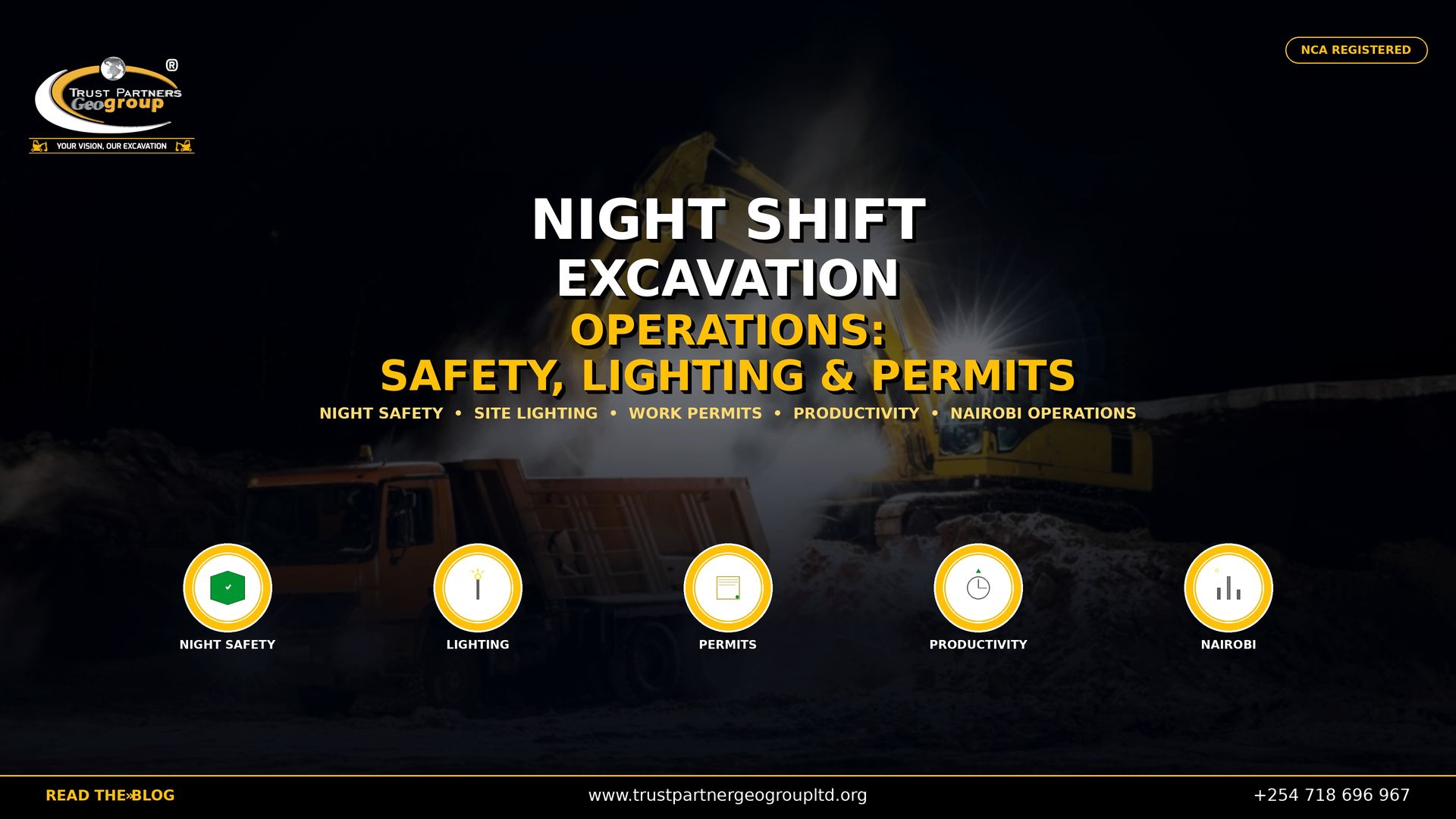
Night Shift Excavation Operations: Safety, Lighting, Permits and Productivity in Nairobi [2026]
24-Hour Construction Done Right — Permits, Lighting, Crews & Night-Safe Procedures
Some of Nairobi's most important excavation happens after dark: CBD basements dug while the city sleeps, road crossings cut during possession windows, emergency failures cleared before the morning commute. Done well, night shift excavation is a programme superpower. Done badly, it is where accidents, noise stop-orders and blown budgets live. This 2026 operations guide covers 24-hour construction in Nairobi, night work permits in Kenya, excavation lighting requirements and after-hours construction — the permits, the lighting standards, the safety controls, fatigue management, productivity planning and the true cost premium. With 15+ years of excavation experience across Kenya and a genuine 24/7 operation, Trust Partners Geo-Group runs night shifts as a discipline, not an improvisation.

From CBD basement digs to emergency night responses, our night crews operate with the same supervision, documentation and safety standards as day work — plus the lighting, rostering and neighbour management that darkness demands.
1. Why Nairobi Works at Night: The 2026 Case for 24-Hour Construction
Night work is not about working longer for its own sake — it solves specific problems that daylight cannot:
- CBD and traffic-constrained sites: central Nairobi sites where daytime haulage and delivery are strangled by congestion move material freely at night.
- Possession windows: road, rail and airport interfaces where work is only permitted in night possessions — the same constraint that drives our aviation pavement works.
- Programme recovery: projects behind schedule buy back weeks with night shifts on critical-path earthworks.
- Continuous operations: large basements and bulk digs where machine utilization matters — a machine earning 20 hours a day outperforms two machines earning 10.
- Emergencies: collapses, burst water mains and storm damage do not wait for morning — the core of our 24/7 emergency dispatch.
2. Night Work Permits and Noise Compliance in Kenya
After-hours construction sits inside a web of consents — ignore it and the first complaint ends your shift:
| Requirement | Authority | What It Controls |
|---|---|---|
| Night-work notification / permit | County government (Nairobi County for city sites) | Permission to operate construction plant outside normal hours |
| Noise limits | NEMA licence conditions + county noise rules | Boundary noise levels, stricter near residential, hospitals, hotels |
| EIA conditions | NEMA | Project-specific working-hours and mitigation conditions |
| Road occupation / possession | KeNHA / KURA / KeRRA | Night windows for works in or over road reserves |
| Neighbour notification | Good practice; often a licence condition | Advance notice, duration, contact number for complaints |
| Labour law compliance | Employment law / DOSH | Night-shift hours, rest periods, overtime terms for crews |
The contractor should handle this end-to-end. On our night works, permits, notifications and neighbour letters go out before the first lighting tower arrives — see also the contractor-side requirements in our NCA registration guide.
3. Excavation Lighting Requirements and Tower Layout
Lighting is the foundation of night work — everything else stands on it:
- Lux levels: working faces and excavation zones need roughly 50–100 lux; access routes, pedestrian crossings and reversing areas need dedicated coverage; offices and welfare areas are lit separately.
- Tower layout: mobile lighting towers positioned for shadow-free coverage of the active face — the operator must never dig into their own shadow, and banksmen must be visible from every cab.
- Glare control: towers angled and shielded so light lands on the work, not into road users' eyes or neighbours' windows — glare is both a safety hazard and the fastest route to noise-and-light complaints.
- Machine lighting: machine-mounted work lights supplement towers, never replace them; beacons and reversing lights checked at every shift start.
- Resilience: a failed tower mid-shift must not plunge a live excavation into darkness — spare units and a refuelling plan are part of the setup, not an afterthought.
- Edge visibility: excavation edges get their own treatment — barrier lighting or illuminated markers so nobody, on foot or in a cab, meets an unlit edge at 3 AM.
4. Night Shift Safety: The Controls That Matter After Dark
Every day-shift risk survives the night and brings friends — reduced visibility, slower reaction, thinner supervision. The night-specific control set:
- High-visibility PPE with reflective banding for every person on site — no exceptions, including visitors and delivery drivers.
- Banksmen on every reversing move — reversing in darkness without a lit, visible banksman is how night shifts write incident reports.
- Enhanced edge protection: barriers and illumination at every open edge, ramp and trench — what is obvious by day is invisible by night.
- Ground-condition discipline: faces and floors inspected at every shift start — overnight seepage, weather and relaxation change excavations; the day crew's assumptions do not apply.
- Radio discipline: a defined channel, tested at shift start; hand signals alone do not survive darkness.
- Emergency readiness: first aider on shift, emergency services briefed on site access, and response plans that assume the slower night-time response — the same posture as our emergency operations.
- Supervision parity: a night shift with thinner supervision than the day shift is a decision to accept more risk — staff nights to the same level.
5. Fatigue Management and Crew Rostering
Fatigue is night work's quietest and most dangerous variable — human performance bottoms out between 02:00 and 05:00, exactly when concentration matters most:
- Genuine rest before the first night: rostering that hands a day-tired crew a night shift manufactures fatigue on day one.
- Relief operators for long operations: continuous digging runs on rotated seats, not heroic single shifts — the same rotation discipline covered in our operator standards guide.
- Break architecture: scheduled breaks in lit, warm welfare areas; the 02:00–05:00 window gets the most supervision attention, not the least.
- Shift-length limits: night shifts run shorter than day shifts, and total weekly hours stay inside labour-law limits — fatigue debt compounds across a programme.
- Watch the signs: supervisors track micro-sleeps, sloppy cycles and missed radio calls as leading indicators, and stand operators down before the incident, not after.
6. Night Productivity: Planning for 85–95% of Day Output
Night shifts can match day output — but only when planned for it:
- Plan at 85–95%: realistic programmes assume modestly lower night output; anything planned at 100% of day rate is a fiction that surfaces as slippage.
- Pre-position everything: fuel, water bowsers, spare teeth, survey stakes and truck schedules staged before dark — a night shift that stops for supplies never restarts on time.
- Simplify the task mix: nights favour long, repetitive production tasks — bulk dig, load-and-haul — over intricate multi-trade interfaces. Save the fiddly work for daylight.
- Support services at night strength: survey, mechanics and dewatering support matched to the shift, not a phone-call away. A night breakdown without night maintenance turns one failed hose into a lost shift.
- Shift handover as a document: night production, ground changes and incidents handed to the day crew in writing — verbal handovers lose exactly the information that matters.
7. Noise Management and Neighbour Relations
More night operations die by noise complaint than by any technical failure:
- Sequence noise early: breaking, ripping and heavy loading front-loaded into the 19:00–23:00 window; quieter tasks (trimming, grading, clean-up) through the small hours.
- Plant condition is a noise control: worn silencers, loose panels and tired engines are noise sources — maintained plant is quieter plant, as covered in our operating cost guide.
- Positioning: static plant (crushers, pumps, generators) sited away from sensitive boundaries; reversing alarms set to the lowest compliant level or broadband type.
- Advance notice with a phone number: a neighbour warned in writing, with a name and number to call, tolerates a difficult week; a neighbour surprised at midnight calls the county.
- Boundary monitoring: noise logged at the boundary during night shifts — your defence if complaints arrive, and your early warning before they do.
8. Where Night Excavation Is Used Across Kenya
| Application | Why Night | Typical Night Scope |
|---|---|---|
| Nairobi CBD basements | Daytime haulage restrictions and congestion | Bulk dig and spoil haulage to tips |
| Road works in live corridors | Possession windows; daytime traffic impossible | Crossing cuts, drainage, pavement excavation |
| Airport airside works | Runway/taxiway possessions between movements | Pavement and shoulder excavation in tight windows |
| Rail corridor works | Possessions between services | Formation works, drainage, underpasses |
| Programme-critical commercial sites | Schedule recovery; plant utilization | Continuous bulk excavation |
| Emergency response | Failures do not keep office hours | Collapse clearance, flood and scour response, drainage emergencies |
9. Equipment and Support Plant for Night Work
| Item | Night Role |
|---|---|
| Lighting towers (diesel/hybrid) | Primary illumination of faces, routes and reversing areas — one tower per active work zone plus spares |
| Excavators with full work-light kits | Production digging; machine lights supplement, never replace, tower lighting |
| Tippers with night markings | Spoil haulage on night-quiet roads — the CBD's reason for night digging |
| Service truck / mobile workshop | Night-strength maintenance response; breakdowns cannot wait for morning |
| Fuel bowser | Night refuelling in lit, bunded areas with spill kits |
| Dewatering pumps | Overnight seepage control — excavations change after dark |
| Generations & distribution | Power for welfare, offices and charging beyond the tower circuit |
All of it — towers, plant, relief operators and night supervision — is supplied through our heavy equipment hire operation, which runs 24/7 by design rather than by exception.
10. Night Shift Costs: 2026 Premiums and Budget Benchmarks
| Item | Typical 2026 Night Premium / Cost (KES) | Notes |
|---|---|---|
| Night-shift operator premium | +25–50% on day rate | Relief rotations add a second operator for continuous work |
| Lighting tower hire | 3,500–8,000 per tower per day | Plus fuel (8–15 l/night each); one tower per work zone + spares |
| Additional supervision & safety staff | 15,000–40,000 per shift | Supervisor, banksmen, first aider at night strength |
| Night machine hire (operated) | +20–40% on day rate | Reflects crewing and support costs |
| Noise monitoring & compliance | 8,000–25,000 per week | Boundary logging where licence conditions require |
| Typical all-in night premium | +20–40% vs day shift | At 85–95% of day output |
| Programme value recovered | Project-specific | Weeks of programme, possession compliance, or continuous plant utilization |
11. Frequently Asked Questions
Is night construction allowed in Nairobi?
Yes, with conditions — county night-work notification or permit, NEMA licence conditions on noise and hours, and possession agreements for road, rail and airport interfaces. Many CBD and infrastructure projects actively prefer night work to avoid daytime disruption.
What lighting is required for night excavation work?
Mobile lighting towers delivering roughly 50–100 lux on working faces, with dedicated coverage of access routes, pedestrian areas and reversing zones, glare shielded from roads and neighbours. Machine lights supplement but never replace tower lighting.
How much more does night shift excavation cost in Kenya?
In 2026: a 20–40% premium over day rates — operator premiums of 25–50%, lighting towers with fuel, night-strength supervision and safety staff — at typically 85–95% of day output. Programme-critical projects recover this many times over.
What are the main safety risks of night excavation?
Reduced visibility around open edges and reversing plant, operator fatigue in the 02:00–05:00 window, unseen ground changes, and slower emergency response. Controls: lighting towers, reflective PPE, banksmen on every reverse, relief operators and enhanced barriers.
How do you manage noise for night construction near homes?
Front-load noisy tasks into early night hours, run well-maintained silenced plant, position static plant away from boundaries, notify neighbours in advance with a contact number, and monitor boundary noise against licence limits.
When does night work make sense for a project?
When daytime work is impossible or costly: CBD traffic restrictions, road and airport possessions, programme recovery, and continuous operations where plant utilization matters. On unrestricted greenfield sites it rarely pays.
Who provides 24-hour excavation services in Nairobi?
NCA-registered contractors with genuine night capability — lighting fleets, relief crews, permits experience. Trust Partners Geo-Group runs night shifts and 24/7 emergency operations across Nairobi and all 47 counties — call +254 718 686 967.
12. Conclusion: Darkness Is a Condition, Not an Excuse
Night excavation succeeds on the same fundamentals as day work — planning, supervision, discipline — with three additions: light the work properly, manage the humans through the low hours, and keep the neighbours onside. Sites that treat the night shift as a full-strength operation get full-strength results; sites that treat it as a skeleton crew get skeleton output and real incidents.
For CBD developers, roads and aviation clients, and anyone facing a programme that needs more hours than daylight offers, the 2026 night playbook is proven: permits first, towers up, crews rostered, noise front-loaded, handovers in writing. It sits alongside our operator standards, logistics and operating cost disciplines — the four pillars of well-run plant operations.
Trust Partners Geo-Group delivers night shift and 24-hour excavation end-to-end: permits and notifications, lighting tower deployment, relief crews, night-strength supervision and 24/7 emergency response — Nairobi and all 47 counties.
Programme Can't Wait for Daylight? Neither Can We.
Trust Partners Geo-Group runs permitted, fully-lit night shifts and 24/7 excavation operations — operators, lighting, supervision and support plant — across Nairobi and all 47 counties.
Call +254 718 686 967 — 24/7 Plan a Night ShiftNight Shift Excavation Operations: Safety, Lighting, Permits and Productivity in Nairobi [2026]
24-Hour Construction Done Right — Permits, Lighting, Crews & Night-Safe Procedures
Some of Nairobi's most important excavation happens after dark: CBD basements dug while the city sleeps, road crossings cut during possession windows, emergency failures cleared before the morning commute. Done well, night shift excavation is a programme superpower. Done badly, it is where accidents, noise stop-orders and blown budgets live. This 2026 operations guide covers 24-hour construction in Nairobi, night work permits in Kenya, excavation lighting requirements and after-hours construction — the permits, the lighting standards, the safety controls, fatigue management, productivity planning and the true cost premium. With 15+ years of excavation experience across Kenya and a genuine 24/7 operation, Trust Partners Geo-Group runs night shifts as a discipline, not an improvisation.
From CBD basement digs to emergency night responses, our night crews operate with the same supervision, documentation and safety standards as day work — plus the lighting, rostering and neighbour management that darkness demands.
1. Why Nairobi Works at Night: The 2026 Case for 24-Hour Construction
Night work is not about working longer for its own sake — it solves specific problems that daylight cannot:
- CBD and traffic-constrained sites: central Nairobi sites where daytime haulage and delivery are strangled by congestion move material freely at night.
- Possession windows: road, rail and airport interfaces where work is only permitted in night possessions — the same constraint that drives our aviation pavement works.
- Programme recovery: projects behind schedule buy back weeks with night shifts on critical-path earthworks.
- Continuous operations: large basements and bulk digs where machine utilization matters — a machine earning 20 hours a day outperforms two machines earning 10.
- Emergencies: collapses, burst water mains and storm damage do not wait for morning — the core of our 24/7 emergency dispatch.
2. Night Work Permits and Noise Compliance in Kenya
After-hours construction sits inside a web of consents — ignore it and the first complaint ends your shift:
| Requirement | Authority | What It Controls |
|---|---|---|
| Night-work notification / permit | County government (Nairobi County for city sites) | Permission to operate construction plant outside normal hours |
| Noise limits | NEMA licence conditions + county noise rules | Boundary noise levels, stricter near residential, hospitals, hotels |
| EIA conditions | NEMA | Project-specific working-hours and mitigation conditions |
| Road occupation / possession | KeNHA / KURA / KeRRA | Night windows for works in or over road reserves |
| Neighbour notification | Good practice; often a licence condition | Advance notice, duration, contact number for complaints |
| Labour law compliance | Employment law / DOSH | Night-shift hours, rest periods, overtime terms for crews |
The contractor should handle this end-to-end. On our night works, permits, notifications and neighbour letters go out before the first lighting tower arrives — see also the contractor-side requirements in our NCA registration guide.
3. Excavation Lighting Requirements and Tower Layout
Lighting is the foundation of night work — everything else stands on it:
- Lux levels: working faces and excavation zones need roughly 50–100 lux; access routes, pedestrian crossings and reversing areas need dedicated coverage; offices and welfare areas are lit separately.
- Tower layout: mobile lighting towers positioned for shadow-free coverage of the active face — the operator must never dig into their own shadow, and banksmen must be visible from every cab.
- Glare control: towers angled and shielded so light lands on the work, not into road users' eyes or neighbours' windows — glare is both a safety hazard and the fastest route to noise-and-light complaints.
- Machine lighting: machine-mounted work lights supplement towers, never replace them; beacons and reversing lights checked at every shift start.
- Resilience: a failed tower mid-shift must not plunge a live excavation into darkness — spare units and a refuelling plan are part of the setup, not an afterthought.
- Edge visibility: excavation edges get their own treatment — barrier lighting or illuminated markers so nobody, on foot or in a cab, meets an unlit edge at 3 AM.
4. Night Shift Safety: The Controls That Matter After Dark
Every day-shift risk survives the night and brings friends — reduced visibility, slower reaction, thinner supervision. The night-specific control set:
- High-visibility PPE with reflective banding for every person on site — no exceptions, including visitors and delivery drivers.
- Banksmen on every reversing move — reversing in darkness without a lit, visible banksman is how night shifts write incident reports.
- Enhanced edge protection: barriers and illumination at every open edge, ramp and trench — what is obvious by day is invisible by night.
- Ground-condition discipline: faces and floors inspected at every shift start — overnight seepage, weather and relaxation change excavations; the day crew's assumptions do not apply.
- Radio discipline: a defined channel, tested at shift start; hand signals alone do not survive darkness.
- Emergency readiness: first aider on shift, emergency services briefed on site access, and response plans that assume the slower night-time response — the same posture as our emergency operations.
- Supervision parity: a night shift with thinner supervision than the day shift is a decision to accept more risk — staff nights to the same level.
5. Fatigue Management and Crew Rostering
Fatigue is night work's quietest and most dangerous variable — human performance bottoms out between 02:00 and 05:00, exactly when concentration matters most:
- Genuine rest before the first night: rostering that hands a day-tired crew a night shift manufactures fatigue on day one.
- Relief operators for long operations: continuous digging runs on rotated seats, not heroic single shifts — the same rotation discipline covered in our operator standards guide.
- Break architecture: scheduled breaks in lit, warm welfare areas; the 02:00–05:00 window gets the most supervision attention, not the least.
- Shift-length limits: night shifts run shorter than day shifts, and total weekly hours stay inside labour-law limits — fatigue debt compounds across a programme.
- Watch the signs: supervisors track micro-sleeps, sloppy cycles and missed radio calls as leading indicators, and stand operators down before the incident, not after.
6. Night Productivity: Planning for 85–95% of Day Output
Night shifts can match day output — but only when planned for it:
- Plan at 85–95%: realistic programmes assume modestly lower night output; anything planned at 100% of day rate is a fiction that surfaces as slippage.
- Pre-position everything: fuel, water bowsers, spare teeth, survey stakes and truck schedules staged before dark — a night shift that stops for supplies never restarts on time.
- Simplify the task mix: nights favour long, repetitive production tasks — bulk dig, load-and-haul — over intricate multi-trade interfaces. Save the fiddly work for daylight.
- Support services at night strength: survey, mechanics and dewatering support matched to the shift, not a phone-call away. A night breakdown without night maintenance turns one failed hose into a lost shift.
- Shift handover as a document: night production, ground changes and incidents handed to the day crew in writing — verbal handovers lose exactly the information that matters.
7. Noise Management and Neighbour Relations
More night operations die by noise complaint than by any technical failure:
- Sequence noise early: breaking, ripping and heavy loading front-loaded into the 19:00–23:00 window; quieter tasks (trimming, grading, clean-up) through the small hours.
- Plant condition is a noise control: worn silencers, loose panels and tired engines are noise sources — maintained plant is quieter plant, as covered in our operating cost guide.
- Positioning: static plant (crushers, pumps, generators) sited away from sensitive boundaries; reversing alarms set to the lowest compliant level or broadband type.
- Advance notice with a phone number: a neighbour warned in writing, with a name and number to call, tolerates a difficult week; a neighbour surprised at midnight calls the county.
- Boundary monitoring: noise logged at the boundary during night shifts — your defence if complaints arrive, and your early warning before they do.
8. Where Night Excavation Is Used Across Kenya
| Application | Why Night | Typical Night Scope |
|---|---|---|
| Nairobi CBD basements | Daytime haulage restrictions and congestion | Bulk dig and spoil haulage to tips |
| Road works in live corridors | Possession windows; daytime traffic impossible | Crossing cuts, drainage, pavement excavation |
| Airport airside works | Runway/taxiway possessions between movements | Pavement and shoulder excavation in tight windows |
| Rail corridor works | Possessions between services | Formation works, drainage, underpasses |
| Programme-critical commercial sites | Schedule recovery; plant utilization | Continuous bulk excavation |
| Emergency response | Failures do not keep office hours | Collapse clearance, flood and scour response, drainage emergencies |
9. Equipment and Support Plant for Night Work
| Item | Night Role |
|---|---|
| Lighting towers (diesel/hybrid) | Primary illumination of faces, routes and reversing areas — one tower per active work zone plus spares |
| Excavators with full work-light kits | Production digging; machine lights supplement, never replace, tower lighting |
| Tippers with night markings | Spoil haulage on night-quiet roads — the CBD's reason for night digging |
| Service truck / mobile workshop | Night-strength maintenance response; breakdowns cannot wait for morning |
| Fuel bowser | Night refuelling in lit, bunded areas with spill kits |
| Dewatering pumps | Overnight seepage control — excavations change after dark |
| Generations & distribution | Power for welfare, offices and charging beyond the tower circuit |
All of it — towers, plant, relief operators and night supervision — is supplied through our heavy equipment hire operation, which runs 24/7 by design rather than by exception.
10. Night Shift Costs: 2026 Premiums and Budget Benchmarks
| Item | Typical 2026 Night Premium / Cost (KES) | Notes |
|---|---|---|
| Night-shift operator premium | +25–50% on day rate | Relief rotations add a second operator for continuous work |
| Lighting tower hire | 3,500–8,000 per tower per day | Plus fuel (8–15 l/night each); one tower per work zone + spares |
| Additional supervision & safety staff | 15,000–40,000 per shift | Supervisor, banksmen, first aider at night strength |
| Night machine hire (operated) | +20–40% on day rate | Reflects crewing and support costs |
| Noise monitoring & compliance | 8,000–25,000 per week | Boundary logging where licence conditions require |
| Typical all-in night premium | +20–40% vs day shift | At 85–95% of day output |
| Programme value recovered | Project-specific | Weeks of programme, possession compliance, or continuous plant utilization |
11. Frequently Asked Questions
Is night construction allowed in Nairobi?
Yes, with conditions — county night-work notification or permit, NEMA licence conditions on noise and hours, and possession agreements for road, rail and airport interfaces. Many CBD and infrastructure projects actively prefer night work to avoid daytime disruption.
What lighting is required for night excavation work?
Mobile lighting towers delivering roughly 50–100 lux on working faces, with dedicated coverage of access routes, pedestrian areas and reversing zones, glare shielded from roads and neighbours. Machine lights supplement but never replace tower lighting.
How much more does night shift excavation cost in Kenya?
In 2026: a 20–40% premium over day rates — operator premiums of 25–50%, lighting towers with fuel, night-strength supervision and safety staff — at typically 85–95% of day output. Programme-critical projects recover this many times over.
What are the main safety risks of night excavation?
Reduced visibility around open edges and reversing plant, operator fatigue in the 02:00–05:00 window, unseen ground changes, and slower emergency response. Controls: lighting towers, reflective PPE, banksmen on every reverse, relief operators and enhanced barriers.
How do you manage noise for night construction near homes?
Front-load noisy tasks into early night hours, run well-maintained silenced plant, position static plant away from boundaries, notify neighbours in advance with a contact number, and monitor boundary noise against licence limits.
When does night work make sense for a project?
When daytime work is impossible or costly: CBD traffic restrictions, road and airport possessions, programme recovery, and continuous operations where plant utilization matters. On unrestricted greenfield sites it rarely pays.
Who provides 24-hour excavation services in Nairobi?
NCA-registered contractors with genuine night capability — lighting fleets, relief crews, permits experience. Trust Partners Geo-Group runs night shifts and 24/7 emergency operations across Nairobi and all 47 counties — call +254 718 686 967.
12. Conclusion: Darkness Is a Condition, Not an Excuse
Night excavation succeeds on the same fundamentals as day work — planning, supervision, discipline — with three additions: light the work properly, manage the humans through the low hours, and keep the neighbours onside. Sites that treat the night shift as a full-strength operation get full-strength results; sites that treat it as a skeleton crew get skeleton output and real incidents.
For CBD developers, roads and aviation clients, and anyone facing a programme that needs more hours than daylight offers, the 2026 night playbook is proven: permits first, towers up, crews rostered, noise front-loaded, handovers in writing. It sits alongside our operator standards, logistics and operating cost disciplines — the four pillars of well-run plant operations.
Trust Partners Geo-Group delivers night shift and 24-hour excavation end-to-end: permits and notifications, lighting tower deployment, relief crews, night-strength supervision and 24/7 emergency response — Nairobi and all 47 counties.
Programme Can't Wait for Daylight? Neither Can We.
Trust Partners Geo-Group runs permitted, fully-lit night shifts and 24/7 excavation operations — operators, lighting, supervision and support plant — across Nairobi and all 47 counties.
Call +254 718 686 967 — 24/7 Plan a Night Shift