
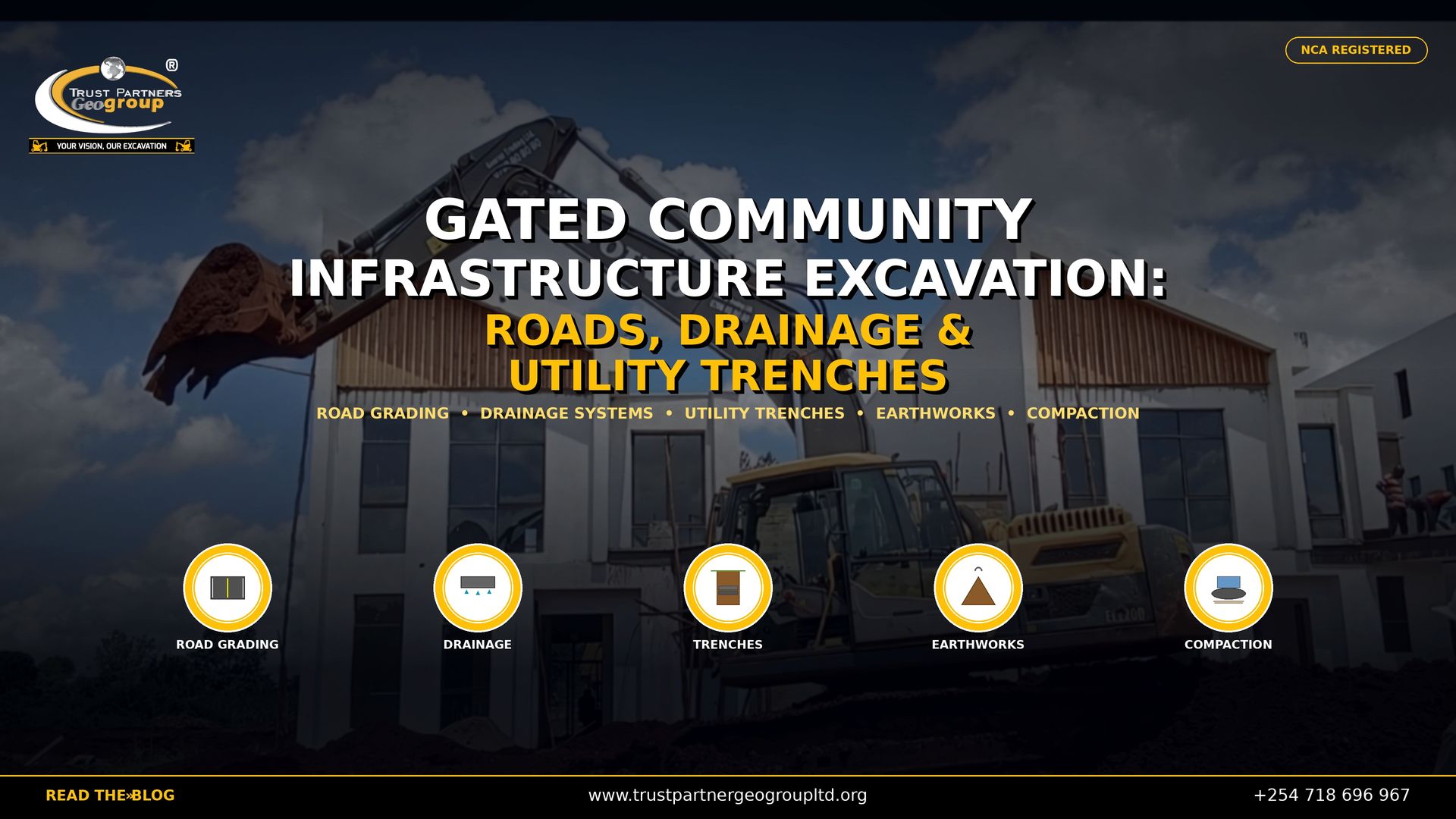
Gated Community Infrastructure Excavation: Roads, Drainage & Utility Trenches in Kenya [2026]
Case study approach to estate road construction, residential drainage and utility earthworks for gated communities
Table of Contents
- 1. The Estate Earthworks Challenge: Beyond Individual Plots
- 2. Case Study: 50-Unit Gated Community in Kiambu County
- 3. Estate Road Construction Excavation
- 4. Residential Drainage System Excavation
- 5. Utility Trenching: Water, Power, Sewer and Fibre
- 6. Cut-and-Fill Balance and Soil Management
- 7. Equipment Selection for Estate Infrastructure
- 8. Estate Compliance and Environmental Controls
- 9. Cost Analysis and Programme [2026]
- 10. Frequently Asked Questions
- 11. Conclusion
Before the first house rises in a gated community, the land must be transformed. Hills must be cut, valleys filled, roads carved into the contours, drainage channels dug to carry stormwater, and trenches excavated for the invisible arteries of modern living - water, power, sewerage, and fibre optic communication. This is gated community infrastructure excavation, and it is the most complex earthworks discipline in Kenyan residential construction. Unlike a single basement or a straight road, estate infrastructure requires simultaneous management of cut-and-fill balance, multi-utility coordination, drainage hydrology, and the unforgiving scrutiny of estate management committees that demand perfection before a single plot is sold. In 2026, as Nairobi's urban fringe expands into Kiambu, Kajiado, and Machakos counties, the demand for estate infrastructure excavation in Kenya has never been higher. Developers who master the earthworks phase deliver sellable communities on time. Those who underestimate it face cost overruns, drainage failures, and estate disputes that destroy brand reputation. This guide presents a detailed case study of a 50-unit gated community in Kiambu County, walking through the technical decisions, equipment deployment, cost structures, and compliance requirements that define successful estate road construction in Nairobi and beyond. Whether you are a developer breaking ground on a 200-unit master-planned estate or a contractor bidding on residential drainage excavation, Trust Partners Geo-Group Ltd provides the heavy equipment for hire and earthworks expertise that turns raw land into ready-to-build community infrastructure.
Trust Partners Geo-Group Ltd - Estate Infrastructure & Residential Earthworks Team
NCA-registered contractor with 15+ years in gated community infrastructure excavation, estate road construction, drainage earthworks and utility trenching across Nairobi, Kiambu, Kajiado, Machakos and Nakuru.
1. The Estate Earthworks Challenge: Beyond Individual Plots
Gated community infrastructure excavation differs fundamentally from single-project earthworks in four dimensions. First, scale: a 50-unit estate on 10 acres generates 8,000-15,000 m3 of earthworks - equivalent to 20-30 individual residential basements - but must be completed as a coordinated programme, not a sequence of independent jobs. Second, interdependency: roads cannot be final-graded until drainage is installed; drainage cannot be tested until roads provide access; utilities cannot be backfilled until compaction testing is complete. Third, compliance: estate management committees, county governments, NEMA, and utility providers each impose requirements that constrain timing, methods, and finishes. Fourth, visibility: estate infrastructure is permanent public space within a private community. Poor drainage, uneven roads, or failed compaction are visible to every resident and every prospective buyer for decades.
The commercial stakes are equally high. A developer selling plots in a gated community cannot transfer title until infrastructure is complete and certified. Delays in earthworks delay sales, delay cash flow, and trigger financing costs that compound monthly. In 2026, with Kenyan mortgage rates at 13-16% and development finance at 18-20%, a three-month earthworks delay can add KES 2-5 million to project finance costs alone.
Trust Partners Geo-Group Ltd approaches estate infrastructure as a system, not a collection of trenches. Our methodology integrates road earthworks, drainage hydrology, utility coordination, and landscape restoration into a single programme with defined milestones, quality gates, and handover documentation. This systems approach is the difference between an estate that functions and one that floods.
2. Case Study: 50-Unit Gated Community in Kiambu County
To illustrate the complexity and cost structure of estate infrastructure excavation, we present a real-world case study based on a project completed by Trust Partners Geo-Group Ltd in Kiambu County in 2025-2026. Names and exact locations are anonymised, but all technical data, costs, and programme durations are authentic.
Project Parameters
- Site area: 12 acres (4.8 hectares) of formerly agricultural land with 15-metre elevation difference between highest and lowest points
- Topography: Rolling hills with slopes ranging from 2% to 12%
- Soil conditions: Upper 1.5 metres red coffee soil (good bearing, excavatable); underlying weathered volcanic tuff at 2-4 metres in cut areas
- Development: 50 residential plots, internal road network (1.2 km), stormwater drainage, water reticulation, sewerage, power and fibre optic infrastructure
- Contract value: KES 8.4 million for all earthworks, drainage excavation, and utility trenching
- Programme: 10 weeks including weather delays
Earthworks Volume Summary
| Element | Volume (m3) | Rate (KES/m3) | Cost (KES) |
|---|---|---|---|
| Road cut (bulk) | 4,200 | 520 | 2,184,000 |
| Road fill (imported) | 2,800 | 650 | 1,820,000 |
| Drainage excavation | 1,600 | 480 | 768,000 |
| Manhole pits | 180 | 720 | 129,600 |
| Utility trenching | 2,400 linear m | 380/m | 912,000 |
| Rock breaking (tuff) | 320 m3 equivalent | 7,500/hr | 840,000 |
| Topsoil strip and stockpile | 3,500 | 180 | 630,000 |
| Compaction and testing | 8,500 m2 area | 45/m2 | 382,500 |
| Site protection & restoration | Lump sum | - | 380,000 |
| Equipment mobilisation | Lump sum | - | 350,000 |
| Total | Including management and contingency | 8,396,100 | |
The project achieved 78% earthworks balance by reusing cut material as fill, reducing imported fill requirements and disposal costs. GPS machine control on the motor grader ensured road levels were achieved within ±30mm, eliminating rework and preserving the programme.
3. Estate Road Construction Excavation
Estate roads are not miniature highways. They are low-speed, high-aesthetic corridors that must drain effectively, support utility services, and integrate with landscape design. The excavation requirements are precise and unforgiving.
Road Formation and Camber
Estate roads in Kenya typically have a 6-8 metre carriageway width with 1.5-2.0 metre verges. The formation width is therefore 9-12 metres. Excavation must achieve: subgrade level at design formation level minus pavement thickness (typically 300-500mm); 2.5-3.5% crossfall (camber) for surface water drainage; and longitudinal gradient between 0.5% and 8% depending on topography. In cut sections, side drains are excavated simultaneously with the road formation. In fill sections, the subgrade is built up in 300mm compacted layers to prevent settlement.
Cut-and-Fill Optimisation
The economic success of estate road earthworks depends on cut-and-fill balance. Every cubic metre hauled off-site costs KES 900-1,400 in transport and disposal. Every cubic metre imported costs KES 650-1,100 in material and placement. Achieving balance within 10% saves hundreds of thousands of shillings. Trust Partners Geo-Group uses drone surveying and 3D terrain modelling to optimise road alignments before excavation begins, shifting horizontal alignments by metres to achieve balance without compromising the estate master plan.
Black Cotton Soil Management
In low-lying areas of Kiambu, Kajiado, and Machakos, black cotton soil (expansive clay) is common. This soil swells when wet and shrinks when dry, destroying road pavements within one rainy season. The standard treatment is complete removal to 1.0-1.5 metres depth and replacement with select granular fill or stabilised material. This adds KES 800-1,200 per m2 to road construction costs but prevents catastrophic pavement failure. Trust Partners Geo-Group identifies black cotton soil during initial test pitting and programmes removal before road formation begins.
4. Residential Drainage System Excavation
Drainage is the invisible infrastructure that determines whether an estate thrives or floods. In Kenya's climate, where a single storm can deliver 50mm of rain in two hours, inadequate drainage destroys roads, undermines foundations, and creates mosquito breeding grounds.
Drainage System Design
A typical estate drainage system comprises: perimeter catch drains (300mm x 300mm trapezoidal) at the uphill boundary to intercept external runoff; internal roadside drains (400mm x 400mm) with 1:200 minimum gradient; collector channels (600mm x 600mm) that gather water from roadside drains; manhole chambers at 50-80 metre intervals for maintenance access; and discharge points to public drains, water pans, or soak pits. In sloping estates like those in Kitisuru or Ngong, stepped channels with gabion energy dissipators are required to prevent erosion at gradient changes.
Excavation Specifications
Drainage channel excavation must achieve: exact width and depth to accommodate precast concrete channel sections or in-situ concrete lining; uniform gradient (±0.1%) to prevent ponding; stable side slopes of 1:1 in red coffee soil or 1:1.5 in loose material; and compacted subgrade (95% MDD) to prevent settlement that disrupts gradient. Manhole pits are excavated 1.2m x 1.2m x 1.5m deep with reinforced concrete bases. All excavated drainage must be protected from construction traffic and sedimentation until lining is complete.
Sediment and Erosion Control
NEMA requires sediment control on all earthworks exceeding 500m2. For estate drainage excavation, this means: silt fences along all drain outlets; check dams in temporary channels; sediment traps at manhole inlets; and revegetation of exposed slopes within 14 days of excavation. Trust Partners Geo-Group includes sediment control as a standard line item in every estate drainage quotation, not as an afterthought.
5. Utility Trenching: Water, Power, Sewer and Fibre
Modern gated communities require four utility services, each with specific trenching requirements. Coordinating these trenches is the difference between organised infrastructure and chaotic excavation.
Water Supply Trenching
Water reticulation trenches are typically 1.0-1.5 metres deep and 400-600mm wide, accommodating 110mm-200mm diameter PVC or HDPE pipes. Pipes are bedded on 100mm sand or granular material and backfilled to 300mm above pipe with selected fill free from sharp stones. Trench gradient follows pipe gradient (typically 1:500 to 1:1,000) to maintain pressure and flow. Excavation must avoid existing farm wells and water pans that may be present on converted agricultural land.
Sewerage Trenching
Sewer trenches are the deepest utility excavations, typically 1.5-2.5 metres to achieve gravity flow to treatment systems or septic tanks. Minimum gradient is 1:200 for 150mm pipes and 1:300 for 225mm pipes. Manholes are excavated at every change of direction, gradient, or pipe diameter, and at 50-80 metre intervals. Sewer trenches require the most precise excavation because pipe inverts must be level to prevent blockages. Trust Partners Geo-Group uses laser levels and total stations to achieve ±10mm invert accuracy.
Electrical and Communication Trenching
Power trenches (0.8-1.2m deep) and fibre optic trenches (0.6-1.0m deep) are shallower but require careful coordination with water and sewer lines. Minimum 300mm horizontal separation is required between all utilities. Where crossings are unavoidable, the lower utility is protected with concrete encasement or steel sleeves. Warning tape is placed 300mm below ground level above all utilities to prevent accidental damage during future landscaping.
Utility Coordination Protocol
The most common cause of utility trenching failure is uncoordinated excavation - water pipes damaged by sewer trenching, power cables severed by drainage work. Trust Partners Geo-Group implements a phased trenching protocol: Phase 1 excavates the deepest utility (sewer) first; Phase 2 excavates water at the required offset; Phase 3 excavates power and communication in the shallowest trenches. Each phase is backfilled and compacted before the next begins, preventing open trench hazards and maintaining site access.
6. Cut-and-Fill Balance and Soil Management
Earthworks balance is the art of making the site produce its own fill. A perfectly balanced site requires no imported material and generates no waste spoil. In practice, 70-85% balance is achievable on rolling terrain, with the remainder imported or exported depending on soil quality.
Soil Classification and Reuse
Not all excavated soil is suitable for reuse. Trust Partners Geo-Group classifies excavated material into four categories: Category A - topsoil (organic, high fertility) stockpiled for landscaping; Category B - red coffee soil (stable, good bearing) suitable for general fill and subgrade; Category C - black cotton soil (expansive, unstable) requiring removal and replacement; and Category D - rock and oversize material requiring breaker processing or disposal. Only Category B material is reused as structural fill. Category A is reserved for landscape reinstatement. Category C and D are disposed of at approved sites.
Volume Calculation and Monitoring
Drone surveying is now standard for estate earthworks volume tracking. Trust Partners Geo-Group conducts weekly drone flights to compare actual excavation against design volumes, identifying balance deviations before they become costly problems. Weekly volume reports show: cumulative cut volume; cumulative fill volume; balance percentage; and projected import/export requirements. This data-driven approach prevents the end-of-project surprises that destroy margins.
Spoil Management
Excess spoil must be disposed of at licensed disposal sites or approved borrow pits. Transport costs are significant - KES 900-1,400 per m3 for haulage distances exceeding 10km. Trust Partners Geo-Group negotiates disposal agreements before mobilisation and tracks every load with weighbridge tickets to prevent unauthorised dumping that exposes the developer to NEMA enforcement.
7. Equipment Selection for Estate Infrastructure
Estate infrastructure requires a mixed fleet deployed in sequence. The wrong machine at the wrong phase destroys productivity and damages the estate environment.
| Phase | Primary Equipment | Support Equipment | Duration |
|---|---|---|---|
| Site clearance & topsoil strip | 20-tonne excavator | Dump trucks, motor grader | 3-5 days |
| Road cut-and-fill | 20-tonne excavator, motor grader | Dump trucks, 10-tonne roller | 15-20 days |
| Drainage excavation | 20-tonne excavator | Dump trucks, compact excavator | 10-14 days |
| Utility trenching | 5-tonne compact excavator | Dump trucks, plate compactor | 12-18 days |
| Rock breaking | 30-tonne excavator + breaker | Dump trucks, seismograph | 5-8 days |
| Final grading & compaction | Motor grader | 10-tonne roller, plate compactor | 5-7 days |
| Landscape restoration | 5-tonne excavator | Dump trucks, spreader | 3-5 days |
Equipment Constraints in Estates
Estates impose equipment constraints that commercial sites do not: working hours typically 08:00-17:00; no Sunday work in some communities; noise limits that prohibit breaker work near occupied plots; access roads that cannot support 40-tonne low-loaders; and tree protection zones that restrict machine movement. Trust Partners Geo-Group selects equipment specifically for estate constraints: zero-tail-swing excavators for tight road corridors; sound-attenuated breakers for noise-sensitive areas; and smaller dump trucks (10-tonne) for estates with weak access roads.
8. Estate Compliance and Environmental Controls
Estate infrastructure excavation operates under multiple regulatory layers. Non-compliance stops work, triggers fines, and delays plot sales.
County Government Requirements
Kiambu, Nairobi, Kajiado and Machakos counties require: approved engineering drawings for roads and drainage; NEMA Environmental Impact Assessment (EIA) for estates exceeding 200 units or 20 acres; building plan approval for infrastructure structures (manholes, pump stations); and road reserve dedication agreements for estates connecting to public roads. Trust Partners Geo-Group coordinates with county engineers to ensure that earthworks align with approved designs and that as-built drawings are submitted for final approval.
NEMA Environmental Compliance
NEMA requirements for estate earthworks include: sediment control plan with silt fences, check dams and sediment traps; dust suppression programme (water spraying twice daily on unpaved surfaces); topsoil conservation plan (strip, stockpile, and reinstate); and waste management plan for concrete, timber, and packaging waste. NEMA inspectors visit active sites without notice. A single violation notice can halt work for 2-3 weeks. Trust Partners Geo-Group maintains NEMA compliance documentation on every estate site and conducts weekly self-audits.
Estate Management Committee Coordination
Even before the first resident moves in, estate management committees (or developers acting in that capacity) enforce bylaws governing: working hours and noise limits; tree replacement ratios (typically 3:1 for indigenous trees); landscape restoration standards; and construction material storage locations. Trust Partners Geo-Group submits weekly progress reports to estate management, maintains clean site standards, and repairs any estate road damage caused by construction traffic before handover.
9. Cost Analysis and Programme [2026]
Estate infrastructure excavation costs in 2026 reflect fuel prices, labour rates, and the increasing scarcity of approved disposal sites.
| Cost Element | Unit | 2026 Rate (KES) | Notes |
|---|---|---|---|
| Bulk excavation (red soil) | m3 | 350-550 | Cut, load, and short haul |
| Rock breaking (tuff) | hour | 7,000-8,500 | Breaker on 20/30-tonne excavator |
| Imported select fill | m3 | 650-1,100 | Delivered and placed |
| Drainage excavation | m3 | 400-650 | Channel and manhole pits |
| Utility trenching | linear m | 280-450 | 600-1,200mm deep |
| Compaction (roller) | m2 | 35-55 | 95% MDD specification |
| Topsoil strip and stockpile | m3 | 150-220 | Careful stripping for reuse |
| Spoil disposal | m3 | 900-1,400 | Licensed site, >10km haul |
| Site protection & restoration | lump sum | 250,000-450,000 | Silt fences, tree protection, lawns |
| Equipment mobilisation | lump sum | 200,000-400,000 | Depends on fleet size and distance |
Typical programme: A 50-unit estate infrastructure project requires 8-12 weeks from mobilisation to handover, assuming reasonable weather and no major geological surprises. Programme breakdown: site clearance 1 week; road earthworks 3-4 weeks; drainage excavation 2-3 weeks; utility trenching 2-3 weeks; final grading and compaction 1 week; and landscape restoration 1 week. Overlap between phases saves 2-3 weeks, but utility coordination requires sequential trenching in shared corridors.
10. Frequently Asked Questions: Gated Community Infrastructure Excavation in Kenya
How much does gated community infrastructure excavation cost in Kenya in 2026?
Gated community infrastructure excavation costs in Kenya in 2026 vary by estate size and topography. Estate road earthworks typically cost KES 450-850 per m3 for cut-and-fill in rolling terrain. Drainage channel excavation costs KES 350-650 per m3 for open trapezoidal channels, plus KES 1,200-2,000 per m3 for concrete lining. Utility trenching for water, power and sewer costs KES 250-450 per linear metre for 600mm-1,200mm deep trenches in stable soil. A typical 50-unit gated community on 10 acres requires 8,000-15,000 m3 of earthworks for roads, drainage and utilities, costing KES 4-12 million depending on terrain and soil conditions. Trust Partners Geo-Group provides fixed-price estate infrastructure packages with no hidden access surcharges.
What equipment is needed for gated community infrastructure excavation?
Gated community infrastructure excavation typically requires: 20-tonne excavators for bulk road cut-and-fill and drainage channel excavation; 5-tonne compact excavators for utility trenches and confined areas; motor graders for road subgrade preparation and camber formation; 10-tonne smooth drum rollers for subgrade and backfill compaction; 20-tonne dump trucks for spoil haulage and imported fill delivery; and hydraulic breaker attachments for rock encountered in cuttings. For large estates, GPS machine control on graders and excavators ensures accurate levels and reduces rework. Trust Partners Geo-Group provides complete estate infrastructure fleets with NCA-certified operators.
How deep should utility trenches be in Kenyan residential estates?
Utility trench depths in Kenyan residential estates follow standard engineering practice: water supply pipes at 1.0-1.5 metres depth to prevent freezing and traffic damage; sewer lines at 1.5-2.5 metres depth depending on gradient and manhole spacing; electrical conduits at 0.8-1.2 metres depth; and fibre optic cables at 0.6-1.0 metres depth in dedicated communication ducts. Trenches must maintain minimum 300mm horizontal separation between utilities and 150mm vertical separation where crossings are unavoidable. In rocky ground, trench depth may increase to achieve bedding on stable material. Trust Partners Geo-Group excavates utility trenches with laser-guided depth control and utility avoidance protocols.
What are the main challenges for estate road construction excavation in Kenya?
Estate road construction excavation in Kenya faces: rolling terrain requiring extensive cut-and-fill balance; black cotton soil in low-lying areas requiring removal and replacement with select fill; seasonal waterlogging requiring raised subgrades and side drains; rock outcrops in highland areas requiring breaker work; estate access constraints limiting equipment size and working hours; and coordination with multiple utility providers requiring phased trenching. Additionally, estate management committees often impose strict environmental controls: tree protection, sediment fencing, and dust suppression. Trust Partners Geo-Group has completed estate infrastructure in over 40 Kenyan residential developments, navigating these constraints with estate-compliant equipment and protocols.
How do you manage drainage for gated communities on sloping land?
Sloping estate drainage requires a cascading system: perimeter catch drains at the uphill boundary to intercept runoff before it enters the estate; internal roadside drains with 1:200 minimum gradient leading to collector channels; sediment traps at drain inlets to prevent siltation; energy dissipators at steep channel sections to prevent erosion; and detention ponds or soak pits at the lowest point before discharge to public drains. In Kitisuru, Karen and Ngong, where slopes exceed 8%, stepped channel designs with gabion protection are standard. All drainage earthworks must achieve 95% compaction in the trench bottom and backfill to prevent settlement. Trust Partners Geo-Group designs and excavates estate drainage systems with integrated sediment control and erosion protection.
Can estate infrastructure excavation be done during the rainy season in Kenya?
Estate infrastructure excavation during Kenya's long rains (March-May) and short rains (October-November) is challenging but possible with proper planning. Key measures include: prioritising drainage excavation first to create site dewatering routes; using geotextile and gravel access mats to prevent machinery from bogging; scheduling concrete pipe laying and manhole construction during dry windows; maintaining sediment fences and silt traps to prevent off-site pollution; and stockpiling topsoil under cover for later landscape restoration. Cut slopes in red coffee soil should be limited to 1:1.5 during wet weather to prevent slumping. Trust Partners Geo-Group programmes estate earthworks to minimise rain exposure and provides rapid dewatering response when storms interrupt progress.
Where can I hire heavy equipment for gated community infrastructure projects in Kenya?
Trust Partners Geo-Group Ltd provides heavy equipment for hire for gated community infrastructure excavation across Nairobi, Kiambu, Kajiado, Machakos, Nakuru and all Kenyan counties. Our estate infrastructure fleet includes: 20-tonne zero-tail-swing excavators for road and drainage earthworks in confined estate layouts; 5-tonne compact excavators for utility trenches and landscape areas; motor graders for road formation and camber; 10-tonne rollers for compaction; 20-tonne dump trucks for balanced earthworks; and hydraulic breakers for rock cuttings. All equipment is operated by NCA-certified drivers trained in estate etiquette, noise control, dust suppression and landscape protection. We provide fixed-price estate infrastructure packages including earthworks, drainage excavation and utility trenching. Contact +254 718 68 69 67 for estate project quotations.
11. Conclusion: Earthworks That Build Communities
A gated community is more than a collection of houses behind a gate. It is a system of roads that must drain, drains that must flow, utilities that must function, and landscapes that must thrive. The earthworks phase is where this system is born - where contours are tamed, water is directed, pipes are buried, and the raw land is prepared to support decades of residential life.
In Kenya's expanding urban fringe, the developers who succeed are those who treat estate infrastructure excavation as a strategic discipline, not an afterthought. They invest in topographic survey and earthworks balance. They coordinate utilities before breaking ground. They enforce sediment control from day one. They select equipment that fits estate constraints. And they hire contractors who understand that estate work is different - more precise, more regulated, and more visible - than commercial construction.
Trust Partners Geo-Group Ltd has built estate infrastructure across 40+ Kenyan residential developments, from 20-unit boutique communities to 500-unit master-planned estates. We understand the regulatory landscape, the geological variability, and the commercial pressure that developers face. Our heavy equipment for hire fleet is selected for estate constraints. Our operators are trained in estate etiquette. And our project managers coordinate roads, drainage, and utilities as an integrated system, not isolated tasks.
For developers planning gated communities in Nairobi, Kiambu, Kajiado, Machakos, or Nakuru, we provide the earthworks partnership that transforms agricultural land into sellable residential infrastructure. Contact Trust Partners Geo-Group Ltd for a site-specific earthworks assessment, cut-and-fill balance calculation, and fixed-price quotation for your estate infrastructure excavation.
Gated Community Infrastructure Excavation in Kenya
Estate road construction, residential drainage excavation and utility trenching with heavy equipment for hire across Nairobi, Kiambu, Kajiado, Machakos and Nakuru.
Free lead magnet: ask for our Estate Infrastructure Earthworks Cost Calculator (PDF) - cut-and-fill balance tool, drainage sizing guide, utility trenching benchmarks and 2026 rate estimates for Kenyan residential developments.
Related Resources
Attachments and Accessories Hire: Hydraulic Breakers, Augers, Rippers and Compactors in Kenya
Excavator-mounted attachment hire rates, compatibility and applications for rock breaking, piling, scarification and compaction.
READ MOREHeavy Equipment Hire with Operator Packages: What's Included in Kenyan Rates
Wet hire vs dry hire, inclusions, exclusions and 2026 pricing transparency for excavators, graders, rollers and dump trucks.
READ MOREBasement Excavation for Residential Estates: Runda, Karen & Kitisuru Luxury Home Guide
Wine cellars, home cinemas, swimming pools, gyms and staff quarters for luxury homes in Nairobi's premium estates.
READ MORERoad Construction in Kenya: Earthwork and Base Preparation
Subgrade preparation, CBR testing, compaction standards and earthwork techniques for Kenyan road projects.
READ MOREDrainage Solutions for Road Construction in Kenya
Culvert installation, side drain excavation, stormwater management and erosion control for Kenyan roads.
READ MOREExcavation in Kenya: Complete Guide to Costs, Methods and Contractors 2026
Comprehensive guide to excavation costs, methods, equipment selection and contractor evaluation across Kenya.
READ MORETRUST PARTNERS GEO-GROUP LTD | YOUR EXCAVATION IS OUR FUTURE
WEBSITE: WWW.TRUSTPARTNERGEOGROUPLTD.ORG | EMAIL: INFO@TRUSTPARTNERGEOGROUPLTD.ORG | PHONE: +254 718 68 69 67
FOLLOW US: FACEBOOK | TIKTOK | INSTAGRAM | LINKEDIN
© 2026 TRUST PARTNERS GEO-GROUP LTD. ALL RIGHTS RESERVED.
Gated Community Infrastructure Excavation: Roads, Drainage & Utility Trenches in Kenya [2026]
Case study approach to estate road construction, residential drainage and utility earthworks for gated communities
Table of Contents
- 1. The Estate Earthworks Challenge: Beyond Individual Plots
- 2. Case Study: 50-Unit Gated Community in Kiambu County
- 3. Estate Road Construction Excavation
- 4. Residential Drainage System Excavation
- 5. Utility Trenching: Water, Power, Sewer and Fibre
- 6. Cut-and-Fill Balance and Soil Management
- 7. Equipment Selection for Estate Infrastructure
- 8. Estate Compliance and Environmental Controls
- 9. Cost Analysis and Programme [2026]
- 10. Frequently Asked Questions
- 11. Conclusion
Before the first house rises in a gated community, the land must be transformed. Hills must be cut, valleys filled, roads carved into the contours, drainage channels dug to carry stormwater, and trenches excavated for the invisible arteries of modern living - water, power, sewerage, and fibre optic communication. This is gated community infrastructure excavation, and it is the most complex earthworks discipline in Kenyan residential construction. Unlike a single basement or a straight road, estate infrastructure requires simultaneous management of cut-and-fill balance, multi-utility coordination, drainage hydrology, and the unforgiving scrutiny of estate management committees that demand perfection before a single plot is sold. In 2026, as Nairobi's urban fringe expands into Kiambu, Kajiado, and Machakos counties, the demand for estate infrastructure excavation in Kenya has never been higher. Developers who master the earthworks phase deliver sellable communities on time. Those who underestimate it face cost overruns, drainage failures, and estate disputes that destroy brand reputation. This guide presents a detailed case study of a 50-unit gated community in Kiambu County, walking through the technical decisions, equipment deployment, cost structures, and compliance requirements that define successful estate road construction in Nairobi and beyond. Whether you are a developer breaking ground on a 200-unit master-planned estate or a contractor bidding on residential drainage excavation, Trust Partners Geo-Group Ltd provides the heavy equipment for hire and earthworks expertise that turns raw land into ready-to-build community infrastructure.
Trust Partners Geo-Group Ltd - Estate Infrastructure & Residential Earthworks Team
NCA-registered contractor with 15+ years in gated community infrastructure excavation, estate road construction, drainage earthworks and utility trenching across Nairobi, Kiambu, Kajiado, Machakos and Nakuru.
1. The Estate Earthworks Challenge: Beyond Individual Plots
Gated community infrastructure excavation differs fundamentally from single-project earthworks in four dimensions. First, scale: a 50-unit estate on 10 acres generates 8,000-15,000 m3 of earthworks - equivalent to 20-30 individual residential basements - but must be completed as a coordinated programme, not a sequence of independent jobs. Second, interdependency: roads cannot be final-graded until drainage is installed; drainage cannot be tested until roads provide access; utilities cannot be backfilled until compaction testing is complete. Third, compliance: estate management committees, county governments, NEMA, and utility providers each impose requirements that constrain timing, methods, and finishes. Fourth, visibility: estate infrastructure is permanent public space within a private community. Poor drainage, uneven roads, or failed compaction are visible to every resident and every prospective buyer for decades.
The commercial stakes are equally high. A developer selling plots in a gated community cannot transfer title until infrastructure is complete and certified. Delays in earthworks delay sales, delay cash flow, and trigger financing costs that compound monthly. In 2026, with Kenyan mortgage rates at 13-16% and development finance at 18-20%, a three-month earthworks delay can add KES 2-5 million to project finance costs alone.
Trust Partners Geo-Group Ltd approaches estate infrastructure as a system, not a collection of trenches. Our methodology integrates road earthworks, drainage hydrology, utility coordination, and landscape restoration into a single programme with defined milestones, quality gates, and handover documentation. This systems approach is the difference between an estate that functions and one that floods.
2. Case Study: 50-Unit Gated Community in Kiambu County
To illustrate the complexity and cost structure of estate infrastructure excavation, we present a real-world case study based on a project completed by Trust Partners Geo-Group Ltd in Kiambu County in 2025-2026. Names and exact locations are anonymised, but all technical data, costs, and programme durations are authentic.
Project Parameters
- Site area: 12 acres (4.8 hectares) of formerly agricultural land with 15-metre elevation difference between highest and lowest points
- Topography: Rolling hills with slopes ranging from 2% to 12%
- Soil conditions: Upper 1.5 metres red coffee soil (good bearing, excavatable); underlying weathered volcanic tuff at 2-4 metres in cut areas
- Development: 50 residential plots, internal road network (1.2 km), stormwater drainage, water reticulation, sewerage, power and fibre optic infrastructure
- Contract value: KES 8.4 million for all earthworks, drainage excavation, and utility trenching
- Programme: 10 weeks including weather delays
Earthworks Volume Summary
| Element | Volume (m3) | Rate (KES/m3) | Cost (KES) |
|---|---|---|---|
| Road cut (bulk) | 4,200 | 520 | 2,184,000 |
| Road fill (imported) | 2,800 | 650 | 1,820,000 |
| Drainage excavation | 1,600 | 480 | 768,000 |
| Manhole pits | 180 | 720 | 129,600 |
| Utility trenching | 2,400 linear m | 380/m | 912,000 |
| Rock breaking (tuff) | 320 m3 equivalent | 7,500/hr | 840,000 |
| Topsoil strip and stockpile | 3,500 | 180 | 630,000 |
| Compaction and testing | 8,500 m2 area | 45/m2 | 382,500 |
| Site protection & restoration | Lump sum | - | 380,000 |
| Equipment mobilisation | Lump sum | - | 350,000 |
| Total | Including management and contingency | 8,396,100 | |
The project achieved 78% earthworks balance by reusing cut material as fill, reducing imported fill requirements and disposal costs. GPS machine control on the motor grader ensured road levels were achieved within ±30mm, eliminating rework and preserving the programme.
3. Estate Road Construction Excavation
Estate roads are not miniature highways. They are low-speed, high-aesthetic corridors that must drain effectively, support utility services, and integrate with landscape design. The excavation requirements are precise and unforgiving.
Road Formation and Camber
Estate roads in Kenya typically have a 6-8 metre carriageway width with 1.5-2.0 metre verges. The formation width is therefore 9-12 metres. Excavation must achieve: subgrade level at design formation level minus pavement thickness (typically 300-500mm); 2.5-3.5% crossfall (camber) for surface water drainage; and longitudinal gradient between 0.5% and 8% depending on topography. In cut sections, side drains are excavated simultaneously with the road formation. In fill sections, the subgrade is built up in 300mm compacted layers to prevent settlement.
Cut-and-Fill Optimisation
The economic success of estate road earthworks depends on cut-and-fill balance. Every cubic metre hauled off-site costs KES 900-1,400 in transport and disposal. Every cubic metre imported costs KES 650-1,100 in material and placement. Achieving balance within 10% saves hundreds of thousands of shillings. Trust Partners Geo-Group uses drone surveying and 3D terrain modelling to optimise road alignments before excavation begins, shifting horizontal alignments by metres to achieve balance without compromising the estate master plan.
Black Cotton Soil Management
In low-lying areas of Kiambu, Kajiado, and Machakos, black cotton soil (expansive clay) is common. This soil swells when wet and shrinks when dry, destroying road pavements within one rainy season. The standard treatment is complete removal to 1.0-1.5 metres depth and replacement with select granular fill or stabilised material. This adds KES 800-1,200 per m2 to road construction costs but prevents catastrophic pavement failure. Trust Partners Geo-Group identifies black cotton soil during initial test pitting and programmes removal before road formation begins.
4. Residential Drainage System Excavation
Drainage is the invisible infrastructure that determines whether an estate thrives or floods. In Kenya's climate, where a single storm can deliver 50mm of rain in two hours, inadequate drainage destroys roads, undermines foundations, and creates mosquito breeding grounds.
Drainage System Design
A typical estate drainage system comprises: perimeter catch drains (300mm x 300mm trapezoidal) at the uphill boundary to intercept external runoff; internal roadside drains (400mm x 400mm) with 1:200 minimum gradient; collector channels (600mm x 600mm) that gather water from roadside drains; manhole chambers at 50-80 metre intervals for maintenance access; and discharge points to public drains, water pans, or soak pits. In sloping estates like those in Kitisuru or Ngong, stepped channels with gabion energy dissipators are required to prevent erosion at gradient changes.
Excavation Specifications
Drainage channel excavation must achieve: exact width and depth to accommodate precast concrete channel sections or in-situ concrete lining; uniform gradient (±0.1%) to prevent ponding; stable side slopes of 1:1 in red coffee soil or 1:1.5 in loose material; and compacted subgrade (95% MDD) to prevent settlement that disrupts gradient. Manhole pits are excavated 1.2m x 1.2m x 1.5m deep with reinforced concrete bases. All excavated drainage must be protected from construction traffic and sedimentation until lining is complete.
Sediment and Erosion Control
NEMA requires sediment control on all earthworks exceeding 500m2. For estate drainage excavation, this means: silt fences along all drain outlets; check dams in temporary channels; sediment traps at manhole inlets; and revegetation of exposed slopes within 14 days of excavation. Trust Partners Geo-Group includes sediment control as a standard line item in every estate drainage quotation, not as an afterthought.
5. Utility Trenching: Water, Power, Sewer and Fibre
Modern gated communities require four utility services, each with specific trenching requirements. Coordinating these trenches is the difference between organised infrastructure and chaotic excavation.
Water Supply Trenching
Water reticulation trenches are typically 1.0-1.5 metres deep and 400-600mm wide, accommodating 110mm-200mm diameter PVC or HDPE pipes. Pipes are bedded on 100mm sand or granular material and backfilled to 300mm above pipe with selected fill free from sharp stones. Trench gradient follows pipe gradient (typically 1:500 to 1:1,000) to maintain pressure and flow. Excavation must avoid existing farm wells and water pans that may be present on converted agricultural land.
Sewerage Trenching
Sewer trenches are the deepest utility excavations, typically 1.5-2.5 metres to achieve gravity flow to treatment systems or septic tanks. Minimum gradient is 1:200 for 150mm pipes and 1:300 for 225mm pipes. Manholes are excavated at every change of direction, gradient, or pipe diameter, and at 50-80 metre intervals. Sewer trenches require the most precise excavation because pipe inverts must be level to prevent blockages. Trust Partners Geo-Group uses laser levels and total stations to achieve ±10mm invert accuracy.
Electrical and Communication Trenching
Power trenches (0.8-1.2m deep) and fibre optic trenches (0.6-1.0m deep) are shallower but require careful coordination with water and sewer lines. Minimum 300mm horizontal separation is required between all utilities. Where crossings are unavoidable, the lower utility is protected with concrete encasement or steel sleeves. Warning tape is placed 300mm below ground level above all utilities to prevent accidental damage during future landscaping.
Utility Coordination Protocol
The most common cause of utility trenching failure is uncoordinated excavation - water pipes damaged by sewer trenching, power cables severed by drainage work. Trust Partners Geo-Group implements a phased trenching protocol: Phase 1 excavates the deepest utility (sewer) first; Phase 2 excavates water at the required offset; Phase 3 excavates power and communication in the shallowest trenches. Each phase is backfilled and compacted before the next begins, preventing open trench hazards and maintaining site access.
6. Cut-and-Fill Balance and Soil Management
Earthworks balance is the art of making the site produce its own fill. A perfectly balanced site requires no imported material and generates no waste spoil. In practice, 70-85% balance is achievable on rolling terrain, with the remainder imported or exported depending on soil quality.
Soil Classification and Reuse
Not all excavated soil is suitable for reuse. Trust Partners Geo-Group classifies excavated material into four categories: Category A - topsoil (organic, high fertility) stockpiled for landscaping; Category B - red coffee soil (stable, good bearing) suitable for general fill and subgrade; Category C - black cotton soil (expansive, unstable) requiring removal and replacement; and Category D - rock and oversize material requiring breaker processing or disposal. Only Category B material is reused as structural fill. Category A is reserved for landscape reinstatement. Category C and D are disposed of at approved sites.
Volume Calculation and Monitoring
Drone surveying is now standard for estate earthworks volume tracking. Trust Partners Geo-Group conducts weekly drone flights to compare actual excavation against design volumes, identifying balance deviations before they become costly problems. Weekly volume reports show: cumulative cut volume; cumulative fill volume; balance percentage; and projected import/export requirements. This data-driven approach prevents the end-of-project surprises that destroy margins.
Spoil Management
Excess spoil must be disposed of at licensed disposal sites or approved borrow pits. Transport costs are significant - KES 900-1,400 per m3 for haulage distances exceeding 10km. Trust Partners Geo-Group negotiates disposal agreements before mobilisation and tracks every load with weighbridge tickets to prevent unauthorised dumping that exposes the developer to NEMA enforcement.
7. Equipment Selection for Estate Infrastructure
Estate infrastructure requires a mixed fleet deployed in sequence. The wrong machine at the wrong phase destroys productivity and damages the estate environment.
| Phase | Primary Equipment | Support Equipment | Duration |
|---|---|---|---|
| Site clearance & topsoil strip | 20-tonne excavator | Dump trucks, motor grader | 3-5 days |
| Road cut-and-fill | 20-tonne excavator, motor grader | Dump trucks, 10-tonne roller | 15-20 days |
| Drainage excavation | 20-tonne excavator | Dump trucks, compact excavator | 10-14 days |
| Utility trenching | 5-tonne compact excavator | Dump trucks, plate compactor | 12-18 days |
| Rock breaking | 30-tonne excavator + breaker | Dump trucks, seismograph | 5-8 days |
| Final grading & compaction | Motor grader | 10-tonne roller, plate compactor | 5-7 days |
| Landscape restoration | 5-tonne excavator | Dump trucks, spreader | 3-5 days |
Equipment Constraints in Estates
Estates impose equipment constraints that commercial sites do not: working hours typically 08:00-17:00; no Sunday work in some communities; noise limits that prohibit breaker work near occupied plots; access roads that cannot support 40-tonne low-loaders; and tree protection zones that restrict machine movement. Trust Partners Geo-Group selects equipment specifically for estate constraints: zero-tail-swing excavators for tight road corridors; sound-attenuated breakers for noise-sensitive areas; and smaller dump trucks (10-tonne) for estates with weak access roads.
8. Estate Compliance and Environmental Controls
Estate infrastructure excavation operates under multiple regulatory layers. Non-compliance stops work, triggers fines, and delays plot sales.
County Government Requirements
Kiambu, Nairobi, Kajiado and Machakos counties require: approved engineering drawings for roads and drainage; NEMA Environmental Impact Assessment (EIA) for estates exceeding 200 units or 20 acres; building plan approval for infrastructure structures (manholes, pump stations); and road reserve dedication agreements for estates connecting to public roads. Trust Partners Geo-Group coordinates with county engineers to ensure that earthworks align with approved designs and that as-built drawings are submitted for final approval.
NEMA Environmental Compliance
NEMA requirements for estate earthworks include: sediment control plan with silt fences, check dams and sediment traps; dust suppression programme (water spraying twice daily on unpaved surfaces); topsoil conservation plan (strip, stockpile, and reinstate); and waste management plan for concrete, timber, and packaging waste. NEMA inspectors visit active sites without notice. A single violation notice can halt work for 2-3 weeks. Trust Partners Geo-Group maintains NEMA compliance documentation on every estate site and conducts weekly self-audits.
Estate Management Committee Coordination
Even before the first resident moves in, estate management committees (or developers acting in that capacity) enforce bylaws governing: working hours and noise limits; tree replacement ratios (typically 3:1 for indigenous trees); landscape restoration standards; and construction material storage locations. Trust Partners Geo-Group submits weekly progress reports to estate management, maintains clean site standards, and repairs any estate road damage caused by construction traffic before handover.
9. Cost Analysis and Programme [2026]
Estate infrastructure excavation costs in 2026 reflect fuel prices, labour rates, and the increasing scarcity of approved disposal sites.
| Cost Element | Unit | 2026 Rate (KES) | Notes |
|---|---|---|---|
| Bulk excavation (red soil) | m3 | 350-550 | Cut, load, and short haul |
| Rock breaking (tuff) | hour | 7,000-8,500 | Breaker on 20/30-tonne excavator |
| Imported select fill | m3 | 650-1,100 | Delivered and placed |
| Drainage excavation | m3 | 400-650 | Channel and manhole pits |
| Utility trenching | linear m | 280-450 | 600-1,200mm deep |
| Compaction (roller) | m2 | 35-55 | 95% MDD specification |
| Topsoil strip and stockpile | m3 | 150-220 | Careful stripping for reuse |
| Spoil disposal | m3 | 900-1,400 | Licensed site, >10km haul |
| Site protection & restoration | lump sum | 250,000-450,000 | Silt fences, tree protection, lawns |
| Equipment mobilisation | lump sum | 200,000-400,000 | Depends on fleet size and distance |
Typical programme: A 50-unit estate infrastructure project requires 8-12 weeks from mobilisation to handover, assuming reasonable weather and no major geological surprises. Programme breakdown: site clearance 1 week; road earthworks 3-4 weeks; drainage excavation 2-3 weeks; utility trenching 2-3 weeks; final grading and compaction 1 week; and landscape restoration 1 week. Overlap between phases saves 2-3 weeks, but utility coordination requires sequential trenching in shared corridors.
10. Frequently Asked Questions: Gated Community Infrastructure Excavation in Kenya
How much does gated community infrastructure excavation cost in Kenya in 2026?
Gated community infrastructure excavation costs in Kenya in 2026 vary by estate size and topography. Estate road earthworks typically cost KES 450-850 per m3 for cut-and-fill in rolling terrain. Drainage channel excavation costs KES 350-650 per m3 for open trapezoidal channels, plus KES 1,200-2,000 per m3 for concrete lining. Utility trenching for water, power and sewer costs KES 250-450 per linear metre for 600mm-1,200mm deep trenches in stable soil. A typical 50-unit gated community on 10 acres requires 8,000-15,000 m3 of earthworks for roads, drainage and utilities, costing KES 4-12 million depending on terrain and soil conditions. Trust Partners Geo-Group provides fixed-price estate infrastructure packages with no hidden access surcharges.
What equipment is needed for gated community infrastructure excavation?
Gated community infrastructure excavation typically requires: 20-tonne excavators for bulk road cut-and-fill and drainage channel excavation; 5-tonne compact excavators for utility trenches and confined areas; motor graders for road subgrade preparation and camber formation; 10-tonne smooth drum rollers for subgrade and backfill compaction; 20-tonne dump trucks for spoil haulage and imported fill delivery; and hydraulic breaker attachments for rock encountered in cuttings. For large estates, GPS machine control on graders and excavators ensures accurate levels and reduces rework. Trust Partners Geo-Group provides complete estate infrastructure fleets with NCA-certified operators.
How deep should utility trenches be in Kenyan residential estates?
Utility trench depths in Kenyan residential estates follow standard engineering practice: water supply pipes at 1.0-1.5 metres depth to prevent freezing and traffic damage; sewer lines at 1.5-2.5 metres depth depending on gradient and manhole spacing; electrical conduits at 0.8-1.2 metres depth; and fibre optic cables at 0.6-1.0 metres depth in dedicated communication ducts. Trenches must maintain minimum 300mm horizontal separation between utilities and 150mm vertical separation where crossings are unavoidable. In rocky ground, trench depth may increase to achieve bedding on stable material. Trust Partners Geo-Group excavates utility trenches with laser-guided depth control and utility avoidance protocols.
What are the main challenges for estate road construction excavation in Kenya?
Estate road construction excavation in Kenya faces: rolling terrain requiring extensive cut-and-fill balance; black cotton soil in low-lying areas requiring removal and replacement with select fill; seasonal waterlogging requiring raised subgrades and side drains; rock outcrops in highland areas requiring breaker work; estate access constraints limiting equipment size and working hours; and coordination with multiple utility providers requiring phased trenching. Additionally, estate management committees often impose strict environmental controls: tree protection, sediment fencing, and dust suppression. Trust Partners Geo-Group has completed estate infrastructure in over 40 Kenyan residential developments, navigating these constraints with estate-compliant equipment and protocols.
How do you manage drainage for gated communities on sloping land?
Sloping estate drainage requires a cascading system: perimeter catch drains at the uphill boundary to intercept runoff before it enters the estate; internal roadside drains with 1:200 minimum gradient leading to collector channels; sediment traps at drain inlets to prevent siltation; energy dissipators at steep channel sections to prevent erosion; and detention ponds or soak pits at the lowest point before discharge to public drains. In Kitisuru, Karen and Ngong, where slopes exceed 8%, stepped channel designs with gabion protection are standard. All drainage earthworks must achieve 95% compaction in the trench bottom and backfill to prevent settlement. Trust Partners Geo-Group designs and excavates estate drainage systems with integrated sediment control and erosion protection.
Can estate infrastructure excavation be done during the rainy season in Kenya?
Estate infrastructure excavation during Kenya's long rains (March-May) and short rains (October-November) is challenging but possible with proper planning. Key measures include: prioritising drainage excavation first to create site dewatering routes; using geotextile and gravel access mats to prevent machinery from bogging; scheduling concrete pipe laying and manhole construction during dry windows; maintaining sediment fences and silt traps to prevent off-site pollution; and stockpiling topsoil under cover for later landscape restoration. Cut slopes in red coffee soil should be limited to 1:1.5 during wet weather to prevent slumping. Trust Partners Geo-Group programmes estate earthworks to minimise rain exposure and provides rapid dewatering response when storms interrupt progress.
Where can I hire heavy equipment for gated community infrastructure projects in Kenya?
Trust Partners Geo-Group Ltd provides heavy equipment for hire for gated community infrastructure excavation across Nairobi, Kiambu, Kajiado, Machakos, Nakuru and all Kenyan counties. Our estate infrastructure fleet includes: 20-tonne zero-tail-swing excavators for road and drainage earthworks in confined estate layouts; 5-tonne compact excavators for utility trenches and landscape areas; motor graders for road formation and camber; 10-tonne rollers for compaction; 20-tonne dump trucks for balanced earthworks; and hydraulic breakers for rock cuttings. All equipment is operated by NCA-certified drivers trained in estate etiquette, noise control, dust suppression and landscape protection. We provide fixed-price estate infrastructure packages including earthworks, drainage excavation and utility trenching. Contact +254 718 68 69 67 for estate project quotations.
11. Conclusion: Earthworks That Build Communities
A gated community is more than a collection of houses behind a gate. It is a system of roads that must drain, drains that must flow, utilities that must function, and landscapes that must thrive. The earthworks phase is where this system is born - where contours are tamed, water is directed, pipes are buried, and the raw land is prepared to support decades of residential life.
In Kenya's expanding urban fringe, the developers who succeed are those who treat estate infrastructure excavation as a strategic discipline, not an afterthought. They invest in topographic survey and earthworks balance. They coordinate utilities before breaking ground. They enforce sediment control from day one. They select equipment that fits estate constraints. And they hire contractors who understand that estate work is different - more precise, more regulated, and more visible - than commercial construction.
Trust Partners Geo-Group Ltd has built estate infrastructure across 40+ Kenyan residential developments, from 20-unit boutique communities to 500-unit master-planned estates. We understand the regulatory landscape, the geological variability, and the commercial pressure that developers face. Our heavy equipment for hire fleet is selected for estate constraints. Our operators are trained in estate etiquette. And our project managers coordinate roads, drainage, and utilities as an integrated system, not isolated tasks.
For developers planning gated communities in Nairobi, Kiambu, Kajiado, Machakos, or Nakuru, we provide the earthworks partnership that transforms agricultural land into sellable residential infrastructure. Contact Trust Partners Geo-Group Ltd for a site-specific earthworks assessment, cut-and-fill balance calculation, and fixed-price quotation for your estate infrastructure excavation.
Gated Community Infrastructure Excavation in Kenya
Estate road construction, residential drainage excavation and utility trenching with heavy equipment for hire across Nairobi, Kiambu, Kajiado, Machakos and Nakuru.
Free lead magnet: ask for our Estate Infrastructure Earthworks Cost Calculator (PDF) - cut-and-fill balance tool, drainage sizing guide, utility trenching benchmarks and 2026 rate estimates for Kenyan residential developments.
Related Resources
Attachments and Accessories Hire: Hydraulic Breakers, Augers, Rippers and Compactors in Kenya
Excavator-mounted attachment hire rates, compatibility and applications for rock breaking, piling, scarification and compaction.
READ MOREHeavy Equipment Hire with Operator Packages: What's Included in Kenyan Rates
Wet hire vs dry hire, inclusions, exclusions and 2026 pricing transparency for excavators, graders, rollers and dump trucks.
READ MOREBasement Excavation for Residential Estates: Runda, Karen & Kitisuru Luxury Home Guide
Wine cellars, home cinemas, swimming pools, gyms and staff quarters for luxury homes in Nairobi's premium estates.
READ MORERoad Construction in Kenya: Earthwork and Base Preparation
Subgrade preparation, CBR testing, compaction standards and earthwork techniques for Kenyan road projects.
READ MOREDrainage Solutions for Road Construction in Kenya
Culvert installation, side drain excavation, stormwater management and erosion control for Kenyan roads.
READ MOREExcavation in Kenya: Complete Guide to Costs, Methods and Contractors 2026
Comprehensive guide to excavation costs, methods, equipment selection and contractor evaluation across Kenya.
READ MORETRUST PARTNERS GEO-GROUP LTD | YOUR EXCAVATION IS OUR FUTURE
WEBSITE: WWW.TRUSTPARTNERGEOGROUPLTD.ORG | EMAIL: INFO@TRUSTPARTNERGEOGROUPLTD.ORG | PHONE: +254 718 68 69 67
FOLLOW US: FACEBOOK | TIKTOK | INSTAGRAM | LINKEDIN
© 2026 TRUST PARTNERS GEO-GROUP LTD. ALL RIGHTS RESERVED.