Excavation Services in Mombasa, Kilifi and Malindi: Coastal Sand and Coral Rock Challenges [2027]
Coastal Foundation Excavation, Coral Rock Breaking & Earthworks for Kenya's Shoreline Construction Belt
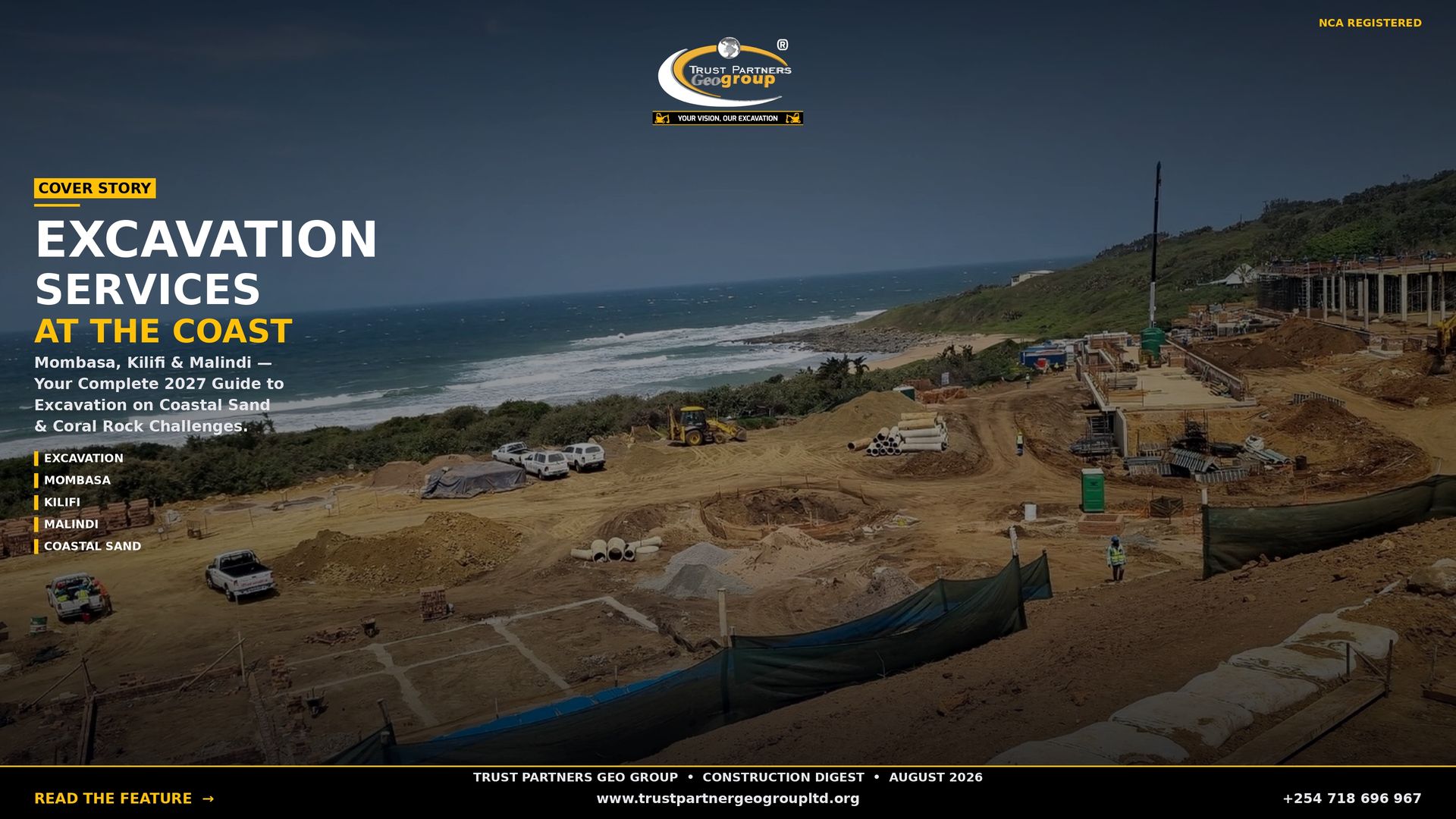
Along Kenya's 536-kilometre coastline, a construction revolution is reshaping the shoreline from Lamu to Vanga. Mombasa, Kilifi and Malindi — historic Swahili trading ports and colonial beach resorts — are now the epicentre of Kenya's most complex excavation environment. Beneath the white sands and coconut palms lies a geological puzzle that has humbled many inland contractors: loose saturated sand that collapses into trenches, ancient coral rock as hard as concrete, salt-laden groundwater that corrodes steel, and a regulatory maze of marine parks, coastal setbacks and monsoon drainage. This guide covers everything developers need to know about coastal excavation — from sheet piling and coral breaking to Kenya Maritime Authority permits and 2027 hire rates.

NCA-registered excavation and heavy equipment hire contractor with 15+ years operating across Kenya. We maintain a coastal-capable fleet with corrosion-resistant equipment, amphibious capability and marine-permit experience for Mombasa, Kilifi, Malindi and all shoreline projects.
Why Mombasa, Kilifi and Malindi Are Expanding
Kenya's coastal belt is experiencing its fastest construction boom in decades, driven by seven key factors:
- LAPSSET corridor: The Lamu Port-South Sudan-Ethiopia Transport corridor has unlocked the entire northern coast for logistics, industry and trade. The new Lamu port, connecting highways and railway spurs are driving earthworks at an unprecedented scale.
- Tourism recovery and expansion: Post-pandemic tourism growth has spurred hotel, resort and villa construction from Diani to Watamu. Malindi and Kilifi are seeing premium eco-resort, wellness retreat and retirement home developments targeting European and diaspora buyers.
- Mombasa-Nairobi SGR: The Standard Gauge Railway has reduced freight costs by 40% and passenger travel time to 4.5 hours, increasing Mombasa's attractiveness as a logistics and distribution hub for East Africa.
- Dongo Kundu Special Economic Zone: The 3,000-acre SEZ south of Mombasa is attracting manufacturing, warehousing and export-processing investments. Phase 1 earthworks involved over 5 million m³ of cut-and-fill on coral rag and sand.
- Affordable coastal land: Beachfront and near-beach plots in Kilifi and Malindi cost KES 3–8 million for 50×100 ft, versus KES 15–30 million in Mombasa's Nyali or Shanzu. This price differential drives northward expansion.
- Diaspora and foreign investment: European, Middle Eastern and Kenyan diaspora buyers are driving gated community, holiday home and retirement estate construction across the coast.
- County infrastructure upgrades: Tarmac roads, water supply and power extensions into previously remote coastal areas — particularly the Malindi-Lamu highway upgrade — have opened new development zones.
The Coastal Excavation Challenge: Sand, Coral and Salt
Unlike the volcanic soils of the highlands or the black cotton clay of Thika, Kenya's coast presents a unique geological and environmental profile:
- Coral rag limestone: Much of the coast sits on ancient coral reefs raised above sea level. This coral rock varies from soft and honeycombed (porous, crumbling under light pressure) to dense crystalline layers approaching concrete strength. Standard excavator buckets struggle, and breaker tool steel wears 30–50% faster than on inland rock.
- Loose coastal sand: Beachfront, dune and back-beach areas consist of loose, saturated quartz and coral sand with an angle of repose of only 25–30 degrees. Trenches collapse without support, and excavations require sheet piling or benching.
- High water table: The coastal aquifer lies just 1–3 metres below surface in Mombasa's Bamburi, Shanzu and Nyali areas. Foundation excavation requires continuous dewatering, and basements are rare due to hydrostatic pressure.
- Salt corrosion: Salt-laden air and groundwater accelerate corrosion on steel reinforcement, sheet piles, equipment hydraulics and exposed metal. Galvanized components, fresh-water washing and protective coatings are essential.
- Variable stratification: Coastal plots often show rapid vertical changes — loose sand over hard coral, then soft sand again, then waterlogged clay lenses. Boreholes every 15–20 metres are essential before design.
- Monsoon drainage: The long rains (April–June) and short rains (October–December) create flash flooding in low-lying coastal areas. Open excavations become ponds, and unprotected cuts wash out within hours.
- Marine ecosystem sensitivity: Mangroves, seagrass beds, coral reefs and turtle nesting beaches face strict protection. Excavation near these features requires KWS approval and often environmental monitoring.
Excavation Services for Coastal Sites
Coastal Foundation Excavation
Foundations on the coast must account for loose sand, coral rock and high water tables. Trust Partners Geo-Group excavates to geotechnical specifications for strip footings, raft slabs, pile caps and ground beams. In loose sand, we install sheet piles or soldier piles before excavation. On coral rock, we use hydraulic breakers, chemical splitting or controlled blasting to reach design depth.
Sheet Piling and Excavation Support
For basements, deep foundations and shoreline works in loose sand, we install interlocking steel or vinyl sheet piles using hydraulic vibratory hammers. Sheet piles exclude groundwater, retain sand walls and create a dry working environment. Extraction after construction is standard practice to minimize permanent environmental impact.
Dewatering and Groundwater Control
Coastal dewatering is continuous, not occasional. We deploy well-point systems, deep-well pumps and vacuum dewatering to lower water tables below excavation bases. In Mombasa's urban areas, dewatering discharge requires NEMA water quality approval — we manage permit compliance and discharge monitoring.
Coral Rock Breaking and Removal
From soft honeycombed coral that rips with dozer blades to crystalline hardpan requiring diamond saws, we match the coral breaking method to site conditions. Our coastal fleet includes heavy-duty breakers with hardened tool steel, chemical splitting kits and diamond wire sawing equipment for precision work near resorts.
Shoreline Protection and Seawall Foundations
Coastal erosion threatens developments from Mombasa to Malindi. We excavate for gabion foundations, concrete seawalls, revetments and breakwaters. Amphibious excavators and long-reach machines allow work below the high-water mark and on tidal flats where conventional equipment cannot operate.
Resort and Hotel Site Preparation
Luxury resorts demand precision earthworks with minimal environmental disruption. We clear indigenous vegetation selectively, preserve mature trees, grade sites to natural contours where possible, and construct hidden drainage systems that maintain beach aesthetics.
Coral Rock Excavation Methods
| Method | Best For | Equipment | Relative Cost |
|---|---|---|---|
| Hydraulic breaking | Medium-hard coral rag; urban sites where blasting is restricted | 30-ton excavator + heavy-duty breaker (2,000–3,000 J output) | Moderate — KES 2,500–4,500/m³ |
| Controlled blasting | Deep cuts, mass removal, remote sites away from resorts | Drill rig, explosives, blast mats, vibration monitoring | High — KES 4,000–6,500/m³ including permits |
| Diamond wire sawing | Precision cuts near buildings, sensitive structures, final trimming | Diamond wire saw, pulley system, water cooling | High — KES 3,500–5,500/m³ |
| Chemical splitting | Resort sites, noise-sensitive areas, vibration-restricted zones | Expanding grout, drilled holes, 12–24 hour fracture time | Moderate — KES 2,800–4,200/m³ |
| Dozer ripping | Soft, weathered coral and honeycombed layers | Bulldozer with single-shank ripper | Low — KES 1,500–2,500/m³ |
| Bucket excavation | Very soft coral sand and fragmented rubble | Standard excavator bucket | Low — KES 900–1,400/m³ |
Method selection depends on coral hardness, proximity to structures, environmental sensitivity and permit status. Trust Partners Geo-Group conducts pre-site coral assessment before recommending the most cost-effective approach.
Excavation Rates on the Kenyan Coast 2027
| Service | Rate (KES) | Notes |
|---|---|---|
| Plot cutting and clearing (per m²) | 200 – 400 | Upper end for dense coastal bush, coconut palm removal or rocky ground |
| Topsoil stripping (per m²) | 90 – 150 | Includes preservation of topsoil for landscaping reuse |
| Bulk excavation — loose sand (per m³) | 700 – 1,200 | Beachfront and dune areas; dewatering extra |
| Bulk excavation — coral rock with breaker (per m³) | 2,500 – 4,500 | Medium-hard coral rag; includes breaker wear premium |
| Foundation excavation — sand with dewatering (per m³) | 1,500 – 2,500 | Includes well-point or sump pump operation |
| Basement excavation — coral rock (per m³) | 3,000 – 5,000 | Rare on coast; includes sheet piling and waterproofing |
| Controlled blasting — hard coral (per m³) | 4,000 – 6,500 | Includes drilling, explosives, KWS/NEMA permits and safety |
| Sheet pile installation (per m² wall) | 3,500 – 6,000 | Steel or vinyl; includes driving, extraction if temporary |
| Dewatering — well-point system (per week) | 35,000 – 55,000 | Pumps, header pipes, discharge management |
| Seawall foundation excavation (per m) | 8,000 – 15,000 | Trench in coral/sand, bedding, backfill |
| Resort site grading (per m²) | 350 – 600 | Precision grading, drainage falls, aesthetic contours |
| Spoil disposal — coral/sand (per 20-ton truck) | 5,000 – 10,000 | Haul to approved county/quarry sites; distance varies |
| 30-ton excavator + breaker wet hire (daily) | 48,000 – 65,000 | Operator, fuel, breaker wear, salt-wash maintenance included |
| Amphibious excavator wet hire (daily) | 75,000 – 110,000 | Operator, fuel; for tidal flat and mangrove-area works |
Key Development Zones
Mombasa Island and Nyali: Urban Density and Logistics
Mombasa Island remains the commercial and transport heart of the coast, with new high-rise residential towers, hotels and mixed-use developments. Nyali — across the Tudor Creek bridge — is Mombasa's most affluent suburb, with gated estates, beachfront villas and shopping complexes. Excavation here is constrained by dense existing infrastructure, narrow access roads and the need for vibration control near historic buildings. Coral rock underlies most of Nyali, requiring breaker excavation for every foundation.
Dongo Kundu and South Coast: SEZ and Industrial Expansion
The Dongo Kundu Special Economic Zone south of Mombasa is transforming former bushland into Kenya's premier coastal industrial park. Earthworks here involve mass coral rock breaking, valley filling and road construction across 3,000 acres. The Likoni Ferry area and south coast resorts (Diani, Tiwi) also see continuous villa and hotel construction on sand-over-coral profiles.
Kilifi: Creek-Side Resorts and Gated Communities
Kilifi sits on a beautiful estuary where the Kilifi Creek meets the Indian Ocean. The town is booming with eco-resorts, retirement communities and holiday home estates. The terrain varies from sandy beachfront to coral ridge uplands. Creek-side developments require careful drainage engineering to prevent saltwater intrusion into foundations.
Malindi and Watamu: Tourism and Diaspora Investment
Malindi — Kenya's original Italian tourism hub — continues to attract European and diaspora investment in villas, boutique hotels and retirement estates. Watamu, to the south, is dominated by marine park tourism and eco-lodge development. Excavation in both areas faces strict KWS oversight due to proximity to Watamu and Malindi Marine National Parks. Turtle nesting beaches have seasonal construction restrictions (March–July).
Lamu Archipelago: LAPSSET and Heritage Development
The Lamu Port and associated infrastructure have triggered construction across the archipelago. Traditional Swahili building techniques meet modern foundation requirements on coral rag islands with no road access. Equipment arrives by sea, and all spoil must be managed within island ecosystems.
Shoreline Protection and Marine Works
Coastal erosion — accelerated by sea-level rise and coral reef degradation — threatens developments along Kenya's shoreline. Trust Partners Geo-Group provides excavation and foundation services for shoreline protection structures:
- Gabion revetments: Wire-mesh baskets filled with coral rock, founded on excavated trenches cut into beach rock or coral. We excavate trenches, place geotextile bedding, and backfill with graded coral.
- Concrete seawalls: Reinforced concrete walls founded on deep excavations through sand to coral bedrock. Require sheet piling during construction and salt-resistant concrete mixes.
- Breakwaters and groynes: Offshore structures that dissipate wave energy. Foundation excavation occurs in tidal zones using amphibious equipment or cofferdams.
- Beach nourishment: Excavating sand from offshore borrow areas and placing it on eroded beaches. Requires precision dredging and environmental monitoring.
- Mangrove restoration: Excavating tidal channels and planting platforms to restore degraded mangrove forests. Highly sensitive work requiring KWS and NEMA supervision.
Coastal Permits: NEMA, KWS and County
Coastal excavation in Kenya requires navigating a multi-agency permit framework:
- County building permits: Mombasa County, Kilifi County or Lamu County building control approvals. Submissions must include geotechnical reports, setback compliance from high-water mark, drainage plans and structural drawings. Processing takes 3–5 weeks.
- NEMA Environmental Impact Assessment: Mandatory for projects over 1 hectare, any development within 30 metres of the shoreline, or work in environmentally sensitive areas. Coastal EIAs require marine biologist input and often public participation.
- Kenya Wildlife Service (KWS) approval: Required for excavation within 1 km of marine protected areas (Watamu Marine National Park, Malindi Marine National Park, Mombasa Marine National Park) or near turtle nesting beaches. Seasonal restrictions apply March–July.
- Kenya Maritime Authority (KMA): Notification required for any excavation affecting navigation, beach access, port operations or coastal infrastructure. Offshore works require additional KMA permits.
- Physical Planning compliance: Coastal setbacks vary by county — Mombasa typically requires 30–50 metres from high-water mark; Kilifi and Malindi may require 60–100 metres in sensitive zones. Lamu Old Town has UNESCO World Heritage buffer restrictions.
- Water Authority permits: Dewatering discharge into the ocean, creeks or mangroves requires NEMA water quality approval and often KWS sign-off.
- NCA registration: All structural excavation must be carried out by NCA-registered contractors. Trust Partners Geo-Group holds full coastal registration.
Trust Partners Geo-Group Coastal Fleet
Our coastal fleet is configured for salt-air operation, sand mobility and marine-permit compliance, mobilised to Mombasa, Kilifi and Malindi:
- Hyundai HX300SL 30-ton Excavators (4 units): Primary coral-breaking machines with heavy-duty breakers and hardened tool steel. Fresh-water wash systems after each shift prevent salt corrosion.
- Long-Reach Excavators (2 units): 15–18 metre reach for shoreline protection works, seawall foundations and beach nourishment where conventional reach is insufficient.
- Amphibious Excavators (1 unit): For mangrove-area works, tidal flat excavation and lagoon dredging. Pontoon undercarriage allows operation in 1.5 m water depth.
- Hydraulic Sheet Pile Drivers (2 units): Vibratory and impact hammers for installing steel sheet piles in loose sand. Extraction capability for temporary works.
- Dewatering Pump Sets (4 units): Well-point systems, submersible pumps and vacuum dewatering units for continuous groundwater control on coastal sites.
- Shacman 30-ton Tippers with High-Flotation Tyres (8 units): Wide-base tyres prevent sinking in loose sand. Essential for beachfront and dune-area haulage.
- Sany Motor Grader (1 unit): Coastal road profiling and resort site grading with corrosion-protected hydraulics.
- Water Bowsers — Fresh Water (2 units): Daily equipment washing and salt-flush maintenance. Separate from dust-suppression bowsers.
- Mini-Excavators 5-ton (3 units): Restricted-access resort sites, precision trenching near marine ecosystems and historic structures.
- Diamond Wire Saw (1 unit): Precision coral cutting for sensitive sites where blasting and breaking are prohibited.
All coastal operators receive salt-corrosion training, marine safety certification and environmental awareness instruction. Projects receive dedicated supervisors, daily progress reports and compliance documentation for county, NEMA and KWS inspections.
Start Your Coastal Project in Mombasa, Kilifi or Malindi
Trust Partners Geo-Group is Kenya's leading coastal excavation contractor. Free site assessment, coral hardness testing, itemised quote and rapid mobilisation to the shoreline.
Call +254 718 686 967 Email for QuoteFrequently Asked Questions
Why are Mombasa, Kilifi and Malindi growing so fast?
Kenya's coastal belt is experiencing its fastest construction boom in decades, driven by: (1) Lamu Port-South Sudan-Ethiopia Transport (LAPSSET) corridor — the new Lamu port and connecting infrastructure have unlocked the entire northern coast for logistics, industry and trade. (2) Tourism recovery and expansion — post-pandemic tourism growth has spurred hotel, resort and villa construction from Diani to Watamu. Malindi and Kilifi are seeing premium eco-resort and retirement home developments. (3) Mombasa-Nairobi Standard Gauge Railway (SGR) — the passenger and freight rail link has reduced transport costs and increased Mombasa's attractiveness as a logistics and distribution hub. (4) Dongo Kundu Special Economic Zone — the 3,000-acre SEZ south of Mombasa is attracting manufacturing, warehousing and export-processing investments at scale. (5) Affordable coastal land — beachfront and near-beach plots in Kilifi and Malindi cost KES 3–8 million for 50×100 ft, versus KES 15–30 million in Mombasa's Nyali or Shanzu. (6) Diaspora and foreign investment — European, Middle Eastern and Kenyan diaspora buyers are driving gated community, holiday home and retirement estate construction. (7) County infrastructure upgrades — tarmac roads, water supply and power extensions into previously remote coastal areas have opened new development zones.
What makes coastal excavation different from inland excavation?
Coastal excavation in Mombasa, Kilifi and Malindi presents challenges rarely encountered in Nairobi or the highlands: (1) Coral rock — much of the coast sits on ancient coral limestone (coral rag) that is highly variable in hardness, from soft and porous to dense and brittle. Standard excavator buckets struggle, and breaker attachments wear rapidly on the abrasive coral. (2) Loose coastal sand — beachfront and dune areas consist of loose, saturated sand that collapses into excavations and requires sheet piling or benching to maintain stable walls. (3) High water table — the coastal water table lies just 1–3 metres below surface in many areas, requiring continuous dewatering during foundation excavation. (4) Salt corrosion — salt-laden air and groundwater accelerate corrosion on steel reinforcement, sheet piles and equipment. Galvanized or stainless components are essential. (5) Marine regulations — excavation within 30 metres of the high-water mark requires NEMA coastal zone approval, Kenya Maritime Authority notification and often physical planning compliance for setback rules. (6) Seasonal monsoon drainage — the long rains (April–June) and short rains (October–December) create flash flooding in low-lying coastal areas, washing out open excavations if drainage is not engineered. (7) Mangrove and marine ecosystem protection — excavation near mangroves, seagrass beds or turtle nesting beaches faces strict environmental controls. Trust Partners Geo-Group has developed coastal-specific methodologies for all these conditions.
What is coral rock and how do you excavate it?
Coral rock — also called coral rag or coral limestone — is a sedimentary rock formed from ancient coral reefs that once covered much of Kenya's coast. It varies enormously: soft, honeycombed coral that crumbles under bucket pressure; medium-density layers that require hydraulic breakers; and hard, crystalline coral that approaches the strength of concrete and needs controlled blasting or diamond saw cutting. Excavation methods include: (1) Hydraulic breaking — 30-ton excavators with heavy-duty breakers (2,000–3,000 joule output) for medium-hard coral. Breaker tool steel wears 30–50% faster on coral than on volcanic rock due to abrasiveness. (2) Controlled blasting — for deep cuts and mass removal in remote sites. Requires NEMA coastal zone approval, KWS notification if near marine parks, and police supervision. (3) Diamond wire sawing — for precision cuts near existing buildings or sensitive structures where vibration must be minimized. (4) Chemical splitting — expanding grout injected into drilled holes fractures coral without noise or vibration. Suitable for resort sites where guest experience matters. (5) Ripper and bucket combination — some weathered coral can be ripped with dozer shanks then loaded with buckets. Trust Partners Geo-Group assesses coral hardness on every site before selecting the most cost-effective method.
How much does coastal excavation cost in Mombasa and Malindi?
Coastal excavation costs in Mombasa, Kilifi and Malindi vary significantly by soil/rock type and proximity to the shoreline: Soft sand excavation costs KES 700–1,200 per m³. Coral rock breaking with hydraulic breakers costs KES 2,500–4,500 per m³. Controlled blasting for hard coral costs KES 4,000–6,500 per m³ including permits. Foundation excavation in loose sand with dewatering costs KES 1,500–2,500 per m³. Basement excavation in Mombasa's urban coral rock costs KES 3,000–5,000 per m³. Plot cutting and clearing costs KES 200–400 per m². Key cost drivers include: distance from equipment depots (Mombasa has the best access; Malindi and Kilifi add mobilization premiums of 15–25%), coral hardness variability, dewatering requirements, marine permit processing times, and salt-corrosion equipment maintenance. A typical 2-level basement on 800 m² in Mombasa's Nyali coral rock costs KES 20–35 million all-in. Trust Partners Geo-Group provides fixed-price quotes after coastal-specific site investigation.
Do I need special permits for coastal excavation in Kenya?
Yes. Coastal excavation in Kenya requires a layered permit framework: (1) County building permits — Mombasa County, Kilifi County or Malindi sub-county building control approvals. Submissions must include geotechnical reports, setback compliance from high-water mark, and drainage plans. (2) NEMA Environmental Impact Assessment — mandatory for projects over 1 hectare, any development within 30 metres of the shoreline, or work in environmentally sensitive areas (mangroves, marine parks, turtle nesting beaches). (3) Kenya Wildlife Service (KWS) approval — required for excavation within 1 km of marine protected areas including Watamu Marine National Park, Malindi Marine National Park and Mombasa Marine National Park. (4) Kenya Maritime Authority notification — required for any excavation affecting navigation, beach access or coastal infrastructure. (5) Physical Planning compliance — coastal setbacks vary by county: Mombasa typically requires 30–50 metres from high-water mark for permanent structures; Kilifi and Malindi may require 60–100 metres in ecologically sensitive zones. (6) Water Authority permits — dewatering discharge into the ocean or coastal creeks requires National Environment Management Authority (NEMA) water quality approval. (7) NCA-registered contractor — all structural excavation must be carried out by NCA-registered firms. Trust Partners Geo-Group holds all coastal excavation licenses and manages the full permit chain from county application to post-construction environmental audit.
How do you prevent excavation collapse in loose coastal sand?
Loose, saturated coastal sand has an angle of repose of only 25–30 degrees and collapses readily into open cuts. Prevention methods include: (1) Sheet piling — interlocking steel or vinyl sheet piles driven around the excavation perimeter to retain sand and exclude groundwater. Essential for basements and deep foundations near the beach. (2) Benching — stepping excavation walls at 1:1 or 1.5:1 slopes to prevent mass failure. Used on larger sites where sheet piling is uneconomical. (3) Dewatering — well-point systems, sump pumps or deep-well dewatering to lower the water table below excavation base. Critical in Mombasa's Bamburi, Shanzu and Nyali areas where the water table sits 1–2 metres below surface. (4) Soil cement mixing — injecting cement grout into loose sand to create stabilized columns or walls that prevent liquefaction and collapse. (5) Geotextile wrapping — wrapping excavation faces with high-strength geotextile to prevent sand sloughing while allowing water drainage. (6) Immediate blinding — pouring 75–100 mm blinding concrete within 24 hours of reaching foundation level to seal the sand surface and prevent disturbance. Trust Partners Geo-Group designs excavation support systems based on sand density, water table depth and proximity to structures.
What equipment is needed for coastal excavation?
Coastal excavation requires specialized fleet adapted to sand, salt and coral conditions: (1) 30-ton excavators with heavy-duty breakers — primary coral-breaking tool. Breakers need hardened tool steel and more frequent replacement due to coral abrasiveness. (2) Long-reach excavators — for shoreline protection works, seawall foundations and beach nourishment projects where reach over water or steep slopes is required. (3) Sheet pile drivers — hydraulic vibratory hammers or impact hammers for installing steel sheet piles in loose sand. (4) Dewatering pumps — submersible pumps, well-point systems and vacuum dewatering units for continuous groundwater control. (5) Amphibious excavators — for mangrove-area works, tidal flat excavation and lagoon dredging where conventional machines cannot operate. (6) 20–30 ton tippers with high-flotation tyres — sand sites require wide tyres to prevent sinking; standard tyres bog down in loose coastal sand. (7) Motor graders with corrosion protection — salt air accelerates rust on exposed steel; graders need enhanced protective coatings. (8) Water bowsers with fresh water — equipment washing after each shift is essential to prevent salt corrosion. (9) Mini-excavators on mats — for restricted-access resort sites and sensitive environmental zones. All coastal equipment is available wet hire with NITA-certified operators from Trust Partners Geo-Group, mobilised to Mombasa, Kilifi and Malindi.
Where does excavated coral and sand from coastal sites go?
Excavated material from Kenya's coast is managed through: (1) On-site re-use — crushed coral makes excellent hardcore for foundations, access roads and drainage layers within the same development. Coral sand is used for concrete aggregate, plastering and landscaping fill. (2) Approved quarry and landfill sites — Mombasa County designates specific disposal areas for unsuitable spoil. Transport costs range KES 600–1,200 per 20-ton truck depending on haul distance. (3) Beach nourishment — clean, graded sand from inland excavation can be used for beach replenishment projects where erosion has depleted shorelines. Requires NEMA and KWS approval. (4) Road construction — crushed coral rag is valued for road base and sub-base in coastal counties where hard rock is scarce. (5) Block and tile manufacturing — coral limestone is burned for lime and processed into coral bricks, a traditional coastal building material. (6) Reclamation fill — excess sand and coral fill is used for land reclamation in port expansion, lagoon filling and industrial yard creation. Trust Partners Geo-Group manages disposal logistics including county permits, environmental compliance documentation and on-site crushing where justified. Note that dumping excavated material into the ocean, mangroves or unapproved sites carries severe NEMA and KWS penalties.
Related Resources
Planning a Coastal Project in Mombasa, Kilifi or Malindi?
Contact Trust Partners Geo-Group at +254 718 686 967 for a free coastal site assessment and itemised excavation quote. Serving Mombasa, Kilifi, Malindi, Lamu and all 47 counties.
Call +254 718 686 967 Request QuoteExcavation Services in Mombasa, Kilifi and Malindi: Coastal Sand and Coral Rock Challenges [2027]
Coastal Foundation Excavation, Coral Rock Breaking & Earthworks for Kenya's Shoreline Construction Belt
Along Kenya's 536-kilometre coastline, a construction revolution is reshaping the shoreline from Lamu to Vanga. Mombasa, Kilifi and Malindi — historic Swahili trading ports and colonial beach resorts — are now the epicentre of Kenya's most complex excavation environment. Beneath the white sands and coconut palms lies a geological puzzle that has humbled many inland contractors: loose saturated sand that collapses into trenches, ancient coral rock as hard as concrete, salt-laden groundwater that corrodes steel, and a regulatory maze of marine parks, coastal setbacks and monsoon drainage. This guide covers everything developers need to know about coastal excavation — from sheet piling and coral breaking to Kenya Maritime Authority permits and 2027 hire rates.
NCA-registered excavation and heavy equipment hire contractor with 15+ years operating across Kenya. We maintain a coastal-capable fleet with corrosion-resistant equipment, amphibious capability and marine-permit experience for Mombasa, Kilifi, Malindi and all shoreline projects.
Why Mombasa, Kilifi and Malindi Are Expanding
Kenya's coastal belt is experiencing its fastest construction boom in decades, driven by seven key factors:
- LAPSSET corridor: The Lamu Port-South Sudan-Ethiopia Transport corridor has unlocked the entire northern coast for logistics, industry and trade. The new Lamu port, connecting highways and railway spurs are driving earthworks at an unprecedented scale.
- Tourism recovery and expansion: Post-pandemic tourism growth has spurred hotel, resort and villa construction from Diani to Watamu. Malindi and Kilifi are seeing premium eco-resort, wellness retreat and retirement home developments targeting European and diaspora buyers.
- Mombasa-Nairobi SGR: The Standard Gauge Railway has reduced freight costs by 40% and passenger travel time to 4.5 hours, increasing Mombasa's attractiveness as a logistics and distribution hub for East Africa.
- Dongo Kundu Special Economic Zone: The 3,000-acre SEZ south of Mombasa is attracting manufacturing, warehousing and export-processing investments. Phase 1 earthworks involved over 5 million m³ of cut-and-fill on coral rag and sand.
- Affordable coastal land: Beachfront and near-beach plots in Kilifi and Malindi cost KES 3–8 million for 50×100 ft, versus KES 15–30 million in Mombasa's Nyali or Shanzu. This price differential drives northward expansion.
- Diaspora and foreign investment: European, Middle Eastern and Kenyan diaspora buyers are driving gated community, holiday home and retirement estate construction across the coast.
- County infrastructure upgrades: Tarmac roads, water supply and power extensions into previously remote coastal areas — particularly the Malindi-Lamu highway upgrade — have opened new development zones.
The Coastal Excavation Challenge: Sand, Coral and Salt
Unlike the volcanic soils of the highlands or the black cotton clay of Thika, Kenya's coast presents a unique geological and environmental profile:
- Coral rag limestone: Much of the coast sits on ancient coral reefs raised above sea level. This coral rock varies from soft and honeycombed (porous, crumbling under light pressure) to dense crystalline layers approaching concrete strength. Standard excavator buckets struggle, and breaker tool steel wears 30–50% faster than on inland rock.
- Loose coastal sand: Beachfront, dune and back-beach areas consist of loose, saturated quartz and coral sand with an angle of repose of only 25–30 degrees. Trenches collapse without support, and excavations require sheet piling or benching.
- High water table: The coastal aquifer lies just 1–3 metres below surface in Mombasa's Bamburi, Shanzu and Nyali areas. Foundation excavation requires continuous dewatering, and basements are rare due to hydrostatic pressure.
- Salt corrosion: Salt-laden air and groundwater accelerate corrosion on steel reinforcement, sheet piles, equipment hydraulics and exposed metal. Galvanized components, fresh-water washing and protective coatings are essential.
- Variable stratification: Coastal plots often show rapid vertical changes — loose sand over hard coral, then soft sand again, then waterlogged clay lenses. Boreholes every 15–20 metres are essential before design.
- Monsoon drainage: The long rains (April–June) and short rains (October–December) create flash flooding in low-lying coastal areas. Open excavations become ponds, and unprotected cuts wash out within hours.
- Marine ecosystem sensitivity: Mangroves, seagrass beds, coral reefs and turtle nesting beaches face strict protection. Excavation near these features requires KWS approval and often environmental monitoring.
Excavation Services for Coastal Sites
Coastal Foundation Excavation
Foundations on the coast must account for loose sand, coral rock and high water tables. Trust Partners Geo-Group excavates to geotechnical specifications for strip footings, raft slabs, pile caps and ground beams. In loose sand, we install sheet piles or soldier piles before excavation. On coral rock, we use hydraulic breakers, chemical splitting or controlled blasting to reach design depth.
Sheet Piling and Excavation Support
For basements, deep foundations and shoreline works in loose sand, we install interlocking steel or vinyl sheet piles using hydraulic vibratory hammers. Sheet piles exclude groundwater, retain sand walls and create a dry working environment. Extraction after construction is standard practice to minimize permanent environmental impact.
Dewatering and Groundwater Control
Coastal dewatering is continuous, not occasional. We deploy well-point systems, deep-well pumps and vacuum dewatering to lower water tables below excavation bases. In Mombasa's urban areas, dewatering discharge requires NEMA water quality approval — we manage permit compliance and discharge monitoring.
Coral Rock Breaking and Removal
From soft honeycombed coral that rips with dozer blades to crystalline hardpan requiring diamond saws, we match the coral breaking method to site conditions. Our coastal fleet includes heavy-duty breakers with hardened tool steel, chemical splitting kits and diamond wire sawing equipment for precision work near resorts.
Shoreline Protection and Seawall Foundations
Coastal erosion threatens developments from Mombasa to Malindi. We excavate for gabion foundations, concrete seawalls, revetments and breakwaters. Amphibious excavators and long-reach machines allow work below the high-water mark and on tidal flats where conventional equipment cannot operate.
Resort and Hotel Site Preparation
Luxury resorts demand precision earthworks with minimal environmental disruption. We clear indigenous vegetation selectively, preserve mature trees, grade sites to natural contours where possible, and construct hidden drainage systems that maintain beach aesthetics.
Coral Rock Excavation Methods
| Method | Best For | Equipment | Relative Cost |
|---|---|---|---|
| Hydraulic breaking | Medium-hard coral rag; urban sites where blasting is restricted | 30-ton excavator + heavy-duty breaker (2,000–3,000 J output) | Moderate — KES 2,500–4,500/m³ |
| Controlled blasting | Deep cuts, mass removal, remote sites away from resorts | Drill rig, explosives, blast mats, vibration monitoring | High — KES 4,000–6,500/m³ including permits |
| Diamond wire sawing | Precision cuts near buildings, sensitive structures, final trimming | Diamond wire saw, pulley system, water cooling | High — KES 3,500–5,500/m³ |
| Chemical splitting | Resort sites, noise-sensitive areas, vibration-restricted zones | Expanding grout, drilled holes, 12–24 hour fracture time | Moderate — KES 2,800–4,200/m³ |
| Dozer ripping | Soft, weathered coral and honeycombed layers | Bulldozer with single-shank ripper | Low — KES 1,500–2,500/m³ |
| Bucket excavation | Very soft coral sand and fragmented rubble | Standard excavator bucket | Low — KES 900–1,400/m³ |
Method selection depends on coral hardness, proximity to structures, environmental sensitivity and permit status. Trust Partners Geo-Group conducts pre-site coral assessment before recommending the most cost-effective approach.
Excavation Rates on the Kenyan Coast 2027
| Service | Rate (KES) | Notes |
|---|---|---|
| Plot cutting and clearing (per m²) | 200 – 400 | Upper end for dense coastal bush, coconut palm removal or rocky ground |
| Topsoil stripping (per m²) | 90 – 150 | Includes preservation of topsoil for landscaping reuse |
| Bulk excavation — loose sand (per m³) | 700 – 1,200 | Beachfront and dune areas; dewatering extra |
| Bulk excavation — coral rock with breaker (per m³) | 2,500 – 4,500 | Medium-hard coral rag; includes breaker wear premium |
| Foundation excavation — sand with dewatering (per m³) | 1,500 – 2,500 | Includes well-point or sump pump operation |
| Basement excavation — coral rock (per m³) | 3,000 – 5,000 | Rare on coast; includes sheet piling and waterproofing |
| Controlled blasting — hard coral (per m³) | 4,000 – 6,500 | Includes drilling, explosives, KWS/NEMA permits and safety |
| Sheet pile installation (per m² wall) | 3,500 – 6,000 | Steel or vinyl; includes driving, extraction if temporary |
| Dewatering — well-point system (per week) | 35,000 – 55,000 | Pumps, header pipes, discharge management |
| Seawall foundation excavation (per m) | 8,000 – 15,000 | Trench in coral/sand, bedding, backfill |
| Resort site grading (per m²) | 350 – 600 | Precision grading, drainage falls, aesthetic contours |
| Spoil disposal — coral/sand (per 20-ton truck) | 5,000 – 10,000 | Haul to approved county/quarry sites; distance varies |
| 30-ton excavator + breaker wet hire (daily) | 48,000 – 65,000 | Operator, fuel, breaker wear, salt-wash maintenance included |
| Amphibious excavator wet hire (daily) | 75,000 – 110,000 | Operator, fuel; for tidal flat and mangrove-area works |
Key Development Zones
Mombasa Island and Nyali: Urban Density and Logistics
Mombasa Island remains the commercial and transport heart of the coast, with new high-rise residential towers, hotels and mixed-use developments. Nyali — across the Tudor Creek bridge — is Mombasa's most affluent suburb, with gated estates, beachfront villas and shopping complexes. Excavation here is constrained by dense existing infrastructure, narrow access roads and the need for vibration control near historic buildings. Coral rock underlies most of Nyali, requiring breaker excavation for every foundation.
Dongo Kundu and South Coast: SEZ and Industrial Expansion
The Dongo Kundu Special Economic Zone south of Mombasa is transforming former bushland into Kenya's premier coastal industrial park. Earthworks here involve mass coral rock breaking, valley filling and road construction across 3,000 acres. The Likoni Ferry area and south coast resorts (Diani, Tiwi) also see continuous villa and hotel construction on sand-over-coral profiles.
Kilifi: Creek-Side Resorts and Gated Communities
Kilifi sits on a beautiful estuary where the Kilifi Creek meets the Indian Ocean. The town is booming with eco-resorts, retirement communities and holiday home estates. The terrain varies from sandy beachfront to coral ridge uplands. Creek-side developments require careful drainage engineering to prevent saltwater intrusion into foundations.
Malindi and Watamu: Tourism and Diaspora Investment
Malindi — Kenya's original Italian tourism hub — continues to attract European and diaspora investment in villas, boutique hotels and retirement estates. Watamu, to the south, is dominated by marine park tourism and eco-lodge development. Excavation in both areas faces strict KWS oversight due to proximity to Watamu and Malindi Marine National Parks. Turtle nesting beaches have seasonal construction restrictions (March–July).
Lamu Archipelago: LAPSSET and Heritage Development
The Lamu Port and associated infrastructure have triggered construction across the archipelago. Traditional Swahili building techniques meet modern foundation requirements on coral rag islands with no road access. Equipment arrives by sea, and all spoil must be managed within island ecosystems.
Shoreline Protection and Marine Works
Coastal erosion — accelerated by sea-level rise and coral reef degradation — threatens developments along Kenya's shoreline. Trust Partners Geo-Group provides excavation and foundation services for shoreline protection structures:
- Gabion revetments: Wire-mesh baskets filled with coral rock, founded on excavated trenches cut into beach rock or coral. We excavate trenches, place geotextile bedding, and backfill with graded coral.
- Concrete seawalls: Reinforced concrete walls founded on deep excavations through sand to coral bedrock. Require sheet piling during construction and salt-resistant concrete mixes.
- Breakwaters and groynes: Offshore structures that dissipate wave energy. Foundation excavation occurs in tidal zones using amphibious equipment or cofferdams.
- Beach nourishment: Excavating sand from offshore borrow areas and placing it on eroded beaches. Requires precision dredging and environmental monitoring.
- Mangrove restoration: Excavating tidal channels and planting platforms to restore degraded mangrove forests. Highly sensitive work requiring KWS and NEMA supervision.
Coastal Permits: NEMA, KWS and County
Coastal excavation in Kenya requires navigating a multi-agency permit framework:
- County building permits: Mombasa County, Kilifi County or Lamu County building control approvals. Submissions must include geotechnical reports, setback compliance from high-water mark, drainage plans and structural drawings. Processing takes 3–5 weeks.
- NEMA Environmental Impact Assessment: Mandatory for projects over 1 hectare, any development within 30 metres of the shoreline, or work in environmentally sensitive areas. Coastal EIAs require marine biologist input and often public participation.
- Kenya Wildlife Service (KWS) approval: Required for excavation within 1 km of marine protected areas (Watamu Marine National Park, Malindi Marine National Park, Mombasa Marine National Park) or near turtle nesting beaches. Seasonal restrictions apply March–July.
- Kenya Maritime Authority (KMA): Notification required for any excavation affecting navigation, beach access, port operations or coastal infrastructure. Offshore works require additional KMA permits.
- Physical Planning compliance: Coastal setbacks vary by county — Mombasa typically requires 30–50 metres from high-water mark; Kilifi and Malindi may require 60–100 metres in sensitive zones. Lamu Old Town has UNESCO World Heritage buffer restrictions.
- Water Authority permits: Dewatering discharge into the ocean, creeks or mangroves requires NEMA water quality approval and often KWS sign-off.
- NCA registration: All structural excavation must be carried out by NCA-registered contractors. Trust Partners Geo-Group holds full coastal registration.
Trust Partners Geo-Group Coastal Fleet
Our coastal fleet is configured for salt-air operation, sand mobility and marine-permit compliance, mobilised to Mombasa, Kilifi and Malindi:
- Hyundai HX300SL 30-ton Excavators (4 units): Primary coral-breaking machines with heavy-duty breakers and hardened tool steel. Fresh-water wash systems after each shift prevent salt corrosion.
- Long-Reach Excavators (2 units): 15–18 metre reach for shoreline protection works, seawall foundations and beach nourishment where conventional reach is insufficient.
- Amphibious Excavators (1 unit): For mangrove-area works, tidal flat excavation and lagoon dredging. Pontoon undercarriage allows operation in 1.5 m water depth.
- Hydraulic Sheet Pile Drivers (2 units): Vibratory and impact hammers for installing steel sheet piles in loose sand. Extraction capability for temporary works.
- Dewatering Pump Sets (4 units): Well-point systems, submersible pumps and vacuum dewatering units for continuous groundwater control on coastal sites.
- Shacman 30-ton Tippers with High-Flotation Tyres (8 units): Wide-base tyres prevent sinking in loose sand. Essential for beachfront and dune-area haulage.
- Sany Motor Grader (1 unit): Coastal road profiling and resort site grading with corrosion-protected hydraulics.
- Water Bowsers — Fresh Water (2 units): Daily equipment washing and salt-flush maintenance. Separate from dust-suppression bowsers.
- Mini-Excavators 5-ton (3 units): Restricted-access resort sites, precision trenching near marine ecosystems and historic structures.
- Diamond Wire Saw (1 unit): Precision coral cutting for sensitive sites where blasting and breaking are prohibited.
All coastal operators receive salt-corrosion training, marine safety certification and environmental awareness instruction. Projects receive dedicated supervisors, daily progress reports and compliance documentation for county, NEMA and KWS inspections.
Start Your Coastal Project in Mombasa, Kilifi or Malindi
Trust Partners Geo-Group is Kenya's leading coastal excavation contractor. Free site assessment, coral hardness testing, itemised quote and rapid mobilisation to the shoreline.
Call +254 718 686 967 Email for QuoteFrequently Asked Questions
Why are Mombasa, Kilifi and Malindi growing so fast?
Kenya's coastal belt is experiencing its fastest construction boom in decades, driven by: (1) Lamu Port-South Sudan-Ethiopia Transport (LAPSSET) corridor — the new Lamu port and connecting infrastructure have unlocked the entire northern coast for logistics, industry and trade. (2) Tourism recovery and expansion — post-pandemic tourism growth has spurred hotel, resort and villa construction from Diani to Watamu. Malindi and Kilifi are seeing premium eco-resort and retirement home developments. (3) Mombasa-Nairobi Standard Gauge Railway (SGR) — the passenger and freight rail link has reduced transport costs and increased Mombasa's attractiveness as a logistics and distribution hub. (4) Dongo Kundu Special Economic Zone — the 3,000-acre SEZ south of Mombasa is attracting manufacturing, warehousing and export-processing investments at scale. (5) Affordable coastal land — beachfront and near-beach plots in Kilifi and Malindi cost KES 3–8 million for 50×100 ft, versus KES 15–30 million in Mombasa's Nyali or Shanzu. (6) Diaspora and foreign investment — European, Middle Eastern and Kenyan diaspora buyers are driving gated community, holiday home and retirement estate construction. (7) County infrastructure upgrades — tarmac roads, water supply and power extensions into previously remote coastal areas have opened new development zones.
What makes coastal excavation different from inland excavation?
Coastal excavation in Mombasa, Kilifi and Malindi presents challenges rarely encountered in Nairobi or the highlands: (1) Coral rock — much of the coast sits on ancient coral limestone (coral rag) that is highly variable in hardness, from soft and porous to dense and brittle. Standard excavator buckets struggle, and breaker attachments wear rapidly on the abrasive coral. (2) Loose coastal sand — beachfront and dune areas consist of loose, saturated sand that collapses into excavations and requires sheet piling or benching to maintain stable walls. (3) High water table — the coastal water table lies just 1–3 metres below surface in many areas, requiring continuous dewatering during foundation excavation. (4) Salt corrosion — salt-laden air and groundwater accelerate corrosion on steel reinforcement, sheet piles and equipment. Galvanized or stainless components are essential. (5) Marine regulations — excavation within 30 metres of the high-water mark requires NEMA coastal zone approval, Kenya Maritime Authority notification and often physical planning compliance for setback rules. (6) Seasonal monsoon drainage — the long rains (April–June) and short rains (October–December) create flash flooding in low-lying coastal areas, washing out open excavations if drainage is not engineered. (7) Mangrove and marine ecosystem protection — excavation near mangroves, seagrass beds or turtle nesting beaches faces strict environmental controls. Trust Partners Geo-Group has developed coastal-specific methodologies for all these conditions.
What is coral rock and how do you excavate it?
Coral rock — also called coral rag or coral limestone — is a sedimentary rock formed from ancient coral reefs that once covered much of Kenya's coast. It varies enormously: soft, honeycombed coral that crumbles under bucket pressure; medium-density layers that require hydraulic breakers; and hard, crystalline coral that approaches the strength of concrete and needs controlled blasting or diamond saw cutting. Excavation methods include: (1) Hydraulic breaking — 30-ton excavators with heavy-duty breakers (2,000–3,000 joule output) for medium-hard coral. Breaker tool steel wears 30–50% faster on coral than on volcanic rock due to abrasiveness. (2) Controlled blasting — for deep cuts and mass removal in remote sites. Requires NEMA coastal zone approval, KWS notification if near marine parks, and police supervision. (3) Diamond wire sawing — for precision cuts near existing buildings or sensitive structures where vibration must be minimized. (4) Chemical splitting — expanding grout injected into drilled holes fractures coral without noise or vibration. Suitable for resort sites where guest experience matters. (5) Ripper and bucket combination — some weathered coral can be ripped with dozer shanks then loaded with buckets. Trust Partners Geo-Group assesses coral hardness on every site before selecting the most cost-effective method.
How much does coastal excavation cost in Mombasa and Malindi?
Coastal excavation costs in Mombasa, Kilifi and Malindi vary significantly by soil/rock type and proximity to the shoreline: Soft sand excavation costs KES 700–1,200 per m³. Coral rock breaking with hydraulic breakers costs KES 2,500–4,500 per m³. Controlled blasting for hard coral costs KES 4,000–6,500 per m³ including permits. Foundation excavation in loose sand with dewatering costs KES 1,500–2,500 per m³. Basement excavation in Mombasa's urban coral rock costs KES 3,000–5,000 per m³. Plot cutting and clearing costs KES 200–400 per m². Key cost drivers include: distance from equipment depots (Mombasa has the best access; Malindi and Kilifi add mobilization premiums of 15–25%), coral hardness variability, dewatering requirements, marine permit processing times, and salt-corrosion equipment maintenance. A typical 2-level basement on 800 m² in Mombasa's Nyali coral rock costs KES 20–35 million all-in. Trust Partners Geo-Group provides fixed-price quotes after coastal-specific site investigation.
Do I need special permits for coastal excavation in Kenya?
Yes. Coastal excavation in Kenya requires a layered permit framework: (1) County building permits — Mombasa County, Kilifi County or Malindi sub-county building control approvals. Submissions must include geotechnical reports, setback compliance from high-water mark, and drainage plans. (2) NEMA Environmental Impact Assessment — mandatory for projects over 1 hectare, any development within 30 metres of the shoreline, or work in environmentally sensitive areas (mangroves, marine parks, turtle nesting beaches). (3) Kenya Wildlife Service (KWS) approval — required for excavation within 1 km of marine protected areas including Watamu Marine National Park, Malindi Marine National Park and Mombasa Marine National Park. (4) Kenya Maritime Authority notification — required for any excavation affecting navigation, beach access or coastal infrastructure. (5) Physical Planning compliance — coastal setbacks vary by county: Mombasa typically requires 30–50 metres from high-water mark for permanent structures; Kilifi and Malindi may require 60–100 metres in ecologically sensitive zones. (6) Water Authority permits — dewatering discharge into the ocean or coastal creeks requires National Environment Management Authority (NEMA) water quality approval. (7) NCA-registered contractor — all structural excavation must be carried out by NCA-registered firms. Trust Partners Geo-Group holds all coastal excavation licenses and manages the full permit chain from county application to post-construction environmental audit.
How do you prevent excavation collapse in loose coastal sand?
Loose, saturated coastal sand has an angle of repose of only 25–30 degrees and collapses readily into open cuts. Prevention methods include: (1) Sheet piling — interlocking steel or vinyl sheet piles driven around the excavation perimeter to retain sand and exclude groundwater. Essential for basements and deep foundations near the beach. (2) Benching — stepping excavation walls at 1:1 or 1.5:1 slopes to prevent mass failure. Used on larger sites where sheet piling is uneconomical. (3) Dewatering — well-point systems, sump pumps or deep-well dewatering to lower the water table below excavation base. Critical in Mombasa's Bamburi, Shanzu and Nyali areas where the water table sits 1–2 metres below surface. (4) Soil cement mixing — injecting cement grout into loose sand to create stabilized columns or walls that prevent liquefaction and collapse. (5) Geotextile wrapping — wrapping excavation faces with high-strength geotextile to prevent sand sloughing while allowing water drainage. (6) Immediate blinding — pouring 75–100 mm blinding concrete within 24 hours of reaching foundation level to seal the sand surface and prevent disturbance. Trust Partners Geo-Group designs excavation support systems based on sand density, water table depth and proximity to structures.
What equipment is needed for coastal excavation?
Coastal excavation requires specialized fleet adapted to sand, salt and coral conditions: (1) 30-ton excavators with heavy-duty breakers — primary coral-breaking tool. Breakers need hardened tool steel and more frequent replacement due to coral abrasiveness. (2) Long-reach excavators — for shoreline protection works, seawall foundations and beach nourishment projects where reach over water or steep slopes is required. (3) Sheet pile drivers — hydraulic vibratory hammers or impact hammers for installing steel sheet piles in loose sand. (4) Dewatering pumps — submersible pumps, well-point systems and vacuum dewatering units for continuous groundwater control. (5) Amphibious excavators — for mangrove-area works, tidal flat excavation and lagoon dredging where conventional machines cannot operate. (6) 20–30 ton tippers with high-flotation tyres — sand sites require wide tyres to prevent sinking; standard tyres bog down in loose coastal sand. (7) Motor graders with corrosion protection — salt air accelerates rust on exposed steel; graders need enhanced protective coatings. (8) Water bowsers with fresh water — equipment washing after each shift is essential to prevent salt corrosion. (9) Mini-excavators on mats — for restricted-access resort sites and sensitive environmental zones. All coastal equipment is available wet hire with NITA-certified operators from Trust Partners Geo-Group, mobilised to Mombasa, Kilifi and Malindi.
Where does excavated coral and sand from coastal sites go?
Excavated material from Kenya's coast is managed through: (1) On-site re-use — crushed coral makes excellent hardcore for foundations, access roads and drainage layers within the same development. Coral sand is used for concrete aggregate, plastering and landscaping fill. (2) Approved quarry and landfill sites — Mombasa County designates specific disposal areas for unsuitable spoil. Transport costs range KES 600–1,200 per 20-ton truck depending on haul distance. (3) Beach nourishment — clean, graded sand from inland excavation can be used for beach replenishment projects where erosion has depleted shorelines. Requires NEMA and KWS approval. (4) Road construction — crushed coral rag is valued for road base and sub-base in coastal counties where hard rock is scarce. (5) Block and tile manufacturing — coral limestone is burned for lime and processed into coral bricks, a traditional coastal building material. (6) Reclamation fill — excess sand and coral fill is used for land reclamation in port expansion, lagoon filling and industrial yard creation. Trust Partners Geo-Group manages disposal logistics including county permits, environmental compliance documentation and on-site crushing where justified. Note that dumping excavated material into the ocean, mangroves or unapproved sites carries severe NEMA and KWS penalties.
Related Resources
Planning a Coastal Project in Mombasa, Kilifi or Malindi?
Contact Trust Partners Geo-Group at +254 718 686 967 for a free coastal site assessment and itemised excavation quote. Serving Mombasa, Kilifi, Malindi, Lamu and all 47 counties.
Call +254 718 686 967 Request Quote