
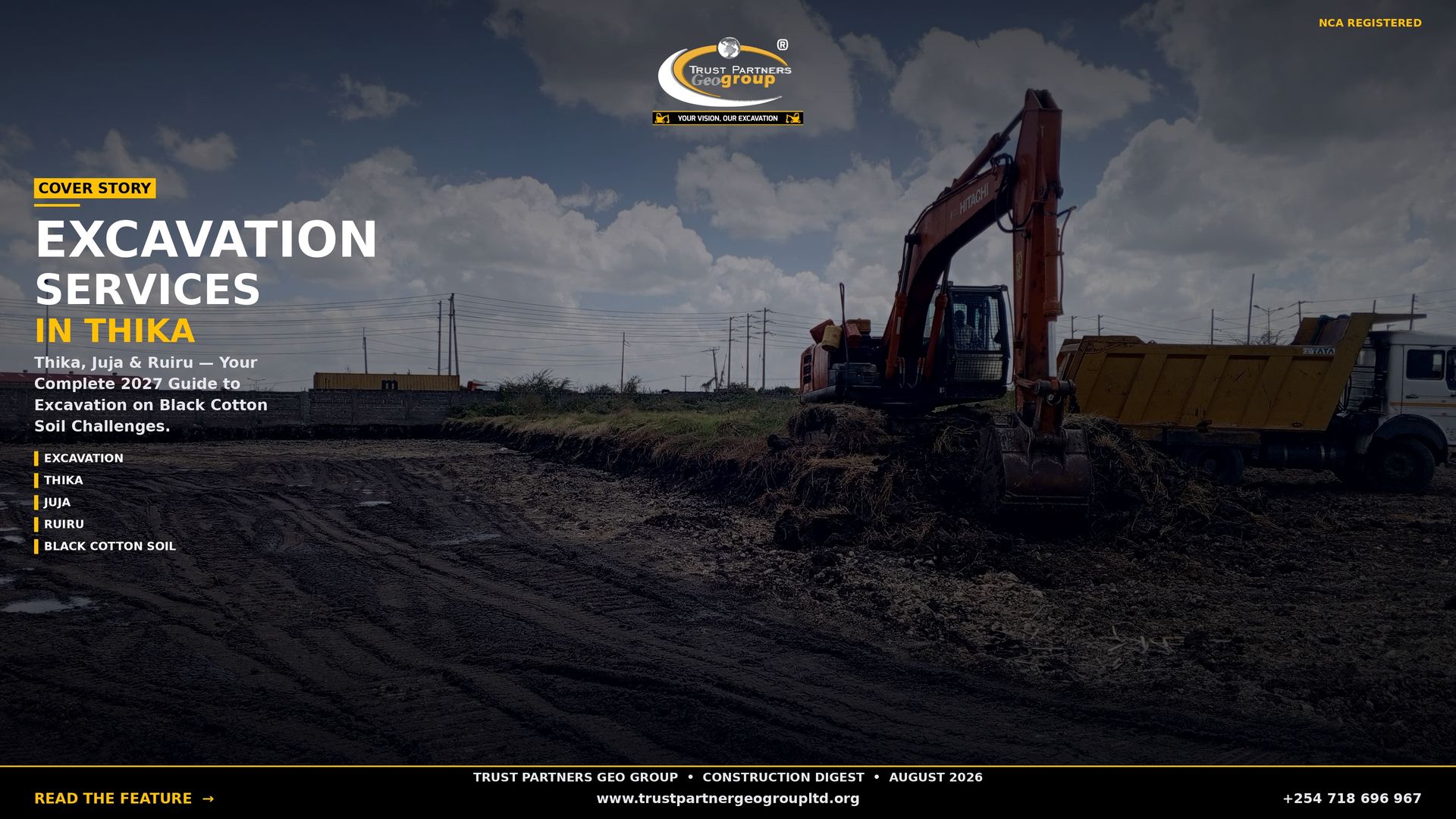
Excavation Services in Thika, Juja and Ruiru: Black Cotton Soil Challenges [2027]
Foundation Excavation, Soil Stabilization & Earthworks for Kiambu County's Northeastern Corridor
Northeast of Nairobi, the Thika Superhighway corridor is Kenya's busiest industrial-residential growth axis. Thika, Juja and Ruiru — once separate colonial towns and agricultural settlements — have merged into a continuous urban ribbon stretching 40 kilometres from Nairobi's city limits to the foothills of Mount Kenya. But beneath the red murram and coffee-belt soils that dominate the ridges lies a hidden enemy that has destroyed more foundations than any other soil type in Kenya: black cotton soil — expansive, unstable and unforgiving. This guide covers everything developers need to know about excavation in Kiambu County's northeastern corridor — from soil testing and stabilization to foundation design and 2027 hire rates.

NCA-registered excavation and heavy equipment hire contractor with 15+ years operating across Kenya. We provide soil stabilization, foundation excavation and earthworks for black cotton soil sites in Thika, Juja, Ruiru and all Kiambu County projects.
Why Thika, Juja and Ruiru Are Expanding
The Thika-Juja-Ruiru corridor is experiencing sustained growth driven by six key factors:
- Thika Superhighway connectivity: The 50 km dual carriageway — completed in 2012 and continuously upgraded — cut commute times from Thika to Nairobi CBD to under 45 minutes. Juja and Ruiru are even closer, at 25–35 minutes during off-peak hours. This rivals commute times from Langata or Karen.
- Affordable land with development upside: A 50×100 ft plot in Ruiru costs KES 3–6 million, Juja plots range KES 2.5–5 million, and Thika outskirts offer land at KES 1.5–3 million. Comparable plots in Nairobi's eastern suburbs (Umoja, Buru Buru) command KES 10–20 million for smaller parcels.
- Industrial anchor economy: Thika hosts Kenya's second-largest industrial concentration after Nairobi EPZ. Bidco Africa, Del Monte Kenya, Blue Nile Group, and over 100 manufacturing plants employ tens of thousands, driving massive demand for worker housing, logistics yards and supporting infrastructure.
- JKUAT and educational institutions: Jomo Kenyatta University of Agriculture and Technology (JKUAT) in Juja is Kenya's leading technical university with 50,000+ students. The student housing market alone drives hundreds of multi-storey residential projects annually, each requiring foundation excavation.
- Tatu City mega-development: The 5,000-acre mixed-use city on Ruiru's northern edge is attracting multinational headquarters, logistics parks, residential estates and retail centres at unprecedented scale. Phase 1 earthworks alone involved over 2 million m³ of cut-and-fill.
- Nairobi metropolitan overflow: As Nairobi County reaches saturation, Kiambu County's northeastern towns absorb overflow residential and commercial demand. Ruiru is now functionally part of Greater Nairobi, with continuous development along the entire Thika Road corridor.
The Black Cotton Soil Challenge
Unlike the volcanic rock of Ngong or the red loam of Kikuyu, the Thika-Juja-Ruiru corridor sits on a geological patchwork that creates distinct excavation challenges:
- Black cotton soil (vertisols): Found in low-lying areas, former swamp zones and along seasonal river courses. This heavy clay contains montmorillonite minerals that swell up to 30% when wet and shrink dramatically in dry spells. Safe bearing capacity is only 50–100 kN/m² in natural state — insufficient for anything beyond single-storey structures without treatment.
- Murram and red soil ridges: Higher ground and ridge tops consist of iron-cemented murram and oxidized red volcanic soils with excellent bearing capacity (150–300 kN/m²). These areas require only standard excavation and compaction.
- Alluvial deposits: The Chania and Thika rivers have deposited layers of sand, silt and clay across floodplains. These stratified soils vary dramatically over short distances, requiring borehole investigation before foundation design.
- Seasonal water tables: Black cotton soil areas hold water close to the surface during rainy seasons, creating perched water tables that complicate basement construction and require dewatering during excavation.
- Variable depth to stable strata: In some Juja and Ruiru plots, stable murram lies just 0.5 metres below surface. In others, black cotton soil extends to 3+ metres depth, requiring deep over-excavation and replacement.
- Agricultural chemical residues: Former coffee and horticulture farms in the Thika area may have soil contamination from historical pesticide and fertilizer use, requiring NEMA testing before residential excavation.
Excavation Services for Expansive Clay Sites
Soil Testing and Site Investigation
Before breaking ground on any Thika corridor project, Trust Partners Geo-Group coordinates geotechnical investigation including borehole drilling, soil sampling and laboratory testing. We identify black cotton soil extent, depth, swelling potential and bearing capacity — data that determines whether standard strip footings, raft foundations or piles are required.
Over-Excavation and Soil Replacement
The most common solution for black cotton soil is removing the problematic layer to 1.0–1.5 m depth and replacing with compacted hardcore, murram or engineered fill. Our teams excavate to geotechnical specifications, haul unsuitable soil to approved disposal sites, and import and compact replacement material in 200 mm layers with plate compactor or roller proofing.
Mechanical Soil Stabilization
For large industrial yards, estate roads and parking areas, we mix black cotton soil in-situ with 3–8% cement or lime using rotavators and pulverizers, then compact to 95% Mod AASHTO density. This creates a stable platform at roughly 40% the cost of full soil replacement.
Foundation Excavation
We excavate to precise levels for strip footings, raft foundations, pile caps and ground beams. In black cotton soil zones, we over-excavate to stable strata or to the depth specified by structural engineers, then blind with concrete immediately to prevent soil re-wetting.
Basement Excavation
As Thika and Ruiru shift toward multi-storey apartments and commercial buildings, basement demand is rising. Basement excavation in black cotton soil requires dewatering, over-excavation below slab level, waterproof tanking and perimeter drainage — all coordinated by our specialized teams.
Industrial Site Preparation
Factory yards, warehouse pads and logistics hardstands in Thika's industrial zone require large-area cut-and-fill, soil stabilization and precision grading to ±20 mm tolerance. We profile sites with motor graders, compact subgrades with vibratory rollers, and construct drainage falls to prevent ponding on expansive clay.
Foundation Solutions for Black Cotton Soil
| Foundation Type | Best For | Construction Method | Relative Cost |
|---|---|---|---|
| Raft (mat) foundation | Light-to-medium structures on moderate expansive soil; 1–3 storey buildings | Continuous reinforced concrete slab across entire footprint; 200–300 mm thick | Moderate — KES 4,500–6,500/m² |
| Strip footing on replaced soil | Standard bungalows and maisonettes where black cotton soil is shallow | Over-excavate to 1.0–1.5 m, backfill with hardcore, construct conventional strip footings | Low — KES 2,500–4,000/linear m |
| Bored pile foundation | Multi-storey buildings, apartments, heavy industrial structures | Drill 300–450 mm diameter piles to 6–12 m depth through black cotton soil into stable bearing | High — KES 8,000–15,000/pile |
| Pier and beam | Medium-load structures on variable soil depth | Isolated piers on stable soil, connected by ground beams above expansive clay | Moderate — KES 6,000–10,000/pier |
| Stabilized earth pad | Industrial yards, estate roads, large commercial hardstands | Mix black cotton soil with 3–8% cement/lime, compact in layers to 95% density | Low — KES 350–600/m² treated |
Foundation selection depends on soil test results, building load, budget and timeline. Trust Partners Geo-Group excavates to the precise specifications of your structural engineer for any foundation type.
Excavation Rates in Thika, Juja and Ruiru 2027
| Service | Rate (KES) | Notes |
|---|---|---|
| Plot cutting and clearing (per m²) | 180 – 350 | Upper end for dense bush, coffee stump removal or rocky patches |
| Topsoil stripping (per m²) | 80 – 140 | Includes haul to on-site stockpile for landscaping reuse |
| Bulk excavation — murram/red soil (per m³) | 800 – 1,300 | Ridge tops and stable ground; standard bucket excavation |
| Bulk excavation — black cotton soil (per m³) | 1,200 – 2,000 | Includes over-excavation and disposal of unsuitable material |
| Foundation excavation on replaced soil (per m³) | 1,500 – 2,500 | Over-excavation, disposal, backfill with hardcore, compaction |
| Basement excavation — stable soil (per m³) | 1,800 – 2,800 | Trimmed excavation; dewatering if required |
| Soil stabilization — cement/lime (per m²) | 350 – 600 | In-situ mixing, 200–300 mm depth, compaction to 95% Mod AASHTO |
| Pile cap excavation (per cap) | 8,000 – 18,000 | Depends on cap size (1.5–3.0 m²) and depth |
| Industrial yard grading (per m²) | 280 – 450 | Cut-and-fill, subgrade preparation, drainage falls |
| Estate road subgrade (per m²) | 320 – 550 | Cut to level, compaction, camber and drainage |
| Spoil disposal — black cotton soil (per 20-ton truck) | 3,500 – 6,500 | Haul to Kiambu County approved dumping sites |
| 30-ton excavator wet hire (daily) | 38,000 – 52,000 | Operator, fuel, maintenance included |
| Vibratory roller 10-ton wet hire (daily) | 18,000 – 28,000 | Operator, fuel included; essential for compaction proofing |
Key Neighbourhoods and Development Zones
Thika Town: Industrial Heartland
Thika Town and its surrounding industrial zone — Makongeni, Witeithie, and the Nairobi-Thika Road frontage — are dominated by manufacturing, warehousing and logistics. Excavation here focuses on industrial yard preparation, factory foundations and roadworks. The soil is generally stable murram on higher ground, but black cotton soil appears in low-lying areas near the Chania River. New residential estates on Thika's outskirts (Gatitu, Ngoliba direction) require careful soil testing.
Juja: University Town and Student Housing
Juja revolves around JKUAT and the student economy. The town has exploded with multi-storey hostels, rental apartments and staff housing. Foundation excavation in Juja is complicated by variable soil — some plots sit on excellent murram, while others (particularly toward the seasonal stream valleys) contain deep black cotton soil. The Kalimoni and Juja Farm areas are seeing rapid gated community development with mixed soil profiles.
Ruiru: Nairobi's Northern Extension
Ruiru is effectively a northern suburb of Nairobi, with continuous development from Kasarani through Kamakis to Tatu City. The Kamakis area and Ruiru town centre have stable red soil suitable for standard foundations, but pockets of black cotton soil appear toward the eastern lowlands. Tatu City's mega-development has transformed large-scale earthmoving in the area, with our teams involved in cut-and-fill balancing for road networks and building platforms.
Tatu City and Environs
Tatu City represents the largest single earthworks project in Kiambu County. The 5,000-acre development required mass grading, valley filling, road construction and utility installation across varied topography. Trust Partners Geo-Group has supported Tatu City contractors with equipment hire and earthworks services since 2023.
Industrial Site Preparation and Earthworks
Thika's industrial zone demands earthworks at a scale and precision distinct from residential projects:
- Large-area cut-and-fill: Factory sites often require 10,000–50,000 m² platforms graded to ±20 mm tolerance. We use GPS-guided motor graders and laser levels to achieve specification.
- Soil stabilization for heavy loads: Warehouse slabs supporting racking systems and forklift traffic require subgrades stabilized with 5–8% cement to prevent differential settlement under point loads.
- Drainage and falls: Industrial yards need 1:100 to 1:200 falls to surface drains. On expansive clay, we construct subsoil drainage blankets to prevent water accumulation beneath pavements.
- Loading bay excavation: Truck docking bays require precise excavation to match vehicle bed heights, with reinforced concrete aprons founded on treated soil.
- Environmental containment: Chemical and fuel storage areas require impermeable clay liners or synthetic membranes, with excavation to specific depths and compaction standards.
Permits for Kiambu County and NEMA
Excavation in Kiambu County involves a structured compliance framework:
- Kiambu County building permits: Required for all construction. Submissions must include excavation depth, soil test reports, foundation type specifications and drainage designs. Processing takes 2–4 weeks. Thika town has its own sub-county building control office.
- NEMA Environmental Impact Assessment: Mandatory for projects over 1 hectare, developments near the Chania or Thika rivers, or work within 500 metres of wetlands and seasonal watercourses.
- Water Authority permits: Required for dewatering operations that discharge into rivers or county drainage systems. Thika's industrial zone has strict effluent controls.
- NCA registration: All structural excavation must be carried out by NCA-registered contractors. Trust Partners Geo-Group holds NCA registration for all building categories.
- Soil disposal permits: Kiambu County requires documentation for hauling black cotton soil and unsuitable fill to approved dumping sites. Unauthorized dumping attracts penalties of KES 50,000–200,000.
- Tatu City design review: Projects within Tatu City must pass additional design review for earthworks, drainage and environmental compliance beyond county requirements.
Trust Partners Geo-Group Thika Fleet
Our Thika-dedicated fleet is mobilised from our Nairobi depot to Thika, Juja and Ruiru within 1–2 hours via the Superhighway:
- Hyundai HX300SL 30-ton Excavators (4 units): Primary excavation machines for bulk earthworks, foundation trenches and basement digging. Fitted with buckets, rippers and hydraulic breakers for variable soil conditions.
- Komatsu D65 Bulldozers (2 units): Site clearing, rough grading and push-loading on large industrial and estate projects.
- Shacman 30-ton Tippers (10 units): Spoil removal and hardcore delivery fleet. Black cotton soil haulage requires careful scheduling to avoid peak Thika Road traffic.
- Sany Motor Grader (1 unit): Precision grading for estate roads, industrial yards and drainage channels with GPS guidance capability.
- Vibratory Rollers 10-ton (2 units): Essential for compaction proofing of replaced soil and stabilized earth pads to 95% Mod AASHTO density.
- Plate Compactors (4 units): Trench backfill compaction and confined-area work near existing structures.
- Water Bowser 15,000 litres (2 units): Dust suppression along Thika Road frontage and moisture conditioning for soil stabilization.
- Mini-Excavators 5-ton (3 units): Restricted-access work on narrow Juja plots and precision trenching near JKUAT infrastructure.
- Soil Pulverizer/Stabilizer (1 unit): Tractor-mounted rotavator for in-situ cement and lime mixing on large stabilization projects.
All operators are NITA-certified with specific training in black cotton soil handling, compaction standards and environmental controls. Projects receive dedicated supervisors, daily progress reports and photographic documentation.
Start Your Thika, Juja or Ruiru Project Today
Trust Partners Geo-Group is Kiambu County's leading black cotton soil excavation contractor. Free site assessment, soil type identification, itemised quote and rapid mobilisation.
Call +254 718 686 967 Email for QuoteFrequently Asked Questions
Why are Thika, Juja and Ruiru growing so fast?
Thika, Juja and Ruiru are among Nairobi's fastest-growing northeastern corridors due to: (1) Thika Superhighway — the 50 km dual carriageway cut commute times from Thika to Nairobi CBD to under 45 minutes, unlocking the entire corridor for daily commuting. (2) Affordable land — a 50×100 ft plot in Ruiru costs KES 3–6 million, Juja plots range KES 2.5–5 million, and Thika outskirts offer land at KES 1.5–3 million. Comparable plots in Nairobi's eastern suburbs command KES 10–20 million. (3) Industrial anchor — Thika hosts Kenya's second-largest industrial concentration after Nairobi EPZ, with Bidco, Del Monte, Blue Nile and over 100 manufacturing plants driving employment and worker housing demand. (4) Institutional growth — JKUAT in Juja is Kenya's leading technical university, creating massive student housing, staff quarters and research facility construction. (5) Tatu City — the 5,000-acre mixed-use development on Ruiru's northern edge is attracting multinational headquarters, logistics parks and residential estates at scale. (6) Nairobi Metropolitan boundary expansion — as Nairobi County reaches saturation, Kiambu County's northeastern towns absorb overflow residential and commercial demand.
What is black cotton soil and why does it cause foundation problems?
Black cotton soil — also called vertisol or expansive clay — is a heavy, dark clay soil containing high percentages of montmorillonite minerals. Found across the Thika-Juja-Ruiru corridor, particularly in low-lying areas and former swamp zones, this soil type is notorious in construction for three reasons: (1) Extreme volume change — black cotton soil swells when wet (absorbing water and expanding up to 30% in volume) and shrinks dramatically during dry spells, creating cycles of ground heave and subsidence. (2) Deep cracking — during dry periods, the soil forms polygonal cracks up to 50 cm deep and 10 cm wide. These cracks channel water deep into the soil profile during rains, accelerating the swelling cycle. (3) Low bearing capacity — in its natural state, black cotton soil has a safe bearing capacity of only 50–100 kN/m², insufficient for multi-storey buildings without treatment or deep foundations. Standard strip foundations on untreated black cotton soil crack within 1–2 rainy seasons. Trust Partners Geo-Group identifies black cotton soil during site investigation and recommends appropriate stabilization before excavation begins.
How much does excavation cost in Thika and Ruiru?
Excavation in the Thika corridor costs KES 800–1,300 per cubic metre for bulk earthworks in normal red-murram soil, and KES 1,200–2,000 per cubic metre in black cotton soil zones due to the need for over-excavation and replacement with engineered fill. Foundation excavation with soil stabilization (lime or cement treatment) adds KES 400–800 per m² of treated area. Basement excavation in Thika town centre costs KES 1,800–2,800 per m³. Plot cutting and clearing costs KES 180–350 per m². Key cost drivers include: soil type (black cotton adds 40–60% premium), haul distance to disposal sites (Ruiru and Juja have limited approved dumping areas), proximity to Thika Road for equipment access, and the need for geotechnical testing before foundation design. A typical 3-bedroom bungalow foundation on black cotton soil in Juja costs KES 450,000–750,000 including soil replacement and compaction. Trust Partners Geo-Group provides fixed-price quotes after soil testing.
What foundation types work best on black cotton soil in Kiambu County?
Five foundation systems are proven for black cotton soil in the Thika-Juja-Ruiru corridor: (1) Raft (mat) foundation — a continuous reinforced concrete slab distributing building loads across the entire footprint. Best for light structures on moderate expansive soil. Cost: KES 4,500–6,500 per m². (2) Strip foundation on replaced soil — excavating black cotton soil to 1.0–1.5 m depth, backfilling with hardcore or murram, and constructing conventional strip footings. Cost: KES 2,500–4,000 per linear metre. (3) Pile foundation — bored cast-in-situ piles or precast driven piles extending through black cotton soil into stable bearing strata below. Essential for multi-storey buildings. Cost: KES 8,000–15,000 per pile (300–450 mm diameter, 6–12 m depth). (4) Pier and beam — isolated piers founded on stable soil or rock, connected by ground beams. Suitable for medium-load structures on variable soil. (5) Mechanically stabilized earth pad — mixing black cotton soil with 3–8% cement or lime, compacting in layers to create a stable platform. Cost-effective for large industrial yards and estate roads. Trust Partners Geo-Group excavates to geotechnical specifications for all foundation types and manages spoil disposal.
Do I need a soil test before excavating in Thika or Ruiru?
Yes — a geotechnical investigation is strongly recommended and often mandatory before foundation excavation in Thika, Juja and Ruiru. Kiambu County building control requires soil test reports for all structures over 2 storeys and any building on visibly problematic soils. A standard geotechnical investigation includes: (1) Boreholes — 2–4 boreholes per plot to 6–10 m depth, logging soil strata and collecting samples. Cost: KES 25,000–45,000 per plot. (2) Laboratory testing — Atterberg limits, moisture content, particle size distribution, swelling potential, and bearing capacity tests. (3) Foundation recommendation report — structural engineers use this to specify foundation type, depth and any soil treatment required. (4) NEMA may require soil contamination testing for former agricultural or industrial sites near Thika's factory zone. Trust Partners Geo-Group works with NCA-registered geotechnical firms to coordinate site investigations before excavation begins, ensuring foundation designs match actual ground conditions. Skipping this step risks foundation failure, wall cracking and repair costs exceeding KES 1 million.
How long does foundation excavation take in black cotton soil?
Foundation excavation in black cotton soil takes 25–40% longer than in stable murram or red soil. A standard bungalow foundation (150 m² footprint) on replaced black cotton soil requires 2–3 weeks: 3–4 days for over-excavation to 1.0–1.5 m depth, 2–3 days for spoil removal and disposal, 3–4 days for backfilling with hardcore in 200 mm layers with compaction, and 3–4 days for footing excavation in the stabilized pad. By comparison, the same foundation in good murram soil takes 5–8 days. Multi-storey building foundations with piles add 3–5 weeks for pile boring and casting. Basement excavation in Thika's town centre (where soil is more stable) takes 3–5 weeks for a 2-level basement on 1,000 m². Rainy season work (March–May, October–December) extends timelines by 20–30% as black cotton soil becomes unworkable when saturated — equipment sinks, haul roads degrade and compaction standards cannot be achieved. Trust Partners Geo-Group schedules black cotton soil excavation in dry-season windows where possible.
Can basements be built in Thika and Juja's black cotton soil?
Yes, but basements in black cotton soil require specialized design and construction. The swelling pressure of saturated black cotton soil can exert 100–300 kPa of upward force on basement slabs — enough to crack conventional ground floors. Successful basement construction in the Thika-Juja corridor requires: (1) Over-excavation and replacement — removing black cotton soil to 1.5–2.0 m below basement slab level and replacing with compacted murram or graded stone. (2) Waterproofing — comprehensive tanking with bituminous membranes or crystalline waterproofing, because black cotton soil holds water against basement walls. (3) Drainage — perimeter French drains and sump pumps to relieve hydrostatic pressure. (4) Structural design — raft or pile-supported basement slabs designed for heave pressure. (5) Construction sequencing — basement excavation should occur in dry weather, with immediate blinding concrete and wall construction to prevent soil saturation in the open cut. A 2-level basement on 1,000 m² in Juja's black cotton soil zone costs KES 18–32 million all-in, versus KES 12–18 million in stable soil. Trust Partners Geo-Group has excavated basements for apartment blocks, cold storage facilities and shopping complexes in Thika and Ruiru.
Where does excavated black cotton soil from Thika and Ruiru go?
Excavated black cotton soil from Kiambu County sites is disposed of at: (1) Approved county dumping sites — Kiambu County designates specific disposal areas for engineered fill and unsuitable soil. Transport costs range KES 400–700 per 20-ton truck depending on distance from Thika Road. (2) On-site re-use — lightly expansive black cotton soil can be mixed with 3–8% cement or lime and recompacted as engineered fill within the same development, reducing haul costs by 60–80%. (3) Brick and block manufacturing — some Ruiru and Thika block makers accept black cotton soil for fired brick production, though this requires testing for plasticity index. (4) Landfill capping material — approved sanitary landfills use black cotton soil as daily cover material. (5) Road subgrade — after stabilization with cement, black cotton soil can be used for estate road sub-base in low-traffic areas. Trust Partners Geo-Group manages disposal logistics including county transport permits, weighbridge documentation and on-site stabilization where economically justified. Note that dumping black cotton soil in watercourses or unapproved sites carries KES 50,000–200,000 NEMA penalties.
Related Resources
Planning a Project in Thika, Juja or Ruiru?
Contact Trust Partners Geo-Group at +254 718 686 967 for a free site assessment and itemised excavation quote. Serving Thika, Juja, Ruiru, Kiambu County and all 47 counties.
Call +254 718 686 967 Request QuoteExcavation Services in Thika, Juja and Ruiru: Black Cotton Soil Challenges [2027]
Foundation Excavation, Soil Stabilization & Earthworks for Kiambu County's Northeastern Corridor
Northeast of Nairobi, the Thika Superhighway corridor is Kenya's busiest industrial-residential growth axis. Thika, Juja and Ruiru — once separate colonial towns and agricultural settlements — have merged into a continuous urban ribbon stretching 40 kilometres from Nairobi's city limits to the foothills of Mount Kenya. But beneath the red murram and coffee-belt soils that dominate the ridges lies a hidden enemy that has destroyed more foundations than any other soil type in Kenya: black cotton soil — expansive, unstable and unforgiving. This guide covers everything developers need to know about excavation in Kiambu County's northeastern corridor — from soil testing and stabilization to foundation design and 2027 hire rates.
NCA-registered excavation and heavy equipment hire contractor with 15+ years operating across Kenya. We provide soil stabilization, foundation excavation and earthworks for black cotton soil sites in Thika, Juja, Ruiru and all Kiambu County projects.
Why Thika, Juja and Ruiru Are Expanding
The Thika-Juja-Ruiru corridor is experiencing sustained growth driven by six key factors:
- Thika Superhighway connectivity: The 50 km dual carriageway — completed in 2012 and continuously upgraded — cut commute times from Thika to Nairobi CBD to under 45 minutes. Juja and Ruiru are even closer, at 25–35 minutes during off-peak hours. This rivals commute times from Langata or Karen.
- Affordable land with development upside: A 50×100 ft plot in Ruiru costs KES 3–6 million, Juja plots range KES 2.5–5 million, and Thika outskirts offer land at KES 1.5–3 million. Comparable plots in Nairobi's eastern suburbs (Umoja, Buru Buru) command KES 10–20 million for smaller parcels.
- Industrial anchor economy: Thika hosts Kenya's second-largest industrial concentration after Nairobi EPZ. Bidco Africa, Del Monte Kenya, Blue Nile Group, and over 100 manufacturing plants employ tens of thousands, driving massive demand for worker housing, logistics yards and supporting infrastructure.
- JKUAT and educational institutions: Jomo Kenyatta University of Agriculture and Technology (JKUAT) in Juja is Kenya's leading technical university with 50,000+ students. The student housing market alone drives hundreds of multi-storey residential projects annually, each requiring foundation excavation.
- Tatu City mega-development: The 5,000-acre mixed-use city on Ruiru's northern edge is attracting multinational headquarters, logistics parks, residential estates and retail centres at unprecedented scale. Phase 1 earthworks alone involved over 2 million m³ of cut-and-fill.
- Nairobi metropolitan overflow: As Nairobi County reaches saturation, Kiambu County's northeastern towns absorb overflow residential and commercial demand. Ruiru is now functionally part of Greater Nairobi, with continuous development along the entire Thika Road corridor.
The Black Cotton Soil Challenge
Unlike the volcanic rock of Ngong or the red loam of Kikuyu, the Thika-Juja-Ruiru corridor sits on a geological patchwork that creates distinct excavation challenges:
- Black cotton soil (vertisols): Found in low-lying areas, former swamp zones and along seasonal river courses. This heavy clay contains montmorillonite minerals that swell up to 30% when wet and shrink dramatically in dry spells. Safe bearing capacity is only 50–100 kN/m² in natural state — insufficient for anything beyond single-storey structures without treatment.
- Murram and red soil ridges: Higher ground and ridge tops consist of iron-cemented murram and oxidized red volcanic soils with excellent bearing capacity (150–300 kN/m²). These areas require only standard excavation and compaction.
- Alluvial deposits: The Chania and Thika rivers have deposited layers of sand, silt and clay across floodplains. These stratified soils vary dramatically over short distances, requiring borehole investigation before foundation design.
- Seasonal water tables: Black cotton soil areas hold water close to the surface during rainy seasons, creating perched water tables that complicate basement construction and require dewatering during excavation.
- Variable depth to stable strata: In some Juja and Ruiru plots, stable murram lies just 0.5 metres below surface. In others, black cotton soil extends to 3+ metres depth, requiring deep over-excavation and replacement.
- Agricultural chemical residues: Former coffee and horticulture farms in the Thika area may have soil contamination from historical pesticide and fertilizer use, requiring NEMA testing before residential excavation.
Excavation Services for Expansive Clay Sites
Soil Testing and Site Investigation
Before breaking ground on any Thika corridor project, Trust Partners Geo-Group coordinates geotechnical investigation including borehole drilling, soil sampling and laboratory testing. We identify black cotton soil extent, depth, swelling potential and bearing capacity — data that determines whether standard strip footings, raft foundations or piles are required.
Over-Excavation and Soil Replacement
The most common solution for black cotton soil is removing the problematic layer to 1.0–1.5 m depth and replacing with compacted hardcore, murram or engineered fill. Our teams excavate to geotechnical specifications, haul unsuitable soil to approved disposal sites, and import and compact replacement material in 200 mm layers with plate compactor or roller proofing.
Mechanical Soil Stabilization
For large industrial yards, estate roads and parking areas, we mix black cotton soil in-situ with 3–8% cement or lime using rotavators and pulverizers, then compact to 95% Mod AASHTO density. This creates a stable platform at roughly 40% the cost of full soil replacement.
Foundation Excavation
We excavate to precise levels for strip footings, raft foundations, pile caps and ground beams. In black cotton soil zones, we over-excavate to stable strata or to the depth specified by structural engineers, then blind with concrete immediately to prevent soil re-wetting.
Basement Excavation
As Thika and Ruiru shift toward multi-storey apartments and commercial buildings, basement demand is rising. Basement excavation in black cotton soil requires dewatering, over-excavation below slab level, waterproof tanking and perimeter drainage — all coordinated by our specialized teams.
Industrial Site Preparation
Factory yards, warehouse pads and logistics hardstands in Thika's industrial zone require large-area cut-and-fill, soil stabilization and precision grading to ±20 mm tolerance. We profile sites with motor graders, compact subgrades with vibratory rollers, and construct drainage falls to prevent ponding on expansive clay.
Foundation Solutions for Black Cotton Soil
| Foundation Type | Best For | Construction Method | Relative Cost |
|---|---|---|---|
| Raft (mat) foundation | Light-to-medium structures on moderate expansive soil; 1–3 storey buildings | Continuous reinforced concrete slab across entire footprint; 200–300 mm thick | Moderate — KES 4,500–6,500/m² |
| Strip footing on replaced soil | Standard bungalows and maisonettes where black cotton soil is shallow | Over-excavate to 1.0–1.5 m, backfill with hardcore, construct conventional strip footings | Low — KES 2,500–4,000/linear m |
| Bored pile foundation | Multi-storey buildings, apartments, heavy industrial structures | Drill 300–450 mm diameter piles to 6–12 m depth through black cotton soil into stable bearing | High — KES 8,000–15,000/pile |
| Pier and beam | Medium-load structures on variable soil depth | Isolated piers on stable soil, connected by ground beams above expansive clay | Moderate — KES 6,000–10,000/pier |
| Stabilized earth pad | Industrial yards, estate roads, large commercial hardstands | Mix black cotton soil with 3–8% cement/lime, compact in layers to 95% density | Low — KES 350–600/m² treated |
Foundation selection depends on soil test results, building load, budget and timeline. Trust Partners Geo-Group excavates to the precise specifications of your structural engineer for any foundation type.
Excavation Rates in Thika, Juja and Ruiru 2027
| Service | Rate (KES) | Notes |
|---|---|---|
| Plot cutting and clearing (per m²) | 180 – 350 | Upper end for dense bush, coffee stump removal or rocky patches |
| Topsoil stripping (per m²) | 80 – 140 | Includes haul to on-site stockpile for landscaping reuse |
| Bulk excavation — murram/red soil (per m³) | 800 – 1,300 | Ridge tops and stable ground; standard bucket excavation |
| Bulk excavation — black cotton soil (per m³) | 1,200 – 2,000 | Includes over-excavation and disposal of unsuitable material |
| Foundation excavation on replaced soil (per m³) | 1,500 – 2,500 | Over-excavation, disposal, backfill with hardcore, compaction |
| Basement excavation — stable soil (per m³) | 1,800 – 2,800 | Trimmed excavation; dewatering if required |
| Soil stabilization — cement/lime (per m²) | 350 – 600 | In-situ mixing, 200–300 mm depth, compaction to 95% Mod AASHTO |
| Pile cap excavation (per cap) | 8,000 – 18,000 | Depends on cap size (1.5–3.0 m²) and depth |
| Industrial yard grading (per m²) | 280 – 450 | Cut-and-fill, subgrade preparation, drainage falls |
| Estate road subgrade (per m²) | 320 – 550 | Cut to level, compaction, camber and drainage |
| Spoil disposal — black cotton soil (per 20-ton truck) | 3,500 – 6,500 | Haul to Kiambu County approved dumping sites |
| 30-ton excavator wet hire (daily) | 38,000 – 52,000 | Operator, fuel, maintenance included |
| Vibratory roller 10-ton wet hire (daily) | 18,000 – 28,000 | Operator, fuel included; essential for compaction proofing |
Key Neighbourhoods and Development Zones
Thika Town: Industrial Heartland
Thika Town and its surrounding industrial zone — Makongeni, Witeithie, and the Nairobi-Thika Road frontage — are dominated by manufacturing, warehousing and logistics. Excavation here focuses on industrial yard preparation, factory foundations and roadworks. The soil is generally stable murram on higher ground, but black cotton soil appears in low-lying areas near the Chania River. New residential estates on Thika's outskirts (Gatitu, Ngoliba direction) require careful soil testing.
Juja: University Town and Student Housing
Juja revolves around JKUAT and the student economy. The town has exploded with multi-storey hostels, rental apartments and staff housing. Foundation excavation in Juja is complicated by variable soil — some plots sit on excellent murram, while others (particularly toward the seasonal stream valleys) contain deep black cotton soil. The Kalimoni and Juja Farm areas are seeing rapid gated community development with mixed soil profiles.
Ruiru: Nairobi's Northern Extension
Ruiru is effectively a northern suburb of Nairobi, with continuous development from Kasarani through Kamakis to Tatu City. The Kamakis area and Ruiru town centre have stable red soil suitable for standard foundations, but pockets of black cotton soil appear toward the eastern lowlands. Tatu City's mega-development has transformed large-scale earthmoving in the area, with our teams involved in cut-and-fill balancing for road networks and building platforms.
Tatu City and Environs
Tatu City represents the largest single earthworks project in Kiambu County. The 5,000-acre development required mass grading, valley filling, road construction and utility installation across varied topography. Trust Partners Geo-Group has supported Tatu City contractors with equipment hire and earthworks services since 2023.
Industrial Site Preparation and Earthworks
Thika's industrial zone demands earthworks at a scale and precision distinct from residential projects:
- Large-area cut-and-fill: Factory sites often require 10,000–50,000 m² platforms graded to ±20 mm tolerance. We use GPS-guided motor graders and laser levels to achieve specification.
- Soil stabilization for heavy loads: Warehouse slabs supporting racking systems and forklift traffic require subgrades stabilized with 5–8% cement to prevent differential settlement under point loads.
- Drainage and falls: Industrial yards need 1:100 to 1:200 falls to surface drains. On expansive clay, we construct subsoil drainage blankets to prevent water accumulation beneath pavements.
- Loading bay excavation: Truck docking bays require precise excavation to match vehicle bed heights, with reinforced concrete aprons founded on treated soil.
- Environmental containment: Chemical and fuel storage areas require impermeable clay liners or synthetic membranes, with excavation to specific depths and compaction standards.
Permits for Kiambu County and NEMA
Excavation in Kiambu County involves a structured compliance framework:
- Kiambu County building permits: Required for all construction. Submissions must include excavation depth, soil test reports, foundation type specifications and drainage designs. Processing takes 2–4 weeks. Thika town has its own sub-county building control office.
- NEMA Environmental Impact Assessment: Mandatory for projects over 1 hectare, developments near the Chania or Thika rivers, or work within 500 metres of wetlands and seasonal watercourses.
- Water Authority permits: Required for dewatering operations that discharge into rivers or county drainage systems. Thika's industrial zone has strict effluent controls.
- NCA registration: All structural excavation must be carried out by NCA-registered contractors. Trust Partners Geo-Group holds NCA registration for all building categories.
- Soil disposal permits: Kiambu County requires documentation for hauling black cotton soil and unsuitable fill to approved dumping sites. Unauthorized dumping attracts penalties of KES 50,000–200,000.
- Tatu City design review: Projects within Tatu City must pass additional design review for earthworks, drainage and environmental compliance beyond county requirements.
Trust Partners Geo-Group Thika Fleet
Our Thika-dedicated fleet is mobilised from our Nairobi depot to Thika, Juja and Ruiru within 1–2 hours via the Superhighway:
- Hyundai HX300SL 30-ton Excavators (4 units): Primary excavation machines for bulk earthworks, foundation trenches and basement digging. Fitted with buckets, rippers and hydraulic breakers for variable soil conditions.
- Komatsu D65 Bulldozers (2 units): Site clearing, rough grading and push-loading on large industrial and estate projects.
- Shacman 30-ton Tippers (10 units): Spoil removal and hardcore delivery fleet. Black cotton soil haulage requires careful scheduling to avoid peak Thika Road traffic.
- Sany Motor Grader (1 unit): Precision grading for estate roads, industrial yards and drainage channels with GPS guidance capability.
- Vibratory Rollers 10-ton (2 units): Essential for compaction proofing of replaced soil and stabilized earth pads to 95% Mod AASHTO density.
- Plate Compactors (4 units): Trench backfill compaction and confined-area work near existing structures.
- Water Bowser 15,000 litres (2 units): Dust suppression along Thika Road frontage and moisture conditioning for soil stabilization.
- Mini-Excavators 5-ton (3 units): Restricted-access work on narrow Juja plots and precision trenching near JKUAT infrastructure.
- Soil Pulverizer/Stabilizer (1 unit): Tractor-mounted rotavator for in-situ cement and lime mixing on large stabilization projects.
All operators are NITA-certified with specific training in black cotton soil handling, compaction standards and environmental controls. Projects receive dedicated supervisors, daily progress reports and photographic documentation.
Start Your Thika, Juja or Ruiru Project Today
Trust Partners Geo-Group is Kiambu County's leading black cotton soil excavation contractor. Free site assessment, soil type identification, itemised quote and rapid mobilisation.
Call +254 718 686 967 Email for QuoteFrequently Asked Questions
Why are Thika, Juja and Ruiru growing so fast?
Thika, Juja and Ruiru are among Nairobi's fastest-growing northeastern corridors due to: (1) Thika Superhighway — the 50 km dual carriageway cut commute times from Thika to Nairobi CBD to under 45 minutes, unlocking the entire corridor for daily commuting. (2) Affordable land — a 50×100 ft plot in Ruiru costs KES 3–6 million, Juja plots range KES 2.5–5 million, and Thika outskirts offer land at KES 1.5–3 million. Comparable plots in Nairobi's eastern suburbs command KES 10–20 million. (3) Industrial anchor — Thika hosts Kenya's second-largest industrial concentration after Nairobi EPZ, with Bidco, Del Monte, Blue Nile and over 100 manufacturing plants driving employment and worker housing demand. (4) Institutional growth — JKUAT in Juja is Kenya's leading technical university, creating massive student housing, staff quarters and research facility construction. (5) Tatu City — the 5,000-acre mixed-use development on Ruiru's northern edge is attracting multinational headquarters, logistics parks and residential estates at scale. (6) Nairobi Metropolitan boundary expansion — as Nairobi County reaches saturation, Kiambu County's northeastern towns absorb overflow residential and commercial demand.
What is black cotton soil and why does it cause foundation problems?
Black cotton soil — also called vertisol or expansive clay — is a heavy, dark clay soil containing high percentages of montmorillonite minerals. Found across the Thika-Juja-Ruiru corridor, particularly in low-lying areas and former swamp zones, this soil type is notorious in construction for three reasons: (1) Extreme volume change — black cotton soil swells when wet (absorbing water and expanding up to 30% in volume) and shrinks dramatically during dry spells, creating cycles of ground heave and subsidence. (2) Deep cracking — during dry periods, the soil forms polygonal cracks up to 50 cm deep and 10 cm wide. These cracks channel water deep into the soil profile during rains, accelerating the swelling cycle. (3) Low bearing capacity — in its natural state, black cotton soil has a safe bearing capacity of only 50–100 kN/m², insufficient for multi-storey buildings without treatment or deep foundations. Standard strip foundations on untreated black cotton soil crack within 1–2 rainy seasons. Trust Partners Geo-Group identifies black cotton soil during site investigation and recommends appropriate stabilization before excavation begins.
How much does excavation cost in Thika and Ruiru?
Excavation in the Thika corridor costs KES 800–1,300 per cubic metre for bulk earthworks in normal red-murram soil, and KES 1,200–2,000 per cubic metre in black cotton soil zones due to the need for over-excavation and replacement with engineered fill. Foundation excavation with soil stabilization (lime or cement treatment) adds KES 400–800 per m² of treated area. Basement excavation in Thika town centre costs KES 1,800–2,800 per m³. Plot cutting and clearing costs KES 180–350 per m². Key cost drivers include: soil type (black cotton adds 40–60% premium), haul distance to disposal sites (Ruiru and Juja have limited approved dumping areas), proximity to Thika Road for equipment access, and the need for geotechnical testing before foundation design. A typical 3-bedroom bungalow foundation on black cotton soil in Juja costs KES 450,000–750,000 including soil replacement and compaction. Trust Partners Geo-Group provides fixed-price quotes after soil testing.
What foundation types work best on black cotton soil in Kiambu County?
Five foundation systems are proven for black cotton soil in the Thika-Juja-Ruiru corridor: (1) Raft (mat) foundation — a continuous reinforced concrete slab distributing building loads across the entire footprint. Best for light structures on moderate expansive soil. Cost: KES 4,500–6,500 per m². (2) Strip foundation on replaced soil — excavating black cotton soil to 1.0–1.5 m depth, backfilling with hardcore or murram, and constructing conventional strip footings. Cost: KES 2,500–4,000 per linear metre. (3) Pile foundation — bored cast-in-situ piles or precast driven piles extending through black cotton soil into stable bearing strata below. Essential for multi-storey buildings. Cost: KES 8,000–15,000 per pile (300–450 mm diameter, 6–12 m depth). (4) Pier and beam — isolated piers founded on stable soil or rock, connected by ground beams. Suitable for medium-load structures on variable soil. (5) Mechanically stabilized earth pad — mixing black cotton soil with 3–8% cement or lime, compacting in layers to create a stable platform. Cost-effective for large industrial yards and estate roads. Trust Partners Geo-Group excavates to geotechnical specifications for all foundation types and manages spoil disposal.
Do I need a soil test before excavating in Thika or Ruiru?
Yes — a geotechnical investigation is strongly recommended and often mandatory before foundation excavation in Thika, Juja and Ruiru. Kiambu County building control requires soil test reports for all structures over 2 storeys and any building on visibly problematic soils. A standard geotechnical investigation includes: (1) Boreholes — 2–4 boreholes per plot to 6–10 m depth, logging soil strata and collecting samples. Cost: KES 25,000–45,000 per plot. (2) Laboratory testing — Atterberg limits, moisture content, particle size distribution, swelling potential, and bearing capacity tests. (3) Foundation recommendation report — structural engineers use this to specify foundation type, depth and any soil treatment required. (4) NEMA may require soil contamination testing for former agricultural or industrial sites near Thika's factory zone. Trust Partners Geo-Group works with NCA-registered geotechnical firms to coordinate site investigations before excavation begins, ensuring foundation designs match actual ground conditions. Skipping this step risks foundation failure, wall cracking and repair costs exceeding KES 1 million.
How long does foundation excavation take in black cotton soil?
Foundation excavation in black cotton soil takes 25–40% longer than in stable murram or red soil. A standard bungalow foundation (150 m² footprint) on replaced black cotton soil requires 2–3 weeks: 3–4 days for over-excavation to 1.0–1.5 m depth, 2–3 days for spoil removal and disposal, 3–4 days for backfilling with hardcore in 200 mm layers with compaction, and 3–4 days for footing excavation in the stabilized pad. By comparison, the same foundation in good murram soil takes 5–8 days. Multi-storey building foundations with piles add 3–5 weeks for pile boring and casting. Basement excavation in Thika's town centre (where soil is more stable) takes 3–5 weeks for a 2-level basement on 1,000 m². Rainy season work (March–May, October–December) extends timelines by 20–30% as black cotton soil becomes unworkable when saturated — equipment sinks, haul roads degrade and compaction standards cannot be achieved. Trust Partners Geo-Group schedules black cotton soil excavation in dry-season windows where possible.
Can basements be built in Thika and Juja's black cotton soil?
Yes, but basements in black cotton soil require specialized design and construction. The swelling pressure of saturated black cotton soil can exert 100–300 kPa of upward force on basement slabs — enough to crack conventional ground floors. Successful basement construction in the Thika-Juja corridor requires: (1) Over-excavation and replacement — removing black cotton soil to 1.5–2.0 m below basement slab level and replacing with compacted murram or graded stone. (2) Waterproofing — comprehensive tanking with bituminous membranes or crystalline waterproofing, because black cotton soil holds water against basement walls. (3) Drainage — perimeter French drains and sump pumps to relieve hydrostatic pressure. (4) Structural design — raft or pile-supported basement slabs designed for heave pressure. (5) Construction sequencing — basement excavation should occur in dry weather, with immediate blinding concrete and wall construction to prevent soil saturation in the open cut. A 2-level basement on 1,000 m² in Juja's black cotton soil zone costs KES 18–32 million all-in, versus KES 12–18 million in stable soil. Trust Partners Geo-Group has excavated basements for apartment blocks, cold storage facilities and shopping complexes in Thika and Ruiru.
Where does excavated black cotton soil from Thika and Ruiru go?
Excavated black cotton soil from Kiambu County sites is disposed of at: (1) Approved county dumping sites — Kiambu County designates specific disposal areas for engineered fill and unsuitable soil. Transport costs range KES 400–700 per 20-ton truck depending on distance from Thika Road. (2) On-site re-use — lightly expansive black cotton soil can be mixed with 3–8% cement or lime and recompacted as engineered fill within the same development, reducing haul costs by 60–80%. (3) Brick and block manufacturing — some Ruiru and Thika block makers accept black cotton soil for fired brick production, though this requires testing for plasticity index. (4) Landfill capping material — approved sanitary landfills use black cotton soil as daily cover material. (5) Road subgrade — after stabilization with cement, black cotton soil can be used for estate road sub-base in low-traffic areas. Trust Partners Geo-Group manages disposal logistics including county transport permits, weighbridge documentation and on-site stabilization where economically justified. Note that dumping black cotton soil in watercourses or unapproved sites carries KES 50,000–200,000 NEMA penalties.
Related Resources
Planning a Project in Thika, Juja or Ruiru?
Contact Trust Partners Geo-Group at +254 718 686 967 for a free site assessment and itemised excavation quote. Serving Thika, Juja, Ruiru, Kiambu County and all 47 counties.
Call +254 718 686 967 Request Quote