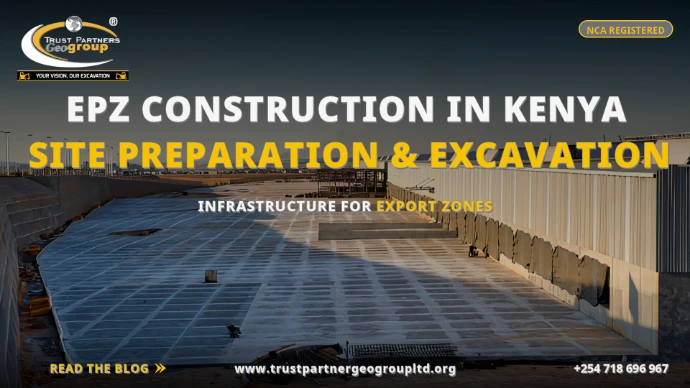
EPZ Construction in Kenya: Site Preparation, Excavation & Infrastructure for Export Zones
Bulk earthworks, roads, drainage & multi-tenant platform preparation for Export Processing Zones in Athi River, Mombasa, Naivasha & Eldoret
Table of Contents
- 1. What Is EPZ Construction?
- 2. Master Planning & Site Selection
- 3. Clearing, Stripping & Bulk Earthworks
- 4. Platform Grading & Compaction
- 5. Internal Road Construction & Paving Sub-bases
- 6. Stormwater Drainage & Attenuation
- 7. Power, Water & Telecom Infrastructure Trenches
- 8. Warehouse & Factory Pad Preparation
- 9. EPZ Authority, NEMA & Regulatory Compliance
- 10. Equipment & Fleet Productivity
- 11. Construction Costs & Programme [2026]
- 12. Frequently Asked Questions
- 13. Conclusion
From the garment factories of Athi River to the agro-processing hubs of Eldoret, Kenya's Export Processing Zones are engines of foreign exchange and employment. But before the first container arrives or the first production line hums, hundreds of hectares of raw land must be transformed into a serviced industrial platform: levelled, drained, roaded, wired and piped. EPZ construction Kenya developers depend on earthworks contractors who can deliver not just bulk excavation, but the coordinated industrial park site preparation that allows multiple tenants to build simultaneously without sharing mud, flooding or power outages. This guide covers the full EPZ infrastructure development sequence - clearing, cut-to-fill, roads, drainage, utilities and compliance - with 2026 costs and the regulatory framework that governs zone construction from groundbreaking to first tenant.
Trust Partners Geo-Group Ltd - Engineering Team
NCA-registered excavation & civil engineering contractor with 15+ years of industrial park earthworks, EPZ infrastructure and heavy civil construction experience across East Africa. Reviewed by registered engineers.
1. What Is EPZ Construction?
An Export Processing Zone is more than a fenced industrial area. It is a customs-controlled, infrastructure-heavy development that must meet international investor expectations for reliable power, all-weather access, wastewater handling and security. The earthworks and civil infrastructure phase creates the physical canvas:
- Bulk earthworks: transforming undulating or vegetated land into level platforms capable of supporting warehouses, factories and container yards;
- Internal roads: heavy-duty haul routes that carry container trucks, fuel tankers and employee buses year-round without turning to dust or mud;
- Stormwater management: attenuation ponds and drainage channels sized for the increased runoff from large impervious roof and pavement areas;
- Utility corridors: buried trenches carrying medium-voltage power, potable water, fiber optic cables and sewer lines to every plot;
- Building pads: individually graded and compacted platforms ready for slab-on-grade or raised-floor construction by tenant contractors.
Unlike single-factory projects, EPZs are phased multi-tenant developments. Phase 1 must be operational while Phase 2 is still under construction - which means the earthworks contractor must deliver clean, tested platforms on schedule, maintain haul roads through active construction, and manage sediment and drainage so that early tenants are not flooded by later-phase runoff.
2. Master Planning & Site Selection
Successful EPZ earthworks Nairobi and regional contractors begin with the master plan:
- Topography and drainage: EPZs favor gently sloping sites that allow natural drainage without excessive cut-to-fill. Flat sites are ideal; steep sites require terracing and retaining walls that add cost;
- Soil conditions: laterite and murram allow slab-on-grade construction and economical road sub-bases. Black cotton soil, peat or expansive clay require complete removal or chemical stabilization across the entire zone - a major cost driver;
- Groundwater: high water tables (common in Mombasa, Kisumu and parts of Naivasha) require dewatering during excavation, raised floor designs for buildings, and careful drainage outfall design;
- Access: proximity to highways, rail spurs (for major zones), port connections (Mombasa EPZs) and grid power;
- Phasing strategy: the earthworks contractor must understand which platforms, roads and utilities are Phase 1 critical versus Phase 2 future, to avoid wasting compaction and surfacing on areas that will sit idle for years.
Geotechnical investigation for an EPZ is extensive: boreholes at 50-100m spacing across the full development area, test pits for borrow material, and CBR testing for road design. The investigation budget for a 50-hectare zone typically runs KES 3-8 million - modest against the KES 100-300 million earthworks contract, and essential for accurate quantity estimation.
3. Clearing, Stripping & Bulk Earthworks
The first physical transformation is removing everything that is not engineered fill:
- Vegetation clearing: complete removal of trees, stumps and root systems. In savanna and bush zones (Athi River, Kitengela), this includes treating termite mounds that destabilize foundations;
- Topsoil stripping: the organic-rich upper 200-400mm is stockpiled for buffer zone rehabilitation and landscaping - never used as structural fill;
- Demolition of existing structures: some EPZ sites are developed on former agricultural or industrial land with abandoned buildings that must be demolished and removed;
- Bulk cut-and-fill: cutting high areas, hauling to low areas, and compacting in 200-300mm layers to achieve design platform levels. Import fill is expensive (KES 350-600/m3 delivered); balanced earthworks is the economic ideal.
For a 50-hectare site stripped to 300mm depth, topsoil volumes alone reach 150,000 m3. This material must be stockpiled outside the development footprint or used immediately for berming and landscaping. Our cut-and-fill volume calculation guide explains the survey methods for balancing these quantities.
4. Platform Grading & Compaction
Each tenant plot must be a stable, level, drained platform:
| Platform Use | Design Grade | Compaction | Tolerance |
|---|---|---|---|
| Standard warehouse / factory | Level to 0.5% fall | 95-98% MDD | +/- 75mm over 20m |
| Heavy-duty container yard | 1-2% cross-fall | 98% MDD, CBR 30+ | +/- 50mm over 20m |
| High-bay automated warehouse | Level | 98% MDD | +/- 50mm over 20m |
| Administrative / light commercial | Level to 1% fall | 95% MDD | +/- 100mm over 20m |
| Utility yard / substation | Level | 98% MDD | +/- 50mm over 10m |
Layer placement: 200-300mm loose lifts, moisture within +/- 2% of optimum, compacted with smooth drum and padfoot rollers. Testing frequency: one nuclear density test per 500 m2 per layer. Proof-rolling with a 10-tonne roller identifies any remaining soft spots before the platform is handed over to the building contractor.
Because EPZ tenants may not be identified when earthworks begin, developers typically specify the highest standard (98% MDD) across all platforms. This future-proofs the site for any tenant but increases earthworks cost by 10-15% compared to variable standards.
5. Internal Road Construction & Paving Sub-bases
EPZ internal roads are the arteries of the zone - and they must carry container trucks, fuel deliveries and employee buses without failure:
- Road hierarchy: main arterial roads (9-12m wide) connecting the zone to the public highway; distributor roads (7-9m) linking clusters of factories; and access roads (5-7m) serving individual plots;
- Sub-base: 200-300mm of compacted crushed stone or selected murram, CBR 30+, compacted to 98% MDD. In weak soil areas, this may increase to 400mm or require geotextile separation;
- Base course: 150-200mm of graded crushed stone for roads that will receive asphalt or concrete surfacing;
- Wearing course: some EPZs surface immediately with asphalt or concrete; others leave a gravel wearing course for the first 2-3 years to allow settlement to occur before final paving;
- Camber and drainage: 2-3% cross-fall to side drains, with minimum longitudinal grade 0.5% to prevent ponding.
Container yards and truck parking areas require the heaviest pavement design: 300-400mm sub-base plus 200mm base, surfaced with concrete or interlocking pavers that can withstand point loads from container corner castings. The earthworks contractor must achieve near-perfect level and compaction in these areas because any settlement creates potholes that damage trucks and slow operations.
6. Stormwater Drainage & Attenuation
EPZs replace permeable ground with roofs, roads and container yards. Runoff increases dramatically and must be managed:
| Drainage Element | Function | Typical Construction |
|---|---|---|
| Roadside channels | Collect runoff from paved surfaces | Concrete V-drain or U-drain, 300-500mm deep |
| Culverts | Pass drainage beneath roads | Reinforced concrete pipe or box culvert, 600-1,200mm |
| Attenuation pond | Store and slow peak runoff | Excavated basin 2-4m deep, 2,000-10,000 m3, clay or geomembrane lined |
| Silt trap | Remove sediment before discharge | Concrete chamber with baffles, regular desilting access |
| Oil interceptor | Capture fuel and lubricants | Coalescing plate separator at fueling and workshop areas |
| Outfall | Discharge to watercourse or soakaway | Designed for 1-in-25 or 1-in-50 year storm, NEMA permitted |
Attenuation pond excavation is a significant earthworks item. A pond serving 20 hectares of paved EPZ may be 5,000-15,000 m3 of excavation, requiring lining with compacted clay (300-500mm) or HDPE geomembrane to prevent seepage into groundwater. The pond must be accessible for maintenance desilting - which means stable access ramps and platforms excavated as part of the earthworks package.
In high-rainfall areas (Kisumu, Kakamega, Nyeri), stormwater design uses 1-in-50-year rainfall intensity. In arid areas (Kajiado, Garissa), 1-in-25-year may suffice but flash-flood volumes must still be accommodated.
7. Power, Water & Telecom Infrastructure Trenches
Modern EPZs are utility-intensive. The earthworks contractor excavates the corridors:
- Medium-voltage power: trenches 600-800mm deep carrying 11kV or 33kV cables in concrete-encased ducts or HDPE conduits. Transformer yards are excavated pits 2-3m deep with compacted granular backfill;
- Water supply: trenches 800-1,000mm deep for mains distribution, with valve chambers and fire hydrant pits excavated at intervals;
- Sewer: gravity sewers at 1,000-1,500mm depth (or deeper depending on invert levels), with manholes excavated 2-3m deep;
- Fiber optic / telecom: shallow trenches 400-600mm deep, often bundled with power in shared corridors with separation barriers;
- Stormwater pipes: 600-1,200mm diameter pipes in trenches 1,500-2,500mm deep, particularly where open channels are not feasible between buildings.
Trench backfill is critical: selected granular material in 150mm layers compacted to 95% MDD. Native clay backfill is prohibited in utility trenches because it settles and crushes pipes. The earthworks contractor must maintain accurate as-built records of every trench depth, invert level and pipe position - these become the reference for all future maintenance and tenant connections.
8. Warehouse & Factory Pad Preparation
Individual tenant plots are the revenue-generating heart of the EPZ. The earthworks contractor delivers each pad ready for the building contractor:
- Final trim: fine-grading to +/- 50mm with motor graders and laser levels;
- Compaction verification: density tests at 250-500 m2 intervals, proof-rolling documentation;
- Perimeter drainage: excavated channels or French drains around each plot to prevent water accumulating against future buildings;
- Utility stubs: excavated pits at plot boundaries where power, water and sewer connections will be made;
- Access provision: temporary haul roads to each pad so building materials can be delivered without destroying finished platforms.
Handover is formal: the earthworks contractor signs off the pad level, compaction and drainage; the building contractor accepts it and begins formwork. Any settlement or soft spot discovered after handover becomes a variation or dispute - which is why hold points and testing documentation are essential.
9. EPZ Authority, NEMA & Regulatory Compliance
EPZ construction operates under a multi-layered regulatory framework:
| Requirement | Authority | What It Covers |
|---|---|---|
| EPZ license / developer approval | EPZ Authority | Zone designation, tenant criteria, customs infrastructure, reporting |
| EIA license | NEMA | Master plan environmental approval, effluent, dust, noise |
| Building plan approval | County government | Roads, drainage, fire access, plot sub-division |
| NCA registration | National Construction Authority | Contractor registration, site safety, quality standards |
| Power connection | Kenya Power / ERA | Substation design, transformer yards, distribution |
| Water abstraction / discharge | Water Resources Authority | Borehole drilling, surface water use, effluent discharge |
| Fire clearance | County fire services | Hydrant spacing, access road widths, hardstands |
The earthworks phase triggers NEMA scrutiny for dust generation (especially on dry murram sites), sediment runoff into watercourses, and noise from heavy plant near residential areas. EPZ developers must submit an Environmental Management Plan (EMP) that the earthworks contractor implements daily: sediment fences, dust suppression watering, topsoil stockpile protection, and silt traps in drainage outfalls.
International tenants and lenders increasingly require IFC Performance Standards or Equator Principles compliance, which adds requirements for community engagement, biodiversity offsets, and construction-phase social management. The earthworks contractor must be prepared for third-party environmental audits that inspect the site weekly.
10. Equipment & Fleet Productivity
EPZ earthworks demand heavy civil fleets operating at scale:
| Equipment | Role | Typical Size Class |
|---|---|---|
| Excavator | Bulk digging, trenching, pond excavation | 20-30 tonne (CAT 320, Komatsu PC200) |
| Articulated dump truck | Haulage of cut and fill material | 30-40 tonne (CAT 730, Volvo A35) |
| Dozer with GPS | Spreading fill, rough grading | D6-D8 (GPS machine control standard) |
| Motor grader | Final platform and road grading | 140-160 hp |
| Smooth drum roller | Platform and road sub-base compaction | 10-14 tonne |
| Padfoot roller | Cohesive fill compaction | 12-16 tonne |
| Water bowser | Dust suppression and moisture conditioning | 10,000-20,000 litre |
| Trencher / excavator | Utility corridor excavation | Chain trencher or 13-20t excavator |
For a 50-hectare EPZ phase, typical fleet productivity is: one 30-tonne excavator and three 30-tonne ADTs can move 2,500-4,000 m3 per day in balanced cut-to-fill. GPS machine control on dozers and graders reduces rework by 30-40% on large platforms and is now standard for developments of this scale. Fuel logistics become a project management discipline in themselves - a fleet this size consumes 2,000-4,000 litres per day.
11. Construction Costs & Programme [2026]
Indicative earthworks and infrastructure costs for EPZ development in Kenya (per hectare or per square meter):
| Item | 2026 Rate | Typical Share |
|---|---|---|
| Clearing and topsoil strip | KES 70-150/m2 | 5-8% |
| Bulk cut-and-fill earthworks | KES 250-450/m3 | 25-35% |
| Platform grading and compaction | KES 180-300/m2 | 15-20% |
| Road sub-base (supply and place) | KES 450-800/m3 | 15-20% |
| Drainage channels and culverts | KES 2,000-4,000/m | 10-15% |
| Attenuation pond excavation | KES 300-500/m3 | 5-8% |
| Utility trench excavation | KES 1,500-3,000/m | 10-15% |
| Compaction testing and QA | KES 15,000-30,000/day | 2-3% |
All-in project estimates by zone size:
- Small EPZ phase (10 hectares): KES 25-50 million earthworks and infrastructure;
- Medium EPZ (50 hectares): KES 80-180 million;
- Large zone (100+ hectares): KES 150-350 million.
Programme: small phases 3-5 months; medium zones 6-10 months; large developments 12-18 months. Phased handover is standard - Phase 1 platforms and roads are completed in 3-4 months so building construction can begin while Phase 2 earthworks continues. Dry-season execution (January-March, June-September) is critical for achieving compaction standards on the large fill volumes EPZs require.
Pro tip: unit-rate vs lump-sum for EPZ earthworks
Where ground conditions are well-understood and quantities are reliable, a lump-sum contract gives the developer cost certainty and incentivizes the contractor for efficiency. Where significant geotechnical uncertainty exists (variable soil, unknown fill requirements, high groundwater), a unit-rate contract with preliminary investigation reduces risk for both parties. Trust Partners Geo-Group Ltd offers both structures, with preliminary boreholes and test pits to de-risk pricing before mobilization.
12. Frequently Asked Questions: EPZ Construction in Kenya
What is an Export Processing Zone (EPZ) and how is it constructed?
An Export Processing Zone (EPZ) is a designated geographic area where manufacturing and processing for export operate under special regulatory, tax and customs frameworks. EPZ construction in Kenya begins with master-planned site preparation: bulk clearing and topsoil stripping, cut-to-fill earthworks to create level platforms for multiple factories and warehouses, internal all-weather roads with paving sub-bases, stormwater drainage and attenuation ponds, buried infrastructure trenches for power, water and fiber, and individual building pad preparation. The EPZ Authority oversees licensing and compliance, while county governments manage building approvals and infrastructure connections. Unlike single-factory builds, EPZs are multi-tenant developments where earthworks must be coordinated across phases to allow early tenants to operate while later phases are still under construction.
How much does EPZ site preparation cost in Kenya in 2026?
2026 indicative costs for EPZ site preparation in Kenya: clearing and topsoil stripping KES 70-150 per m2; bulk cut-and-fill earthworks KES 250-450 per m3; platform grading and compaction KES 180-300 per m2; internal road sub-base and gravel wearing course KES 450-800 per m3 placed; drainage channels and culverts KES 2,000-4,000 per linear meter; power and utility trenches KES 1,500-3,000 per meter; attenuation pond excavation KES 300-500 per m3. For a 50-hectare EPZ phase, bulk earthworks and infrastructure typically run KES 80-180 million before paving, buildings or services. Costs vary significantly with topography - a flat laterite site in Athi River costs far less than a cut-to-fill site in Naivasha or a swampy coastal plot requiring extensive fill import.
What infrastructure does an EPZ need before factories can be built?
Before the first factory slab is poured, an EPZ needs: perimeter fencing and secure gate control (EPZs are customs-controlled areas); internal all-weather roads with drainage and street lighting; a site-wide stormwater management system including attenuation ponds and discharge channels; buried medium-voltage power distribution with transformer yards; potable water supply and fire hydrant networks; sewer or septic treatment capacity; fiber optic and telecom ducting; and levelled, compacted building pads ready for warehouse and factory construction. Some EPZs also pre-install wastewater pre-treatment plants for textile and food processing tenants. The earthworks contractor delivers the platforms, roads, drainage trenches and utility corridors that make all of this possible.
Who regulates EPZ construction in Kenya?
EPZ construction is regulated by multiple bodies: the EPZ Authority (licensing, tenant approval, customs compliance and operational standards); NEMA (EIA license, environmental audits and effluent controls for the master development); county governments (building plan approval, physical planning, fire safety, local rates and access agreements); the National Construction Authority (NCA contractor registration and site safety); Kenya Power and the Energy Regulatory Authority (power infrastructure and connection); the Water Resources Authority (abstraction and discharge permits); and the Kenya Revenue Authority (customs control infrastructure including fencing, gates and CCTV). International tenants may also require IFC or Equator Principles compliance, which adds social and environmental safeguards beyond statutory minimums.
What compaction standard applies to EPZ platforms and roads?
EPZ building platforms in Kenya are compacted to 95-98% of maximum dry density (Mod AASHTO) for general warehouse and factory pads, with the upper 300mm compacted to 98% where heavy container handling or racking loads are anticipated. Internal haul roads and container yards require 98% MDD with a minimum CBR of 30%. All compaction is verified by nuclear density testing at 500 m2 intervals per layer, with proof-rolling by a 10-tonne roller. Because EPZs are multi-tenant, the developer often specifies the highest standard across the entire site to accommodate any future tenant, rather than varying compaction by plot.
How are stormwater and drainage managed in EPZ developments?
EPZ stormwater design uses a two-tier system: internal site drainage (roadside channels, culverts and pipe networks) that collects runoff from paved surfaces and building roofs, and attenuation or detention ponds that slow discharge to prevent downstream flooding. Because EPZs have large impervious areas (roofs, roads, container yards), runoff coefficients are high and ponds must be sized for 1-in-25 or 1-in-50-year storm events depending on NEMA requirements. The earthworks contractor excavates attenuation ponds (often 2-4 meters deep, lined with clay or geomembrane), constructs lined drainage channels with concrete or riprap protection, and installs culverts at road crossings. Oil and silt interceptors are required at vehicle washing and fueling areas before water enters the main drainage system.
What equipment is used for EPZ site preparation?
EPZ site preparation requires a heavy civil fleet: 30-40 tonne excavators for bulk earthworks and pond excavation; articulated dump trucks (30-40 tonne) for long-distance haulage within large sites; dozers (D6-D8) for spreading and grading; motor graders for road sub-base and platform finishing; smooth drum and padfoot rollers for compaction to 98% MDD; wheel loaders for stockpile management; and trenchers or excavators for utility corridor digging. GPS machine control is standard on dozers and graders for achieving the consistent platform levels that multi-tenant developments require. For large EPZs (100+ hectares), the earthworks programme may run 6-12 months and require dedicated plant maintenance and fuel logistics on site.
How long does EPZ site preparation take in Kenya?
A small EPZ phase (10-20 hectares) on moderate terrain requires 3-5 months for complete site preparation: 2-4 weeks clearing and stripping, 6-10 weeks bulk earthworks and platform grading, 4-6 weeks road sub-base and drainage, and 2-4 weeks utility trenching running in parallel. A large EPZ (50-100 hectares) or a site requiring significant cut-to-fill balance can take 8-14 months. Phased handover is common - the earthworks contractor completes Phase 1 platforms and roads so the building contractor can begin while Phase 2 earthworks continues. Dry-season execution is critical for compaction quality; attempting major earthworks during April-May or October-November rains adds weeks and risks subgrade failure under building loads.
13. Conclusion: The Platform Determines the Investment
An EPZ is sold to international investors on the reliability of its infrastructure: all-weather roads that do not turn to mud, stormwater systems that do not flood factories, power trenches that do not collapse, and building pads that do not settle. The earthworks contractor creates all of these conditions before the first tenant breaks ground. Poor site preparation - uneven platforms, inadequate compaction, missing drainage, or utility corridors that are not backfilled properly - creates a legacy of maintenance costs, tenant complaints and failed inspections that undermines the zone's competitiveness.
Trust Partners Geo-Group Ltd delivers the full EPZ site preparation package across Kenya: master-planned bulk earthworks with GPS-controlled grading, platform compaction to 98% MDD with documented testing, internal road sub-base construction, stormwater drainage and attenuation pond excavation, utility trenching for power, water and fiber, and phased handover to building contractors. We work with developers, EPZ Authority requirements and county building codes to deliver serviced industrial land ready for global tenants - on unit-rate or lump-sum contracts, with NCA-registered crews and the heavy fleet to execute 50-hectare phases on programme.
EPZ Site Preparation & Industrial Park Earthworks
Bulk earthworks, platform grading, road construction, drainage and utility trenching for Export Processing Zones and industrial parks across Kenya.
Free lead magnet: ask for our EPZ Site Preparation Checklist (PDF) - earthworks hold points, compaction testing frequencies, drainage inspection records and utility trench as-built standards your EPZ Authority review will require.
Related Resources
Factory Floor Excavation for Heavy Machinery: Vibration Control & Precision Grading
The previous blog in our industrial series - precision machine foundations and vibration isolation for manufacturing plants.
READ MOREWarehouse Foundation Excavation in Kenya: Slab-on-Grade vs. Raised Floor Systems
Industrial floor earthworks for ambient warehouses, logistics parks and distribution centres within EPZs.
READ MORECold Storage Facility Excavation: Insulated Foundations & Frost Line Considerations in Kenya
Deep excavation and thermal protection for refrigerated warehouses in export-oriented cold chain facilities.
READ MOREBulk Excavation Cost Per Cubic Meter in Kenya [2026 Updated Rates]
Transparent pricing for the mass earthworks behind every EPZ platform and road network.
READ MOREEarthworks QA/QC: Compaction Testing & Density Control
The layer-by-layer testing regime every EPZ platform and road sub-base demands.
READ MORECut-and-Fill Earthworks Balance: Calculate Volumes for Kenyan Sites
Volume balancing for large-scale industrial park earthworks and platform construction.
READ MORETRUST PARTNERS GEO-GROUP LTD | YOUR VISION, OUR EXCAVATION
WEBSITE: WWW.TRUSTPARTNERGEOGROUPLTD.ORG | EMAIL: INFO@TRUSTPARTNERGEOGROUPLTD.ORG | PHONE: +254 718 68 69 67
FOLLOW US: FACEBOOK | TIKTOK | INSTAGRAM | YOUTUBE | LINKEDIN
© 2026 TRUST PARTNERS GEO-GROUP LTD. ALL RIGHTS RESERVED.
EPZ Construction in Kenya: Site Preparation, Excavation & Infrastructure for Export Zones
Bulk earthworks, roads, drainage & multi-tenant platform preparation for Export Processing Zones in Athi River, Mombasa, Naivasha & Eldoret
Table of Contents
- 1. What Is EPZ Construction?
- 2. Master Planning & Site Selection
- 3. Clearing, Stripping & Bulk Earthworks
- 4. Platform Grading & Compaction
- 5. Internal Road Construction & Paving Sub-bases
- 6. Stormwater Drainage & Attenuation
- 7. Power, Water & Telecom Infrastructure Trenches
- 8. Warehouse & Factory Pad Preparation
- 9. EPZ Authority, NEMA & Regulatory Compliance
- 10. Equipment & Fleet Productivity
- 11. Construction Costs & Programme [2026]
- 12. Frequently Asked Questions
- 13. Conclusion
From the garment factories of Athi River to the agro-processing hubs of Eldoret, Kenya's Export Processing Zones are engines of foreign exchange and employment. But before the first container arrives or the first production line hums, hundreds of hectares of raw land must be transformed into a serviced industrial platform: levelled, drained, roaded, wired and piped. EPZ construction Kenya developers depend on earthworks contractors who can deliver not just bulk excavation, but the coordinated industrial park site preparation that allows multiple tenants to build simultaneously without sharing mud, flooding or power outages. This guide covers the full EPZ infrastructure development sequence - clearing, cut-to-fill, roads, drainage, utilities and compliance - with 2026 costs and the regulatory framework that governs zone construction from groundbreaking to first tenant.
Trust Partners Geo-Group Ltd - Engineering Team
NCA-registered excavation & civil engineering contractor with 15+ years of industrial park earthworks, EPZ infrastructure and heavy civil construction experience across East Africa. Reviewed by registered engineers.
1. What Is EPZ Construction?
An Export Processing Zone is more than a fenced industrial area. It is a customs-controlled, infrastructure-heavy development that must meet international investor expectations for reliable power, all-weather access, wastewater handling and security. The earthworks and civil infrastructure phase creates the physical canvas:
- Bulk earthworks: transforming undulating or vegetated land into level platforms capable of supporting warehouses, factories and container yards;
- Internal roads: heavy-duty haul routes that carry container trucks, fuel tankers and employee buses year-round without turning to dust or mud;
- Stormwater management: attenuation ponds and drainage channels sized for the increased runoff from large impervious roof and pavement areas;
- Utility corridors: buried trenches carrying medium-voltage power, potable water, fiber optic cables and sewer lines to every plot;
- Building pads: individually graded and compacted platforms ready for slab-on-grade or raised-floor construction by tenant contractors.
Unlike single-factory projects, EPZs are phased multi-tenant developments. Phase 1 must be operational while Phase 2 is still under construction - which means the earthworks contractor must deliver clean, tested platforms on schedule, maintain haul roads through active construction, and manage sediment and drainage so that early tenants are not flooded by later-phase runoff.
2. Master Planning & Site Selection
Successful EPZ earthworks Nairobi and regional contractors begin with the master plan:
- Topography and drainage: EPZs favor gently sloping sites that allow natural drainage without excessive cut-to-fill. Flat sites are ideal; steep sites require terracing and retaining walls that add cost;
- Soil conditions: laterite and murram allow slab-on-grade construction and economical road sub-bases. Black cotton soil, peat or expansive clay require complete removal or chemical stabilization across the entire zone - a major cost driver;
- Groundwater: high water tables (common in Mombasa, Kisumu and parts of Naivasha) require dewatering during excavation, raised floor designs for buildings, and careful drainage outfall design;
- Access: proximity to highways, rail spurs (for major zones), port connections (Mombasa EPZs) and grid power;
- Phasing strategy: the earthworks contractor must understand which platforms, roads and utilities are Phase 1 critical versus Phase 2 future, to avoid wasting compaction and surfacing on areas that will sit idle for years.
Geotechnical investigation for an EPZ is extensive: boreholes at 50-100m spacing across the full development area, test pits for borrow material, and CBR testing for road design. The investigation budget for a 50-hectare zone typically runs KES 3-8 million - modest against the KES 100-300 million earthworks contract, and essential for accurate quantity estimation.
3. Clearing, Stripping & Bulk Earthworks
The first physical transformation is removing everything that is not engineered fill:
- Vegetation clearing: complete removal of trees, stumps and root systems. In savanna and bush zones (Athi River, Kitengela), this includes treating termite mounds that destabilize foundations;
- Topsoil stripping: the organic-rich upper 200-400mm is stockpiled for buffer zone rehabilitation and landscaping - never used as structural fill;
- Demolition of existing structures: some EPZ sites are developed on former agricultural or industrial land with abandoned buildings that must be demolished and removed;
- Bulk cut-and-fill: cutting high areas, hauling to low areas, and compacting in 200-300mm layers to achieve design platform levels. Import fill is expensive (KES 350-600/m3 delivered); balanced earthworks is the economic ideal.
For a 50-hectare site stripped to 300mm depth, topsoil volumes alone reach 150,000 m3. This material must be stockpiled outside the development footprint or used immediately for berming and landscaping. Our cut-and-fill volume calculation guide explains the survey methods for balancing these quantities.
4. Platform Grading & Compaction
Each tenant plot must be a stable, level, drained platform:
| Platform Use | Design Grade | Compaction | Tolerance |
|---|---|---|---|
| Standard warehouse / factory | Level to 0.5% fall | 95-98% MDD | +/- 75mm over 20m |
| Heavy-duty container yard | 1-2% cross-fall | 98% MDD, CBR 30+ | +/- 50mm over 20m |
| High-bay automated warehouse | Level | 98% MDD | +/- 50mm over 20m |
| Administrative / light commercial | Level to 1% fall | 95% MDD | +/- 100mm over 20m |
| Utility yard / substation | Level | 98% MDD | +/- 50mm over 10m |
Layer placement: 200-300mm loose lifts, moisture within +/- 2% of optimum, compacted with smooth drum and padfoot rollers. Testing frequency: one nuclear density test per 500 m2 per layer. Proof-rolling with a 10-tonne roller identifies any remaining soft spots before the platform is handed over to the building contractor.
Because EPZ tenants may not be identified when earthworks begin, developers typically specify the highest standard (98% MDD) across all platforms. This future-proofs the site for any tenant but increases earthworks cost by 10-15% compared to variable standards.
5. Internal Road Construction & Paving Sub-bases
EPZ internal roads are the arteries of the zone - and they must carry container trucks, fuel deliveries and employee buses without failure:
- Road hierarchy: main arterial roads (9-12m wide) connecting the zone to the public highway; distributor roads (7-9m) linking clusters of factories; and access roads (5-7m) serving individual plots;
- Sub-base: 200-300mm of compacted crushed stone or selected murram, CBR 30+, compacted to 98% MDD. In weak soil areas, this may increase to 400mm or require geotextile separation;
- Base course: 150-200mm of graded crushed stone for roads that will receive asphalt or concrete surfacing;
- Wearing course: some EPZs surface immediately with asphalt or concrete; others leave a gravel wearing course for the first 2-3 years to allow settlement to occur before final paving;
- Camber and drainage: 2-3% cross-fall to side drains, with minimum longitudinal grade 0.5% to prevent ponding.
Container yards and truck parking areas require the heaviest pavement design: 300-400mm sub-base plus 200mm base, surfaced with concrete or interlocking pavers that can withstand point loads from container corner castings. The earthworks contractor must achieve near-perfect level and compaction in these areas because any settlement creates potholes that damage trucks and slow operations.
6. Stormwater Drainage & Attenuation
EPZs replace permeable ground with roofs, roads and container yards. Runoff increases dramatically and must be managed:
| Drainage Element | Function | Typical Construction |
|---|---|---|
| Roadside channels | Collect runoff from paved surfaces | Concrete V-drain or U-drain, 300-500mm deep |
| Culverts | Pass drainage beneath roads | Reinforced concrete pipe or box culvert, 600-1,200mm |
| Attenuation pond | Store and slow peak runoff | Excavated basin 2-4m deep, 2,000-10,000 m3, clay or geomembrane lined |
| Silt trap | Remove sediment before discharge | Concrete chamber with baffles, regular desilting access |
| Oil interceptor | Capture fuel and lubricants | Coalescing plate separator at fueling and workshop areas |
| Outfall | Discharge to watercourse or soakaway | Designed for 1-in-25 or 1-in-50 year storm, NEMA permitted |
Attenuation pond excavation is a significant earthworks item. A pond serving 20 hectares of paved EPZ may be 5,000-15,000 m3 of excavation, requiring lining with compacted clay (300-500mm) or HDPE geomembrane to prevent seepage into groundwater. The pond must be accessible for maintenance desilting - which means stable access ramps and platforms excavated as part of the earthworks package.
In high-rainfall areas (Kisumu, Kakamega, Nyeri), stormwater design uses 1-in-50-year rainfall intensity. In arid areas (Kajiado, Garissa), 1-in-25-year may suffice but flash-flood volumes must still be accommodated.
7. Power, Water & Telecom Infrastructure Trenches
Modern EPZs are utility-intensive. The earthworks contractor excavates the corridors:
- Medium-voltage power: trenches 600-800mm deep carrying 11kV or 33kV cables in concrete-encased ducts or HDPE conduits. Transformer yards are excavated pits 2-3m deep with compacted granular backfill;
- Water supply: trenches 800-1,000mm deep for mains distribution, with valve chambers and fire hydrant pits excavated at intervals;
- Sewer: gravity sewers at 1,000-1,500mm depth (or deeper depending on invert levels), with manholes excavated 2-3m deep;
- Fiber optic / telecom: shallow trenches 400-600mm deep, often bundled with power in shared corridors with separation barriers;
- Stormwater pipes: 600-1,200mm diameter pipes in trenches 1,500-2,500mm deep, particularly where open channels are not feasible between buildings.
Trench backfill is critical: selected granular material in 150mm layers compacted to 95% MDD. Native clay backfill is prohibited in utility trenches because it settles and crushes pipes. The earthworks contractor must maintain accurate as-built records of every trench depth, invert level and pipe position - these become the reference for all future maintenance and tenant connections.
8. Warehouse & Factory Pad Preparation
Individual tenant plots are the revenue-generating heart of the EPZ. The earthworks contractor delivers each pad ready for the building contractor:
- Final trim: fine-grading to +/- 50mm with motor graders and laser levels;
- Compaction verification: density tests at 250-500 m2 intervals, proof-rolling documentation;
- Perimeter drainage: excavated channels or French drains around each plot to prevent water accumulating against future buildings;
- Utility stubs: excavated pits at plot boundaries where power, water and sewer connections will be made;
- Access provision: temporary haul roads to each pad so building materials can be delivered without destroying finished platforms.
Handover is formal: the earthworks contractor signs off the pad level, compaction and drainage; the building contractor accepts it and begins formwork. Any settlement or soft spot discovered after handover becomes a variation or dispute - which is why hold points and testing documentation are essential.
9. EPZ Authority, NEMA & Regulatory Compliance
EPZ construction operates under a multi-layered regulatory framework:
| Requirement | Authority | What It Covers |
|---|---|---|
| EPZ license / developer approval | EPZ Authority | Zone designation, tenant criteria, customs infrastructure, reporting |
| EIA license | NEMA | Master plan environmental approval, effluent, dust, noise |
| Building plan approval | County government | Roads, drainage, fire access, plot sub-division |
| NCA registration | National Construction Authority | Contractor registration, site safety, quality standards |
| Power connection | Kenya Power / ERA | Substation design, transformer yards, distribution |
| Water abstraction / discharge | Water Resources Authority | Borehole drilling, surface water use, effluent discharge |
| Fire clearance | County fire services | Hydrant spacing, access road widths, hardstands |
The earthworks phase triggers NEMA scrutiny for dust generation (especially on dry murram sites), sediment runoff into watercourses, and noise from heavy plant near residential areas. EPZ developers must submit an Environmental Management Plan (EMP) that the earthworks contractor implements daily: sediment fences, dust suppression watering, topsoil stockpile protection, and silt traps in drainage outfalls.
International tenants and lenders increasingly require IFC Performance Standards or Equator Principles compliance, which adds requirements for community engagement, biodiversity offsets, and construction-phase social management. The earthworks contractor must be prepared for third-party environmental audits that inspect the site weekly.
10. Equipment & Fleet Productivity
EPZ earthworks demand heavy civil fleets operating at scale:
| Equipment | Role | Typical Size Class |
|---|---|---|
| Excavator | Bulk digging, trenching, pond excavation | 20-30 tonne (CAT 320, Komatsu PC200) |
| Articulated dump truck | Haulage of cut and fill material | 30-40 tonne (CAT 730, Volvo A35) |
| Dozer with GPS | Spreading fill, rough grading | D6-D8 (GPS machine control standard) |
| Motor grader | Final platform and road grading | 140-160 hp |
| Smooth drum roller | Platform and road sub-base compaction | 10-14 tonne |
| Padfoot roller | Cohesive fill compaction | 12-16 tonne |
| Water bowser | Dust suppression and moisture conditioning | 10,000-20,000 litre |
| Trencher / excavator | Utility corridor excavation | Chain trencher or 13-20t excavator |
For a 50-hectare EPZ phase, typical fleet productivity is: one 30-tonne excavator and three 30-tonne ADTs can move 2,500-4,000 m3 per day in balanced cut-to-fill. GPS machine control on dozers and graders reduces rework by 30-40% on large platforms and is now standard for developments of this scale. Fuel logistics become a project management discipline in themselves - a fleet this size consumes 2,000-4,000 litres per day.
11. Construction Costs & Programme [2026]
Indicative earthworks and infrastructure costs for EPZ development in Kenya (per hectare or per square meter):
| Item | 2026 Rate | Typical Share |
|---|---|---|
| Clearing and topsoil strip | KES 70-150/m2 | 5-8% |
| Bulk cut-and-fill earthworks | KES 250-450/m3 | 25-35% |
| Platform grading and compaction | KES 180-300/m2 | 15-20% |
| Road sub-base (supply and place) | KES 450-800/m3 | 15-20% |
| Drainage channels and culverts | KES 2,000-4,000/m | 10-15% |
| Attenuation pond excavation | KES 300-500/m3 | 5-8% |
| Utility trench excavation | KES 1,500-3,000/m | 10-15% |
| Compaction testing and QA | KES 15,000-30,000/day | 2-3% |
All-in project estimates by zone size:
- Small EPZ phase (10 hectares): KES 25-50 million earthworks and infrastructure;
- Medium EPZ (50 hectares): KES 80-180 million;
- Large zone (100+ hectares): KES 150-350 million.
Programme: small phases 3-5 months; medium zones 6-10 months; large developments 12-18 months. Phased handover is standard - Phase 1 platforms and roads are completed in 3-4 months so building construction can begin while Phase 2 earthworks continues. Dry-season execution (January-March, June-September) is critical for achieving compaction standards on the large fill volumes EPZs require.
Pro tip: unit-rate vs lump-sum for EPZ earthworks
Where ground conditions are well-understood and quantities are reliable, a lump-sum contract gives the developer cost certainty and incentivizes the contractor for efficiency. Where significant geotechnical uncertainty exists (variable soil, unknown fill requirements, high groundwater), a unit-rate contract with preliminary investigation reduces risk for both parties. Trust Partners Geo-Group Ltd offers both structures, with preliminary boreholes and test pits to de-risk pricing before mobilization.
12. Frequently Asked Questions: EPZ Construction in Kenya
What is an Export Processing Zone (EPZ) and how is it constructed?
An Export Processing Zone (EPZ) is a designated geographic area where manufacturing and processing for export operate under special regulatory, tax and customs frameworks. EPZ construction in Kenya begins with master-planned site preparation: bulk clearing and topsoil stripping, cut-to-fill earthworks to create level platforms for multiple factories and warehouses, internal all-weather roads with paving sub-bases, stormwater drainage and attenuation ponds, buried infrastructure trenches for power, water and fiber, and individual building pad preparation. The EPZ Authority oversees licensing and compliance, while county governments manage building approvals and infrastructure connections. Unlike single-factory builds, EPZs are multi-tenant developments where earthworks must be coordinated across phases to allow early tenants to operate while later phases are still under construction.
How much does EPZ site preparation cost in Kenya in 2026?
2026 indicative costs for EPZ site preparation in Kenya: clearing and topsoil stripping KES 70-150 per m2; bulk cut-and-fill earthworks KES 250-450 per m3; platform grading and compaction KES 180-300 per m2; internal road sub-base and gravel wearing course KES 450-800 per m3 placed; drainage channels and culverts KES 2,000-4,000 per linear meter; power and utility trenches KES 1,500-3,000 per meter; attenuation pond excavation KES 300-500 per m3. For a 50-hectare EPZ phase, bulk earthworks and infrastructure typically run KES 80-180 million before paving, buildings or services. Costs vary significantly with topography - a flat laterite site in Athi River costs far less than a cut-to-fill site in Naivasha or a swampy coastal plot requiring extensive fill import.
What infrastructure does an EPZ need before factories can be built?
Before the first factory slab is poured, an EPZ needs: perimeter fencing and secure gate control (EPZs are customs-controlled areas); internal all-weather roads with drainage and street lighting; a site-wide stormwater management system including attenuation ponds and discharge channels; buried medium-voltage power distribution with transformer yards; potable water supply and fire hydrant networks; sewer or septic treatment capacity; fiber optic and telecom ducting; and levelled, compacted building pads ready for warehouse and factory construction. Some EPZs also pre-install wastewater pre-treatment plants for textile and food processing tenants. The earthworks contractor delivers the platforms, roads, drainage trenches and utility corridors that make all of this possible.
Who regulates EPZ construction in Kenya?
EPZ construction is regulated by multiple bodies: the EPZ Authority (licensing, tenant approval, customs compliance and operational standards); NEMA (EIA license, environmental audits and effluent controls for the master development); county governments (building plan approval, physical planning, fire safety, local rates and access agreements); the National Construction Authority (NCA contractor registration and site safety); Kenya Power and the Energy Regulatory Authority (power infrastructure and connection); the Water Resources Authority (abstraction and discharge permits); and the Kenya Revenue Authority (customs control infrastructure including fencing, gates and CCTV). International tenants may also require IFC or Equator Principles compliance, which adds social and environmental safeguards beyond statutory minimums.
What compaction standard applies to EPZ platforms and roads?
EPZ building platforms in Kenya are compacted to 95-98% of maximum dry density (Mod AASHTO) for general warehouse and factory pads, with the upper 300mm compacted to 98% where heavy container handling or racking loads are anticipated. Internal haul roads and container yards require 98% MDD with a minimum CBR of 30%. All compaction is verified by nuclear density testing at 500 m2 intervals per layer, with proof-rolling by a 10-tonne roller. Because EPZs are multi-tenant, the developer often specifies the highest standard across the entire site to accommodate any future tenant, rather than varying compaction by plot.
How are stormwater and drainage managed in EPZ developments?
EPZ stormwater design uses a two-tier system: internal site drainage (roadside channels, culverts and pipe networks) that collects runoff from paved surfaces and building roofs, and attenuation or detention ponds that slow discharge to prevent downstream flooding. Because EPZs have large impervious areas (roofs, roads, container yards), runoff coefficients are high and ponds must be sized for 1-in-25 or 1-in-50-year storm events depending on NEMA requirements. The earthworks contractor excavates attenuation ponds (often 2-4 meters deep, lined with clay or geomembrane), constructs lined drainage channels with concrete or riprap protection, and installs culverts at road crossings. Oil and silt interceptors are required at vehicle washing and fueling areas before water enters the main drainage system.
What equipment is used for EPZ site preparation?
EPZ site preparation requires a heavy civil fleet: 30-40 tonne excavators for bulk earthworks and pond excavation; articulated dump trucks (30-40 tonne) for long-distance haulage within large sites; dozers (D6-D8) for spreading and grading; motor graders for road sub-base and platform finishing; smooth drum and padfoot rollers for compaction to 98% MDD; wheel loaders for stockpile management; and trenchers or excavators for utility corridor digging. GPS machine control is standard on dozers and graders for achieving the consistent platform levels that multi-tenant developments require. For large EPZs (100+ hectares), the earthworks programme may run 6-12 months and require dedicated plant maintenance and fuel logistics on site.
How long does EPZ site preparation take in Kenya?
A small EPZ phase (10-20 hectares) on moderate terrain requires 3-5 months for complete site preparation: 2-4 weeks clearing and stripping, 6-10 weeks bulk earthworks and platform grading, 4-6 weeks road sub-base and drainage, and 2-4 weeks utility trenching running in parallel. A large EPZ (50-100 hectares) or a site requiring significant cut-to-fill balance can take 8-14 months. Phased handover is common - the earthworks contractor completes Phase 1 platforms and roads so the building contractor can begin while Phase 2 earthworks continues. Dry-season execution is critical for compaction quality; attempting major earthworks during April-May or October-November rains adds weeks and risks subgrade failure under building loads.
13. Conclusion: The Platform Determines the Investment
An EPZ is sold to international investors on the reliability of its infrastructure: all-weather roads that do not turn to mud, stormwater systems that do not flood factories, power trenches that do not collapse, and building pads that do not settle. The earthworks contractor creates all of these conditions before the first tenant breaks ground. Poor site preparation - uneven platforms, inadequate compaction, missing drainage, or utility corridors that are not backfilled properly - creates a legacy of maintenance costs, tenant complaints and failed inspections that undermines the zone's competitiveness.
Trust Partners Geo-Group Ltd delivers the full EPZ site preparation package across Kenya: master-planned bulk earthworks with GPS-controlled grading, platform compaction to 98% MDD with documented testing, internal road sub-base construction, stormwater drainage and attenuation pond excavation, utility trenching for power, water and fiber, and phased handover to building contractors. We work with developers, EPZ Authority requirements and county building codes to deliver serviced industrial land ready for global tenants - on unit-rate or lump-sum contracts, with NCA-registered crews and the heavy fleet to execute 50-hectare phases on programme.
EPZ Site Preparation & Industrial Park Earthworks
Bulk earthworks, platform grading, road construction, drainage and utility trenching for Export Processing Zones and industrial parks across Kenya.
Free lead magnet: ask for our EPZ Site Preparation Checklist (PDF) - earthworks hold points, compaction testing frequencies, drainage inspection records and utility trench as-built standards your EPZ Authority review will require.
Related Resources
Factory Floor Excavation for Heavy Machinery: Vibration Control & Precision Grading
The previous blog in our industrial series - precision machine foundations and vibration isolation for manufacturing plants.
READ MOREWarehouse Foundation Excavation in Kenya: Slab-on-Grade vs. Raised Floor Systems
Industrial floor earthworks for ambient warehouses, logistics parks and distribution centres within EPZs.
READ MORECold Storage Facility Excavation: Insulated Foundations & Frost Line Considerations in Kenya
Deep excavation and thermal protection for refrigerated warehouses in export-oriented cold chain facilities.
READ MOREBulk Excavation Cost Per Cubic Meter in Kenya [2026 Updated Rates]
Transparent pricing for the mass earthworks behind every EPZ platform and road network.
READ MOREEarthworks QA/QC: Compaction Testing & Density Control
The layer-by-layer testing regime every EPZ platform and road sub-base demands.
READ MORECut-and-Fill Earthworks Balance: Calculate Volumes for Kenyan Sites
Volume balancing for large-scale industrial park earthworks and platform construction.
READ MORETRUST PARTNERS GEO-GROUP LTD | YOUR VISION, OUR EXCAVATION
WEBSITE: WWW.TRUSTPARTNERGEOGROUPLTD.ORG | EMAIL: INFO@TRUSTPARTNERGEOGROUPLTD.ORG | PHONE: +254 718 68 69 67
FOLLOW US: FACEBOOK | TIKTOK | INSTAGRAM | YOUTUBE | LINKEDIN
© 2026 TRUST PARTNERS GEO-GROUP LTD. ALL RIGHTS RESERVED.