
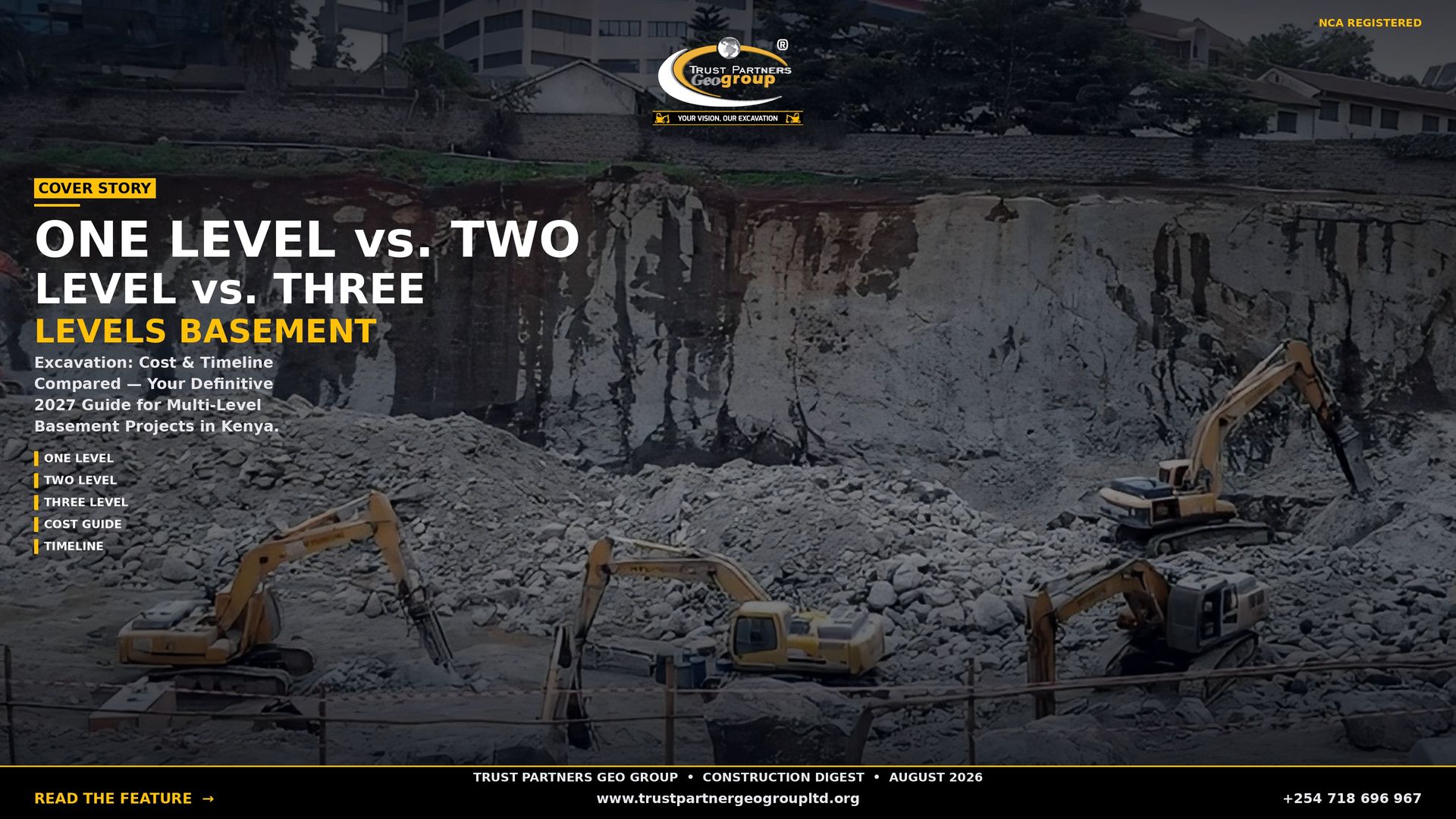
One-Level vs Two-Level vs Three-Level Basement Excavation: Cost and Timeline Compared [2027]
The Developer's Guide to Multi-Level Basement Economics in Nairobi
The decision between a one-level, two-level or three-level basement is one of the most consequential early choices a Nairobi developer makes. It determines not only construction cost and programme duration, but also the structural system, shoring strategy, dewatering complexity and ultimately the project's financial viability. This guide compares all three options using 2027 unit rates, real project timelines and equipment requirements — so you can make an informed decision before committing to foundation design. For base per-m² pricing by depth and soil type, see our companion guide on basement excavation cost per square meter in Nairobi.

NCA-registered excavation contractors serving Nairobi, Kiambu, Kajiado, Machakos and all 47 counties. 15+ years of multi-level basement excavation from residential podiums to high-rise commercial substructures across Kenya and East Africa.
Executive Summary: Cost and Timeline at a Glance
Before examining each option in detail, here is the 2027 Trust Partners Geo-Group summary matrix for a 500 m² footprint basement in loose material within the greater Nairobi area:
| Metric | One-Level | Two-Level | Three-Level |
|---|---|---|---|
| Excavation Depth | 2.5 – 4.0 m | 6.0 – 8.0 m | 10.0 – 15.0 m |
| Cost per m² (Loose Material) | KES 3,200 – 4,000 | KES 8,400 – 10,500 | KES 18,000 – 22,000 |
| Cost per m² (Weathered Rock) | KES 3,600 – 4,800 | KES 10,500 – 12,500 | KES 22,000 – 26,000 |
| Total Excavation Cost (500 m²) | KES 1.6 – 2.0 M | KES 4.2 – 5.3 M | KES 9.0 – 11.0 M |
| Excavation Timeline | 3 – 6 weeks | 8 – 14 weeks | 16 – 28 weeks |
| Primary Equipment | 20-ton excavator | 30-ton excavator + crane/skip | 30-ton long-reach + diaphragm rig |
| Shoring System | Battered slopes / sheet piles | Soldier piles / contiguous piles | Diaphragm wall / top-down |
| Dewatering | Sump pumping | Well-point system | Deep well + eductor system |
One-Level Basement Excavation (Up to 4m Deep)
Typical Applications
One-level basements are the standard for residential townhouses, small commercial buildings, and light industrial facilities across Nairobi, Kiambu and Kajiado. They provide parking for 15–20 vehicles per 500 m² footprint, plus limited storage and utility space. In satellite towns like Kitengela, Athi River and Ruaka, one-level basements are the dominant specification due to lower land costs and relaxed zoning.
Construction Method
Most one-level basements in Kenya are built using open-cut excavation with 1:1.5 battered side slopes on unconstrained sites, or sheet pile walls on tight urban plots. A 20-ton hydraulic excavator with a 0.8 m³ bucket is the primary machine, achieving 40–60 m² per day in loose material. Spoil is trucked directly from the excavation face to approved dumping sites — included in the 2027 rate of KES 3,200 per m² for loose material and KES 3,600 per m² for weathered rock.
Timeline Breakdown
- Week 1: Site clearance, topsoil strip, setting out
- Weeks 2–4: Bulk excavation to formation level
- Week 5: Trimming, tolerance verification, compaction testing
- Week 6: Formation handover to structural contractor
When to Choose One Level
Choose a one-level basement when land area is adequate for surface parking, when the geotechnical report shows high water table within 3 meters, when the project budget is constrained, or when the building use does not demand extensive below-grade space. Residential estates in Runda, Karen and Kitisuru frequently use one-level basements for luxury homes with 4–6 vehicle bays and a wine cellar.
Two-Level Basement Excavation (6–8m Deep)
Typical Applications
Two-level basements are the workhorse of Nairobi's mid-rise commercial and residential market. They appear in 8–15 storey apartment buildings in Kilimani, Westlands and Upper Hill, providing 30–40 parking bays per 500 m² footprint. Retail podiums, hospital service floors and institutional buildings also favour two-level basements to maximize usable floor area without exceeding plot ratio limits.
Construction Method
At 6–8 meters deep, open-cut with battered slopes is rarely feasible on urban plots under 0.5 acres. Soldier piles and lagging or contiguous bored piles become the standard temporary earth retention system. A 30-ton excavator handles bulk excavation, but material must be lifted vertically via crane-and-skip or telescopic conveyor because direct haulage from the excavation floor is impossible. Production rates drop to 15–25 m² per day.
The 2027 rate of KES 8,400 per m² for loose material and KES 10,500 per m² for weathered rock reflects this vertical handling penalty, plus the cost of deeper dewatering. Mixed-use developments in Nairobi with retail on basement level one and parking on level two are increasingly common.
Timeline Breakdown
- Weeks 1–2: Site clearance, shoring installation (soldier piles or contiguous bored piles)
- Weeks 3–5: First-level excavation (0 to -4m), dewatering system activation
- Weeks 6–8: Second-level excavation (-4m to -8m), vertical muck hoisting
- Weeks 9–11: Trimming, tolerance verification, compaction testing
- Weeks 12–14: Formation handover, basement slab preparation
When to Choose Two Levels
Choose two levels when surface parking is insufficient for the building's occupancy, when plot ratio restrictions limit above-ground floors, or when the project is in a high-density zone like Kilimani or Westlands where land values justify the deeper investment. Two-level basements are the sweet spot for high-rise apartment developments under 20 storeys.
Three-Level Basement Excavation (10–15m Deep)
Typical Applications
Three-level basements are found in premium commercial high-rises, five-star hotels, large hospital complexes and mixed-use towers in Nairobi CBD, Upper Hill and emerging nodes along Mombasa Road. They provide 45–60 parking bays per 500 m², plus space for plant rooms, switchgear, water storage, fire tanks and sometimes metro-style retail arcades.
Construction Method
At 10–15 meters, conventional open-cut is impossible on virtually all Nairobi plots. Diaphragm walls or top-down construction are required. Diaphragm walls (slurry walls) are excavated in panels under bentonite slurry, reinforced with steel cages and concreted tremie-style. Top-down construction casts permanent basement slabs at each level, which act as internal struts while excavation proceeds below.
Both methods require specialized equipment: hydraulic grabs for diaphragm wall panels, crane towers for muck hoisting, and deep-well dewatering systems with redundant pumps. The 2027 rate of KES 18,000 per m² for loose material and KES 22,000 per m² for weathered rock covers bulk excavation only — diaphragm walls, permanent slabs and dewatering plants are separate civil works packages.
Timeline Breakdown
- Weeks 1–4: Site clearance, diaphragm wall or top-down rig mobilization, guide wall construction
- Weeks 5–10: Diaphragm wall panel excavation and concreting (or top-down level 1 slab casting)
- Weeks 11–16: First-level excavation, dewatering system commissioning
- Weeks 17–22: Second and third-level excavation with vertical muck hoisting
- Weeks 23–26: Trimming, tolerance verification, extensive compaction testing
- Weeks 27–28: Formation handover, basement waterproofing commencement
When to Choose Three Levels
Choose three levels only when land value is exceptionally high (Upper Hill, CBD, Westlands), when the building programme demands maximum parking density, or when below-grade plant and storage space is critical. For most Kenyan developments, three levels represent diminishing returns — the cost per parking bay at three levels is often 40–50% higher than at two levels. Mega basements over 30 meters are a separate category entirely.
Side-by-Side Comparison: Cost, Timeline and Equipment
| Factor | One-Level | Two-Level | Three-Level |
|---|---|---|---|
| Depth Range | Up to 4m | 6 – 8m | 10 – 15m |
| Excavation Cost (Loose) | KES 3,200 / m² | KES 8,400 / m² | KES 18,000 / m² |
| Excavation Cost (Rock) | KES 3,600 / m² | KES 10,500 / m² | KES 22,000 / m² |
| Shoring Cost / m² Wall | KES 3,500 – 5,000 | KES 5,000 – 7,000 | KES 8,000 – 12,000 |
| Dewatering | KES 150k – 300k | KES 400k – 800k | KES 1.0M – 2.5M |
| Primary Excavator | 20-ton, 0.8m³ bucket | 30-ton, 1.4m³ bucket | 30-ton long-reach |
| Muck Handling | Direct truck loading | Crane + skip / conveyor | Crane tower + hoist |
| Production Rate | 40 – 60 m²/day | 15 – 25 m²/day | 8 – 15 m²/day |
| Typical Programme | 3 – 6 weeks | 8 – 14 weeks | 16 – 28 weeks |
| Labour Crew Size | 6 – 8 workers | 10 – 14 workers | 18 – 28 workers |
| Adjacent Building Risk | Low | Moderate | High (underpinning likely) |
Shoring and Earth Retention by Basement Level
Shoring is where the cost divergence between basement levels becomes most pronounced. One-level basements can often avoid permanent shoring entirely by using battered slopes on three sides and a single retaining wall on the boundary side. Two-level basements require active earth retention on all four sides. Three-level basements demand structural-grade permanent walls that become part of the building's final design.
One-Level Shoring Options
- Battered slopes (1:1.5): Cheapest option, requires 3–4m extra working space per side. Only viable on plots over 0.3 acres.
- Sheet pile walls (Larssen sections): KES 3,500–5,000 per m² of wall face. Suitable for cohesive soils and shallow water table.
- Timber shoring: Occasional use for short-term trenches, not recommended for full basement perimeters.
Two-Level Shoring Options
- Soldier piles and lagging: KES 5,000–6,500 per m². Steel H-piles driven at 1.5–2.0m centers with timber or concrete lagging between. Good for medium-dense soils.
- Contiguous bored piles: KES 6,000–7,500 per m². Reinforced concrete piles drilled at close centers, providing a near-solid wall. Preferred in loose sands and high water table zones.
- Anchored sheet piles: KES 5,500–7,000 per m². Sheet piles with ground anchors at 2–3m depth for lateral support.
Three-Level Shoring Options
- Diaphragm walls: KES 8,000–12,000 per m². Reinforced concrete walls cast in-situ under slurry, typically 600–800mm thick. Become permanent basement walls. The standard for Nairobi CBD and Upper Hill high-rises.
- Top-down construction: No separate shoring cost — permanent floor slabs act as internal struts. But programme is extended and excavation is slower.
- Secant piled walls: KES 7,500–10,000 per m². Interlocking hard/soft piles forming a watertight wall. Alternative to diaphragm walls on smaller sites.
Explore our complete retaining wall and earth retention guide for detailed design and pricing of each system.
Dewatering Requirements by Depth
Nairobi's groundwater table varies dramatically by location. In Parklands, parts of Kilimani and low-lying areas near the Nairobi River, water can be encountered within 2–3 meters. In Kajiado, Ngong and upper Kiambu, it may be 10+ meters down. Dewatering costs escalate non-linearly with depth:
| Basement Level | Dewatering Method | Typical Cost (KES) | Duration |
|---|---|---|---|
| One-Level (up to 4m) | Sump pumping + perimeter drains | 150,000 – 300,000 | During excavation only |
| Two-Level (6–8m) | Well-point system (6–10 points) | 400,000 – 800,000 | Excavation + 4 weeks post-handover |
| Three-Level (10–15m) | Deep wells + eductor system | 1,000,000 – 2,500,000 | Full construction period + commissioning |
Multi-Level Basement Cost Calculator [2027]
Use this calculator to compare total project costs across one, two and three basement levels for your specific footprint. Rates include spoil disposal within 15 km.
2027 Multi-Level Basement Cost Calculator
Cost Comparison for Your Project:
| Basement Levels | Excavation Cost | Est. Timeline |
|---|---|---|
| One-Level (up to 4m) | 3 – 6 weeks | |
| Two-Level (6–8m) | 8 – 14 weeks | |
| Three-Level (10–15m) | 16 – 28 weeks |
Excavation cost only. Add shoring, dewatering and rock breaking as separate line items. Rates include spoil disposal within 15 km.
How to Choose the Right Basement Level Count
The decision framework is economic, not merely engineering. Follow this sequence:
- Calculate required bays. Commercial: 1 bay per 80–100 m² GFA. Residential: 1 bay per unit plus 20% visitor parking. If the required bays fit within one level, stop there.
- Check plot ratio. If zoning restricts above-ground floors, a second basement level may be the only way to achieve target GFA.
- Review geotechnical constraints. High water table within 4 meters makes two-level basements expensive. Weathered rock at 6 meters makes three-level basements prohibitive without blasting alternatives. Expansive soils in Kikuyu, Redhill and Limuru add further complexity.
- Assess adjacent buildings. Within 5 meters of an existing structure, three-level excavation almost certainly requires underpinning — add KES 8,000–15,000 per linear meter.
- Compare cost per bay. Divide total basement cost (excavation + shoring + dewatering) by number of parking bays. If the cost per bay exceeds the value of the space, reduce basement levels.
- Factor programme risk. Each additional basement level adds 6–10 weeks. In a rising-interest-rate environment, programme delays erode project IRR faster than capital cost overruns.
Frequently Asked Questions
How much does a two-level basement cost compared to a one-level basement in Nairobi?
A two-level basement in Nairobi costs approximately 2.5 to 3 times more than a one-level basement of the same footprint, not merely double. The second level requires deeper shoring, dewatering systems, vertical muck hoisting, and slower production rates. In 2027, a one-level basement averages KES 3,200–4,000 per m² for loose material, while a two-level basement ranges KES 8,400–10,500 per m². All rates include spoil disposal.
What is the typical timeline for one-level vs two-level vs three-level basement excavation?
One-level basement excavation (up to 4m deep) typically takes 3–6 weeks for a standard residential or commercial footprint. Two-level basements (6–8m deep) require 8–14 weeks due to staged excavation, shoring installation and dewatering. Three-level basements (10–15m deep) take 16–28 weeks, with significant time allocated to permanent retaining wall construction, multi-stage dewatering and precision bench cutting.
What equipment is needed for three-level basement excavation in Kenya?
Three-level basement excavation requires 30-ton long-reach excavators, crane-and-skip mucking systems or telescopic conveyors, hydraulic hammers for weathered rock, dewatering pumps with backup power, and real-time inclinometer monitoring. Diaphragm wall equipment or top-down construction rigs may be needed for deep urban sites. Standard 20-ton excavators suffice for one-level work.
Is a three-level basement worth the cost for residential developments in Nairobi?
For high-end residential estates in Runda, Karen and Kitisuru, a three-level basement is rarely justified unless the plot is severely constrained or the client requires extensive parking, wine cellars, safe rooms and staff quarters. The cost per m² at three levels (KES 18,000–22,000) makes it economically viable only when above-ground space is limited by zoning or when land values exceed KES 150 million per acre. Most residential projects in Nairobi use one-level or two-level basements.
What are the main risks when excavating a three-level basement in Nairobi?
The primary risks include groundwater ingress in high-water-table zones like Parklands and Kilimani, lateral earth pressure failure if shoring is inadequate, settlement of adjacent buildings requiring underpinning, unexpected hard rock below the weathered layer, and delayed dewatering permits from NEMA. Three-level basements also face stricter traffic management and noise restriction compliance in the CBD.
How does shoring differ between one-level and three-level basements?
One-level basements often use simple battered slopes or sheet pile walls. Two-level basements require soldier piles with lagging, contiguous bored piles, or anchored retaining walls. Three-level basements typically need diaphragm walls, top-down construction with permanent floor slabs acting as internal bracing, or multi-anchor retaining systems. Shoring costs escalate from KES 3,500 per m² of wall face at one level to KES 8,000–12,000 per m² at three levels.
Can you build a three-level basement on a small urban plot in Nairobi?
Yes, but it requires top-down construction or diaphragm wall methods that minimize working space. Small plots in Upper Hill, Kilimani and Westlands frequently use top-down construction where permanent basement slabs are cast at each level to act as internal struts while excavation continues below. This method is 30–40% more expensive than conventional open-cut but is the only feasible option on plots under 0.25 acres with zero setback.
What is the deepest basement Trust Partners Geo-Group has excavated in Kenya?
Trust Partners Geo-Group has excavated multi-level basements exceeding 20 meters in depth for high-rise commercial developments in Nairobi's Upper Hill and Westlands corridors. These projects used a combination of diaphragm walls, top-down construction and staged dewatering. For basements over 30 meters deep, refer to our mega basement excavation guide. Call +254 718 686 967 for project references and case studies.
Get Your Multi-Level Basement Excavation Quote
Planning a one, two or three-level basement? Contact Trust Partners Geo-Group at +254 718 686 967 for a free site assessment and level-specific itemized quote. Serving Nairobi, Kitengela, Athi River, Ruaka, Ngong, Naivasha, Nanyuki and all 47 counties.
Call +254 718 686 967 Email Our Estimating TeamOne-Level vs Two-Level vs Three-Level Basement Excavation: Cost and Timeline Compared [2027]
The Developer's Guide to Multi-Level Basement Economics in Nairobi
The decision between a one-level, two-level or three-level basement is one of the most consequential early choices a Nairobi developer makes. It determines not only construction cost and programme duration, but also the structural system, shoring strategy, dewatering complexity and ultimately the project's financial viability. This guide compares all three options using 2027 unit rates, real project timelines and equipment requirements — so you can make an informed decision before committing to foundation design. For base per-m² pricing by depth and soil type, see our companion guide on basement excavation cost per square meter in Nairobi.
NCA-registered excavation contractors serving Nairobi, Kiambu, Kajiado, Machakos and all 47 counties. 15+ years of multi-level basement excavation from residential podiums to high-rise commercial substructures across Kenya and East Africa.
Executive Summary: Cost and Timeline at a Glance
Before examining each option in detail, here is the 2027 Trust Partners Geo-Group summary matrix for a 500 m² footprint basement in loose material within the greater Nairobi area:
| Metric | One-Level | Two-Level | Three-Level |
|---|---|---|---|
| Excavation Depth | 2.5 – 4.0 m | 6.0 – 8.0 m | 10.0 – 15.0 m |
| Cost per m² (Loose Material) | KES 3,200 – 4,000 | KES 8,400 – 10,500 | KES 18,000 – 22,000 |
| Cost per m² (Weathered Rock) | KES 3,600 – 4,800 | KES 10,500 – 12,500 | KES 22,000 – 26,000 |
| Total Excavation Cost (500 m²) | KES 1.6 – 2.0 M | KES 4.2 – 5.3 M | KES 9.0 – 11.0 M |
| Excavation Timeline | 3 – 6 weeks | 8 – 14 weeks | 16 – 28 weeks |
| Primary Equipment | 20-ton excavator | 30-ton excavator + crane/skip | 30-ton long-reach + diaphragm rig |
| Shoring System | Battered slopes / sheet piles | Soldier piles / contiguous piles | Diaphragm wall / top-down |
| Dewatering | Sump pumping | Well-point system | Deep well + eductor system |
One-Level Basement Excavation (Up to 4m Deep)
Typical Applications
One-level basements are the standard for residential townhouses, small commercial buildings, and light industrial facilities across Nairobi, Kiambu and Kajiado. They provide parking for 15–20 vehicles per 500 m² footprint, plus limited storage and utility space. In satellite towns like Kitengela, Athi River and Ruaka, one-level basements are the dominant specification due to lower land costs and relaxed zoning.
Construction Method
Most one-level basements in Kenya are built using open-cut excavation with 1:1.5 battered side slopes on unconstrained sites, or sheet pile walls on tight urban plots. A 20-ton hydraulic excavator with a 0.8 m³ bucket is the primary machine, achieving 40–60 m² per day in loose material. Spoil is trucked directly from the excavation face to approved dumping sites — included in the 2027 rate of KES 3,200 per m² for loose material and KES 3,600 per m² for weathered rock.
Timeline Breakdown
- Week 1: Site clearance, topsoil strip, setting out
- Weeks 2–4: Bulk excavation to formation level
- Week 5: Trimming, tolerance verification, compaction testing
- Week 6: Formation handover to structural contractor
When to Choose One Level
Choose a one-level basement when land area is adequate for surface parking, when the geotechnical report shows high water table within 3 meters, when the project budget is constrained, or when the building use does not demand extensive below-grade space. Residential estates in Runda, Karen and Kitisuru frequently use one-level basements for luxury homes with 4–6 vehicle bays and a wine cellar.
Two-Level Basement Excavation (6–8m Deep)
Typical Applications
Two-level basements are the workhorse of Nairobi's mid-rise commercial and residential market. They appear in 8–15 storey apartment buildings in Kilimani, Westlands and Upper Hill, providing 30–40 parking bays per 500 m² footprint. Retail podiums, hospital service floors and institutional buildings also favour two-level basements to maximize usable floor area without exceeding plot ratio limits.
Construction Method
At 6–8 meters deep, open-cut with battered slopes is rarely feasible on urban plots under 0.5 acres. Soldier piles and lagging or contiguous bored piles become the standard temporary earth retention system. A 30-ton excavator handles bulk excavation, but material must be lifted vertically via crane-and-skip or telescopic conveyor because direct haulage from the excavation floor is impossible. Production rates drop to 15–25 m² per day.
The 2027 rate of KES 8,400 per m² for loose material and KES 10,500 per m² for weathered rock reflects this vertical handling penalty, plus the cost of deeper dewatering. Mixed-use developments in Nairobi with retail on basement level one and parking on level two are increasingly common.
Timeline Breakdown
- Weeks 1–2: Site clearance, shoring installation (soldier piles or contiguous bored piles)
- Weeks 3–5: First-level excavation (0 to -4m), dewatering system activation
- Weeks 6–8: Second-level excavation (-4m to -8m), vertical muck hoisting
- Weeks 9–11: Trimming, tolerance verification, compaction testing
- Weeks 12–14: Formation handover, basement slab preparation
When to Choose Two Levels
Choose two levels when surface parking is insufficient for the building's occupancy, when plot ratio restrictions limit above-ground floors, or when the project is in a high-density zone like Kilimani or Westlands where land values justify the deeper investment. Two-level basements are the sweet spot for high-rise apartment developments under 20 storeys.
Three-Level Basement Excavation (10–15m Deep)
Typical Applications
Three-level basements are found in premium commercial high-rises, five-star hotels, large hospital complexes and mixed-use towers in Nairobi CBD, Upper Hill and emerging nodes along Mombasa Road. They provide 45–60 parking bays per 500 m², plus space for plant rooms, switchgear, water storage, fire tanks and sometimes metro-style retail arcades.
Construction Method
At 10–15 meters, conventional open-cut is impossible on virtually all Nairobi plots. Diaphragm walls or top-down construction are required. Diaphragm walls (slurry walls) are excavated in panels under bentonite slurry, reinforced with steel cages and concreted tremie-style. Top-down construction casts permanent basement slabs at each level, which act as internal struts while excavation proceeds below.
Both methods require specialized equipment: hydraulic grabs for diaphragm wall panels, crane towers for muck hoisting, and deep-well dewatering systems with redundant pumps. The 2027 rate of KES 18,000 per m² for loose material and KES 22,000 per m² for weathered rock covers bulk excavation only — diaphragm walls, permanent slabs and dewatering plants are separate civil works packages.
Timeline Breakdown
- Weeks 1–4: Site clearance, diaphragm wall or top-down rig mobilization, guide wall construction
- Weeks 5–10: Diaphragm wall panel excavation and concreting (or top-down level 1 slab casting)
- Weeks 11–16: First-level excavation, dewatering system commissioning
- Weeks 17–22: Second and third-level excavation with vertical muck hoisting
- Weeks 23–26: Trimming, tolerance verification, extensive compaction testing
- Weeks 27–28: Formation handover, basement waterproofing commencement
When to Choose Three Levels
Choose three levels only when land value is exceptionally high (Upper Hill, CBD, Westlands), when the building programme demands maximum parking density, or when below-grade plant and storage space is critical. For most Kenyan developments, three levels represent diminishing returns — the cost per parking bay at three levels is often 40–50% higher than at two levels. Mega basements over 30 meters are a separate category entirely.
Side-by-Side Comparison: Cost, Timeline and Equipment
| Factor | One-Level | Two-Level | Three-Level |
|---|---|---|---|
| Depth Range | Up to 4m | 6 – 8m | 10 – 15m |
| Excavation Cost (Loose) | KES 3,200 / m² | KES 8,400 / m² | KES 18,000 / m² |
| Excavation Cost (Rock) | KES 3,600 / m² | KES 10,500 / m² | KES 22,000 / m² |
| Shoring Cost / m² Wall | KES 3,500 – 5,000 | KES 5,000 – 7,000 | KES 8,000 – 12,000 |
| Dewatering | KES 150k – 300k | KES 400k – 800k | KES 1.0M – 2.5M |
| Primary Excavator | 20-ton, 0.8m³ bucket | 30-ton, 1.4m³ bucket | 30-ton long-reach |
| Muck Handling | Direct truck loading | Crane + skip / conveyor | Crane tower + hoist |
| Production Rate | 40 – 60 m²/day | 15 – 25 m²/day | 8 – 15 m²/day |
| Typical Programme | 3 – 6 weeks | 8 – 14 weeks | 16 – 28 weeks |
| Labour Crew Size | 6 – 8 workers | 10 – 14 workers | 18 – 28 workers |
| Adjacent Building Risk | Low | Moderate | High (underpinning likely) |
Shoring and Earth Retention by Basement Level
Shoring is where the cost divergence between basement levels becomes most pronounced. One-level basements can often avoid permanent shoring entirely by using battered slopes on three sides and a single retaining wall on the boundary side. Two-level basements require active earth retention on all four sides. Three-level basements demand structural-grade permanent walls that become part of the building's final design.
One-Level Shoring Options
- Battered slopes (1:1.5): Cheapest option, requires 3–4m extra working space per side. Only viable on plots over 0.3 acres.
- Sheet pile walls (Larssen sections): KES 3,500–5,000 per m² of wall face. Suitable for cohesive soils and shallow water table.
- Timber shoring: Occasional use for short-term trenches, not recommended for full basement perimeters.
Two-Level Shoring Options
- Soldier piles and lagging: KES 5,000–6,500 per m². Steel H-piles driven at 1.5–2.0m centers with timber or concrete lagging between. Good for medium-dense soils.
- Contiguous bored piles: KES 6,000–7,500 per m². Reinforced concrete piles drilled at close centers, providing a near-solid wall. Preferred in loose sands and high water table zones.
- Anchored sheet piles: KES 5,500–7,000 per m². Sheet piles with ground anchors at 2–3m depth for lateral support.
Three-Level Shoring Options
- Diaphragm walls: KES 8,000–12,000 per m². Reinforced concrete walls cast in-situ under slurry, typically 600–800mm thick. Become permanent basement walls. The standard for Nairobi CBD and Upper Hill high-rises.
- Top-down construction: No separate shoring cost — permanent floor slabs act as internal struts. But programme is extended and excavation is slower.
- Secant piled walls: KES 7,500–10,000 per m². Interlocking hard/soft piles forming a watertight wall. Alternative to diaphragm walls on smaller sites.
Explore our complete retaining wall and earth retention guide for detailed design and pricing of each system.
Dewatering Requirements by Depth
Nairobi's groundwater table varies dramatically by location. In Parklands, parts of Kilimani and low-lying areas near the Nairobi River, water can be encountered within 2–3 meters. In Kajiado, Ngong and upper Kiambu, it may be 10+ meters down. Dewatering costs escalate non-linearly with depth:
| Basement Level | Dewatering Method | Typical Cost (KES) | Duration |
|---|---|---|---|
| One-Level (up to 4m) | Sump pumping + perimeter drains | 150,000 – 300,000 | During excavation only |
| Two-Level (6–8m) | Well-point system (6–10 points) | 400,000 – 800,000 | Excavation + 4 weeks post-handover |
| Three-Level (10–15m) | Deep wells + eductor system | 1,000,000 – 2,500,000 | Full construction period + commissioning |
Multi-Level Basement Cost Calculator [2027]
Use this calculator to compare total project costs across one, two and three basement levels for your specific footprint. Rates include spoil disposal within 15 km.
2027 Multi-Level Basement Cost Calculator
Cost Comparison for Your Project:
| Basement Levels | Excavation Cost | Est. Timeline |
|---|---|---|
| One-Level (up to 4m) | 3 – 6 weeks | |
| Two-Level (6–8m) | 8 – 14 weeks | |
| Three-Level (10–15m) | 16 – 28 weeks |
Excavation cost only. Add shoring, dewatering and rock breaking as separate line items. Rates include spoil disposal within 15 km.
How to Choose the Right Basement Level Count
The decision framework is economic, not merely engineering. Follow this sequence:
- Calculate required bays. Commercial: 1 bay per 80–100 m² GFA. Residential: 1 bay per unit plus 20% visitor parking. If the required bays fit within one level, stop there.
- Check plot ratio. If zoning restricts above-ground floors, a second basement level may be the only way to achieve target GFA.
- Review geotechnical constraints. High water table within 4 meters makes two-level basements expensive. Weathered rock at 6 meters makes three-level basements prohibitive without blasting alternatives. Expansive soils in Kikuyu, Redhill and Limuru add further complexity.
- Assess adjacent buildings. Within 5 meters of an existing structure, three-level excavation almost certainly requires underpinning — add KES 8,000–15,000 per linear meter.
- Compare cost per bay. Divide total basement cost (excavation + shoring + dewatering) by number of parking bays. If the cost per bay exceeds the value of the space, reduce basement levels.
- Factor programme risk. Each additional basement level adds 6–10 weeks. In a rising-interest-rate environment, programme delays erode project IRR faster than capital cost overruns.
Frequently Asked Questions
How much does a two-level basement cost compared to a one-level basement in Nairobi?
A two-level basement in Nairobi costs approximately 2.5 to 3 times more than a one-level basement of the same footprint, not merely double. The second level requires deeper shoring, dewatering systems, vertical muck hoisting, and slower production rates. In 2027, a one-level basement averages KES 3,200–4,000 per m² for loose material, while a two-level basement ranges KES 8,400–10,500 per m². All rates include spoil disposal.
What is the typical timeline for one-level vs two-level vs three-level basement excavation?
One-level basement excavation (up to 4m deep) typically takes 3–6 weeks for a standard residential or commercial footprint. Two-level basements (6–8m deep) require 8–14 weeks due to staged excavation, shoring installation and dewatering. Three-level basements (10–15m deep) take 16–28 weeks, with significant time allocated to permanent retaining wall construction, multi-stage dewatering and precision bench cutting.
What equipment is needed for three-level basement excavation in Kenya?
Three-level basement excavation requires 30-ton long-reach excavators, crane-and-skip mucking systems or telescopic conveyors, hydraulic hammers for weathered rock, dewatering pumps with backup power, and real-time inclinometer monitoring. Diaphragm wall equipment or top-down construction rigs may be needed for deep urban sites. Standard 20-ton excavators suffice for one-level work.
Is a three-level basement worth the cost for residential developments in Nairobi?
For high-end residential estates in Runda, Karen and Kitisuru, a three-level basement is rarely justified unless the plot is severely constrained or the client requires extensive parking, wine cellars, safe rooms and staff quarters. The cost per m² at three levels (KES 18,000–22,000) makes it economically viable only when above-ground space is limited by zoning or when land values exceed KES 150 million per acre. Most residential projects in Nairobi use one-level or two-level basements.
What are the main risks when excavating a three-level basement in Nairobi?
The primary risks include groundwater ingress in high-water-table zones like Parklands and Kilimani, lateral earth pressure failure if shoring is inadequate, settlement of adjacent buildings requiring underpinning, unexpected hard rock below the weathered layer, and delayed dewatering permits from NEMA. Three-level basements also face stricter traffic management and noise restriction compliance in the CBD.
How does shoring differ between one-level and three-level basements?
One-level basements often use simple battered slopes or sheet pile walls. Two-level basements require soldier piles with lagging, contiguous bored piles, or anchored retaining walls. Three-level basements typically need diaphragm walls, top-down construction with permanent floor slabs acting as internal bracing, or multi-anchor retaining systems. Shoring costs escalate from KES 3,500 per m² of wall face at one level to KES 8,000–12,000 per m² at three levels.
Can you build a three-level basement on a small urban plot in Nairobi?
Yes, but it requires top-down construction or diaphragm wall methods that minimize working space. Small plots in Upper Hill, Kilimani and Westlands frequently use top-down construction where permanent basement slabs are cast at each level to act as internal struts while excavation continues below. This method is 30–40% more expensive than conventional open-cut but is the only feasible option on plots under 0.25 acres with zero setback.
What is the deepest basement Trust Partners Geo-Group has excavated in Kenya?
Trust Partners Geo-Group has excavated multi-level basements exceeding 20 meters in depth for high-rise commercial developments in Nairobi's Upper Hill and Westlands corridors. These projects used a combination of diaphragm walls, top-down construction and staged dewatering. For basements over 30 meters deep, refer to our mega basement excavation guide. Call +254 718 686 967 for project references and case studies.
Get Your Multi-Level Basement Excavation Quote
Planning a one, two or three-level basement? Contact Trust Partners Geo-Group at +254 718 686 967 for a free site assessment and level-specific itemized quote. Serving Nairobi, Kitengela, Athi River, Ruaka, Ngong, Naivasha, Nanyuki and all 47 counties.
Call +254 718 686 967 Email Our Estimating Team