
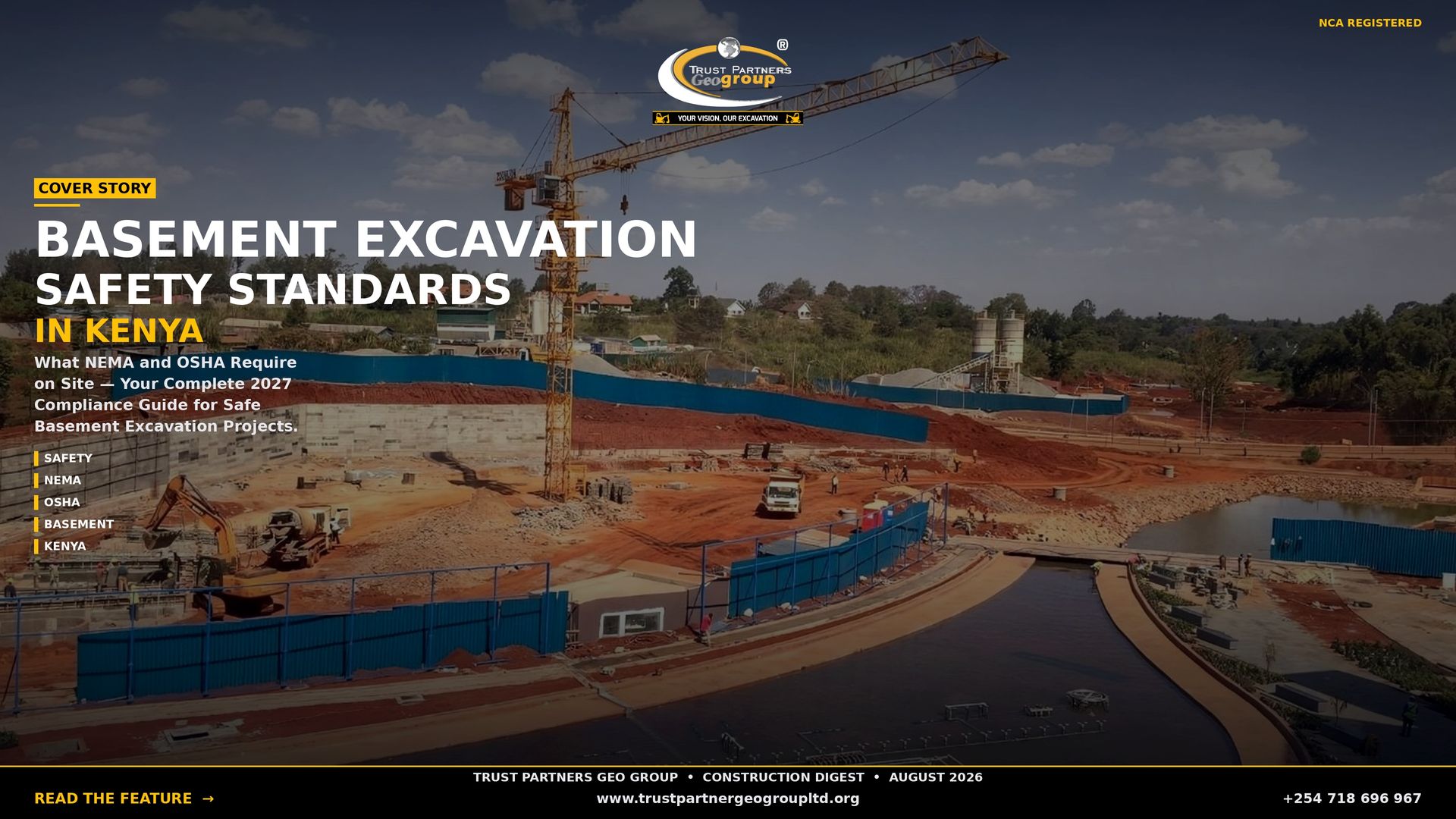
Basement Excavation Safety Standards in Kenya: What NEMA and OSHA Require on Site [2027]
The Compliance Blueprint for Safe, Legal and Zero-Incident Earthworks
Every basement excavation in Kenya operates at the intersection of three regulatory regimes: NEMA's environmental controls, DOSH's occupational safety mandates, and county-level building and traffic permits. Get any one wrong, and your project faces stop-work orders, criminal liability or — worst of all — a preventable fatality. This guide is the 2027 compliance reference for site managers, safety officers and project engineers supervising basement excavation in Nairobi, Kiambu, Kajiado and Machakos. For method-specific excavation planning, see our guide on bulk vs selective excavation methods.

NCA-registered excavation contractors with 15+ years of NEMA-compliant, OSHA-standard basement excavation across Nairobi, Kiambu, Kajiado, Machakos and all 47 counties. Zero lost-time incidents on deep basement projects since 2019.
Regulatory Overview: NEMA, DOSH and County Requirements
Basement excavation in Kenya is governed by a layered compliance framework. Understanding which authority governs which aspect prevents permit gaps and enforcement surprises:
| Regulator | Governing Law | Key Requirements | Enforcement Action |
|---|---|---|---|
| NEMA | Environmental Management and Coordination Act (EMCA) 1999, amended 2015 | EIA/EA licence, dewatering discharge permit, erosion control, rehabilitation bond | Stop-work order, fines up to KES 2M, criminal prosecution |
| DOSH | Occupational Safety and Health Act (OSHA) 2007 | Competent person, daily inspections, protective systems, PPE, incident reporting | Improvement notice, prohibition notice, prosecution for fatalities |
| County Government | County Building Codes, Physical Planning Act | Building permit, structural approval, traffic management, noise restrictions | Demolition order, stop-work, licence revocation |
| NCA | Construction Industry Registration Act | Contractor registration, project registration, skilled worker certification | De-registration, project suspension |
| Chief Inspector of Explosives | Explosives Act Cap 115 | Blasting permit for rock breaking, storage licence, blast monitoring | Imprisonment, explosives confiscation |
NEMA Environmental Compliance for Excavation Works
When Is NEMA Approval Required?
NEMA requires an Environmental Impact Assessment (EIA) or Environmental Audit (EA) for excavation projects that meet any of the following criteria:
- Site area exceeds 0.5 hectares
- Excavation depth exceeds 6 meters in environmentally sensitive areas
- Project is within 50 meters of a water body, wetland or riparian reserve
- Site has known or suspected contamination
- Excavation will generate over 10,000 m³ of spoil
- Project is in a gazetted forest, wildlife corridor or coastal zone
For smaller residential basements under 0.5 hectares with no sensitive features, a NEMA self-audit or county-level environmental approval may suffice. Always confirm with a NEMA-licensed environmental expert before assuming exemption.
Key NEMA Requirements During Excavation
| Requirement | Standard / Threshold | Penalty for Non-Compliance |
|---|---|---|
| Sediment and erosion control | Silt fences, sediment traps, stabilized haul roads | KES 500,000 – 2,000,000 fine |
| Dust suppression | Water spraying every 2 hours or dust < 150 μg/m³ PM10 | Stop-work order + KES 200,000 fine |
| Dewatering discharge | NEMA discharge permit; pH 6.5–8.5; suspended solids < 50 mg/L | Criminal prosecution + KES 1M fine |
| Noise control | < 65 dB daytime, < 55 dB nighttime at site boundary | KES 100,000 – 500,000 fine |
| Topsoil preservation | Strip and stockpile upper 300mm; reuse for rehabilitation | Rehabilitation bond forfeiture |
| Spoil disposal documentation | Waste manifest for every load; approved dump site receipt | KES 300,000 fine + cleanup liability |
| Rehabilitation bond | 2–5% of project value held until site restoration | Forfeiture + mandatory restoration |
Read our complete construction compliance guide for county-specific permit requirements and processing timelines.
OSHA and DOSH: Trench Safety and Protective Systems
Kenyan OSHA 2007 vs US OSHA Standards
While Kenyan contractors often reference US OSHA trench safety tables, the legally binding standard is the Kenyan Occupational Safety and Health Act 2007, enforced by DOSH. The two frameworks are broadly aligned but differ in specifics:
| Parameter | US OSHA 29 CFR 1926 | Kenyan OSHA 2007 / DOSH |
|---|---|---|
| Shoring trigger depth | 1.5 m (5 ft) for trenches | 1.5 m for excavations; 1.2 m for trenches in Type C soil |
| Competent person | Required; training-based qualification | Required; diploma/degree + site-specific training recommended |
| Daily inspection | Before each shift and after events | Before each shift; after rain, vibration, soil changes |
| Access/egress | Ladder within 7.5 m lateral travel | Ladder within 7.5 m; stairway for excavations > 3.5 m |
| Spoil placement | Minimum 0.6 m from edge | Minimum 1.0 m from edge; berm or barrier required |
| Atmospheric testing | Required for excavations > 1.2 m in contaminated soil | Required for excavations > 1.5 m or known contamination |
Protective System Selection
DOSH recognizes three protective systems for excavations over 1.5 meters:
- Sloping and benching: Cut back excavation walls to a stable angle. Type A soil (cohesive clay): 0.75:1 (53°). Type B soil (angular gravel, silt): 1:1 (45°). Type C soil (granular, saturated): 1.5:1 (34°). Nairobi's black cotton soil is typically Type C — requiring the flattest slope.
- Shoring: Aluminum hydraulic shores, timber shoring or trench boxes. Standard for trenches and confined urban basements where sloping is impossible.
- Shielding: Trench boxes and man cages that protect workers but do not prevent cave-ins. Used in stable soils where shoring is impractical.
Permits and Licences Required Before Breaking Ground
The following permits must be in place before the first bucket of soil is moved:
- NEMA EIA Licence or EA Report — Apply through a NEMA-registered lead expert. Timeline: 4–8 weeks for EA; 12–16 weeks for full EIA.
- County Building Permit — Submit structural drawings, geotechnical report and method statement to the county physical planning department. Timeline: 2–6 weeks.
- NCA Project Registration — Register the project on the NCA portal with the registered contractor's details. Timeline: 1–2 weeks.
- NCA Contractor Registration — Verify your excavation contractor is NCA-registered for the appropriate category and class. Review NCA registration requirements for excavation works.
- Dewatering Discharge Permit — Required from NEMA if groundwater will be pumped. Requires water quality baseline and discharge point approval. Timeline: 3–4 weeks.
- Traffic Management Permit — From the county transport department if haul trucks use public roads. Requires route plan, truck schedules and dust control measures.
- Blasting Permit — From the Chief Inspector of Explosives if rock breaking by blasting is required. Requires blast design, vibration monitoring plan and community notification. Timeline: 4–8 weeks.
- Archaeological Clearance — From the National Museums of Kenya if the site is in a gazetted zone or if archaeological features are discovered during excavation.
The Eight Critical Excavation Hazards on Kenyan Sites
Based on DOSH incident data and Trust Partners Geo-Group's internal safety records, these are the eight hazards that cause the majority of excavation-related injuries and fatalities in Kenya:
| Hazard | Cause | Control Measure | Kenyan Incident Frequency |
|---|---|---|---|
| Cave-ins | Unshored walls, vibration, water ingress, Type C soil | Shoring/sloping, daily inspection, dewatering, exclusion zones | High — leading cause of fatality |
| Falls | Unprotected edges, no guardrails, poor lighting | Perimeter guardrails, warning lines, edge protection, lighting | Moderate |
| Struck-by | Falling spoil, swinging loads, equipment backing | Spoil berms, spotters, exclusion zones, reversing alarms | Moderate |
| Asphyxiation | Confined space, hazardous atmosphere, oxygen depletion | Atmospheric testing, ventilation, confined space rescue plan | Low but fatal |
| Drowning | Groundwater surge, burst pipes, flash flooding | Dewatering systems, sump pumps, emergency evacuation plan | Moderate — seasonal |
| Electrocution | Overhead power lines, buried cables, generator faults | Utility mapping, safe approach distances, lock-out/tag-out | Low but fatal |
| Vehicle collisions | ADT operations at excavation edges, poor visibility | Banksmen, edge barriers, designated haul routes, lighting | Moderate |
| Hazardous atmosphere | Contaminated soil, methane, hydrogen sulfide | Gas monitoring, forced ventilation, breathing apparatus | Low — increasing in industrial zones |
Site Safety Checklist: Daily, Weekly and Event-Triggered Inspections
Daily Pre-Shift Inspection (Competent Person)
- Excavation walls checked for cracks, slumping or water seepage
- Shoring systems inspected for damage, displacement or overloading
- Spoil piles verified at minimum 1.0 m from edge
- Access ladders / stairways secure and unobstructed
- Dewatering pumps operational; sumps clear
- Perimeter fencing, signage and lighting functional
- PPE compliance: hard hats, high-visibility vests, steel-toe boots, gloves
- Toolbox talk conducted and attendance recorded
- Emergency rescue equipment checked and accessible
- Weather forecast reviewed; rain contingency activated if required
Weekly Inspection (Site Manager + Safety Officer)
- Review all daily inspection logs for trends
- Check shoring design against as-built excavation profile
- Verify spoil disposal documentation and dump site receipts
- Inspect dewatering discharge quality and NEMA compliance
- Test emergency communication systems
- Audit PPE stock and replacement schedule
- Review near-miss reports and corrective actions
Event-Triggered Inspection (Immediate)
- After every rain event: Check for wall saturation, sump overflow, access route erosion
- After vibration event: Inspect shoring, wall stability, adjacent building settlement markers
- After soil change: Reclassify soil type; adjust protective system if Type C encountered
- After utility strike: Isolate, evacuate, notify, investigate before resuming
- After any injury or near-miss: Full stop-work investigation; DOSH notification within 24 hours for lost-time incidents
The Competent Person: Qualifications, Duties and Authority
The competent person is the single most important safety role on an excavation site. Under Kenyan OSHA 2007, the competent person must:
- Have training and experience to identify excavation hazards
- Have authority to take corrective measures — including stopping work
- Conduct daily inspections and document findings
- Classify soil types and select appropriate protective systems
- Coordinate with DOSH inspectors and respond to enforcement actions
Trust Partners Geo-Group requires its competent persons to hold:
- Diploma or degree in civil engineering, construction management or occupational health and safety
- Minimum 5 years of excavation site experience
- Current first aid and fire safety certification
- Site-specific excavation safety training (internal or NEMA-accredited)
- Authority to issue stop-work orders without consulting project management
Vetting your excavation contractor's safety credentials is as important as checking their equipment fleet.
Emergency Rescue Planning for Deep Excavations
Every excavation over 1.5 meters deep must have a written emergency rescue plan. For basements over 6 meters — where ladder egress is impractical — the plan must include:
- Rescue equipment on-site: Tripod and winch system rated for 300 kg, full-body harnesses, rescue ropes, first aid trauma kits, AED (for excavations > 10 workers)
- Trained rescue personnel: Minimum 2 workers per shift with current rescue training certification
- Communication protocol: Dedicated radio channel, emergency contact list (ambulance, fire, police, hospital), 24-hour emergency number posted at site entrance
- Scenario-specific procedures:
- Cave-in: Do not attempt unshored rescue. Call emergency services. Use listening devices. Only trained rescue team enters with shoring.
- Drowning: Cut power to all electrical equipment. Deploy sump pumps. Evacuate via designated routes. Account for all personnel.
- Electrocution: Do not touch victim until power is isolated. Call ambulance. Begin CPR if qualified. Preserve scene for investigation.
- Hazardous atmosphere: Do not enter without SCBA. Force ventilation. Monitor gas levels continuously. Standby rescue team in breathing apparatus.
- Hospital coordination: Pre-identify receiving hospital with trauma capability. Confirm ambulance response time (target: < 20 minutes in Nairobi CBD; < 45 minutes in satellite areas)
Penalties for Non-Compliance: Fines, Stop-Work and Prosecution
| Violation | Regulator | Penalty | Real-World Impact |
|---|---|---|---|
| Excavation without NEMA licence | NEMA | KES 500,000 – 2,000,000 fine; up to 2 years imprisonment | Stop-work order; project delay 8–16 weeks |
| Unshored excavation > 1.5m | DOSH | Prohibition notice; KES 100,000 – 500,000 fine | Immediate stop-work; contractor blacklisting risk |
| Fatality without DOSH notification | DOSH | Criminal prosecution; KES 1M+ fine; imprisonment | Project suspension; contractor de-registration |
| Dewatering discharge without permit | NEMA | KES 300,000 – 1,000,000 fine; cleanup liability | Environmental damage claim from downstream landowners |
| Construction without county permit | County | Demolition order; KES 200,000 – 1,000,000 fine | Complete loss of sunk investment |
| Unregistered contractor (NCA) | NCA | De-registration; project suspension | Insurance void; bank financing withdrawal |
| Blasting without permit | Chief Inspector | Imprisonment up to 7 years; explosives confiscation | Criminal record; permanent licence revocation |
Frequently Asked Questions
What are the key NEMA requirements for excavation projects in Kenya?
NEMA requires an Environmental Impact Assessment (EIA) or Environmental Audit (EA) for excavation projects over 0.5 hectares or within 50 meters of water bodies. Key requirements include sediment and erosion control, dust suppression, dewatering discharge permits, topsoil preservation, hazardous material handling plans, and rehabilitation bonds. Failure to comply can result in stop-work orders, fines up to KES 2 million, and criminal prosecution under the Environmental Management and Coordination Act.
Does OSHA apply to excavation sites in Kenya?
OSHA is a US standard, but Kenyan construction sites frequently adopt OSHA trench safety protocols as best practice, particularly on projects with international financing or foreign contractors. Kenya's primary safety legislation is the Occupational Safety and Health Act (OSHA) 2007, enforced by the Directorate of Occupational Safety and Health Services (DOSH). The Kenyan OSHA mandates trench shoring for excavations over 1.5 meters deep, competent person oversight, daily inspection logs, and emergency rescue plans.
How deep can you excavate without shoring in Kenya?
Under Kenyan OSHA 2007 and DOSH guidelines, excavations over 1.5 meters deep require protective systems — shoring, benching, or sloping — unless a geotechnical engineer certifies the soil as stable and the excavation is continuously monitored. For trenches, the standard is more stringent: any trench over 1.2 meters deep in Type C soil (cohesive or granular with water) requires shoring. Excavations in Nairobi's black cotton soil or high-water-table zones like Parklands require shoring regardless of depth.
What permits are required before starting basement excavation in Nairobi?
Required permits include: (1) NEMA Environmental Impact Assessment licence or Environmental Audit report; (2) County building permit with approved structural drawings; (3) NCA project registration and contractor registration; (4) Dewatering discharge permit from NEMA if groundwater will be pumped; (5) Traffic management permit from the county if haulage affects public roads; (6) Blasting permit from the Chief Inspector of Explosives if rock breaking is required. Processing time ranges from 4–12 weeks.
What is a competent person in excavation safety?
A competent person is an individual designated by the employer who has training and experience to identify hazards in excavation works and has the authority to take corrective measures. In Kenya, DOSH recommends the competent person hold a diploma or degree in civil engineering, construction management or occupational health and safety, plus site-specific excavation safety training. Trust Partners Geo-Group assigns a competent person to every basement excavation project over 1.5 meters deep.
What are the most common excavation hazards on Kenyan construction sites?
The most common hazards are: (1) Cave-ins and sidewall collapse — responsible for the majority of excavation fatalities; (2) Falls into unprotected excavations; (3) Struck-by incidents from falling spoil, tools or equipment; (4) Asphyxiation in confined excavation spaces; (5) Drowning from groundwater ingress or burst pipes; (6) Electrocution from contact with overhead power lines or buried cables; (7) Vehicle collisions at excavation edges; (8) Exposure to hazardous atmospheres in deep or contaminated excavations.
How often must excavations be inspected for safety in Kenya?
DOSH requires daily inspection of all excavations by a competent person before each shift begins. Additional inspections are mandatory after: every rain event, every vibration event from nearby traffic or construction, any change in soil conditions, and after placement or removal of shoring systems. Inspection records must be kept on-site for the duration of the project and retained for 3 years post-completion. Trust Partners Geo-Group uses digital inspection apps with photo documentation for real-time compliance tracking.
What should an excavation emergency rescue plan include?
An excavation emergency rescue plan must include: identified rescue equipment on-site (tripods, harnesses, winches, first aid kits); trained rescue personnel with current certification; communication protocols (radio frequencies, emergency contacts for ambulance, fire and police); evacuation routes from the excavation zone; procedures for cave-in, drowning, electrocution and hazardous atmosphere scenarios; and coordination with local emergency services. For excavations over 6 meters deep, a standby rescue team from a certified provider is recommended.
Ensure Full Compliance on Your Next Excavation Project
Contact Trust Partners Geo-Group at +254 718 686 967 for NEMA-compliant, OSHA-standard basement excavation with zero lost-time incidents since 2019. Serving Nairobi, Kitengela, Athi River, Ruaka, Ngong, Naivasha, Nanyuki and all 47 counties.
Call +254 718 686 967 Request Safety Compliance AuditBasement Excavation Safety Standards in Kenya: What NEMA and OSHA Require on Site [2027]
The Compliance Blueprint for Safe, Legal and Zero-Incident Earthworks
Every basement excavation in Kenya operates at the intersection of three regulatory regimes: NEMA's environmental controls, DOSH's occupational safety mandates, and county-level building and traffic permits. Get any one wrong, and your project faces stop-work orders, criminal liability or — worst of all — a preventable fatality. This guide is the 2027 compliance reference for site managers, safety officers and project engineers supervising basement excavation in Nairobi, Kiambu, Kajiado and Machakos. For method-specific excavation planning, see our guide on bulk vs selective excavation methods.
NCA-registered excavation contractors with 15+ years of NEMA-compliant, OSHA-standard basement excavation across Nairobi, Kiambu, Kajiado, Machakos and all 47 counties. Zero lost-time incidents on deep basement projects since 2019.
Regulatory Overview: NEMA, DOSH and County Requirements
Basement excavation in Kenya is governed by a layered compliance framework. Understanding which authority governs which aspect prevents permit gaps and enforcement surprises:
| Regulator | Governing Law | Key Requirements | Enforcement Action |
|---|---|---|---|
| NEMA | Environmental Management and Coordination Act (EMCA) 1999, amended 2015 | EIA/EA licence, dewatering discharge permit, erosion control, rehabilitation bond | Stop-work order, fines up to KES 2M, criminal prosecution |
| DOSH | Occupational Safety and Health Act (OSHA) 2007 | Competent person, daily inspections, protective systems, PPE, incident reporting | Improvement notice, prohibition notice, prosecution for fatalities |
| County Government | County Building Codes, Physical Planning Act | Building permit, structural approval, traffic management, noise restrictions | Demolition order, stop-work, licence revocation |
| NCA | Construction Industry Registration Act | Contractor registration, project registration, skilled worker certification | De-registration, project suspension |
| Chief Inspector of Explosives | Explosives Act Cap 115 | Blasting permit for rock breaking, storage licence, blast monitoring | Imprisonment, explosives confiscation |
NEMA Environmental Compliance for Excavation Works
When Is NEMA Approval Required?
NEMA requires an Environmental Impact Assessment (EIA) or Environmental Audit (EA) for excavation projects that meet any of the following criteria:
- Site area exceeds 0.5 hectares
- Excavation depth exceeds 6 meters in environmentally sensitive areas
- Project is within 50 meters of a water body, wetland or riparian reserve
- Site has known or suspected contamination
- Excavation will generate over 10,000 m³ of spoil
- Project is in a gazetted forest, wildlife corridor or coastal zone
For smaller residential basements under 0.5 hectares with no sensitive features, a NEMA self-audit or county-level environmental approval may suffice. Always confirm with a NEMA-licensed environmental expert before assuming exemption.
Key NEMA Requirements During Excavation
| Requirement | Standard / Threshold | Penalty for Non-Compliance |
|---|---|---|
| Sediment and erosion control | Silt fences, sediment traps, stabilized haul roads | KES 500,000 – 2,000,000 fine |
| Dust suppression | Water spraying every 2 hours or dust < 150 μg/m³ PM10 | Stop-work order + KES 200,000 fine |
| Dewatering discharge | NEMA discharge permit; pH 6.5–8.5; suspended solids < 50 mg/L | Criminal prosecution + KES 1M fine |
| Noise control | < 65 dB daytime, < 55 dB nighttime at site boundary | KES 100,000 – 500,000 fine |
| Topsoil preservation | Strip and stockpile upper 300mm; reuse for rehabilitation | Rehabilitation bond forfeiture |
| Spoil disposal documentation | Waste manifest for every load; approved dump site receipt | KES 300,000 fine + cleanup liability |
| Rehabilitation bond | 2–5% of project value held until site restoration | Forfeiture + mandatory restoration |
Read our complete construction compliance guide for county-specific permit requirements and processing timelines.
OSHA and DOSH: Trench Safety and Protective Systems
Kenyan OSHA 2007 vs US OSHA Standards
While Kenyan contractors often reference US OSHA trench safety tables, the legally binding standard is the Kenyan Occupational Safety and Health Act 2007, enforced by DOSH. The two frameworks are broadly aligned but differ in specifics:
| Parameter | US OSHA 29 CFR 1926 | Kenyan OSHA 2007 / DOSH |
|---|---|---|
| Shoring trigger depth | 1.5 m (5 ft) for trenches | 1.5 m for excavations; 1.2 m for trenches in Type C soil |
| Competent person | Required; training-based qualification | Required; diploma/degree + site-specific training recommended |
| Daily inspection | Before each shift and after events | Before each shift; after rain, vibration, soil changes |
| Access/egress | Ladder within 7.5 m lateral travel | Ladder within 7.5 m; stairway for excavations > 3.5 m |
| Spoil placement | Minimum 0.6 m from edge | Minimum 1.0 m from edge; berm or barrier required |
| Atmospheric testing | Required for excavations > 1.2 m in contaminated soil | Required for excavations > 1.5 m or known contamination |
Protective System Selection
DOSH recognizes three protective systems for excavations over 1.5 meters:
- Sloping and benching: Cut back excavation walls to a stable angle. Type A soil (cohesive clay): 0.75:1 (53°). Type B soil (angular gravel, silt): 1:1 (45°). Type C soil (granular, saturated): 1.5:1 (34°). Nairobi's black cotton soil is typically Type C — requiring the flattest slope.
- Shoring: Aluminum hydraulic shores, timber shoring or trench boxes. Standard for trenches and confined urban basements where sloping is impossible.
- Shielding: Trench boxes and man cages that protect workers but do not prevent cave-ins. Used in stable soils where shoring is impractical.
Permits and Licences Required Before Breaking Ground
The following permits must be in place before the first bucket of soil is moved:
- NEMA EIA Licence or EA Report — Apply through a NEMA-registered lead expert. Timeline: 4–8 weeks for EA; 12–16 weeks for full EIA.
- County Building Permit — Submit structural drawings, geotechnical report and method statement to the county physical planning department. Timeline: 2–6 weeks.
- NCA Project Registration — Register the project on the NCA portal with the registered contractor's details. Timeline: 1–2 weeks.
- NCA Contractor Registration — Verify your excavation contractor is NCA-registered for the appropriate category and class. Review NCA registration requirements for excavation works.
- Dewatering Discharge Permit — Required from NEMA if groundwater will be pumped. Requires water quality baseline and discharge point approval. Timeline: 3–4 weeks.
- Traffic Management Permit — From the county transport department if haul trucks use public roads. Requires route plan, truck schedules and dust control measures.
- Blasting Permit — From the Chief Inspector of Explosives if rock breaking by blasting is required. Requires blast design, vibration monitoring plan and community notification. Timeline: 4–8 weeks.
- Archaeological Clearance — From the National Museums of Kenya if the site is in a gazetted zone or if archaeological features are discovered during excavation.
The Eight Critical Excavation Hazards on Kenyan Sites
Based on DOSH incident data and Trust Partners Geo-Group's internal safety records, these are the eight hazards that cause the majority of excavation-related injuries and fatalities in Kenya:
| Hazard | Cause | Control Measure | Kenyan Incident Frequency |
|---|---|---|---|
| Cave-ins | Unshored walls, vibration, water ingress, Type C soil | Shoring/sloping, daily inspection, dewatering, exclusion zones | High — leading cause of fatality |
| Falls | Unprotected edges, no guardrails, poor lighting | Perimeter guardrails, warning lines, edge protection, lighting | Moderate |
| Struck-by | Falling spoil, swinging loads, equipment backing | Spoil berms, spotters, exclusion zones, reversing alarms | Moderate |
| Asphyxiation | Confined space, hazardous atmosphere, oxygen depletion | Atmospheric testing, ventilation, confined space rescue plan | Low but fatal |
| Drowning | Groundwater surge, burst pipes, flash flooding | Dewatering systems, sump pumps, emergency evacuation plan | Moderate — seasonal |
| Electrocution | Overhead power lines, buried cables, generator faults | Utility mapping, safe approach distances, lock-out/tag-out | Low but fatal |
| Vehicle collisions | ADT operations at excavation edges, poor visibility | Banksmen, edge barriers, designated haul routes, lighting | Moderate |
| Hazardous atmosphere | Contaminated soil, methane, hydrogen sulfide | Gas monitoring, forced ventilation, breathing apparatus | Low — increasing in industrial zones |
Site Safety Checklist: Daily, Weekly and Event-Triggered Inspections
Daily Pre-Shift Inspection (Competent Person)
- Excavation walls checked for cracks, slumping or water seepage
- Shoring systems inspected for damage, displacement or overloading
- Spoil piles verified at minimum 1.0 m from edge
- Access ladders / stairways secure and unobstructed
- Dewatering pumps operational; sumps clear
- Perimeter fencing, signage and lighting functional
- PPE compliance: hard hats, high-visibility vests, steel-toe boots, gloves
- Toolbox talk conducted and attendance recorded
- Emergency rescue equipment checked and accessible
- Weather forecast reviewed; rain contingency activated if required
Weekly Inspection (Site Manager + Safety Officer)
- Review all daily inspection logs for trends
- Check shoring design against as-built excavation profile
- Verify spoil disposal documentation and dump site receipts
- Inspect dewatering discharge quality and NEMA compliance
- Test emergency communication systems
- Audit PPE stock and replacement schedule
- Review near-miss reports and corrective actions
Event-Triggered Inspection (Immediate)
- After every rain event: Check for wall saturation, sump overflow, access route erosion
- After vibration event: Inspect shoring, wall stability, adjacent building settlement markers
- After soil change: Reclassify soil type; adjust protective system if Type C encountered
- After utility strike: Isolate, evacuate, notify, investigate before resuming
- After any injury or near-miss: Full stop-work investigation; DOSH notification within 24 hours for lost-time incidents
The Competent Person: Qualifications, Duties and Authority
The competent person is the single most important safety role on an excavation site. Under Kenyan OSHA 2007, the competent person must:
- Have training and experience to identify excavation hazards
- Have authority to take corrective measures — including stopping work
- Conduct daily inspections and document findings
- Classify soil types and select appropriate protective systems
- Coordinate with DOSH inspectors and respond to enforcement actions
Trust Partners Geo-Group requires its competent persons to hold:
- Diploma or degree in civil engineering, construction management or occupational health and safety
- Minimum 5 years of excavation site experience
- Current first aid and fire safety certification
- Site-specific excavation safety training (internal or NEMA-accredited)
- Authority to issue stop-work orders without consulting project management
Vetting your excavation contractor's safety credentials is as important as checking their equipment fleet.
Emergency Rescue Planning for Deep Excavations
Every excavation over 1.5 meters deep must have a written emergency rescue plan. For basements over 6 meters — where ladder egress is impractical — the plan must include:
- Rescue equipment on-site: Tripod and winch system rated for 300 kg, full-body harnesses, rescue ropes, first aid trauma kits, AED (for excavations > 10 workers)
- Trained rescue personnel: Minimum 2 workers per shift with current rescue training certification
- Communication protocol: Dedicated radio channel, emergency contact list (ambulance, fire, police, hospital), 24-hour emergency number posted at site entrance
- Scenario-specific procedures:
- Cave-in: Do not attempt unshored rescue. Call emergency services. Use listening devices. Only trained rescue team enters with shoring.
- Drowning: Cut power to all electrical equipment. Deploy sump pumps. Evacuate via designated routes. Account for all personnel.
- Electrocution: Do not touch victim until power is isolated. Call ambulance. Begin CPR if qualified. Preserve scene for investigation.
- Hazardous atmosphere: Do not enter without SCBA. Force ventilation. Monitor gas levels continuously. Standby rescue team in breathing apparatus.
- Hospital coordination: Pre-identify receiving hospital with trauma capability. Confirm ambulance response time (target: < 20 minutes in Nairobi CBD; < 45 minutes in satellite areas)
Penalties for Non-Compliance: Fines, Stop-Work and Prosecution
| Violation | Regulator | Penalty | Real-World Impact |
|---|---|---|---|
| Excavation without NEMA licence | NEMA | KES 500,000 – 2,000,000 fine; up to 2 years imprisonment | Stop-work order; project delay 8–16 weeks |
| Unshored excavation > 1.5m | DOSH | Prohibition notice; KES 100,000 – 500,000 fine | Immediate stop-work; contractor blacklisting risk |
| Fatality without DOSH notification | DOSH | Criminal prosecution; KES 1M+ fine; imprisonment | Project suspension; contractor de-registration |
| Dewatering discharge without permit | NEMA | KES 300,000 – 1,000,000 fine; cleanup liability | Environmental damage claim from downstream landowners |
| Construction without county permit | County | Demolition order; KES 200,000 – 1,000,000 fine | Complete loss of sunk investment |
| Unregistered contractor (NCA) | NCA | De-registration; project suspension | Insurance void; bank financing withdrawal |
| Blasting without permit | Chief Inspector | Imprisonment up to 7 years; explosives confiscation | Criminal record; permanent licence revocation |
Frequently Asked Questions
What are the key NEMA requirements for excavation projects in Kenya?
NEMA requires an Environmental Impact Assessment (EIA) or Environmental Audit (EA) for excavation projects over 0.5 hectares or within 50 meters of water bodies. Key requirements include sediment and erosion control, dust suppression, dewatering discharge permits, topsoil preservation, hazardous material handling plans, and rehabilitation bonds. Failure to comply can result in stop-work orders, fines up to KES 2 million, and criminal prosecution under the Environmental Management and Coordination Act.
Does OSHA apply to excavation sites in Kenya?
OSHA is a US standard, but Kenyan construction sites frequently adopt OSHA trench safety protocols as best practice, particularly on projects with international financing or foreign contractors. Kenya's primary safety legislation is the Occupational Safety and Health Act (OSHA) 2007, enforced by the Directorate of Occupational Safety and Health Services (DOSH). The Kenyan OSHA mandates trench shoring for excavations over 1.5 meters deep, competent person oversight, daily inspection logs, and emergency rescue plans.
How deep can you excavate without shoring in Kenya?
Under Kenyan OSHA 2007 and DOSH guidelines, excavations over 1.5 meters deep require protective systems — shoring, benching, or sloping — unless a geotechnical engineer certifies the soil as stable and the excavation is continuously monitored. For trenches, the standard is more stringent: any trench over 1.2 meters deep in Type C soil (cohesive or granular with water) requires shoring. Excavations in Nairobi's black cotton soil or high-water-table zones like Parklands require shoring regardless of depth.
What permits are required before starting basement excavation in Nairobi?
Required permits include: (1) NEMA Environmental Impact Assessment licence or Environmental Audit report; (2) County building permit with approved structural drawings; (3) NCA project registration and contractor registration; (4) Dewatering discharge permit from NEMA if groundwater will be pumped; (5) Traffic management permit from the county if haulage affects public roads; (6) Blasting permit from the Chief Inspector of Explosives if rock breaking is required. Processing time ranges from 4–12 weeks.
What is a competent person in excavation safety?
A competent person is an individual designated by the employer who has training and experience to identify hazards in excavation works and has the authority to take corrective measures. In Kenya, DOSH recommends the competent person hold a diploma or degree in civil engineering, construction management or occupational health and safety, plus site-specific excavation safety training. Trust Partners Geo-Group assigns a competent person to every basement excavation project over 1.5 meters deep.
What are the most common excavation hazards on Kenyan construction sites?
The most common hazards are: (1) Cave-ins and sidewall collapse — responsible for the majority of excavation fatalities; (2) Falls into unprotected excavations; (3) Struck-by incidents from falling spoil, tools or equipment; (4) Asphyxiation in confined excavation spaces; (5) Drowning from groundwater ingress or burst pipes; (6) Electrocution from contact with overhead power lines or buried cables; (7) Vehicle collisions at excavation edges; (8) Exposure to hazardous atmospheres in deep or contaminated excavations.
How often must excavations be inspected for safety in Kenya?
DOSH requires daily inspection of all excavations by a competent person before each shift begins. Additional inspections are mandatory after: every rain event, every vibration event from nearby traffic or construction, any change in soil conditions, and after placement or removal of shoring systems. Inspection records must be kept on-site for the duration of the project and retained for 3 years post-completion. Trust Partners Geo-Group uses digital inspection apps with photo documentation for real-time compliance tracking.
What should an excavation emergency rescue plan include?
An excavation emergency rescue plan must include: identified rescue equipment on-site (tripods, harnesses, winches, first aid kits); trained rescue personnel with current certification; communication protocols (radio frequencies, emergency contacts for ambulance, fire and police); evacuation routes from the excavation zone; procedures for cave-in, drowning, electrocution and hazardous atmosphere scenarios; and coordination with local emergency services. For excavations over 6 meters deep, a standby rescue team from a certified provider is recommended.
Ensure Full Compliance on Your Next Excavation Project
Contact Trust Partners Geo-Group at +254 718 686 967 for NEMA-compliant, OSHA-standard basement excavation with zero lost-time incidents since 2019. Serving Nairobi, Kitengela, Athi River, Ruaka, Ngong, Naivasha, Nanyuki and all 47 counties.
Call +254 718 686 967 Request Safety Compliance Audit