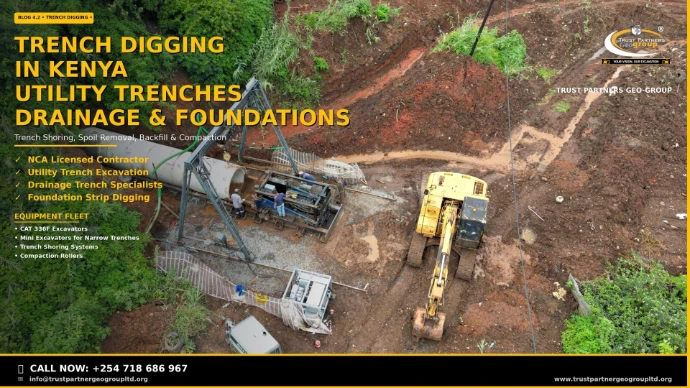
Trench Digging in Kenya: Utility Trenches, Drainage & Foundation Strip Excavation
Trenches are linear engineering: every metre has a design width, a depth, a shoring decision and a backfill specification. Here are the standards, the rates and the discipline that keep them from collapsing — literally and financially.

1. The Trench Economy: Linear Metres Rule
Trenching is bought and sold in linear metres, and the price of a metre is set by four inputs: the cross-section it must hold, the ground it must pass through, the protection it must carry, and what lies beneath the route. A 500-metre estate utility run and a 500-metre arterial water main are both 'trenches' in conversation but different orders of magnitude in fact — the first is a mini-excavator week at under KES 300,000 all-in; the second is a shored, scanned, live-corridor operation that can carry a seven-figure budget. The discipline that separates the two prices is specification: width to design, depth to formation, shoring to trigger, backfill to layer — and a contractor who prices all four. Our trench digging service runs the full specification chain from setting out to compaction certificates.
2. Trench Types & Design Dimensions
| Trench Type | Typical Width | Typical Depth | Standard & Notes |
|---|---|---|---|
| Foundation strip (residential) | 450–600 mm | 0.6–1.2 m | To engineer's drawing; formation ±50mm |
| Water service (25–50mm) | 300–450 mm | 0.75–1.0 m | Below frost line; 100mm bedding |
| Sewer lateral (100–200mm) | 600–900 mm | 1.0–1.8 m | To invert level; falls 1:60–1:80 |
| Power cable (LV/MV) | 450–600 mm | 0.9–1.2 m | Red warning tape 150mm above; half-hoops |
| Fibre/telecom | 300–450 mm | 0.6–0.9 m | Ducts on warning tape; sand surround |
| Storm drainage (300–600mm pipe) | 900–1,500 mm | 1.2–2.5 m | To invert; bedded and haunched in concrete where specified |
Width discipline pays: an over-wide trench of 100mm costs an extra 10–15% in bedding, backfill and carting per metre, multiplied by every metre of the run. Pipeline trenching practice carries the per-service detail for oil, gas, water and fibre.
3. Trench Shoring: Triggers, Systems & Costs
The trigger is 1.5 metres for any trench a worker enters; the choice follows soil, width and programme:
- Trench boxes (shields) — steel walls the crew works between; the fastest system at KES 500–1,500 per metre; suits uniform sections and fast programmes.
- Hydraulic shoring — jacks and plates adapting to variable widths; mid-cost, flexible where services cross.
- Benching/battering — stepped or sloped sides where space allows; free of steel but doubles excavation width and spoil.
- Sheeted faces — on deep drainage in unstable ground; full shoring cost, full protection.
⚠️ The statistic that prices shoring
Trench collapses kill more construction workers than any other excavation failure mode, and the fatalities cluster in trenches under 2.5 metres deep — the 'shallow enough to skip it' band. Shoring at 15–30% of trench cost is the cheapest life insurance and the cheapest schedule insurance in earthworks. Any quote without a shoring line is not cheaper; it is unpriced.
4. Utility Avoidance: The Real Strike Costs
The strike ledger, priced honestly: a cut LV service — hours of outage and a KES 50K–200K repair; a struck 11kV line — burns, arc-flash, KES 500K+ in damage and a criminal report; a burst 300mm water main — flooding, road damage and six-figure municipal claims; a cut fibre trunk — carrier penalties calculated per minute. Against these, the avoidance protocol costs little: records review (days), electromagnetic scanning (KES 150–400 per 100m of alignment), trial holes at crossings (KES 3,000–8,000 each), and spotter discipline on the day (hours). The ratio is at least ten to one in favour of the protocol, every single time — and on Nairobi's undocumented corridors, the scan finds services on nearly every alignment.
5. Backfill & Compaction: The Layer Cake
Backfill is the invisible half of the trench — and the half that surfaces, literally, when it fails. The specification that holds: bedding of 75–100mm compacted sand under and around the service, protecting from point loads; sidefill to +150mm over the service, placed in 150mm layers and compacted; general backfill in 200mm compacted layers to surface; compaction at 90–95% Proctor under pavements, verified by density testing where specified. Material rules: no topsoil, no organics, no rubble in any layer — trench spoil rarely qualifies untreated. Costed: KES 150–350 per metre to do it right, against KES 2,000–5,000 per metre to reopen and redo a settled trench beneath cracked paving.
6. Production Rates & Cost per Metre
| Trench (soil, unshored) | Daily Production | Cost per m (2026) |
|---|---|---|
| Foundation strip 450×900mm | 150–250 m (mini) | 250–450 |
| Utility 600×1,200mm | 200–400 m (midi/20t) | 350–600 |
| Drainage 1,200×1,500mm | 80–150 m (20t) | 600–1,200 |
| Add shoring below 1.5m | −20–30% production | +150–400 per m |
| Add rock breaking | 15–40 m/day | +900–2,500 per m |
| Machine + operator (day) | — | Mini 12–18K; 20t 15–22K |
Compare quotes against these bands line by line; a 'cheap' per-metre rate that excludes shoring, carting or layered backfill will collect the difference later, with interest.
7. Machine Selection by Trench Type
- Minis (1–5t) — 300–600mm trenches in estates and live corridors; precision over production; KES 8,000–15,000/day.
- Midis (8–14t) — 600–900mm utility trenches at doubled production.
- 20-ton standard — 1.2m+ drainage and formation trenches at full rate where access allows.
- The corridor rule — in scanned utility zones, the smallest machine that fits the trench wins: precision beats production when a strike costs a fortune. Certified operators — the certification standard matters more in a trench than anywhere else, because the margins are centimetres and the consequences are catastrophic.
8. Frequently Asked Questions
Trench costs price per linear metre against width, depth, ground and shoring — the honest 2026 bands: a 450mm-wide foundation strip trench at 0.9m depth in ordinary soil runs KES 250–450 per metre; a 600mm utility trench at 1.2m runs KES 350–600 per metre; a 1.2m drainage trench at 1.5m depth runs KES 600–1,200 per metre; and anything deeper than 1.5m or through rock adds shoring or breaking on top. Production context: a mini excavator digs 80–150 metres of light trench per day in good soil, a 20-ton machine 200–400 metres — so a 500-metre estate utility run is a 2–3 day job, not a two-week one. Machine-and-operator day rates are the usual contract basis: minis at KES 12,000–18,000, 20-ton units at KES 15,000–22,000. Compare quotes per metre against these bands — anything far below is missing shoring, carting or backfill.
The regulatory trigger is 1.5 metres — OSHA-aligned practice and Kenyan safety standards require protective systems for any trench deeper than 1.5 m where workers enter, and common sense extends that: sandy or waterlogged soils move at shallower depths, and even 1.2 m trenches have buried workers where soil sloughed. The systems: trench boxes (steel shields the crew works within — fastest to deploy at KES 500–1,500 per metre of trench); hydraulic shoring (jacks and plates — flexible for variable widths); and benching or battering where space and soil allow. The cost insight: shoring runs 15–30% of trench cost and turns a rescue-risk job into a routine one. The question to ask any trench contractor is not whether shoring is included but which system, at what trigger depth, on whose rate — the answers separate professionals from gamblers.
Backfill is where trench quality is decided — and where cheap work shows up two rainy seasons later as settlement cracks across your pavement. The specification: bedding — 75–100mm of compacted sand or fine fill under and around pipes and cables, protecting them from point loads; sidefill placed and compacted in 150mm layers to 150mm above the service; then general backfill in 200mm compacted layers. Compaction targets: 90–95% of maximum dry density (Proctor) under pavements and structures, verified by density testing where the engineer specifies. Material rules: no topsoil, no rubble, no organic matter in any layer; excavated trench spoil rarely qualifies untreated. The cost of doing it right: KES 150–350 per metre of trench for bedding and layered compaction — against the KES 2,000–5,000 per metre it costs to re-open and redo a failed backfill beneath a cracked driveway.
Utility strikes are the most expensive surprise in trenching — a cut 11kV cable or a burst 300mm water main costs multiples of the entire trench contract, before the outage penalties and the reputational damage. The professional sequence: drawings review against Kenya Power, Nairobi Water and telecom records first; electromagnetic scanning of the alignment second — locating metallic services to within decimetres; then trial holes by hand or vacuum excavation at every crossing and every 20–30 metres of uncertainty, exposing services before the machine arrives. On-site discipline: machine buckets never enter the scan's exclusion zone without visual confirmation, spotters control every crossing, and services found unmapped are recorded and reported. On Nairobi's older corridors, assume undocumented services exist everywhere — the record drawings are archaeology, not geography. Our pipeline trenching practice runs this protocol on every alignment.
Match the machine to the trench cross-section and the working room. Mini excavators (1–5 ton) dig 300–600mm wide trenches in estates, gardens and between structures — the utility and residential standard, at KES 8,000–15,000 per day. Midi machines (8–14 ton) handle 600–900mm trenches with double the daily production. Standard 20-ton excavators take 1.2m+ drainage and foundation trenches at full production where access allows. Trench width discipline matters: the bucket should match the design width within 100mm — a 50% over-wide trench doubles bedding and backfill cost per metre for zero engineering benefit. And in live utility corridors, the rule is reversed: the smallest machine that fits the trench wins, because precision beats production when a strike costs a fortune.
Specify the Metre, Not the Machine.
Trust Partners Geo-Group Ltd digs trenches to specification — width, depth, shoring, bedding, layered backfill and compaction certificates — across Kenya's estates, corridors and county works. Send your alignment for a per-metre quote.
Get a Trench Digging Quote📞 +254 718 68 69 67
Trench Digging in Kenya: Utility Trenches, Drainage & Foundation Strip Excavation
Trenches are linear engineering: every metre has a design width, a depth, a shoring decision and a backfill specification. Here are the standards, the rates and the discipline that keep them from collapsing — literally and financially.
1. The Trench Economy: Linear Metres Rule
Trenching is bought and sold in linear metres, and the price of a metre is set by four inputs: the cross-section it must hold, the ground it must pass through, the protection it must carry, and what lies beneath the route. A 500-metre estate utility run and a 500-metre arterial water main are both 'trenches' in conversation but different orders of magnitude in fact — the first is a mini-excavator week at under KES 300,000 all-in; the second is a shored, scanned, live-corridor operation that can carry a seven-figure budget. The discipline that separates the two prices is specification: width to design, depth to formation, shoring to trigger, backfill to layer — and a contractor who prices all four. Our trench digging service runs the full specification chain from setting out to compaction certificates.
2. Trench Types & Design Dimensions
| Trench Type | Typical Width | Typical Depth | Standard & Notes |
|---|---|---|---|
| Foundation strip (residential) | 450–600 mm | 0.6–1.2 m | To engineer's drawing; formation ±50mm |
| Water service (25–50mm) | 300–450 mm | 0.75–1.0 m | Below frost line; 100mm bedding |
| Sewer lateral (100–200mm) | 600–900 mm | 1.0–1.8 m | To invert level; falls 1:60–1:80 |
| Power cable (LV/MV) | 450–600 mm | 0.9–1.2 m | Red warning tape 150mm above; half-hoops |
| Fibre/telecom | 300–450 mm | 0.6–0.9 m | Ducts on warning tape; sand surround |
| Storm drainage (300–600mm pipe) | 900–1,500 mm | 1.2–2.5 m | To invert; bedded and haunched in concrete where specified |
Width discipline pays: an over-wide trench of 100mm costs an extra 10–15% in bedding, backfill and carting per metre, multiplied by every metre of the run. Pipeline trenching practice carries the per-service detail for oil, gas, water and fibre.
3. Trench Shoring: Triggers, Systems & Costs
The trigger is 1.5 metres for any trench a worker enters; the choice follows soil, width and programme:
- Trench boxes (shields) — steel walls the crew works between; the fastest system at KES 500–1,500 per metre; suits uniform sections and fast programmes.
- Hydraulic shoring — jacks and plates adapting to variable widths; mid-cost, flexible where services cross.
- Benching/battering — stepped or sloped sides where space allows; free of steel but doubles excavation width and spoil.
- Sheeted faces — on deep drainage in unstable ground; full shoring cost, full protection.
⚠️ The statistic that prices shoring
Trench collapses kill more construction workers than any other excavation failure mode, and the fatalities cluster in trenches under 2.5 metres deep — the 'shallow enough to skip it' band. Shoring at 15–30% of trench cost is the cheapest life insurance and the cheapest schedule insurance in earthworks. Any quote without a shoring line is not cheaper; it is unpriced.
4. Utility Avoidance: The Real Strike Costs
The strike ledger, priced honestly: a cut LV service — hours of outage and a KES 50K–200K repair; a struck 11kV line — burns, arc-flash, KES 500K+ in damage and a criminal report; a burst 300mm water main — flooding, road damage and six-figure municipal claims; a cut fibre trunk — carrier penalties calculated per minute. Against these, the avoidance protocol costs little: records review (days), electromagnetic scanning (KES 150–400 per 100m of alignment), trial holes at crossings (KES 3,000–8,000 each), and spotter discipline on the day (hours). The ratio is at least ten to one in favour of the protocol, every single time — and on Nairobi's undocumented corridors, the scan finds services on nearly every alignment.
5. Backfill & Compaction: The Layer Cake
Backfill is the invisible half of the trench — and the half that surfaces, literally, when it fails. The specification that holds: bedding of 75–100mm compacted sand under and around the service, protecting from point loads; sidefill to +150mm over the service, placed in 150mm layers and compacted; general backfill in 200mm compacted layers to surface; compaction at 90–95% Proctor under pavements, verified by density testing where specified. Material rules: no topsoil, no organics, no rubble in any layer — trench spoil rarely qualifies untreated. Costed: KES 150–350 per metre to do it right, against KES 2,000–5,000 per metre to reopen and redo a settled trench beneath cracked paving.
6. Production Rates & Cost per Metre
| Trench (soil, unshored) | Daily Production | Cost per m (2026) |
|---|---|---|
| Foundation strip 450×900mm | 150–250 m (mini) | 250–450 |
| Utility 600×1,200mm | 200–400 m (midi/20t) | 350–600 |
| Drainage 1,200×1,500mm | 80–150 m (20t) | 600–1,200 |
| Add shoring below 1.5m | −20–30% production | +150–400 per m |
| Add rock breaking | 15–40 m/day | +900–2,500 per m |
| Machine + operator (day) | — | Mini 12–18K; 20t 15–22K |
Compare quotes against these bands line by line; a 'cheap' per-metre rate that excludes shoring, carting or layered backfill will collect the difference later, with interest.
7. Machine Selection by Trench Type
- Minis (1–5t) — 300–600mm trenches in estates and live corridors; precision over production; KES 8,000–15,000/day.
- Midis (8–14t) — 600–900mm utility trenches at doubled production.
- 20-ton standard — 1.2m+ drainage and formation trenches at full rate where access allows.
- The corridor rule — in scanned utility zones, the smallest machine that fits the trench wins: precision beats production when a strike costs a fortune. Certified operators — the certification standard matters more in a trench than anywhere else, because the margins are centimetres and the consequences are catastrophic.
8. Frequently Asked Questions
Trench costs price per linear metre against width, depth, ground and shoring — the honest 2026 bands: a 450mm-wide foundation strip trench at 0.9m depth in ordinary soil runs KES 250–450 per metre; a 600mm utility trench at 1.2m runs KES 350–600 per metre; a 1.2m drainage trench at 1.5m depth runs KES 600–1,200 per metre; and anything deeper than 1.5m or through rock adds shoring or breaking on top. Production context: a mini excavator digs 80–150 metres of light trench per day in good soil, a 20-ton machine 200–400 metres — so a 500-metre estate utility run is a 2–3 day job, not a two-week one. Machine-and-operator day rates are the usual contract basis: minis at KES 12,000–18,000, 20-ton units at KES 15,000–22,000. Compare quotes per metre against these bands — anything far below is missing shoring, carting or backfill.
The regulatory trigger is 1.5 metres — OSHA-aligned practice and Kenyan safety standards require protective systems for any trench deeper than 1.5 m where workers enter, and common sense extends that: sandy or waterlogged soils move at shallower depths, and even 1.2 m trenches have buried workers where soil sloughed. The systems: trench boxes (steel shields the crew works within — fastest to deploy at KES 500–1,500 per metre of trench); hydraulic shoring (jacks and plates — flexible for variable widths); and benching or battering where space and soil allow. The cost insight: shoring runs 15–30% of trench cost and turns a rescue-risk job into a routine one. The question to ask any trench contractor is not whether shoring is included but which system, at what trigger depth, on whose rate — the answers separate professionals from gamblers.
Backfill is where trench quality is decided — and where cheap work shows up two rainy seasons later as settlement cracks across your pavement. The specification: bedding — 75–100mm of compacted sand or fine fill under and around pipes and cables, protecting them from point loads; sidefill placed and compacted in 150mm layers to 150mm above the service; then general backfill in 200mm compacted layers. Compaction targets: 90–95% of maximum dry density (Proctor) under pavements and structures, verified by density testing where the engineer specifies. Material rules: no topsoil, no rubble, no organic matter in any layer; excavated trench spoil rarely qualifies untreated. The cost of doing it right: KES 150–350 per metre of trench for bedding and layered compaction — against the KES 2,000–5,000 per metre it costs to re-open and redo a failed backfill beneath a cracked driveway.
Utility strikes are the most expensive surprise in trenching — a cut 11kV cable or a burst 300mm water main costs multiples of the entire trench contract, before the outage penalties and the reputational damage. The professional sequence: drawings review against Kenya Power, Nairobi Water and telecom records first; electromagnetic scanning of the alignment second — locating metallic services to within decimetres; then trial holes by hand or vacuum excavation at every crossing and every 20–30 metres of uncertainty, exposing services before the machine arrives. On-site discipline: machine buckets never enter the scan's exclusion zone without visual confirmation, spotters control every crossing, and services found unmapped are recorded and reported. On Nairobi's older corridors, assume undocumented services exist everywhere — the record drawings are archaeology, not geography. Our pipeline trenching practice runs this protocol on every alignment.
Match the machine to the trench cross-section and the working room. Mini excavators (1–5 ton) dig 300–600mm wide trenches in estates, gardens and between structures — the utility and residential standard, at KES 8,000–15,000 per day. Midi machines (8–14 ton) handle 600–900mm trenches with double the daily production. Standard 20-ton excavators take 1.2m+ drainage and foundation trenches at full production where access allows. Trench width discipline matters: the bucket should match the design width within 100mm — a 50% over-wide trench doubles bedding and backfill cost per metre for zero engineering benefit. And in live utility corridors, the rule is reversed: the smallest machine that fits the trench wins, because precision beats production when a strike costs a fortune.
Specify the Metre, Not the Machine.
Trust Partners Geo-Group Ltd digs trenches to specification — width, depth, shoring, bedding, layered backfill and compaction certificates — across Kenya's estates, corridors and county works. Send your alignment for a per-metre quote.
Get a Trench Digging Quote📞 +254 718 68 69 67