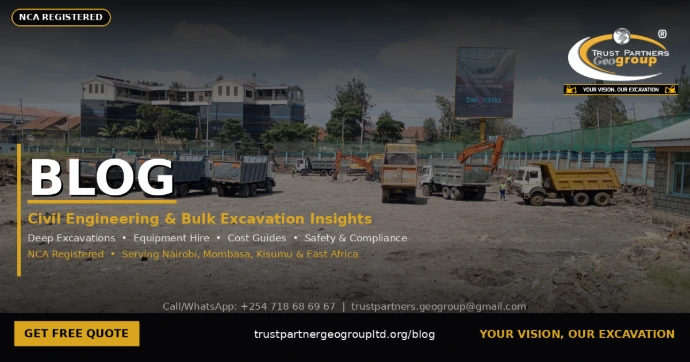
What to Expect from a Professional Excavation Contractor in Kenya: Services, Standards & Pricing
Hiring an excavation contractor in Kenya? Here is exactly what a professional should deliver — from services and equipment to NCA compliance, pricing structures and the red flags to avoid.

1. What a Professional Excavation Contractor Actually Does
An excavation contractor is not simply a person with an excavator. A professional excavation contractor in Kenya is a specialised earthworks firm that plans, executes and hands over ground engineering works — safely, to specification, and within a defined cost structure. They take responsibility for everything that happens between the raw plot and the foundation level: assessing ground conditions, selecting equipment, managing operators, controlling water, compacting to engineering standards, and carting spoil off-site.
The difference matters because earthworks are the single most risk-laden phase of any construction project. Poor excavation leads to foundation failures, settlement cracks, water intrusion and collapsed trenches — defects that cost ten times more to fix after the structure is up than to prevent on day one. Hiring a generalist or a briefcase intermediary instead of a professional basement and bulk excavation specialist is the most expensive shortcut in Kenyan construction.
2. Core Services You Should Expect
A full-scope excavation contractor should deliver every service below with their own crews and equipment — not by subcontracting pieces of your project to third parties you have never vetted.
2.1 Site Preparation & Soil Assessment
Professional works begin before any machine arrives. Expect bush clearing, topsoil stripping and stockpiling, pegging verification against the structural drawings, and a ground assessment covering soil type, bearing capacity and groundwater. In Nairobi's red soil zones, black cotton soil areas like Kajiado and Thika, and coastal coral regions, the excavation method changes completely based on this assessment — a professional contractor explains why and adjusts the programme accordingly.
2.2 Bulk Excavation & Foundation Digging
Bulk excavation covers mass earth removal for basements, plinths and platforms, while foundation digging covers precise strip, raft, mat and pile excavations to formation level. The professional standard is excavation to the engineer's tolerance — typically ±50mm — with over-excavation backfilled with compacted approved material, never with loose spoil.
2.3 Trench Digging & Utility Works
From foundation strip trenches to trench digging for utilities, drainage and services, professional contractors bench or shore trenches deeper than 1.5 metres, scan for existing utilities, and backfill in compacted layers. In Nairobi's CBD and established estates, utility congestion makes this one of the highest-risk services — and one where amateur operators cause the most damage.
2.4 Site Grading, Compaction & Testing
Final site grading to drainage falls, compaction in controlled layers (typically 150–200mm), and coordination of density testing are non-negotiable deliverables. A professional contractor compacts to the engineer's specification — usually 95% of maximum dry density per standard Proctor tests — and arranges laboratory testing certificates as proof, not as an extra.
💡 What "full-service" means in practice
At Trust Partners Geo-Group Ltd, every service above — from clearing to compaction testing — is delivered in-house. One contract, one site manager, one accountable team. Explore our full range on the heavy equipment hire and service pages.
3. Standards, Licensing & Compliance (NCA, NEMA & OSHA)
Compliance is the clearest divider between a professional excavation contractor and a casual operator. Before signing anything, verify the following:
- NCA registration — a valid National Construction Authority certificate in the correct category (NCA 4–8 for civil/earthworks). Verify the number directly on the NCA portal.
- County business permit & KRA compliance — current single business permit and tax compliance certificate.
- Insurance — public liability cover for third-party damage and WIBA cover for site workers and operators.
- NEMA awareness — for projects requiring an EIA licence, the contractor must understand erosion control, dust suppression and site runoff rules, and operate within them.
- OSHA-aligned site safety — trench shoring protocols, exclusion zones around plant, operator certification, and daily toolbox talks.
✅ The professional test
A professional contractor volunteers these documents at quotation stage. If you have to ask twice, walk away — compliance gaps become your legal liability the moment their machine enters your site.
4. Equipment & Fleet Capabilities
The fleet tells you almost everything about a contractor's real capacity. A professional excavation contractor in Kenya should own or directly control a matched fleet, because ownership controls availability, maintenance standards and response times when a machine goes down.
- Excavators (11–50 ton) — 11-ton units for confined residential sites, 30-ton machines as the bulk-excavation workhorse, 50-ton class for heavy rock and mega-basements.
- Bulldozers — clearing, pushing and spreading on large platforms.
- Motor graders & rollers — grading to falls and compaction to specification.
- Tippers (20–40 ton) — matched fleet sizing for spoil carting so excavation never waits on trucks.
- Attachments — hydraulic breakers for rock, augers for pile drilling, rippers for hard ground.
Ask one direct question: "Which of these machines do you own, and can I see the fleet list?" Contractors who rely entirely on third-party hire cannot guarantee mobilisation dates, and their daily rates usually hide a hire margin you are paying without knowing.
5. Pricing: How Excavation Contractors Structure Quotes
Professional contractors quote using three recognised structures. Each protects a different party — understanding them lets you negotiate from knowledge, not guesswork.
| Pricing Structure | How It Works | Best For | Watch Out For |
|---|---|---|---|
| Per cubic meter (KES 350–800/m³ soil; 1,200–2,500/m³ rock) | Pay for measured volume excavated and carted | Well-defined volumes with surveyed quantities | Unmeasured "estimate" claims; re-measure disputes |
| Dayworks / machine-hour (30-ton excavator + operator: KES 15,000–25,000/day) | Pay per machine-day or hour on site | Uncertain ground, rock risk, small sites | Idle time charges; slow operator productivity |
| Lump-sum fixed price | Fixed total for a fully engineered scope | Complete drawings, clear BOQ quantities | Exclusions buried in fine print; variation abuse |
For current market benchmarks, see our detailed rate breakdowns in the excavator hire prices in Kenya guide and the excavation costs & rates category.
⚠️ The too-cheap quote
A quote 30–40% below the others is not a bargain — it is a quote missing mobilisation, fuel, carting or testing costs. Those costs surface later as variations. Insist on itemised quotes from at least three contractors before comparing.
6. The Step-by-Step Process From Site Visit to Handover
A professional contractor follows a disciplined sequence. If any step is skipped, the risk transfers to you:
- Site visit & ground assessment — no professional quotes blind. Expect questions about soil history, water table and access.
- Method statement & programme — equipment selection, sequence, haul routes and estimated duration.
- Itemised quotation — scope, rates, exclusions, payment schedule tied to measured progress.
- Mobilisation & setting out — machines arrive with certified operators; excavation pegged and verified against drawings.
- Execution with daily reporting — progress updates, encounters (rock, water, utilities) flagged immediately with costed options.
- Formation approval & compaction testing — engineer inspects formation level; density tests certified before backfill or blinding.
- Demobilisation & site handover — clean site, documented handover, retention release per contract.
7. Red Flags: When a "Contractor" Falls Short
- No verifiable NCA registration, or certificates that expired last year.
- Quotes issued without a site visit or any questions about ground conditions.
- Verbal quotes with no itemisation, exclusions or payment schedule.
- Demands for full upfront payment before mobilisation.
- Zero insurance — no public liability, no WIBA for crews.
- Entirely hired equipment with no ownership or standby maintenance.
- No references or completed projects you can physically inspect.
- Cannot explain black cotton soil behaviour, dewatering or compaction requirements — the basics of the trade.
💡 Your protection
Pay against measured progress, retain 5–10% until handover, and verify every certificate before the first machine arrives. For a complete selection framework, read our companion guide on how to choose the best excavation company in Kenya.
8. Frequently Asked Questions
A professional excavation contractor provides a full scope of earthworks services: site clearing and topsoil stripping, bulk excavation for basements and foundations, foundation digging for strip, raft, mat and pile foundations, site grading and levelling, trench digging for utilities and drainage, soil testing coordination, compaction and density testing, rock breaking and removal, and spoil carting — all deliverable in-house with owned equipment and certified operators.
Verify the NCA registration certificate number on the NCA portal, confirm the county single business permit and KRA tax compliance certificate are current, and request public liability and WIBA insurance documents. For EIA-regulated projects, confirm prior NEMA-licensed site experience. Professional contractors provide these documents proactively at quotation stage.
Expect KES 350–800 per m³ for soil excavation and KES 1,200–2,500 per m³ for rock on per-volume contracts; KES 15,000–25,000 per day for a 30-ton excavator with operator on dayworks; or a fixed lump-sum for fully engineered scopes. A professional quote itemises mobilisation, fuel, operator, maintenance and carting separately — always compare at least three itemised quotes.
A matched fleet: 11–30 ton hydraulic excavators, 50-ton class machines for heavy work, bulldozers, motor graders, vibratory rollers and plate compactors, 20–40 ton tippers, and attachments including hydraulic breakers, augers and rippers. Ownership matters — it guarantees availability, maintenance standards and mobilisation speed, which hired-only contractors cannot promise.
Key red flags: unverifiable or expired NCA registration, no insurance, quotes far below market with hidden exclusions, reliance on third-party equipment, no site visit before quoting, refusal to itemise, demands for full upfront payment, no inspectable references, and inability to explain soil behaviour, groundwater risk or compaction requirements for your site. Pay against measured progress and retain 5–10% until handover.
Need a Professional Excavation Contractor in Kenya?
Trust Partners Geo-Group Ltd delivers fully licensed, insured, in-house earthworks across Kenya — with owned equipment, certified operators and itemised, transparent pricing. Talk to our engineering team before you commit.
Get a Free Site Assessment & Quote📞 +254 718 68 69 67
What to Expect from a Professional Excavation Contractor in Kenya: Services, Standards & Pricing
Hiring an excavation contractor in Kenya? Here is exactly what a professional should deliver — from services and equipment to NCA compliance, pricing structures and the red flags to avoid.
1. What a Professional Excavation Contractor Actually Does
An excavation contractor is not simply a person with an excavator. A professional excavation contractor in Kenya is a specialised earthworks firm that plans, executes and hands over ground engineering works — safely, to specification, and within a defined cost structure. They take responsibility for everything that happens between the raw plot and the foundation level: assessing ground conditions, selecting equipment, managing operators, controlling water, compacting to engineering standards, and carting spoil off-site.
The difference matters because earthworks are the single most risk-laden phase of any construction project. Poor excavation leads to foundation failures, settlement cracks, water intrusion and collapsed trenches — defects that cost ten times more to fix after the structure is up than to prevent on day one. Hiring a generalist or a briefcase intermediary instead of a professional basement and bulk excavation specialist is the most expensive shortcut in Kenyan construction.
2. Core Services You Should Expect
A full-scope excavation contractor should deliver every service below with their own crews and equipment — not by subcontracting pieces of your project to third parties you have never vetted.
2.1 Site Preparation & Soil Assessment
Professional works begin before any machine arrives. Expect bush clearing, topsoil stripping and stockpiling, pegging verification against the structural drawings, and a ground assessment covering soil type, bearing capacity and groundwater. In Nairobi's red soil zones, black cotton soil areas like Kajiado and Thika, and coastal coral regions, the excavation method changes completely based on this assessment — a professional contractor explains why and adjusts the programme accordingly.
2.2 Bulk Excavation & Foundation Digging
Bulk excavation covers mass earth removal for basements, plinths and platforms, while foundation digging covers precise strip, raft, mat and pile excavations to formation level. The professional standard is excavation to the engineer's tolerance — typically ±50mm — with over-excavation backfilled with compacted approved material, never with loose spoil.
2.3 Trench Digging & Utility Works
From foundation strip trenches to trench digging for utilities, drainage and services, professional contractors bench or shore trenches deeper than 1.5 metres, scan for existing utilities, and backfill in compacted layers. In Nairobi's CBD and established estates, utility congestion makes this one of the highest-risk services — and one where amateur operators cause the most damage.
2.4 Site Grading, Compaction & Testing
Final site grading to drainage falls, compaction in controlled layers (typically 150–200mm), and coordination of density testing are non-negotiable deliverables. A professional contractor compacts to the engineer's specification — usually 95% of maximum dry density per standard Proctor tests — and arranges laboratory testing certificates as proof, not as an extra.
💡 What "full-service" means in practice
At Trust Partners Geo-Group Ltd, every service above — from clearing to compaction testing — is delivered in-house. One contract, one site manager, one accountable team. Explore our full range on the heavy equipment hire and service pages.
3. Standards, Licensing & Compliance (NCA, NEMA & OSHA)
Compliance is the clearest divider between a professional excavation contractor and a casual operator. Before signing anything, verify the following:
- NCA registration — a valid National Construction Authority certificate in the correct category (NCA 4–8 for civil/earthworks). Verify the number directly on the NCA portal.
- County business permit & KRA compliance — current single business permit and tax compliance certificate.
- Insurance — public liability cover for third-party damage and WIBA cover for site workers and operators.
- NEMA awareness — for projects requiring an EIA licence, the contractor must understand erosion control, dust suppression and site runoff rules, and operate within them.
- OSHA-aligned site safety — trench shoring protocols, exclusion zones around plant, operator certification, and daily toolbox talks.
✅ The professional test
A professional contractor volunteers these documents at quotation stage. If you have to ask twice, walk away — compliance gaps become your legal liability the moment their machine enters your site.
4. Equipment & Fleet Capabilities
The fleet tells you almost everything about a contractor's real capacity. A professional excavation contractor in Kenya should own or directly control a matched fleet, because ownership controls availability, maintenance standards and response times when a machine goes down.
- Excavators (11–50 ton) — 11-ton units for confined residential sites, 30-ton machines as the bulk-excavation workhorse, 50-ton class for heavy rock and mega-basements.
- Bulldozers — clearing, pushing and spreading on large platforms.
- Motor graders & rollers — grading to falls and compaction to specification.
- Tippers (20–40 ton) — matched fleet sizing for spoil carting so excavation never waits on trucks.
- Attachments — hydraulic breakers for rock, augers for pile drilling, rippers for hard ground.
Ask one direct question: "Which of these machines do you own, and can I see the fleet list?" Contractors who rely entirely on third-party hire cannot guarantee mobilisation dates, and their daily rates usually hide a hire margin you are paying without knowing.
5. Pricing: How Excavation Contractors Structure Quotes
Professional contractors quote using three recognised structures. Each protects a different party — understanding them lets you negotiate from knowledge, not guesswork.
| Pricing Structure | How It Works | Best For | Watch Out For |
|---|---|---|---|
| Per cubic meter (KES 350–800/m³ soil; 1,200–2,500/m³ rock) | Pay for measured volume excavated and carted | Well-defined volumes with surveyed quantities | Unmeasured "estimate" claims; re-measure disputes |
| Dayworks / machine-hour (30-ton excavator + operator: KES 15,000–25,000/day) | Pay per machine-day or hour on site | Uncertain ground, rock risk, small sites | Idle time charges; slow operator productivity |
| Lump-sum fixed price | Fixed total for a fully engineered scope | Complete drawings, clear BOQ quantities | Exclusions buried in fine print; variation abuse |
For current market benchmarks, see our detailed rate breakdowns in the excavator hire prices in Kenya guide and the excavation costs & rates category.
⚠️ The too-cheap quote
A quote 30–40% below the others is not a bargain — it is a quote missing mobilisation, fuel, carting or testing costs. Those costs surface later as variations. Insist on itemised quotes from at least three contractors before comparing.
6. The Step-by-Step Process From Site Visit to Handover
A professional contractor follows a disciplined sequence. If any step is skipped, the risk transfers to you:
- Site visit & ground assessment — no professional quotes blind. Expect questions about soil history, water table and access.
- Method statement & programme — equipment selection, sequence, haul routes and estimated duration.
- Itemised quotation — scope, rates, exclusions, payment schedule tied to measured progress.
- Mobilisation & setting out — machines arrive with certified operators; excavation pegged and verified against drawings.
- Execution with daily reporting — progress updates, encounters (rock, water, utilities) flagged immediately with costed options.
- Formation approval & compaction testing — engineer inspects formation level; density tests certified before backfill or blinding.
- Demobilisation & site handover — clean site, documented handover, retention release per contract.
7. Red Flags: When a "Contractor" Falls Short
- No verifiable NCA registration, or certificates that expired last year.
- Quotes issued without a site visit or any questions about ground conditions.
- Verbal quotes with no itemisation, exclusions or payment schedule.
- Demands for full upfront payment before mobilisation.
- Zero insurance — no public liability, no WIBA for crews.
- Entirely hired equipment with no ownership or standby maintenance.
- No references or completed projects you can physically inspect.
- Cannot explain black cotton soil behaviour, dewatering or compaction requirements — the basics of the trade.
💡 Your protection
Pay against measured progress, retain 5–10% until handover, and verify every certificate before the first machine arrives. For a complete selection framework, read our companion guide on how to choose the best excavation company in Kenya.
8. Frequently Asked Questions
A professional excavation contractor provides a full scope of earthworks services: site clearing and topsoil stripping, bulk excavation for basements and foundations, foundation digging for strip, raft, mat and pile foundations, site grading and levelling, trench digging for utilities and drainage, soil testing coordination, compaction and density testing, rock breaking and removal, and spoil carting — all deliverable in-house with owned equipment and certified operators.
Verify the NCA registration certificate number on the NCA portal, confirm the county single business permit and KRA tax compliance certificate are current, and request public liability and WIBA insurance documents. For EIA-regulated projects, confirm prior NEMA-licensed site experience. Professional contractors provide these documents proactively at quotation stage.
Expect KES 350–800 per m³ for soil excavation and KES 1,200–2,500 per m³ for rock on per-volume contracts; KES 15,000–25,000 per day for a 30-ton excavator with operator on dayworks; or a fixed lump-sum for fully engineered scopes. A professional quote itemises mobilisation, fuel, operator, maintenance and carting separately — always compare at least three itemised quotes.
A matched fleet: 11–30 ton hydraulic excavators, 50-ton class machines for heavy work, bulldozers, motor graders, vibratory rollers and plate compactors, 20–40 ton tippers, and attachments including hydraulic breakers, augers and rippers. Ownership matters — it guarantees availability, maintenance standards and mobilisation speed, which hired-only contractors cannot promise.
Key red flags: unverifiable or expired NCA registration, no insurance, quotes far below market with hidden exclusions, reliance on third-party equipment, no site visit before quoting, refusal to itemise, demands for full upfront payment, no inspectable references, and inability to explain soil behaviour, groundwater risk or compaction requirements for your site. Pay against measured progress and retain 5–10% until handover.
Need a Professional Excavation Contractor in Kenya?
Trust Partners Geo-Group Ltd delivers fully licensed, insured, in-house earthworks across Kenya — with owned equipment, certified operators and itemised, transparent pricing. Talk to our engineering team before you commit.
Get a Free Site Assessment & Quote📞 +254 718 68 69 67