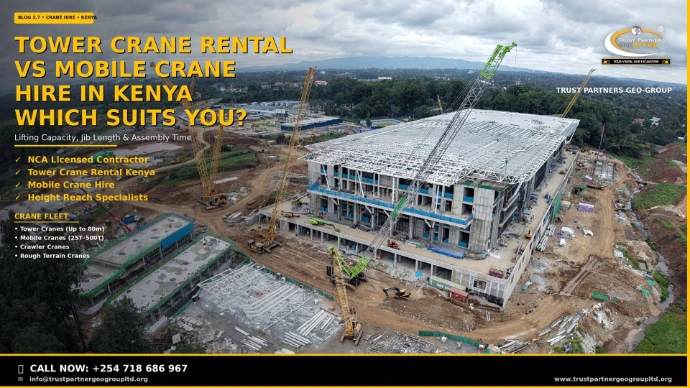
Tower Crane Rental vs Mobile Crane Hire in Kenya: Which Suits Your Project?
One is a marathon runner bolted to your building for months; the other is a sprinter that arrives on its own wheels. Here is how to choose — with real Kenyan costs and lead times.

1. Two Machines, One Confusing Choice
Both machines lift, and both appear on construction sites — but they solve opposite problems. The mobile crane rents you capability per day: it arrives, lifts, and leaves, charging for its presence only when it works. The tower crane rents you capability per month: it is assembled once, fixed to your structure, and serves every trade every day for the life of the build. Choosing between them is not a brand decision — it is a project arithmetic problem involving duration, height, footprint, lift frequency and cost shape. This guide runs the arithmetic with Kenyan numbers.
2. Mobile Cranes: Flexibility on Wheels
Mobile cranes — all-terrain and rough-terrain units — travel on public roads and set up in hours. Their strengths: no fixed infrastructure, no assembly programme, deployment wherever the lift is; capacity classes from 25 tons to over 500 tons; and per-day pricing that matches episodic demand. Their limits: they occupy ground, they must be re-positioned as the structure grows, their capacity falls steeply with boom extension, and above certain heights they cannot reach at all. They dominate infrastructure work, industrial plants, low-to-mid-rise construction and one-off heavy lifts across Kenya — and they complement tower cranes on high-rise sites, handling the assembly pick itself.
3. Tower Cranes: The Vertical Marathon
The tower crane is assembled once and climbs with the building, its fixed jib sweeping the entire footprint from a single position. It lifts continuously through every working day — formwork up, rebar up, precast up, debris down — and amortises its substantial fixed costs across hundreds of daily cycles. It needs nothing from the ground below once standing except power and operator focus, which is why it owns the high-rise market. Its demands are equally substantial: a designed foundation, weeks of base lead time, days of assembly, and a monthly rental commitment measured in months, not days. Our tower crane rental service covers flat-top and hammerhead configurations to 80-metre jibs.
4. The Five Decision Factors
| Factor | Favours Tower Crane | Favours Mobile Crane |
|---|---|---|
| Duration | 6+ months continuous lifting | Days to weeks, or episodic lifts |
| Height | 20–25+ storeys | Below boom envelope (~40–60m typical) |
| Lift frequency | Dozens of picks per day | Occasional heavy picks |
| Site footprint | Fixed position covers the works | Open ground for outriggers & travel |
| Cost shape | High fixed, low marginal per lift | Zero fixed, higher marginal per day |
Score your project on the five factors; the column with the majority is your answer. Mixed answers — a high-rise with episodic steel erection, say — often mean both: tower for the daily grind, mobile for the heavy picks.
5. Cost Comparison: Real Kenyan Numbers
| Cost Item | Tower Crane | Mobile Crane (100t class) |
|---|---|---|
| Base/foundation | KES 150K–400K | Outrigger mats only |
| Assembly/disassembly | KES 200K–400K each way | Included in mobilisation |
| Rental | KES 350K–700K / month | KES 90K–150K / lifting day |
| Operator | Monthly wages | Usually included |
| Mobilisation | Low (delivered once) | KES 50K–150K per move |
| Break-even logic | Cheap per lift after ~15–25 lift-days | Cheap until usage becomes continuous |
The break-even line typically falls around three to four weeks of continuous demand: below it, mobiles win; above it, towers dominate. Our crane hire cost guide works the full arithmetic with examples.
6. Assembly, Foundations & Lead Times
The tower crane's schedule starts weeks before its steel arrives: the base is a structural footing engineered for overturning moment and vertical load, poured and cured over 2–3 weeks, longer where basements or weak soils complicate it. Assembly then takes 2–5 days with an assisting mobile crane and a competent crew, followed by testing and commissioning. Mobile cranes invert the timeline entirely — they drive in and lift within hours. For programme planners: the tower decision must be made at foundation-design stage, not when the structure reaches for the sky; retrofitting a base into a poured raft is the expensive version of a free decision.
7. Safety & Operator Certification
Cranes concentrate risk like no other site plant: falling loads, structural overload, electrical contact, and collapse all live in their operating envelope. The Kenyan compliance framework: certified crane operators with class-specific licences, rigging crews trained in slinging and signalling, documented daily pre-use inspections, third-party periodic examinations, and lift plans for anything beyond routine picks. Tower cranes add wind-speed operating limits and climb-section procedures; mobiles add outrigger ground assessment and travel configuration discipline. Any hire proposal that glosses these is pricing your risk, not managing it — demand the certificates, the inspection records and the lift plan template with every quote.
8. Frequently Asked Questions
Neither is universally better — the answer is a function of five project parameters. Duration: projects running many months with continuous lifting favour tower cranes; short or one-off lifts favour mobile. Height and reach: towers win above roughly 20–25 storeys or where a fixed jib must cover the whole footprint; mobiles win for anything below their boom envelope. Site footprint: tight urban sites with no crane parking favour towers; open sites with truck access favour mobiles. Lift schedule: frequent small lifts all day — precast panels, blockwork, formwork — is tower territory; occasional heavy picks are mobile territory. Budget shape: towers carry high fixed costs (base, assembly, operator) that amortise over months; mobiles charge per lift day with no fixed infrastructure. Run the five parameters and the answer usually names itself.
Mobile crane hire in Kenya prices by tonnage class: 25–50 ton all-terrain units at roughly KES 45,000–80,000 per day; 80–130 ton units at KES 90,000–150,000; and the 200–500 ton heavy lifters at KES 180,000–400,000 or more per lifting day, plus mobilisation that can match the day rate for long distances. Tower crane rental runs on monthly structures — typically KES 350,000–700,000 per month for standard flat-top construction units — plus base and anchorage foundations (KES 150,000–400,000), assembly and disassembly (KES 200,000–400,000 each way), and operator wages. The full cost picture with worked comparisons is in our crane hire cost guide and the 2027 equipment rate update.
Hire the tower crane when the project crosses three thresholds together: the structure rises beyond roughly 20–25 storeys; the lifting demand is continuous — daily cycles of formwork, rebar, precast or blockwork across months; and the site footprint allows a fixed position whose jib covers the working area. Towers earn their keep on multi-storey residential and commercial builds, hospitals and campuses where a single machine serves every trade every day. Below those thresholds — low-rise builds, industrial plants, infrastructure picks, one-off heavy lifts — the mobile crane's flexibility and zero fixed infrastructure win decisively. See our tower crane rental service for the configuration options.
For a standard construction tower crane on a prepared base, allow 2–5 days for assembly with a competent crew and assisting mobile crane — the base concrete itself needs 2–3 weeks to design, pour and cure before the crane arrives, and is the schedule item most often forgotten. Base design is structural engineering: the crane's overturning moments and vertical loads transfer into pad footings or ballast blocks sized for the ground, and basement proximity or poor soils complicate it further. Disassembly at completion takes similar time. Mobile cranes, by contrast, travel on their own wheels and typically set up in hours — the assembly-time difference is the practical heart of the tower-versus-mobile decision.
Size the crane to the heaviest single lift at the greatest radius — the combination that determines capacity, not weight alone. A 3-tonne panel at 40 metres radius demands a far larger crane than the same panel at 10 metres. Residential towers typically peak at 2–4 tonnes (formwork tables, rebar bundles, precast balconies); commercial frames at 4–8 tonnes; and industrial or infrastructure picks — transformers, vessels, bridge beams — define their own classes upward of 10, 50 or 100 tonnes. Also plan the hook height: the tallest pour plus rigging plus clearance. Share the lift schedule — weights, radii, heights — with your crane supplier and let the configuration follow the loads; our heavy equipment desk sizes crane packages from lift schedules weekly.
Not Sure Which Crane? Send Us the Lift Schedule.
Trust Partners Geo-Group Ltd fields mobile cranes to 500 tons and tower crane rental to 80-metre jibs — with certified operators, lift planning and nationwide mobilisation. Send your loads, radii and heights; we will return a configured recommendation.
Get a Crane Hire Recommendation📞 +254 718 68 69 67
Tower Crane Rental vs Mobile Crane Hire in Kenya: Which Suits Your Project?
One is a marathon runner bolted to your building for months; the other is a sprinter that arrives on its own wheels. Here is how to choose — with real Kenyan costs and lead times.
1. Two Machines, One Confusing Choice
Both machines lift, and both appear on construction sites — but they solve opposite problems. The mobile crane rents you capability per day: it arrives, lifts, and leaves, charging for its presence only when it works. The tower crane rents you capability per month: it is assembled once, fixed to your structure, and serves every trade every day for the life of the build. Choosing between them is not a brand decision — it is a project arithmetic problem involving duration, height, footprint, lift frequency and cost shape. This guide runs the arithmetic with Kenyan numbers.
2. Mobile Cranes: Flexibility on Wheels
Mobile cranes — all-terrain and rough-terrain units — travel on public roads and set up in hours. Their strengths: no fixed infrastructure, no assembly programme, deployment wherever the lift is; capacity classes from 25 tons to over 500 tons; and per-day pricing that matches episodic demand. Their limits: they occupy ground, they must be re-positioned as the structure grows, their capacity falls steeply with boom extension, and above certain heights they cannot reach at all. They dominate infrastructure work, industrial plants, low-to-mid-rise construction and one-off heavy lifts across Kenya — and they complement tower cranes on high-rise sites, handling the assembly pick itself.
3. Tower Cranes: The Vertical Marathon
The tower crane is assembled once and climbs with the building, its fixed jib sweeping the entire footprint from a single position. It lifts continuously through every working day — formwork up, rebar up, precast up, debris down — and amortises its substantial fixed costs across hundreds of daily cycles. It needs nothing from the ground below once standing except power and operator focus, which is why it owns the high-rise market. Its demands are equally substantial: a designed foundation, weeks of base lead time, days of assembly, and a monthly rental commitment measured in months, not days. Our tower crane rental service covers flat-top and hammerhead configurations to 80-metre jibs.
4. The Five Decision Factors
| Factor | Favours Tower Crane | Favours Mobile Crane |
|---|---|---|
| Duration | 6+ months continuous lifting | Days to weeks, or episodic lifts |
| Height | 20–25+ storeys | Below boom envelope (~40–60m typical) |
| Lift frequency | Dozens of picks per day | Occasional heavy picks |
| Site footprint | Fixed position covers the works | Open ground for outriggers & travel |
| Cost shape | High fixed, low marginal per lift | Zero fixed, higher marginal per day |
Score your project on the five factors; the column with the majority is your answer. Mixed answers — a high-rise with episodic steel erection, say — often mean both: tower for the daily grind, mobile for the heavy picks.
5. Cost Comparison: Real Kenyan Numbers
| Cost Item | Tower Crane | Mobile Crane (100t class) |
|---|---|---|
| Base/foundation | KES 150K–400K | Outrigger mats only |
| Assembly/disassembly | KES 200K–400K each way | Included in mobilisation |
| Rental | KES 350K–700K / month | KES 90K–150K / lifting day |
| Operator | Monthly wages | Usually included |
| Mobilisation | Low (delivered once) | KES 50K–150K per move |
| Break-even logic | Cheap per lift after ~15–25 lift-days | Cheap until usage becomes continuous |
The break-even line typically falls around three to four weeks of continuous demand: below it, mobiles win; above it, towers dominate. Our crane hire cost guide works the full arithmetic with examples.
6. Assembly, Foundations & Lead Times
The tower crane's schedule starts weeks before its steel arrives: the base is a structural footing engineered for overturning moment and vertical load, poured and cured over 2–3 weeks, longer where basements or weak soils complicate it. Assembly then takes 2–5 days with an assisting mobile crane and a competent crew, followed by testing and commissioning. Mobile cranes invert the timeline entirely — they drive in and lift within hours. For programme planners: the tower decision must be made at foundation-design stage, not when the structure reaches for the sky; retrofitting a base into a poured raft is the expensive version of a free decision.
7. Safety & Operator Certification
Cranes concentrate risk like no other site plant: falling loads, structural overload, electrical contact, and collapse all live in their operating envelope. The Kenyan compliance framework: certified crane operators with class-specific licences, rigging crews trained in slinging and signalling, documented daily pre-use inspections, third-party periodic examinations, and lift plans for anything beyond routine picks. Tower cranes add wind-speed operating limits and climb-section procedures; mobiles add outrigger ground assessment and travel configuration discipline. Any hire proposal that glosses these is pricing your risk, not managing it — demand the certificates, the inspection records and the lift plan template with every quote.
8. Frequently Asked Questions
Neither is universally better — the answer is a function of five project parameters. Duration: projects running many months with continuous lifting favour tower cranes; short or one-off lifts favour mobile. Height and reach: towers win above roughly 20–25 storeys or where a fixed jib must cover the whole footprint; mobiles win for anything below their boom envelope. Site footprint: tight urban sites with no crane parking favour towers; open sites with truck access favour mobiles. Lift schedule: frequent small lifts all day — precast panels, blockwork, formwork — is tower territory; occasional heavy picks are mobile territory. Budget shape: towers carry high fixed costs (base, assembly, operator) that amortise over months; mobiles charge per lift day with no fixed infrastructure. Run the five parameters and the answer usually names itself.
Mobile crane hire in Kenya prices by tonnage class: 25–50 ton all-terrain units at roughly KES 45,000–80,000 per day; 80–130 ton units at KES 90,000–150,000; and the 200–500 ton heavy lifters at KES 180,000–400,000 or more per lifting day, plus mobilisation that can match the day rate for long distances. Tower crane rental runs on monthly structures — typically KES 350,000–700,000 per month for standard flat-top construction units — plus base and anchorage foundations (KES 150,000–400,000), assembly and disassembly (KES 200,000–400,000 each way), and operator wages. The full cost picture with worked comparisons is in our crane hire cost guide and the 2027 equipment rate update.
Hire the tower crane when the project crosses three thresholds together: the structure rises beyond roughly 20–25 storeys; the lifting demand is continuous — daily cycles of formwork, rebar, precast or blockwork across months; and the site footprint allows a fixed position whose jib covers the working area. Towers earn their keep on multi-storey residential and commercial builds, hospitals and campuses where a single machine serves every trade every day. Below those thresholds — low-rise builds, industrial plants, infrastructure picks, one-off heavy lifts — the mobile crane's flexibility and zero fixed infrastructure win decisively. See our tower crane rental service for the configuration options.
For a standard construction tower crane on a prepared base, allow 2–5 days for assembly with a competent crew and assisting mobile crane — the base concrete itself needs 2–3 weeks to design, pour and cure before the crane arrives, and is the schedule item most often forgotten. Base design is structural engineering: the crane's overturning moments and vertical loads transfer into pad footings or ballast blocks sized for the ground, and basement proximity or poor soils complicate it further. Disassembly at completion takes similar time. Mobile cranes, by contrast, travel on their own wheels and typically set up in hours — the assembly-time difference is the practical heart of the tower-versus-mobile decision.
Size the crane to the heaviest single lift at the greatest radius — the combination that determines capacity, not weight alone. A 3-tonne panel at 40 metres radius demands a far larger crane than the same panel at 10 metres. Residential towers typically peak at 2–4 tonnes (formwork tables, rebar bundles, precast balconies); commercial frames at 4–8 tonnes; and industrial or infrastructure picks — transformers, vessels, bridge beams — define their own classes upward of 10, 50 or 100 tonnes. Also plan the hook height: the tallest pour plus rigging plus clearance. Share the lift schedule — weights, radii, heights — with your crane supplier and let the configuration follow the loads; our heavy equipment desk sizes crane packages from lift schedules weekly.
Not Sure Which Crane? Send Us the Lift Schedule.
Trust Partners Geo-Group Ltd fields mobile cranes to 500 tons and tower crane rental to 80-metre jibs — with certified operators, lift planning and nationwide mobilisation. Send your loads, radii and heights; we will return a configured recommendation.
Get a Crane Hire Recommendation📞 +254 718 68 69 67