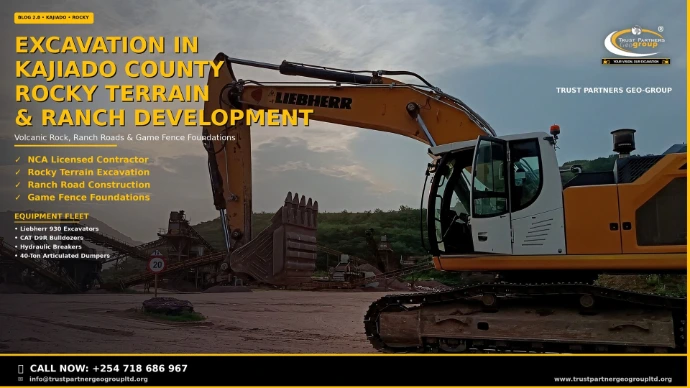
Excavation in Kajiado County: Rocky Terrain & Ranch Development Solutions
Volcanic rock, thousand-acre ranches and the fastest-growing crescent south of Nairobi. Here is how excavation really works across Kajiado's big country.

1. Kajiado's Two Grounds: Rock & Black Cotton
Kajiado County asks two questions of every dig: will you hit rock, or will you hit black cotton? The county's volcanic spine — the Ngong hills down through the Rift flanks toward Namanga — carries tuff and basalt bands that stop conventional buckets within metres. Between the ridges, the lowlands carry expansive black cotton that swells and shrinks with the seasons. Between those extremes lies excellent red-soil ground that builds beautifully. The Ngong–Kiserian–Rongai corridor knows both personalities street by street. Every honest Kajiado quotation starts with a walk of the plot to answer which ground is waiting.
2. Breaking Volcanic Rock: Methods & Costs
Rock volumes drive Kajiado budgets, so method selection is the county's core engineering decision:
- Ripping — heavy dozers pulling through fractured tuff where bedding allows; the cheapest per-m³ method by far where it works.
- Hydraulic breaking — breaker attachments on 20–50 ton machines; the versatile default near buildings and in confined sites; see breaking alternatives compared and our attachment hire options.
- Controlled blasting — for massive volumes in remote ranch country, under county permits with professional blast management.
Costs follow the method: our rock excavation rate breakdown for Kenya puts breaking at KES 1,200–2,500 per m³ depending on hardness, access and haul — the single biggest variable in any Kajiado project budget.
💡 The walk that saves the budget
Experienced Kajiado contractors read the ground before quoting: exposed rock on neighbouring plots, ridge lines on the horizon, the sound of the probe bar. An hour on site separates an honest rock allowance from a variation claim waiting to happen. Never accept a Kajiado quote from someone who priced without walking.
3. Ranch Roads: Building Across Big Country
Kajiado's ranches and conservancies live on their roads — stock movement, tourism circuits, supply lines across enormous acreages. Building them is corridor engineering at county scale: alignment chosen to skirt rock ridges, drifts and culverts sized for cloudbursts, and gravel surfaces compacted to carry season after season. The road construction scope typically runs clearing, cut-and-fill, drainage and graveling as one programme, with hired fleets staging between ranches to keep mobilisation sensible. A ranch road done right lasts decades; done cheaply it washes out in the first long rains and becomes an annual expense.
4. Game Fence Foundations & Conservancy Works
Conservancy boundaries are earthworks: kilometres of post holes through alternating rock and clay, gate structures on heavier footings, and the patrol track that doubles as a firebreak. Post holes bore or break to 600–900mm depending on fence class; rock sections are drilled and pinned; black cotton sections get removal-and-replacement or oversized collars; corners and gates take the deep, heavy footings that carry the line's tension. The difference between a fence that stands twenty years and one that leans in five is set in these foundations — unglamorous, decisive, and exactly where county experience shows.
5. The Urban Crescent: Ngong, Rongai & Kiserian
South-west of Nairobi, the crescent is one of Kenya's fastest-growing residential markets — and it is pure Kajiado ground. Black cotton pockets demand foundation treatment on perhaps a third of plots; rock bands surprise first-time builders on the ridges; and water security is engineered rather than assumed. Developers who master the ground rules — treated foundations, realistic rock allowances, pans or boreholes from day one — deliver plots that hold value; those who skip them sell problems. The crescent rewards contractors who carry both the surgical estate skills and the heavy breaking plant on one fleet.
6. Water Works for Ranches & Conservancies
Water is Kajiado's limiting resource, and its earthworks follow: dams and water pans sited on the clay pockets that hold water, sited away from the rock that leaks it; borehole sumps and pipeline trenching across ranch scale; and trough pads and cattle dip works across conservancy land. Pan siting here is the county's highest-stakes dig — the same pan that transforms a ranch can fail entirely if cut into fractured volcanic ground without a lining plan. Survey first, dig once.
7. Kajiado Excavation Costs at a Glance
| Scope | Typical Range (KES) | Kajiado Note |
|---|---|---|
| Soil excavation & carting (per m³) | 350–800 | Red-soil valleys |
| Rock breaking (per m³) | 1,200–2,500 | The budget-defining line |
| Controlled ripping (per m³) | 700–1,500 | Where fractured tuff allows |
| Ranch road (per km, formed & gravelled) | 800K–2.5M | Rock cuts & haul dominate |
| Game fence post holes (per km of line) | 120K–350K | Plus concrete & posts |
| Farm pan 5,000 m³ (sited, clay ground) | 300K–700K | Rock floors need lining |
| Plot cut (crescent towns, 50x100) | 35,000–90,000 | Black cotton allowance varies |
Ranges assume county access; remote ranch mobilisation adds to isolated jobs. Compare itemised quotes covering breaking plant, fuel, haulage and testing.
8. Frequently Asked Questions
Kajiado's cost profile is dominated by one word: rock. Much of the county sits on volcanic tuff and basalt that conventional digging cannot touch — foundations, pans and road cuts all hit it, and breaking runs KES 1,200–2,500 per m³ against 350–800 for soil. Add the county's scale — ranches measure in thousands of acres, and mobilisation to remote sites is real money — and honest Kajiado quotes look nothing like Nairobi's. The offset: where ground is soil, it is excellent, and where budgets plan rock realistically from day one, projects finish on them. The expensive Kajiado projects are the ones where rock was a surprise.
Three methods, chosen by volume, access and proximity to structures. Hydraulic breaking is the default: breaker attachments on 20–50 ton excavators, productive where access allows and gentle enough near buildings — our breaker and attachment hire guide covers sizing. Ripping with a heavy dozer out-produces breaking on fractured tuff at a fraction of the cost per m³. Controlled blasting remains for massive volumes in remote ranch country, under a county permit process and professional blast management. The method choice is an engineering decision, not a hire decision — experienced contractors walk the site and choose per formation.
Ranch and conservancy roads run KES 800K–2.5M per kilometre for formed and compacted gravel surfaces, with the spread driven by three things: rock — road cuts through volcanic ground add breaking; drainage — Kajiado's cloudbursts demand proper cross-culverts and drifts; and material — the county's murram pits are good but far apart, and haul becomes the largest line item. The cheapest ranch road is the one aligned to avoid the rock ridges and use the soil valleys: a day with a surveyor and an experienced operator saves kilometres of breaking. Our road construction and paving teams carry ranch roads from clearing to surface.
Conservancy and ranch game fences run for kilometres across ground that alternates rock and black cotton, and the fence is only as strong as its posts. Standard practice: post holes excavated or bored to 600–900mm depending on fence class, set in mass concrete on compacted formation; in rock, holes are drilled and posts pinned; in expansive clay, the standard black cotton treatment applies — remove and replace, or oversize the concrete collar. Gate and corner posts carry heavier loads and deeper, larger footings. Fence-line earthworks also include the graded track that doubles as a patrol road and firebreak — one of those scopes where county ground experience pays for itself post by post.
The Ngong–Rongai–Kiserian crescent is one of Kenya's hottest residential markets precisely because Kajiado builds well once ground rules are respected. The rules: black cotton patches demand foundation treatment — removal and replacement or raft design, exactly as our expansive soils engineering guide details; rock bands need realistic breaking budgets; and water security — pans, boreholes or county supply — must be engineered from the start. Respect those three, and the crescent's red-soil ridges deliver some of the best-value building land in the Nairobi sphere.
Digging Kajiado's Big Country? Hire Rock-Country Crews.
Trust Partners Geo-Group Ltd excavates across Kajiado — breaking, ranch roads, fence lines, pans and the crescent's urban growth — with fleets that carry both the breaking plant and the soil expertise. Book a free site walk.
Get a Free Kajiado Site Assessment📞 +254 718 68 69 67
Excavation in Kajiado County: Rocky Terrain & Ranch Development Solutions
Volcanic rock, thousand-acre ranches and the fastest-growing crescent south of Nairobi. Here is how excavation really works across Kajiado's big country.
1. Kajiado's Two Grounds: Rock & Black Cotton
Kajiado County asks two questions of every dig: will you hit rock, or will you hit black cotton? The county's volcanic spine — the Ngong hills down through the Rift flanks toward Namanga — carries tuff and basalt bands that stop conventional buckets within metres. Between the ridges, the lowlands carry expansive black cotton that swells and shrinks with the seasons. Between those extremes lies excellent red-soil ground that builds beautifully. The Ngong–Kiserian–Rongai corridor knows both personalities street by street. Every honest Kajiado quotation starts with a walk of the plot to answer which ground is waiting.
2. Breaking Volcanic Rock: Methods & Costs
Rock volumes drive Kajiado budgets, so method selection is the county's core engineering decision:
- Ripping — heavy dozers pulling through fractured tuff where bedding allows; the cheapest per-m³ method by far where it works.
- Hydraulic breaking — breaker attachments on 20–50 ton machines; the versatile default near buildings and in confined sites; see breaking alternatives compared and our attachment hire options.
- Controlled blasting — for massive volumes in remote ranch country, under county permits with professional blast management.
Costs follow the method: our rock excavation rate breakdown for Kenya puts breaking at KES 1,200–2,500 per m³ depending on hardness, access and haul — the single biggest variable in any Kajiado project budget.
💡 The walk that saves the budget
Experienced Kajiado contractors read the ground before quoting: exposed rock on neighbouring plots, ridge lines on the horizon, the sound of the probe bar. An hour on site separates an honest rock allowance from a variation claim waiting to happen. Never accept a Kajiado quote from someone who priced without walking.
3. Ranch Roads: Building Across Big Country
Kajiado's ranches and conservancies live on their roads — stock movement, tourism circuits, supply lines across enormous acreages. Building them is corridor engineering at county scale: alignment chosen to skirt rock ridges, drifts and culverts sized for cloudbursts, and gravel surfaces compacted to carry season after season. The road construction scope typically runs clearing, cut-and-fill, drainage and graveling as one programme, with hired fleets staging between ranches to keep mobilisation sensible. A ranch road done right lasts decades; done cheaply it washes out in the first long rains and becomes an annual expense.
4. Game Fence Foundations & Conservancy Works
Conservancy boundaries are earthworks: kilometres of post holes through alternating rock and clay, gate structures on heavier footings, and the patrol track that doubles as a firebreak. Post holes bore or break to 600–900mm depending on fence class; rock sections are drilled and pinned; black cotton sections get removal-and-replacement or oversized collars; corners and gates take the deep, heavy footings that carry the line's tension. The difference between a fence that stands twenty years and one that leans in five is set in these foundations — unglamorous, decisive, and exactly where county experience shows.
5. The Urban Crescent: Ngong, Rongai & Kiserian
South-west of Nairobi, the crescent is one of Kenya's fastest-growing residential markets — and it is pure Kajiado ground. Black cotton pockets demand foundation treatment on perhaps a third of plots; rock bands surprise first-time builders on the ridges; and water security is engineered rather than assumed. Developers who master the ground rules — treated foundations, realistic rock allowances, pans or boreholes from day one — deliver plots that hold value; those who skip them sell problems. The crescent rewards contractors who carry both the surgical estate skills and the heavy breaking plant on one fleet.
6. Water Works for Ranches & Conservancies
Water is Kajiado's limiting resource, and its earthworks follow: dams and water pans sited on the clay pockets that hold water, sited away from the rock that leaks it; borehole sumps and pipeline trenching across ranch scale; and trough pads and cattle dip works across conservancy land. Pan siting here is the county's highest-stakes dig — the same pan that transforms a ranch can fail entirely if cut into fractured volcanic ground without a lining plan. Survey first, dig once.
7. Kajiado Excavation Costs at a Glance
| Scope | Typical Range (KES) | Kajiado Note |
|---|---|---|
| Soil excavation & carting (per m³) | 350–800 | Red-soil valleys |
| Rock breaking (per m³) | 1,200–2,500 | The budget-defining line |
| Controlled ripping (per m³) | 700–1,500 | Where fractured tuff allows |
| Ranch road (per km, formed & gravelled) | 800K–2.5M | Rock cuts & haul dominate |
| Game fence post holes (per km of line) | 120K–350K | Plus concrete & posts |
| Farm pan 5,000 m³ (sited, clay ground) | 300K–700K | Rock floors need lining |
| Plot cut (crescent towns, 50x100) | 35,000–90,000 | Black cotton allowance varies |
Ranges assume county access; remote ranch mobilisation adds to isolated jobs. Compare itemised quotes covering breaking plant, fuel, haulage and testing.
8. Frequently Asked Questions
Kajiado's cost profile is dominated by one word: rock. Much of the county sits on volcanic tuff and basalt that conventional digging cannot touch — foundations, pans and road cuts all hit it, and breaking runs KES 1,200–2,500 per m³ against 350–800 for soil. Add the county's scale — ranches measure in thousands of acres, and mobilisation to remote sites is real money — and honest Kajiado quotes look nothing like Nairobi's. The offset: where ground is soil, it is excellent, and where budgets plan rock realistically from day one, projects finish on them. The expensive Kajiado projects are the ones where rock was a surprise.
Three methods, chosen by volume, access and proximity to structures. Hydraulic breaking is the default: breaker attachments on 20–50 ton excavators, productive where access allows and gentle enough near buildings — our breaker and attachment hire guide covers sizing. Ripping with a heavy dozer out-produces breaking on fractured tuff at a fraction of the cost per m³. Controlled blasting remains for massive volumes in remote ranch country, under a county permit process and professional blast management. The method choice is an engineering decision, not a hire decision — experienced contractors walk the site and choose per formation.
Ranch and conservancy roads run KES 800K–2.5M per kilometre for formed and compacted gravel surfaces, with the spread driven by three things: rock — road cuts through volcanic ground add breaking; drainage — Kajiado's cloudbursts demand proper cross-culverts and drifts; and material — the county's murram pits are good but far apart, and haul becomes the largest line item. The cheapest ranch road is the one aligned to avoid the rock ridges and use the soil valleys: a day with a surveyor and an experienced operator saves kilometres of breaking. Our road construction and paving teams carry ranch roads from clearing to surface.
Conservancy and ranch game fences run for kilometres across ground that alternates rock and black cotton, and the fence is only as strong as its posts. Standard practice: post holes excavated or bored to 600–900mm depending on fence class, set in mass concrete on compacted formation; in rock, holes are drilled and posts pinned; in expansive clay, the standard black cotton treatment applies — remove and replace, or oversize the concrete collar. Gate and corner posts carry heavier loads and deeper, larger footings. Fence-line earthworks also include the graded track that doubles as a patrol road and firebreak — one of those scopes where county ground experience pays for itself post by post.
The Ngong–Rongai–Kiserian crescent is one of Kenya's hottest residential markets precisely because Kajiado builds well once ground rules are respected. The rules: black cotton patches demand foundation treatment — removal and replacement or raft design, exactly as our expansive soils engineering guide details; rock bands need realistic breaking budgets; and water security — pans, boreholes or county supply — must be engineered from the start. Respect those three, and the crescent's red-soil ridges deliver some of the best-value building land in the Nairobi sphere.
Digging Kajiado's Big Country? Hire Rock-Country Crews.
Trust Partners Geo-Group Ltd excavates across Kajiado — breaking, ranch roads, fence lines, pans and the crescent's urban growth — with fleets that carry both the breaking plant and the soil expertise. Book a free site walk.
Get a Free Kajiado Site Assessment📞 +254 718 68 69 67