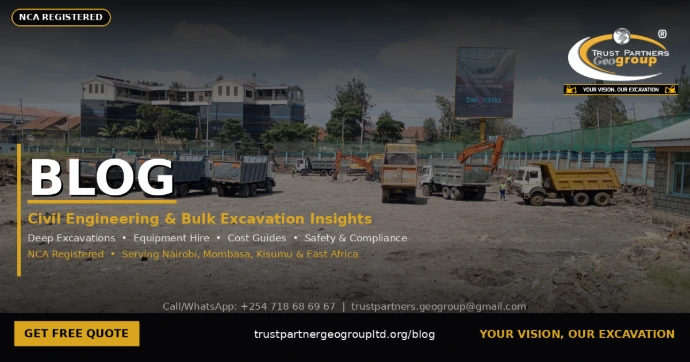
Commercial Excavation Services in Kenya: Office Complexes, Retail Centers & Industrial Parks
A developer's guide to commercial excavation in Kenya — from office basements and mall car parks to industrial park platforms, with real costs, compliance steps and equipment.

1. Why Commercial Excavation Is a Different Discipline
Commercial excavation is not residential digging scaled up. An office complex, retail center or industrial park brings structural loads, programme pressure and compliance layers that demand a different class of earthworks contractor. Column loads are measured in thousands of tonnes rather than hundreds, basements stack two and three levels deep, and the cost of standing time is measured in hundreds of thousands of shillings per week once a development loan is drawing interest.
A professional basement and bulk excavation contractor for commercial work brings engineered method statements, sequenced excavation plans, temporary works design and a fleet large enough to keep production rates high from day one. The sections below break down what each commercial typology demands — and what your contractor must prove before you sign.
2. Office Complexes: Basements & Podiums
2.1 Typical Scope
Nairobi's office pipeline — Upper Hill, Westlands, Karen Business Park and the expanding CBD fringe — runs on multi-level basements. A Grade-A office block typically needs a two or three-level basement for parking and plant, excavated 6–12 metres below natural ground, immediately beside live roads and sometimes neighbouring structures. Podium levels add terraced excavation with tight formation tolerances.
2.2 Engineering Challenges
- Deep cuts beside live infrastructure — soldier piles, sheet piles or anchored walls protect adjacent roads and buildings; vibration limits are strict near occupied offices.
- Groundwater — Upper Hill and parts of Westlands sit in high water table zones; wellpoint or deep-well dewatering must run continuously until the slab is cast.
- Rock — tuff and coral bands appear below 4–6 metres in several Nairobi submarkets; hydraulic breakers or controlled ripping keep the programme moving.
- Spoil logistics — CBD-fringe sites have restricted haulage windows; tipper fleets must be sized to clear each day's production within them.
3. Retail Centers & Shopping Malls: Multi-Level Car Parks
Retail developments are earthworks-heavy by design: big footprints, flat platforms, and multi-level basement car parks that often exceed the retail floor area itself. Our dedicated guide to shopping mall basement and multi-level car park excavation covers the typology in depth — the key commercial points:
- Platforms must be graded to engineered falls for stormwater before structure begins; re-grading later is ruinously expensive.
- Basement ramps and dock levellers demand formation accuracy within ±50mm over long distances.
- Anchor tenants drive the programme — excavation sequences are often phased so structural steel for one anchor starts while bulk digging continues elsewhere.
💡 Phasing is profit
On mall sites, a contractor who can sequence excavation into independent work fronts lets the developer release structure packages early. That is worth weeks on the critical path — ask for a phasing plan in the method statement, not just a machine list.
4. Industrial Parks & Warehouses
Industrial earthworks trade depth for area. Warehouses, factories and logistics parks need broad, heavily compacted platforms — typically 95–98% Proctor density — with drainage swales, detention basins and heavy-duty hardstandings. See our specialist guides on warehouse foundation excavation, factory floors for heavy machinery and logistics park earthworks.
- Cut-and-fill balance — large platforms should be designed to balance on site; importing or exporting fill adds KES 500–1,500 per m³ once haul is counted.
- Service corridors — industrial estates need deep utility trenches for power, water, fire and fibre; coordinate trenching with platform grading to avoid double handling.
- EPZ and agri-industrial sites — export processing zones and processing plants add stormwater ponds and treatment lagoons to the earthworks scope.
2.5 Site Preparation for Commercial Developments
Before any structural dig, commercial sites need disciplined preparation: bush clearing and site preparation, topsoil strip and stockpile for reinstatement, platform grading to design falls, and haul roads built to carry 40-ton tipper cycles in all weather. Where an existing structure stands on the plot, controlled demolition and rubble removal precede earthworks — sequenced so demolition debris never contaminates the structural dig.
✅ One accountable team
Trust Partners Geo-Group Ltd clears, demolishes, excavates, trenches and grades with its own fleet and crews — see the full capability on our heavy equipment hire page. One contract means no gaps between the clearing crew and the basement diggers.
6. Approvals & Compliance for Commercial Projects
- County building permit — approved drawings before any machine mobilises.
- NCA registration — contractor certified in the correct civil works category, verified on the NCA portal.
- NEMA EIA licence — required for most commercial sites; covers dust suppression, noise limits, erosion and runoff control during excavation.
- Traffic and haulage approvals — Nairobi County requires haulage plans for spoil movement on public roads; route and timing restrictions apply near schools and hospitals.
- Utility wayleaves — utility trenching crossing Kenya Power, Nairobi City Water or fibre corridors needs wayleave clearance before digging.
⚠️ The cost of skipping compliance
A stop order on a commercial site costs more than every approval combined — demolition of unapproved works, programme delays of months, and county penalties. Professional contractors file the paperwork as a programmed activity, not an afterthought.
7. Commercial Excavation Costs in Kenya
| Scope Item | Typical Range (KES) | Key Cost Drivers |
|---|---|---|
| Bulk soil excavation | 350–800 per m³ | Haul distance, access, spoil fees |
| Rock excavation | 1,200–2,500 per m³ | Breaking method, quantity, haul |
| 30-ton excavator + operator (dayworks) | 15,000–25,000 per day | Mobilisation, fuel terms, standby |
| Single-level commercial basement | 3M–8M lump sum | Depth, dewatering, shoring type |
| Two-level commercial basement | 8M–20M lump sum | Retaining system, rock, programme |
| Industrial platform (grading + compaction) | 150–400 per m² | Cut-fill balance, testing density |
For rate benchmarks across machine classes, see our excavator hire prices in Kenya guide. Always demand itemised quotes — mobilisation, fuel, carting and testing listed separately — from at least three contractors.
8. Frequently Asked Questions
Commercial excavation in Kenya covers site clearing and mass grading, bulk basement excavation for offices and retail centers, multi-level car park digging, foundation excavation for warehouses and industrial sheds, trenching for utility corridors, and drainage earthworks. On larger developments it also includes cut-and-fill balancing, temporary works like soldier piles or sheet piles for deep urban basements, and coordination of compaction testing to engineering specification. Trust Partners Geo-Group Ltd delivers all of these in-house with owned equipment.
Commercial basements in Nairobi typically run one to three levels. A single-level basement sits 3–4 metres deep, two levels 6–8 metres, and three levels 9–12 metres, depending on structural loads and parking layout. Depths beyond 8 metres usually require a piled retaining system — soldier piles, sheet piles or diaphragm walls — plus a dewatering programme, especially in high water table zones like Upper Hill, parts of Westlands and the CBD fringe. Mega commercial basements over 15 metres are executed in sequenced passes with braced excavations.
A matched commercial fleet: 30-ton hydraulic excavators as the bulk workhorse, 50-ton class machines for rock and heavy passes, bulldozers for spreading, motor graders for platform grading, vibratory rollers for compaction, and 20–40 ton tippers sized to the haul distance so excavation never waits on trucks. Attachments include hydraulic breakers for Nairobi's occasional coral and tuff bands, and augers for foundation piles. At Trust Partners Geo-Group Ltd this fleet is owned, maintained in-house and operated by certified operators.
Commercial earthworks typically price at KES 350–800 per m³ for soil, KES 1,200–2,500 per m³ for rock, or KES 15,000–25,000 per day for a 30-ton excavator with operator on dayworks. A single-level commercial basement commonly ranges from KES 3M–8M, a two-level basement KES 8M–20M, depending on depth, shoring method, dewatering intensity and haul distance. Lump-sum pricing suits fully engineered scopes; always compare at least three itemised quotes covering mobilisation, fuel, carting and testing.
You need an approved building permit from the county government, NCA registration for the contractor in the relevant category, and — for larger sites — an EIA licence from NEMA covering dust, noise, erosion and runoff control. Nairobi County additionally requires traffic management approval for spoil haulage on public roads, and utility wayleaves where trenching crosses service corridors. A professional contractor prepares and submits these as part of the programme rather than leaving them to the developer.
Planning a Commercial Development in Kenya?
Trust Partners Geo-Group Ltd delivers commercial basements, retail platforms and industrial park earthworks across Kenya — owned fleet, certified operators, engineered method statements and itemised pricing. Talk to our team before you commit.
Get a Free Commercial Site Assessment📞 +254 718 68 69 67
Commercial Excavation Services in Kenya: Office Complexes, Retail Centers & Industrial Parks
A developer's guide to commercial excavation in Kenya — from office basements and mall car parks to industrial park platforms, with real costs, compliance steps and equipment.
1. Why Commercial Excavation Is a Different Discipline
Commercial excavation is not residential digging scaled up. An office complex, retail center or industrial park brings structural loads, programme pressure and compliance layers that demand a different class of earthworks contractor. Column loads are measured in thousands of tonnes rather than hundreds, basements stack two and three levels deep, and the cost of standing time is measured in hundreds of thousands of shillings per week once a development loan is drawing interest.
A professional basement and bulk excavation contractor for commercial work brings engineered method statements, sequenced excavation plans, temporary works design and a fleet large enough to keep production rates high from day one. The sections below break down what each commercial typology demands — and what your contractor must prove before you sign.
2. Office Complexes: Basements & Podiums
2.1 Typical Scope
Nairobi's office pipeline — Upper Hill, Westlands, Karen Business Park and the expanding CBD fringe — runs on multi-level basements. A Grade-A office block typically needs a two or three-level basement for parking and plant, excavated 6–12 metres below natural ground, immediately beside live roads and sometimes neighbouring structures. Podium levels add terraced excavation with tight formation tolerances.
2.2 Engineering Challenges
- Deep cuts beside live infrastructure — soldier piles, sheet piles or anchored walls protect adjacent roads and buildings; vibration limits are strict near occupied offices.
- Groundwater — Upper Hill and parts of Westlands sit in high water table zones; wellpoint or deep-well dewatering must run continuously until the slab is cast.
- Rock — tuff and coral bands appear below 4–6 metres in several Nairobi submarkets; hydraulic breakers or controlled ripping keep the programme moving.
- Spoil logistics — CBD-fringe sites have restricted haulage windows; tipper fleets must be sized to clear each day's production within them.
3. Retail Centers & Shopping Malls: Multi-Level Car Parks
Retail developments are earthworks-heavy by design: big footprints, flat platforms, and multi-level basement car parks that often exceed the retail floor area itself. Our dedicated guide to shopping mall basement and multi-level car park excavation covers the typology in depth — the key commercial points:
- Platforms must be graded to engineered falls for stormwater before structure begins; re-grading later is ruinously expensive.
- Basement ramps and dock levellers demand formation accuracy within ±50mm over long distances.
- Anchor tenants drive the programme — excavation sequences are often phased so structural steel for one anchor starts while bulk digging continues elsewhere.
💡 Phasing is profit
On mall sites, a contractor who can sequence excavation into independent work fronts lets the developer release structure packages early. That is worth weeks on the critical path — ask for a phasing plan in the method statement, not just a machine list.
4. Industrial Parks & Warehouses
Industrial earthworks trade depth for area. Warehouses, factories and logistics parks need broad, heavily compacted platforms — typically 95–98% Proctor density — with drainage swales, detention basins and heavy-duty hardstandings. See our specialist guides on warehouse foundation excavation, factory floors for heavy machinery and logistics park earthworks.
- Cut-and-fill balance — large platforms should be designed to balance on site; importing or exporting fill adds KES 500–1,500 per m³ once haul is counted.
- Service corridors — industrial estates need deep utility trenches for power, water, fire and fibre; coordinate trenching with platform grading to avoid double handling.
- EPZ and agri-industrial sites — export processing zones and processing plants add stormwater ponds and treatment lagoons to the earthworks scope.
2.5 Site Preparation for Commercial Developments
Before any structural dig, commercial sites need disciplined preparation: bush clearing and site preparation, topsoil strip and stockpile for reinstatement, platform grading to design falls, and haul roads built to carry 40-ton tipper cycles in all weather. Where an existing structure stands on the plot, controlled demolition and rubble removal precede earthworks — sequenced so demolition debris never contaminates the structural dig.
✅ One accountable team
Trust Partners Geo-Group Ltd clears, demolishes, excavates, trenches and grades with its own fleet and crews — see the full capability on our heavy equipment hire page. One contract means no gaps between the clearing crew and the basement diggers.
6. Approvals & Compliance for Commercial Projects
- County building permit — approved drawings before any machine mobilises.
- NCA registration — contractor certified in the correct civil works category, verified on the NCA portal.
- NEMA EIA licence — required for most commercial sites; covers dust suppression, noise limits, erosion and runoff control during excavation.
- Traffic and haulage approvals — Nairobi County requires haulage plans for spoil movement on public roads; route and timing restrictions apply near schools and hospitals.
- Utility wayleaves — utility trenching crossing Kenya Power, Nairobi City Water or fibre corridors needs wayleave clearance before digging.
⚠️ The cost of skipping compliance
A stop order on a commercial site costs more than every approval combined — demolition of unapproved works, programme delays of months, and county penalties. Professional contractors file the paperwork as a programmed activity, not an afterthought.
7. Commercial Excavation Costs in Kenya
| Scope Item | Typical Range (KES) | Key Cost Drivers |
|---|---|---|
| Bulk soil excavation | 350–800 per m³ | Haul distance, access, spoil fees |
| Rock excavation | 1,200–2,500 per m³ | Breaking method, quantity, haul |
| 30-ton excavator + operator (dayworks) | 15,000–25,000 per day | Mobilisation, fuel terms, standby |
| Single-level commercial basement | 3M–8M lump sum | Depth, dewatering, shoring type |
| Two-level commercial basement | 8M–20M lump sum | Retaining system, rock, programme |
| Industrial platform (grading + compaction) | 150–400 per m² | Cut-fill balance, testing density |
For rate benchmarks across machine classes, see our excavator hire prices in Kenya guide. Always demand itemised quotes — mobilisation, fuel, carting and testing listed separately — from at least three contractors.
8. Frequently Asked Questions
Commercial excavation in Kenya covers site clearing and mass grading, bulk basement excavation for offices and retail centers, multi-level car park digging, foundation excavation for warehouses and industrial sheds, trenching for utility corridors, and drainage earthworks. On larger developments it also includes cut-and-fill balancing, temporary works like soldier piles or sheet piles for deep urban basements, and coordination of compaction testing to engineering specification. Trust Partners Geo-Group Ltd delivers all of these in-house with owned equipment.
Commercial basements in Nairobi typically run one to three levels. A single-level basement sits 3–4 metres deep, two levels 6–8 metres, and three levels 9–12 metres, depending on structural loads and parking layout. Depths beyond 8 metres usually require a piled retaining system — soldier piles, sheet piles or diaphragm walls — plus a dewatering programme, especially in high water table zones like Upper Hill, parts of Westlands and the CBD fringe. Mega commercial basements over 15 metres are executed in sequenced passes with braced excavations.
A matched commercial fleet: 30-ton hydraulic excavators as the bulk workhorse, 50-ton class machines for rock and heavy passes, bulldozers for spreading, motor graders for platform grading, vibratory rollers for compaction, and 20–40 ton tippers sized to the haul distance so excavation never waits on trucks. Attachments include hydraulic breakers for Nairobi's occasional coral and tuff bands, and augers for foundation piles. At Trust Partners Geo-Group Ltd this fleet is owned, maintained in-house and operated by certified operators.
Commercial earthworks typically price at KES 350–800 per m³ for soil, KES 1,200–2,500 per m³ for rock, or KES 15,000–25,000 per day for a 30-ton excavator with operator on dayworks. A single-level commercial basement commonly ranges from KES 3M–8M, a two-level basement KES 8M–20M, depending on depth, shoring method, dewatering intensity and haul distance. Lump-sum pricing suits fully engineered scopes; always compare at least three itemised quotes covering mobilisation, fuel, carting and testing.
You need an approved building permit from the county government, NCA registration for the contractor in the relevant category, and — for larger sites — an EIA licence from NEMA covering dust, noise, erosion and runoff control. Nairobi County additionally requires traffic management approval for spoil haulage on public roads, and utility wayleaves where trenching crosses service corridors. A professional contractor prepares and submits these as part of the programme rather than leaving them to the developer.
Planning a Commercial Development in Kenya?
Trust Partners Geo-Group Ltd delivers commercial basements, retail platforms and industrial park earthworks across Kenya — owned fleet, certified operators, engineered method statements and itemised pricing. Talk to our team before you commit.
Get a Free Commercial Site Assessment📞 +254 718 68 69 67