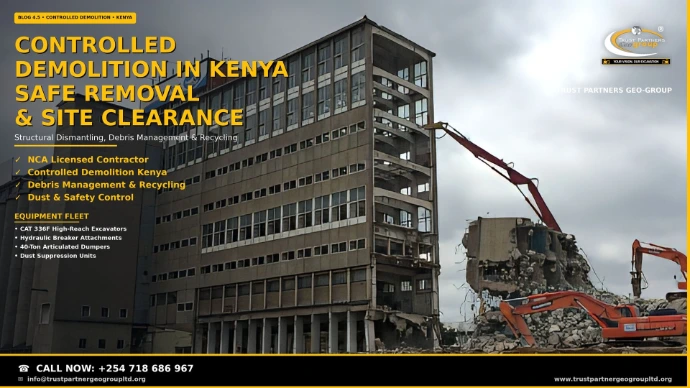
Controlled Demolition in Kenya: Safe Structure Removal & Site Clearance
Demolition is structural engineering in reverse — every element comes down in an order someone decided. The methods, the hazards, the debris economics and the real 2026 costs.

1. Demolition Economics: Why Controlled Costs Less
The instinct says controlled demolition — with its surveys, method statements and engineered sequences — costs more than hiring a machine and knocking the building down. The arithmetic disagrees. Uncontrolled demolition externalises its costs: the collapsed structure that took the neighbour's wall with it, the debris that blocked the county drain, the four weeks of programme lost negotiating with the authorities after an incident, and the legal exposure that outlives the rubble. Controlled demolition internalises them: every shilling of engineering shows up in the quote, and nothing shows up in court. The rule of thumb across Kenyan projects: demolition runs 2–5% of the replacement structure's cost, and within that envelope the controlled method is the cheaper total almost every time the site touches anything of value — roads, neighbours, utilities, or the programme itself.
2. Pre-Demolition Engineering: Surveys to Permits
The work that happens before the first swing, and what each piece buys:
- Structural appraisal — an engineer reads how the building stands so it can be taken down in the reverse order; skips become the moments that matter.
- Materials and hazard audit — identifying asbestos-containing materials, lead paint, fuel systems and chemical stores; each triggers a removal and disposal method of its own, and each is a NEMA issue if found mid-demolition.
- Services isolation — Kenya Power, water and telecoms formally disconnected and certified; a live 11kV service in a wall being demolished is not a surprise you survive twice.
- Neighbour condition surveys — photographs, crack gauges and vibration baselines agreed before work, so post-works conversations happen on data.
- The permit stack — county demolition permit (2–6 weeks in Nairobi), NEMA clearance where hazards or volumes trigger it, and neighbour notifications. Start the stack the day the decision is made.
3. Method Selection: Manual, Mechanical, Top-Down
| Method | Where It Fits | Indicative Rate Basis |
|---|---|---|
| Manual dismantling | Interior strip-out, salvage, sensitive adjacency | Labour gangs, KES 2,500–4,000/person/day |
| Mechanical (standard reach) | Low-rise, open sites, robust structures | Machine day rates, KES 15,000–25,000 |
| High-reach top-down | Multi-storey beside live environments | High-reach premium, KES 30,000–45,000/day |
| Explosive (rare) | Remote isolated structures only | Specialist per project |
Selection follows structure height, adjacency, hazards and programme — not machine availability. The method statement names the sequence element by element: which columns release which floors, where the debris lands, and what never moves until something else has. Our controlled demolition service drafts that statement as the first deliverable, not an afterthought.
4. The High-Reach Discipline: Top-Down Dismantling
Multi-storey demolition beside live environments belongs to the high-reach excavator — 20–30 metre booms with hydraulic processors and shears, standing back and dismantling floor by floor from the top. The discipline: the structure is weakened in a planned sequence that always leaves it folding inward and downward; operators work from surveyed reference points with the machine on verified stable ground; exclusion zones scale to the boom's working envelope, not the fence line; and dust suppression runs continuously because a falling floor is a dust factory. The alternative methods — undermining, pushing, or ball-and-chain nostalgia — transfer the structure's energy to whatever stands beside it. High-reach work is slower per day and faster per project: the machine class and the method are one decision.
5. Debris Management: Volumes, Haul & Recycling
The volume rule of thumb: a framed building produces roughly 0.4–0.6 m³ of debris per m² of floor area — a 2,000 m² block yields 800–1,200 m³, twenty to forty tipper loads. The hierarchy that turns that liability into an asset:
- Segregate at the drop — steel to scrap at KES 20–35/kg, salvageable timber and fittings to reuse, clean concrete separated from mixed rubble.
- Crush on site where volumes justify — mobile crushers at KES 25,000–40,000/day convert clean rubble to graded aggregate worth KES 900–1,500/m³, reused in the same project's blinding, backfill and hardstanding.
- Haul the residue to licensed disposal at KES 300–600/m³, documented per NEMA's waste hierarchy.
Projects running the hierarchy well flip the debris line from largest cost to modest credit — the crushing economics show how.
6. Hazards Register: Asbestos, Services, Neighbours
- Asbestos — pre-2000 roofing, ceiling boards and pipe lagging; licensed removal precedes demolition, and disturbing it unawares converts a demolition job into an environmental incident.
- Live services — isolation certificates verified on site, not assumed from paperwork.
- Adjacent structures — condition surveys, vibration monitoring, exclusion zones and sequenced weakening as covered above.
- Unplanned collapse — the reason method statements exist: structures weakened out of sequence fail sideways, and sideways is where the neighbours live.
- Dust and public interface — water suppression, wheel cleaning, haulage route agreements; the county's first complaint letter names all three.
7. Real Costs 2026: Per m² and Per Structure
| Scope | Rate Basis | 2026 Band (KES) |
|---|---|---|
| Light demolition (sheds, walls, single storey) | per m² floor area | 80–150 |
| Medium demolition (2–4 storey framed) | per m² | 150–300 |
| High-reach / heavy structures | per structure | from 800/m², per project |
| Debris carting | per m³ | 300–600 |
| On-site crushing | per day | 25,000–40,000 |
| Crushed aggregate value (recovered) | per m³ | 900–1,500 |
| Steel scrap credit | per kg | 20–35 |
| Surveys, method statement, permits | per project | 80,000–250,000 |
Cross-check: demolition at 2–5% of replacement cost; a quote far below the bands is missing surveys, dust control or the debris plan — collect the difference later, with interest. Site clearance that follows resets the plot for its next life.
8. Frequently Asked Questions
Demolition prices by structure and method, at honest 2026 rates: light demolition — single-storey masonry, sheds, walls — at KES 80–150 per m² of floor area; medium demolition — 2–4 storey framed buildings — at KES 150–300 per m², the spread driven by reinforcement density and access; and heavy or high-reach demolition — towers, silos, industrial structures — priced per structure from KES 800/m² upward, where the high-reach plant and extended programmes dominate. Debris carting prices separately at KES 300–600 per m³, unless crushing on site — a mobile crusher at KES 25,000–40,000 per day converts demolition waste to reusable aggregate worth KES 900–1,500 per m³, flipping the debris line from cost to credit. Steel recovery credits KES 20–35 per kilogram of rebar recovered. The budget rule: demolition runs roughly 2–5% of the replacement structure's cost, and the cheapest quote in the stack is usually missing the surveys, the dust control or the debris plan.
Controlled demolition is demolition executed as an engineered process rather than a labour line: a structural engineer appraises the building and drafts the method statement — the sequence in which every element comes down, the machines and attachments assigned, the exclusion zones, the dust and noise controls, and the emergency procedures. Ordinary demolition inverts that: machines arrive, walls come down in whatever order is convenient, and the structure's own collapse does the planning. The differences surface in everything that matters: safety statistics, neighbour relations, programme certainty, and cost — controlled methods cost more per day and less per project, because uncontrolled collapses do not respect fences, adjacent buildings or budgets. On anything above single-storey, or beside anything standing, controlled is not a premium service; it is the definition of the service. Our controlled demolition service runs the full engineered sequence.
The demolition permit stack, in order: a county demolition permit from the county government where the structure stands — applied for with ownership documentation and, where relevant, structural justification; NEMA clearance where hazardous materials or significant waste volumes apply — an asbestos survey and management plan is the usual trigger; utility isolations and disconnections — Kenya Power, water, telecoms formally decommissioned and certified, because demolishing a live service is both dangerous and prosecutable; and neighbour notifications on shared boundaries, which professional contractors issue as a matter of course. On buildings of public significance or unusual height, county authorities may add method-review requirements. The sequencing insight: the permit stack takes 2–6 weeks in Nairobi — start it the day the decision is made, because every other programme line waits on it.
Adjacent-structure demolition is where the discipline earns its name. The method: top-down dismantling — the structure is reduced floor by floor from the top, with high-reach excavators or manual cutting on the upper levels, never undermining from below; pre-works condition surveys of neighbouring buildings — photographs, crack gauges and vibration monitoring baselines agreed with the neighbours before work starts, so post-works claims rest on data rather than emotion; exclusion zones set at 1.5 times the structure height or the debris-throw analysis, whichever governs, fenced and signed; sequenced weakening — the method statement literally lists which columns and beams are cut in which order, so the structure folds inward and downward, never outward toward the neighbour; and live vibration monitoring at the boundary, with work stopped and methods revised when readings approach the agreed limits. Done properly, a building can come down within metres of its neighbour; done casually, the lawyers arrive before the debris does.
A demolished building is a materials stockpile in the wrong place — and the professional's job is converting it. The volumes: a framed building generates roughly 0.4–0.6 m³ of debris per m² of floor area, so a 2,000 m² block produces 800–1,200 m³ — twenty to forty tipper loads. The hierarchy: segregate at the drop — steel pulled for scrap credit at KES 20–35/kg, timber and doors salvaged for reuse, clean concrete separated from mixed rubble; crush on site where volumes justify — mobile crushers at KES 25,000–40,000/day convert clean concrete and masonry to graded aggregate the same project reuses in blinding, backfill and hardstanding, at KES 900–1,500/m³ against KES 1,200–2,000 bought-in; haul the residue to licensed disposal, carting at KES 300–600/m³. NEMA's waste rules expect the hierarchy documented — the demolition waste plan is now a standard contract schedule, and the projects that run it well turn the debris line from their largest cost into a modest credit. On-site crushing economics carries the worked numbers.
Demolish by Design, Not by Accident.
Trust Partners Geo-Group Ltd delivers engineered demolition across Kenya — surveys, method statements, high-reach dismantling, on-site crushing and documented clearance — for structures from walls to towers. Request a method-scoped quotation.
Request a Controlled Demolition Quote📞 +254 718 68 69 67
Controlled Demolition in Kenya: Safe Structure Removal & Site Clearance
Demolition is structural engineering in reverse — every element comes down in an order someone decided. The methods, the hazards, the debris economics and the real 2026 costs.
1. Demolition Economics: Why Controlled Costs Less
The instinct says controlled demolition — with its surveys, method statements and engineered sequences — costs more than hiring a machine and knocking the building down. The arithmetic disagrees. Uncontrolled demolition externalises its costs: the collapsed structure that took the neighbour's wall with it, the debris that blocked the county drain, the four weeks of programme lost negotiating with the authorities after an incident, and the legal exposure that outlives the rubble. Controlled demolition internalises them: every shilling of engineering shows up in the quote, and nothing shows up in court. The rule of thumb across Kenyan projects: demolition runs 2–5% of the replacement structure's cost, and within that envelope the controlled method is the cheaper total almost every time the site touches anything of value — roads, neighbours, utilities, or the programme itself.
2. Pre-Demolition Engineering: Surveys to Permits
The work that happens before the first swing, and what each piece buys:
- Structural appraisal — an engineer reads how the building stands so it can be taken down in the reverse order; skips become the moments that matter.
- Materials and hazard audit — identifying asbestos-containing materials, lead paint, fuel systems and chemical stores; each triggers a removal and disposal method of its own, and each is a NEMA issue if found mid-demolition.
- Services isolation — Kenya Power, water and telecoms formally disconnected and certified; a live 11kV service in a wall being demolished is not a surprise you survive twice.
- Neighbour condition surveys — photographs, crack gauges and vibration baselines agreed before work, so post-works conversations happen on data.
- The permit stack — county demolition permit (2–6 weeks in Nairobi), NEMA clearance where hazards or volumes trigger it, and neighbour notifications. Start the stack the day the decision is made.
3. Method Selection: Manual, Mechanical, Top-Down
| Method | Where It Fits | Indicative Rate Basis |
|---|---|---|
| Manual dismantling | Interior strip-out, salvage, sensitive adjacency | Labour gangs, KES 2,500–4,000/person/day |
| Mechanical (standard reach) | Low-rise, open sites, robust structures | Machine day rates, KES 15,000–25,000 |
| High-reach top-down | Multi-storey beside live environments | High-reach premium, KES 30,000–45,000/day |
| Explosive (rare) | Remote isolated structures only | Specialist per project |
Selection follows structure height, adjacency, hazards and programme — not machine availability. The method statement names the sequence element by element: which columns release which floors, where the debris lands, and what never moves until something else has. Our controlled demolition service drafts that statement as the first deliverable, not an afterthought.
4. The High-Reach Discipline: Top-Down Dismantling
Multi-storey demolition beside live environments belongs to the high-reach excavator — 20–30 metre booms with hydraulic processors and shears, standing back and dismantling floor by floor from the top. The discipline: the structure is weakened in a planned sequence that always leaves it folding inward and downward; operators work from surveyed reference points with the machine on verified stable ground; exclusion zones scale to the boom's working envelope, not the fence line; and dust suppression runs continuously because a falling floor is a dust factory. The alternative methods — undermining, pushing, or ball-and-chain nostalgia — transfer the structure's energy to whatever stands beside it. High-reach work is slower per day and faster per project: the machine class and the method are one decision.
5. Debris Management: Volumes, Haul & Recycling
The volume rule of thumb: a framed building produces roughly 0.4–0.6 m³ of debris per m² of floor area — a 2,000 m² block yields 800–1,200 m³, twenty to forty tipper loads. The hierarchy that turns that liability into an asset:
- Segregate at the drop — steel to scrap at KES 20–35/kg, salvageable timber and fittings to reuse, clean concrete separated from mixed rubble.
- Crush on site where volumes justify — mobile crushers at KES 25,000–40,000/day convert clean rubble to graded aggregate worth KES 900–1,500/m³, reused in the same project's blinding, backfill and hardstanding.
- Haul the residue to licensed disposal at KES 300–600/m³, documented per NEMA's waste hierarchy.
Projects running the hierarchy well flip the debris line from largest cost to modest credit — the crushing economics show how.
6. Hazards Register: Asbestos, Services, Neighbours
- Asbestos — pre-2000 roofing, ceiling boards and pipe lagging; licensed removal precedes demolition, and disturbing it unawares converts a demolition job into an environmental incident.
- Live services — isolation certificates verified on site, not assumed from paperwork.
- Adjacent structures — condition surveys, vibration monitoring, exclusion zones and sequenced weakening as covered above.
- Unplanned collapse — the reason method statements exist: structures weakened out of sequence fail sideways, and sideways is where the neighbours live.
- Dust and public interface — water suppression, wheel cleaning, haulage route agreements; the county's first complaint letter names all three.
7. Real Costs 2026: Per m² and Per Structure
| Scope | Rate Basis | 2026 Band (KES) |
|---|---|---|
| Light demolition (sheds, walls, single storey) | per m² floor area | 80–150 |
| Medium demolition (2–4 storey framed) | per m² | 150–300 |
| High-reach / heavy structures | per structure | from 800/m², per project |
| Debris carting | per m³ | 300–600 |
| On-site crushing | per day | 25,000–40,000 |
| Crushed aggregate value (recovered) | per m³ | 900–1,500 |
| Steel scrap credit | per kg | 20–35 |
| Surveys, method statement, permits | per project | 80,000–250,000 |
Cross-check: demolition at 2–5% of replacement cost; a quote far below the bands is missing surveys, dust control or the debris plan — collect the difference later, with interest. Site clearance that follows resets the plot for its next life.
8. Frequently Asked Questions
Demolition prices by structure and method, at honest 2026 rates: light demolition — single-storey masonry, sheds, walls — at KES 80–150 per m² of floor area; medium demolition — 2–4 storey framed buildings — at KES 150–300 per m², the spread driven by reinforcement density and access; and heavy or high-reach demolition — towers, silos, industrial structures — priced per structure from KES 800/m² upward, where the high-reach plant and extended programmes dominate. Debris carting prices separately at KES 300–600 per m³, unless crushing on site — a mobile crusher at KES 25,000–40,000 per day converts demolition waste to reusable aggregate worth KES 900–1,500 per m³, flipping the debris line from cost to credit. Steel recovery credits KES 20–35 per kilogram of rebar recovered. The budget rule: demolition runs roughly 2–5% of the replacement structure's cost, and the cheapest quote in the stack is usually missing the surveys, the dust control or the debris plan.
Controlled demolition is demolition executed as an engineered process rather than a labour line: a structural engineer appraises the building and drafts the method statement — the sequence in which every element comes down, the machines and attachments assigned, the exclusion zones, the dust and noise controls, and the emergency procedures. Ordinary demolition inverts that: machines arrive, walls come down in whatever order is convenient, and the structure's own collapse does the planning. The differences surface in everything that matters: safety statistics, neighbour relations, programme certainty, and cost — controlled methods cost more per day and less per project, because uncontrolled collapses do not respect fences, adjacent buildings or budgets. On anything above single-storey, or beside anything standing, controlled is not a premium service; it is the definition of the service. Our controlled demolition service runs the full engineered sequence.
The demolition permit stack, in order: a county demolition permit from the county government where the structure stands — applied for with ownership documentation and, where relevant, structural justification; NEMA clearance where hazardous materials or significant waste volumes apply — an asbestos survey and management plan is the usual trigger; utility isolations and disconnections — Kenya Power, water, telecoms formally decommissioned and certified, because demolishing a live service is both dangerous and prosecutable; and neighbour notifications on shared boundaries, which professional contractors issue as a matter of course. On buildings of public significance or unusual height, county authorities may add method-review requirements. The sequencing insight: the permit stack takes 2–6 weeks in Nairobi — start it the day the decision is made, because every other programme line waits on it.
Adjacent-structure demolition is where the discipline earns its name. The method: top-down dismantling — the structure is reduced floor by floor from the top, with high-reach excavators or manual cutting on the upper levels, never undermining from below; pre-works condition surveys of neighbouring buildings — photographs, crack gauges and vibration monitoring baselines agreed with the neighbours before work starts, so post-works claims rest on data rather than emotion; exclusion zones set at 1.5 times the structure height or the debris-throw analysis, whichever governs, fenced and signed; sequenced weakening — the method statement literally lists which columns and beams are cut in which order, so the structure folds inward and downward, never outward toward the neighbour; and live vibration monitoring at the boundary, with work stopped and methods revised when readings approach the agreed limits. Done properly, a building can come down within metres of its neighbour; done casually, the lawyers arrive before the debris does.
A demolished building is a materials stockpile in the wrong place — and the professional's job is converting it. The volumes: a framed building generates roughly 0.4–0.6 m³ of debris per m² of floor area, so a 2,000 m² block produces 800–1,200 m³ — twenty to forty tipper loads. The hierarchy: segregate at the drop — steel pulled for scrap credit at KES 20–35/kg, timber and doors salvaged for reuse, clean concrete separated from mixed rubble; crush on site where volumes justify — mobile crushers at KES 25,000–40,000/day convert clean concrete and masonry to graded aggregate the same project reuses in blinding, backfill and hardstanding, at KES 900–1,500/m³ against KES 1,200–2,000 bought-in; haul the residue to licensed disposal, carting at KES 300–600/m³. NEMA's waste rules expect the hierarchy documented — the demolition waste plan is now a standard contract schedule, and the projects that run it well turn the debris line from their largest cost into a modest credit. On-site crushing economics carries the worked numbers.
Demolish by Design, Not by Accident.
Trust Partners Geo-Group Ltd delivers engineered demolition across Kenya — surveys, method statements, high-reach dismantling, on-site crushing and documented clearance — for structures from walls to towers. Request a method-scoped quotation.
Request a Controlled Demolition Quote📞 +254 718 68 69 67