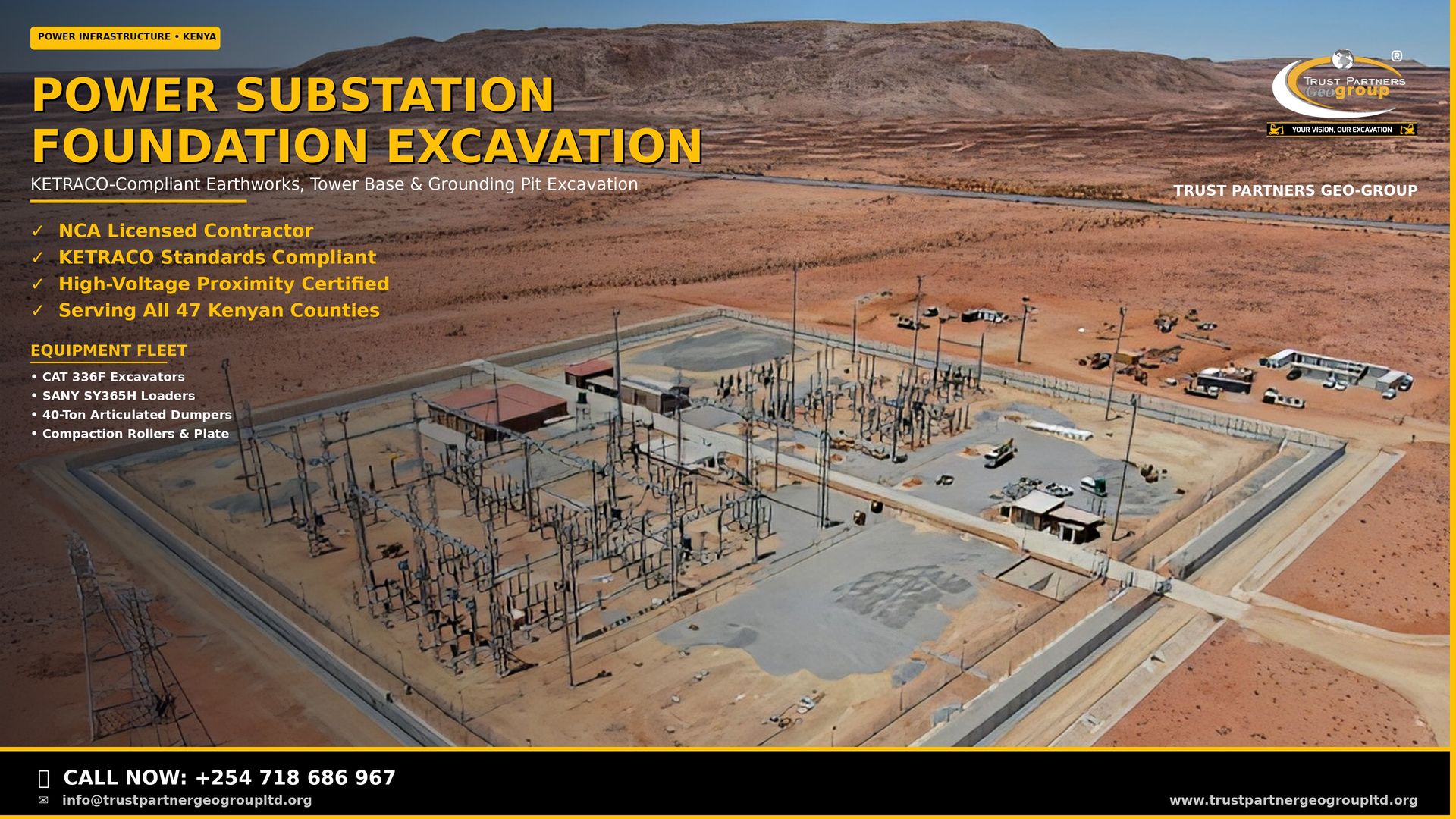
Power Substation and Transmission Line Foundation Excavation in Kenya
A KETRACO-compliant technical guide to switchyard grading, tower base excavation, and grounding pit earthworks for Kenya's power infrastructure. Trusted by electrical contractors and IPP developers nationwide.

📋 Table of Contents
- Understanding Power Infrastructure Earthworks Requirements
- Substation Foundation Excavation Standards & Specifications
- Transmission Tower Foundation Excavation Process
- KETRACO & Kenya Power Compliance Standards
- Equipment Fleet for Power Project Excavation
- Safety Protocols for Live-Line Proximity Excavation
- Cost Guide for Substation & Transmission Line Earthworks
- Frequently Asked Questions
- Contact Trust Partners for Power Infrastructure Excavation
Kenya's power infrastructure expansion — from the Lamu coal plant to Lake Turkana Wind Power and the Nairobi-Mombasa transmission corridor — depends on precision earthworks at every substation and transmission tower. Substation foundation excavation Kenya is not standard civil works; it demands KETRACO-compliant methodologies, high-voltage safety protocols, and geotechnical precision that few foundation excavation contractors can deliver.
At Trust Partners Geo-Group Ltd, we provide power line earthworks for Kenya Electricity Transmission Company (KETRACO), Independent Power Producers (IPPs), and county energy departments. From transmission tower foundation pits in Turkana's rocky terrain to switchyard grading in Nairobi's red soil, our team understands the unique demands of KETRACO substation construction.
Understanding Power Infrastructure Earthworks Requirements
Power infrastructure excavation differs fundamentally from commercial or residential earthworks. The technical specifications are governed by:
- KETRACO Technical Standards — Kenya's national grid operator mandates specific soil bearing capacities, foundation depths, and compaction densities for all grid-connected infrastructure.
- Kenya Power Safety Regulations — Excavation near live transmission lines requires specialized safety clearances, insulated equipment, and trained personnel.
- IEC 61936 Standards — International standards for substation earthing and foundation design that KETRACO adopts for all major projects.
- High-voltage proximity protocols — Working within 50 meters of 132kV, 220kV, or 400kV lines requires hot-work permits and electrical safety clearances.
⚡ Critical Distinction
Standard bulk excavation contractors lack the KETRACO compliance knowledge and high-voltage safety certifications required for power infrastructure. Using uncertified contractors risks project rejection, safety incidents, and grid connection delays.
Substation Foundation Excavation Standards & Specifications
A typical substation foundation excavation project involves three distinct earthwork zones, each with unique technical requirements:
Switchyard Grading and Leveling
The switchyard is the heart of any substation — where transformers, circuit breakers, and busbars are installed. Earthworks requirements include:
- Zero-fall grading — Switchyard floors must be perfectly level (±25mm over 100m) to ensure proper equipment alignment and oil containment.
- Crushed stone bedding layer — 150-300mm of graded crushed stone (19mm to 37mm) provides both drainage and a stable working surface.
- Oil containment bunds — Transformer foundations include excavated bunds (typically 1.2m high walls) to contain transformer oil spills.
- Surface water drainage — Substation yards require 1:200 fall toward drainage channels to prevent water pooling near live equipment.
Our team uses GPS machine control to achieve the ±25mm tolerance KETRACO demands for switchyard grading.
Transformer Foundation Pit Excavation
Power transformers (10MVA to 100MVA+) exert massive static and dynamic loads. Foundation requirements include:
- Foundation depth — Typically 2.5-4.0 meters depending on transformer weight and soil conditions.
- Reinforced concrete raft — Transformer foundations are typically reinforced concrete rafts (minimum 300mm thick) with embedded anchor bolts.
- Vibration isolation — Transformer foundations include vibration-dampening pads or spring isolators to prevent harmonic resonance.
- Fire walls — Oil-filled transformers require fire-rated separation walls (typically 3-hour rating) with excavated footings.
| Transformer Rating | Foundation Size (m) | Excavation Depth | Concrete Volume |
|---|---|---|---|
| 10 MVA | 4.0 x 3.5 | 2.5 m | 12 m³ |
| 30 MVA | 5.5 x 4.5 | 3.0 m | 22 m³ |
| 60 MVA | 7.0 x 5.5 | 3.5 m | 38 m³ |
| 100 MVA | 9.0 x 7.0 | 4.0 m | 65 m³ |
Grounding Pit and Cable Trench Excavation
Proper earthing is critical for substation safety. Our grounding pit excavation services include:
- Earth mat excavation — A grid of buried copper conductors (typically 600mm deep) that dissipates fault currents safely into the ground.
- Grounding electrode pits — Deep boreholes (6-12 meters) filled with bentonite and copper electrodes to achieve <1 ohm earth resistance.
- Cable trench networks — Excavated trenches (800mm wide x 1200mm deep) for HV cable routing between switchyard equipment.
- Lightning protection foundations — Excavated bases for lightning masts and overhead earth wires.
All grounding work is tested with fall-of-potential method to verify compliance with KETRACO's <1 ohm requirement.
Transmission Tower Foundation Excavation Process
Transmission tower foundation earthworks vary by tower type, voltage level, and terrain. Kenya's transmission network uses three primary tower types:
Lattice Steel Towers (132kV - 400kV)
Lattice towers use four independent concrete footings (one per leg). Each footing requires:
- Excavation depth — 2.5-4.5 meters depending on soil bearing capacity and wind load.
- Stub angle setting — Precise alignment of steel stub angles within ±5mm for tower erection.
- Concrete grade — Minimum C25 concrete with reinforcement cages.
Monopole Towers (66kV - 132kV)
Monopoles use a single large-diameter foundation:
- Caisson excavation — Drilled shafts 1.5-3.0 meters diameter, 4-8 meters deep.
- Reinforcement cage — Heavy steel cages lowered into excavated shafts.
- Concrete placement — Tremie concrete placement for wet conditions.
Guyed Masts (Communication & Distribution)
Guyed structures require:
- Central mast foundation — Typically 2.0-3.0 meter deep pad foundation.
- Guy anchor excavations — Four inclined anchor blocks (45°) excavated 3-5 meters from mast base.
| Tower Type | Voltage | Foundation Depth | Soil Bearing Requirement |
|---|---|---|---|
| Lattice (Suspension) | 132kV | 2.5 - 3.5 m | 150 kPa |
| Lattice (Tension) | 220kV | 3.0 - 4.5 m | 150 kPa |
| Lattice (Terminal) | 400kV | 3.5 - 5.0 m | 200 kPa |
| Monopole | 66-132kV | 4.0 - 8.0 m (caisson) | 150 kPa |
| Guyed Mast | Distribution | 2.0 - 3.0 m | 100 kPa |
KETRACO & Kenya Power Compliance Standards
Every substation foundation excavation Kenya project must comply with a multi-layered regulatory framework:
KETRACO Technical Requirements
- Geotechnical investigation report — Mandatory for all substation and transmission line projects. Must include borehole logs, soil classification, and bearing capacity recommendations.
- Foundation design approval — All foundation designs must be stamped by a registered structural engineer and approved by KETRACO's engineering department.
- Material testing — Concrete cube tests, reinforcement bar tests, and soil compaction tests must be conducted by KETRACO-accredited laboratories.
- As-built documentation — Final drawings showing actual foundation dimensions, elevations, and test results.
Kenya Power Safety Clearances
- Live-line proximity permits — Required for excavation within 50 meters of energized transmission lines.
- Hot-work permits — Required for any work that could generate sparks or heat near live equipment.
- Electrical safety training — All personnel must have KETRACO-recognized electrical safety certification.
NEMA & County Requirements
- NEMA EIA License — Required for transmission lines >50km and substations >132kV.
- Wayleave agreements — Legal right-of-way documentation for transmission line corridors.
- County construction permits — Standard building permits from county public works departments.
✅ Trust Partners Advantage
We are one of the few earthworks contractors Kenya with direct KETRACO project experience. Our team has completed substation earthworks for 132kV and 220kV projects, with full compliance documentation delivered on every contract.
Equipment Fleet for Power Project Excavation
Power infrastructure earthworks demand specialized equipment. Our heavy equipment hire Kenya fleet for power projects includes:
| Equipment | Application | Specification |
|---|---|---|
| 30-Ton Excavator | Tower base pits, switchyard grading | 1.5 m³ bucket, GPS control, insulated cab |
| Auger Drill Rig | Monopole caisson drilling | 1.5-3.0m diameter, 12m depth |
| Bulldozer (D6/D7) | Switchyard grading, access roads | GPS blade control, ripper |
| Vibratory Roller | Switchyard compaction | 10-ton smooth drum, 95% density |
| Dump Trucks | Spoil removal, aggregate delivery | 20-30 ton capacity |
| Concrete Mixer Truck | Foundation concrete delivery | 6-8 m³ capacity |
| Plate Compactor | Trench and confined compaction | 500 kg reversible |
For projects near live lines, we deploy insulated equipment and maintain minimum approach distances per KETRACO safety standards.
Safety Protocols for Live-Line Proximity Excavation
Working near energized transmission lines is one of the highest-risk activities in civil construction. Our safety protocols include:
- Minimum approach distances — 3.0m for 66kV, 4.5m for 132kV, 6.0m for 220kV, 8.0m for 400kV.
- Insulated tools and equipment — All hand tools and machinery within approach zones use insulated handles and non-conductive components.
- Spotter system — Dedicated safety spotters monitor all excavation activities near live lines.
- Barricading and signage — High-visibility barriers and warning signs demarcate exclusion zones.
- Toolbox talks — Daily safety briefings specific to live-line proximity hazards.
- Emergency response plan — Pre-planned evacuation routes and emergency contact protocols.
Cost Guide for Substation & Transmission Line Earthworks
Our transparent 2027 pricing for power line earthworks:
| Item | Unit | Rate (KES) | Notes |
|---|---|---|---|
| Switchyard grading | per m² | 350 – 600 | Incl. compaction to 95% |
| Transformer foundation excavation | per m³ | 2,000 – 3,500 | Depth 2.5-4.0m |
| Transmission tower base (lattice) | per base | 45,000 – 85,000 | Incl. concrete & stub setting |
| Monopole caisson drilling | per m | 8,000 – 15,000 | Rock add 50% |
| Grounding pit excavation | per pit | 8,000 – 15,000 | Incl. bentonite backfill |
| Cable trench excavation | per linear m | 2,500 – 4,500 | 800mmW x 1200mmD |
| Earth mat excavation | per m² | 450 – 750 | 600mm depth |
Note: Rates exclude concrete, reinforcement, and KETRACO testing fees. Substation foundation excavation Nairobi and urban areas may attract 10-15% mobilization premium. Remote projects (Turkana, Marsabit) may require additional logistics costs.
Frequently Asked Questions About Substation Foundation Excavation in Kenya
Transmission tower foundation depth in Kenya typically ranges from 2.5 to 4.5 meters depending on tower type, soil bearing capacity, and wind load requirements. KETRACO standards require minimum 150 kPa soil bearing capacity at foundation base. Lattice towers typically require 3.0-3.5 meter depth, while monopole towers need 2.5-3.0 meters. Terminal towers and angle towers subject to higher tension loads may require depths up to 5.0 meters.
Substation foundation excavation in Kenya costs between KES 2,000 and KES 4,500 per cubic meter depending on soil type, depth, and proximity to live infrastructure. Switchyard grading costs KES 350-600 per square meter. Grounding pit excavation ranges from KES 8,000-15,000 per pit including backfill with bentonite. For a complete 132kV substation, total earthworks typically range from KES 2.5M to KES 6M depending on site size and soil conditions.
Substation earthworks require comprehensive geotechnical investigation including soil bearing capacity tests, resistivity testing for grounding design, groundwater analysis, and soil classification per USCS standards. KETRACO mandates plate load tests for transformer foundations and standard penetration tests (SPT) for tower foundations. Additional tests include soil resistivity (for earthing design), chemical analysis (for concrete aggression), and compaction tests for every 500m² of switchyard grading.
Yes. Power infrastructure projects in Kenya require NEMA Environmental Impact Assessment (EIA) approval, Energy Regulatory Commission (ERC) permits, KETRACO technical approval for grid-connected projects, and county construction permits. Projects near existing live lines require Kenya Power safety clearance and specialized hot-work permits. Wayleave agreements are mandatory for transmission line corridors crossing private land.
Transmission line foundation excavation uses 20-30 ton excavators for tower base pits, auger drills for bored pile foundations, bulldozers for switchyard grading, and specialized grounding equipment. For rocky terrain, hydraulic hammers and rock drills are used. All equipment must be electrically insulated when working near live transmission lines. GPS machine control ensures tower base alignment within ±5mm for proper tower erection.
Tendering for a Power Infrastructure Project?
Trust Partners Geo-Group delivers KETRACO-compliant substation and transmission line foundation excavation. From switchyard grading to tower base excavation and grounding systems, we handle every cubic meter with engineering precision and safety.
📞 +254 718 68 69 67Request Technical Consultation
Serving all 47 counties including Nairobi, Mombasa, Kisumu, Nakuru, Turkana, Marsabit, and beyond.
Power Substation and Transmission Line Foundation Excavation in Kenya
A KETRACO-compliant technical guide to switchyard grading, tower base excavation, and grounding pit earthworks for Kenya's power infrastructure. Trusted by electrical contractors and IPP developers nationwide.
📋 Table of Contents
- Understanding Power Infrastructure Earthworks Requirements
- Substation Foundation Excavation Standards & Specifications
- Transmission Tower Foundation Excavation Process
- KETRACO & Kenya Power Compliance Standards
- Equipment Fleet for Power Project Excavation
- Safety Protocols for Live-Line Proximity Excavation
- Cost Guide for Substation & Transmission Line Earthworks
- Frequently Asked Questions
- Contact Trust Partners for Power Infrastructure Excavation
Kenya's power infrastructure expansion — from the Lamu coal plant to Lake Turkana Wind Power and the Nairobi-Mombasa transmission corridor — depends on precision earthworks at every substation and transmission tower. Substation foundation excavation Kenya is not standard civil works; it demands KETRACO-compliant methodologies, high-voltage safety protocols, and geotechnical precision that few foundation excavation contractors can deliver.
At Trust Partners Geo-Group Ltd, we provide power line earthworks for Kenya Electricity Transmission Company (KETRACO), Independent Power Producers (IPPs), and county energy departments. From transmission tower foundation pits in Turkana's rocky terrain to switchyard grading in Nairobi's red soil, our team understands the unique demands of KETRACO substation construction.
Understanding Power Infrastructure Earthworks Requirements
Power infrastructure excavation differs fundamentally from commercial or residential earthworks. The technical specifications are governed by:
- KETRACO Technical Standards — Kenya's national grid operator mandates specific soil bearing capacities, foundation depths, and compaction densities for all grid-connected infrastructure.
- Kenya Power Safety Regulations — Excavation near live transmission lines requires specialized safety clearances, insulated equipment, and trained personnel.
- IEC 61936 Standards — International standards for substation earthing and foundation design that KETRACO adopts for all major projects.
- High-voltage proximity protocols — Working within 50 meters of 132kV, 220kV, or 400kV lines requires hot-work permits and electrical safety clearances.
⚡ Critical Distinction
Standard bulk excavation contractors lack the KETRACO compliance knowledge and high-voltage safety certifications required for power infrastructure. Using uncertified contractors risks project rejection, safety incidents, and grid connection delays.
Substation Foundation Excavation Standards & Specifications
A typical substation foundation excavation project involves three distinct earthwork zones, each with unique technical requirements:
Switchyard Grading and Leveling
The switchyard is the heart of any substation — where transformers, circuit breakers, and busbars are installed. Earthworks requirements include:
- Zero-fall grading — Switchyard floors must be perfectly level (±25mm over 100m) to ensure proper equipment alignment and oil containment.
- Crushed stone bedding layer — 150-300mm of graded crushed stone (19mm to 37mm) provides both drainage and a stable working surface.
- Oil containment bunds — Transformer foundations include excavated bunds (typically 1.2m high walls) to contain transformer oil spills.
- Surface water drainage — Substation yards require 1:200 fall toward drainage channels to prevent water pooling near live equipment.
Our team uses GPS machine control to achieve the ±25mm tolerance KETRACO demands for switchyard grading.
Transformer Foundation Pit Excavation
Power transformers (10MVA to 100MVA+) exert massive static and dynamic loads. Foundation requirements include:
- Foundation depth — Typically 2.5-4.0 meters depending on transformer weight and soil conditions.
- Reinforced concrete raft — Transformer foundations are typically reinforced concrete rafts (minimum 300mm thick) with embedded anchor bolts.
- Vibration isolation — Transformer foundations include vibration-dampening pads or spring isolators to prevent harmonic resonance.
- Fire walls — Oil-filled transformers require fire-rated separation walls (typically 3-hour rating) with excavated footings.
| Transformer Rating | Foundation Size (m) | Excavation Depth | Concrete Volume |
|---|---|---|---|
| 10 MVA | 4.0 x 3.5 | 2.5 m | 12 m³ |
| 30 MVA | 5.5 x 4.5 | 3.0 m | 22 m³ |
| 60 MVA | 7.0 x 5.5 | 3.5 m | 38 m³ |
| 100 MVA | 9.0 x 7.0 | 4.0 m | 65 m³ |
Grounding Pit and Cable Trench Excavation
Proper earthing is critical for substation safety. Our grounding pit excavation services include:
- Earth mat excavation — A grid of buried copper conductors (typically 600mm deep) that dissipates fault currents safely into the ground.
- Grounding electrode pits — Deep boreholes (6-12 meters) filled with bentonite and copper electrodes to achieve <1 ohm earth resistance.
- Cable trench networks — Excavated trenches (800mm wide x 1200mm deep) for HV cable routing between switchyard equipment.
- Lightning protection foundations — Excavated bases for lightning masts and overhead earth wires.
All grounding work is tested with fall-of-potential method to verify compliance with KETRACO's <1 ohm requirement.
Transmission Tower Foundation Excavation Process
Transmission tower foundation earthworks vary by tower type, voltage level, and terrain. Kenya's transmission network uses three primary tower types:
Lattice Steel Towers (132kV - 400kV)
Lattice towers use four independent concrete footings (one per leg). Each footing requires:
- Excavation depth — 2.5-4.5 meters depending on soil bearing capacity and wind load.
- Stub angle setting — Precise alignment of steel stub angles within ±5mm for tower erection.
- Concrete grade — Minimum C25 concrete with reinforcement cages.
Monopole Towers (66kV - 132kV)
Monopoles use a single large-diameter foundation:
- Caisson excavation — Drilled shafts 1.5-3.0 meters diameter, 4-8 meters deep.
- Reinforcement cage — Heavy steel cages lowered into excavated shafts.
- Concrete placement — Tremie concrete placement for wet conditions.
Guyed Masts (Communication & Distribution)
Guyed structures require:
- Central mast foundation — Typically 2.0-3.0 meter deep pad foundation.
- Guy anchor excavations — Four inclined anchor blocks (45°) excavated 3-5 meters from mast base.
| Tower Type | Voltage | Foundation Depth | Soil Bearing Requirement |
|---|---|---|---|
| Lattice (Suspension) | 132kV | 2.5 - 3.5 m | 150 kPa |
| Lattice (Tension) | 220kV | 3.0 - 4.5 m | 150 kPa |
| Lattice (Terminal) | 400kV | 3.5 - 5.0 m | 200 kPa |
| Monopole | 66-132kV | 4.0 - 8.0 m (caisson) | 150 kPa |
| Guyed Mast | Distribution | 2.0 - 3.0 m | 100 kPa |
KETRACO & Kenya Power Compliance Standards
Every substation foundation excavation Kenya project must comply with a multi-layered regulatory framework:
KETRACO Technical Requirements
- Geotechnical investigation report — Mandatory for all substation and transmission line projects. Must include borehole logs, soil classification, and bearing capacity recommendations.
- Foundation design approval — All foundation designs must be stamped by a registered structural engineer and approved by KETRACO's engineering department.
- Material testing — Concrete cube tests, reinforcement bar tests, and soil compaction tests must be conducted by KETRACO-accredited laboratories.
- As-built documentation — Final drawings showing actual foundation dimensions, elevations, and test results.
Kenya Power Safety Clearances
- Live-line proximity permits — Required for excavation within 50 meters of energized transmission lines.
- Hot-work permits — Required for any work that could generate sparks or heat near live equipment.
- Electrical safety training — All personnel must have KETRACO-recognized electrical safety certification.
NEMA & County Requirements
- NEMA EIA License — Required for transmission lines >50km and substations >132kV.
- Wayleave agreements — Legal right-of-way documentation for transmission line corridors.
- County construction permits — Standard building permits from county public works departments.
✅ Trust Partners Advantage
We are one of the few earthworks contractors Kenya with direct KETRACO project experience. Our team has completed substation earthworks for 132kV and 220kV projects, with full compliance documentation delivered on every contract.
Equipment Fleet for Power Project Excavation
Power infrastructure earthworks demand specialized equipment. Our heavy equipment hire Kenya fleet for power projects includes:
| Equipment | Application | Specification |
|---|---|---|
| 30-Ton Excavator | Tower base pits, switchyard grading | 1.5 m³ bucket, GPS control, insulated cab |
| Auger Drill Rig | Monopole caisson drilling | 1.5-3.0m diameter, 12m depth |
| Bulldozer (D6/D7) | Switchyard grading, access roads | GPS blade control, ripper |
| Vibratory Roller | Switchyard compaction | 10-ton smooth drum, 95% density |
| Dump Trucks | Spoil removal, aggregate delivery | 20-30 ton capacity |
| Concrete Mixer Truck | Foundation concrete delivery | 6-8 m³ capacity |
| Plate Compactor | Trench and confined compaction | 500 kg reversible |
For projects near live lines, we deploy insulated equipment and maintain minimum approach distances per KETRACO safety standards.
Safety Protocols for Live-Line Proximity Excavation
Working near energized transmission lines is one of the highest-risk activities in civil construction. Our safety protocols include:
- Minimum approach distances — 3.0m for 66kV, 4.5m for 132kV, 6.0m for 220kV, 8.0m for 400kV.
- Insulated tools and equipment — All hand tools and machinery within approach zones use insulated handles and non-conductive components.
- Spotter system — Dedicated safety spotters monitor all excavation activities near live lines.
- Barricading and signage — High-visibility barriers and warning signs demarcate exclusion zones.
- Toolbox talks — Daily safety briefings specific to live-line proximity hazards.
- Emergency response plan — Pre-planned evacuation routes and emergency contact protocols.
Cost Guide for Substation & Transmission Line Earthworks
Our transparent 2027 pricing for power line earthworks:
| Item | Unit | Rate (KES) | Notes |
|---|---|---|---|
| Switchyard grading | per m² | 350 – 600 | Incl. compaction to 95% |
| Transformer foundation excavation | per m³ | 2,000 – 3,500 | Depth 2.5-4.0m |
| Transmission tower base (lattice) | per base | 45,000 – 85,000 | Incl. concrete & stub setting |
| Monopole caisson drilling | per m | 8,000 – 15,000 | Rock add 50% |
| Grounding pit excavation | per pit | 8,000 – 15,000 | Incl. bentonite backfill |
| Cable trench excavation | per linear m | 2,500 – 4,500 | 800mmW x 1200mmD |
| Earth mat excavation | per m² | 450 – 750 | 600mm depth |
Note: Rates exclude concrete, reinforcement, and KETRACO testing fees. Substation foundation excavation Nairobi and urban areas may attract 10-15% mobilization premium. Remote projects (Turkana, Marsabit) may require additional logistics costs.
Frequently Asked Questions About Substation Foundation Excavation in Kenya
Transmission tower foundation depth in Kenya typically ranges from 2.5 to 4.5 meters depending on tower type, soil bearing capacity, and wind load requirements. KETRACO standards require minimum 150 kPa soil bearing capacity at foundation base. Lattice towers typically require 3.0-3.5 meter depth, while monopole towers need 2.5-3.0 meters. Terminal towers and angle towers subject to higher tension loads may require depths up to 5.0 meters.
Substation foundation excavation in Kenya costs between KES 2,000 and KES 4,500 per cubic meter depending on soil type, depth, and proximity to live infrastructure. Switchyard grading costs KES 350-600 per square meter. Grounding pit excavation ranges from KES 8,000-15,000 per pit including backfill with bentonite. For a complete 132kV substation, total earthworks typically range from KES 2.5M to KES 6M depending on site size and soil conditions.
Substation earthworks require comprehensive geotechnical investigation including soil bearing capacity tests, resistivity testing for grounding design, groundwater analysis, and soil classification per USCS standards. KETRACO mandates plate load tests for transformer foundations and standard penetration tests (SPT) for tower foundations. Additional tests include soil resistivity (for earthing design), chemical analysis (for concrete aggression), and compaction tests for every 500m² of switchyard grading.
Yes. Power infrastructure projects in Kenya require NEMA Environmental Impact Assessment (EIA) approval, Energy Regulatory Commission (ERC) permits, KETRACO technical approval for grid-connected projects, and county construction permits. Projects near existing live lines require Kenya Power safety clearance and specialized hot-work permits. Wayleave agreements are mandatory for transmission line corridors crossing private land.
Transmission line foundation excavation uses 20-30 ton excavators for tower base pits, auger drills for bored pile foundations, bulldozers for switchyard grading, and specialized grounding equipment. For rocky terrain, hydraulic hammers and rock drills are used. All equipment must be electrically insulated when working near live transmission lines. GPS machine control ensures tower base alignment within ±5mm for proper tower erection.
Tendering for a Power Infrastructure Project?
Trust Partners Geo-Group delivers KETRACO-compliant substation and transmission line foundation excavation. From switchyard grading to tower base excavation and grounding systems, we handle every cubic meter with engineering precision and safety.
📞 +254 718 68 69 67Request Technical Consultation
Serving all 47 counties including Nairobi, Mombasa, Kisumu, Nakuru, Turkana, Marsabit, and beyond.