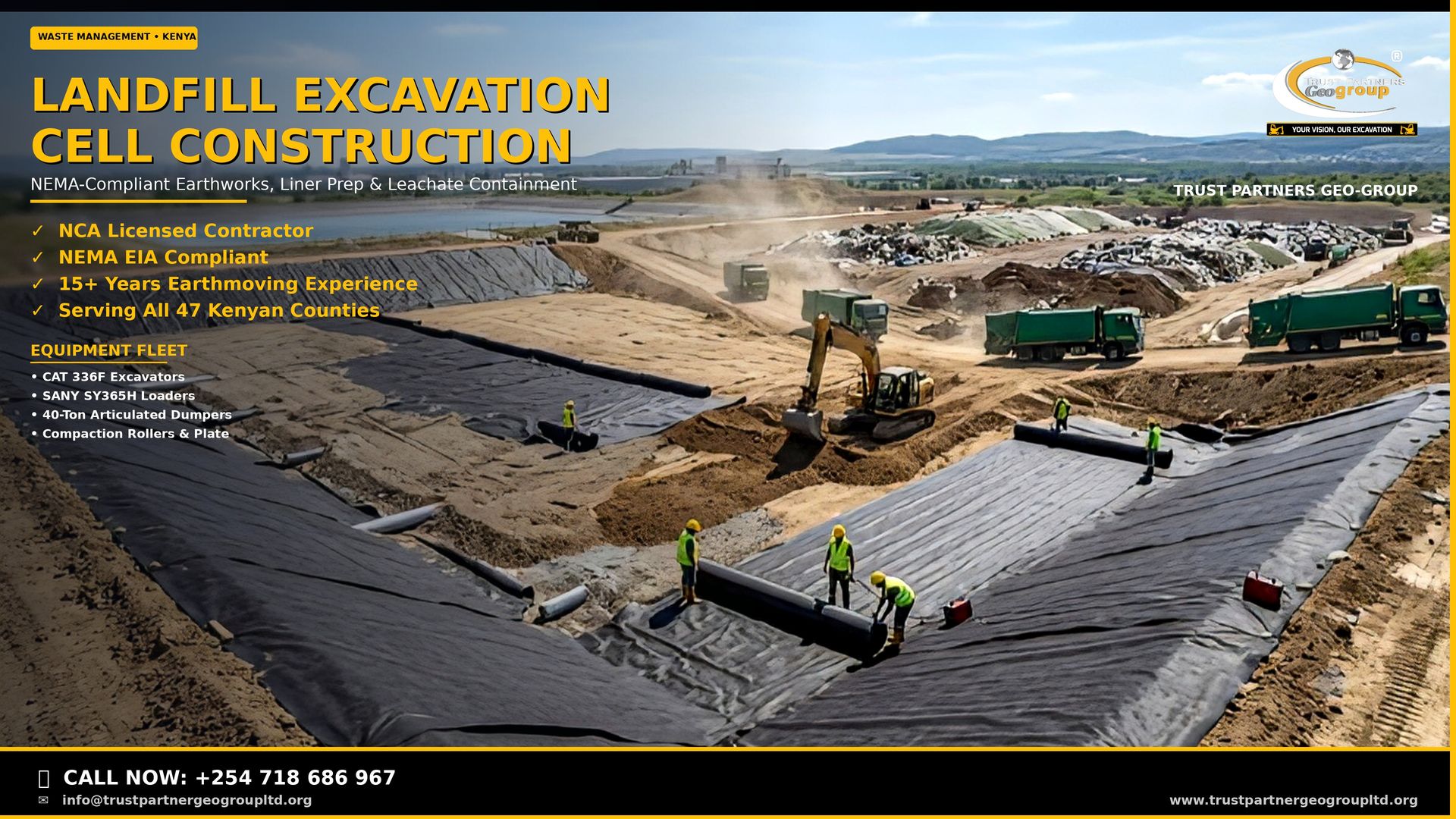
Landfill & Waste Management Site Excavation in Kenya: Cell Construction and Liner Systems
A NEMA-compliant technical guide to sanitary landfill excavation, waste cell construction, liner system preparation, and leachate containment earthworks. Trusted by county governments and waste management developers nationwide.

📋 Table of Contents
- Understanding Sanitary Landfill Construction Requirements
- Landfill Cell Excavation Process
- Liner System Preparation Excavation
- Leachate Collection System Excavation
- NEMA Environmental Compliance for Landfill Earthworks
- Equipment for Landfill Excavation Projects
- Cost Factors for Landfill Cell Construction in Kenya
- Frequently Asked Questions
- Contact Trust Partners for Landfill Excavation
Kenya generates over 22,000 tonnes of solid waste daily, with Nairobi County alone producing approximately 2,400 tonnes per day. As open dumpsites like Dandora reach capacity and the National Environment Management Authority (NEMA) tightens enforcement of the Waste Management Regulations 2021, counties and private developers are investing in engineered sanitary landfill facilities. Landfill excavation Kenya is a specialized discipline that goes far beyond bulk earthworks — it demands precision grading for liner systems, leachate containment, and NEMA-compliant environmental safeguards.
At Trust Partners Geo-Group Ltd, we provide waste cell construction earthworks for county governments, private waste management companies, and environmental contractors. From dumpsite rehabilitation in Nairobi to greenfield sanitary landfill cell construction in Nakuru and Kisumu, our team delivers the geotechnical precision and regulatory compliance that modern waste infrastructure demands.
Understanding Sanitary Landfill Construction Requirements
The transition from open dumping to sanitary landfill engineering represents one of the most significant environmental challenges facing Kenya's 47 counties. A sanitary landfill is an engineered facility that isolates waste from the environment using a combination of bottom liners, leachate collection systems, and daily soil cover. Unlike open dumpsites, sanitary landfills prevent groundwater contamination, control methane emissions, and allow for post-closure rehabilitation.
Key technical requirements for sanitary landfill construction in Kenya include:
- Cell-based phased design — Landfills are constructed in discrete cells (typically 50m x 50m to 100m x 100m) that allow phased filling, liner installation, and leachate management. Each cell operates as an independent containment unit.
- Composite liner systems — NEMA mandates a minimum double-liner approach for municipal solid waste landfills: a compacted clay liner (CCL) overlain by a high-density polyethylene (HDPE) geomembrane with a leachate collection layer above.
- Groundwater protection — The landfill base must maintain a minimum 2-meter vertical separation between the waste containment zone and the highest anticipated groundwater table.
- Leachate containment — All liquid percolating through waste must be collected, stored, and treated. Leachate collection sumps and pump stations require excavated chambers with waterproof concrete.
- Gas management — Methane and carbon dioxide generated by decomposing waste require venting or extraction systems, often involving trenching for gas collection pipes.
⚠️ Critical Distinction
Standard bulk excavation contractors lack the environmental engineering knowledge and NEMA compliance experience required for landfill projects. Improper cell grading or liner subgrade preparation can result in geomembrane punctures, leachate leakage, and multi-million shilling remediation costs — not to mention NEMA enforcement action and county liability.
Landfill Cell Excavation Process
Landfill cell excavation follows a rigorous sequence designed to protect liner integrity and ensure decades of environmental containment. Our process aligns with NEMA guidelines and international best practices from the World Bank and US EPA.
Site Clearing and Topsoil Removal
The first phase of sanitary landfill earthworks involves complete site stripping:
- Vegetation and organic removal — All trees, shrubs, and root systems are cleared to prevent future decomposition voids beneath the liner. Organic material is segregated for composting or disposal.
- Topsoil stockpiling — Fertile topsoil (typically 300-500mm) is carefully stripped and stockpiled for final capping and site rehabilitation. This reduces import costs and supports post-closure vegetation.
- Subsoil exposure — The exposed subgrade is inspected for organic lenses, peat deposits, or karst features that could compromise liner integrity. Problematic areas are over-excavated and backfilled with engineered fill.
Cell Bottom Excavation and Grading
The cell bottom excavation is the most critical earthwork operation:
- Excavation depth — Typical cell depths range from 5 to 15 meters depending on waste volume projections and groundwater constraints. Deep cells maximize airspace but increase leachate head pressure.
- Positive drainage gradient — The cell floor is graded at 1-3% toward leachate collection sumps. This ensures gravitational flow of leachate and prevents ponding that could increase hydrostatic pressure on the liner.
- Subgrade compaction — Native soil beneath the clay liner is compacted to 95% of maximum dry density (Modified Proctor) to provide a stable, non-settling foundation.
- Proof rolling — A heavily loaded dump truck or roller is driven across the subgrade to identify soft spots, which are excavated and replaced with compacted engineered fill.
Slope Construction for Cell Walls
Cell side slopes must balance stability, liner constructability, and airspace volume:
- Slope gradients — Side slopes typically range from 1 vertical to 3 horizontal (1V:3H) for soil stability, though 1V:2H may be used in competent rock or with geosynthetic reinforcement.
- Benching — In deep cells or unstable soils, intermediate benches (3-5m wide every 6-8m of height) improve slope stability and provide access for liner installation crews.
- Anchor trench integration — The perimeter of each cell includes excavated anchor trenches (typically 500mm deep x 300mm wide) that secure the HDPE geomembrane against wind uplift and waste sliding forces.
| Parameter | Specification | NEMA / International Standard |
|---|---|---|
| Cell depth | 5 – 15 meters | Project-specific EIA |
| Floor gradient | 1% – 3% toward sump | US EPA Subtitle D |
| Side slope | 1V:2H to 1V:3H | Geotechnical design |
| Groundwater separation | Minimum 2.0 meters | NEMA Waste Regs 2021 |
| Subgrade compaction | ≥95% MDD (Modified Proctor) | ASTM D1557 / BS 1377 |
| Anchor trench size | 500mm D x 300mm W | Geomembrane manufacturer |
Liner System Preparation Excavation
The liner system is the environmental heart of any sanitary landfill. Our landfill liner preparation earthworks ensure a flawless subgrade for the multi-layer containment system.
Clay Liner Subgrade Preparation
The compacted clay liner (CCL) provides the primary hydraulic barrier:
- Clay source identification — We identify on-site or nearby sources of low-permeability clay (hydraulic conductivity k ≤ 1×10⁻⁹ m/s). If native soils are too permeable, imported bentonite-enhanced clay is used.
- Over-excavation and replacement — Where native soils are unsuitable, we over-excavate and backfill with engineered clay in 150mm lifts, each compacted to 95% MDD at moisture content within 2% of optimum.
- Thickness — NEMA typically requires a minimum 600mm compacted clay thickness for municipal landfills. High-risk sites (near water bodies or in sandy soils) may require 1,000mm.
- Testing — Every lift is tested for density and moisture. Permeability testing (falling head permeameter) verifies k ≤ 1×10⁻⁹ m/s before geomembrane placement.
Geomembrane Anchor Trench Excavation
HDPE geomembrane sheets must be securely anchored to prevent wind uplift and waste sliding:
- Perimeter anchor trenches — Excavated 500mm deep x 300mm wide around the entire cell perimeter. The geomembrane edge is buried and backfilled with compacted clay or concrete.
- Intermediate anchor trenches — On wide cells or in windy areas, intermediate trenches every 20-30 meters prevent billowing during installation.
- Leachate pipe penetration trenches — Excavated channels for leachate collection pipes passing through the liner, fitted with sealed boot connections.
✅ Trust Partners Advantage
We are one of the few site clearing contractors Kenya with documented sanitary landfill project experience. Our team has completed cell excavation and liner subgrade preparation for county waste facilities, with full NEMA compliance documentation and third-party geotechnical verification delivered on every contract.
Leachate Collection System Excavation
Leachate — the liquid that drains from a landfill — is highly contaminated and must be captured before it escapes the cell. Our leachate containment excavation services include:
- Gravel blanket excavation — A 300mm thick blanket of clean, graded gravel (19-37mm) is placed above the geomembrane to provide a high-permeability drainage layer. Excavation tolerances of ±25mm ensure uniform thickness.
- Perforated pipe network trenches — Trenches excavated within the gravel blanket house perforated HDPE collection pipes (typically 160-250mm diameter) that convey leachate to sumps.
- Leachate sump excavation — Sumps (typically 2.0m x 2.0m x 3.0m deep) are excavated at the cell low points and constructed with reinforced concrete walls and base slabs. Sump floors include sumps pumps and level sensors.
- Leachate transmission main trenches — Excavated trenches (800mm wide x 1,200mm deep) route leachate from cell sumps to storage lagoons or treatment plants. These often require trench excavation through variable soils.
NEMA Environmental Compliance for Landfill Earthworks
Every landfill excavation Kenya project must navigate a multi-layered regulatory framework:
NEMA Environmental Impact Assessment (EIA)
- Full EIA License — Mandatory for all new sanitary landfills and major dumpsite rehabilitation projects. The EIA must address groundwater vulnerability, air quality, noise, and socio-economic impacts.
- Environmental Audit (EA) — Existing dumpsites undergoing rehabilitation may require a simplified EA rather than a full EIA, depending on NEMA screening.
- Public participation — NEMA requires documented public consultation with affected communities, including site visits and disclosure of mitigation measures.
Water Resources Management Authority (WRMA)
- Groundwater permits — Baseline groundwater monitoring boreholes and any dewatering activities require WRMA permits.
- Watercourse protection — Landfills within 500 meters of rivers, lakes, or wetlands require additional hydrological impact assessment and buffer zone establishment.
County Government and Public Health Requirements
- County construction permits — Standard NCA and county public works permits for earthmoving and civil works.
- Public health clearance — The Ministry of Health and county public health departments must approve landfill siting and operational plans.
- NCA contractor registration — All landfill earthworks must be executed by NCA-registered contractors with appropriate categories (NCA 1 or NCA 2 for civil works).
Equipment for Landfill Excavation Projects
Sanitary landfill construction demands specialized earthmoving equipment. Our heavy equipment hire Kenya fleet for waste management projects includes:
| Equipment | Application | Specification |
|---|---|---|
| 30-Ton Excavator | Cell bottom and slope excavation | 1.5 m³ bucket, GPS grade control |
| Bulldozer (D6/D7) | Subgrade grading, clay spreading | GPS blade control, ripper |
| 20-Ton Smooth Drum Roller | Clay liner compaction | Vibratory, 95% density target |
| Dump Trucks | Spoil removal, gravel delivery | 20-30 ton capacity |
| Plate Compactor | Trench and confined compaction | 500 kg reversible |
| Water Bowser | Moisture conditioning for clay | 10,000 litre capacity |
For dumpsite rehabilitation Nairobi projects, we also deploy specialized equipment for soil screening, cover material placement, and gas venting trench installation.
Cost Factors for Landfill Cell Construction in Kenya
Our transparent 2027 pricing for waste management earthworks:
| Item | Unit | Rate (KES) | Notes |
|---|---|---|---|
| Site clearing & topsoil strip | per m² | 150 – 300 | Incl. vegetation removal |
| Cell bulk excavation (soil) | per m³ | 1,800 – 3,500 | Depth 5-15m |
| Cell bulk excavation (rock) | per m³ | 4,500 – 8,000 | Incl. blasting/hammer |
| Clay liner subgrade prep | per m² | 800 – 1,500 | Compaction & testing |
| Geomembrane anchor trench | per linear m | 2,500 – 4,000 | 500mm D x 300mm W |
| Leachate sump excavation | per sump | 45,000 – 85,000 | 2m x 2m x 3m |
| Gravel blanket placement | per m³ | 2,000 – 3,200 | Supply & install |
Note: Rates exclude liner materials (geomembrane, geotextile), concrete, leachate pipes, and NEMA testing fees. Dumpsite rehabilitation Nairobi and urban sites may attract 15-20% mobilization premium due to traffic and access constraints. Remote county projects may require additional logistics costs.
Frequently Asked Questions About Landfill Excavation in Kenya
Landfill cell excavation depth in Kenya typically ranges from 5 to 15 meters depending on waste volume projections, groundwater table, and soil conditions. NEMA guidelines require a minimum separation of 2 meters between the landfill base and the highest anticipated groundwater level. Clay liner systems add 0.6 to 1.0 meters to the total excavation depth requirement.
Landfill excavation in Kenya costs between KES 1,800 and KES 3,500 per cubic meter depending on soil type, depth, and haul distance. Rock excavation increases costs to KES 4,500-8,000 per cubic meter. Clay liner subgrade preparation adds KES 800-1,500 per square meter, while geomembrane anchor trench excavation ranges from KES 2,500-4,000 per linear meter.
Yes. All sanitary landfill projects in Kenya require a NEMA Environmental Impact Assessment (EIA) License under the Environmental Management and Coordination Act (EMCA). Additional permits include Water Resources Management Authority (WRMA) approvals for groundwater protection, county construction permits, and public health clearances from the Ministry of Health. Dumpsite rehabilitation projects may require a simplified NEMA Environmental Audit.
Kenyan sanitary landfills typically use a composite liner system comprising a compacted clay liner (CCL) with hydraulic conductivity less than 1×10⁻⁹ m/s, overlain by a 1.5mm to 2.0mm HDPE geomembrane. A geotextile protective layer and leachate collection gravel blanket (300mm) are installed above the geomembrane. Some modern facilities also incorporate a geosynthetic clay liner (GCL) as a secondary barrier.
Leachate control begins during excavation by establishing a positive drainage gradient (1-3%) toward collection sumps. A perforated pipe network is installed within a gravel blanket above the liner. Leachate sumps (typically 2m x 2m x 3m deep) are excavated at the cell low points and fitted with submersible pumps. During construction, temporary diversion channels prevent surface water from entering the excavated cell.
Tendering for a Waste Management or Landfill Project?
Trust Partners Geo-Group delivers NEMA-compliant landfill excavation and waste cell construction. From cell bottom grading to clay liner subgrade preparation and geomembrane anchor trench excavation, we handle every cubic meter with environmental precision and regulatory compliance.
📞 +254 718 68 69 67Request Technical Consultation
Serving all 47 counties including Nairobi, Mombasa, Kisumu, Nakuru, and beyond.
Landfill & Waste Management Site Excavation in Kenya: Cell Construction and Liner Systems
A NEMA-compliant technical guide to sanitary landfill excavation, waste cell construction, liner system preparation, and leachate containment earthworks. Trusted by county governments and waste management developers nationwide.
📋 Table of Contents
- Understanding Sanitary Landfill Construction Requirements
- Landfill Cell Excavation Process
- Liner System Preparation Excavation
- Leachate Collection System Excavation
- NEMA Environmental Compliance for Landfill Earthworks
- Equipment for Landfill Excavation Projects
- Cost Factors for Landfill Cell Construction in Kenya
- Frequently Asked Questions
- Contact Trust Partners for Landfill Excavation
Kenya generates over 22,000 tonnes of solid waste daily, with Nairobi County alone producing approximately 2,400 tonnes per day. As open dumpsites like Dandora reach capacity and the National Environment Management Authority (NEMA) tightens enforcement of the Waste Management Regulations 2021, counties and private developers are investing in engineered sanitary landfill facilities. Landfill excavation Kenya is a specialized discipline that goes far beyond bulk earthworks — it demands precision grading for liner systems, leachate containment, and NEMA-compliant environmental safeguards.
At Trust Partners Geo-Group Ltd, we provide waste cell construction earthworks for county governments, private waste management companies, and environmental contractors. From dumpsite rehabilitation in Nairobi to greenfield sanitary landfill cell construction in Nakuru and Kisumu, our team delivers the geotechnical precision and regulatory compliance that modern waste infrastructure demands.
Understanding Sanitary Landfill Construction Requirements
The transition from open dumping to sanitary landfill engineering represents one of the most significant environmental challenges facing Kenya's 47 counties. A sanitary landfill is an engineered facility that isolates waste from the environment using a combination of bottom liners, leachate collection systems, and daily soil cover. Unlike open dumpsites, sanitary landfills prevent groundwater contamination, control methane emissions, and allow for post-closure rehabilitation.
Key technical requirements for sanitary landfill construction in Kenya include:
- Cell-based phased design — Landfills are constructed in discrete cells (typically 50m x 50m to 100m x 100m) that allow phased filling, liner installation, and leachate management. Each cell operates as an independent containment unit.
- Composite liner systems — NEMA mandates a minimum double-liner approach for municipal solid waste landfills: a compacted clay liner (CCL) overlain by a high-density polyethylene (HDPE) geomembrane with a leachate collection layer above.
- Groundwater protection — The landfill base must maintain a minimum 2-meter vertical separation between the waste containment zone and the highest anticipated groundwater table.
- Leachate containment — All liquid percolating through waste must be collected, stored, and treated. Leachate collection sumps and pump stations require excavated chambers with waterproof concrete.
- Gas management — Methane and carbon dioxide generated by decomposing waste require venting or extraction systems, often involving trenching for gas collection pipes.
⚠️ Critical Distinction
Standard bulk excavation contractors lack the environmental engineering knowledge and NEMA compliance experience required for landfill projects. Improper cell grading or liner subgrade preparation can result in geomembrane punctures, leachate leakage, and multi-million shilling remediation costs — not to mention NEMA enforcement action and county liability.
Landfill Cell Excavation Process
Landfill cell excavation follows a rigorous sequence designed to protect liner integrity and ensure decades of environmental containment. Our process aligns with NEMA guidelines and international best practices from the World Bank and US EPA.
Site Clearing and Topsoil Removal
The first phase of sanitary landfill earthworks involves complete site stripping:
- Vegetation and organic removal — All trees, shrubs, and root systems are cleared to prevent future decomposition voids beneath the liner. Organic material is segregated for composting or disposal.
- Topsoil stockpiling — Fertile topsoil (typically 300-500mm) is carefully stripped and stockpiled for final capping and site rehabilitation. This reduces import costs and supports post-closure vegetation.
- Subsoil exposure — The exposed subgrade is inspected for organic lenses, peat deposits, or karst features that could compromise liner integrity. Problematic areas are over-excavated and backfilled with engineered fill.
Cell Bottom Excavation and Grading
The cell bottom excavation is the most critical earthwork operation:
- Excavation depth — Typical cell depths range from 5 to 15 meters depending on waste volume projections and groundwater constraints. Deep cells maximize airspace but increase leachate head pressure.
- Positive drainage gradient — The cell floor is graded at 1-3% toward leachate collection sumps. This ensures gravitational flow of leachate and prevents ponding that could increase hydrostatic pressure on the liner.
- Subgrade compaction — Native soil beneath the clay liner is compacted to 95% of maximum dry density (Modified Proctor) to provide a stable, non-settling foundation.
- Proof rolling — A heavily loaded dump truck or roller is driven across the subgrade to identify soft spots, which are excavated and replaced with compacted engineered fill.
Slope Construction for Cell Walls
Cell side slopes must balance stability, liner constructability, and airspace volume:
- Slope gradients — Side slopes typically range from 1 vertical to 3 horizontal (1V:3H) for soil stability, though 1V:2H may be used in competent rock or with geosynthetic reinforcement.
- Benching — In deep cells or unstable soils, intermediate benches (3-5m wide every 6-8m of height) improve slope stability and provide access for liner installation crews.
- Anchor trench integration — The perimeter of each cell includes excavated anchor trenches (typically 500mm deep x 300mm wide) that secure the HDPE geomembrane against wind uplift and waste sliding forces.
| Parameter | Specification | NEMA / International Standard |
|---|---|---|
| Cell depth | 5 – 15 meters | Project-specific EIA |
| Floor gradient | 1% – 3% toward sump | US EPA Subtitle D |
| Side slope | 1V:2H to 1V:3H | Geotechnical design |
| Groundwater separation | Minimum 2.0 meters | NEMA Waste Regs 2021 |
| Subgrade compaction | ≥95% MDD (Modified Proctor) | ASTM D1557 / BS 1377 |
| Anchor trench size | 500mm D x 300mm W | Geomembrane manufacturer |
Liner System Preparation Excavation
The liner system is the environmental heart of any sanitary landfill. Our landfill liner preparation earthworks ensure a flawless subgrade for the multi-layer containment system.
Clay Liner Subgrade Preparation
The compacted clay liner (CCL) provides the primary hydraulic barrier:
- Clay source identification — We identify on-site or nearby sources of low-permeability clay (hydraulic conductivity k ≤ 1×10⁻⁹ m/s). If native soils are too permeable, imported bentonite-enhanced clay is used.
- Over-excavation and replacement — Where native soils are unsuitable, we over-excavate and backfill with engineered clay in 150mm lifts, each compacted to 95% MDD at moisture content within 2% of optimum.
- Thickness — NEMA typically requires a minimum 600mm compacted clay thickness for municipal landfills. High-risk sites (near water bodies or in sandy soils) may require 1,000mm.
- Testing — Every lift is tested for density and moisture. Permeability testing (falling head permeameter) verifies k ≤ 1×10⁻⁹ m/s before geomembrane placement.
Geomembrane Anchor Trench Excavation
HDPE geomembrane sheets must be securely anchored to prevent wind uplift and waste sliding:
- Perimeter anchor trenches — Excavated 500mm deep x 300mm wide around the entire cell perimeter. The geomembrane edge is buried and backfilled with compacted clay or concrete.
- Intermediate anchor trenches — On wide cells or in windy areas, intermediate trenches every 20-30 meters prevent billowing during installation.
- Leachate pipe penetration trenches — Excavated channels for leachate collection pipes passing through the liner, fitted with sealed boot connections.
✅ Trust Partners Advantage
We are one of the few site clearing contractors Kenya with documented sanitary landfill project experience. Our team has completed cell excavation and liner subgrade preparation for county waste facilities, with full NEMA compliance documentation and third-party geotechnical verification delivered on every contract.
Leachate Collection System Excavation
Leachate — the liquid that drains from a landfill — is highly contaminated and must be captured before it escapes the cell. Our leachate containment excavation services include:
- Gravel blanket excavation — A 300mm thick blanket of clean, graded gravel (19-37mm) is placed above the geomembrane to provide a high-permeability drainage layer. Excavation tolerances of ±25mm ensure uniform thickness.
- Perforated pipe network trenches — Trenches excavated within the gravel blanket house perforated HDPE collection pipes (typically 160-250mm diameter) that convey leachate to sumps.
- Leachate sump excavation — Sumps (typically 2.0m x 2.0m x 3.0m deep) are excavated at the cell low points and constructed with reinforced concrete walls and base slabs. Sump floors include sumps pumps and level sensors.
- Leachate transmission main trenches — Excavated trenches (800mm wide x 1,200mm deep) route leachate from cell sumps to storage lagoons or treatment plants. These often require trench excavation through variable soils.
NEMA Environmental Compliance for Landfill Earthworks
Every landfill excavation Kenya project must navigate a multi-layered regulatory framework:
NEMA Environmental Impact Assessment (EIA)
- Full EIA License — Mandatory for all new sanitary landfills and major dumpsite rehabilitation projects. The EIA must address groundwater vulnerability, air quality, noise, and socio-economic impacts.
- Environmental Audit (EA) — Existing dumpsites undergoing rehabilitation may require a simplified EA rather than a full EIA, depending on NEMA screening.
- Public participation — NEMA requires documented public consultation with affected communities, including site visits and disclosure of mitigation measures.
Water Resources Management Authority (WRMA)
- Groundwater permits — Baseline groundwater monitoring boreholes and any dewatering activities require WRMA permits.
- Watercourse protection — Landfills within 500 meters of rivers, lakes, or wetlands require additional hydrological impact assessment and buffer zone establishment.
County Government and Public Health Requirements
- County construction permits — Standard NCA and county public works permits for earthmoving and civil works.
- Public health clearance — The Ministry of Health and county public health departments must approve landfill siting and operational plans.
- NCA contractor registration — All landfill earthworks must be executed by NCA-registered contractors with appropriate categories (NCA 1 or NCA 2 for civil works).
Equipment for Landfill Excavation Projects
Sanitary landfill construction demands specialized earthmoving equipment. Our heavy equipment hire Kenya fleet for waste management projects includes:
| Equipment | Application | Specification |
|---|---|---|
| 30-Ton Excavator | Cell bottom and slope excavation | 1.5 m³ bucket, GPS grade control |
| Bulldozer (D6/D7) | Subgrade grading, clay spreading | GPS blade control, ripper |
| 20-Ton Smooth Drum Roller | Clay liner compaction | Vibratory, 95% density target |
| Dump Trucks | Spoil removal, gravel delivery | 20-30 ton capacity |
| Plate Compactor | Trench and confined compaction | 500 kg reversible |
| Water Bowser | Moisture conditioning for clay | 10,000 litre capacity |
For dumpsite rehabilitation Nairobi projects, we also deploy specialized equipment for soil screening, cover material placement, and gas venting trench installation.
Cost Factors for Landfill Cell Construction in Kenya
Our transparent 2027 pricing for waste management earthworks:
| Item | Unit | Rate (KES) | Notes |
|---|---|---|---|
| Site clearing & topsoil strip | per m² | 150 – 300 | Incl. vegetation removal |
| Cell bulk excavation (soil) | per m³ | 1,800 – 3,500 | Depth 5-15m |
| Cell bulk excavation (rock) | per m³ | 4,500 – 8,000 | Incl. blasting/hammer |
| Clay liner subgrade prep | per m² | 800 – 1,500 | Compaction & testing |
| Geomembrane anchor trench | per linear m | 2,500 – 4,000 | 500mm D x 300mm W |
| Leachate sump excavation | per sump | 45,000 – 85,000 | 2m x 2m x 3m |
| Gravel blanket placement | per m³ | 2,000 – 3,200 | Supply & install |
Note: Rates exclude liner materials (geomembrane, geotextile), concrete, leachate pipes, and NEMA testing fees. Dumpsite rehabilitation Nairobi and urban sites may attract 15-20% mobilization premium due to traffic and access constraints. Remote county projects may require additional logistics costs.
Frequently Asked Questions About Landfill Excavation in Kenya
Landfill cell excavation depth in Kenya typically ranges from 5 to 15 meters depending on waste volume projections, groundwater table, and soil conditions. NEMA guidelines require a minimum separation of 2 meters between the landfill base and the highest anticipated groundwater level. Clay liner systems add 0.6 to 1.0 meters to the total excavation depth requirement.
Landfill excavation in Kenya costs between KES 1,800 and KES 3,500 per cubic meter depending on soil type, depth, and haul distance. Rock excavation increases costs to KES 4,500-8,000 per cubic meter. Clay liner subgrade preparation adds KES 800-1,500 per square meter, while geomembrane anchor trench excavation ranges from KES 2,500-4,000 per linear meter.
Yes. All sanitary landfill projects in Kenya require a NEMA Environmental Impact Assessment (EIA) License under the Environmental Management and Coordination Act (EMCA). Additional permits include Water Resources Management Authority (WRMA) approvals for groundwater protection, county construction permits, and public health clearances from the Ministry of Health. Dumpsite rehabilitation projects may require a simplified NEMA Environmental Audit.
Kenyan sanitary landfills typically use a composite liner system comprising a compacted clay liner (CCL) with hydraulic conductivity less than 1×10⁻⁹ m/s, overlain by a 1.5mm to 2.0mm HDPE geomembrane. A geotextile protective layer and leachate collection gravel blanket (300mm) are installed above the geomembrane. Some modern facilities also incorporate a geosynthetic clay liner (GCL) as a secondary barrier.
Leachate control begins during excavation by establishing a positive drainage gradient (1-3%) toward collection sumps. A perforated pipe network is installed within a gravel blanket above the liner. Leachate sumps (typically 2m x 2m x 3m deep) are excavated at the cell low points and fitted with submersible pumps. During construction, temporary diversion channels prevent surface water from entering the excavated cell.
Tendering for a Waste Management or Landfill Project?
Trust Partners Geo-Group delivers NEMA-compliant landfill excavation and waste cell construction. From cell bottom grading to clay liner subgrade preparation and geomembrane anchor trench excavation, we handle every cubic meter with environmental precision and regulatory compliance.
📞 +254 718 68 69 67Request Technical Consultation
Serving all 47 counties including Nairobi, Mombasa, Kisumu, Nakuru, and beyond.