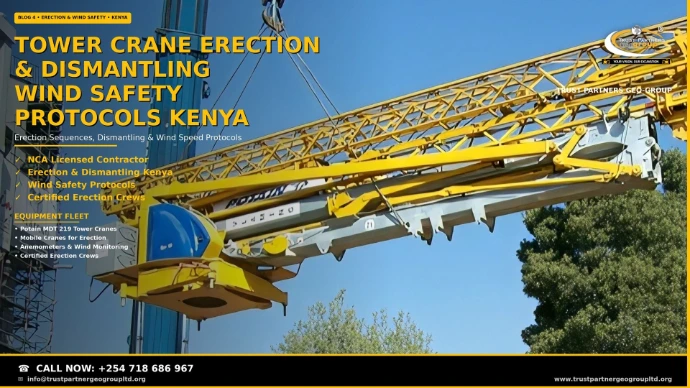
Tower Crane Erection Process in Kenya: Timeline, Site Requirements & Wind Safety Protocols
Erection is where the crane becomes real — and where schedules most often slip. The assembly sequence, the site checklist, realistic day-by-day timelines, base specifications and the wind rules that govern every pick.

1. What Erection Actually Involves
Erection is the least visible and most underestimated line in the crane budget: a choreographed lifting operation in which the tower crane assembles itself from below, one picked section at a time, under the care of a specialist crew and an assisting mobile crane. It is engineering, rigging and programme management in one — and its failures are expensive: an erection booked against an uncured base, a mobile crane that cannot reach its picks, a wind day nobody planned for. This guide covers the full process for Kenyan sites — from our services portfolio, delivered by Trust Partners Geo-Group's certified erection crews on Nairobi high-rises and regional projects alike. The cost context for every stage below sits in our companion piece on tower crane rental prices in Kenya 2026.
2. Site Requirements Before the Crew Arrives
The erection crew lands to a checklist — every unchecked item costs a day:
- Hardstanding for the assist crane — ground or mats carrying the outrigger loads of a 50–80 tonne mobile crane working at the radiuses the picks demand.
- Delivery access — mast sections arrive on long trucks; a site they cannot enter delays everything before the first pick.
- The base, poured, cured and surveyed — level to the manufacturer's tolerance, anchor bolts positioned true; base error multiplies up the mast.
- Power for tools, lighting and commissioning checks.
- Exclusion zones under every lift path, briefed to the whole site — dropped-object discipline during erection is absolute.
- Paperwork — erection method statement, qualified supervision named, plant certificates for both cranes.
💡 The checklist is the schedule
Professional suppliers issue the site-requirements checklist weeks before the erection date. Its arrival — not the crane's — is the real start of the erection programme, because every item on it has a lead time measured in days or weeks.
3. The Assembly Sequence, Step by Step
Gravity's logic — bottom up, tested at every stage:
- Base section lands on the foundation and bolts to the anchor cage.
- Mast sections follow — climbing frame first where climbs are planned — each lifted, seated, aligned and torqued before the next.
- Slewing unit, operator cab and machinery deck land on the mast top.
- The jib assembles horizontally at ground level — chords, lattice, trolley, tie bars — then flies whole and pins to the slewing head.
- Counter-jib, then counterweights, added progressively per the manual.
- Reeving — hoist and trolley ropes through the sheaves.
- Commissioning — limit and overload devices calibrated, brakes tested, rated-load test lift performed, documentation signed. Only then does the crane hand over to the operator.
Every stage above is delivered in-house by our tower crane rental crews — one accountable team from base survey to commissioning.
4. Timeline: Days per Stage
| Stage | Typical Duration | Governing Constraint |
|---|---|---|
| Base design, pour & cure (pre-erection) | 2–3 weeks | Concrete cure — immovable |
| Delivery to site | 1 day | Access |
| Base section & first mast | Day 1 | Anchor alignment |
| Mast to working height | 1–2 days | Sections & bolting pace |
| Slewing unit, cab, machinery deck | Day 2–3 | Assist crane availability |
| Jib ground assembly & fly | 1 day | Wind window |
| Counter-jib, weights, reeving | Day 3–4 | Sequence discipline |
| Testing & commissioning | Day 4–5 | Calibrated test weights |
Total for a standard flat-top on a prepared base: 2–5 working days, plus the base lead time before it. Stretches come from wind days, assist crane scheduling and urban logistics — not from the assembly itself, which a competent crew performs at assembly-line pace.
5. The Crane Base: Specs & Lead Time
Every tower crane stands on engineered concrete — typically a pad footing of 15–40 m³ depending on class and ground, in C25/30 concrete or better, cast around the manufacturer's anchor cage with bolts positioned to millimetre tolerance and surveyed twice: after casting and again before the first section lands. On basement sites, the base may wait for slab levels or sit on designed temporary works. Costed honestly: KES 150,000–400,000 including excavation, reinforcement, concrete and survey — and two to three weeks of programme that no erection crew can compress. The base is where the erection timeline is actually won or lost.
6. Wind Safety Protocols
Three envelopes govern every crane, from the manufacturer's manual:
- In-service working limit — typically 14–20 m/s by class. Above it, lifting halts: airborne loads are landed, the hook secured.
- Out-of-service storm protocol — higher thresholds, with the crane left free to slew (the weathervane principle), hook drawn up, trolley at the designated storm radius.
- Erection and dismantling envelope — the tightest, roughly 10–12 m/s, because the structure is incomplete and the assist crane works at its most vulnerable radii.
Nairobi's storm cells blow through all three limits within an hour during the long rains; the discipline is not the number but the protocol — a calibrated anemometer at the jib head, a named person watching it, and documented stop-work authority no programme overrides. The wider safety architecture around deep works and lifting sits in our top ten safe excavation factors guide.
7. Dismantling in Reverse
Dismantling mirrors assembly — jib and counter-jib flown down, mast sections removed top-down, slewing unit and base section last — with two complications: every pick happens at final height where wind exposure peaks, and climbed cranes must be partly un-climbed first. Budget honestly: dismantling runs near erection in cost (KES 200,000–400,000 for standard classes) and time. Book it at contract stage as a line item; discovered at completion, it becomes a negotiation. And the site selection that minimises every one of these costs starts earlier — with the right crane chosen from its load chart.
8. Frequently Asked Questions
For a standard 6–10 tonne flat-top on a prepared base: two to five working days from delivery to commissioning. The realistic breakdown — delivery and base-section installation on day one; mast sections raised to working height over one to two days depending on free-standing height (each mast section takes under an hour with a competent crew, but rigging, alignment and bolted-joint checks set the pace); the slewing unit, operator cab and machinery deck on day two or three; the jib assembled at ground level, flown and connected over a day; then reeving of the hoist and trolley ropes, limit-switch calibration, load testing and commissioning on the final day. What stretches the programme: assisting mobile crane availability, wind days (erection halts above roughly 10–12 m/s sustained), and urban logistics. What the timeline assumes: the base designed, poured and cured two to three weeks earlier — the single most common schedule failure is booking erection against an uncured base.
The erection crew arrives to a checklist, and every unchecked item costs a day. Hardstanding for the assisting mobile crane — compacted ground or mats taking the assist crane's outrigger loads, with room to rig at the radius the picks demand. Clear access for the delivery trucks — mast sections arrive on long vehicles, and a site they cannot enter is an erection that cannot start. The base poured, cured and surveyed — level within the manufacturer's tolerance, anchor bolts positioned accurately, because the first mast section lands on them and every millimetre of base error multiplies up the mast. Power for tools and the commissioning checks. Exclusion zones established below every lift path, with the site briefed — dropped-object zones during erection are absolute. And the documentation: erection method statement, qualified supervision, and plant certificates for both cranes. Professional suppliers issue this checklist weeks ahead; treat its arrival as the real start date.
The assembly follows gravity's logic — bottom up, tested at every stage. One: the base section or portal sits on the prepared foundation and bolts to the anchor cage. Two: mast sections are added — the climbing frame first where climbs are planned, then sections lifted by the assisting mobile crane, each seated, aligned and torqued before the next. Three: the slewing unit lands on the mast top, followed by the operator cab and machinery deck. Four: the jib is assembled horizontally at ground level — chords, lattice, trolley and tie bars — then flown whole by the assist crane and pinned to the slewing head. Five: the counter-jib follows, then counterweights added progressively per the manual. Six: hoist and trolley ropes are reeved through the sheaves. Seven: commissioning — limit and overload devices calibrated, brakes tested, a rated-load test lift performed, documentation signed. Only then does the crane hand over to the operator.
Two limits govern every tower crane, and both come from the manufacturer's manual. The in-service working limit — typically 14–20 m/s depending on class — halts lifting when the anemometer at the jib head reads above it; loads already airborne are landed and the hook secured. The out-of-service storm protocol engages well above that: the crane is left free to slew — the weathervane principle — so the jib presents its smallest face to the wind, with the hook drawn up to the highest permissible position and trolley parked at the designated storm radius. Erection and dismantling operate under a third, tighter envelope — roughly 10–12 m/s — because the structure is incomplete and the assist crane works at its most vulnerable radii. Nairobi's long-rain season storms routinely blow past all three limits within an hour; the discipline is not the number but the protocol: calibrated anemometer, named person watching it, and a documented stop-work authority that no programme pressure overrides.
Dismantling is erection in reverse, with two complications: height and decay. The sequence — jib and counter-jib lowered by the assist crane after the reeving is slacked; mast sections removed top-down; the slewing unit, cab and base section following — mirrors assembly, but every pick happens at the crane's final height, where wind exposure is greatest and the structure's own wear must be trusted. Climbed cranes are partly un-climbed first, masts lowered back through the climbing frames. The practical notes: dismantling costs land near erection costs — KES 200,000–400,000 for standard classes — and take similar time; the assist crane again governs access and cost; and the base, once freed of anchors, is cut back and made good under the finishing contractor. Book dismantling at contract stage, when it is a line item; discover it at completion, when it is a negotiation.
Erection Is a Process. We Run It End to End.
Trust Partners Geo-Group Ltd erects, climbs, operates and dismantles tower cranes across Kenya — certified crews, assisting mobile crane coordination, engineered base supervision and wind-protocol discipline from first pick to final de-rig.
Price Your Crane Project on the Calculator✉️ Contact Us
📞 +254 718 68 69 67
Tower Crane Erection Process in Kenya: Timeline, Site Requirements & Wind Safety Protocols
Erection is where the crane becomes real — and where schedules most often slip. The assembly sequence, the site checklist, realistic day-by-day timelines, base specifications and the wind rules that govern every pick.
1. What Erection Actually Involves
Erection is the least visible and most underestimated line in the crane budget: a choreographed lifting operation in which the tower crane assembles itself from below, one picked section at a time, under the care of a specialist crew and an assisting mobile crane. It is engineering, rigging and programme management in one — and its failures are expensive: an erection booked against an uncured base, a mobile crane that cannot reach its picks, a wind day nobody planned for. This guide covers the full process for Kenyan sites — from our services portfolio, delivered by Trust Partners Geo-Group's certified erection crews on Nairobi high-rises and regional projects alike. The cost context for every stage below sits in our companion piece on tower crane rental prices in Kenya 2026.
2. Site Requirements Before the Crew Arrives
The erection crew lands to a checklist — every unchecked item costs a day:
- Hardstanding for the assist crane — ground or mats carrying the outrigger loads of a 50–80 tonne mobile crane working at the radiuses the picks demand.
- Delivery access — mast sections arrive on long trucks; a site they cannot enter delays everything before the first pick.
- The base, poured, cured and surveyed — level to the manufacturer's tolerance, anchor bolts positioned true; base error multiplies up the mast.
- Power for tools, lighting and commissioning checks.
- Exclusion zones under every lift path, briefed to the whole site — dropped-object discipline during erection is absolute.
- Paperwork — erection method statement, qualified supervision named, plant certificates for both cranes.
💡 The checklist is the schedule
Professional suppliers issue the site-requirements checklist weeks before the erection date. Its arrival — not the crane's — is the real start of the erection programme, because every item on it has a lead time measured in days or weeks.
3. The Assembly Sequence, Step by Step
Gravity's logic — bottom up, tested at every stage:
- Base section lands on the foundation and bolts to the anchor cage.
- Mast sections follow — climbing frame first where climbs are planned — each lifted, seated, aligned and torqued before the next.
- Slewing unit, operator cab and machinery deck land on the mast top.
- The jib assembles horizontally at ground level — chords, lattice, trolley, tie bars — then flies whole and pins to the slewing head.
- Counter-jib, then counterweights, added progressively per the manual.
- Reeving — hoist and trolley ropes through the sheaves.
- Commissioning — limit and overload devices calibrated, brakes tested, rated-load test lift performed, documentation signed. Only then does the crane hand over to the operator.
Every stage above is delivered in-house by our tower crane rental crews — one accountable team from base survey to commissioning.
4. Timeline: Days per Stage
| Stage | Typical Duration | Governing Constraint |
|---|---|---|
| Base design, pour & cure (pre-erection) | 2–3 weeks | Concrete cure — immovable |
| Delivery to site | 1 day | Access |
| Base section & first mast | Day 1 | Anchor alignment |
| Mast to working height | 1–2 days | Sections & bolting pace |
| Slewing unit, cab, machinery deck | Day 2–3 | Assist crane availability |
| Jib ground assembly & fly | 1 day | Wind window |
| Counter-jib, weights, reeving | Day 3–4 | Sequence discipline |
| Testing & commissioning | Day 4–5 | Calibrated test weights |
Total for a standard flat-top on a prepared base: 2–5 working days, plus the base lead time before it. Stretches come from wind days, assist crane scheduling and urban logistics — not from the assembly itself, which a competent crew performs at assembly-line pace.
5. The Crane Base: Specs & Lead Time
Every tower crane stands on engineered concrete — typically a pad footing of 15–40 m³ depending on class and ground, in C25/30 concrete or better, cast around the manufacturer's anchor cage with bolts positioned to millimetre tolerance and surveyed twice: after casting and again before the first section lands. On basement sites, the base may wait for slab levels or sit on designed temporary works. Costed honestly: KES 150,000–400,000 including excavation, reinforcement, concrete and survey — and two to three weeks of programme that no erection crew can compress. The base is where the erection timeline is actually won or lost.
6. Wind Safety Protocols
Three envelopes govern every crane, from the manufacturer's manual:
- In-service working limit — typically 14–20 m/s by class. Above it, lifting halts: airborne loads are landed, the hook secured.
- Out-of-service storm protocol — higher thresholds, with the crane left free to slew (the weathervane principle), hook drawn up, trolley at the designated storm radius.
- Erection and dismantling envelope — the tightest, roughly 10–12 m/s, because the structure is incomplete and the assist crane works at its most vulnerable radii.
Nairobi's storm cells blow through all three limits within an hour during the long rains; the discipline is not the number but the protocol — a calibrated anemometer at the jib head, a named person watching it, and documented stop-work authority no programme overrides. The wider safety architecture around deep works and lifting sits in our top ten safe excavation factors guide.
7. Dismantling in Reverse
Dismantling mirrors assembly — jib and counter-jib flown down, mast sections removed top-down, slewing unit and base section last — with two complications: every pick happens at final height where wind exposure peaks, and climbed cranes must be partly un-climbed first. Budget honestly: dismantling runs near erection in cost (KES 200,000–400,000 for standard classes) and time. Book it at contract stage as a line item; discovered at completion, it becomes a negotiation. And the site selection that minimises every one of these costs starts earlier — with the right crane chosen from its load chart.
8. Frequently Asked Questions
For a standard 6–10 tonne flat-top on a prepared base: two to five working days from delivery to commissioning. The realistic breakdown — delivery and base-section installation on day one; mast sections raised to working height over one to two days depending on free-standing height (each mast section takes under an hour with a competent crew, but rigging, alignment and bolted-joint checks set the pace); the slewing unit, operator cab and machinery deck on day two or three; the jib assembled at ground level, flown and connected over a day; then reeving of the hoist and trolley ropes, limit-switch calibration, load testing and commissioning on the final day. What stretches the programme: assisting mobile crane availability, wind days (erection halts above roughly 10–12 m/s sustained), and urban logistics. What the timeline assumes: the base designed, poured and cured two to three weeks earlier — the single most common schedule failure is booking erection against an uncured base.
The erection crew arrives to a checklist, and every unchecked item costs a day. Hardstanding for the assisting mobile crane — compacted ground or mats taking the assist crane's outrigger loads, with room to rig at the radius the picks demand. Clear access for the delivery trucks — mast sections arrive on long vehicles, and a site they cannot enter is an erection that cannot start. The base poured, cured and surveyed — level within the manufacturer's tolerance, anchor bolts positioned accurately, because the first mast section lands on them and every millimetre of base error multiplies up the mast. Power for tools and the commissioning checks. Exclusion zones established below every lift path, with the site briefed — dropped-object zones during erection are absolute. And the documentation: erection method statement, qualified supervision, and plant certificates for both cranes. Professional suppliers issue this checklist weeks ahead; treat its arrival as the real start date.
The assembly follows gravity's logic — bottom up, tested at every stage. One: the base section or portal sits on the prepared foundation and bolts to the anchor cage. Two: mast sections are added — the climbing frame first where climbs are planned, then sections lifted by the assisting mobile crane, each seated, aligned and torqued before the next. Three: the slewing unit lands on the mast top, followed by the operator cab and machinery deck. Four: the jib is assembled horizontally at ground level — chords, lattice, trolley and tie bars — then flown whole by the assist crane and pinned to the slewing head. Five: the counter-jib follows, then counterweights added progressively per the manual. Six: hoist and trolley ropes are reeved through the sheaves. Seven: commissioning — limit and overload devices calibrated, brakes tested, a rated-load test lift performed, documentation signed. Only then does the crane hand over to the operator.
Two limits govern every tower crane, and both come from the manufacturer's manual. The in-service working limit — typically 14–20 m/s depending on class — halts lifting when the anemometer at the jib head reads above it; loads already airborne are landed and the hook secured. The out-of-service storm protocol engages well above that: the crane is left free to slew — the weathervane principle — so the jib presents its smallest face to the wind, with the hook drawn up to the highest permissible position and trolley parked at the designated storm radius. Erection and dismantling operate under a third, tighter envelope — roughly 10–12 m/s — because the structure is incomplete and the assist crane works at its most vulnerable radii. Nairobi's long-rain season storms routinely blow past all three limits within an hour; the discipline is not the number but the protocol: calibrated anemometer, named person watching it, and a documented stop-work authority that no programme pressure overrides.
Dismantling is erection in reverse, with two complications: height and decay. The sequence — jib and counter-jib lowered by the assist crane after the reeving is slacked; mast sections removed top-down; the slewing unit, cab and base section following — mirrors assembly, but every pick happens at the crane's final height, where wind exposure is greatest and the structure's own wear must be trusted. Climbed cranes are partly un-climbed first, masts lowered back through the climbing frames. The practical notes: dismantling costs land near erection costs — KES 200,000–400,000 for standard classes — and take similar time; the assist crane again governs access and cost; and the base, once freed of anchors, is cut back and made good under the finishing contractor. Book dismantling at contract stage, when it is a line item; discover it at completion, when it is a negotiation.
Erection Is a Process. We Run It End to End.
Trust Partners Geo-Group Ltd erects, climbs, operates and dismantles tower cranes across Kenya — certified crews, assisting mobile crane coordination, engineered base supervision and wind-protocol discipline from first pick to final de-rig.
Price Your Crane Project on the Calculator✉️ Contact Us
📞 +254 718 68 69 67