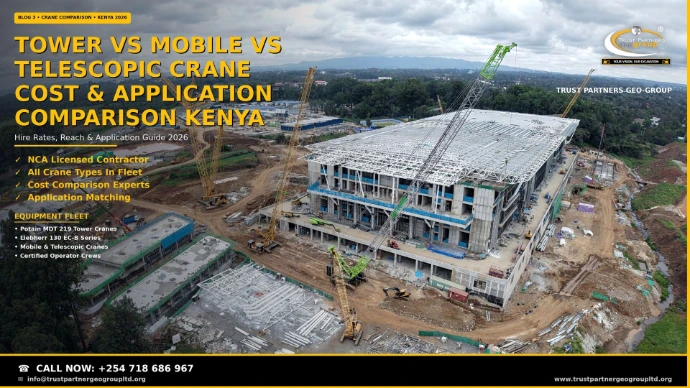
Tower Crane vs Mobile Crane vs Telescopic Crane: Cost & Application Comparison in Kenya
Three machines, three cost structures, three jobs. The honest 2026 comparison of tower, mobile and telescopic crane hire in Kenya — rates, reach, setup and the decision logic that picks the right one.

1. Three Machines, Three Jobs
Every lifting question on a Kenyan site resolves to one of three machines — and most hiring mistakes come from asking the wrong machine to do another's job. The tower crane, the mobile crane and the telescopic crane each carry a fundamentally different cost structure: monthly-plus-fixed, per-day, and per-day-with-crawler-premium. This comparison prices all three for 2026 and gives the decision logic that matches machine to job — from the full lifting and earthworks portfolio behind our services, delivered by Trust Partners Geo-Group with all three classes in one fleet.
2. Tower Cranes: The Marathon Runners
The tower crane stands for months, climbs with the building and serves every trade daily — the only machine whose cost structure rewards continuous use. The 2026 stack: KES 350,000–700,000 per month by class, plus fixed erection, base and dismantling of KES 650,000–1,150,000, plus operators, power and climbs. Its kingdom: multi-storey programmes where hundreds of small lifts per month make its per-lift cost the lowest of any machine. Its limits: months of commitment, structural bases, and a hook ceiling set by the sky rather than the boom. The full pricing anatomy lives in our tower crane rental prices guide, and the load chart literacy that sizes the right unit sits beside it.
3. Mobile Cranes: The Heavy Sprinters
The mobile crane — all-terrain or rough-terrain — arrives on its own wheels, sets up in hours, lifts, and leaves. Day rates for 2026: KES 45,000–80,000 for the 25–50 tonne class that handles most construction picks; KES 90,000–150,000 for 80–130 tonne units on steel and precast work; KES 180,000–400,000 for the 200-tonne-plus heavy lifters on industrial and infrastructure picks — mobilisation charged per move. Its kingdom: the heavy, episodic lift — plant installation, bridge beams, tower crane erection itself — where buying months of crane for days of work is waste. Its limits: capacity that falls steeply with boom extension, a practical hook ceiling well below the tower crane's, and ground that must carry outriggers. Our crane desk fields mobiles to 500 tonnes alongside the tower fleet.
4. Telescopic Cranes: The Middle Ground
The telescopic crawler pairs a boom that extends in sections with a tracked base — the machine that walks where wheels cannot and re-positions in minutes where mobiles must re-rig. It lifts without outrigger gymnastics on rough ground, extends and retracts between radii in minutes, and — uniquely — pick-and-carries loads at low speed on its tracks. Its kingdom: repetitive medium lifts across changing positions — steel erection, precast setting, plant work — and any terrain that punishes tyres. Day rates run KES 120,000–250,000 for the common 50–90 tonne classes, a 20–40% premium over comparable wheeled mobiles that its programme savings routinely repay.
5. The Comparison Table: 2026 Numbers
| Factor | Tower Crane | Mobile Crane | Telescopic Crane |
|---|---|---|---|
| Cost structure | KES 350–700K/month + KES 650K–1.15M fixed | KES 45–400K/day + mobilisation | KES 120–250K/day + mobilisation |
| Setup time | 2–5 days + 2–3 week base | Hours | Hours |
| Commitment | Months (contract) | Days (episodic) | Days (episodic) |
| Hook height | Climbs with building | ~40–80m by class | ~40–60m by class |
| Best loads | Many small lifts, long duration | Occasional heavy picks | Repetitive lifts, rough ground |
| Ground demand | Engineered base | Firm + outriggers | Tracks — minimal prep |
| Crossover logic | Wins above ~3–4 weeks continuous | Wins below it | Wins on terrain + re-positioning |
6. Which Crane for Which Job
- High-rise programme, hundreds of lifts: tower crane — nothing else survives the economics.
- Roof plant, single heavy picks, short frame phase: mobile crane — often the whole answer below fifteen storeys.
- Steel or precast at changing radii: telescopic crawler — one machine replacing a mobile and its re-positioning days.
- Soft, sloped or obstructed ground: telescopic's tracks, or matting costs into the mobile's day rate.
- Tight urban infill with height restrictions: luffing-jib tower, or heavy mobiles planned pick-by-pick.
7. When to Combine
The professional answer on significant sites is rarely one machine: the tower crane handles the daily grind, the mobile crane delivers the heavy picks it cannot — and erects the tower itself — while a telescopic crawler serves the steel or precast phases between them. Fleet hirers owning all three classes plan the relay as one mobilisation: fewer interfaces, one accountability, and a total cost below any single-machine improvisation. Price any combination on the cost estimate calculator, and see the two-machine version of this comparison in our earlier tower crane versus mobile crane analysis.
8. Frequently Asked Questions
Three different answers to the same question — how do loads get from the ground to height? The tower crane stands fixed for months, climbing with the building, serving every trade every day — the marathon runner. The mobile crane drives in on its own wheels, lifts, and leaves — the sprinter, priced per day, best for heavy picks and short engagements. The telescopic crane — typically a telescopic crawler — pairs a boom that extends in sections with a tracked base: no assembly like a tower crane, heavier and steadier than most wheeled mobiles on rough ground, able to pick and carry. Its niche sits between the other two: repetitive medium lifts, industrial plant, infrastructure where mobiles must constantly re-position. In Kenyan practice the tower crane owns the high-rise programme, the mobile crane owns the heavy day-lift, and the telescopic earns its keep where terrain defeats wheels and duration defeats towers.
They price on different currencies, so 'cheaper' is the wrong question until duration enters. Mobile crane hire: KES 45,000–80,000 per day for 25–50 tonne all-terrains, KES 90,000–150,000 for the 80–130 tonne class, KES 180,000–400,000 for heavy lifters — plus mobilisation per move. Tower crane rental: KES 350,000–700,000 per month plus KES 650,000–1,150,000 of fixed erection, base and dismantling costs. The crossover: continuous lifting demand. A crane needed twenty lift-days a month makes the tower cheaper per lift almost immediately — its fixed costs amortise across hundreds of picks; a crane needed five days a month keeps the mobile cheaper forever. Roughly: below three to four weeks of continuous demand, mobiles and telescopics win; above it, towers dominate. The cost calculator runs the comparison against your actual schedule.
Choose the telescopic crawler when the wheeled mobile's two weaknesses — ground and re-positioning — both appear on the same job. Rough or soft ground where outriggers and tyres struggle: the tracked base walks in and lifts without mats gymnastics. Repetitive lifts at changing radii — steel erection, precast setting, plant installation — where a telescopic boom extends and retracts in minutes while a mobile crane re-rigs between positions. And pick-and-carry work — moving loads on the tracks at low speed — which wheeled mobiles simply cannot do. The cost premium runs perhaps 20–40% over a comparable wheeled mobile's day rate, recovered quickly where re-positioning would bill machine-days. Where the ground is firm and the lift is single, the wheeled mobile remains the cheaper tool.
Telescopic crawler cranes hire in the KES 120,000–250,000 per day band for the common 50–90 tonne classes with certified operators — between the mid mobiles and the heavy lifters on the wheeled scale — with mobilisation that tracks their low-bed transport like any crawler machine. The economics that justify them: on steel or precast programmes where a wheeled mobile would re-position ten times a day, one telescopic working continuously often replaces a mobile plus its re-positioning hours — the day rate looks higher and the programme cost lands lower. Ask hirers for the machine's load chart at your working radii, not just the day rate: the telescopic's value is its envelope across many positions, and that envelope is what the chart prices.
For genuine high-rises — beyond roughly twenty storeys — no: hook height and radius defeat even the largest mobiles, and re-positioning a 200-tonne machine beside a rising tower is a programme in itself. But the honest boundary is lower than brochure reach suggests. A mobile can serve a mid-rise frame — up to roughly ten to fifteen storeys depending on class — where the heaviest lifts cluster in one or two phases, and many Kenyan projects genuinely run this way: mobile crane for the frame and roof, no tower at all, at a total cost a fraction of the tower stack. The decision test is the same four inputs from the selection guide: heaviest load, farthest radius, hook height and — decisively here — lift frequency. Few heavy picks: mobile. Hundreds of small picks for months: the tower crane earns its keep, and its full cost stack belongs in the budget early.
One Fleet, Three Machines, Zero Guesswork.
Trust Partners Geo-Group Ltd hires tower cranes, mobile cranes to 500 tonnes and telescopic crawlers across Kenya — with certified operators, load-chart-backed selection and itemised quotations on every class.
Compare Your Crane Options on the Calculator✉️ Contact Us
📞 +254 718 68 69 67
Tower Crane vs Mobile Crane vs Telescopic Crane: Cost & Application Comparison in Kenya
Three machines, three cost structures, three jobs. The honest 2026 comparison of tower, mobile and telescopic crane hire in Kenya — rates, reach, setup and the decision logic that picks the right one.
1. Three Machines, Three Jobs
Every lifting question on a Kenyan site resolves to one of three machines — and most hiring mistakes come from asking the wrong machine to do another's job. The tower crane, the mobile crane and the telescopic crane each carry a fundamentally different cost structure: monthly-plus-fixed, per-day, and per-day-with-crawler-premium. This comparison prices all three for 2026 and gives the decision logic that matches machine to job — from the full lifting and earthworks portfolio behind our services, delivered by Trust Partners Geo-Group with all three classes in one fleet.
2. Tower Cranes: The Marathon Runners
The tower crane stands for months, climbs with the building and serves every trade daily — the only machine whose cost structure rewards continuous use. The 2026 stack: KES 350,000–700,000 per month by class, plus fixed erection, base and dismantling of KES 650,000–1,150,000, plus operators, power and climbs. Its kingdom: multi-storey programmes where hundreds of small lifts per month make its per-lift cost the lowest of any machine. Its limits: months of commitment, structural bases, and a hook ceiling set by the sky rather than the boom. The full pricing anatomy lives in our tower crane rental prices guide, and the load chart literacy that sizes the right unit sits beside it.
3. Mobile Cranes: The Heavy Sprinters
The mobile crane — all-terrain or rough-terrain — arrives on its own wheels, sets up in hours, lifts, and leaves. Day rates for 2026: KES 45,000–80,000 for the 25–50 tonne class that handles most construction picks; KES 90,000–150,000 for 80–130 tonne units on steel and precast work; KES 180,000–400,000 for the 200-tonne-plus heavy lifters on industrial and infrastructure picks — mobilisation charged per move. Its kingdom: the heavy, episodic lift — plant installation, bridge beams, tower crane erection itself — where buying months of crane for days of work is waste. Its limits: capacity that falls steeply with boom extension, a practical hook ceiling well below the tower crane's, and ground that must carry outriggers. Our crane desk fields mobiles to 500 tonnes alongside the tower fleet.
4. Telescopic Cranes: The Middle Ground
The telescopic crawler pairs a boom that extends in sections with a tracked base — the machine that walks where wheels cannot and re-positions in minutes where mobiles must re-rig. It lifts without outrigger gymnastics on rough ground, extends and retracts between radii in minutes, and — uniquely — pick-and-carries loads at low speed on its tracks. Its kingdom: repetitive medium lifts across changing positions — steel erection, precast setting, plant work — and any terrain that punishes tyres. Day rates run KES 120,000–250,000 for the common 50–90 tonne classes, a 20–40% premium over comparable wheeled mobiles that its programme savings routinely repay.
5. The Comparison Table: 2026 Numbers
| Factor | Tower Crane | Mobile Crane | Telescopic Crane |
|---|---|---|---|
| Cost structure | KES 350–700K/month + KES 650K–1.15M fixed | KES 45–400K/day + mobilisation | KES 120–250K/day + mobilisation |
| Setup time | 2–5 days + 2–3 week base | Hours | Hours |
| Commitment | Months (contract) | Days (episodic) | Days (episodic) |
| Hook height | Climbs with building | ~40–80m by class | ~40–60m by class |
| Best loads | Many small lifts, long duration | Occasional heavy picks | Repetitive lifts, rough ground |
| Ground demand | Engineered base | Firm + outriggers | Tracks — minimal prep |
| Crossover logic | Wins above ~3–4 weeks continuous | Wins below it | Wins on terrain + re-positioning |
6. Which Crane for Which Job
- High-rise programme, hundreds of lifts: tower crane — nothing else survives the economics.
- Roof plant, single heavy picks, short frame phase: mobile crane — often the whole answer below fifteen storeys.
- Steel or precast at changing radii: telescopic crawler — one machine replacing a mobile and its re-positioning days.
- Soft, sloped or obstructed ground: telescopic's tracks, or matting costs into the mobile's day rate.
- Tight urban infill with height restrictions: luffing-jib tower, or heavy mobiles planned pick-by-pick.
7. When to Combine
The professional answer on significant sites is rarely one machine: the tower crane handles the daily grind, the mobile crane delivers the heavy picks it cannot — and erects the tower itself — while a telescopic crawler serves the steel or precast phases between them. Fleet hirers owning all three classes plan the relay as one mobilisation: fewer interfaces, one accountability, and a total cost below any single-machine improvisation. Price any combination on the cost estimate calculator, and see the two-machine version of this comparison in our earlier tower crane versus mobile crane analysis.
8. Frequently Asked Questions
Three different answers to the same question — how do loads get from the ground to height? The tower crane stands fixed for months, climbing with the building, serving every trade every day — the marathon runner. The mobile crane drives in on its own wheels, lifts, and leaves — the sprinter, priced per day, best for heavy picks and short engagements. The telescopic crane — typically a telescopic crawler — pairs a boom that extends in sections with a tracked base: no assembly like a tower crane, heavier and steadier than most wheeled mobiles on rough ground, able to pick and carry. Its niche sits between the other two: repetitive medium lifts, industrial plant, infrastructure where mobiles must constantly re-position. In Kenyan practice the tower crane owns the high-rise programme, the mobile crane owns the heavy day-lift, and the telescopic earns its keep where terrain defeats wheels and duration defeats towers.
They price on different currencies, so 'cheaper' is the wrong question until duration enters. Mobile crane hire: KES 45,000–80,000 per day for 25–50 tonne all-terrains, KES 90,000–150,000 for the 80–130 tonne class, KES 180,000–400,000 for heavy lifters — plus mobilisation per move. Tower crane rental: KES 350,000–700,000 per month plus KES 650,000–1,150,000 of fixed erection, base and dismantling costs. The crossover: continuous lifting demand. A crane needed twenty lift-days a month makes the tower cheaper per lift almost immediately — its fixed costs amortise across hundreds of picks; a crane needed five days a month keeps the mobile cheaper forever. Roughly: below three to four weeks of continuous demand, mobiles and telescopics win; above it, towers dominate. The cost calculator runs the comparison against your actual schedule.
Choose the telescopic crawler when the wheeled mobile's two weaknesses — ground and re-positioning — both appear on the same job. Rough or soft ground where outriggers and tyres struggle: the tracked base walks in and lifts without mats gymnastics. Repetitive lifts at changing radii — steel erection, precast setting, plant installation — where a telescopic boom extends and retracts in minutes while a mobile crane re-rigs between positions. And pick-and-carry work — moving loads on the tracks at low speed — which wheeled mobiles simply cannot do. The cost premium runs perhaps 20–40% over a comparable wheeled mobile's day rate, recovered quickly where re-positioning would bill machine-days. Where the ground is firm and the lift is single, the wheeled mobile remains the cheaper tool.
Telescopic crawler cranes hire in the KES 120,000–250,000 per day band for the common 50–90 tonne classes with certified operators — between the mid mobiles and the heavy lifters on the wheeled scale — with mobilisation that tracks their low-bed transport like any crawler machine. The economics that justify them: on steel or precast programmes where a wheeled mobile would re-position ten times a day, one telescopic working continuously often replaces a mobile plus its re-positioning hours — the day rate looks higher and the programme cost lands lower. Ask hirers for the machine's load chart at your working radii, not just the day rate: the telescopic's value is its envelope across many positions, and that envelope is what the chart prices.
For genuine high-rises — beyond roughly twenty storeys — no: hook height and radius defeat even the largest mobiles, and re-positioning a 200-tonne machine beside a rising tower is a programme in itself. But the honest boundary is lower than brochure reach suggests. A mobile can serve a mid-rise frame — up to roughly ten to fifteen storeys depending on class — where the heaviest lifts cluster in one or two phases, and many Kenyan projects genuinely run this way: mobile crane for the frame and roof, no tower at all, at a total cost a fraction of the tower stack. The decision test is the same four inputs from the selection guide: heaviest load, farthest radius, hook height and — decisively here — lift frequency. Few heavy picks: mobile. Hundreds of small picks for months: the tower crane earns its keep, and its full cost stack belongs in the budget early.
One Fleet, Three Machines, Zero Guesswork.
Trust Partners Geo-Group Ltd hires tower cranes, mobile cranes to 500 tonnes and telescopic crawlers across Kenya — with certified operators, load-chart-backed selection and itemised quotations on every class.
Compare Your Crane Options on the Calculator✉️ Contact Us
📞 +254 718 68 69 67