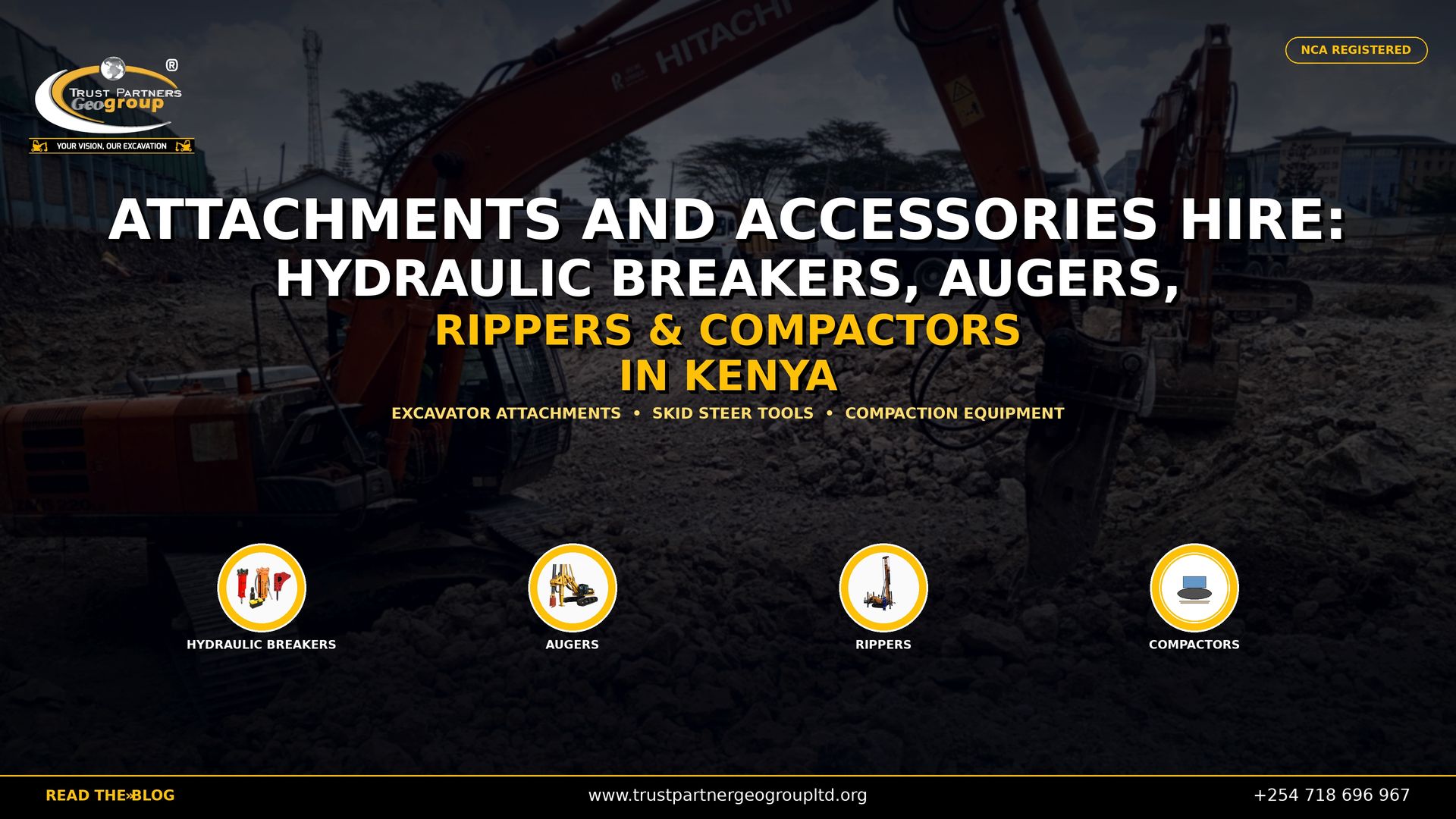
Attachments and Accessories Hire: Hydraulic Breakers, Augers, Rippers and Compactors in Kenya [2026]
Excavator-mounted attachment hire rates, compatibility and applications for rock breaking, piling, scarification and compaction
Table of Contents
- 1. Why Attachments Transform Excavator Capability
- 2. Hydraulic Breaker Hire: Rock Breaking Without Capital Investment
- 3. Auger Hire: Precision Drilling for Piling and Foundations
- 4. Ripper Attachment Hire: Scarifying Hard Ground and Rock
- 5. Compactor Attachment Hire: Plate and Drum Compaction
- 6. Attachment Compatibility and Hydraulic Requirements
- 7. Attachment Hire Rates and Cost Modelling 2026
- 8. Operator Skill Requirements for Attachment Work
- 9. Trust Partners Geo-Group Attachment Fleet
- 10. Frequently Asked Questions
- 11. Conclusion
An excavator without attachments is a shovel with an engine. The bucket digs soil efficiently, but when it strikes volcanic tuff at 3.5 metres depth, it stops. When a foundation requires 400mm diameter piles through clay and murram, the bucket cannot drill. When a road subgrade needs compaction in a trench too narrow for a roller, the bucket only makes it worse. This is where excavator attachments transform a general-purpose machine into a specialised tool. In Kenya's diverse geology - from Nairobi's volcanic highlands to Mombasa's coral limestone to Turkana's sedimentary basins - contractors who understand attachment selection and hire strategies complete projects faster, cheaper, and with less capital tied up in single-purpose equipment. This guide provides complete technical and commercial intelligence on hydraulic breaker hire in Kenya, excavator auger rental in Nairobi, ripper attachment hire, and compactor attachment rental. We cover attachment-excavator compatibility, hydraulic system requirements, 2026 hire rates, operator certification needs, and the specific applications where each attachment outperforms standard buckets. Whether you are breaking rock in Karen, augering piles in Kiambu, ripping laterite in Thika, or compacting trenches in Nakuru, Trust Partners Geo-Group Ltd provides the heavy equipment for hire and attachment expertise that turns your excavator into a multi-tool.
Trust Partners Geo-Group Ltd - Attachment Hire & Specialist Operations Team
NCA-registered contractor with 15+ years in hydraulic breaker, auger, ripper and compactor attachment hire across Nairobi, Mombasa, Kisumu, Nakuru and all Kenyan counties. Specialist operators for rock breaking, piling and precision earthworks.
1. Why Attachments Transform Excavator Capability
The modern hydraulic excavator is essentially a mobile hydraulic power unit with an articulated arm. The bucket is merely the default end-effector. By swapping the bucket for specialised attachments, the same 20-tonne machine becomes a rock breaker, a pile driller, a soil scarifier, or a trench compactor - without the capital cost of owning four separate machines.
In Kenya's construction market, where project margins are thin and capital is expensive, attachment hire offers three strategic advantages. First, capital efficiency: a hydraulic breaker costs KES 3.5-6 million to purchase, but only KES 7,000-11,000 per hour to hire. For a project requiring 100 hours of rock breaking, hire costs KES 700,000-1,100,000 versus KES 3.5-6 million capital plus maintenance, storage, and depreciation. Second, operational flexibility: a contractor working basement excavation in Runda this month and roadworks in Nakuru next month needs different attachments. Hire allows fleet reconfiguration without asset ownership. Third, technology access: attachment technology evolves rapidly. Hire gives contractors access to the latest breaker designs, auger torque systems, and compaction frequencies without retrofitting owned equipment.
Yet attachment hire is poorly understood in the Kenyan market. Many contractors assume any breaker fits any excavator, or that auger diameter is purely a function of hole size. Incorrect attachment selection destroys hydraulic pumps, wastes fuel, and creates safety hazards. This guide provides the technical knowledge to select, hire, and deploy attachments correctly.
2. Hydraulic Breaker Hire: Rock Breaking Without Capital Investment
The hydraulic breaker - also called a hydraulic hammer - is the most commonly hired attachment in Kenyan construction. It converts hydraulic oil pressure into percussive impact energy, fracturing rock, concrete, and hardpan that excavator buckets cannot penetrate.
Breaker Mechanics and Sizing
Breaker performance is defined by impact energy (measured in joules) and strike frequency (blows per minute). Higher impact energy breaks harder rock; higher frequency increases production rate in softer materials. Breaker weight must be matched to excavator carrier weight: a breaker that is too heavy destabilises the excavator and damages the boom; one that is too light is ineffective and suffers premature wear.
| Excavator Size | Breaker Weight | Impact Energy | Application | Typical Rock Types |
|---|---|---|---|---|
| 5-8 tonne | 300-500 kg | 500-1,200 J | Light demolition, trenching in hard soil | Weathered rock, hardpan, reinforced concrete |
| 12-18 tonne | 600-1,000 kg | 1,200-2,500 J | Medium rock breaking, foundation work | Volcanic tuff, limestone, medium basalt |
| 20-25 tonne | 1,000-1,800 kg | 2,500-4,500 J | Heavy rock breaking, quarry work | Hard basalt, granite, fresh volcanic rock |
| 30-40 tonne | 1,800-3,000 kg | 4,500-8,000 J | Mass rock excavation, primary breaking | Hard granite, quartzite, massive basalt |
Hydraulic Compatibility
Breakers require specific hydraulic flow rates and pressures. A 20-tonne excavator typically delivers 120-140 litres per minute at 280-320 bar. The breaker must be rated for these parameters. Excessive flow causes overheating; insufficient flow reduces impact energy. Trust Partners Geo-Group verifies hydraulic compatibility before every breaker dispatch, ensuring that the breaker valve settings match the excavator's hydraulic output.
Applications in Kenyan Construction
In Nairobi's volcanic highlands, breakers are essential for basement excavation below 3.5 metres where tuff and agglomerate appear. In Mombasa and the coast, breakers process coral limestone for foundation preparation. In Turkana and northern Kenya, breakers fracture sedimentary sandstone for road cuttings. In demolition, breakers reduce reinforced concrete structures to rubble for recycling. The key to productive breaking is tool bit selection: moil points for general rock, chisels for concrete, and blunt tools for hard, abrasive rock.
Vibration and Environmental Control
Breaker operation generates ground vibration that can damage adjacent structures. In Runda, Karen and Kitisuru estates, vibration limits of 3-5 mm/s peak particle velocity are typical. Trust Partners Geo-Group provides vibration monitoring equipment and employs techniques to minimise transmission: buffered breaking (short bursts with pauses), pre-splitting with drill and blast, and hydraulic rock splitters as non-percussive alternatives in vibration-sensitive areas.
3. Auger Hire: Precision Drilling for Piling and Foundations
The excavator-mounted auger is a helical drilling attachment that bores cylindrical holes for piles, poles, fence posts, and utility foundations. It replaces manual pit digging and standalone piling rigs for small-to-medium diameter work.
Auger System Components
An auger system consists of: a hydraulic drive unit (motor and gearbox) that mounts to the excavator quick-coupler; extension shafts that increase drilling depth; and interchangeable auger bits matched to soil conditions. The drive unit delivers torque (measured in Newton-metres) and rotation speed (RPM). High torque at low RPM is required for clay and rock; lower torque at higher RPM suits sand and gravel.
Auger Sizing and Applications
| Auger Diameter | Excavator Size | Typical Application | Max Depth |
|---|---|---|---|
| 200-300 mm | 5-12 tonne | Fence posts, sign foundations, small poles | 2-3 metres |
| 400-600 mm | 15-25 tonne | Building piles, utility poles, light foundations | 4-6 metres |
| 700-900 mm | 25-35 tonne | Medium building piles, bridge foundations | 6-8 metres |
| 1,000-1,200 mm | 30-40 tonne | Large-diameter piles, caissons, deep foundations | 8-12 metres |
Soil-Specific Bit Selection
Auger efficiency depends on matching the bit to soil conditions. Clay bits have wide, shallow flights that prevent sticking. Sand and gravel bits have narrower, deeper flights that lift loose material efficiently. Rock bits have carbide-tipped cutting teeth for drilling through weathered rock and boulders. Using a clay bit in sand causes collapse; using a sand bit in clay causes the auger to jam. Trust Partners Geo-Group provides multiple bit types with every auger hire and advises on selection based on geotechnical data.
Stuck Auger Recovery
The most common auger problem is jamming in cohesive clay or encountering unexpected boulders. Recovery requires: reversing rotation while applying upward pull; using the excavator boom to apply vertical extraction force; and in extreme cases, excavating around the auger to relieve pressure. Our auger operators are trained in stuck-bit recovery procedures that minimise equipment damage and downtime.
4. Ripper Attachment Hire: Scarifying Hard Ground and Rock
The ripper is a single-tooth or multi-tooth attachment that tears through hard ground, compacted soils, and weathered rock prior to excavation or grading. It is the precursor to breaker work - ripping loosens material so that buckets can dig it, reducing breaker hours and fuel consumption.
Ripper Types and Applications
Single-tooth rippers concentrate force on one point, penetrating the hardest materials. They are used for: breaking laterite hardpan in Kiambu and Thika; scarifying compacted road bases before resurfacing; and preparing rock faces for secondary breaker work. Multi-tooth rippers (2-5 teeth) distribute force across a wider swath, suitable for: loosening black cotton soil for easier excavation; preparing subgrade for road construction; and stripping overburden in quarry operations.
Penetration Depth and Angle
Ripper effectiveness depends on tooth angle and penetration depth. The optimal attack angle is 45-60 degrees to the ground surface. Penetration depth is typically 300-800mm per pass, depending on material hardness and excavator downforce. Multiple passes at shallow depth are more productive than single deep passes that stall the excavator. Trust Partners Geo-Group operators adjust ripper angle and depth based on real-time penetration resistance.
When to Rip vs When to Break
Ripping is faster and cheaper than breaking but only effective in materials with unconfined compressive strength below 20 MPa. Weathered volcanic tuff, laterite, and soft limestone rip effectively. Fresh basalt, granite, and quartzite require breakers. The decision sequence is: attempt ripping first; if penetration is less than 200mm after three passes, switch to breaker. This sequence can reduce rock processing costs by 40-60% on mixed-hardness sites.
5. Compactor Attachment Hire: Plate and Drum Compaction
Excavator-mounted compactors bring compaction capability to trenches, slopes, and confined areas where standard ride-on rollers cannot operate. They are essential for utility trench backfill, foundation perimeter compaction, and embankment work.
Plate Compactors
Plate compactors are rectangular vibrating plates mounted on the excavator arm. They deliver high-frequency, low-amplitude vibration (2,000-3,000 RPM) that compacts granular soils and select backfill in layers of 150-300mm. Plate widths range from 400mm to 800mm, matching trench widths. A 20-tonne excavator typically runs a 600mm plate compactor for standard utility trenches. Plate compactors are ineffective in cohesive clay and require free-draining granular material to achieve specified density.
Drum Compactors
Drum compactors are cylindrical vibrating drums that provide wider compaction swaths and higher compaction energy than plates. They suit: wider trenches (800mm+); embankment and slope compaction; and subgrade preparation in confined areas. Drum compactors require higher hydraulic flow (100+ L/min) and are typically mounted on 20-30 tonne excavators. They achieve better compaction in mixed soils than plate compactors but are less manoeuvrable in narrow trenches.
Compaction Quality Control
Attachment compaction must achieve the same density standards as roller compaction. In Kenya, trench backfill typically requires 95% of maximum dry density (MDD) per BS 1377 or AASHTO T99. Trust Partners Geo-Group provides compaction testing coordination with geotechnical laboratories, ensuring that attachment-compacted layers meet specification before subsequent works proceed.
6. Attachment Compatibility and Hydraulic Requirements
The most expensive mistake in attachment hire is mismatching the attachment to the excavator's hydraulic system. Incorrect matching destroys pumps, overheats oil, and voids warranties.
Hydraulic Flow and Pressure Matching
| Attachment | Required Flow (L/min) | Required Pressure (bar) | Return Line | Excavator Size |
|---|---|---|---|---|
| Light breaker (300-600kg) | 40-80 | 120-180 | Standard | 5-12 tonne |
| Medium breaker (800-1,500kg) | 100-140 | 180-280 | Standard | 15-25 tonne |
| Heavy breaker (1,800-3,000kg) | 160-220 | 280-350 | Standard or closed-loop | 30-40 tonne |
| Auger drive (small) | 40-70 | 150-200 | Standard | 5-12 tonne |
| Auger drive (large) | 80-140 | 200-280 | Standard | 20-35 tonne |
| Ripper (single-tooth) | Standard bucket circuit | Standard | Standard | Any |
| Plate compactor | 50-100 | 150-200 | Standard | 12-25 tonne |
| Drum compactor | 100-160 | 200-280 | Standard | 20-35 tonne |
Quick-Coupler Compatibility
Attachments must match the excavator's quick-coupler system. The most common systems in Kenya are: manual pin couplers (require manual insertion of retaining pins); hydraulic quick-couplers (allow attachment change from the cabin in 30-60 seconds); and tilt-rotator couplers (provide 360-degree rotation and tilting for precision work). Trust Partners Geo-Group maintains adapters for all major coupler types, ensuring that our attachments fit your excavator regardless of brand.
Hose and Fitting Standards
Hydraulic hoses must be rated for the attachment's maximum pressure plus a safety factor. Breaker hoses require abrasion-resistant covers due to vibration and debris contact. All hoses must carry date stamps and pressure ratings visible for inspection. Trust Partners Geo-Group replaces hoses every 2 years or 4,000 hours, whichever comes first, and pressure-tests all attachment circuits before dispatch.
7. Attachment Hire Rates and Cost Modelling 2026
Attachment hire rates in Kenya are structured as hourly additions to the base excavator hire rate, with minimum durations that reflect mobilisation cost.
| Attachment | Hourly Rate (KES) | Daily Rate (KES) | Min Duration | Excavator + Attachment Daily |
|---|---|---|---|---|
| Light breaker (5-12t carrier) | 4,000-6,000 | 28,000-40,000 | 4 hours | 48,000-68,000 |
| Medium breaker (20-25t carrier) | 7,000-11,000 | 45,000-75,000 | 4 hours | 63,000-103,000 |
| Heavy breaker (30-40t carrier) | 9,000-13,000 | 60,000-95,000 | 4 hours | 88,000-137,000 |
| Auger (small, 200-400mm) | 3,000-5,000 | 22,000-35,000 | 4 hours | 40,000-63,000 |
| Auger (large, 600-1,200mm) | 5,000-8,000 | 35,000-55,000 | 4 hours | 53,000-97,000 |
| Ripper (single-tooth) | 2,000-3,500 | 15,000-25,000 | 1 day | 33,000-53,000 |
| Plate compactor | 2,500-4,000 | 18,000-28,000 | 1 day | 36,000-56,000 |
| Drum compactor | 3,500-5,500 | 25,000-40,000 | 1 day | 43,000-82,000 |
Cost modelling example: A basement excavation in Karen encounters volcanic tuff requiring 40 hours of breaker work. Hiring a 20-tonne excavator with medium breaker for 5 days: excavator KES 24,000 x 5 = KES 120,000; breaker KES 9,000 x 40 hours = KES 360,000; total KES 480,000. Purchasing the same breaker would cost KES 4.5 million plus maintenance. The hire model delivers the capability at 10.7% of purchase cost for this project.
Long-term attachment discounts: Projects requiring attachment use exceeding 2 weeks attract 10-15% discount on attachment hourly rates. Package deals (excavator + breaker + auger on rotation) attract 15-20% total discount.
8. Operator Skill Requirements for Attachment Work
Attachment operation is not standard excavation. Each attachment requires specific skills that general digger operators often lack. Hiring an attachment without a qualified operator is like buying a surgical instrument and asking a nurse to perform the operation.
Breaker Operator Competencies
- Tool bit selection: Matching moil point, chisel, or blunt tool to material hardness and breaking objective
- Vibration management: Understanding ground vibration transmission and techniques to minimise structural impact
- Blank fire prevention: Recognising when the tool is not in contact with rock and stopping immediately to prevent internal damage
- Positioning discipline: Maintaining vertical tool alignment to prevent side loading that breaks pistons
- Cooling protocols: Managing breaker temperature through work-rest cycles to prevent overheating
Auger Operator Competencies
- Vertical alignment: Maintaining plumb within 1:100 to ensure pile verticality
- Torque management: Recognising when soil resistance exceeds safe torque and reversing before jamming
- Bit selection: Choosing correct bit type for soil conditions and changing when strata change
- Extraction technique: Removing auger without collapsing hole or leaving soil in the bore
- Depth control: Achieving design pile depth within ±100mm tolerance
Ripper and Compactor Operator Competencies
Ripper operators must understand attack angle, penetration depth, and sequential pass patterns to maximise loosening without overloading the excavator. Compactor operators must achieve uniform layer thickness, correct overlap between passes, and recognise when density specification is achieved through sound and vibration feedback. Trust Partners Geo-Group provides attachment-specialist operators with documented experience in each tool type, not generalists reassigned from bucket work.
9. Trust Partners Geo-Group Attachment Fleet
Trust Partners Geo-Group Ltd maintains Kenya's most comprehensive attachment hire fleet, with compatibility across all major excavator brands and sizes.
Attachment Inventory
- Hydraulic breakers: 12 units from 400kg to 2,500kg, covering 5-tonne to 40-tonne carriers
- Auger drives: 8 units with torque ratings from 15,000 to 80,000 Nm, with bit diameters 200mm to 1,200mm
- Rippers: 6 single-tooth and 4 multi-tooth units for all excavator sizes
- Plate compactors: 10 units from 400mm to 800mm width
- Drum compactors: 4 units for 20-35 tonne excavators
Service and Inspection Protocol
Every attachment undergoes: pre-hire inspection of hydraulic hoses, couplers, and structural components; pressure testing at rated working pressure; tool bit hardness testing and replacement when worn below specification; and grease system verification for breakers. Attachments are stored under cover to prevent corrosion and UV degradation of hoses.
Compatibility Assurance
Before dispatch, our technical team verifies: excavator make, model, and year; hydraulic flow and pressure specifications; quick-coupler type and pin dimensions; and project material conditions. We provide adapter plates if required and never dispatch an attachment without confirmed compatibility.
10. Frequently Asked Questions: Attachment Hire in Kenya
How much does hydraulic breaker hire cost in Kenya in 2026?
Hydraulic breaker hire in Kenya in 2026 costs KES 7,000-11,000 per hour for 20-tonne excavator-mounted breakers, with a typical 4-hour minimum charge per day. For 30-tonne excavators with larger breakers, rates are KES 9,000-13,000 per hour. Daily packages (8 hours) range from KES 45,000-75,000 including the excavator, operator and breaker attachment. Long-term contracts of 2+ weeks attract 10-15% discounts. Trust Partners Geo-Group provides breaker hire with NCA-certified rock-breaking specialists and vibration monitoring equipment for urban sites.
What size excavator do I need for a hydraulic breaker in Kenya?
Breaker size must match excavator hydraulic flow and pressure. A 20-tonne excavator (120-140 L/min flow, 280-320 bar pressure) handles breakers from 800kg to 1,500kg suitable for medium-hard rock and concrete demolition. A 30-tonne excavator (180-220 L/min flow, 320-350 bar) runs breakers from 1,500kg to 2,500kg for hard volcanic tuff, basalt and heavy demolition. Using an oversized breaker on a small excavator destroys the hydraulic system. Using an undersized breaker on hard rock is ineffective and wastes fuel. Trust Partners Geo-Group matches breaker specification to excavator capacity and rock hardness.
Can I hire auger attachments for excavators in Nairobi?
Yes. Excavator auger hire is available in Nairobi for piling, pole installation, tree planting and foundation work. Auger diameters range from 200mm to 1,200mm depending on excavator size. A 20-tonne excavator typically runs augers from 300mm to 600mm diameter for foundation piles and utility poles. A 30-tonne excavator handles 600mm to 1,200mm diameter augers for large-diameter piling and caisson work. Auger hire rates are KES 5,000-8,000 per hour for 20-tonne machines and KES 6,000-9,000 per hour for 30-tonne machines, with 4-hour minimums. Trust Partners Geo-Group provides auger hire with torque-rated drives and interchangeable bits for clay, sand and rock conditions.
What is a ripper attachment used for in excavation?
A ripper attachment is a single-tooth or multi-tooth tool mounted on an excavator or dozer used to break up hard ground, compacted soils, weathered rock and asphalt prior to excavation or grading. In Kenya, rippers are essential for: breaking through laterite hardpan in Kiambu and Thika; scarifying compacted murram road bases before resurfacing; loosening black cotton soil for easier excavation; and preparing rock faces for breaker work. Ripper hire is typically charged as a daily attachment rate (KES 3,000-5,000 per day) on top of the excavator hire, or included in specialist packages.
Are compactor attachments available for excavator hire in Kenya?
Yes. Excavator-mounted compactor attachments (plate compactors and drum compactors) are available for hire in Kenya for trench backfill compaction, slope compaction and confined area work where standard rollers cannot access. Plate compactors suit 5-20 tonne excavators for trenches up to 600mm width. Drum compactors suit 20-30 tonne excavators for wider trenches and embankments. Compactor attachment hire rates are KES 4,000-7,000 per day additional to excavator hire. These attachments require high-frequency hydraulic circuits and are most effective on granular soils and select backfill materials.
Do I need a special operator for attachment work in Kenya?
Yes. Attachment work requires operators with specific experience beyond standard excavation. Breaker operators need training in: vibration control, tool bit selection for different rock types, avoiding blank firing that destroys the breaker, and monitoring adjacent structures for damage. Auger operators need training in: vertical alignment, torque management, soil type bit selection, and extraction techniques to prevent stuck augers. Ripper operators need to understand: depth control, angle adjustment for different materials, and sequential ripping patterns. Trust Partners Geo-Group provides attachment-specialist operators with documented experience in each attachment type, not generalists reassigned from standard digging work.
Where can I hire hydraulic breaker, auger, ripper and compactor attachments in Kenya?
Trust Partners Geo-Group Ltd provides hydraulic breaker, auger, ripper and compactor attachment hire across Nairobi, Mombasa, Kisumu, Nakuru, Kiambu and all Kenyan counties. Our attachment fleet includes: hydraulic breakers from 800kg to 2,500kg for 20-tonne and 30-tonne excavators; augers from 200mm to 1,200mm diameter with clay, sand and rock bits; single-tooth rippers for hard ground and laterite; and plate and drum compactors for trench and slope work. All attachments are inspected before dispatch, matched to excavator hydraulic specifications, and operated by attachment-certified specialists. Contact +254 718 68 69 67 for attachment hire quotations and compatibility assessment.
11. Conclusion: The Right Tool for the Ground Beneath
Kenyan ground does not cooperate. It hides volcanic tuff beneath red soil in Karen, laterite hardpan beneath loam in Thika, coral limestone beneath sand in Mombasa, and black cotton clay that swells and shrinks with every rain. An excavator bucket alone cannot defeat these materials. It needs attachments - breakers for rock, augers for piles, rippers for hardpan, and compactors for trenches.
Attachment hire is the capital-efficient strategy for accessing this capability. For the cost of a single breaker purchase, a contractor can hire breakers, augers, rippers and compactors across twenty projects, always using the latest technology, always matched to the specific ground condition, and never worrying about maintenance, storage, or obsolescence. The key is correct selection: matching attachment size to excavator hydraulics, matching tool type to material hardness, and matching operator skill to attachment complexity.
Trust Partners Geo-Group Ltd has built Kenya's most comprehensive attachment hire fleet because we understand that the ground determines the tool, and the tool determines the project outcome. Our breakers are sized correctly. Our augers have the right bits. Our rippers are sharpened. Our compactors are tested. And our operators are attachment specialists, not generalists. When your bucket stops, our attachment starts.
For attachment hire quotations, compatibility assessments, and operator-matched packages for your 2026 projects, contact Trust Partners Geo-Group Ltd. We will specify the right attachment for your ground conditions, confirm hydraulic compatibility with your excavator, and deploy a specialist operator who knows how to use it.
Hydraulic Breaker, Auger, Ripper & Compactor Hire in Kenya
Attachment hire with compatibility assessment, hydraulic verification and specialist operators for rock breaking, piling, scarification and trench compaction across Nairobi, Mombasa, Kisumu, Nakuru and nationwide Kenya.
Free lead magnet: ask for our Excavator Attachment Selection Guide (PDF) - compatibility charts, hydraulic matching tables, bit selection matrix and 2026 rate benchmarks for Kenyan contractors.
Related Resources
Heavy Equipment Hire with Operator Packages: What's Included in Kenyan Rates
Wet hire vs dry hire, inclusions, exclusions and 2026 pricing transparency for excavators, graders, rollers and dump trucks.
READ MOREEmergency Heavy Equipment Hire: 24/7 Excavator, Grader & Breaker Dispatch in Nairobi
Immediate equipment mobilisation for breakdowns, floods, rock strikes and urgent earthworks across Nairobi and Kenya.
READ MOREHow to Vet Heavy Equipment Hire Companies in Kenya: A Procurement Officer's Checklist
NCA registration, fleet standards, insurance, operator certification and safety compliance for procurement teams.
READ MORELong-Term Heavy Equipment Hire vs Lease: Which Saves More for Kenyan Contractors in 2026?
Cost comparison, tax implications and decision matrix for contractors evaluating hire versus lease in Kenya.
READ MORERock Breaking and Blasting Alternatives in Nairobi: Hydraulic Hammer vs Chemical Breaking
Technical comparison of rock breaking methods for Nairobi's volcanic geology, including vibration, cost and safety considerations.
READ MOREExcavator Hire Prices in Kenya: Hourly, Daily, Monthly Rates 2026
Granular rate breakdown for 11-tonne, 20-tonne and 30-tonne excavators with operator packages and attachment pricing.
READ MORETRUST PARTNERS GEO-GROUP LTD | YOUR EXCAVATION IS OUR FUTURE
WEBSITE: WWW.TRUSTPARTNERGEOGROUPLTD.ORG | EMAIL: INFO@TRUSTPARTNERGEOGROUPLTD.ORG | PHONE: +254 718 68 69 67
FOLLOW US: FACEBOOK | TIKTOK | INSTAGRAM | LINKEDIN
© 2026 TRUST PARTNERS GEO-GROUP LTD. ALL RIGHTS RESERVED.
Attachments and Accessories Hire: Hydraulic Breakers, Augers, Rippers and Compactors in Kenya [2026]
Excavator-mounted attachment hire rates, compatibility and applications for rock breaking, piling, scarification and compaction
Table of Contents
- 1. Why Attachments Transform Excavator Capability
- 2. Hydraulic Breaker Hire: Rock Breaking Without Capital Investment
- 3. Auger Hire: Precision Drilling for Piling and Foundations
- 4. Ripper Attachment Hire: Scarifying Hard Ground and Rock
- 5. Compactor Attachment Hire: Plate and Drum Compaction
- 6. Attachment Compatibility and Hydraulic Requirements
- 7. Attachment Hire Rates and Cost Modelling 2026
- 8. Operator Skill Requirements for Attachment Work
- 9. Trust Partners Geo-Group Attachment Fleet
- 10. Frequently Asked Questions
- 11. Conclusion
An excavator without attachments is a shovel with an engine. The bucket digs soil efficiently, but when it strikes volcanic tuff at 3.5 metres depth, it stops. When a foundation requires 400mm diameter piles through clay and murram, the bucket cannot drill. When a road subgrade needs compaction in a trench too narrow for a roller, the bucket only makes it worse. This is where excavator attachments transform a general-purpose machine into a specialised tool. In Kenya's diverse geology - from Nairobi's volcanic highlands to Mombasa's coral limestone to Turkana's sedimentary basins - contractors who understand attachment selection and hire strategies complete projects faster, cheaper, and with less capital tied up in single-purpose equipment. This guide provides complete technical and commercial intelligence on hydraulic breaker hire in Kenya, excavator auger rental in Nairobi, ripper attachment hire, and compactor attachment rental. We cover attachment-excavator compatibility, hydraulic system requirements, 2026 hire rates, operator certification needs, and the specific applications where each attachment outperforms standard buckets. Whether you are breaking rock in Karen, augering piles in Kiambu, ripping laterite in Thika, or compacting trenches in Nakuru, Trust Partners Geo-Group Ltd provides the heavy equipment for hire and attachment expertise that turns your excavator into a multi-tool.
Trust Partners Geo-Group Ltd - Attachment Hire & Specialist Operations Team
NCA-registered contractor with 15+ years in hydraulic breaker, auger, ripper and compactor attachment hire across Nairobi, Mombasa, Kisumu, Nakuru and all Kenyan counties. Specialist operators for rock breaking, piling and precision earthworks.
1. Why Attachments Transform Excavator Capability
The modern hydraulic excavator is essentially a mobile hydraulic power unit with an articulated arm. The bucket is merely the default end-effector. By swapping the bucket for specialised attachments, the same 20-tonne machine becomes a rock breaker, a pile driller, a soil scarifier, or a trench compactor - without the capital cost of owning four separate machines.
In Kenya's construction market, where project margins are thin and capital is expensive, attachment hire offers three strategic advantages. First, capital efficiency: a hydraulic breaker costs KES 3.5-6 million to purchase, but only KES 7,000-11,000 per hour to hire. For a project requiring 100 hours of rock breaking, hire costs KES 700,000-1,100,000 versus KES 3.5-6 million capital plus maintenance, storage, and depreciation. Second, operational flexibility: a contractor working basement excavation in Runda this month and roadworks in Nakuru next month needs different attachments. Hire allows fleet reconfiguration without asset ownership. Third, technology access: attachment technology evolves rapidly. Hire gives contractors access to the latest breaker designs, auger torque systems, and compaction frequencies without retrofitting owned equipment.
Yet attachment hire is poorly understood in the Kenyan market. Many contractors assume any breaker fits any excavator, or that auger diameter is purely a function of hole size. Incorrect attachment selection destroys hydraulic pumps, wastes fuel, and creates safety hazards. This guide provides the technical knowledge to select, hire, and deploy attachments correctly.
2. Hydraulic Breaker Hire: Rock Breaking Without Capital Investment
The hydraulic breaker - also called a hydraulic hammer - is the most commonly hired attachment in Kenyan construction. It converts hydraulic oil pressure into percussive impact energy, fracturing rock, concrete, and hardpan that excavator buckets cannot penetrate.
Breaker Mechanics and Sizing
Breaker performance is defined by impact energy (measured in joules) and strike frequency (blows per minute). Higher impact energy breaks harder rock; higher frequency increases production rate in softer materials. Breaker weight must be matched to excavator carrier weight: a breaker that is too heavy destabilises the excavator and damages the boom; one that is too light is ineffective and suffers premature wear.
| Excavator Size | Breaker Weight | Impact Energy | Application | Typical Rock Types |
|---|---|---|---|---|
| 5-8 tonne | 300-500 kg | 500-1,200 J | Light demolition, trenching in hard soil | Weathered rock, hardpan, reinforced concrete |
| 12-18 tonne | 600-1,000 kg | 1,200-2,500 J | Medium rock breaking, foundation work | Volcanic tuff, limestone, medium basalt |
| 20-25 tonne | 1,000-1,800 kg | 2,500-4,500 J | Heavy rock breaking, quarry work | Hard basalt, granite, fresh volcanic rock |
| 30-40 tonne | 1,800-3,000 kg | 4,500-8,000 J | Mass rock excavation, primary breaking | Hard granite, quartzite, massive basalt |
Hydraulic Compatibility
Breakers require specific hydraulic flow rates and pressures. A 20-tonne excavator typically delivers 120-140 litres per minute at 280-320 bar. The breaker must be rated for these parameters. Excessive flow causes overheating; insufficient flow reduces impact energy. Trust Partners Geo-Group verifies hydraulic compatibility before every breaker dispatch, ensuring that the breaker valve settings match the excavator's hydraulic output.
Applications in Kenyan Construction
In Nairobi's volcanic highlands, breakers are essential for basement excavation below 3.5 metres where tuff and agglomerate appear. In Mombasa and the coast, breakers process coral limestone for foundation preparation. In Turkana and northern Kenya, breakers fracture sedimentary sandstone for road cuttings. In demolition, breakers reduce reinforced concrete structures to rubble for recycling. The key to productive breaking is tool bit selection: moil points for general rock, chisels for concrete, and blunt tools for hard, abrasive rock.
Vibration and Environmental Control
Breaker operation generates ground vibration that can damage adjacent structures. In Runda, Karen and Kitisuru estates, vibration limits of 3-5 mm/s peak particle velocity are typical. Trust Partners Geo-Group provides vibration monitoring equipment and employs techniques to minimise transmission: buffered breaking (short bursts with pauses), pre-splitting with drill and blast, and hydraulic rock splitters as non-percussive alternatives in vibration-sensitive areas.
3. Auger Hire: Precision Drilling for Piling and Foundations
The excavator-mounted auger is a helical drilling attachment that bores cylindrical holes for piles, poles, fence posts, and utility foundations. It replaces manual pit digging and standalone piling rigs for small-to-medium diameter work.
Auger System Components
An auger system consists of: a hydraulic drive unit (motor and gearbox) that mounts to the excavator quick-coupler; extension shafts that increase drilling depth; and interchangeable auger bits matched to soil conditions. The drive unit delivers torque (measured in Newton-metres) and rotation speed (RPM). High torque at low RPM is required for clay and rock; lower torque at higher RPM suits sand and gravel.
Auger Sizing and Applications
| Auger Diameter | Excavator Size | Typical Application | Max Depth |
|---|---|---|---|
| 200-300 mm | 5-12 tonne | Fence posts, sign foundations, small poles | 2-3 metres |
| 400-600 mm | 15-25 tonne | Building piles, utility poles, light foundations | 4-6 metres |
| 700-900 mm | 25-35 tonne | Medium building piles, bridge foundations | 6-8 metres |
| 1,000-1,200 mm | 30-40 tonne | Large-diameter piles, caissons, deep foundations | 8-12 metres |
Soil-Specific Bit Selection
Auger efficiency depends on matching the bit to soil conditions. Clay bits have wide, shallow flights that prevent sticking. Sand and gravel bits have narrower, deeper flights that lift loose material efficiently. Rock bits have carbide-tipped cutting teeth for drilling through weathered rock and boulders. Using a clay bit in sand causes collapse; using a sand bit in clay causes the auger to jam. Trust Partners Geo-Group provides multiple bit types with every auger hire and advises on selection based on geotechnical data.
Stuck Auger Recovery
The most common auger problem is jamming in cohesive clay or encountering unexpected boulders. Recovery requires: reversing rotation while applying upward pull; using the excavator boom to apply vertical extraction force; and in extreme cases, excavating around the auger to relieve pressure. Our auger operators are trained in stuck-bit recovery procedures that minimise equipment damage and downtime.
4. Ripper Attachment Hire: Scarifying Hard Ground and Rock
The ripper is a single-tooth or multi-tooth attachment that tears through hard ground, compacted soils, and weathered rock prior to excavation or grading. It is the precursor to breaker work - ripping loosens material so that buckets can dig it, reducing breaker hours and fuel consumption.
Ripper Types and Applications
Single-tooth rippers concentrate force on one point, penetrating the hardest materials. They are used for: breaking laterite hardpan in Kiambu and Thika; scarifying compacted road bases before resurfacing; and preparing rock faces for secondary breaker work. Multi-tooth rippers (2-5 teeth) distribute force across a wider swath, suitable for: loosening black cotton soil for easier excavation; preparing subgrade for road construction; and stripping overburden in quarry operations.
Penetration Depth and Angle
Ripper effectiveness depends on tooth angle and penetration depth. The optimal attack angle is 45-60 degrees to the ground surface. Penetration depth is typically 300-800mm per pass, depending on material hardness and excavator downforce. Multiple passes at shallow depth are more productive than single deep passes that stall the excavator. Trust Partners Geo-Group operators adjust ripper angle and depth based on real-time penetration resistance.
When to Rip vs When to Break
Ripping is faster and cheaper than breaking but only effective in materials with unconfined compressive strength below 20 MPa. Weathered volcanic tuff, laterite, and soft limestone rip effectively. Fresh basalt, granite, and quartzite require breakers. The decision sequence is: attempt ripping first; if penetration is less than 200mm after three passes, switch to breaker. This sequence can reduce rock processing costs by 40-60% on mixed-hardness sites.
5. Compactor Attachment Hire: Plate and Drum Compaction
Excavator-mounted compactors bring compaction capability to trenches, slopes, and confined areas where standard ride-on rollers cannot operate. They are essential for utility trench backfill, foundation perimeter compaction, and embankment work.
Plate Compactors
Plate compactors are rectangular vibrating plates mounted on the excavator arm. They deliver high-frequency, low-amplitude vibration (2,000-3,000 RPM) that compacts granular soils and select backfill in layers of 150-300mm. Plate widths range from 400mm to 800mm, matching trench widths. A 20-tonne excavator typically runs a 600mm plate compactor for standard utility trenches. Plate compactors are ineffective in cohesive clay and require free-draining granular material to achieve specified density.
Drum Compactors
Drum compactors are cylindrical vibrating drums that provide wider compaction swaths and higher compaction energy than plates. They suit: wider trenches (800mm+); embankment and slope compaction; and subgrade preparation in confined areas. Drum compactors require higher hydraulic flow (100+ L/min) and are typically mounted on 20-30 tonne excavators. They achieve better compaction in mixed soils than plate compactors but are less manoeuvrable in narrow trenches.
Compaction Quality Control
Attachment compaction must achieve the same density standards as roller compaction. In Kenya, trench backfill typically requires 95% of maximum dry density (MDD) per BS 1377 or AASHTO T99. Trust Partners Geo-Group provides compaction testing coordination with geotechnical laboratories, ensuring that attachment-compacted layers meet specification before subsequent works proceed.
6. Attachment Compatibility and Hydraulic Requirements
The most expensive mistake in attachment hire is mismatching the attachment to the excavator's hydraulic system. Incorrect matching destroys pumps, overheats oil, and voids warranties.
Hydraulic Flow and Pressure Matching
| Attachment | Required Flow (L/min) | Required Pressure (bar) | Return Line | Excavator Size |
|---|---|---|---|---|
| Light breaker (300-600kg) | 40-80 | 120-180 | Standard | 5-12 tonne |
| Medium breaker (800-1,500kg) | 100-140 | 180-280 | Standard | 15-25 tonne |
| Heavy breaker (1,800-3,000kg) | 160-220 | 280-350 | Standard or closed-loop | 30-40 tonne |
| Auger drive (small) | 40-70 | 150-200 | Standard | 5-12 tonne |
| Auger drive (large) | 80-140 | 200-280 | Standard | 20-35 tonne |
| Ripper (single-tooth) | Standard bucket circuit | Standard | Standard | Any |
| Plate compactor | 50-100 | 150-200 | Standard | 12-25 tonne |
| Drum compactor | 100-160 | 200-280 | Standard | 20-35 tonne |
Quick-Coupler Compatibility
Attachments must match the excavator's quick-coupler system. The most common systems in Kenya are: manual pin couplers (require manual insertion of retaining pins); hydraulic quick-couplers (allow attachment change from the cabin in 30-60 seconds); and tilt-rotator couplers (provide 360-degree rotation and tilting for precision work). Trust Partners Geo-Group maintains adapters for all major coupler types, ensuring that our attachments fit your excavator regardless of brand.
Hose and Fitting Standards
Hydraulic hoses must be rated for the attachment's maximum pressure plus a safety factor. Breaker hoses require abrasion-resistant covers due to vibration and debris contact. All hoses must carry date stamps and pressure ratings visible for inspection. Trust Partners Geo-Group replaces hoses every 2 years or 4,000 hours, whichever comes first, and pressure-tests all attachment circuits before dispatch.
7. Attachment Hire Rates and Cost Modelling 2026
Attachment hire rates in Kenya are structured as hourly additions to the base excavator hire rate, with minimum durations that reflect mobilisation cost.
| Attachment | Hourly Rate (KES) | Daily Rate (KES) | Min Duration | Excavator + Attachment Daily |
|---|---|---|---|---|
| Light breaker (5-12t carrier) | 4,000-6,000 | 28,000-40,000 | 4 hours | 48,000-68,000 |
| Medium breaker (20-25t carrier) | 7,000-11,000 | 45,000-75,000 | 4 hours | 63,000-103,000 |
| Heavy breaker (30-40t carrier) | 9,000-13,000 | 60,000-95,000 | 4 hours | 88,000-137,000 |
| Auger (small, 200-400mm) | 3,000-5,000 | 22,000-35,000 | 4 hours | 40,000-63,000 |
| Auger (large, 600-1,200mm) | 5,000-8,000 | 35,000-55,000 | 4 hours | 53,000-97,000 |
| Ripper (single-tooth) | 2,000-3,500 | 15,000-25,000 | 1 day | 33,000-53,000 |
| Plate compactor | 2,500-4,000 | 18,000-28,000 | 1 day | 36,000-56,000 |
| Drum compactor | 3,500-5,500 | 25,000-40,000 | 1 day | 43,000-82,000 |
Cost modelling example: A basement excavation in Karen encounters volcanic tuff requiring 40 hours of breaker work. Hiring a 20-tonne excavator with medium breaker for 5 days: excavator KES 24,000 x 5 = KES 120,000; breaker KES 9,000 x 40 hours = KES 360,000; total KES 480,000. Purchasing the same breaker would cost KES 4.5 million plus maintenance. The hire model delivers the capability at 10.7% of purchase cost for this project.
Long-term attachment discounts: Projects requiring attachment use exceeding 2 weeks attract 10-15% discount on attachment hourly rates. Package deals (excavator + breaker + auger on rotation) attract 15-20% total discount.
8. Operator Skill Requirements for Attachment Work
Attachment operation is not standard excavation. Each attachment requires specific skills that general digger operators often lack. Hiring an attachment without a qualified operator is like buying a surgical instrument and asking a nurse to perform the operation.
Breaker Operator Competencies
- Tool bit selection: Matching moil point, chisel, or blunt tool to material hardness and breaking objective
- Vibration management: Understanding ground vibration transmission and techniques to minimise structural impact
- Blank fire prevention: Recognising when the tool is not in contact with rock and stopping immediately to prevent internal damage
- Positioning discipline: Maintaining vertical tool alignment to prevent side loading that breaks pistons
- Cooling protocols: Managing breaker temperature through work-rest cycles to prevent overheating
Auger Operator Competencies
- Vertical alignment: Maintaining plumb within 1:100 to ensure pile verticality
- Torque management: Recognising when soil resistance exceeds safe torque and reversing before jamming
- Bit selection: Choosing correct bit type for soil conditions and changing when strata change
- Extraction technique: Removing auger without collapsing hole or leaving soil in the bore
- Depth control: Achieving design pile depth within ±100mm tolerance
Ripper and Compactor Operator Competencies
Ripper operators must understand attack angle, penetration depth, and sequential pass patterns to maximise loosening without overloading the excavator. Compactor operators must achieve uniform layer thickness, correct overlap between passes, and recognise when density specification is achieved through sound and vibration feedback. Trust Partners Geo-Group provides attachment-specialist operators with documented experience in each tool type, not generalists reassigned from bucket work.
9. Trust Partners Geo-Group Attachment Fleet
Trust Partners Geo-Group Ltd maintains Kenya's most comprehensive attachment hire fleet, with compatibility across all major excavator brands and sizes.
Attachment Inventory
- Hydraulic breakers: 12 units from 400kg to 2,500kg, covering 5-tonne to 40-tonne carriers
- Auger drives: 8 units with torque ratings from 15,000 to 80,000 Nm, with bit diameters 200mm to 1,200mm
- Rippers: 6 single-tooth and 4 multi-tooth units for all excavator sizes
- Plate compactors: 10 units from 400mm to 800mm width
- Drum compactors: 4 units for 20-35 tonne excavators
Service and Inspection Protocol
Every attachment undergoes: pre-hire inspection of hydraulic hoses, couplers, and structural components; pressure testing at rated working pressure; tool bit hardness testing and replacement when worn below specification; and grease system verification for breakers. Attachments are stored under cover to prevent corrosion and UV degradation of hoses.
Compatibility Assurance
Before dispatch, our technical team verifies: excavator make, model, and year; hydraulic flow and pressure specifications; quick-coupler type and pin dimensions; and project material conditions. We provide adapter plates if required and never dispatch an attachment without confirmed compatibility.
10. Frequently Asked Questions: Attachment Hire in Kenya
How much does hydraulic breaker hire cost in Kenya in 2026?
Hydraulic breaker hire in Kenya in 2026 costs KES 7,000-11,000 per hour for 20-tonne excavator-mounted breakers, with a typical 4-hour minimum charge per day. For 30-tonne excavators with larger breakers, rates are KES 9,000-13,000 per hour. Daily packages (8 hours) range from KES 45,000-75,000 including the excavator, operator and breaker attachment. Long-term contracts of 2+ weeks attract 10-15% discounts. Trust Partners Geo-Group provides breaker hire with NCA-certified rock-breaking specialists and vibration monitoring equipment for urban sites.
What size excavator do I need for a hydraulic breaker in Kenya?
Breaker size must match excavator hydraulic flow and pressure. A 20-tonne excavator (120-140 L/min flow, 280-320 bar pressure) handles breakers from 800kg to 1,500kg suitable for medium-hard rock and concrete demolition. A 30-tonne excavator (180-220 L/min flow, 320-350 bar) runs breakers from 1,500kg to 2,500kg for hard volcanic tuff, basalt and heavy demolition. Using an oversized breaker on a small excavator destroys the hydraulic system. Using an undersized breaker on hard rock is ineffective and wastes fuel. Trust Partners Geo-Group matches breaker specification to excavator capacity and rock hardness.
Can I hire auger attachments for excavators in Nairobi?
Yes. Excavator auger hire is available in Nairobi for piling, pole installation, tree planting and foundation work. Auger diameters range from 200mm to 1,200mm depending on excavator size. A 20-tonne excavator typically runs augers from 300mm to 600mm diameter for foundation piles and utility poles. A 30-tonne excavator handles 600mm to 1,200mm diameter augers for large-diameter piling and caisson work. Auger hire rates are KES 5,000-8,000 per hour for 20-tonne machines and KES 6,000-9,000 per hour for 30-tonne machines, with 4-hour minimums. Trust Partners Geo-Group provides auger hire with torque-rated drives and interchangeable bits for clay, sand and rock conditions.
What is a ripper attachment used for in excavation?
A ripper attachment is a single-tooth or multi-tooth tool mounted on an excavator or dozer used to break up hard ground, compacted soils, weathered rock and asphalt prior to excavation or grading. In Kenya, rippers are essential for: breaking through laterite hardpan in Kiambu and Thika; scarifying compacted murram road bases before resurfacing; loosening black cotton soil for easier excavation; and preparing rock faces for breaker work. Ripper hire is typically charged as a daily attachment rate (KES 3,000-5,000 per day) on top of the excavator hire, or included in specialist packages.
Are compactor attachments available for excavator hire in Kenya?
Yes. Excavator-mounted compactor attachments (plate compactors and drum compactors) are available for hire in Kenya for trench backfill compaction, slope compaction and confined area work where standard rollers cannot access. Plate compactors suit 5-20 tonne excavators for trenches up to 600mm width. Drum compactors suit 20-30 tonne excavators for wider trenches and embankments. Compactor attachment hire rates are KES 4,000-7,000 per day additional to excavator hire. These attachments require high-frequency hydraulic circuits and are most effective on granular soils and select backfill materials.
Do I need a special operator for attachment work in Kenya?
Yes. Attachment work requires operators with specific experience beyond standard excavation. Breaker operators need training in: vibration control, tool bit selection for different rock types, avoiding blank firing that destroys the breaker, and monitoring adjacent structures for damage. Auger operators need training in: vertical alignment, torque management, soil type bit selection, and extraction techniques to prevent stuck augers. Ripper operators need to understand: depth control, angle adjustment for different materials, and sequential ripping patterns. Trust Partners Geo-Group provides attachment-specialist operators with documented experience in each attachment type, not generalists reassigned from standard digging work.
Where can I hire hydraulic breaker, auger, ripper and compactor attachments in Kenya?
Trust Partners Geo-Group Ltd provides hydraulic breaker, auger, ripper and compactor attachment hire across Nairobi, Mombasa, Kisumu, Nakuru, Kiambu and all Kenyan counties. Our attachment fleet includes: hydraulic breakers from 800kg to 2,500kg for 20-tonne and 30-tonne excavators; augers from 200mm to 1,200mm diameter with clay, sand and rock bits; single-tooth rippers for hard ground and laterite; and plate and drum compactors for trench and slope work. All attachments are inspected before dispatch, matched to excavator hydraulic specifications, and operated by attachment-certified specialists. Contact +254 718 68 69 67 for attachment hire quotations and compatibility assessment.
11. Conclusion: The Right Tool for the Ground Beneath
Kenyan ground does not cooperate. It hides volcanic tuff beneath red soil in Karen, laterite hardpan beneath loam in Thika, coral limestone beneath sand in Mombasa, and black cotton clay that swells and shrinks with every rain. An excavator bucket alone cannot defeat these materials. It needs attachments - breakers for rock, augers for piles, rippers for hardpan, and compactors for trenches.
Attachment hire is the capital-efficient strategy for accessing this capability. For the cost of a single breaker purchase, a contractor can hire breakers, augers, rippers and compactors across twenty projects, always using the latest technology, always matched to the specific ground condition, and never worrying about maintenance, storage, or obsolescence. The key is correct selection: matching attachment size to excavator hydraulics, matching tool type to material hardness, and matching operator skill to attachment complexity.
Trust Partners Geo-Group Ltd has built Kenya's most comprehensive attachment hire fleet because we understand that the ground determines the tool, and the tool determines the project outcome. Our breakers are sized correctly. Our augers have the right bits. Our rippers are sharpened. Our compactors are tested. And our operators are attachment specialists, not generalists. When your bucket stops, our attachment starts.
For attachment hire quotations, compatibility assessments, and operator-matched packages for your 2026 projects, contact Trust Partners Geo-Group Ltd. We will specify the right attachment for your ground conditions, confirm hydraulic compatibility with your excavator, and deploy a specialist operator who knows how to use it.
Hydraulic Breaker, Auger, Ripper & Compactor Hire in Kenya
Attachment hire with compatibility assessment, hydraulic verification and specialist operators for rock breaking, piling, scarification and trench compaction across Nairobi, Mombasa, Kisumu, Nakuru and nationwide Kenya.
Free lead magnet: ask for our Excavator Attachment Selection Guide (PDF) - compatibility charts, hydraulic matching tables, bit selection matrix and 2026 rate benchmarks for Kenyan contractors.
Related Resources
Heavy Equipment Hire with Operator Packages: What's Included in Kenyan Rates
Wet hire vs dry hire, inclusions, exclusions and 2026 pricing transparency for excavators, graders, rollers and dump trucks.
READ MOREEmergency Heavy Equipment Hire: 24/7 Excavator, Grader & Breaker Dispatch in Nairobi
Immediate equipment mobilisation for breakdowns, floods, rock strikes and urgent earthworks across Nairobi and Kenya.
READ MOREHow to Vet Heavy Equipment Hire Companies in Kenya: A Procurement Officer's Checklist
NCA registration, fleet standards, insurance, operator certification and safety compliance for procurement teams.
READ MORELong-Term Heavy Equipment Hire vs Lease: Which Saves More for Kenyan Contractors in 2026?
Cost comparison, tax implications and decision matrix for contractors evaluating hire versus lease in Kenya.
READ MORERock Breaking and Blasting Alternatives in Nairobi: Hydraulic Hammer vs Chemical Breaking
Technical comparison of rock breaking methods for Nairobi's volcanic geology, including vibration, cost and safety considerations.
READ MOREExcavator Hire Prices in Kenya: Hourly, Daily, Monthly Rates 2026
Granular rate breakdown for 11-tonne, 20-tonne and 30-tonne excavators with operator packages and attachment pricing.
READ MORETRUST PARTNERS GEO-GROUP LTD | YOUR EXCAVATION IS OUR FUTURE
WEBSITE: WWW.TRUSTPARTNERGEOGROUPLTD.ORG | EMAIL: INFO@TRUSTPARTNERGEOGROUPLTD.ORG | PHONE: +254 718 68 69 67
FOLLOW US: FACEBOOK | TIKTOK | INSTAGRAM | LINKEDIN
© 2026 TRUST PARTNERS GEO-GROUP LTD. ALL RIGHTS RESERVED.